
Editorials
We hold public servants accountable for maintaining access to public land. Everything here is built on documents — records already public, records released under freedom-of-information, and correspondence with public servants, some of it ours and some forwarded by the people who received it — and we publish them alongside so anyone can check the work.
Newest first 19 editorials
Staged — not deployed · ordered by readiness and impact
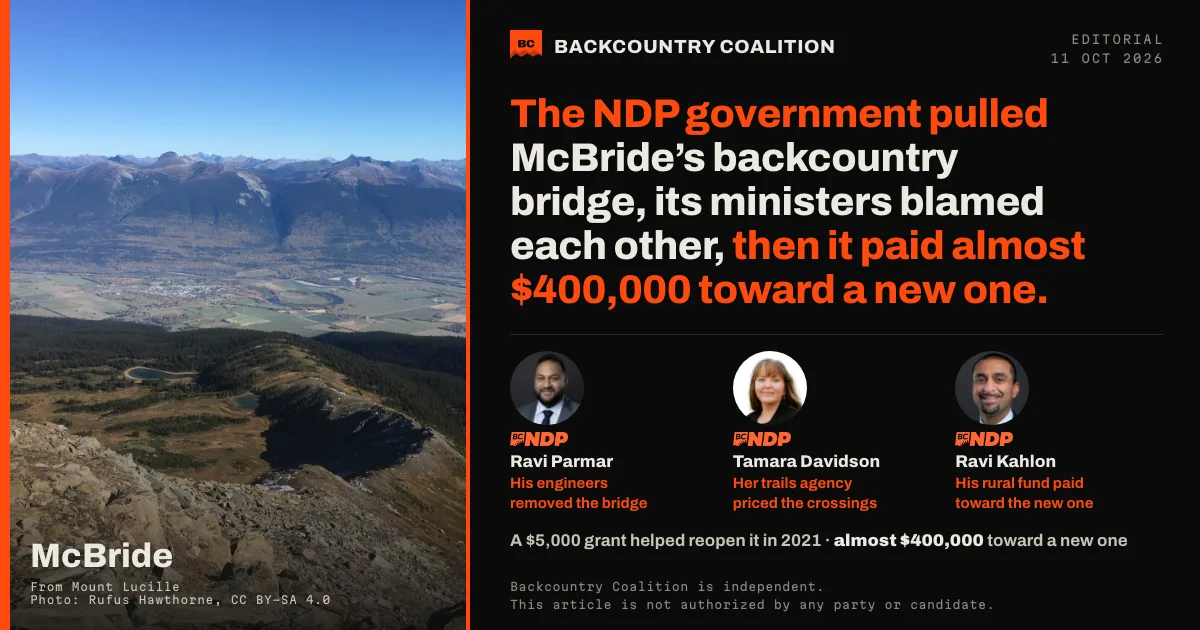
The NDP government pulled McBride’s backcountry bridge, its ministers blamed each other, then it paid almost $400,000 toward a new one.
Under the NDP, the Province pulled the bridge into McBride’s Renshaw snowmobile area in 2024. Forests minister Ravi Parmar and Environment minister Tamara Davidson each told the Legislature it was the other’s, and in 2026 the jobs ministry’s rural fund paid almost $400,000 toward a new one.
Read this editorial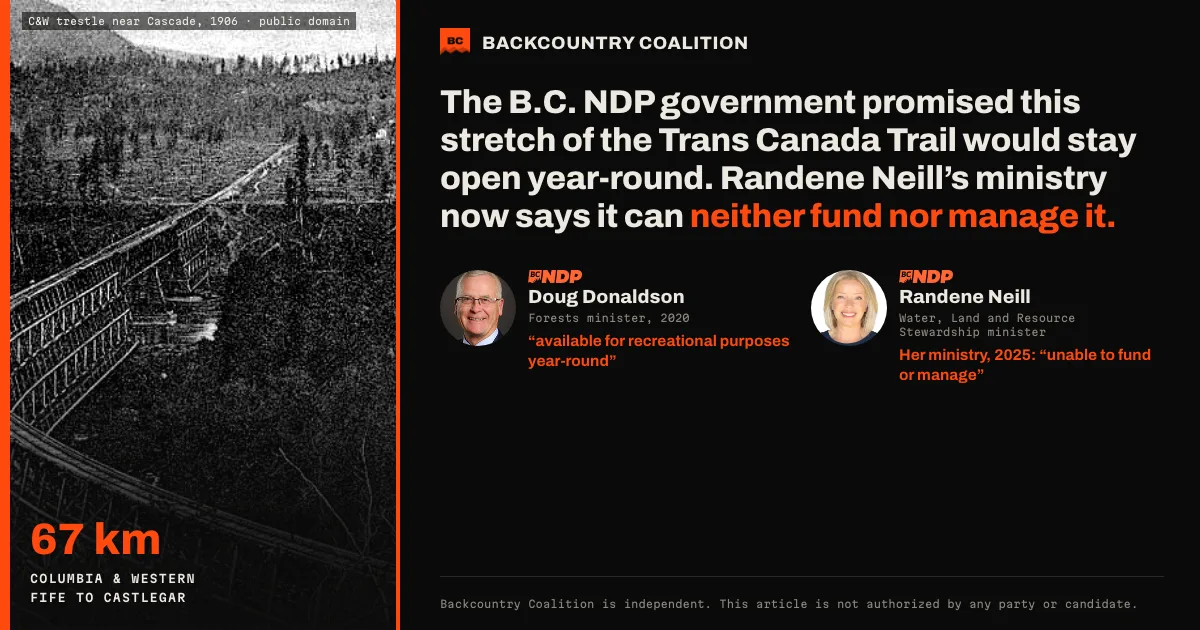
The B.C. NDP government promised this stretch of the Trans Canada Trail would stay open year-round. Randene Neill’s ministry now says it can neither fund nor manage it.
In July 2020 the Province removed the recreation-trail designation from 67 km of the Columbia & Western Rail Trail between Fife and Castlegar, promising year-round recreation and maintenance standards. In December 2025 its deputy minister wrote that the Province is unable to fund or manage the corridor.
Read this editorial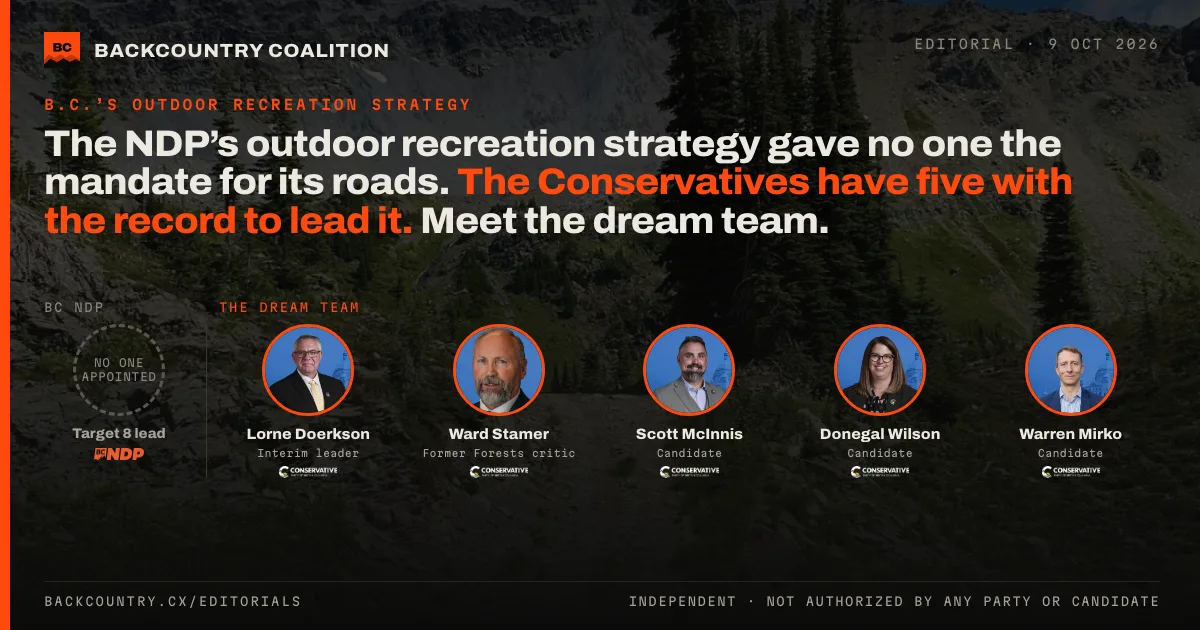
The NDP’s outdoor recreation strategy gave no one the mandate for its roads. The Conservatives have five with the record to lead it. Meet the dream team.
In May 2026 the Province published Look West, B.C.'s outdoor recreation strategy. Target 8, on the resource roads recreation depends on, has no owner, and no minister's mandate letter gives anyone that job. The BC NDP ministers who signed and launched it have not funded it or campaigned on it. Here are seven changes that would make it work, and the Conservative dream team of five whose public records on access already fit them.
Read this editorial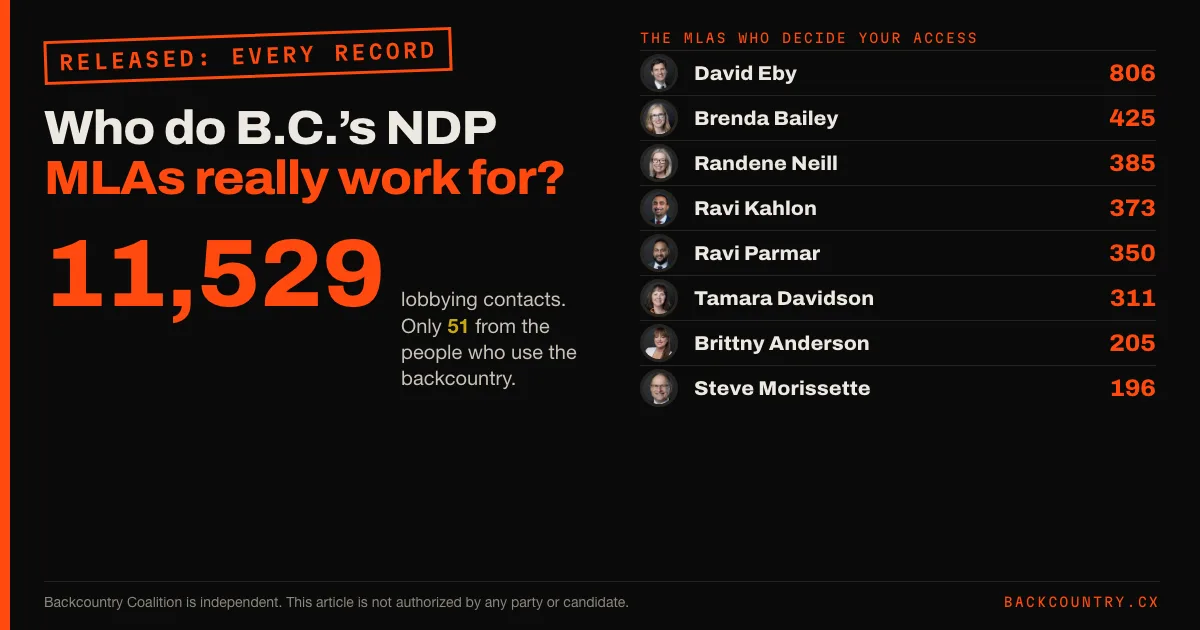
Who do B.C.’s NDP MLAs really work for? Here is every lobbying record: 11,529 contacts, and only 51 from the people who use the backcountry.
From the BC Lobbyists Registry: the heli-ski, guide-outfitter and backcountry-tourism lobby against the public recreation groups, the permitting hub that followed, and every lobbyist who reached a BC NDP MLA from November 2024 to September 2026.
Read this editorial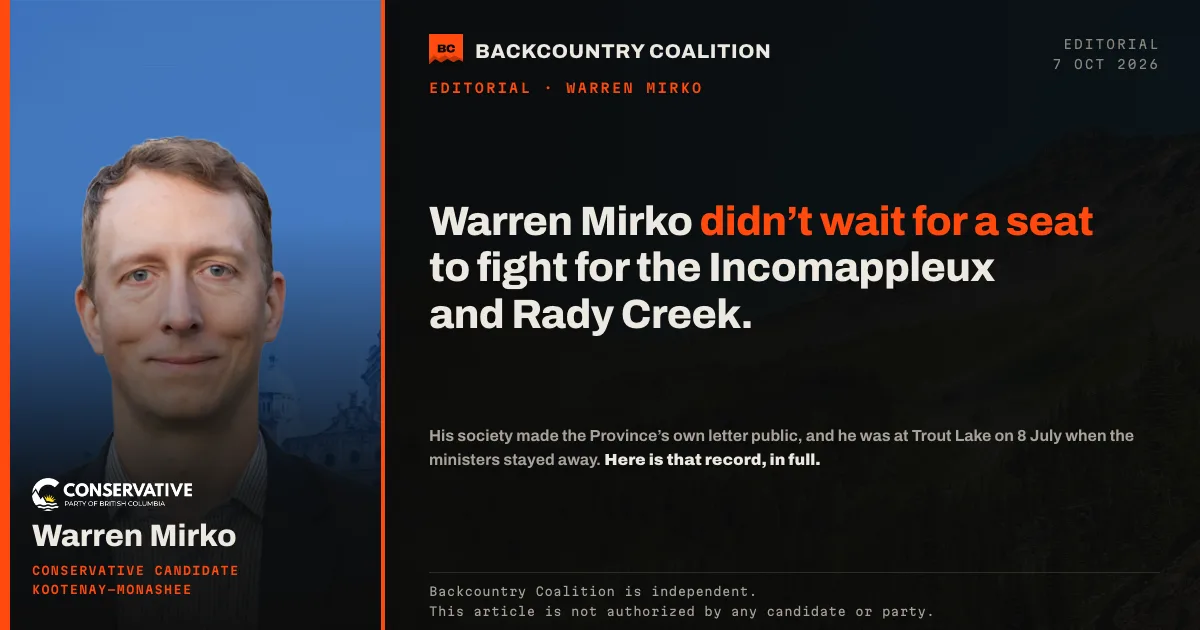
Warren Mirko didn’t wait for a seat to fight for the Incomappleux and Rady Creek.
Warren Mirko’s Public Land Use Society published the Province’s own words: a district letter telling a landowner that road work “will permanently remove road access to your private property.” He stood at Trout Lake on 8 July when the ministers would not. Here is that record, in full, beside the record of the three people running against him.
Read this editorial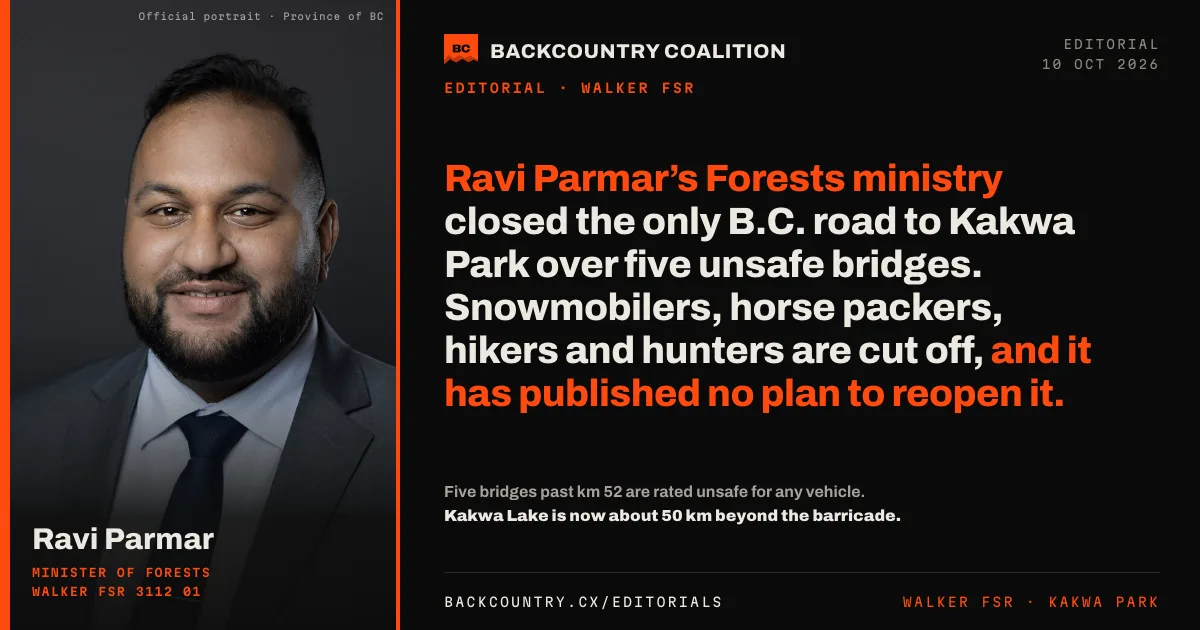
Ravi Parmar’s Forests ministry closed the only B.C. road to Kakwa Park over five unsafe bridges. Snowmobilers, horse packers, hikers and hunters are cut off, and it has published no plan to reopen it.
Walker FSR is the only road from British Columbia to Kakwa Provincial Park. On 22 July 2026 the Prince George district of the Ministry of Forests, which Ravi Parmar heads, closed it near kilometre 52 because five bridges beyond that point can no longer safely carry any vehicle. Kakwa Lake is now about 50 kilometres past the barricade, and the ministry has published no plan to repair, replace or remove the bridges.
Read this editorial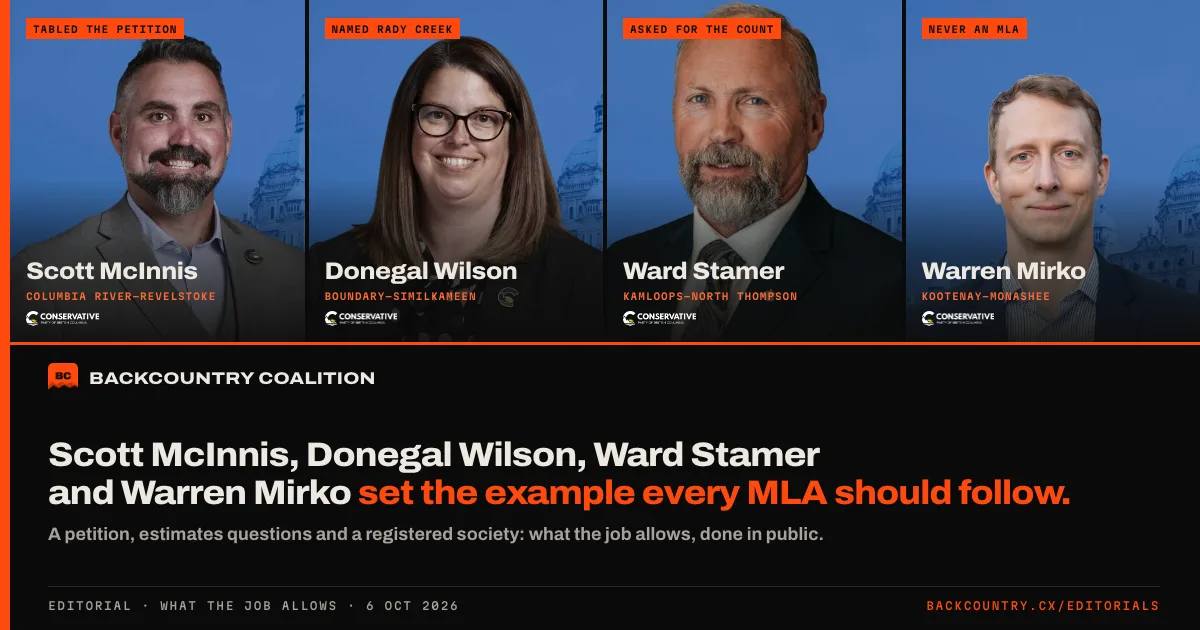
Scott McInnis, Donegal Wilson, Ward Stamer and Warren Mirko set the example every MLA should follow.
Across 188 official transcripts of the 43rd Parliament there were 40 petitions and exactly one against a road deactivation. The record of what four candidates did about public land access, and what each procedure left behind.
Read this editorial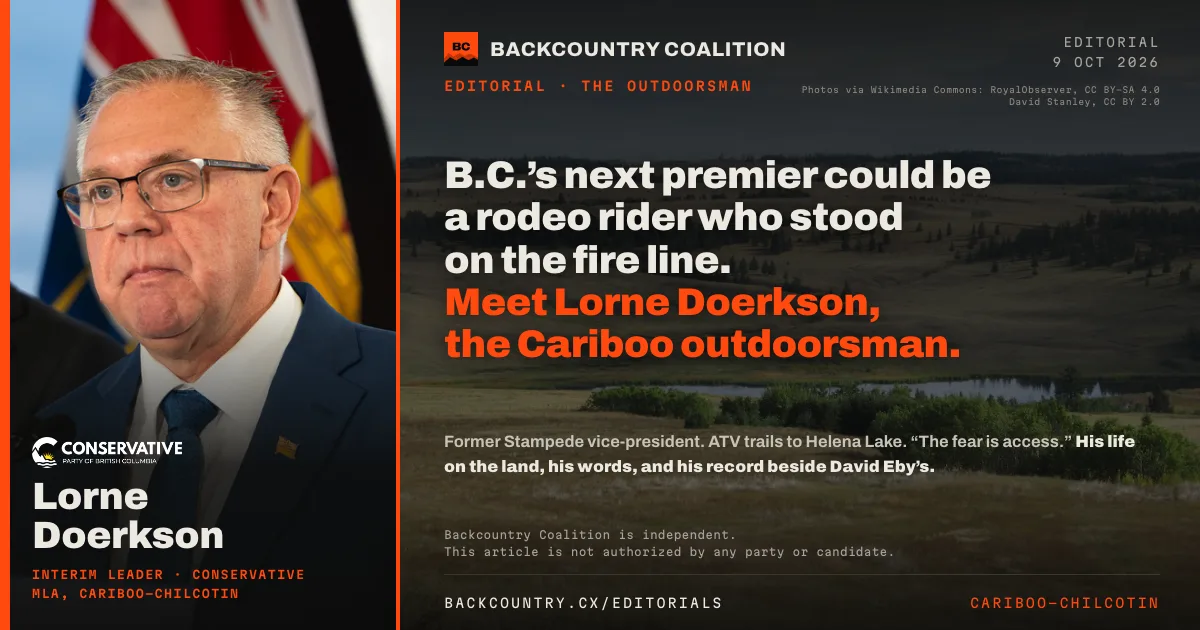
B.C.’s next premier could be a rodeo rider who stood on the fire line. Meet Lorne Doerkson, the Cariboo outdoorsman.
Lorne Doerkson, interim leader of the Conservative Party of BC and MLA for Cariboo-Chilcotin, is a former bareback rider, rodeo announcer and Williams Lake Stampede vice-president who calls himself "an outdoorsman." His life on the land, a timeline from the 1990s to 2026, his words on Crown land access, hunting, trapping, fishing and trails, his fire record since 2017, and David Eby's record on the same measures.
Read this editorial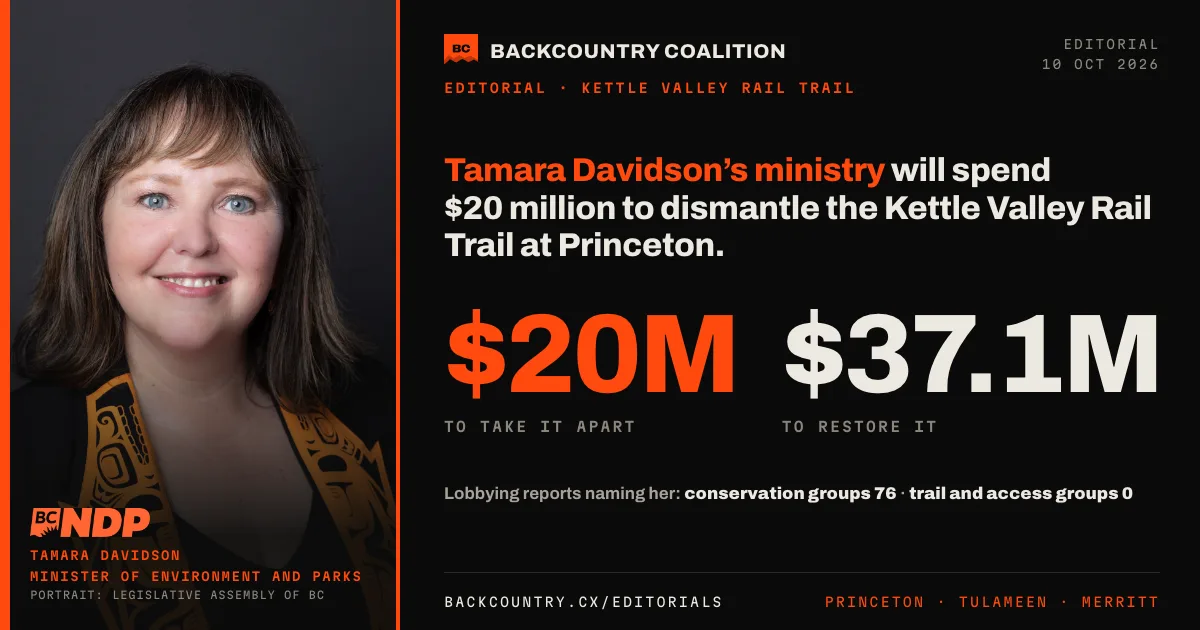
Tamara Davidson’s ministry will spend $20 million to dismantle the Kettle Valley Rail Trail at Princeton.
Sixty-seven kilometres of the Trans Canada Trail between Princeton and the Coquihalla have been closed since the 2021 flood. The Ministry of Environment and Parks, led by Tamara Davidson, will decommission it for about $20 million, mostly federal disaster money, although its own engineers priced restoring it at $37.1 million. Here is what is closed, what the engineering says, and every office that decides what happens next.
Read this editorial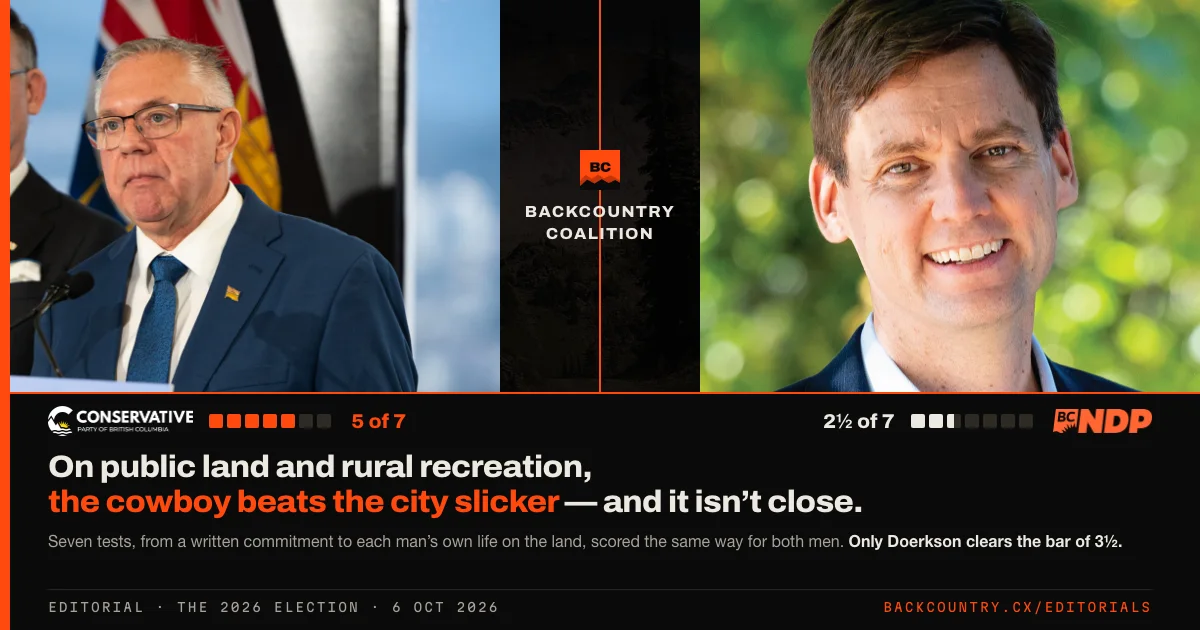
On public land and rural recreation, the cowboy beats the city slicker — and it isn’t close.
Seven tests on public access to public land, applied in the same words to both men: a written commitment, a named owner, money attached, a record in the House, conduct in his own backyard, what his side actually did, and his own record on recreation and the outdoors. The tests weigh each man’s background and life on the land as well as his words in the House. Lorne Doerkson scores 5 of 7 and David Eby 2½, and only Doerkson clears the bar of 3½. Every test is scored with the document shown, and every candidate for both parties is listed by riding.
Read this editorial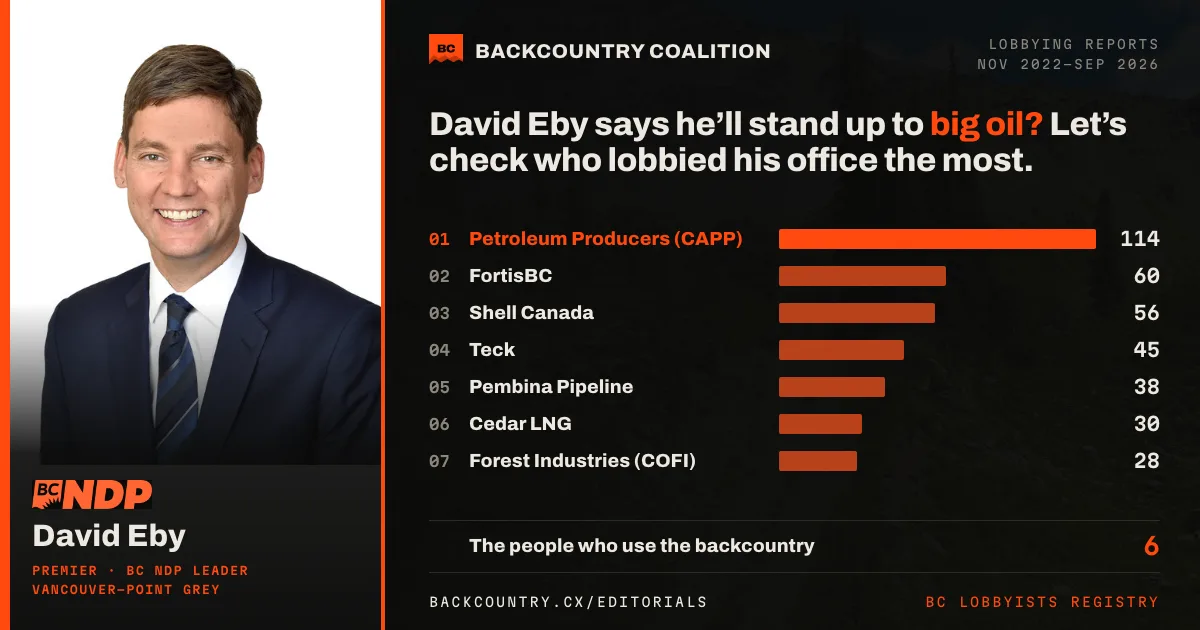
David Eby says he’ll stand up to big oil? Let’s check who lobbied his office the most.
The Canadian Association of Petroleum Producers, 114 times. Then FortisBC 60, Shell Canada 56, Teck 45 and Pembina Pipeline 38. From his swearing-in to the writ, oil, gas, LNG, mining, forest and commercial backcountry companies filed 926 lobbying reports with David Eby or the Office of the Premier. The people who use the backcountry filed six. Then what his government did next, and what it did to the roads.
Read this editorial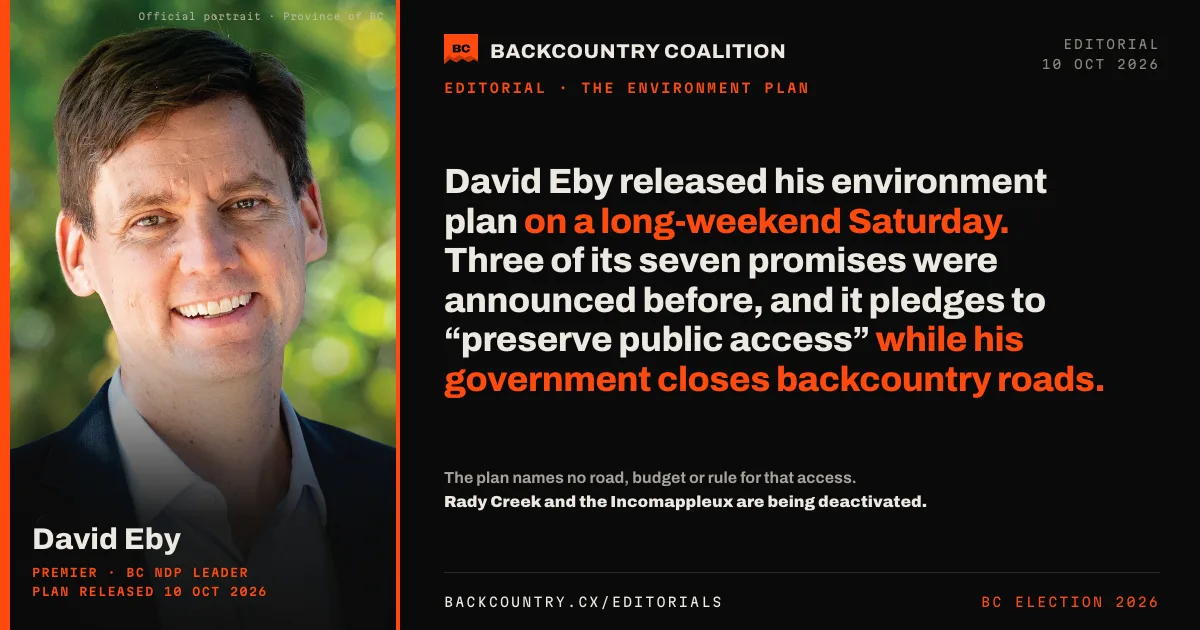
David Eby released his environment plan on a long‑weekend Saturday. Three of its seven promises were announced before, and it pledges to “preserve public access” while his government closes backcountry roads.
On Saturday 10 October 2026, the first day of the Thanksgiving long weekend, the BC NDP released seven environment promises. The 30 by 30 target dates from 2023, the Great Bear Sea reserve was announced in May, and the data-centre power cap has been law since November 2025. The plan says 30 by 30 will “preserve public access,” and names no road, while the Ministry of Forests deactivates Rady Creek and the Incomappleux.
Read this editorialDeployed · newest first
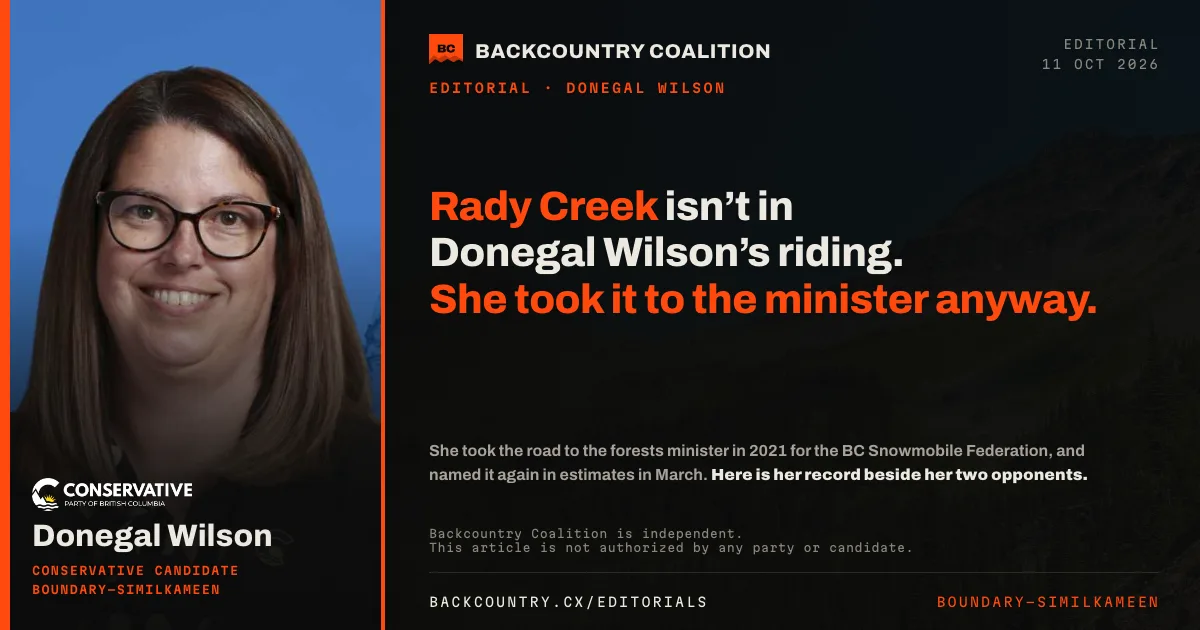
Rady Creek isn’t in Donegal Wilson’s riding. She took it to the minister anyway.
Donegal Wilson, the Conservative candidate in Boundary-Similkameen, asked the Minister of Forests on 12 March 2026 why a road is torn out when a “use at your own risk” sign would do, and named Rady Creek, a road outside her riding, as her example. In 2021, as executive director of the BC Snowmobile Federation, she had signed its letter to the forests minister on the same road. In her own riding she has fought for the Kettle Valley and Columbia & Western rail trails. Here is her record on access, set beside the two people running against her.
Read this editorial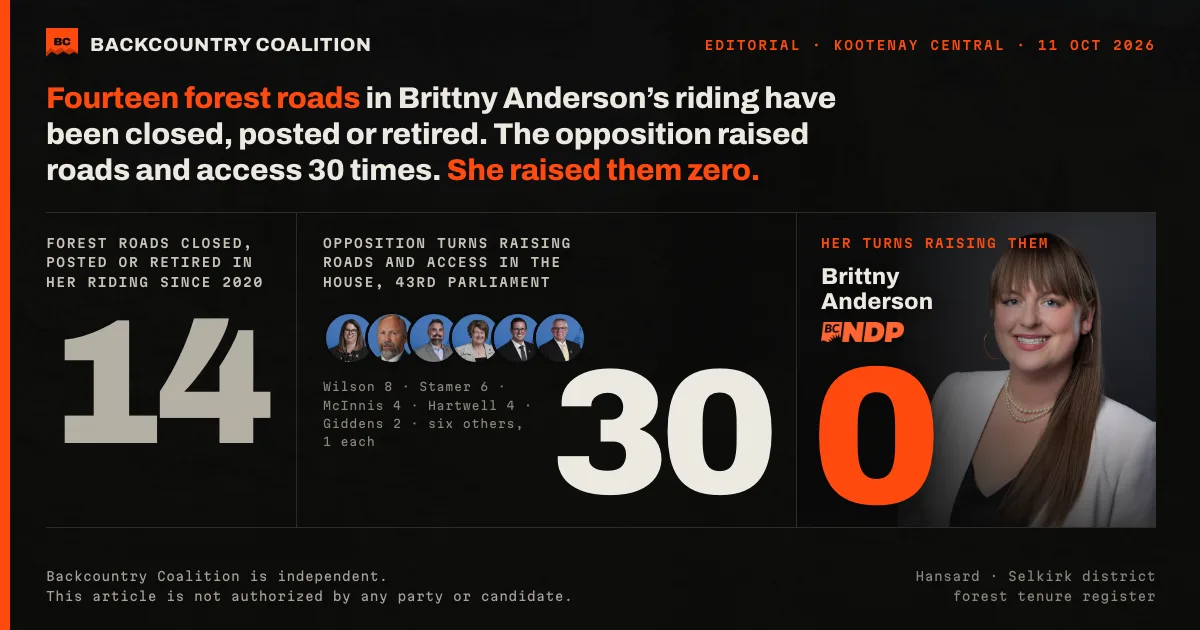
Fourteen forest roads in Brittny Anderson’s riding have been closed, posted or retired. The opposition raised roads and access 30 times. She raised them zero.
Since 2020, fourteen forest service roads in Kootenay Central have been closed, posted for removal or retired. In this Parliament, Conservative MLAs raised forest roads and backcountry access in 30 speaking turns. Brittny Anderson raised them in none of her 68, and in 191 turns since 2020 has never named one of these roads.
Read this editorial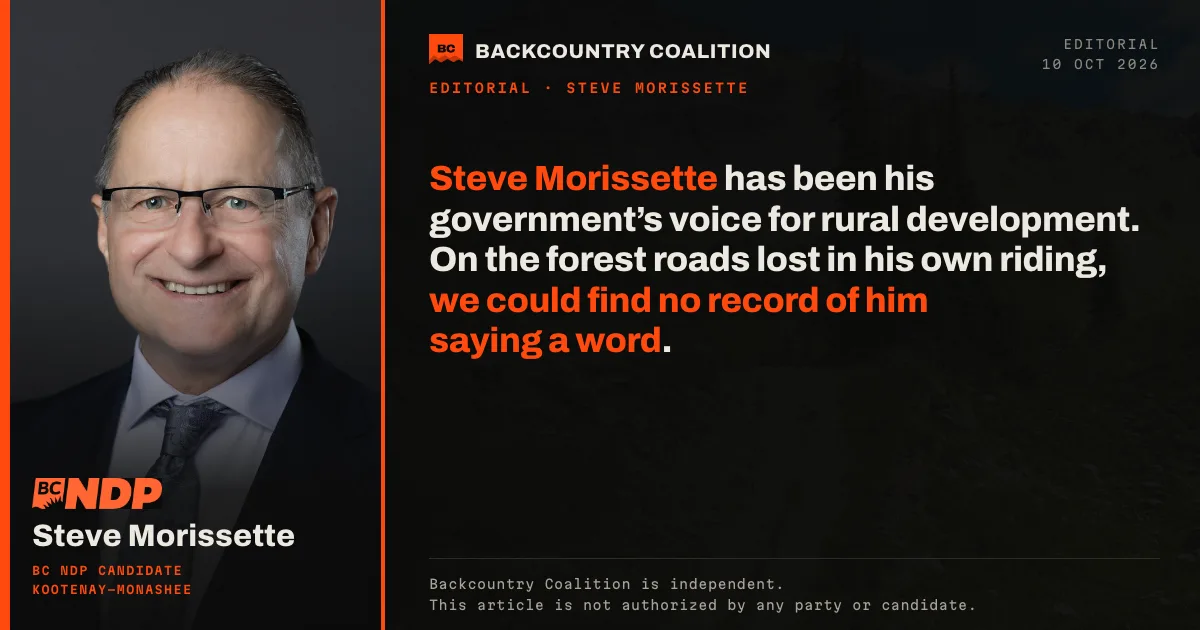
Steve Morissette has been his government’s voice for rural development. On the forest roads lost in his own riding, we could find no record of him saying a word.
Parliamentary Secretary for Rural Development since 2024, Steve Morissette has spoken for the rural money and not for the roads. Thirty-three forest roads in Kootenay-Monashee closed or retired since 2020, and no mention of any in his 72 House turns or his releases; a registered lobbying contact on road deactivation in July 2026.
Read this editorial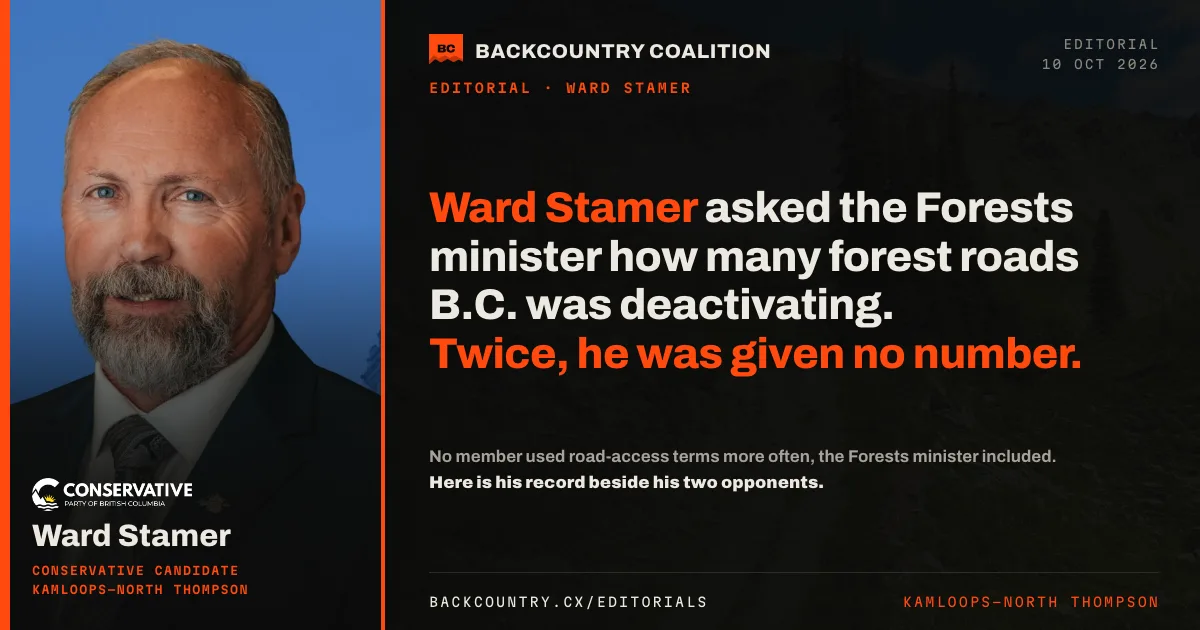
Ward Stamer asked the Forests minister how many forest roads B.C. was deactivating. Twice, he was given no number.
Ward Stamer, the Conservative candidate in Kamloops-North Thompson and the party’s Forests critic, used the language of road access in more speaking turns than any other member of the last Legislature. He asked how many roads and bridges were being pulled, whether the public gets a say first, and what the maps will show. Here is that record, what it left out, and the two people running against him.
Read this editorial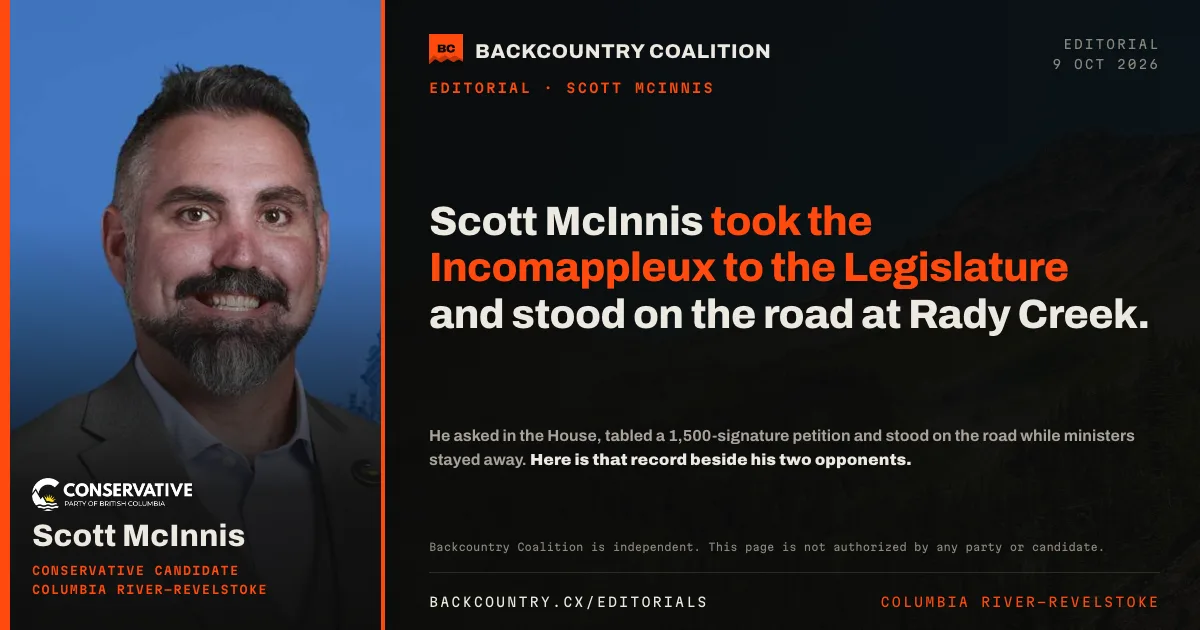
Scott McInnis took the Incomappleux to the Legislature and stood on the road at Rady Creek.
Scott McInnis, the Conservative candidate in Columbia River-Revelstoke, where the Incomappleux and Rady Creek are: an oral question on back-country closures in May 2025, a budget-debate stand against arbitrary closures in February 2026, a 1,500-signature petition against the Incomappleux deactivation on the last sitting day, and a day on the road with residents on 8 July 2026 while ministers declined. Beside it, the record of the two people running against him.
Read this editorial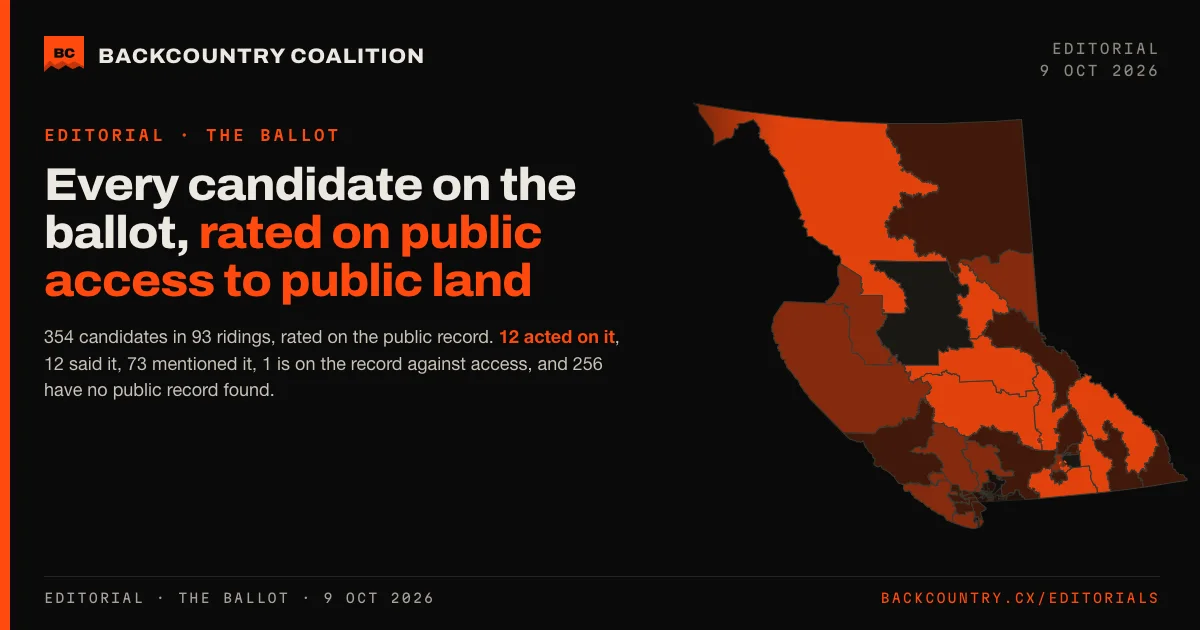
Every candidate on the ballot, rated on public access to public land
All 354 candidates in British Columbia’s 93 ridings, rated on one question: what is on the public record about public access to public land and outdoor recreation. 12 acted on it, 12 said it, 73 mentioned it, 1 is on the record against access, and 256 have no public record found. Pick your riding on the map and the candidates are laid out side by side, with the record behind every rating.
Read this editorial
The Province calls Michael Ferguson an Engineering Officer. The regulator, Engineers and Geoscientists BC, says he is not one of its registrants. Section 52 (3) bars a title that implies otherwise — and the only test is what the public perceived.
Rady Creek Forest Service Road is a public road in the Selkirk mountains. The report that ends it was written at Michael Ferguson’s request. The engineers’ regulator says he is not one of its registrants, and has referred the title to its misuse-of-title team. A referral is not a finding. Seventeen more public servants hold the title, all in the Ministry of Forests.
Read this editorial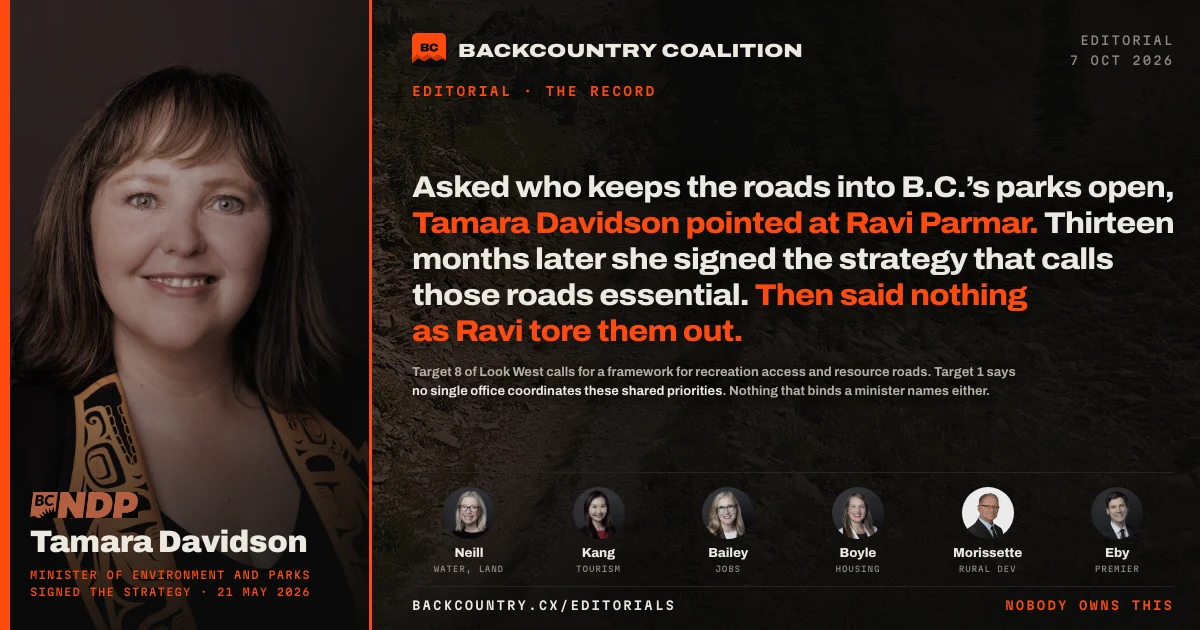
Asked who keeps the roads into B.C.’s parks open, Tamara Davidson pointed at Ravi Parmar. Thirteen months later she signed the strategy that calls those roads essential. Then said nothing as Ravi tore them out.
On 8 April 2025 she told the House that roads are the Ministry of Forests’ responsibility and invited members to canvass Ravi Parmar instead — and the next day he told them his road money is “not for rec sites or for recreation”. Thirteen months later she signed Look West, whose Target 8 says the backcountry depends on resource roads and names no ministry, no budget and no date. Ninety days after that, her own agency refused the Rady Creek road for want of exactly that authority.
Read this editorial
Why it’s a bad idea to ask or name a location online in the NDP’s BC. Especially in front of a hundred thousand people.
Someone posts a photograph of a favourite spot, and someone asks where it is. Nobody asking or answering is doing anything wrong. Here is the list of British Columbia places it has already happened to — every one of them closed, gated or rationed today, each with an instrument, a date, and a reason the Province wrote down itself.
Read this editorial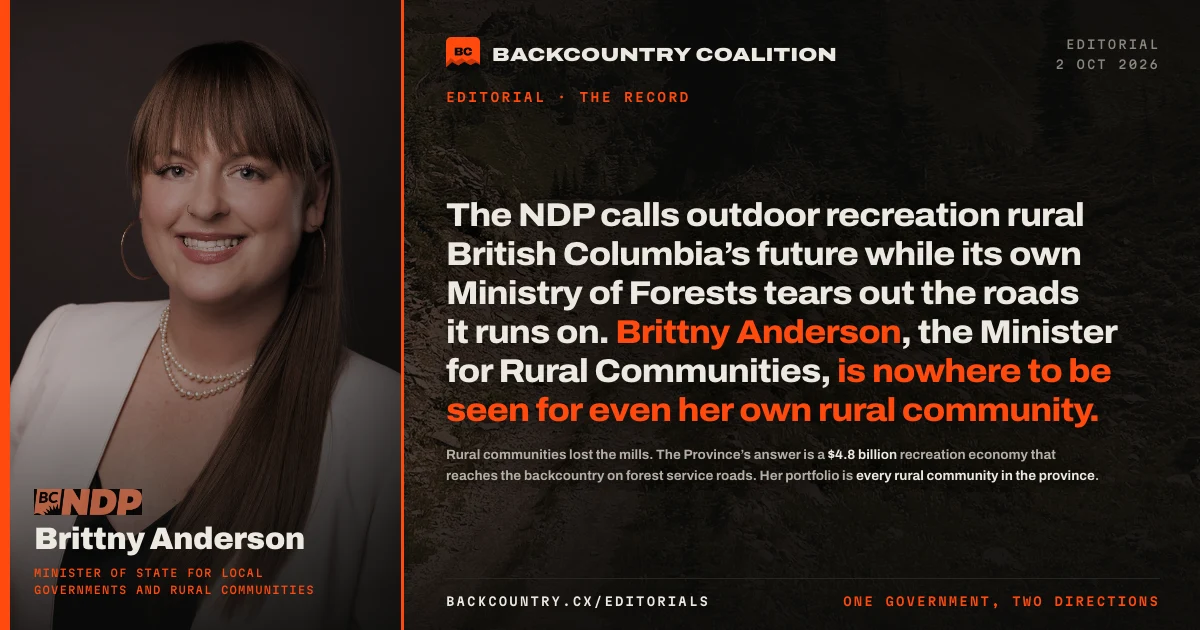
The NDP calls outdoor recreation rural British Columbia’s future while its own Ministry of Forests tears out the roads it runs on.
Brittny Anderson, the Minister for Rural Communities, is nowhere to be seen for even her own rural community.
Rural communities lost the mills. The Province’s answer, in its own strategy, is a $4.8 billion outdoor recreation economy — and that economy reaches the backcountry on forest service roads the Ministry of Forests is pulling out. Her portfolio is every rural community in the province. We read every document that assigns her anything, and crawled a full parliament of Hansard.
Read this editorial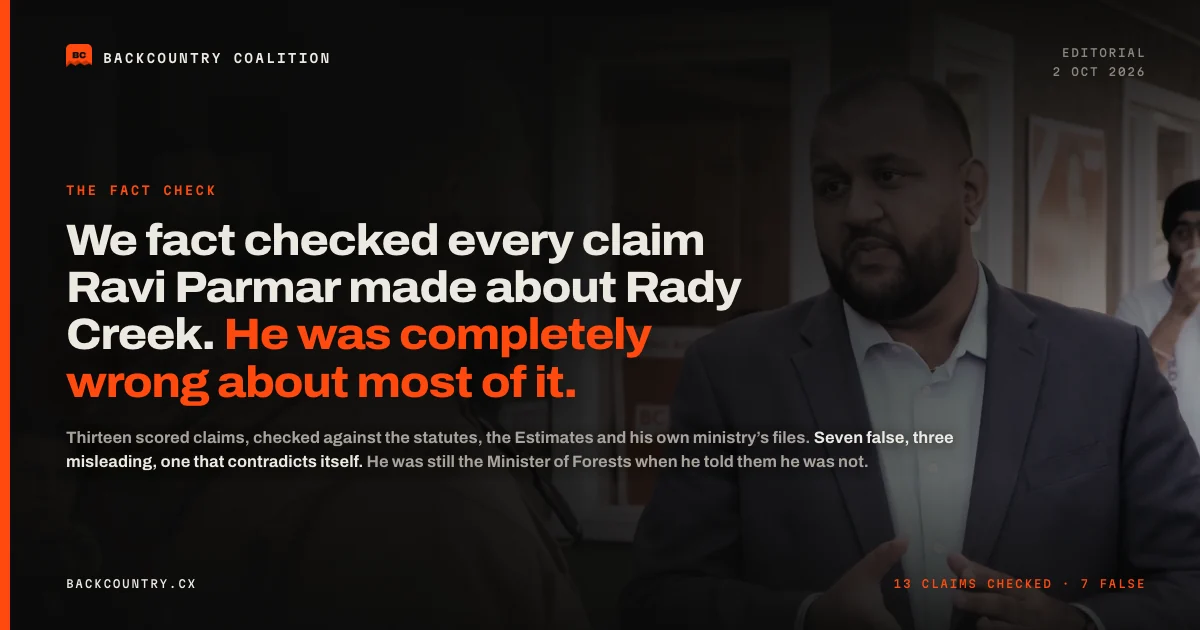
We fact checked every claim Ravi Parmar made about Rady Creek on the record. The truth is, as expected, he was completely wrong about most of what he said to 4WDABC.
Nine minutes on camera at his Langford campaign office — his first public answer on Rady Creek. We transcribed it and checked every claim. Seven are false. The road budget is four times the figure he gave, the club he says could take the road over had already been refused, and the liability he blames was legislated away in 2012, under the headline “More backcountry roads to be kept open.”He had nineteen weeks to read his own file.
Read this editorial
The roads you hunt, sled, fish and climb from are being torn out, and no agency in British Columbia is responsible for keeping any of them open. Here is who should be, and what it would cost.
On 24 September the coalition sent an open letter to candidates and to the organisations whose members use the roads: British Columbia is demolishing the roads its future recreation economy runs on, and no agency here is responsible for keeping any of them open. Kim Reeves, Past President of the Four Wheel Drive Association of BC, wrote back with the mechanism: when a commercial maintainer wants out of a road, it should hand over the engineering record along with the demolition money the law already requires it to spend.
Read this editorial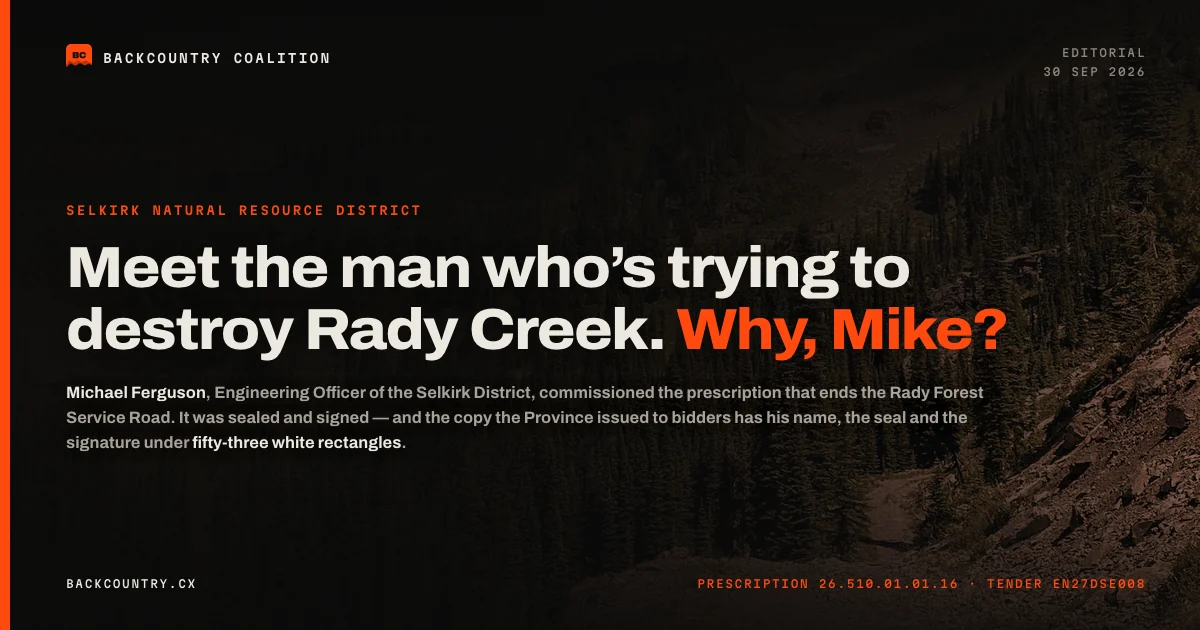
Meet the man who’s trying to destroy Rady Creek; Michael Ferguson and his crusade at the Selkirk District to attack public access to public land. The only question left is; Why, Mike?
Forty-two pages, dated 8 September 2026, on the Province’s own web server. Page two names the officer who asked for it — Michael Ferguson, RFT-1624, the Selkirk district’s Engineering Officer. Page four names Jordan Pyette, RFT-2122 as the professional accountable for it. Neither name is visible: fifty-three white rectangles cover them, and the seal, signature and hand-written date of the geoscientist who sealed it. Twenty-two roads in this district are closed or posted for deactivation. Every one is public.
Read this editorial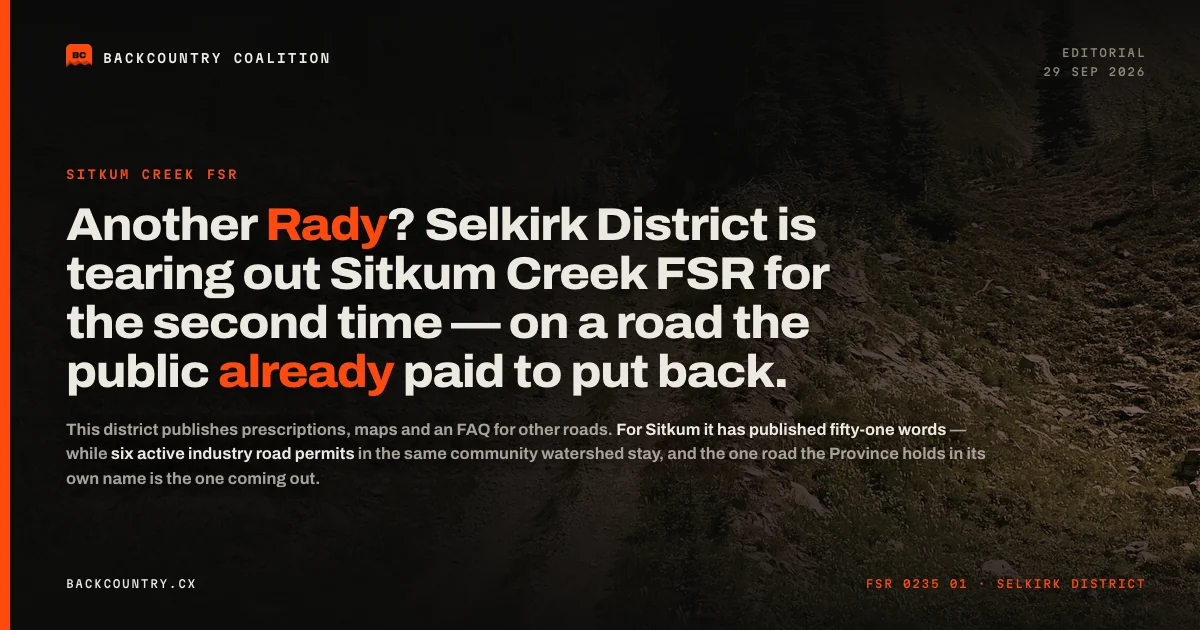
Another Rady? Selkirk District is tearing out Sitkum Creek FSR for the second time — on a road the public already paid to put back.
The Selkirk district has posted 57% of Sitkum Creek FSR for removal in June 2027 — the whole upper half, every metre of the alpine access. Six active Kalesnikoff Lumber road permits cross the same community watershed and every one of them stays; the one road the Province holds in its own name is the one coming out. This district publishes prescriptions, maps and an FAQ for other roads. For Sitkum it has published fifty-one words. The Province designated the watershed in 1995 to protect thirty connections and has never written the water quality objectives — the record still reads “Not completed by 2019”. The law owes that water system forty-eight hours’ notice; before the public’s road goes, it owes the public nothing. The ministry pulled the bridge in 2014, and three volunteers and $8,000 of Crown trust money put the access back in 2016.
Read this editorial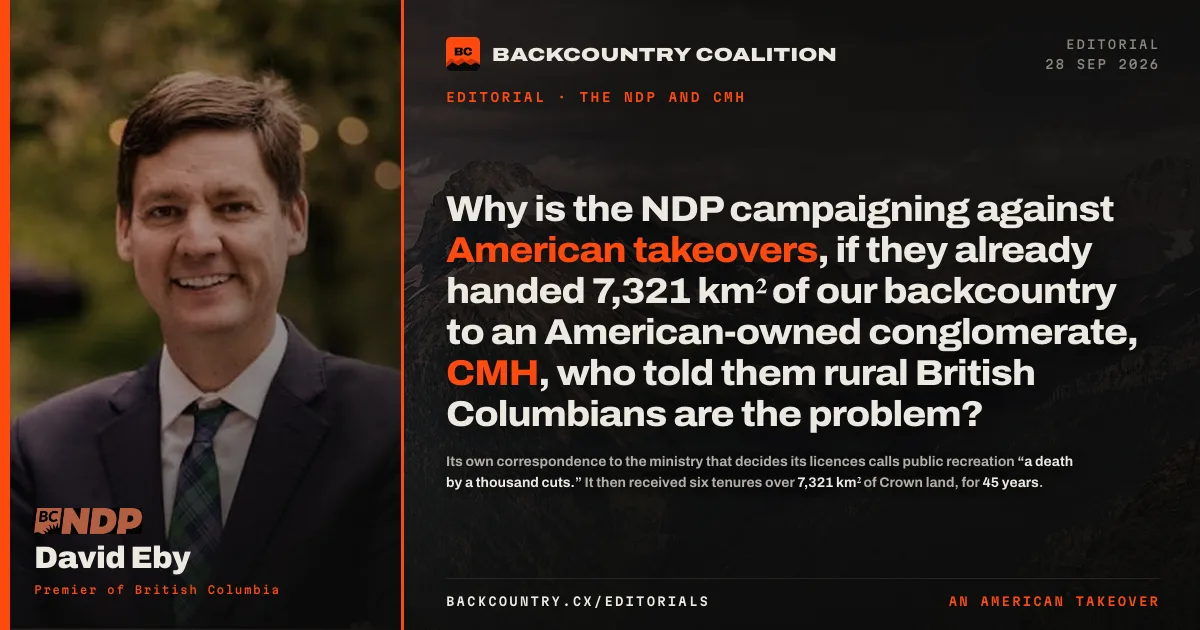
Why is the NDP campaigning against American takeovers, if they already handed 7,321 km² of our backcountry to an American-owned conglomerate — CMH, who told them rural British Columbians are the problem?
A British Columbia limited partnership under a Denver holding company, assembled in a $1.5 billion takeover, holds six commercial recreation tenures covering 7,321 km² of Crown land. Its management plan says it does “not restrict public access in any way.” Its own correspondence calls public recreation “a death by a thousand cuts.”
Read this editorial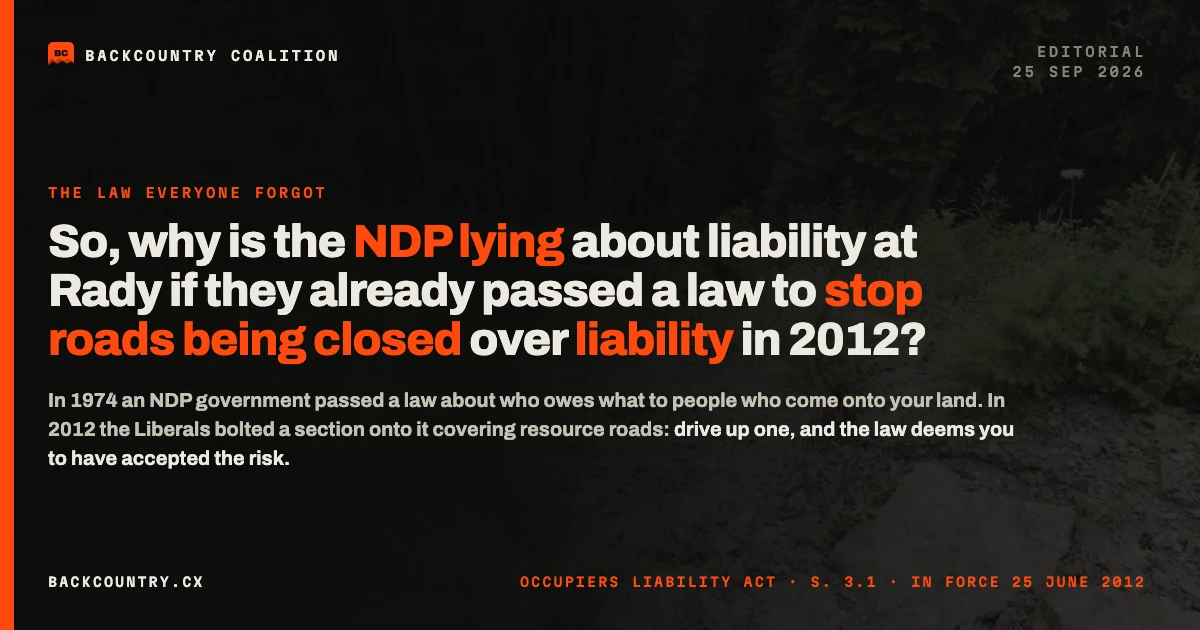
So, why is the NDP lying about liability at Rady if they already passed a law to stop roads being closed over liability in 2012?
Buckle up, folks. This one is thick, but it’s a laugh, and you are not going to believe where it ends up. In 1974 an NDP government passed a law about who owes what to people who come onto your land. In 2012 the Liberals bolted a section onto it covering resource roads: drive up one, and the law deems you to have accepted the risk. They must have forgotten — because the same ministry is now destroying the Trout Lake–Rady Creek road, and the reason it gives is liability.Now it’s time we make them remember.
Read this editorial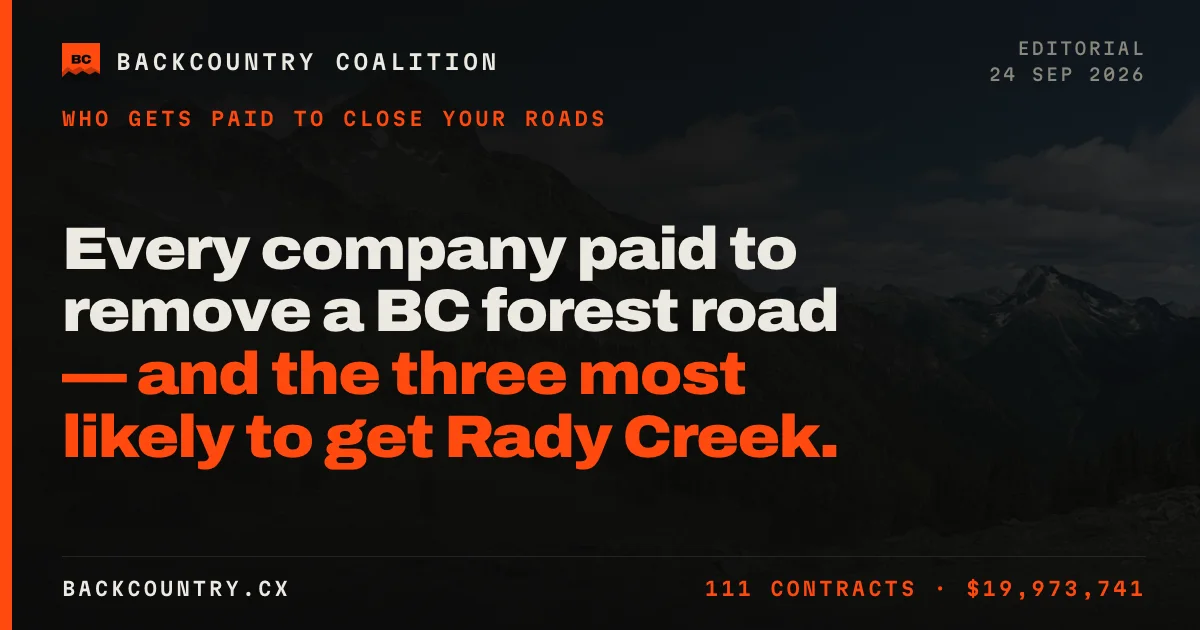
Every company paid to remove a BC forest road — and the three most likely to get Rady Creek
British Columbia has awarded 111 contracts worth $19,973,741 since 2012 to remove forest service roads and their crossings. We read all 15,108 published awards, named all 65 companies, sorted them by what each was actually paid to do, and ranked the three the record puts closest to Rady Creek.
Read this editorial
The Ministry of Forests has spent $20 million destroying public access. Now it needs Transportation to bail it out.
The Ministry of Forests says it is “working with the Ministry of Transportation” on the future of a forest road whose published options include permanent closure. That partnership takes the cost of destroying a road off its books, removes any duty to consult, and leaves a corridor one minister can close by publishing a notice. Idaho Lookout has been shut six years. Rady Creek is next.
Read this editorial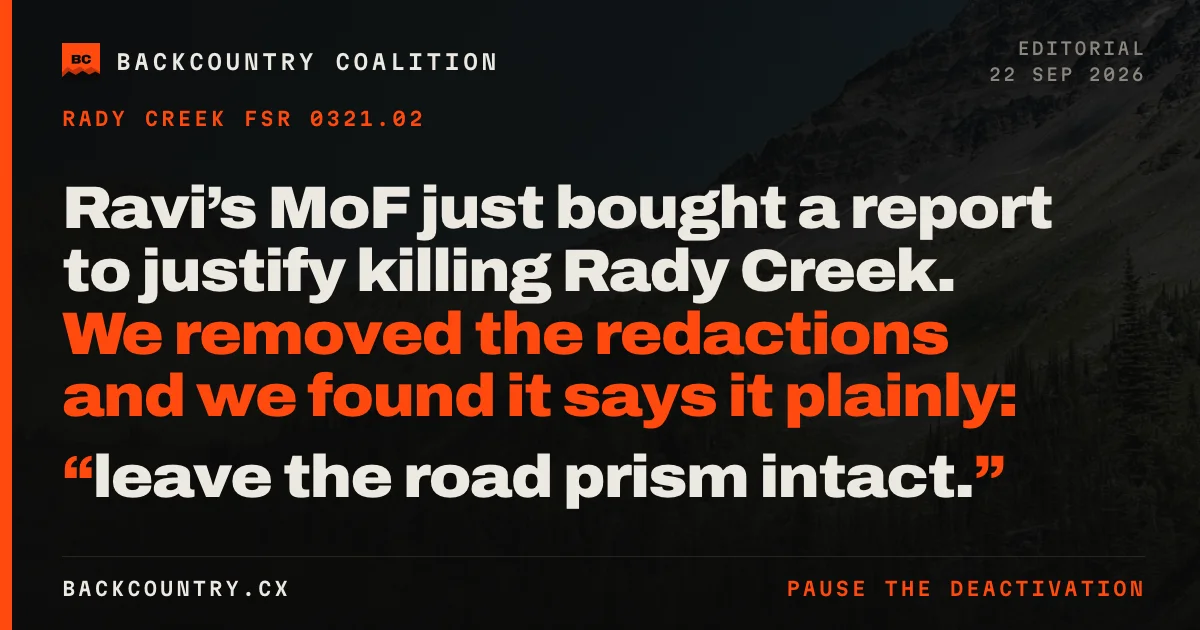
Ravi’s MoF just bought a report to justify killing Rady Creek. We removed the redactions — it says plainly: “leave the road prism intact.”
Selkirk District spent five years citing engineering it never had. So Ravi’s MoF bought a 42-page report mid-tender to justify destroying the Rady Creek road — and on six of its seven sections its own engineer wrote the same instruction: leave the road prism intact. They published him with fourteen names painted out. We had all fourteen back in about thirty seconds.
Read this editorial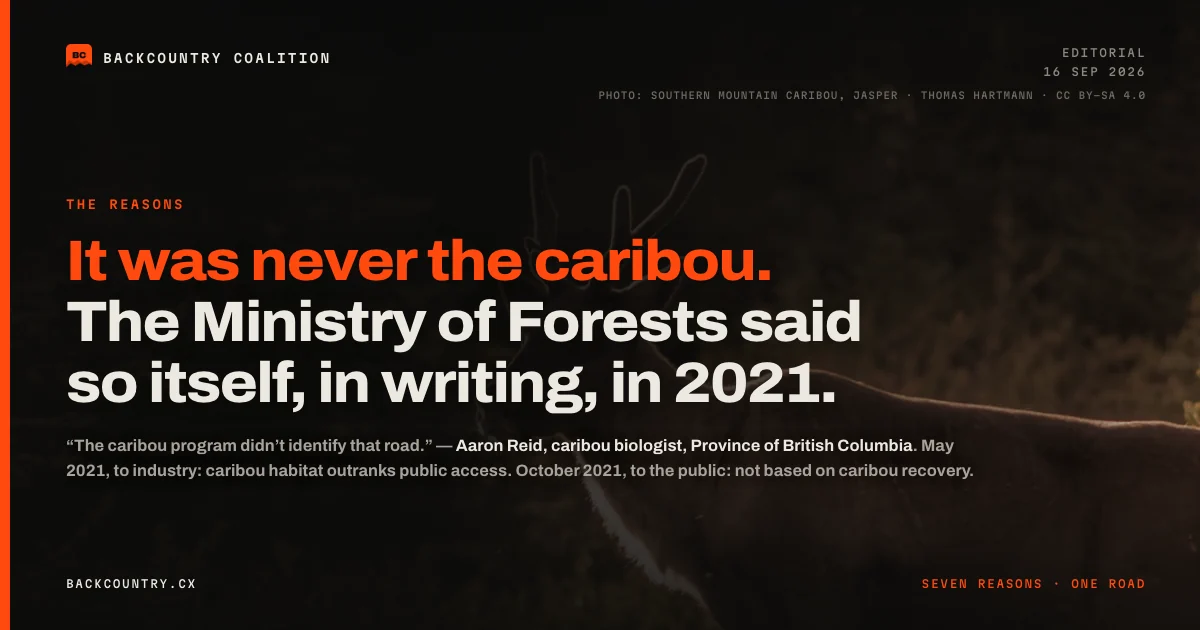
It was never the caribou. The Ministry of Forests said so itself, in writing, in 2021.
In May 2021 the Selkirk district told industry that caribou habitat outranked public access on the Rady Creek road. In October it told the public the decision was “not based on the importance of the habitat for Caribou recovery.” The province’s own caribou biologist: “The caribou program didn’t identify that road.” Seven reasons have now been given for destroying the same 4.4 kilometres.
Read this editorial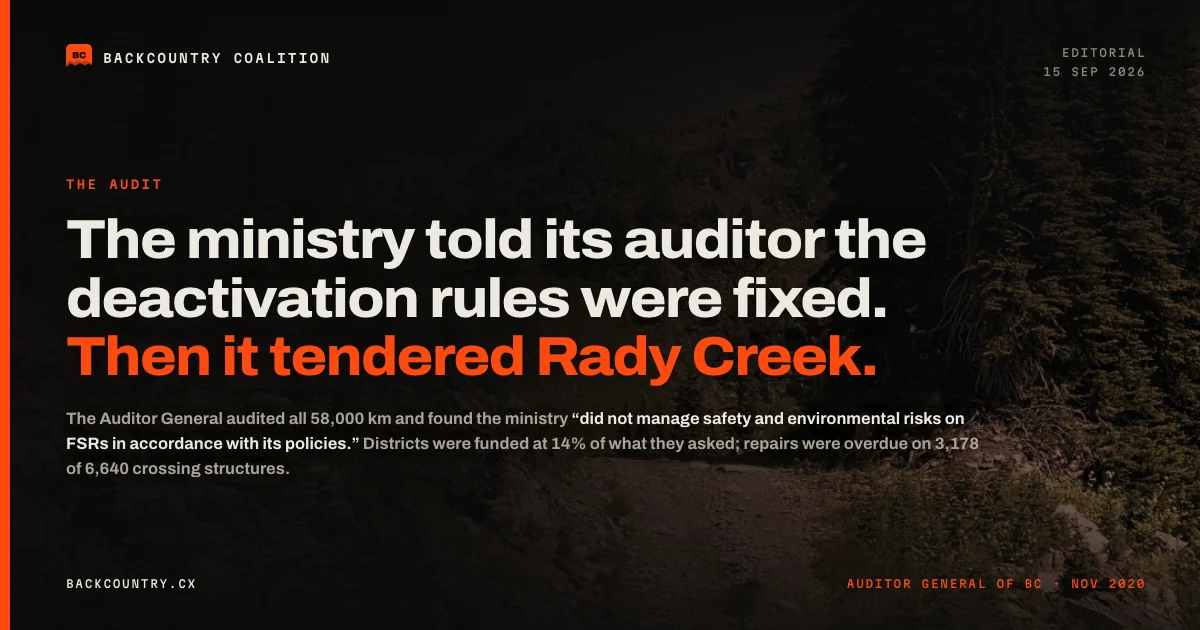
The ministry told its auditor the deactivation rules were fixed. Then it tendered Rady Creek.
The Auditor General audited all 58,000 km of British Columbia’s forest service road and found the ministry was not managing it to its own policies. Districts were funded at 14 per cent of what they asked. High-priority repairs were overdue on 3,178 of 6,640 crossing structures. Nine recommendations followed — and the two that decide what happens at Rady Creek are both marked complete.
Read this editorial
Ravi Parmar — A Legacy of Failed Leadership at the Ministry of Forests
He asked for this portfolio. Since he took it, provincial forest revenue has fallen to a third of what it was, the harvest has run thirteen million cubic metres under his own mandate target, twenty-one mills have closed and more than fifteen thousand jobs have gone. This is the performance record of the Minister of Forests, from his own government’s numbers.
Read this editorial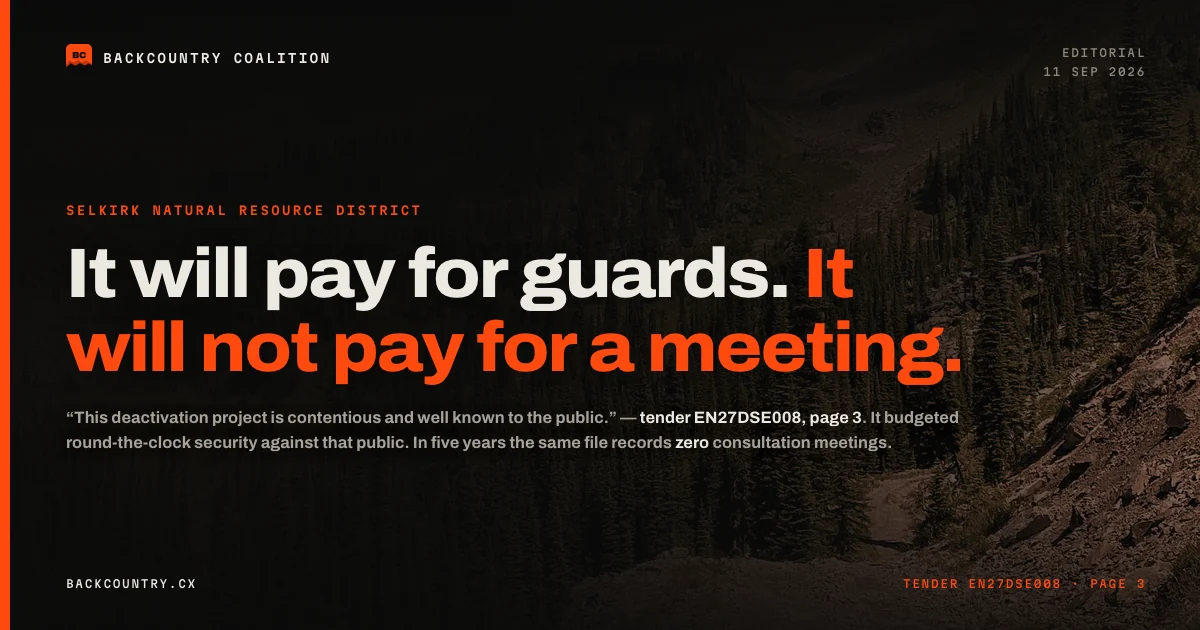
It will pay for guards. It will not pay for a meeting.
Ravi Parmar’s ministry wrote “contentious and well known to the public” into its own contract and budgeted round-the-clock security accordingly. In five years the same file records zero consultation meetings. It filed the public under hazards instead.
Read this editorial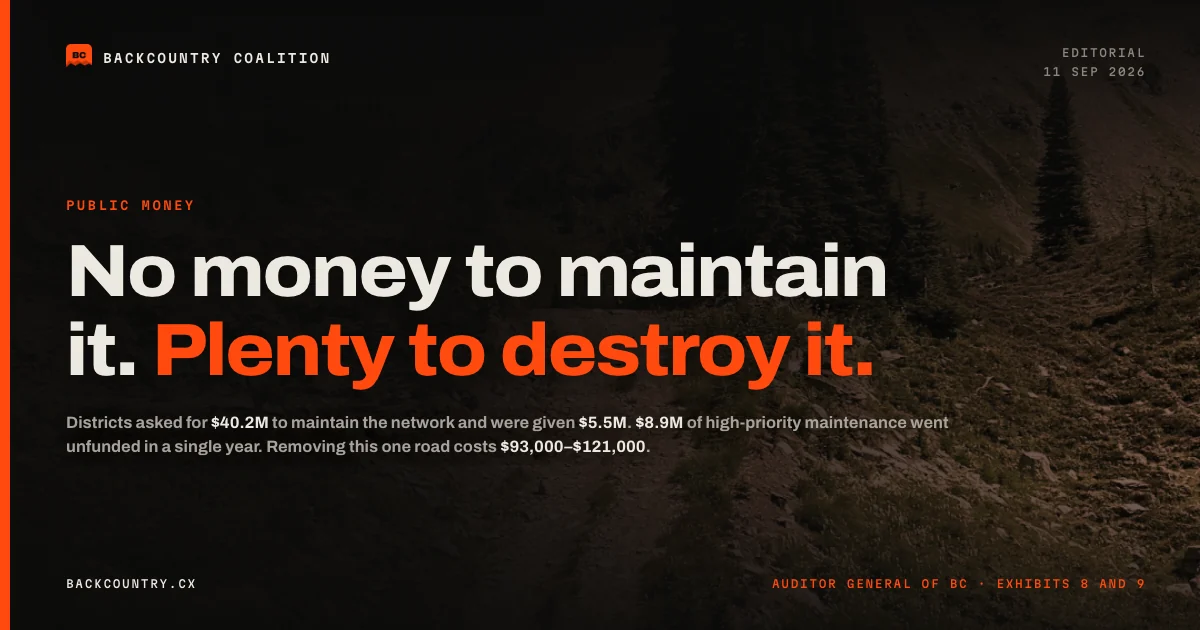
No money to maintain it. Plenty to destroy it.
The Auditor General found this ministry funding its own districts at fourteen cents on the dollar, $8.9 million of high-priority maintenance unfunded in a single year, and seven of the eight districts its auditor sampled unable to produce an inspection record — the same failures an internal audit flagged in 2008. Then it wrote the policy that turns its own neglect into grounds for demolition.
Read this editorial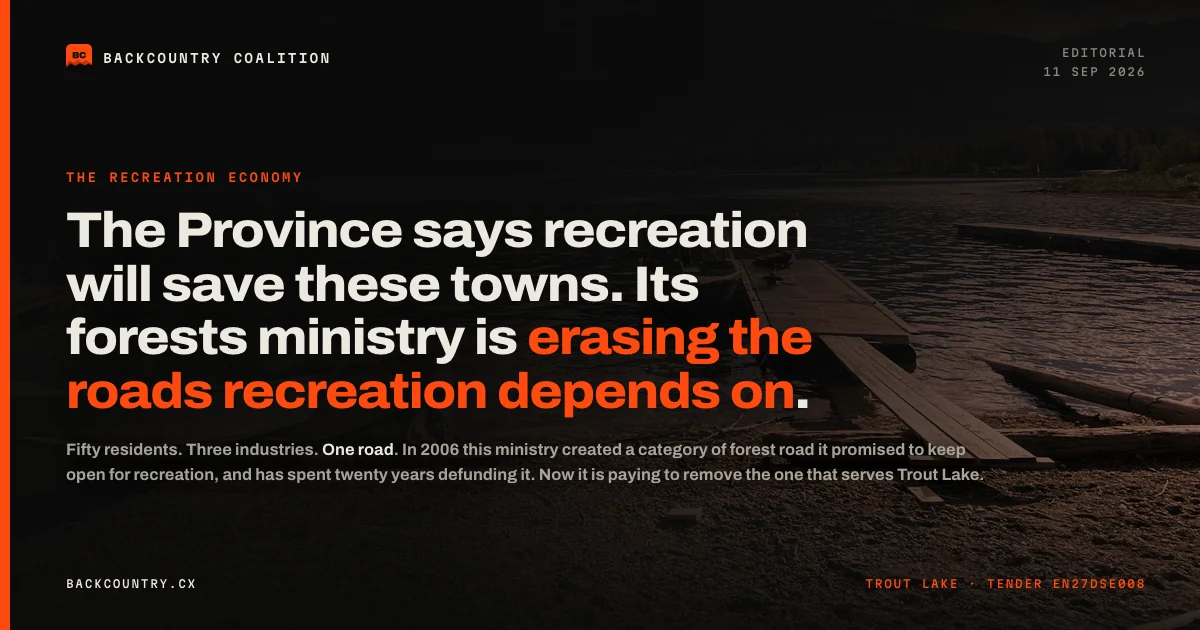
The Province says recreation will save these towns. Its forests ministry is erasing the roads recreation depends on.
Trout Lake has fifty people and three industries left, all of them up one road. In 2006 this ministry invented Recreation Use Forest Service Roads and promised to maintain them. Under Ravi Parmar it is paying to erase the access instead — and it decided before an engineer ever walked the ground.
Read this editorial