
EDITORIAL · PUBLIC MONEY
No money to maintain it. Plenty to destroy it.
The Auditor General found Ravi Parmar’s ministry funding its own districts at fourteen cents on the dollar, $8.9 million of high-priority maintenance unfunded in a single year, and seven of the eight districts its auditor sampled unable to produce an inspection record. An internal audit found the same failures in 2008. Twelve years on, nothing had changed — and the policy that ministry wrote says a road it cannot afford to maintain should be deactivated. Starve it, then cite the starvation.
You cannot call this a budget problem. It is a competence problem. A ministry that funds fourteen cents of every dollar its own districts ask for, cannot produce inspection records for seven of the eight districts its auditor sampled, and was told all of this in 2008 and again in 2020, is not managing a shortfall. It is failing at the job, and the policy it wrote turns that failure into a reason to erase public assets it no longer maintains.
On 9 September 2026 the Ministry of Forests put a contract back out to tender. It buys sixteen days of an excavator on a 4.4-kilometre public road above Trout Lake, and at the end of it the road is gone. Bids close at 1:00 PM on 24 September 2026.01
This is public money, spent to remove a public asset. That is not a slogan; it is what the tender documents say, and the arithmetic underneath it is short enough to check in an afternoon. But the cheque is not the story. The story is that the same ministry, out of the same programme, spent the preceding decade declining to fund the maintenance of roads exactly like this one — and that its own funding policy turns that refusal into the reason the road now has to go.
The Ministry of Forests is not managing this network; it is liquidating the parts of it that it has failed to maintain. That failure is documented — the Auditor General of British Columbia documented it in November 2020, and the Ministry’s own internal audit had documented it twelve years before that. What follows sets out four things, each against the document it rests on: what the Province is buying, what it has undertaken to pay for on top, what it would not pay to prevent, and what its own policy says follows. No motive is needed. The policy does this on its own.
Section 01What is being bought
The re-issued tender carries a price schedule of seven rows. Every quantity on it is the Province’s, printed on the Ministry’s own offer form: one excavator for 160 hours; a labourer for 180 hours; a 4x4 ATV, side-by-side or UTV for 18 days; a 4x4 pickup for 18 days; mobilisation and demobilisation of the excavator for 40 hours; a Certified Faller who also holds a Dangerous Tree Assessor certificate for 8 days; and private accommodations for 18 days.01 The specimen contract attached to the tender defines the unit: “Where the Unit of Measure is a day, 10 hours is the equivalent of one day.”02 Read at that day, 160 hours is sixteen days of machine on the ground, with another forty hours billed to move it in and out.
Every price cell on the form is blank, and so is the Total Estimated Bid Price. That is not an omission — it is a blank offer form issued to bidders, which is exactly why the Province has published no total for this work and no contractor has yet been chosen.
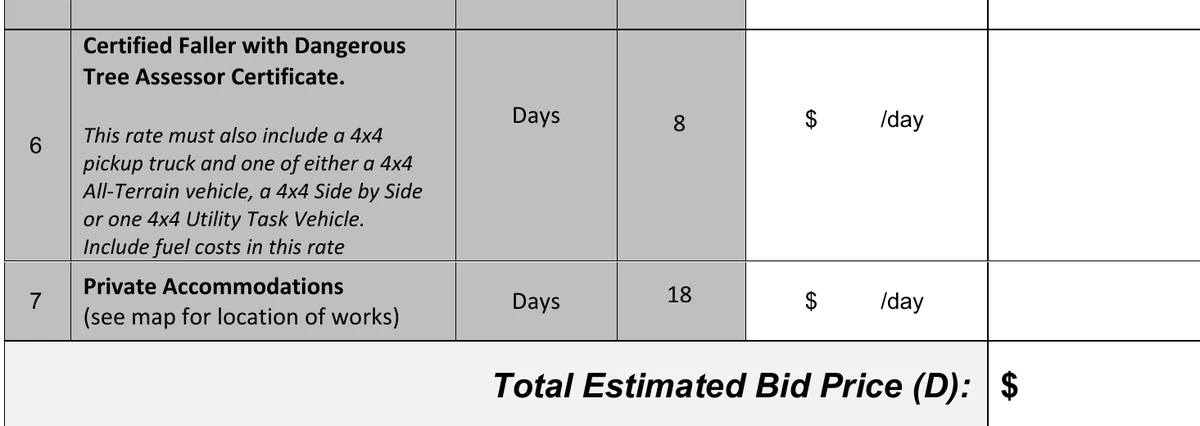
What it shows
The two rows the June 2026 version of this schedule did not have. Item 6 is eight days of a certified faller whose day rate “must also include a 4x4 pickup truck” and a quad; item 7 is eighteen days of private accommodations. The price columns are empty and the Total Estimated Bid Price is empty, because bids do not close until 24 September 2026. Nothing here is decided yet.
A cost can still be put on it, and we have: the quantities are published, and so are the rates the Province uses for exactly this kind of estimate. Priced on the BC Wildfire Service’s 2026 equipment schedule, the five machine rows and the excavator’s fuel come to $70,400 to $93,300.03 The faller and the lodging are not in that number, because the wildfire schedule prices neither — its “Falling” section prices feller-bunchers, which are machines. The Ministry’s own Interior Appraisal Manual prices both, and requires those rates for the Province’s engineering cost estimates: a faller at $99.12 an hour including powersaw, and crew accommodation at $175 a day per person.04 Carry all seven rows at the Province’s own published rates and the job comes to $93,000 to $121,000. Row by row, that arithmetic is set out on the documented record at saverady.com.05
$93,000
Low end of removing 4.4 km of public road, priced on the Province’s own published rates — $121,000 at the top
7
Priced rows on the re-issued schedule, every price cell blank
24 Sep
Bids close, 1:00 PM Pacific, 2026 — no contract is awarded
One quantity in that total is ours and we name it: the tender gives eighteen days of accommodation and no headcount, so the quantities imply a crew of two to three. Everything else is the Province’s — its quantities, its rates, its ten-hour day. Not in the total: the dangerous-tree-assessor ticket item 6 also requires, the contractor’s own overhead and margin, and the fuel-price risk the re-issue moved onto the bidder in the words “Fuel costs shall be incorporated into the hourly or daily rates by the bidder… Fuel costs shall not be invoiced separately.”01
Section 02And the security, which nobody bids on
There is a second cost, and it is not on the price schedule at all. Four paragraphs into the passage that tells bidders what the job is, between the completion deadline and the list of works, the Ministry explains what it expects from the people who live here:

What it shows
The words are “The Ministry of Forests will provide” — not the contractor. Security is a Ministry undertaking for the entire duration of operations, it appears nowhere on the price schedule, and no bidder quotes it. The same finding, in almost the same words, is the first bullet under “Safety” in the contract the winning bidder signs.
The package states no number, and a bidder never sees one. What can be said is where it sits. The two financial securities the tender does name — Bid Security and Contract Performance Security — are both marked “Not applicable.”01 The only security in this procurement that costs anything is the kind with people in it, and the Province pays for that one directly. The public purse pays twice: once to remove the road, and again to guard the removal. It has not paid once, in five years, for a meeting.
Read charitably, that is a contract doing its job. Working a machine on a steep, eroded road beside people who object to the work is a genuine safety problem, and the tender’s hazard list treats it as one: “Members of the public/public disobeying signage” is the second of four items, between dangerous trees and potential soil mass movement.01 Read plainly, it is a ministry recording public opposition to its own decision as a field hazard and budgeting around it rather than answering it. Both readings come from the same paragraph. We will say which one the five-year record supports: you do not need guards for a public you have talked to.
Section 03What it would not pay to prevent
Now set that beside the money this same ministry would not spend, and widen the frame past Trout Lake, because this is a provincial failure with a local casualty. British Columbia has roughly 58,000 kilometres of forest service road. In November 2020 the Auditor General of British Columbia audited how the Province manages it and concluded that the Ministry was not maintaining these roads to its own policies. The reason is not contested and it is not ours: natural resource districts — the Ministry’s own staff, the people who walk these roads and write down what they need — “did not receive the funding from the ministry that they identified as needed to maintain and repair roads according to policy.”06
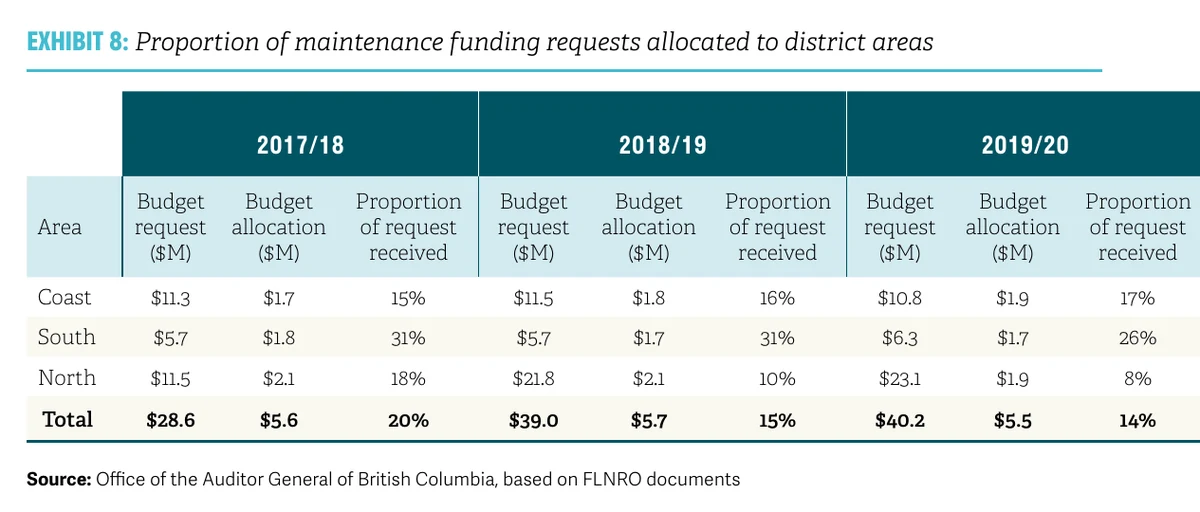
What it shows
Three years, one table. Districts asked for $28.6 million, then $39.0 million, then $40.2 million. They received $5.6, $5.7 and $5.5 million. The request rose by 41%; the allocation did not move. The proportion received fell from 20% to 14%.
In that same year, 2019/20, $8.9 million of high-priority maintenance on priority capital roads went unfunded, along with $1.6 million of medium-priority work.06 Narrow it to the region that contains the Selkirk district and Trout Lake and the shape is the same: the South Area asked for $4.5 million for its priority capital roads and received $1.7 million — 36% — and $3.1 million of what it asked for was recreation access, the single largest slice of the request.06 The districts asked for recreation access more than for anything else, and recreation access is what head office declined hardest.
The record-keeping was worse than the money. Of eight districts the auditors sampled, seven held no historical inspection data and two held no maintenance records at all — the same failure the Ministry’s own internal audit had found in 2008, still there twelve years later.06 So this ministry cannot now say, from its own files, what condition most of this network was ever in. It found its own defect in 2008. It was handed the same finding in 2020. It has changed nothing. That is not a funding problem. An organisation that diagnoses itself and then ignores the diagnosis for twelve years is not under-resourced; it is badly run — and it is now running an excavator over the consequences.

The same ministry that could not afford to maintain the Rady Creek road is funding its destruction.
Auditor General of BC, 2020 · BC Bid opportunity 233877, 2026
Section 04The policy does not merely permit this
Here is the part that turns a budget line into a machine. The Ministry’s Engineering Program Funding Policy ranks what districts may spend maintenance money on: roads accessing communities first, rural residences second, high-value recreation sites third. The Auditor General reproduces what the policy says about everything else — funding is limited to a wilderness road level of maintenance, “otherwise the districts are directed to consider road closures and deactivation.”07 Twenty-four pages later the audit states it again, plainly: the policy “advises districts to deactivate roads that they are unable to maintain at the wilderness standard in order to mitigate risks and manage roads within available maintenance funding.”08
Read those two findings together and the loop closes. Head office funds 14% of what the districts ask for. The policy then tells a district that cannot afford to maintain a road to deactivate it. The shortfall does not merely allow the removal; it directs it. Nobody has to decide that a road should be destroyed. It is sufficient to decline, for long enough, to pay for it — and then the removal arrives looking like engineering rather than a choice. This is not a Rady Creek policy. It applies to every forest service road in British Columbia that a district cannot afford, which, at 14 cents on the dollar, is most of them.
And it is a choice, not an obligation, because the same audit says so in the next sentence: “However, there is no trigger or timeline for deactivation. FSRs can remain open indefinitely if they are maintained as wilderness roads.”08 Nothing in law or policy compels the Rady Creek road to come out on 1 November 2026. A road that carries public recreation access is a road the policy already ranks in its third funding tier; the audit notes that capital roads — the ones serving communities, rural residences or high-value recreation — are “unlikely to be deactivated by the ministry and require continual maintenance.”07 Which tier this road was ever assessed against is not in anything released to us. Somebody in this ministry knows. Nobody has said.
And this is where a budget story becomes a governance one. Twenty years ago the Ministry of Forests and Range amended its own road funding policy to create a subset of forest service roads called Recreation Use Forest Service roads, and revised that policy “to now provide a recreation access level of maintenance” to high-value recreation sites and trails and to important recreation areas. It published that in an audited annual report over a minister’s signature.10 Then, in 2020, told by the Auditor General that it was not maintaining roads to its own policies, the Ministry’s written response was that it had “adjusted our risk-based operational maintenance funding model to focus primarily upon communities and rural residences”06 — tiers one and two. Caught failing, it did not fund recreation. It demoted it. The Province created the category; Parmar’s ministry is quietly dismantling what it was for.
Section 05The fiscal frame, in the Province’s own numbers
There is a bigger frame around all of this, and it belongs to the Ministry of Finance. In Budget 2026, tabled on 17 February 2026, the Province forecasts a deficit of $13.3 billion for 2026‑27, followed by $12.2 billion in 2027‑28 and $11.4 billion in 2028‑29. Taxpayer-supported debt stood at $116.5 billion at the end of 2025‑26 and is “expected to increase to $189 billion over the fiscal plan,” taking the debt-to-GDP ratio from 30.6% to 37.4% by 2028‑29.09 Those are the Province’s figures, published by the Province, in the Province’s own backgrounder.
A hundred thousand dollars does not dent a $13.3 billion deficit, and anyone who tells you otherwise is asking you to stop counting. The point runs the other way. A government this far into deficit is paying to subtract something it already owns — an asset built with public money, kept open by public money, and now removed with public money, after the maintenance that would have kept it was declined for a decade. The deficit is not an argument for destroying the road. Under the funding policy above, it is the machinery that produces the destruction — and every dollar of deficit pressure makes that machinery bite harder, on more roads, in more towns, next year.
14%
Share of maintenance requests districts received in 2019/20 — Auditor General, Exhibit 8
$8.9M
High-priority maintenance left unfunded in that single year
$13.3B
Forecast provincial deficit for 2026‑27 — Budget 2026
Section 06It is not awarded yet
That is the whole of it, and the last fact is the one that matters most. No contractor has been selected. No contract has been signed. The price cells on that schedule are blank, and bidding closes at 1:00 PM Pacific on 24 September 2026. Until then this is a proposal with a deadline, and a proposal with a deadline is the only kind of decision that can still be changed.
Two offices can change it. The Rady Creek road, the tender and the funding policy all belong to the Minister of Forests, Ravi Parmar (FOR.Minister@gov.bc.ca) — the minister who owns a ministry his own auditor says is not meeting its own standards. The fiscal frame — the deficit, the debt, and the standing question of what the Province spends to subtract its own assets — belongs to the Minister of Finance, Josie Osborne (FIN.Minister@gov.bc.ca). Both are published departmental addresses for office-holders acting in an official capacity.
What we are asking for is narrow, and none of it requires anyone to agree with a word above:
- Pause the award of EN27DSE008 until the record is public.
- Publish what the Rady Creek road was assessed as — which funding tier, in which year, on whose assessment — and the cost of maintaining it at the wilderness standard, set against the cost of removing it.
- Publish what the 24/7 onsite security undertaking is expected to cost, since it is the Ministry’s undertaking and not a bidder’s.
Four and a half kilometres of public road are being removed because the funding to keep them was declined, by the ministry now paying to take them out, in a year the Province has budgeted a $13.3 billion deficit. That is not a conspiracy. It is a policy working exactly as written, run by a ministry that has known since 2008 that it cannot do this job properly, and that still has four of its auditor’s nine recommendations outstanding. Minister Parmar owns that ministry. He can stop one road while the rest of it is sorted out. Pause the Rady Creek deactivation.
Share this story
Ten images carrying this story on their own — the figure, the quotation and the document each one comes from. Made to be posted.


Slide 1 of 10
Suggested caption
The Ministry of Forests would not fund the maintenance of British Columbia’s forest roads. It found the money to destroy one.
The Auditor General’s 2020 report: districts asked, and received fourteen cents on the dollar. $8.9 million of high-priority maintenance unfunded in one year. Seven of eight districts with no historical inspection data. The same failures were found in an internal audit in 2008 and were still there twelve years later.
Then read the policy this ministry wrote for itself: a road a district cannot afford to maintain should be deactivated. Starve it, then cite the starvation. That is not a Rady Creek problem. It applies to every forest service road in British Columbia that a district cannot afford.
Priced on the Province’s own published rates, removing this road comes to $93,000 to $121,000. On top of that, the Ministry has undertaken to pay for 24/7 security, because its tender calls the project contentious.
The public purse pays twice: once to remove the road, and again to guard the removal. It has not paid once, in five years, for a meeting.
Bids close 1:00 PM, 24 September 2026. No contract is signed.
Ravi Parmar — pause the Rady Creek deactivation. Publish which funding tier this road was assessed against, and what the 24/7 security will cost.
backcountry.cx/editorials/public-money-public-asset/
#BCpoli #PublicLand #RadyCreek #Kootenays #ForestServiceRoad
Sources
- ↩↩↩↩↩Invitation to Tender, contract EN27DSE008. Trout Lake-Rady Cr FSR Deactivation 0.0 km to 4.4 km, Ministry of Forests, Selkirk Resource District. Re-issued 9 September 2026 via BC Bid opportunity 233877; 27 pages. Closing date and completion deadline, page 1 and Information to Bidders page 3; security undertaking, page 3; known field safety hazards, page 4; Bid Security 6.01 and Contract Performance Security 7, Conditions of Tender; Tender Price Schedule and fuel clause, pages 22–23.
- ↩Specimen Contract, EN27DSE008. Issued with the same tender package, 22 pages. Schedule A, clause 1.02 for the ten-hour day; clause 1.04 “Safety”, page 5, first bullet, for the security undertaking in the document the successful bidder signs.
- ↩2026 BCWS Equipment Rates and Market Fuel Adjustments. BC Wildfire Service, Ministry of Forests. Excavator (guarded) §7.1, lowbeds §6.3, pickups §6.4, all-terrain vehicles §11.1. All eleven sections checked: the schedule publishes no rate for a faller, none for a dangerous tree assessor and none for accommodation — its §1 “Falling” prices feller-bunchers, which are machines. https://www2.gov.bc.ca/assets/gov/public-safety-and-emergency-services/wildfire-status/employment/contract-opportunties/equipment-rates/26_august_bcws_equipment_rates.pdf
- ↩Interior Appraisal Manual. Ministry of Forests, Timber Pricing Branch, effective 1 July 2026. Appendix A, Wage Rates: “Faller, including powersaw cost — 99.12” per hour; and “$175/day/person for crew accommodation if those doing the work must stay in a camp”. The appendix states these rates “must be used for all engineering cost estimates” made under the manual. https://www2.gov.bc.ca/assets/gov/farming-natural-resources-and-industry/forestry/timber-pricing/interior-timber-pricing/interior-appraisal-manual/iam_2026_master_b.pdf
- ↩saverady.com, section 02. The row-by-row costing of the re-issued schedule against the published rates above, with each row’s quantity, rate and arithmetic shown. https://saverady.com/#money
- ↩↩↩↩↩Management of Forest Service Roads. Office of the Auditor General of British Columbia, November 2020. Page 11 for the conclusion that the ministry was not maintaining roads to its own policies, and exhibits 4–6 for the 58,000 km network. Exhibit 8 (page 39) for the three-year request-against-allocation table; page 40 for the $8.9 million unfunded high-priority maintenance and Exhibit 9, the South Area’s $4.5 million request and $1.7 million allocation; page 38 for the districts that kept no historical inspection data, the two that kept no maintenance records, and the 2008 Internal Audit & Advisory Services report that found the same thing. https://www.oag.bc.ca/app/uploads/sites/963/2024/08/OAGBC-20210119-Management-Forest-Service-Roads_RPT.pdf
- ↩↩Same report, page 23. The Engineering Program Funding Policy text box: the three funding tiers, and “otherwise the districts are directed to consider road closures and deactivation”; and, on the same page, capital roads being “unlikely to be deactivated by the ministry and require continual maintenance.” https://www.oag.bc.ca/app/uploads/sites/963/2024/08/OAGBC-20210119-Management-Forest-Service-Roads_RPT.pdf
- ↩↩Same report, page 47. “Deactivation”: the policy “advises districts to deactivate roads that they are unable to maintain at the wilderness standard…”, and “there is no trigger or timeline for deactivation. FSRs can remain open indefinitely if they are maintained as wilderness roads.” https://www.oag.bc.ca/app/uploads/sites/963/2024/08/OAGBC-20210119-Management-Forest-Service-Roads_RPT.pdf
- ↩Budget 2026 — Fiscal plan 2026-27 to 2028-29. Backgrounder, Province of British Columbia, 17 February 2026. Deficits of $13.3 billion, $12.2 billion and $11.4 billion; taxpayer-supported debt of $116.5 billion at the end of 2025-26 and “expected to increase to $189 billion over the fiscal plan”; debt-to-GDP of 30.6%, 34.4% and 37.4%. https://www.bcbudget.gov.bc.ca/2026/pdf/2026_Backgrounder_4.pdf
- ↩2005/06 Annual Service Plan Report. Ministry of Forests and Range, Province of British Columbia; accountability statement signed 30 June 2006. Page 61, Objective 5, Strategies 2 and 3: the funding policy amendment creating “a subset of Forest Service roads called Recreation Use Forest Service roads”, and its revision “to now provide a recreation access level of maintenance” to high-value forest recreation sites and trails and to important recreation areas. Strategy 4 on the same page concerns the forest road network as a whole and is not quoted here. https://www.bcbudget.gov.bc.ca/Annual_Reports/2005_2006/for/for.pdf