
EDITORIAL · THE OPERATOR
Why is the NDP campaigning against American takeovers, if they already handed 7,321 km² of our backcountry to an American-owned conglomerate — CMH, who told them rural British Columbians are the problem?
Canadian Mountain Holidays is a British Columbia limited partnership owned through a holding company in Denver, Colorado, assembled in a $1.5 billion takeover in 2017. It holds six commercial recreation tenures over 7,321 square kilometres of Crown land, and not one of those licences lets it keep anybody out. It told our government that public recreation is “a death by a thousand cuts” — then named the recreation: “unregulated snowmobile use from Trout Lake.”Trout Lake is a village in the Kootenays. The people it describes live there.
Section 01The NDP government pulled American bourbon off the shelves. It never asked who owned CMH, which holds 7,321 km² of British Columbia
British Columbia votes on 24 October 2026. The writ went out on 22 September, and the governing party opened its campaign that same day against an opponent who is not on the ballot in any of the province’s ninety-three ridings. “For B.C. and for Canada, this is an existential moment. Trump is threatening our jobs and driving up costs,” David Eby is quoted as saying in the party’s own launch release. The third of its three planks runs six words: “Build an economy free from the US.”51
None of that was improvised for the campaign. For nineteen months before the writ the same message went out through the government’s own newsroom, on letterhead, with a release number on every one. The clearest single specimen was published by the Office of the Premier on 10 March 2025, and it repays reading as one object — because the sentence at the top and the action at the bottom are not the same size.
Premier’s statement on removing all U.S. alcohol from BCLIQUOR stores · release 2025PREM0032-000187 · 10 March 2025
“Let there be no mistake about the intent behind tariffs. President Trump wants to hurt Canada economically so he can annex Canada politically. As hard as it is to believe, our longtime friend and ally is behaving like a foe. Trump wants to force us into becoming the 51st state. That will never happen. We are proud Canadians. We will always be the true north, strong and free. Elbows up!”
Four paragraphs above it, in the same statement, the measure being announced: “I encourage those who enjoy Napa Valley wines to enjoy the many award winners from the Okanagan Valley. British Columbia distillers produce many distinguished spirits, while we also brew popular domestic and delicious craft beers.”52
Annexation, the 51st state, elbows up — and a wine recommendation. That gap is not a slip of drafting. It is the shape of the entire programme, and the rest of this section is the evidence for saying so.

David Eby
Premier of British Columbia. On 10 March 2025, in a statement published by his own office: “President Trump wants to hurt Canada economically so he can annex Canada politically… Trump wants to force us into becoming the 51st state. That will never happen… Elbows up!” The measure that statement announced was the removal of American alcohol from BC Liquor stores.
Government release 2025PREM0032-000187 · 10 March 2025
What follows is the run of it. Not a paraphrase, not a rally chant, not a reporter’s summary: every line in the third column below is verbatim from a Government of British Columbia release, a BC NDP release or a named news report, and every one was read out of the source page itself on 27 September 2026. The fourth column is what was actually being announced when the words were said. Read down that fourth column first.5253
| When, and where it was publishedEvery line is the Premier unless named | What was said, verbatim | What it announced |
|---|---|---|
| 1 Feb 2025 2025PREM0014-000077 | “We won’t back down or be bullied into becoming another state.” | “Red-state” American liquor pulled from BC Liquor; government and Crown corporations directed to buy Canadian first |
| 4 Mar 2025 2025PREM0026-000166 | “This threat to our sovereignty has brought out a sense of pride, a sense of courage and a sense of solidarity among all Canadians.” | Buy-Canadian-first direction extended to health authorities |
| 4 Mar 2025 2025PREM0026-000166 | “At the grocery store, buy B.C., buy Canadian. If you have a choice about where to travel, avoid the United States.” | An appeal to shoppers and travellers |
| 6 Mar 2025 2025PREM0011-000174 | “The White House started a trade war we didn’t want, and we must answer with strength.” | Further tariff counter-measures |
| 10 Mar 2025 2025PREM0032-000187 | “Trump wants to hurt Canada economically so he can annex Canada politically… Trump wants to force us into becoming the 51st state. That will never happen… Elbows up!” | All American alcohol removed from BC Liquor stores. In the same statement: “I encourage those who enjoy Napa Valley wines to enjoy the many award winners from the Okanagan Valley.” |
| 13 Mar 2025 2025AG0012-000204 | “In the face of escalating attacks on our sovereignty that have included threatening to erase the Canada–U.S. border and taking our water, we are not backing down.” | Bill 7, the tariff-response legislation. Its Part 4 — the one power that reached the terms of licences and permits — was withdrawn before passage |
| 10 Apr 2025 CBC News | “We’ve gotta be prepared to stand on our own two feet.” | Ministries, health authorities and Crowns directed to cancel non-essential American contracts, software subscriptions, publications, industry memberships and travel “where viable”. Starlink ruled out as a rural internet provider |
| 16 Apr 2025 CBC NewsMinistry of Health | Asked to apply that directive to Quest Diagnostics, the American owner of LifeLabs, the Ministry refused: cancelling “would… put patients at risk” and “would also cost hundreds of millions of dollars.” | Nothing. The $1.35 billion acquisition of British Columbia’s main outpatient laboratory provider stood |
| 8 Sep 2026 CBC News | New official border welcome signs, unveiled by the Premier, reading that Canada “will NEVER be the 51st state. Sorry!” | Signage at the Washington, Idaho, Montana and Alaska crossings |
| 18 Sep 2026 2026PREM0034-001088Ravi Parmar, Minister of Forests | “Donald Trump took aim at our forestry workers… This is how we win against the United States.” | $90 million for tariff-hit business; $15 million to extend the BuyBC label beyond agriculture |
| 18 Sep 2026 2026PREM0034-001088 | “But we won’t let decisions made in Washington determine our future.” | The same package |
| 22 Sep 2026 bcndp.caDavid Eby, BC NDP leader | “For B.C. and for Canada, this is an existential moment… Or do we cozy up to Trump, make cuts, raise costs and Americanize our health care?” | The campaign launch. Plank three, in full: “Build an economy free from the US” |
| 24 Sep 2026 bcndp.caBC NDP | The party’s own release describes the Opposition offering American liquor back “as a measure of good faith” while Trump “was pushing his 51st state agenda.” | “Built in B.C. and Canada” procurement rules: minimum Canadian content in wood, steel, aluminium and cement, and penalties on American-made goods and materials |
Bourbon. Wine. Software subscriptions. Industry memberships. Publication subscriptions. Steel, cement, aluminium and wood for public projects. Penalties on American goods. A satellite-internet contract declined. Ninety million dollars for exporters and fifteen for a grocery label. Two road signs at four border crossings. Every instrument this government has built against American economic power operates on things — things you can buy, sell, ship, shelve, cancel or put in a truck.
Nineteen months, thirteen statements, three ministries and a campaign war room — and the whole of British Columbia’s sovereignty apparatus fits inside a shopping basket.
There is exactly one place in the record where this government was asked to act on American ownership rather than American goods, and its answer is on the record too. Quest Diagnostics, a United States company, had acquired LifeLabs — British Columbia’s main outpatient laboratory provider — for $1.35 billion. Six days after the Premier ordered government to cancel American contracts where viable, the BC Health Coalition asked him to apply that order to this one. The Ministry of Health declined, in writing: cancelling the contract “would cause significant delays in basic lab testing and put patients at risk” and “would also cost hundreds of millions of dollars.”53
That may well be the right answer on laboratory services. It is also the only test in the whole record of what this government does when an American company owns a British Columbian asset rather than merely selling into the province — and the answer was that unwinding it costs too much. Bourbon was cheap. Ownership is not.
Which brings the campaign to the ground underneath it.
Six years before those border signs went up, on 15 July 2020, a company owned through a holding company at 3501 Wazee Street in Denver, Colorado filed a document with the Ministry of Forests asking to keep 116,704 hectares of British Columbia for a further forty-five years. Inside it, under a heading the Province requires every applicant to complete, the company wrote down what was wrong with the terrain it was applying for. The recipient was the ministry that issues the licence. The subject was the people who live below it.
Canadian Mountain Holidays LP to the Ministry of Forests · CMH Galena Heli-ski Management Plan, § 2.2, Silver Cup zone · 15 July 2020 · filed under MFLNRO file 4401094 in support of replacing Licence of Occupation #340826 for a further 45 years · released at page 36 of 85 in FOR-2023-31283
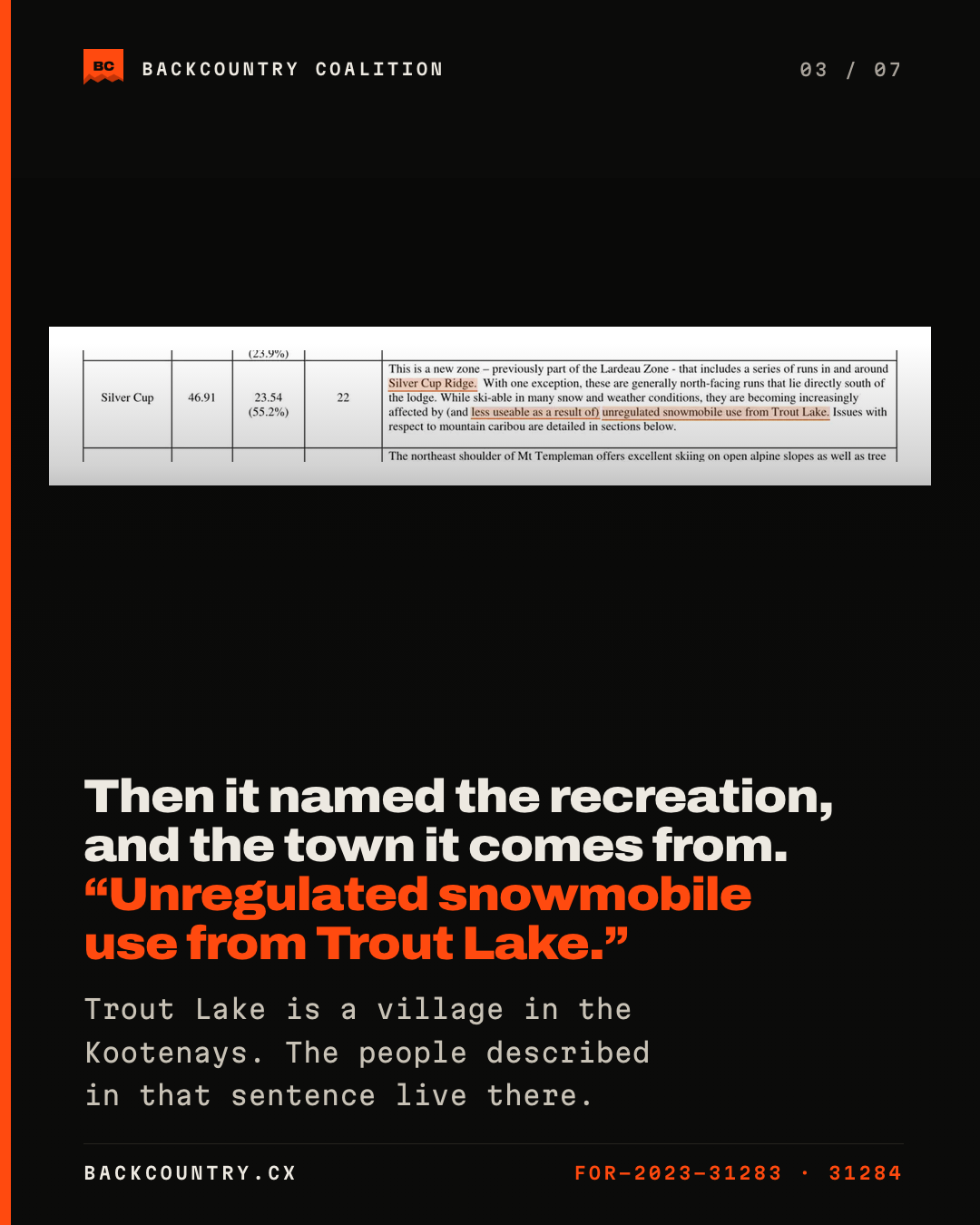
“While ski-able in many snow and weather conditions, they are becoming increasingly affected by (and less useable as a result of) unregulated snowmobile use from Trout Lake.”
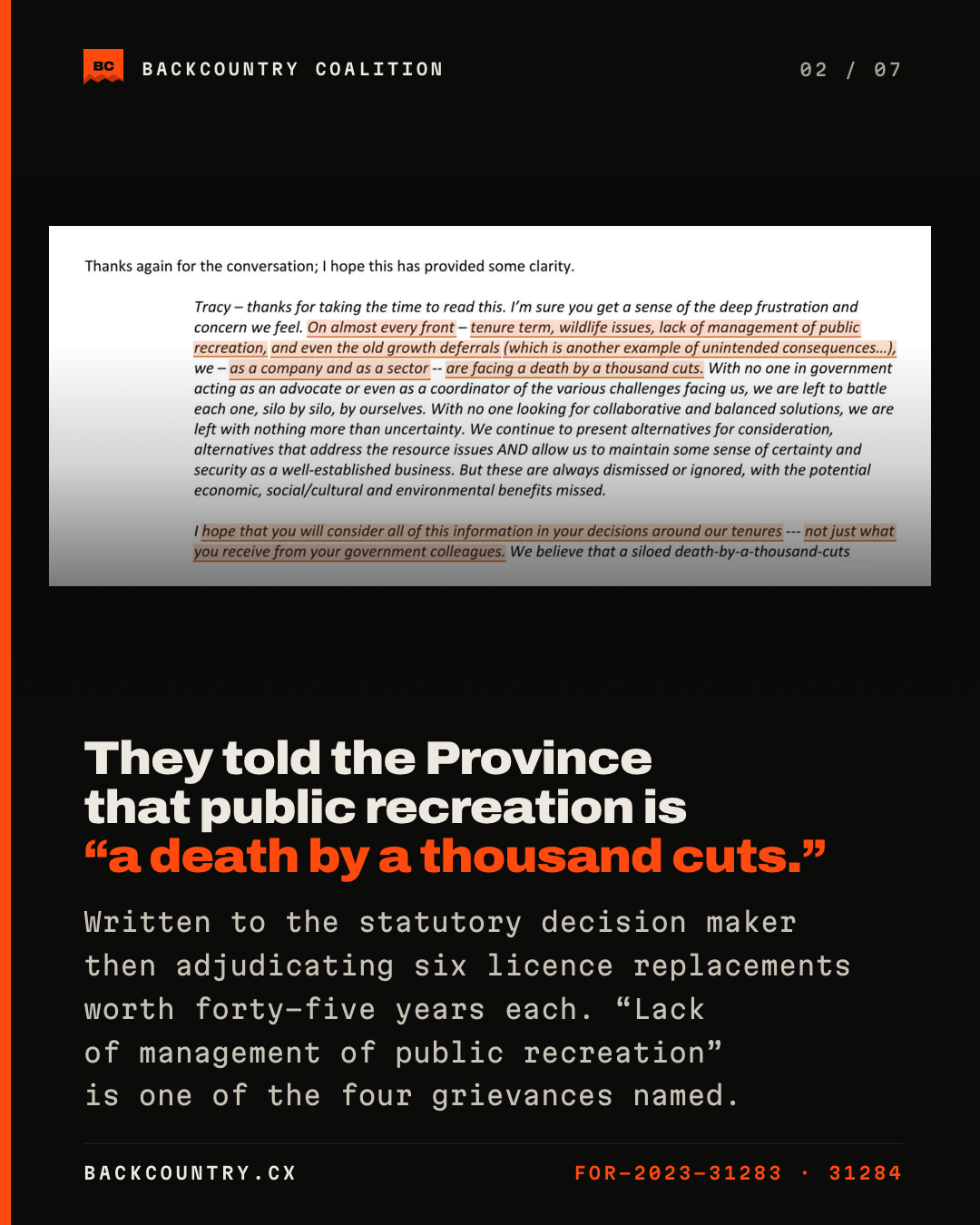
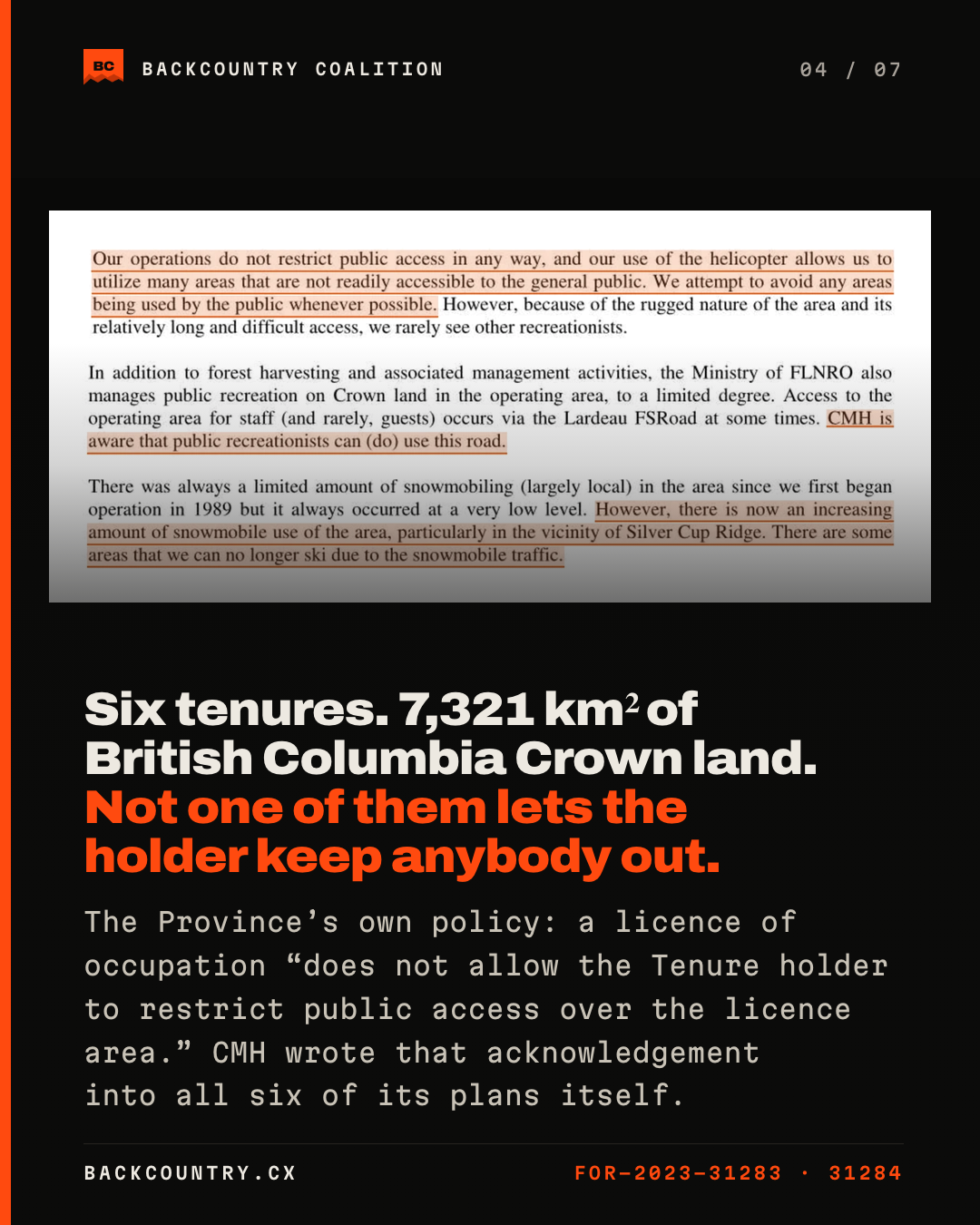
Trout Lake is a village. It sits at the head of the lake of that name, up the Lardeau, in the Badshot Range of the Selkirks, and the snowmobilers the plan is describing are the people who live there. Four pages later in the same document, under Public Use and Access, CMH records the consequence it wants the Ministry to understand: “There are some areas that we can no longer ski due to the snowmobile traffic.” Two years after that, writing directly to the official adjudicating six of its licences, it lists “lack of management of public recreation” among the grievances it calls “a death by a thousand cuts”. Section 06 reproduces all three in full, as the Province released them.0206
A government that pulled every bottle of American liquor off its shelves to defend British Columbia’s sovereignty has been, throughout the whole of that same period, the landlord of 7,321 square kilometres of British Columbia held by a company owned in America — and it has never once asked who owns it.
Not refused. Not weighed and permitted. Never asked. Section 03 sets out why, and it is a matter of statute rather than of will: the Land Act that governs these six licences contains no occurrence of the words “change of control”, “shareholder”, “foreign” or “nationality”, and the one anti-tariff power that would have reached into the terms of a licence was drafted, introduced, and withdrawn before it passed. Then, inside the economic strategy branded as making British Columbia less reliant on the United States, the Province stood up a dedicated hub to make this exact class of land tenure faster to obtain, put $7.5 million behind it, and was thanked for it in its own news release by the heli-skiing industry association.
The bourbon was theatre, and cheap theatre is the point of it: it can be announced on a Monday and reversed on a Tuesday, and nobody loses anything that cannot be restocked. The ground is the asset. The ground is what was already signed, for forty-five years at a time, to an owner nobody in that government has ever been obliged to name.
Section 02The NDP let 7,321 km² of our backcountry come under American control — and then campaigned against American control
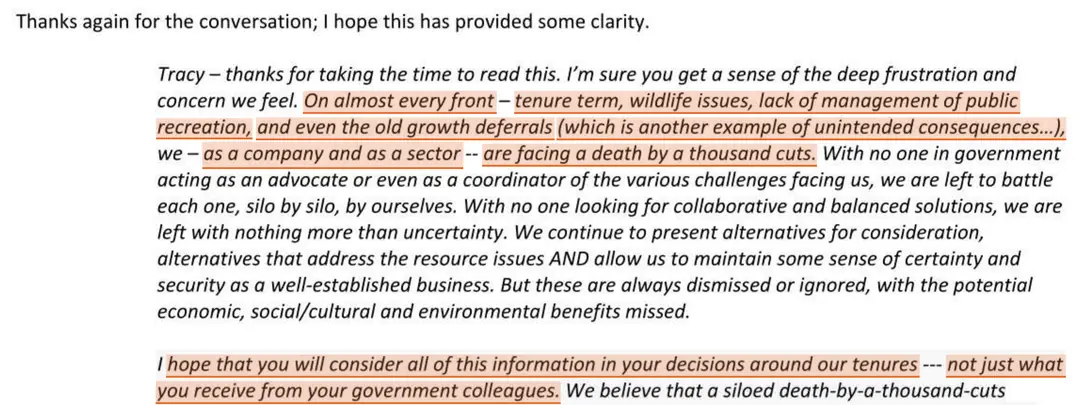
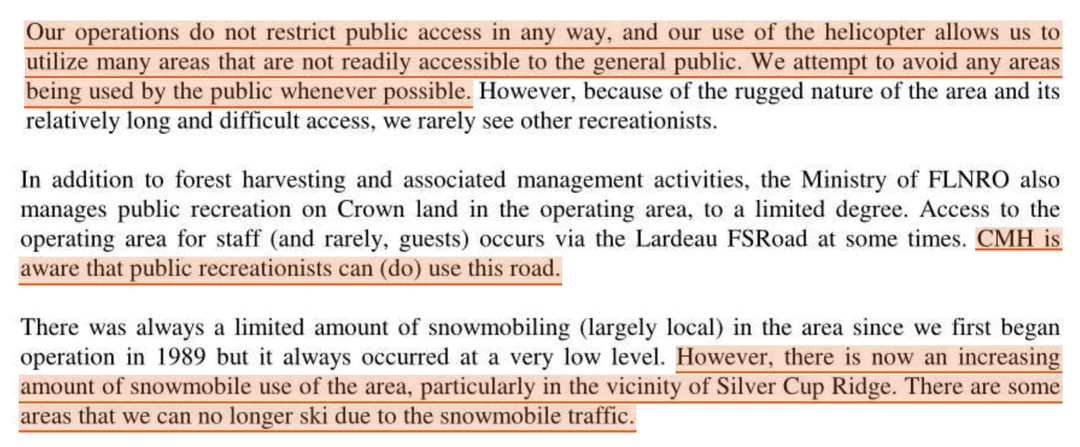
That page is one page of one plan, filed with the Ministry of Forests to win a further forty-five years over 116,704 hectares of Crown land above Trout Lake. It opens by saying the operation restricts nobody. It closes by saying the public has taken terrain off the table. Both sentences sit under the same heading, in a document that becomes part of the tenure.01
The company that filed that document, Canadian Mountain Holidays, is the largest heli-ski operator in British Columbia. It is also the bottom layer of a structure: a limited partnership under a general-partner company, under a Denver holding company assembled out of a takeover valued at approximately $1.5 billion. What that structure holds here is public land — six tenures, 7,321 square kilometres, issued under the Land Act on terms that expressly do not let it keep anybody out.
And the terrain is not empty. The plan names the ridge it wants, and it names the town the problem comes from: Trout Lake, reached up the Lardeau, in the Badshot Range of the Selkirk Mountains. It names the clubs too — the Nakusp Snowmobile Club and the BC Snowmobile Federation. It does not name the Trout Lake Recreational Club — the club whose members ride the terrain the plan is describing, and which maintains the road into it.03
American capital at the top, British Columbia’s Crown land in the middle, and the people who live beside it named in writing as a problem to be managed.
Three releases carry the record, all published by the Government of British Columbia on its own disclosure site. FOR-2023-31283 is eighty-five pages of tenure-replacement correspondence and management plans. FOR-2023-31284 is twenty-one pages of caribou decision notes. WLR-2024-41783 is a two-page ministerial meeting note.1112 Every claim below is a document, named by release number and page.
The management plan names its own author on the first line of its introduction: “Canadian Mountain Holidays LP (LP0604337) is a well-established adventure tourism business that has been in operation for nearly 60 years.”01
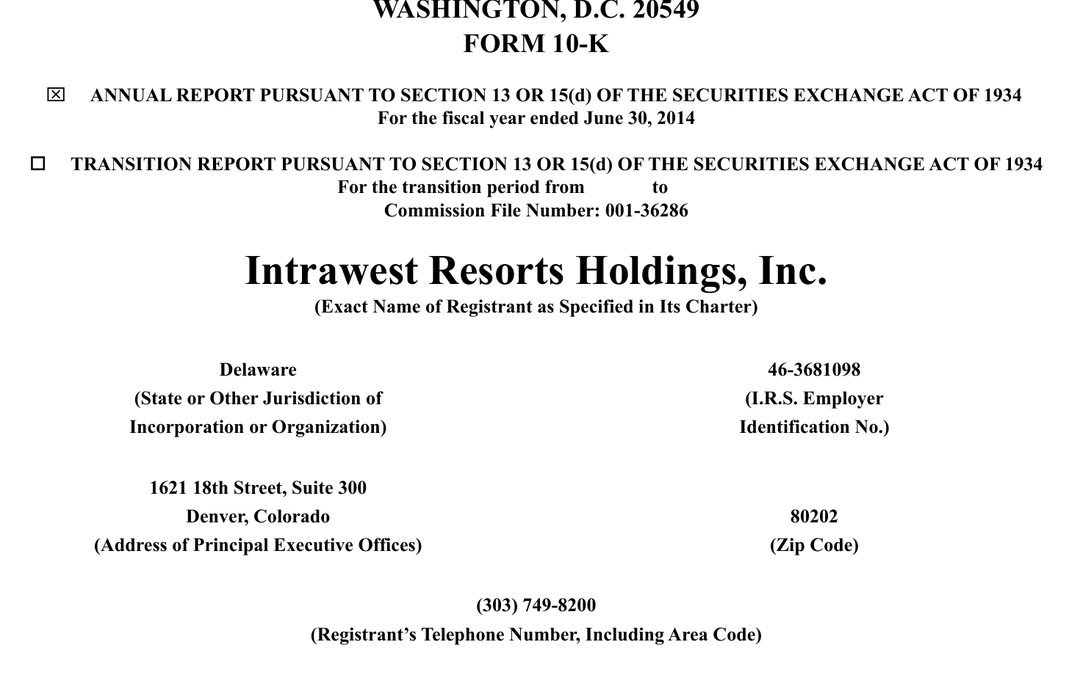
That bracketed string is a British Columbia registration number, and it resolves twice. The corporate register carries LP0604337 as Canadian Mountain Holidays Limited Partnership, with a general partner, Canadian Mountain Holidays GP Inc., at BC0965475.13 Both entities appear under those exact names in a sworn United States securities filing: the list of subsidiaries attached to the annual report of Intrawest Resorts Holdings, Inc., filed on 23 September 2014.14
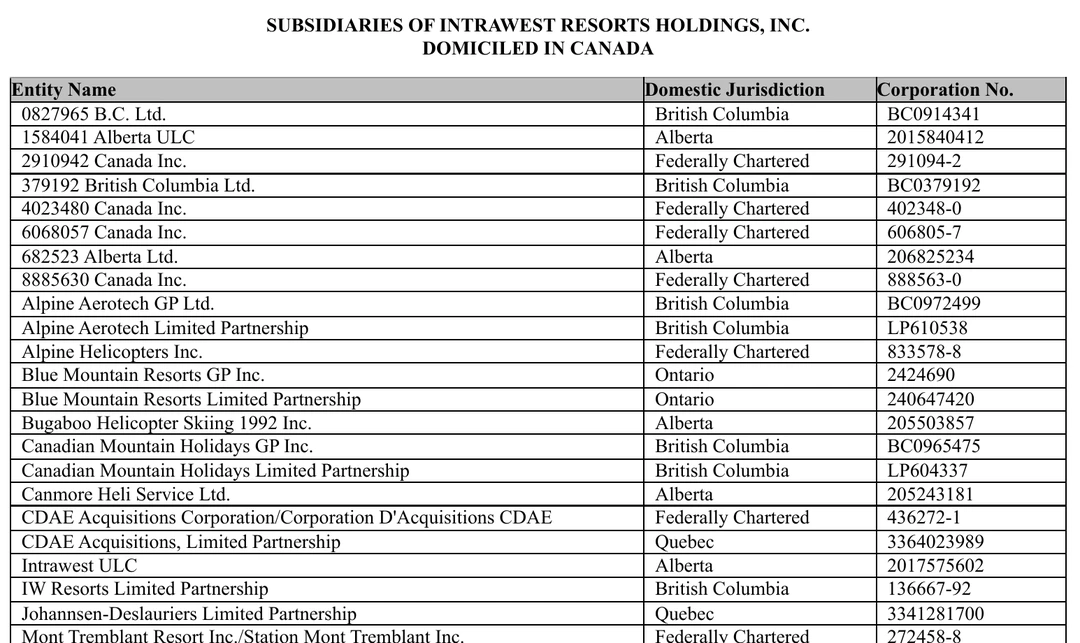
Three corporate layers stand between the guides on that ridge and the people who own the business. Canadian Mountain Holidays LP holds the tenures. Canadian Mountain Holidays GP Inc. is its general partner. Above both sits Alterra Mountain Company in Denver, and above Alterra the joint venture that created it. The land is in the Selkirks and the Monashees. The decisions about it are made four layers up.
The legal person is therefore a British Columbia limited partnership. CMH Heli-Skiing & Summer Adventures is a trading name, and it is the name under which the business appears in its parent’s own list of subsidiaries.
The parent is Alterra Mountain Company. Its own corporate release, datelined “DENVER, CO”, describes the company as “Headquartered in Denver, Colorado” and lists among its brands “CMH Heli-Skiing & Summer Adventures and Mike Wiegele Helicopter Skiing in British Columbia.” The same release calls Alterra the owner of “the world’s largest heli-skiing operation”. CMH’s own newsroom puts the ownership in one clause: “CMH Heli-Skiing & Summer Adventures, which is owned by Alterra Mountain Company…” The Denver company’s British Columbia footprint is wider than CMH alone: it also holds Mike Wiegele Helicopter Skiing, and Alpine Aerotech, a helicopter support and maintenance business in this province.1516
There was no transaction in which Alterra bought CMH. The chain is in the securities record, and it matters that it is described correctly.
The accurate sentence is short: CMH came to Alterra through the Intrawest acquisition that closed on 31 July 2017, and the joint venture that bought it took the Alterra name on 11 January 2018.1718
Section 03British Columbia asks a person whether they are Canadian. It never asks a company who owns it
This government has built a great deal of machinery against American economic pressure, and every piece of it is about things that move. It pulled American spirits from the liquor branch and directed government to buy Canadian first. It passed the Economic Stabilization (Tariff Response) Act, of which one operative power survives: to issue directives “in relation to the procurement of goods or services.” It opened a forest trade office in London, ran its largest forestry mission to Asia, and put $90 million behind tariff-hit business.42
Nine days before the writ dropped, the Minister of Forests put it as plainly as it can be put. “Donald Trump took aim at our forestry workers… This is how we win against the United States.” The Premier, in the same release: “we won’t let decisions made in Washington determine our future.”43
Every one of British Columbia’s sovereignty instruments operates on goods, services, procurement, markets or money. Not one of them touches land, tenure, or who owns either.
And inside Look West, the Province sped the adventure-tourism tenures up
On 29 April 2026 the government published an update on Look West, the economic strategy it describes as setting “a 10-year vision to strengthen B.C.’s economy… so B.C.’s economy is less reliant on the United States.” In the facts section of that same release:44
Look West update · release 2026PREM0020-000479 · 29 April 2026
The new Adventure Tourism Hub is improving British Columbia’s permitting process, making it easier for businesses to seek land-tenure permits for popular tourism activities like heliskiing, cat skiing, heli-assisted guiding activities, commercial snowmobiling and snowmobile-assisted activities.
Three weeks earlier the ministry that actually administers those tenures had launched it: $7.5 million from Budget 2026, applications moved off the regions and into a dedicated group, an initial focus on heli-skiing, cat skiing and guided snowmobiling, and Randene Neill, Minister of Water, Land and Resource Stewardship, promising to make it “easier for businesses to get the permits they need.” HeliCat Canada — the association CMH helps govern, and the subject of Section 07 — thanked the Province in the Province’s own release, calling it “a pivotal step forward in creating the conditions for investment.”4545
Neither release mentions nationality, residency, ownership or control of the applicant. Inside Look West, the strategy branded as making British Columbia less reliant on the United States, the Province made it faster to obtain the exact class of land tenure an American-owned company already holds six of.
The Province’s eligibility policy asks a person whether they are Canadian. It never asks a company who owns it.
This is not rhetoric against conduct. It is one statute against another, and it takes minutes to check.
When a timber tenure changes hands, the Forest Act binds the minister: in considering approval he “must consider the effect of the disposition on (a) the marketing of fibre in British Columbia, and (b) the public interest”, and where it would not be in the public interest for the recipient to hold those rights, he “must not approve the disposition.” Behind that sits an entire division headed “Corporate Changes of Control and Amalgamations”: a corporation holding an agreement must give written notice of a change of control within 30 days, the minister must review it against the public interest, the section reaches through a holding corporation whose subsidiary is the corporation, and the minister may suspend rights and require the agreement be sold to someone at arm’s length.46
Now the Land Act, which governs the six tenures in this piece. Ministerial consent is required to assign one — a purported transfer without it is “void”. But the section attaches no test at all to that consent: no public-interest consideration, no power to compel information, no mandatory refusal. And run the searches on the consolidated Act. “Change of control”: none. “Shareholder”: none. “Foreign”: none. “Nationality”: none.47
British Columbia does ask about nationality. It asks it of people. The Province’s general eligibility policy for Land Act tenures, and the Adventure Tourism policy word for word after it, require an applicant to be:48
General Policy: Eligibility and Restrictions · file 11100-00 · § 2.2
• Canadian citizens or permanent residents 19 years of age or older; or,
• corporations which are incorporated or registered in British Columbia.
Read the “or”. A person has to be Canadian. A company has only to exist here on paper — and “registered” is the extraprovincial registration the Business Corporations Act already compels of what the statute itself calls a “foreign entity” within two months of starting to carry on business in the province. That registration statement asks for a name, a jurisdiction, an address and an attorney for service. It asks nothing about who owns the company. And the Act’s list of who may not be a director — under 18, incapable, undischarged bankrupt, convicted of fraud — carries no citizenship or residency requirement at all, unlike its federal counterpart.48
The one place the Land Act uses the word “Canadian” is section 9, and it bars non-citizens only from taking a Crown grant — outright ownership of the land itself. A commercial recreation tenure is never a Crown grant. It is a licence of occupation or a lease, as the Adventure Tourism policy’s own headings say throughout. So the Act’s only citizenship provision cannot reach these tenures by its own terms.47
British Columbia asks an individual whether they are Canadian. It never asks a corporation who owns it. A company wholly owned in the United States, with an entirely American board, that has filed an extraprovincial registration here, meets every eligibility requirement there is.
In 1999 a previous government did put a Crown tenure transfer to the public
In 1999 an American company, Louisiana-Pacific, proposed to acquire Crown tenures in the Nelson forest region — the region that contains Trout Lake. The Forests Minister of the day, David Zirnhelt, called a public review:49
Ministry of Forests · 1999 · public meetings on a Crown tenure transfer
As Minister of Forests, I must ensure under the Forest Act that transactions of this type are in the best interests of British Columbians. I am particularly concerned about the communities and workers in the Interior that may be affected by the proposed transfer. That is why I have called for a public review.
Public meetings on the Louisiana-Pacific transfer were held in Sicamous, Revelstoke and Golden, taking written and oral submissions. Two limits belong on that precedent: those were timber tenures under the Forest Act, where the change-of-control machinery exists, and Zirnhelt’s stated concern was communities and workers, not the buyer’s nationality. What it establishes is capability. Within living memory this province put a Crown tenure transfer to an American buyer in front of three Interior towns and listened. For a commercial recreation tenure there is no hook to hang that on, and none was ever built.
Section 04CMH’s six tenures, 7,321 km², and three different totals in the Province’s own files
FOR-2023-31283 is a tenure-replacement file. It carries the management plans for six CMH operating areas, and each plan states its own area in its own zone table.
| Operating area | Plan title, as printed | File number | Plan date | Area stated | Pages |
|---|---|---|---|---|---|
| CMH Gothics | Adventure Tourism (Helicopter Skiing) Management Plan | LWBC 4400690 | July 2020 | 1,249.29 km² | 43, 46 |
| CMH Adamants | Adventure Tourism (Heli-ski) Management Plan | MFLNRO 4401957 | 27 Feb / 17 Mar 2020 | 1,050.40 km² | 17, 20 |
| CMH Galena | Adventure Tourism (Heli-skiing) Management Plan | MFLNRO 4401094 | 15 July 2020 | 1,167.44 km² | 33, 36 |
| CMH Monashees | Commercial Mechanized Ski Guiding Management Plan | LWBC 4496099 | 22 July 2020 | 1,487.53 km² | 52, 54 |
| CMH Revelstoke | Adventure Tourism (Heli-ski) Management Plan | MFLNRO 4496100 | 10 Aug 2020 | 1,313.79 km² | 61, 66 |
| CMH Bobbie Burns | Adventure Tourism (Heli-ski) Management Plan | MFLNRO 4492084 | 25 Mar 2021 | 1,052.63 km² | 75, 78 |
| Sum of the six | Our addition of the six printed figures above | — | — | 7,321.08 km² | — |
WHSE_TANTALIS.TA_CROWN_TENURES_SVW with status disposition in good standing and purpose
commercial recreation / heli ski, returned by
CROWN_LANDS_FILE IN ('4400690','4401957','4401094','4496099','4496100','4492084') — the six file
numbers printed on the six management plans released in FOR-2023-31283 — retrieved 27 September 2026. Measured from
the polygons in EPSG:3005: Monashees 1,487.55 km²; Revelstoke 1,309.85 km²; Gothics 1,249.33 km²; Galena 1,167.05 km²; Adamants 1,079.59 km²; Bobbie Burns 1,007.70 km².
The six as mapped total 7,301.08 km². That is not the same number as the
7,321.08 km² obtained by adding the six figures the plans print for themselves (the
bracketed column). The difference, 20.00 km², sits almost entirely in Bobbie
Burns (1,052.63 on the plan against 1,007.70 as mapped) and Adamants
(1,050.40 against 1,079.59); it is a difference between two sources and is not
reconciled here. The same query also returns a stage-APPLICATION polygon for each of the six, expiring 2044
— the forty-five-year replacement — and those are not drawn and not counted.
Province outline: WHSE_LEGAL_ADMIN_BOUNDARIES.ABMS_PROVINCE_SP, generalised for drawing only; no figure
is taken from it. Scale bars are exact in EPSG:3005.There are now three numbers for the same six tenures, and we publish all of them. The plans the operator filed print 7,321.08 km² between them, page by page.09 The Province’s own mapping of those six file numbers gives 7,301.08 km². Our companion research at saverady.com §06 gives 7,349 km². The twenty square kilometres between the first two sit almost entirely in two files — Bobbie Burns, 1,052.63 on the plan against 1,007.70 as mapped, and Adamants, 1,050.40 against 1,079.59. The other four agree within four square kilometres.50
We do not split the difference. On a tenure this size, neither CMH nor the Province can say to within twenty square kilometres how much Crown land is involved.
And the footprint being adjudicated is not the footprint that exists. The same query returns, for every one of the six files, a second polygon at stage APPLICATION expiring in 2044 — the forty-five-year replacement. For Galena that polygon is 113,891.45 hectares, about 2,813 hectares smaller than the tenure in force. Every figure in this piece counts only the tenures actually held.50
For the ridge above Trout Lake the number is one tenure, and the operator and the Province agree on it almost exactly. The Galena plan states “The tenure covers 1167.44 sq km” — 116,744 hectares — and names it on its title page as MFLNRO File Number 4401094, replacing “the existing License of Occupation (#340826)” for “an additional 45-year term.” The Province’s own Crown-tenures layer measures that polygon at 116,704 hectares, three hundredths of one per cent apart.0132
FEATURE_AREA_SQM, which we
recomputed from the returned polygon at 116,704 ha. A second, detached part of the same tenure document,
0.15 ha, is too small to draw. The grey wash is the Central Selkirks snowmobile management
area, 97,501 ha, carried as Legal Closure, management class Wildlife Act – MVPR,
timing “Closed Year Round without a permit”, rationale “Mountain Caribou Recovery”.
Right: the corner where the two meet, enlarged. The Trout Lake–Rady Creek forest service road, section
0321 02, 4,396 m mapped (the layer states 4,395.98 m), life cycle ACTIVE,
held by Selkirk Forest District in the Selkirk Natural Resource District — 0 of its 724 mapped points
falls inside the tenure, and the road’s upper end stops 723 m short of the boundary at the
nearest approach. Silvercup Ridge (BC Geographical Names feature 6379, 50°36′11″N
117°19′56″W) falls inside the tenure, 464 m from the boundary. All
724 of the road’s points fall inside the snowmobile closure.
Layers, all by WFS from openmaps.gov.bc.ca/geo/pub/wfs, retrieved 27 September 2026:
WHSE_TANTALIS.TA_CROWN_TENURES_SVW (CROWN_LANDS_FILE IN (…));
WHSE_FOREST_TENURE.FTEN_ROAD_SECTION_LINES_SVW (FOREST_FILE_ID='0321');
WHSE_WILDLIFE_INVENTORY.AMA_SNOWMOBILE_MGMT_AREAS_SP;
WHSE_BASEMAPPING.GNS_GEOGRAPHICAL_NAMES_SP;
WHSE_BASEMAPPING.FWA_LAKES_POLY (Trout Lake, 2,855 ha).
Projection NAD83 / BC Albers, EPSG:3005, as returned; every area and distance was computed in
that projection from the returned coordinates, and none is taken from the drawn outline, which is generalised
(Douglas–Peucker) to under one pixel at the scale shown. BC Albers is equal-area, so the hectare figures carry
no projection distortion; the two distances do, and we checked them — carried back to the GRS80 ellipsoid they
are 723.9 m and 463.9 m, 0.06 and 0.02 per cent off the grid figures, so both round to the
same metre either way. The road is clear of the boundary along its whole length, not merely at its mapped points:
the minimum distance from any point of the line to the polygon is the same 723 m, and the line lies at least
1,120 m inside the snowmobile closure, against a longest road segment of 34 m. Grid north is up; true north
at Silvercup Ridge is 7.0° west of grid north. One caution: a second polygon in the same snowmobile layer is also
named “Central Selkirks” (218,402 ha, id 197), and the road falls outside that
one; the 97,501 ha figure and the containment statement here are both the polygon with
id 195.Set that beside the instrument pointed the other way on the same ground. Every one of the 724 mapped points on the Trout Lake–Rady Creek forest service road falls inside the Central Selkirks snowmobile management area — polygon id 195 in the Province’s wildlife layer, carried as a legal closure of 97,501 hectares.32
CMH is the largest operator of its kind in the province. Reporting in The Narwhal of 22 January 2024 describes it as “the largest heli-ski company in B.C.” and states that it “holds 16 of B.C.’s 49 heli-ski tenures.” That is a journalist’s count, attributed here to the journalist, and we have not re-derived it from the tenure layer.21
The company’s own acreage figures do not reconcile either. The securities filing for the year ended 30 June 2014 gives “3.1 million acres of terrain granted under renewable 10 to 30 year licenses” and “11 lodges, nine of which we own”. The filing two years later gives “3.0 million tenured acres”. In August 2021 CMH added a 495,000-acre tenure at Golden, and the current consumer pages still say three million. No single acreage figure is asserted in this piece.1920
Section 05A licence of occupation does not let the holder keep anyone out
The instrument is a licence of occupation under the Land Act. The operative policy is the Province’s Adventure Tourism (Commercial Recreation) land use operational policy, file 12150-00, and the plans in the release carry the words “Adventure Tourism” in their own titles. Section 6.4.1 of that policy answers the question directly.
A non-exclusive Licence of Occupation for an Extensive Use Area is the standard form of Tenure obtained by an AT operator to conduct dispersed AT guide activities over large areas of Crown land (e.g. rafting, horseback riding, wildlife viewing, snowmobiling, ski touring, heli-skiing etc.).
A Licence of Occupation:
• conveys fewer rights than a lease;
• conveys non-exclusive use for the purpose described;
• is not a registerable interest that can be mortgaged;
• does not require a survey;
• does not allow the Tenure holder to restrict public access over the licence area; and
• the Authorizing Agency may authorize overlapping and layering of Tenures.
A guided heli-ski tenure over terrain cannot be the exclusive instrument, because the exclusive instrument is not on offer for that use. The Province says the same thing in plain language on its public tenure-types page: a licence of occupation “conveys non-exclusive use”, and it is the instrument used where there are “potentially multiple users of an area (overlapping interests) or the B.C. government needs to retain future options and management control over the use of the lands.”23
The distinction is not in the statute. The Land Act sections creating a licence and a lease are written in the same shape, and neither uses the word “exclusive” or any language about the public.22 It lives in the policy.
The policy calls public access “the public’s ability/privilege” — privilege, not right23 — so the claim is a limit on the holder’s authority, not an entitlement of the public’s: the tenure does not permit its holder to shut the public out.
And non-exclusivity is not universal across the Adventure Tourism policy. A lease over an intensive-use site carries a “Right of exclusive use (‘quiet enjoyment’)”, and an intensive-use-site licence may, at the decision maker’s discretion, “allow the Tenure holder to restrict public access to specific Improvements identified in the TMP” — a locked cabin, a shed, a fuel cache.23 The true sentence names the instrument: a non-exclusive licence of occupation over an extensive use area, which is the only instrument available for guided heli-skiing over terrain, does not allow its holder to restrict public access over the licence area.
The operator wrote the same conclusion into its own filings — eight times across the eighty-five pages. The Galena plan:
As per the Adventure Tourism policy, we recognize that we do not have exclusive use of this area, but we expect that MFLNRO / FCBC will ensure that other AT proposals that may be made in the area will be compatible with our operations. We also expect to continue to receive referrals for any new AT or public recreation (non-profit) applications that may be made in or adjacent to the area in the future.
One further point about the management plan itself, because it is what makes more than a rhetorical flourish. Under the same policy, “once the TMP is approved by the Authorizing Agency, the TMP becomes part of the AT Tenure document” — the plan becomes a component of the legal agreement between the Province and the holder. The policy also requires the decision maker to be satisfied that the plan “Avoids or minimizes potential conflicts with other users of Crown land (including the public).” Of the separate risk-management plan, the same policy says the opposite: acceptance of it “is not tantamount to approval… it is not attached to and does not form part of the Tenure.”23
The Province wrote an express non-endorsement clause for the risk-management plan and none for the management plan. “Our operations do not restrict public access in any way” is a representation in a document that becomes part of a Crown tenure.
Section 06CMH told the Province that public recreation is a death by a thousand cuts
The position on public recreation appears in three places in the released record, across two and a half years. The first is in the plan filed to win the forty-five-year replacement, in the description of the ski zone that covers Silvercup Ridge.
“… becoming increasingly affected by (and less useable as a result of) unregulated snowmobile use from Trout Lake.”CMH Galena Heli-ski Management Plan · § 2.2, Silver Cup zone · 15 July 2020
“There are some areas that we can no longer ski due to the snowmobile traffic.”Same plan · under Public Use and Access

The second is , four pages later in the same plan, under the heading Public Use and Access. It opens with “Our operations do not restrict public access in any way”, records in the middle that “CMH is aware that public recreationists can (do) use this road” — the Lardeau forest service road — and closes with “There are some areas that we can no longer ski due to the snowmobile traffic.”03
CMH Galena Heli-ski Management Plan · § 7.1 · one page, two sentences
“Our operations do not restrict public access in any way…”
“There are some areas that we can no longer ski due to the snowmobile traffic.”
The first sentence is a statement about the operator’s own conduct, and it is accurate. The operator is not the party restricting anybody, and under the policy in Section 05 it could not be. The second sentence says the terrain the operator wants is being used by somebody else, and that this is a cost to the business. Placed under a heading the Province requires the applicant to complete, in a document that becomes part of the tenure, those two sentences are a request that something be done about the public’s use of Crown land the operator does not exclusively hold.
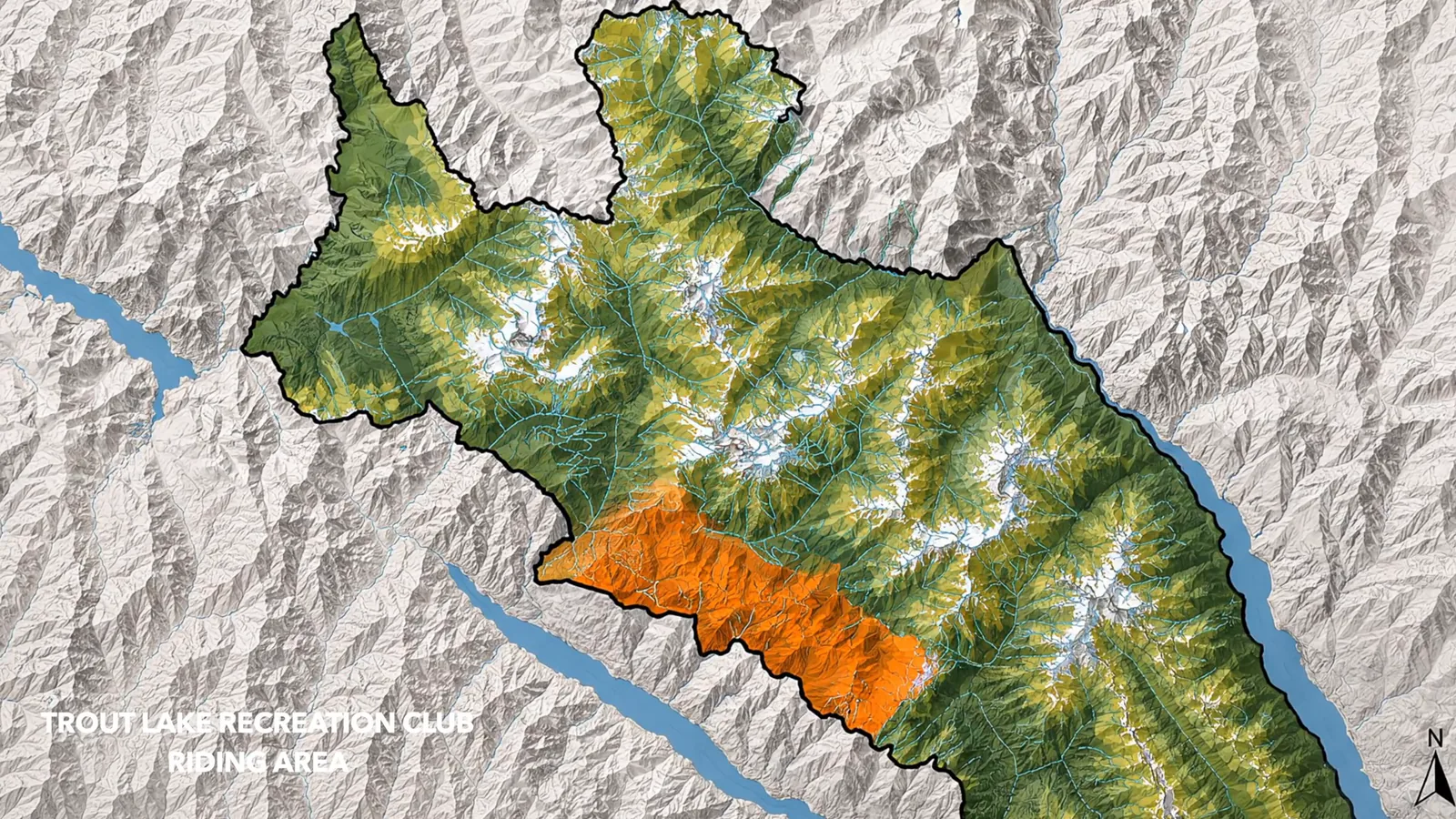
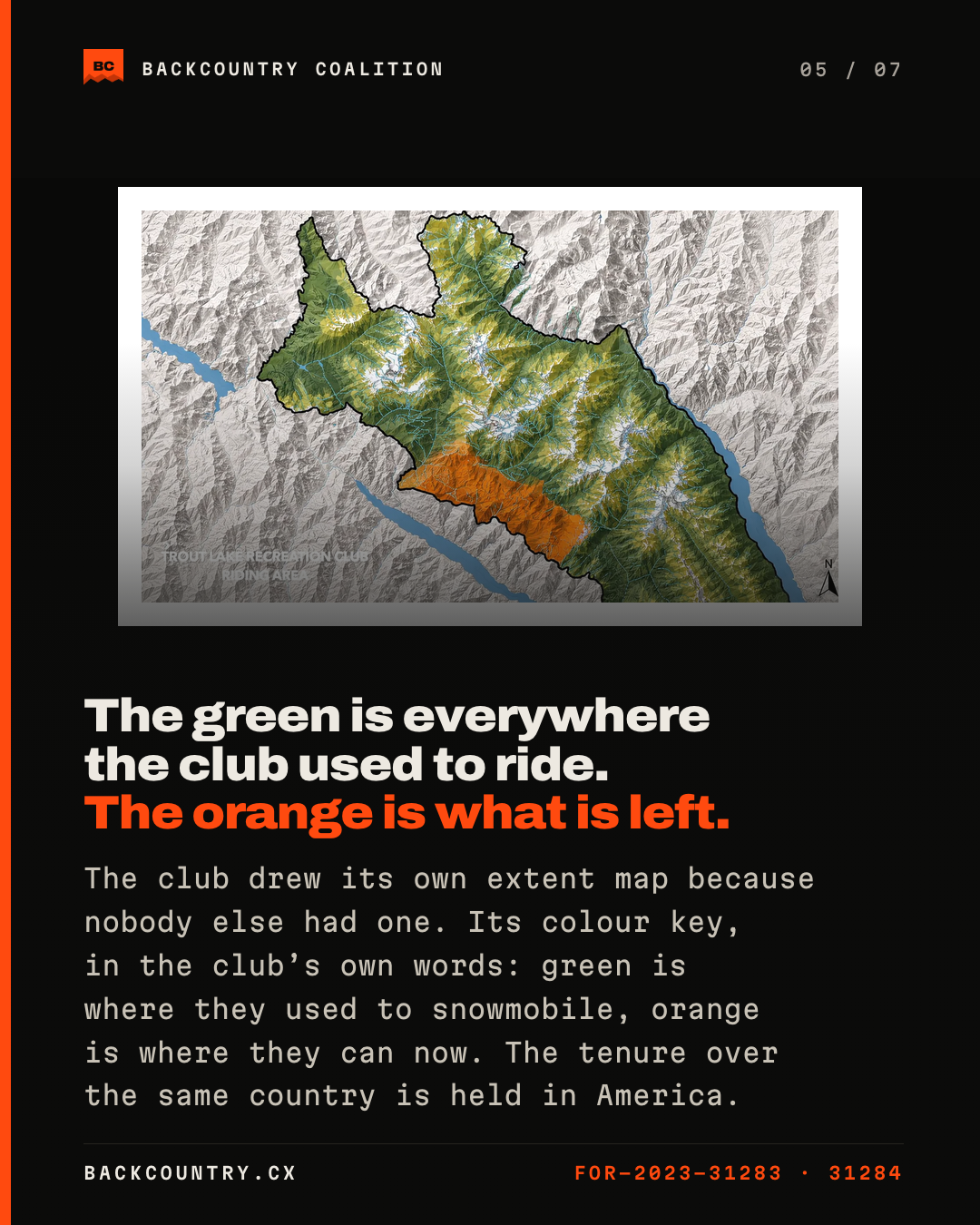
Of that ground, the club says: “We’re down to 95% of our riding area is gone.” That is the club’s own account of its own terrain, and it is the orange wedge above.39
Be clear about who that public is. The plan does not describe a crowd from the city. It names Trout Lake, the village at the head of the lake of that name, and it names the clubs those riders belong to, the Nakusp Snowmobile Club and the BC Snowmobile Federation. It does not name the club that actually rides there.03 These are rural communities in the Kootenay Boundary region, and the activity being described is how people there spend a winter.
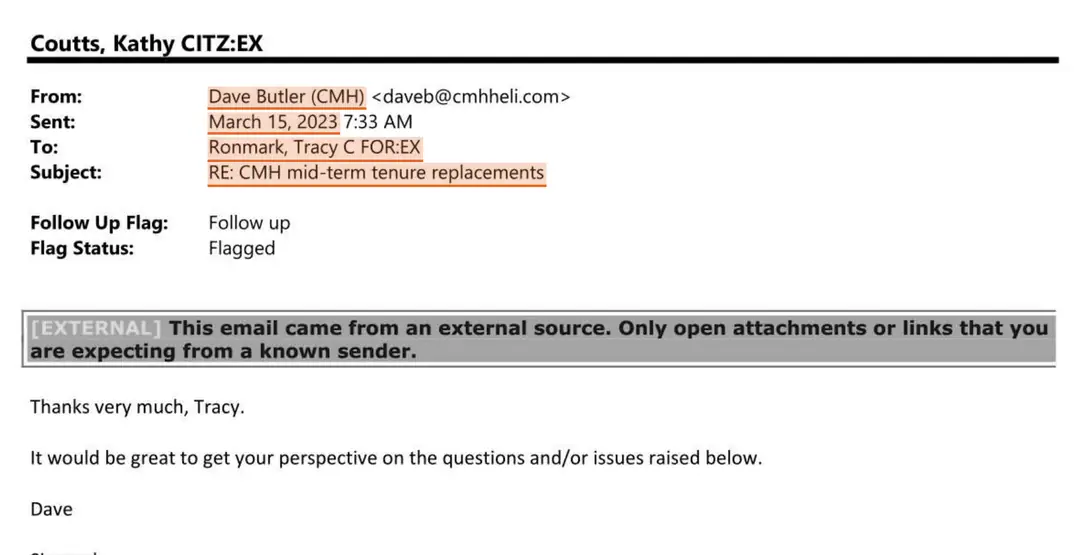
The third place is a letter, and the titles in it matter. CMH’s correspondent is Dave Butler, RPF, RPBio, Director of Sustainability, CMH Heliskiing and Summer Adventures. The Province’s is Tracy Ronmark, MRM, P.Ag., Director of Authorizations, Kootenay Boundary Region, Ministry of Forests — the region that contains Trout Lake. The subject line is CMH mid-term tenure replacements. Inside the thread sits Ronmark’s letter of 9 November 2022 with CMH’s replies interleaved paragraph by paragraph, which the covering emails record as sent back on 28 November 2022.07
The release runs newest first. Start at the header, which establishes who is writing, to whom, and about what.
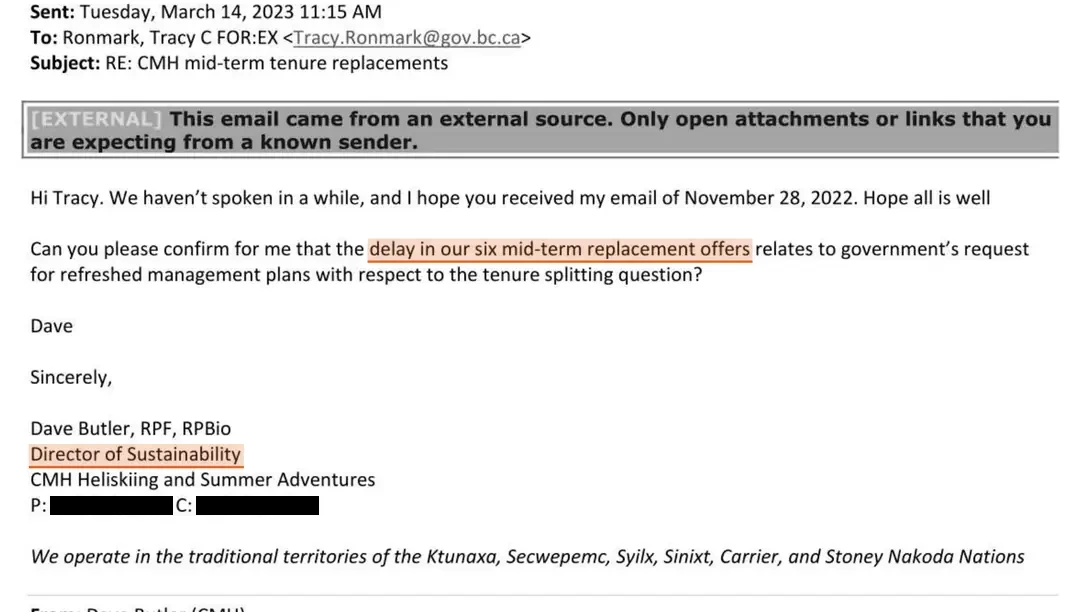
The next page is Butler chasing the file the day before. It puts the number of tenures in play on the record, and names the submission quoted below.
That November submission runs for pages, answering the Ministry of Forests point by point in italics on tenure term, caribou conditions and flight data. Two pages in, listing what CMH was contending with, it reaches public recreation: “growing unmanaged public recreation (which is creating both safety and experiential issues for us)”.05
This is how it ends.
Those three scans are pages out of one thread. Set out as fields, it is an ordinary piece of business correspondence, and that is exactly what makes it worth reading: a named officer of an American-owned company writing to a named official of the Ministry of Forests, about six licences she was in the middle of deciding, naming a village.
Writing to a statutory decision maker about the file she is deciding is lawful, ordinary, and what a tenure holder is entitled to do. The volunteer club on the other side of the ridge had no equivalent way of doing it.
The position does not appear in public. What CMH’s sustainability lead has said on the record runs the other way: in January 2018, in a letter to Nakusp village council reported locally, he said he was “very concerned for tourism businesses like ours, I’m very concerned for other natural resource-based businesses (forestry, mining, etc), for public recreation and communities like Nakusp”. The nearest published remark on public use inside a tenure is from 2019, about mountain bikes: “I think the question should be whether or not mountain bikes should be permitted at all in the alpine, and if so, where and when?”38
An American-owned company told the Government of British Columbia that the people of Trout Lake are what is wrong with Trout Lake. It said so in the document asking to keep the ground under them for another forty-five years. It got the forty-five years. The village was never sent a copy, and has still not been written to.
Section 07CMH holds no lobbying registration. HeliCat Canada, which it helps govern, does
There is a second organisation in the record and it is a different kind of thing. Canadian Mountain Holidays is an operator and holds tenure. HeliCat Canada Association is an industry association and holds none. The lobbying registry filings and the two consultant lobbyists retained belong to the association. None of them is attributed to the operator here.
The association describes itself as “the trade association of the Canadian helicopter and snowcat skiing industry”, and the British Columbia corporate register carries HELICAT CANADA ASSOCIATION as a society, registration S0041170.36
Four connections between the two organisations are published, each by somebody other than us.
Every CMH management plan in the release adopts the association’s standards. The Galena plan: “CMH Galena operates in a manner that is in accordance with the operation guidelines set out by HeliCat Canada.” The same sentence, with the area name changed, appears seven times in the file.10
Every plan also records an expired memorandum between the Province and the association, which the Province says “has not been renewed due to failed negotiations with HCC.”1011
The association’s own governance pages name the operator. Its heliskiing members page states “Businesses listed on this page are legal members of HeliCat Canada” and the list includes “CMH Heli-Skiing & Summer Adventures”. Its executive page lists, as Secretary / Treasurer, Carl Trescher (CMH Heli-Skiing & Summer Adventures), and under Helicat Contractor — Contractor - Industry Specialist, Dave Butler — the same name as the CMH correspondent in Section 06. We read both pages on 27 September 2026.36
And in May 2024 CMH and HeliCat Canada went to the Minister together. That one is a government record.
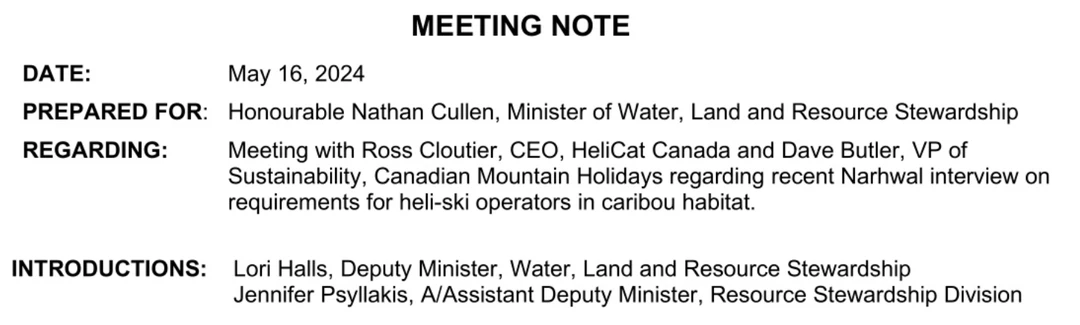
CMH is a member of HeliCat Canada, sits on its executive, operates to its guidelines by its own filings, and went to the Minister alongside HeliCat’s chief executive. Those are the published facts, and they are the two organisations’ own.
On public recreation the association’s published record is cooperative. Its sustainability page states: “Sharing the landscape with others is our responsibility. We need to maintain relationships with stakeholders and communities to ensure welcome access to the landscape in which we operate.” Its one dedicated article on the subject, from June 2017, records that “HeliCat Canada entered into a Memorandum of Understanding in 2013 with the BC Snowmobile Federation and the Association of BC Snowmobile Clubs”.36
Where the record is adversarial is caribou and flight data, and there the Province is doing the describing.
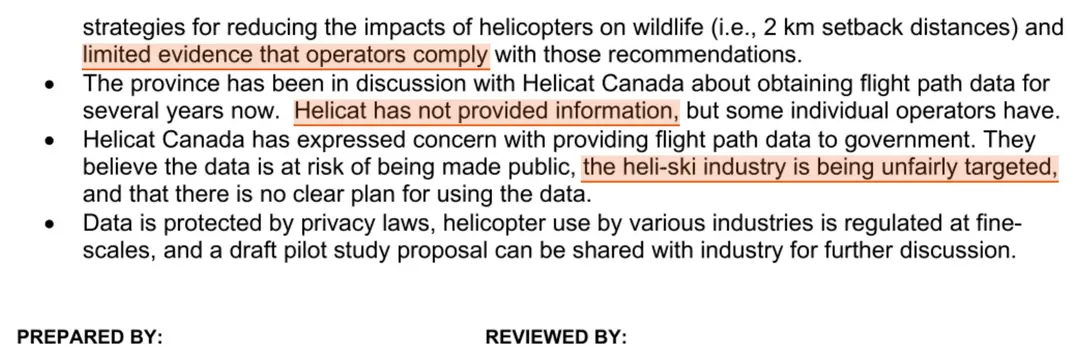
Three years earlier, a briefing note approved by the Deputy Minister of Forests put the same standoff in the government’s own words, and confirmed which statute these tenures sit under.
DATE: February 1, 2021 · PREPARED FOR: John Allan, Deputy Minister
A number of prominent BC industry sectors (such as forestry and mining) have taken steps to improve their operations to support caribou recovery. The lack of similar improvements from the adventure tourism sector, who carry out extensive helicopter-supported commercial recreation activities on Crown land under the Land Act, diminishes the credibility of provincial efforts to recover caribou.
Tenures for adventure-guiding on Crown land in BC are issued under the Wildlife Act (for angling and hunting only), the Park Act or the Land Act.
• HCC, who has historically resisted requests to voluntarily supply GPS flight data, may resume lobbying efforts to block these changes, but recent meetings with industry representatives indicate an understanding and willingness to work with government to implement the measures.
Approved · John Allan, Deputy Minister · 2021.02.10
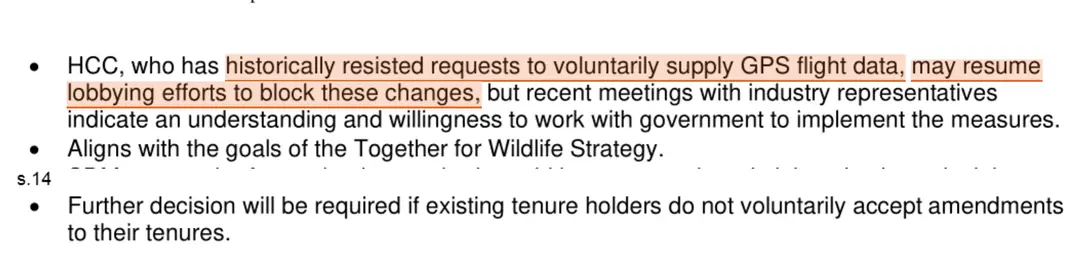
Before the numbers, the line between the two. CMH holds no lobbying registration of its own, and it does not need one. Carl Trescher of CMH Heli-Skiing & Summer Adventures is the association’s Secretary / Treasurer, and Dave Butler — the man who wrote the letters in Section 06 — sits on its contractor listing. On 16 May 2024 the association’s chief executive and CMH’s vice-president of sustainability walked into the same ministerial meeting together, and the Ministry wrote both their names on the same line, at . So when the registry records lobbying by HeliCat Canada, it is recording an organisation that CMH helps govern, staffed on this file by CMH’s own people. The tenure is owned in America. The lobbying is filed by the association. It is one room.
The registry is public, and it counts. Every registered organisation files an activity report each time it lobbies a public office holder, and each report carries its own activity number. Set the association that speaks for heli-skiing against the organisations that speak for the people who ride, hunt and drive the same ground, on one retrieval date, and the asymmetry is not a matter of opinion.
Nor is that total a historical accumulation that stopped. Taking the fifty most recent filings and counting them by month gives the shape of the last year.
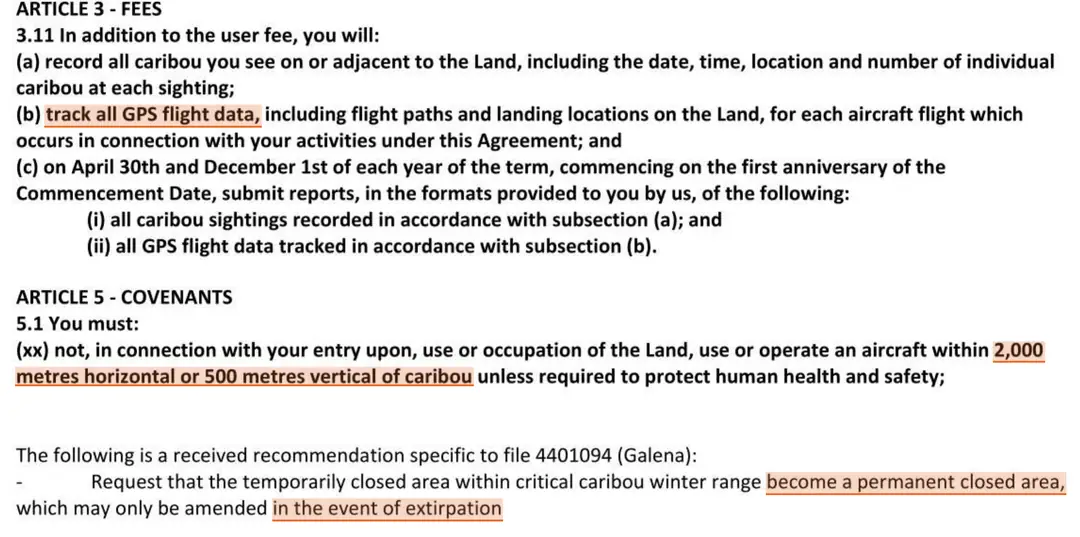
What the Province proposed asking for in return is reproduced above: every caribou sighting recorded, all GPS flight data tracked, reports twice a year, no aircraft within 2,000 metres of caribou — and, for Galena alone, that a temporary closure become permanent.08
Section 08A third of HeliCat Canada’s eleven years of lobbying landed in the last twelve months
British Columbia keeps a public register of lobbying. Every registered contact between a lobbyist and a senior public office holder is filed, dated and numbered, and anyone can search it. The registrations below belong to HeliCat Canada Association, the industry association. None of them belongs to CMH, and nothing in this piece attributes them to the operator.
CMH holds no registration of its own, and not one of the reports counted below is filed in its name. It does not need one. The association that files them lists Carl Trescher of CMH Heli-Skiing & Summer Adventures as its Secretary / Treasurer, and carries Dave Butler — the CMH correspondent in Section 06 — under its contractor listing. On 16 May 2024 the association’s chief executive and CMH’s vice-president of sustainability walked into the same ministerial meeting together, recorded on the same line of the same government note at . The tenure is owned in Denver. The access is held by the association CMH helps govern. It is one room.
We retrieved all three registrations from the registry on 27 September 2026 and counted them ourselves.
The association has been registered since 28 November 2014, under its chief executive, Ross Cloutier. Its stated subject matter includes “BC Parks, Wildlife and related policies and programs as they relate to helicopter and snowcat skiing in BC.” In 2025 it added two consultant lobbyists at the same firm, CSG Canadian Strategy Group LP: Greg D’Avignon, registered 14 July 2025, and Berit Beattie, registered 3 September 2025.41
That total is not a historical curiosity, and the shape of it matters more than its size. The association’s in-house registration has been open since 28 November 2014 — eleven years and ten months. Set everything it has filed in all that time against what it has filed since September 2025, and the answer is the point: 39 of the 115 reports on file — just over a third of eleven years of lobbying — landed in the last twelve months. Those are the twelve months in which the Adventure Tourism Hub was announced, funded with $7.5 million, and thanked for by this association in the Province’s own news release.
D’Avignon’s registration answers two questions on its face. Asked “Will the consultant lobbyist be arranging meetings between a public office holder and the client for the purpose of attempting to influence any of the matters listed” — Yes. Asked whether the consultant has lobbied or plans to lobby a member of the Legislative Assembly, “including a Minister or Premier”, on behalf of this client on or after 21 September 2024 — Yes.41
The lobbying registry shows that the HeliCat Canada meetings happened. It does not show what was said in them. For that there are the documents, and they are the ones above.
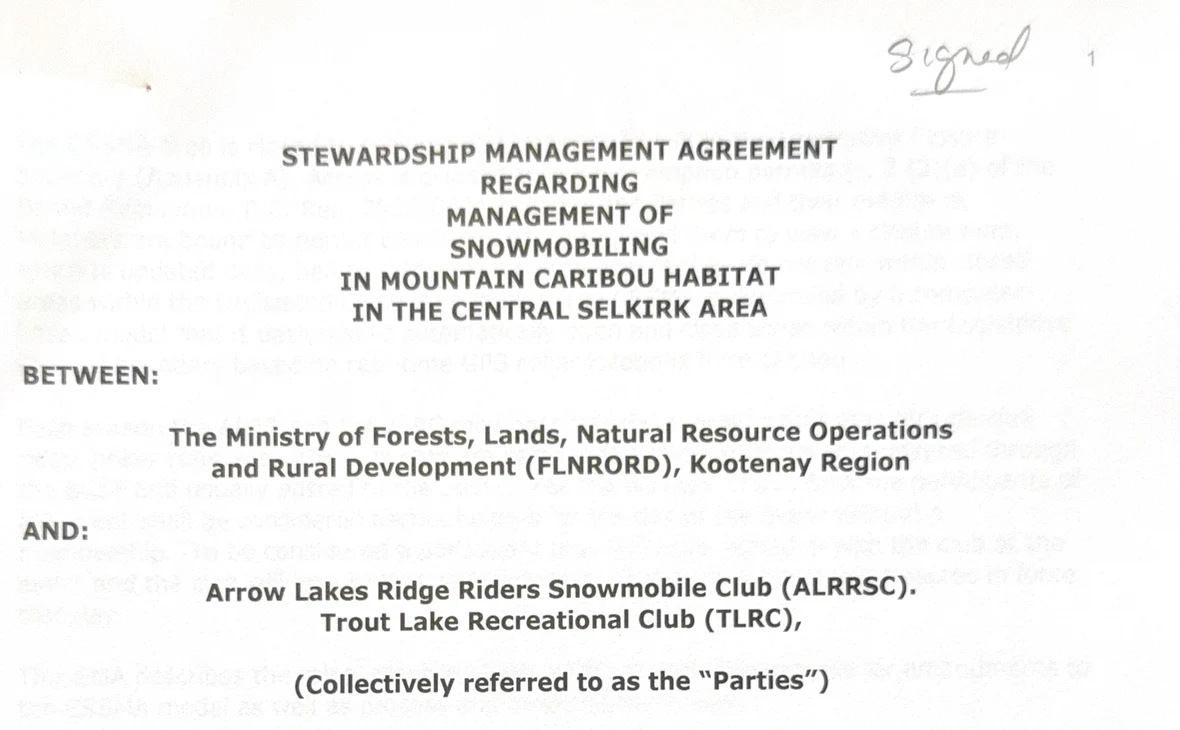
Set that beside the other party on this terrain. The Trout Lake Recreational Club maintains the road, holds a Wildlife Act permit and signed the Stewardship Management Agreement at . It retains no lobbyist, and it was on neither notification list.
Section 09Every time Selkirk District wrote about the Rady Creek road, CMH was on the list. The Trout Lake club never was
On the Trout Lake–Rady Creek forest service road, the record shows what the Province told the operator. It does not show what the Province did with what the operator told it.
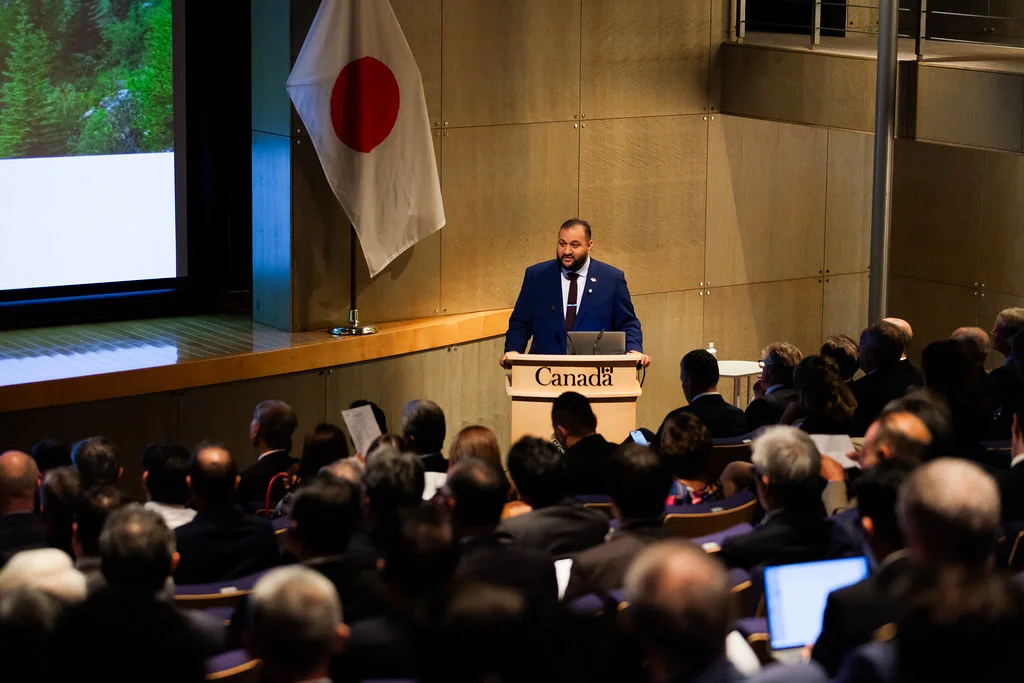
Ravi Parmar
Minister of Forests. The Selkirk Natural Resource District, whose notifications are set out below, is an office of his ministry. On 18 September 2026 he said of the United States: “This is how we win against the United States.” The commercial recreation tenures in Section 04 are administered by a different ministry, Water, Land and Resource Stewardship, under Minister Randene Neill.43
The Ministry of Forests on both sides of this file
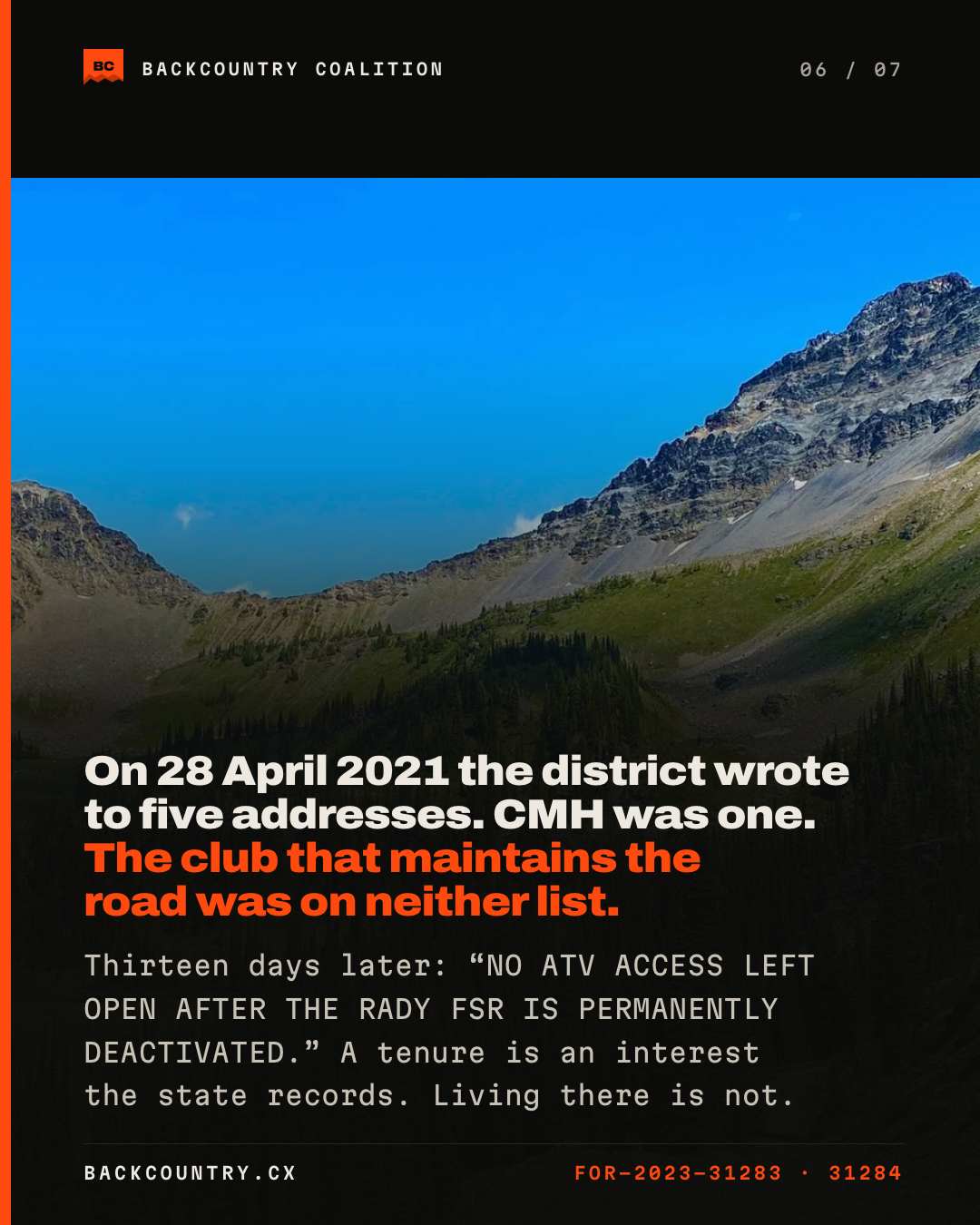
On 28 April 2021 the Selkirk Natural Resource District wrote to five addresses outside government about the permanent deactivation of that road, and said “Every effort will be made to maintain ATV access on the Rady Forest Service Road section.” Thirteen days later, on 11 May 2021, it wrote to those five and one more: “it has been decided that there will be NO ATV ACCESS LEFT OPEN AFTER THE RADY FSR IS PERMANENTLY DEACTIVATED.” CMH was on both lists.28
That is not our inference from a distribution list. One of the five noticed at the time. Two days after the notification went out, the general manager of the provincial ATV association, ATVBC, forwarded it to the Trout Lake Recreational Club herself, and said why: “I received the stakeholder notification below from Tina Zimmerman and noticed you weren’t copied, so forwarding to you.” The club that maintains the Rady Creek road learned it was being destroyed because another recipient passed the letter along.54
Two undertakings preceded the reversal, in two separate documents with two different verbs, and the interval runs from whichever one is quoted. The Consultation Request Intake Form of 27 April 2021 — a form of Kootenay Boundary Region – First Nations Relations, being the district’s request to its own consultation unit that consultation be run — states “Every attempt will be made to maintain ATV access over the FSR and up onto the Silvercup Ridge once the deactivation works are complete.” That is fourteen days before the reversal. The stakeholder email of 28 April states “Every effort will be made…” That is thirteen. We hold page one of the intake form only.29
The district recorded how it built the list. The closing line of the 28 April notification, immediately above the signature block, reads: “Mine claims and water users will be addressed in a separate e-mail.”28 Mineral titles are registered interests in Crown land. Water licences are registered interests. Recreational use is not an interest in anything.
That sorting rule is what the statutes produce. The registry the referral lists are read from is defined by what the Land Act means by a tenure: “any interest in Crown land that is granted or otherwise established under a prescribed instrument”, submitted by a “tenure authority”, which is “a prescribed person”. The public’s own position in that registry is to read it: “the minister must make information in the integrated registry accessible to the public by electronic means”. No provision lets a person who uses Crown land put an interest into it.26 And the Province’s referral page states who a referral reaches: “Referrals are sent to existing tenure holders, government agencies, and invited members of the public.” Tenure holders are on by class. Members of the public are invited, and the page states no route by which a person may ask to be.27
CMH’s own plan said it expected to keep receiving referrals. It was right, and for a reason that has nothing to do with favour: a tenure is an interest the state records, and thirty years on a road is not.
Nothing released to us shows CMH asking for that road to be deactivated, and the word Rady does not appear anywhere in the eighty-five pages.09 It did not have to ask. It was on the list.
Section 10A CMH licence is owed a letter. A Trout Lake resident is owed nothing
The asymmetry in Section 09 is not a local habit. It is what every relevant instrument in British Columbia law produces, and the pattern is legible in a single table.
| Instrument | What it requires | Who is owed it |
|---|---|---|
| FPPR s. 84 | “At least 48 hours before commencement of road construction or deactivation in a community watershed, a person must notify affected water licensees or affected water purveyors.” | Water licensees and water purveyors. The only pre-deactivation notice duty in the regulation, and it runs to holders of a licence |
| FRPA s. 22.2(3)(a) | In the circumstances of s. 22.2(2), the district manager “may (i) close the road or restrict its use” | No notice requirement is stated. The power to close carries no duty to tell anybody |
| FRPA s. 58(3) | “The minister must post a notice of an order under subsection (1) in the area to which the order applies.” | The public, but only for an order restricting or prohibiting recreational use |
| Land Act ss. 32(2), 33.1(1) | An accepted application for a disposition “must” be published on a publicly accessible website, and “Before a disposition is made, a person may provide comments to the minister” | Any person — on the instrument the operator was applying for. There is no equivalent before a road is deactivated |
Every row was read against the King’s Printer consolidations, current to 22 September 2026.3031333435
Any person may comment before the Crown grants a forty-five-year licence over 116,704 hectares. No person has any equivalent right before the Rady Creek road that reaches it is destroyed.
Instruments that lawfully close terrain to public snowmobiles do exist: an order under section 58 of the Forest and Range Practices Act, or a closure scheduled under the Motor Vehicle Prohibition Regulation. Both are made in public, by an official who signs them, against a map anyone can read. A commercial recreation licence of occupation is neither of them.37
The Province’s own forest watchdog wrote this down eleven years ago. The Forest Practices Board, in special report FPB/SR/49 of April 2015: “There is no legal requirement to notify the public about changes in access”, and “there is no formal avenue for appealing the decision to deactivate a road.” Its own footnote states the distinction exactly: “In some cases parties other than the general public must be notified.” Its third recommendation asked government to require timely notification to non-industrial users. On 13 July 2016 the Board’s chair recorded the answer: “We are disappointed that government is not adopting our recommendations… We will now consider this filed closed.”2425
Its first recommendation asked government to bring Land Act sections 93.1 and 93.3 into force, to set access objectives “that could apply to everyone; all industries and the public.” In the consolidation current to 22 September 2026, Part 7.1 still reads “93.1-93.3 [Not in force.]”35 A reader can check that in under a minute.
CloseThe land is British Columbia’s. The paper is American
Who are CMH. A British Columbia limited partnership, LP0604337, trading as CMH Heli-Skiing & Summer Adventures. It was a subsidiary of Intrawest, the New York–listed resort company, and it changed hands in a takeover valued at approximately $1.5 billion including debt, completed on 31 July 2017 by a joint venture of KSL Capital Partners, LLC and Henry Crown and Company. On 11 January 2018 that venture named itself Alterra Mountain Company, of 3501 Wazee Street, Denver, Colorado. It is the largest operator of its kind in this province, and in the file the Province released it holds six commercial recreation tenures over 7,321 square kilometres of British Columbia Crown land.
Why did they tell the Province that public recreation is a problem. Because public use of that terrain reduces what the operator can sell, and because there was a named official to tell. The Director of Authorizations for the Kootenay Boundary Region was adjudicating six licence replacements worth forty-five years each. A tenure holder may write to her, and this one did — listing the snowmobilers of Trout Lake among the cuts in “a death by a thousand cuts.”
Every one of those licences is the Province’s standard non-exclusive instrument, and the policy governing it says in terms that it “does not allow the Tenure holder to restrict public access over the licence area.” The operator wrote that acknowledgement into all six plans itself. In the same plans it recorded the ground it can no longer ski, and named the town whose residents are on it.
A Denver holding company cannot close British Columbia’s backcountry. It can tell the Province that the people already there are the problem — and of the two, it is the one with an address on the file.
CMH never had to ask for the Rady Creek road to go. It was on the list. The riders were not.
And the reason it was on the list is not a favour, a meeting or a phone call. It is a licence. A tenure is an interest in Crown land, and the machinery of this province is built to find interests in Crown land and write to whoever holds them. It found CMH because CMH holds one.
It did not find the Trout Lake club, because there was nothing there to find. Maintaining the Rady Creek road is not an interest. Holding the permit is not an interest. Signing the agreement is not an interest. Living there is not an interest.
Nothing here required anyone to break a rule. That is the point. The state records interests, and consults the people who hold them. A licence held through a general partner beneath a Denver holding company is an interest. Living in Trout Lake is not.
On 10 March 2025 the Premier stood up to warn that Canada would be forced into becoming the fifty-first state, said it would never happen, and said elbows up. The measure he announced that day was that British Columbians might try an Okanagan wine instead of a Napa one. Four years earlier his ministry had written twice about the Rady Creek forest service road to a company held through a Denver holding company, and not once to the Trout Lake club that rides it.
Nobody in Washington took the Rady Creek road. It was signed away here, in writing, by the government now campaigning on the danger of American takeovers.
And there is a phrase for what that is like, which we did not write. CMH’s director of sustainability told the official who decides CMH’s licences that public recreation was inflicting “a death by a thousand cuts” on the company. CMH then received six licences of occupation over 7,321 km² of Crown land, for forty-five years. CMH kept its terrain and its tenure. Trout Lake, the village it named, lost the Rady Creek road.
An American company told this government that the people of Trout Lake were a death by a thousand cuts. The government gave it forty-five years and 7,321 km² of British Columbia. Then it went to the election warning us about Americans.That should make you absolutely furious.
Share this story
Seven images carrying the CMH story on their own — the page, the letter and the two lists. Made to be posted.


Slide 1 of 7
Suggested caption
Canadian Mountain Holidays is a British Columbia limited partnership owned through a holding company in Denver, Colorado, assembled in a takeover valued at approximately $1.5 billion in 2017. It holds six commercial recreation tenures over 7,321 km² of Crown land.
None of those licences lets it restrict public access. The Province’s own Adventure Tourism policy says a licence of occupation “does not allow the Tenure holder to restrict public access over the licence area,” and CMH wrote that acknowledgement into all six of its plans itself.
It told the Ministry of Forests that public recreation is “a death by a thousand cuts” — and named the recreation: “unregulated snowmobile use from Trout Lake.” Trout Lake is a village in the Kootenays. The people described in that sentence live there.
On 28 April 2021 the Selkirk Natural Resource District wrote to five addresses about the permanent deactivation of the Trout Lake–Rady Creek forest service road. Thirteen days later it wrote to those five and one more to withdraw the ATV access it had promised. CMH was on both lists. The Trout Lake Recreational Club — which maintains the road, holds the Wildlife Act permit and signed the caribou stewardship agreement — was on neither.
The land is British Columbia’s. The paper is Denver’s. Only one of them gets a letter.
backcountry.cx/editorials/who-are-cmh/
#BCpoli #PublicLand #Kootenays #TroutLake
Sources
- ↩↩↩CMH Galena Heli-ski Management Plan, 15 July 2020 — title page and § 1–2.1, released as pages 33 and 34 of 85 in response package FOR-2023-31283. Title page: “MFLNRO File Number: 4401094 · Adventure Tourism (Heli-skiing) Management Plan for CMH GALENA · Canadian Mountain Holidays LP”, with the licensee’s block completed — “Dave Butler”, Date: July 15, 2020 — and the facing block, “This Management Plan has been approved by MFLNRO”, left blank as to both signature and date in the released copy. Page 34: “Canadian Mountain Holidays LP (LP0604337) is a well-established adventure tourism business that has been in operation for nearly 60 years”; “This is an up-date of the management plan approved by government in December of 2003 and is the key component in our request to replace — as per policy - the existing License of Occupation (#340826) for an additional 45-year term”; “The subject operating area… is located north, east and south of Trout Lake in the Badshot Range of the Selkirk Mountains”; “The tenure covers 1167.44 sq km.” Every page of the plan carries the footer “CMH Galena — Heli-ski Management Plan — July 15, 2020” and the stamp “Page N of 85 FOR-2023-31283”, so the page citations in this piece are the release’s own. https://docs.openinfo.gov.bc.ca/Response_Package_FOR-2023-31283.pdf
- ↩↩Same plan, § 2.2 ski-zone table, Silver Cup zone — FOR-2023-31283 page 36 of 85. The zone is recorded at 46.91 km² with 22 runs: “This is a new zone — previously part of the Lardeau Zone - that includes a series of runs in and around Silver Cup Ridge. With one exception, these are generally north-facing runs that lie directly south of the lodge. While ski-able in many snow and weather conditions, they are becoming increasingly affected by (and less useable as a result of) unregulated snowmobile use from Trout Lake. Issues with respect to mountain caribou are detailed in sections below.” The table’s own total for the thirteen zones is 1167.44 km². is a shot of that row.
- ↩↩↩Same plan, § 7.1 Public Use and Access — FOR-2023-31283 page 40 of 85. Reproduced as . Opening sentence: “Our operations do not restrict public access in any way, and our use of the helicopter allows us to utilize many areas that are not readily accessible to the general public.” The same section records that “the Ministry of FLNRO also manages public recreation on Crown land in the operating area, to a limited degree”; that “CMH is aware that public recreationists can (do) use this road” — the Lardeau FSR; that “there is now an increasing amount of snowmobile use of the area, particularly in the vicinity of Silver Cup Ridge. There are some areas that we can no longer ski due to the snowmobile traffic”; and that CMH “will continue to work with the Nakusp Snowmobile Club and the BC Snowmobile Federation on ways to resolve these issues, and to report acts of non-compliance to government.” The same page records that “CMH Galena operates in a manner that is in accordance with the operation guidelines set out by HeliCat Canada.” The characterisation of the two quoted sentences as a request that something be done about public use is this publication’s reading, and is presented as such in Section 06.
- ↩Same plan, § 7.3 Other Commercial or Public Recreation Interests — FOR-2023-31283 page 41 of 85. “As per the Adventure Tourism policy, we recognize that we do not have exclusive use of this area, but we expect that MFLNRO / FCBC will ensure that other AT proposals that may be made in the area will be compatible with our operations. We also expect to continue to receive referrals for any new AT or public recreation (non-profit) applications that may be made in or adjacent to the area in the future.” The same acknowledgement of non-exclusivity appears eight times across the release, at pages 15, 23, 31, 41, 50, 58, 73 and 82, with small wording variations between plans; the Bobbie Burns version at page 73 adds that compatible proposals should “have our agreement” before acceptance.
- ↩CMH to the Director of Authorizations — FOR-2023-31283 page 4 of 85. “… this also comes at a time when we are also dealing with the uncertainties of a range of wildlife issues, growing unmanaged public recreation (which is creating both safety and experiential issues for us), along with other issues such as old growth deferrals (which impacts our ability to manage our access to existing ski terrain).” Recorded caution: pages 3 to 6 are a threaded document in which Ronmark’s letter of 9 November 2022 carries CMH’s replies interleaved, and at least one further sentence on page 4 reads as the Ministry’s rather than the company’s. Only paragraphs whose authorship is unambiguous from the surrounding text are quoted.
- ↩↩Same document — FOR-2023-31283 page 6 of 85. “Tracy — thanks for taking the time to read this. I’m sure you get a sense of the deep frustration and concern we feel. On almost every front — tenure term, wildlife issues, lack of management of public recreation, and even the old growth deferrals (which is another example of unintended consequences...), we — as a company and as a sector -- are facing a death by a thousand cuts. With no one in government acting as an advocate or even as a coordinator of the various challenges facing us, we are left to battle each one, silo by silo, by ourselves.” And: “I hope that you will consider all of this information in your decisions around our tenures --- not just what you receive from your government colleagues.”
- ↩↩↩The email thread establishing who was writing to whom — FOR-2023-31283 pages 1 to 3 of 85. Butler to Ronmark, 15 March 2023, 7:33 AM, subject “RE: CMH mid-term tenure replacements”, signed “Dave Butler, RPF, RPBio · Director of Sustainability · CMH Heliskiing and Summer Adventures”. Ronmark’s block on page 2: “Tracy Ronmark, MRM, P.Ag. · Director of Authorizations · Kootenay Boundary Region · Ministry of Forests”. Butler, 14 March 2023: “I hope you received my email of November 28, 2022” and “Can you please confirm for me that the delay in our six mid-term replacement offers relates to government’s request for refreshed management plans…” The underlying letter is Ronmark’s of 9 November 2022, 1:23 PM, subject “Follow up from meeting of Oct 6”. Discrepancy noted and unresolved: CMH refers throughout to six mid-term replacements; the Ministry’s letter of 17 February 2022 at source 08 lists five land files.
- ↩↩Lauren Knowlan, Authorizations Specialist, to CMH, 17 February 2022 — FOR-2023-31283 pages 84 and 85 of 85. “First Nations consultation and Agency Referrals have now concluded and include recommended conditions which I will consider as I work through the adjudication of these files.” The proposed licence language quoted in Section 07 is Article 3.11(a)–(c) and Article 5.1: record all caribou sightings; “track all GPS flight data, including flight paths and landing locations on the Land”; report on 30 April and 1 December each year; and “not… use or operate an aircraft within 2,000 metres horizontal or 500 metres vertical of caribou unless required to protect human health and safety”. And: “The following is a received recommendation specific to file 4401094 (Galena): - Request that the temporarily closed area within critical caribou winter range become a permanent closed area, which may only be amended in the event of extirpation”. The letter names the files under adjudication as “Land Files 4401957, 4401094, 400690, 4496099 and 44096100” — five, and two of those strings appear to carry typographical errors in the original.
- ↩↩The six management plans in FOR-2023-31283, and their stated areas. Title pages at release pages 8 and 43 (CMH Gothics, LWBC file 4400690), 17 and 25 (CMH Adamants, MFLNRO 4401957, two dated versions), 33 (CMH Galena, MFLNRO 4401094), 52 (CMH Monashees, LWBC 4496099), 61 (CMH Revelstoke, MFLNRO 4496100) and 75 (CMH Bobbie Burns, MFLNRO 4492084). Zone-table totals at release pages 46 (1,249.29 km²), 20 (1,050.40), 36 (1,167.44), 54 (1,487.53), 66 (1,313.79) and 78 (1,052.63). The sum, 7,321.08 km², is our addition of those six printed figures. It does not match the 7,349 km² published at saverady.com §06; the difference of about 28 km² is unreconciled, and the page-by-page table in Section 04 should be preferred. Verified negative: the word “Rady” does not appear anywhere in the 85 pages.
- ↩↩The HeliCat Canada guideline and memorandum references in the CMH plans — FOR-2023-31283. “CMH Galena operates in a manner that is in accordance with the operation guidelines set out by HeliCat Canada” — page 40; the same sentence, with the area name changed, appears at pages 14, 22, 30, 49, 57 and 72, seven occurrences in all. “While we fully comply with the MOU between the Province of BC and HCC (which has expired), we will continue to comply with provincial-level approaches as they are developed between government and HCC” — page 41; the same statement, with the association’s name written out in some copies and abbreviated in others, appears at pages 16, 24, 32, 51, 59 and 74.
- ↩↩↩Ministry of Forests, Lands, Natural Resource Operations and Rural Development, Briefing Note for Decision, CLIFF 260639 — response package FOR-2023-31284, release pages 5 to 7 of 21, being pages 1 to 3 of 5 of the note. The note’s own DATE field reads “February 1, 2021”; it is prepared for John Allan, Deputy Minister, and carries “Approved” against his name dated 2021.02.10. Prepared by Michelle Porter, Director, Lands Branch, and Darcy Peel, Director, Caribou Recovery Program. Source for: “The lack of similar improvements from the adventure tourism sector, who carry out extensive helicopter-supported commercial recreation activities on Crown land under the Land Act, diminishes the credibility of provincial efforts to recover caribou”; “HeliCat Canada (HCC) voluntarily committed their members to conduct training and monitoring in caribou habitat through a Memorandum of Understanding which expired in 2017, but this has not been renewed due to failed negotiations with HCC”; “Tenures for adventure-guiding on Crown land in BC are issued under the Wildlife Act (for angling and hunting only), the Park Act or the Land Act”; and “HCC, who has historically resisted requests to voluntarily supply GPS flight data, may resume lobbying efforts to block these changes, but recent meetings with industry representatives indicate an understanding and willingness to work with government to implement the measures.” Passages withheld on the released pages are marked with section references including s. 13 and s. 14. https://docs.openinfo.gov.bc.ca/Response_Package_FOR-2023-31284.pdf
- ↩↩↩Ministry of Water, Land and Resource Stewardship, Meeting Note, CLIFF 41323, 16 May 2024 — response package WLR-2024-41783, 2 pp. Prepared for the Hon. Nathan Cullen; reviewed by Deputy Minister Lori Halls and A/Assistant Deputy Minister Jennifer Psyllakis on 17 May 2024; prepared by Tyler Muhly, Manager, Terrestrial Habitat. The REGARDING field reads “Meeting with Ross Cloutier, CEO, HeliCat Canada and Dave Butler, VP of Sustainability, Canadian Mountain Holidays regarding recent Narhwal interview on requirements for heli-ski operators in caribou habitat” — the misspelling is the Ministry’s. Source also for: “Other industries (e.g., mining and forestry) are required to abide by timing windows and setback distances… These industries also provide detailed spatial data on their operational activities”; “Data for the pilot study will be provided by heli-tourism operators on a voluntary basis and as a condition of some tenures”; “limited evidence that operators comply with those recommendations”; “The province has been in discussion with Helicat Canada about obtaining flight path data for several years now. Helicat has not provided information, but some individual operators have”; and “Helicat Canada has expressed concern with providing flight path data to government. They believe the data is at risk of being made public, the heli-ski industry is being unfairly targeted, and that there is no clear plan for using the data.” https://docs.openinfo.gov.bc.ca/Response_Package_WLR-2024-41783.pdf
- ↩British Columbia corporate registry data, retrieved 27 September 2026. Canadian Mountain Holidays Limited Partnership, registration LP0604337, status active, home jurisdiction British Columbia; and Canadian Mountain Holidays GP Inc., registration BC0965475. LP0604337 is the number printed by the licensee itself at page 34 of FOR-2023-31283, so this is a cross-check rather than an independent discovery. Not established: whether the registration date on that record is the partnership’s formation date or the date of the record in the present registry system; no paid corporate search was obtained. “CMH Heli-Skiing & Summer Adventures” is not a registered legal name and is used here only as a trade name. No record was found for “Canadian Mountain Holidays Inc.”, and that form is not used. https://www.orgbook.gov.bc.ca/entity/LP0604337
- ↩Intrawest Resorts Holdings, Inc., Form 10-K, Exhibit 21.1 — List of Subsidiaries, filed with the United States Securities and Exchange Commission 23 September 2014, CIK 0001587755. Lists, with jurisdictions, “Canadian Mountain Holidays Limited Partnership” (British Columbia), “Canadian Mountain Holidays GP Inc.” (British Columbia) and “Alpine Helicopters Inc.” (federally chartered). A sworn securities filing naming the same two British Columbia entities as the corporate register is the strongest corroboration available for the legal identity. https://www.sec.gov/Archives/edgar/data/1587755/000114036114036337/ex21_1.htm
- ↩Alterra Mountain Company, privacy policy, retrieved 27 September 2026 (page states UPDATED: December 2025). Enumerates “Alterra Mountain Company, its subsidiaries, including… CMH Heli-Skiing & Summer Adventures…” and gives the company’s address as 3501 Wazee Street, Suite 400, Denver, CO 80216. Alterra’s current corporate boilerplate describes the company as headquartered in Denver and lists “CMH Heli-Skiing & Summer Adventures and Mike Wiegele Helicopter Skiing in British Columbia” among its destinations. https://www.alterramtn.co/en/privacy-policy
- ↩CMH’s own newsroom, 30 August 2021. “CMH Heli-Skiing & Summer Adventures, which is owned by Alterra Mountain Company, will fold Purcell Heli-Skiing’s business and ski tenure into its existing operations.” The corresponding Alterra release of 31 August 2021 states that Purcell “will be incorporated into Alterra’s CMH Heli-Skiing & Summer Adventures, adding nearly half a million acres” and describes the acquisition as including “a tenure license for 495,000 acres… in Golden, British Columbia”. https://stories.cmhheli.com/heli-skiing/news-winter/introducing-cmh-purcell/
- ↩Intrawest Resorts Holdings, Inc., Form 8-K exhibits, 10 April 2017 and 31 July 2017. The April filing is headed “Intrawest Resorts Holdings, Inc. to be Acquired by Affiliates of Aspen Skiing Company and KSL Capital Partners” and records “$23.75 in cash for each share of Intrawest common stock, representing a total valuation of approximately $1.5 billion including debt obligations”; its “About Intrawest” text describes an adventure travel business “the cornerstone of which is Canadian Mountain Holidays”. The July filing is headed “Affiliates of KSL Capital Partners and Henry Crown and Company Complete Transactions to Combine Three Major Resort Companies” and records completion of the acquisition on that date. Noted and not resolved: the April filing names Aspen Skiing Company, L.L.C. and the July filing names Henry Crown and Company, and neither document states the relationship between them; this piece therefore names only what each filing names. https://www.sec.gov/Archives/edgar/data/0001587755/000156761917001545/s001803x2_ex99-1.htm
- ↩Alterra Mountain Company founding release, 11 January 2018, subtitled “Formed by Affiliates of KSL Capital Partners and Henry Crown and Company”, describing “a community of 12 iconic year-round destinations, including the world’s largest heli-ski operation” and listing “CMH Heli-Skiing & Summer Adventures in British Columbia”. Not established: current ownership percentages, and whether the structure changed following a reported continuation vehicle for Alterra in 2024. No present-tense ownership share is stated in this piece. https://www.alterramtn.co/en/news/announcing-alterra-mountain-company
- ↩Intrawest Resorts Holdings, Inc., Forms 10-K for the years ended 30 June 2014 (filed 23 September 2014) and 30 June 2016 (filed 8 September 2016). 2014: “CMH has been providing heli-skiing trips for the past 50 years and currently operates in the Purcell, Selkirk, Monashee and Cariboo mountains of eastern British Columbia from 11 lodges, nine of which we own”, and “CMH’s operating area encompasses 3.1 million acres of terrain granted under renewable 10 to 30 year licenses from the government of British Columbia”. The same filing sets out the tenure position: “Pursuant to British Columbia’s Land Act, tenures are issued by the Ministry of Forests, Lands and Natural Resource Operations as Licenses of Occupation or Leases outside park and protected areas, on lands designated as vacant Crown land”; “Detailed management plans and maps are submitted as a foundation for the applications for tenures”; “Most of the tenures that CMH holds are 30 years in length and are renewable at mid-term”; and “the province retains the right not to renew all or a portion of the tenures… when the land is needed for what the province deems to be a ‘higher and better use.’” In that filing the word “exclusive” is used only of Alpine Helicopters Inc. as “the exclusive provider of helicopter services to CMH”; the filing nowhere describes the land tenure as exclusive. 2016: “3.0 million tenured acres of terrain”, the same eleven lodges, and “CMH’s acreage amounts to more skiable terrain than all lift access mountain resorts in North America combined”. https://www.sec.gov/Archives/edgar/data/1587755/000114036114036337/form10k.htm
- ↩The acreage figures do not reconcile, and this is recorded rather than resolved. 3.1 million acres (2014 filing); 3.0 million tenured acres (2016 filing); 495,000 acres added at Golden in 2021 to “more than 3 million acres of existing terrain” (CMH newsroom, 30 August 2021); and current consumer pages still stating three million acres, with the Purcell addition not reflected. Lodge counts differ between sources at eleven and twelve. No single acreage or lodge figure is asserted in this piece. The phrase “exclusive 3 million acre tenure” appears on undated destination-marketing listings for the operator, which we cannot confirm CMH authored; it is not used in this piece.
- ↩Ainslie Cruickshank, “Heli-skiing industry scrutinized over impacts on B.C. caribou”, The Narwhal, 22 January 2024. Describes CMH as “a subsidiary of the Colorado-based Alterra Mountain Company”, as “the largest heli-ski company in B.C.”, and states that it “holds 16 of B.C.’s 49 heli-ski tenures”. Cited as journalism, attributed in the body, and not re-derived by us from the Province’s tenure layer. This is the interview the Ministry’s meeting note of 16 May 2024 refers to. https://thenarwhal.ca/bc-heli-skiing-caribou/
- ↩Land Act, RSBC 1996 c. 245, ss. 38, 39 and 65, King’s Printer consolidation stating “This Act is current to September 22, 2026”. s. 38 (Lease): “The minister may issue a lease of Crown land subject to the terms and reservations the minister considers advisable, including an option to purchase the land.” s. 39 (Licence of occupation): “The minister may issue a licence to occupy and use Crown land, called a ‘licence of occupation’, subject to the terms and reservations the minister considers advisable.” s. 65: a person lawfully entitled to occupy Crown land under a licence of occupation “may, for that land, take proceedings against any person for recovery of possession of, or for trespass to, the interest in the land in the same manner and to the same extent as if the person were the registered owner of the land” — the action protects the interest, and on a non-exclusive licence the interest does not include excluding the public. Neither s. 38 nor s. 39 uses the words “exclusive” or “quiet enjoyment”, and neither mentions public access. The exclusive / non-exclusive distinction is not sourced to the statute in this piece. https://www.bclaws.gov.bc.ca/civix/document/id/complete/statreg/96245_01
- ↩↩↩↩Province of British Columbia, Land Use Operational Policy: Adventure Tourism (Commercial Recreation), file 12150-00, effective February 2015; the cover page is signed by the Assistant Deputy Minister, Reconciliation, Lands and Natural Resource Policy, 9 May 2024, and the amendment table records that the May 2024 change updated the cover page only, with “No amendments to the policy”. § 6.4.1, printed page 16, is reproduced as and is the source of “conveys non-exclusive use for the purpose described” and “does not allow the Tenure holder to restrict public access over the licence area”. § 6.4: “The form of AT Tenure available for guided AT activities on provincial Crown land is a non-exclusive Licence of Occupation for an Extensive Use Area. Leases are not available for guided AT activities.” § 3, definitions: “Public Access refers to the public’s ability/privilege to access provincial Crown land” — hence the wording in Section 05, which claims a limit on the holder’s authority and not a public right; and “once the TMP is approved by the Authorizing Agency, the TMP becomes part of the AT Tenure document”. § 6.1.1: an intensive-use-site licence may, at the decision maker’s discretion, “allow the Tenure holder to restrict public access to specific Improvements identified in the TMP”. Appendix 5: a lease over an intensive use site carries a “Right of exclusive use (‘quiet enjoyment’)”. § 7.1.1: the plan must “Avoid or minimize potential conflicts with other users of Crown land (including the public)”. § 7.1.2: of the risk-management plan, “Acceptance… is not tantamount to approval of the plan and does not represent formal endorsement… it is not attached to and does not form part of the Tenure.” § 7.7.8: the decision maker “will ensure there is diverse, responsible and sustainable growth in both AT and public recreation use on Crown land”, and an applicant “may be required to make reasonable efforts to obtain a JUA with an organized public recreation group”. The plain-language quotations — “A Licence of Occupation conveys non-exclusive use” and the reference to cases where “the B.C. government needs to retain future options and management control over the use of the lands” — are from the Province’s public adventure-tourism tenure page, retrieved 27 September 2026. Not established: whether an individual approved management plan is itself proactively published; what is established is that an accepted application must be published under Land Act s. 32(2), and that advertising is required for licence-of-occupation applications. https://www2.gov.bc.ca/assets/gov/farming-natural-resources-and-industry/natural-resource-use/land-water-use/crown-land/adventure_tourism.pdf
- ↩Forest Practices Board, Special Report FPB/SR/49, Access Management and Resource Roads: 2015 Update, April 2015. Executive summary, page i: “There is currently no agency charged with conducting access planning. There are virtually no proactive legal tools for setting access objectives. There is no legal requirement to notify the public about changes in access…” The same page records that the Ministry “maintains some access on forest service roads that serve communities, rural residences and high value recreation areas, but there is no formal mechanism for public input into that program”; and that “Other users of those roads (commercial interests, the public and First Nations) can have no expectation that access will continue to be provided once the industrial licensee no longer needs the road. Maintaining access created by industry is not the routine responsibility of government.” Recommendation 1: “a regulation bringing into force sections 93.1 and 93.3 of the Land Act, as a way to enable setting and varying of access objectives for a prescribed area that could apply to everyone; all industries and the public.” Recommendation 3: “The Board recommends government require timely notification be provided to non-industrial users of resource roads about pending changes in road status (new construction, changes in maintenance and deactivation).” Section 4.4, page 14: “Notification is the most basic level of public involvement. There is no requirement for any industry to notify the public about the construction or deactivation of a road… A subsequent concern is that there is no formal avenue for appealing the decision to deactivate a road… the only option under FRPA is to deactivate the road.” Footnote 18 to that finding: “In some cases parties other than the general public must be notified. At least 48 hours before commencement of road construction or deactivation in a community watershed, a person must notify affected water licensees or affected water purveyors. The oil and gas industry is required to notify other industrial users and landowners about deactivation of roads – 14 days prior to the event.” The report made six recommendations. https://www.bcfpb.ca/wp-content/uploads/2017/05/SR49-Access-Management.pdf
- ↩Forest Practices Board Chair Timothy S. Ryan, RPF, to Tim Sheldan, Deputy Minister, Ministry of Forest Lands and Natural Resource Operations, file 97350-20-15070, 13 July 2016 — “Re: Government reply to the Forest Practices Board recommendations in the special report Access Management and Resource Roads: 2015 Update.” “We are disappointed that government is not adopting our recommendations but we are hopeful that government has a plan to improve access management and that the initiatives it has underway will be helpful.” “We hope that in five years if we undertake another review of access management, the issues identified in our 2005 report and in our 2015 report will have been resolved.” “We will now consider this filed closed.” Not established: whether the Board has revisited access management since. We found no successor report and do not assert that none exists. https://www.bcfpb.ca/wp-content/uploads/2015/04/SR49-Response-to-Recommendations.pdf
- ↩Land Act, Part 1.1 — ss. 7.1, 7.2 and 7.4, consolidation current to 22 September 2026. s. 7.1 defines “tenure” as “(a) any interest in Crown land that is granted or otherwise established under a prescribed instrument, or (b) a prescribed designation or other status that, under an enactment, is given to, conferred on, or made or otherwise established in relation to Crown land”, and “tenure authority” as “a prescribed person”. s. 7.2(1) requires the minister to maintain “the electronic database known as the Integrated Land and Resource Registry”; s. 7.2(2): “A tenure authority must submit prescribed information in respect of a tenure to the integrated registry”. s. 7.4(1): “Subject to this section, the minister must make information in the integrated registry accessible to the public by electronic means and on conditions satisfactory to the minister.” Verified negative: no provision in Part 1.1 permits a person who uses Crown land to enter an interest in the registry. Source URL as at source 22.
- ↩Province of British Columbia, E-Referral. Source for “Referrals are sent to existing tenure holders, government agencies, and invited members of the public” and “For certain authorizations, it is a legal requirement to notify affected groups or individuals of the proposed authorization.” Not established, and material: the page does not say who decides whom to invite, on what criteria, whether any route exists by which a member of the public may ask to be invited, or which authorizations carry the legal notification requirement. https://www2.gov.bc.ca/gov/content/industry/natural-resource-use/natural-resource-permits/fcbc-locations/e-referral
- ↩↩↩The two stakeholder notifications, Selkirk Natural Resource District, 28 April and 11 May 2021, sent by an engineering technician of the district under the account designation FLNR:EX. The 28 April notification, 11:11 AM, subject “Stakeholder Notification of Permanent Deactivation of Rady Forest Service Road, Trout Lake Area”, went to five addresses outside government and stated “Every effort will be made to maintain ATV access on the Rady Forest Service Road section”; its closing line, immediately above the signature block, reads “Mine claims and water users will be addressed in a separate e-mail.” The 11 May reversal, 4:24 PM, subject “Amendment to Permanent Deactivation works on Rady Forest Service Road, Trout Lake Area”, went to those five and a second private resident, and stated “it has been decided that there will be NO ATV ACCESS LEFT OPEN AFTER THE RADY FSR IS PERMANENTLY DEACTIVATED.” Both are reproduced in full, with recipients, at saverady.com §04 and §07. CMH is on both lists. Not established: which of the two private residents was the address added on 11 May, and neither is named here; and whether the promised separate email to mine claims and water users was ever sent — it is not in anything released to us.
- ↩Consultation Request Intake Form, 27 April 2021, ministry file 11250-30-0321.02, project 71M2707. A form of “Kootenay Boundary Region – First Nations Relations”, addressed internally: the district’s request to its own consultation unit that consultation be run, not the referral and not a stakeholder notice, and this piece does not describe it as either. Source for “Every attempt will be made to maintain ATV access over the FSR and up onto the Silvercup Ridge once the deactivation works are complete”, for the authorization field “District Manager responsible / Forest Service Road”, and for the legislation field listing “Forest Planning and Practises Regulation Sections, 37,38,40,50,54,56,57,59,60,70,82,83,84” — s. 84 among them. We hold page one only, which ends mid-section, and nothing is asserted about its later pages. The form carries no King’s Printer number, and no blank template or second instance was located on the public web. Also not established: whether the road sits in a community watershed, and whether the s. 84 notice was given and to whom.
- ↩Forest Planning and Practices Regulation, B.C. Reg. 14/2004, ss. 82, 83, 84 and 85, King’s Printer consolidation stating “This consolidation is current to September 22, 2026”. s. 84, headed “Notice — road in community watershed”, reads in full: “At least 48 hours before commencement of road construction or deactivation in a community watershed, a person must notify affected water licensees or affected water purveyors.” s. 83 requires a warning sign “At all times while a road is being deactivated”. s. 85 requires an agreement holder to notify the minister before beginning timber harvesting or road construction and does not mention deactivation. The s. 82(1)(a) barricade standard, including the words “other than all-terrain vehicles”, is set out and argued in full at saverady.com §11, and that treatment is the source for it on this page. https://www.bclaws.gov.bc.ca/civix/document/id/complete/statreg/14_2004
- ↩Forest and Range Practices Act, SBC 2002 c. 69, ss. 22.2 and 23.2, consolidation current to 22 September 2026. s. 22.2 is headed “Non-industrial use of a road”. Subsection (1): a forest service road “may be used by any person without charge for a purpose other than a timber harvesting purpose, silviculture purpose or natural resource development purpose”. Subsection (2) makes action under subsection (3) available where use “would likely (i) cause significant damage to the road, (ii) cause significant sediment delivery, or (iii) endanger property, public health or public safety”, or where a vehicle or animal on the road would likely cause damage or danger. Subsection (3)(a): in those circumstances the district manager “may (i) close the road or restrict its use”. No notice or consultation duty is attached to that power anywhere in the section. s. 23.2 gives the minister power to order an agreement holder to deactivate, the order specifying location and completion date. https://www.bclaws.gov.bc.ca/civix/document/id/complete/statreg/00_02069_01
- ↩↩The Province’s own mapping, BC Geographic Warehouse, retrieved 30 August 2026, as published and documented at saverady.com §07. The Crown-tenures layer records the polygon filed under Crown lands file 4401094, tenure document 340826, purpose commercial recreation / heli ski, location Trout Lake, status disposition in good standing, measuring 116,704 hectares — against the 116,744 hectares the management plan states for itself, 0.03 per cent apart. The forest-tenure road layer records section 0321 02 as ACTIVE, named “TROUT LAKE-RADY CR”, 724 vertices, mapped length 4,395.98 m, held by the Selkirk Forest District. None of its 724 vertices falls inside the Galena polygon, and the minimum distance from any point on the line — not merely from a sampled vertex — is 723.45 m. Silvercup Ridge falls 463.77 m inside the boundary. Galena itself measures 116,704.43 ha. All 724 road points fall inside the snowmobile closure, which is the polygon with id 195 in
WHSE_WILDLIFE_INVENTORY.AMA_SNOWMOBILE_MGMT_AREAS_SP, 97,500.68 ha. Trap recorded: a second polygon in that same layer, id 197, is also named “Central Selkirks”, measures 218,402.50 ha, and contains neither the road nor the ridge. A bounding-box query returns both, so the 97,501 ha figure and every containment statement in this piece are id 195 and are cited that way. Distances and areas were computed in EPSG:3005 from archived responses, and the queries are linked on that page. - ↩Forest and Range Practices Act, Part 5, Division 3 — Recreation, ss. 56, 57 and 58, consolidation current to 22 September 2026, read verbatim. s. 56(1) gives the minister power to order the establishment, the variance of boundaries and the disestablishment of an interpretive forest site, recreation site, recreation trail or trail-based recreation area, and states no application right. s. 57(1): “Unless authorized in writing by the minister or under another enactment, a person must not (a) construct, (b) rehabilitate, or (c) maintain a trail or other recreation facility on Crown land”. s. 58 is headed “Protection of recreation and range resources on Crown land”; subsection (1) lets the minister by order restrict or prohibit, under (1)(b), “a recreational use anywhere on Crown land, except a use that is specifically permitted under another enactment”, where necessary “to protect a recreation or range resource or to manage public recreation use on Crown land”; subsection (3): “The minister must post a notice of an order under subsection (1) in the area to which the order applies”; subsection (4) makes it an offence to remove, alter, destroy or deface such a notice without lawful authority. Source URL as at source 31.
- ↩Forest and Range Practices Act s. 20.25 and the mandatory public-comment process that does not reach this decision. s. 20.25 lists the plans that must be made publicly available, and a road deactivation prescription is not among them. The one mandatory public review and comment process for forest operations is the forest operations map: s. 15.1(1) provides that the holder of a forest stewardship plan “may apply for a cutting permit or a road permit to construct a road only if the requirements under subsections (2) and (3) have been met”, and s. 15.1(2)(b) requires the holder to “make the forest operations map publicly available… for review and comment”. The Ministry’s own fact sheet states that plan holders “are required to publish a Forest Operations Map (FOM) of any proposed cutting and road permits starting on April 1, 2024” with “a 30-day public review and commenting period”. Three reasons it does not reach a forest service road deactivation, each sufficient alone: the trigger is road construction and there is no deactivation trigger in that Division; the duty binds forest stewardship plan holders and timber sales managers rather than a district manager; and it came into force on 1 April 2024, after the decision on this road. https://www2.gov.bc.ca/assets/gov/environment/natural-resource-policy-legislation/legislation-regulation/frpa-pac/frpa-information/frpa_facts_-_forest_operations_map.pdf
- ↩↩Land Act ss. 32, 33, 33.1, 93.1–93.3, 93.4 and 93.6, consolidation stating “This Act is current to September 22, 2026”. s. 32(2): “If the application complies with this Act and the regulations and has been accepted, the minister must publish the application on a publicly accessible website maintained by or on behalf of the minister.” s. 33(1): “If the minister considers it advisable in the public interest, the minister may require the applicant to publish a notice of the applicant’s application.” s. 33.1(1): “Before a disposition is made, a person may provide comments to the minister on the application for disposition”; (2) requires comments to be accepted for no less than 14 days after first publication where notice was required; (3): “Failure to provide an opportunity to comment in accordance with this section… does not render a disposition invalid.” Part 7.1 prints, under the heading “Not in force”: “93.1-93.3 [Not in force.]” s. 93.6(1): “Before making an order under section 93.4 establishing or significantly amending an objective, the minister must make the proposed objective or particulars of the proposed amendment publicly available for (a) review, and (b) comment.” Source URL as at source 22.
- ↩↩↩HeliCat Canada Association — its own published pages, and the British Columbia corporate register. Register: HELICAT CANADA ASSOCIATION, society, registration S0041170, retrieved 27 September 2026. Self-description: “HeliCat Canada is the trade association of the Canadian helicopter and snowcat skiing industry.” History page: formed in 1978 as the BC Helicopter and Snowcat Skiing Operator’s Association, and “in October 2005, the name of the Association was changed to HeliCat Canada Association”. Unreconciled: the claimed 1978 founding against the registration date shown on the society record. Membership page, read directly 27 September 2026: “Businesses listed on this page are legal members of HeliCat Canada”, the list including “CMH Heli-Skiing & Summer Adventures”. Executive page, read directly the same day: Chief Executive Officer Ross Cloutier; President Beat Steiner; Vice-President Dave Morrison; Secretary / Treasurer Carl Trescher (CMH Heli-Skiing & Summer Adventures); and under “Helicat Contractor · Contractor - Industry Specialist”, Mike Sadan and Dave Butler. Sustainability page: “Sharing the landscape with others is our responsibility. We need to maintain relationships with stakeholders and communities to ensure welcome access to the landscape in which we operate”, and “Our use of Crown land to provide a dramatic product draws considerable engagement from stakeholders and the public.” Article “Sharing BC’s backcountry”, 6 June 2017: “HeliCat Canada entered into a Memorandum of Understanding in 2013 with the BC Snowmobile Federation and the Association of BC Snowmobile Clubs”. Verified negative, and the honest result of the search: we found no published position by HeliCat Canada asserting exclusivity against public recreational users, and none opposing snowmobiling or ski touring. The registered lobbying activity and the two consultant lobbyists retained belong to the association and not to the operator; the counts published elsewhere on this site are not re-derived here and no registry figure is stated in this piece. The domain helicatcanada.com redirects to helicat.org, which is the domain cited. https://www.helicat.org/executive
- ↩The instruments that can lawfully restrict public motorised recreation, named for contrast. Motor Vehicle Prohibition Regulation, B.C. Reg. 18/2024, made under the Wildlife Act, RSBC 1996 c. 488, ss. 108 and 109; deposited 9 February 2024, effective 1 March 2024; s. 2 prohibits use or operation of a motor vehicle in an area described in Schedule 1 during the period specified for that area, and s. 6 prohibits snowmobiles in Schedule 5 areas during specified periods. It replaced B.C. Reg. 196/99, repealed effective 1 March 2024. The alternative is an order under Forest and Range Practices Act s. 58, made by a named official, carrying newspaper notice under the Forest Recreation Regulation and a posted notice in the area under s. 58(3). A commercial recreation licence of occupation is neither of these instruments. Recorded against us: we did not search the Province’s published recreation orders for an order affecting this specific terrain, which would settle whether any order restricts public motorised use there. https://www.bclaws.gov.bc.ca/civix/document/id/complete/statreg/18_2024
- ↩Public statements by CMH’s sustainability lead, quoted as reported. John Boivin, “Heli-skiing operation ‘very concerned’ by new caribou protection regs”, Trail Times, 13 January 2018, reporting a letter to Nakusp village council and a submission to the Province, and quoting Dave Butler, then Director of Sustainability for CMH: “I’m very concerned for tourism businesses like ours, I’m very concerned for other natural resource-based businesses (forestry, mining, etc), for public recreation and communities like Nakusp”. Andrew Findlay, “Bikepacking the Purcell Mountains”, Kootenay Mountain Culture, 27 September 2019, quoting him as CMH’s vice-president of sustainability: “I think the question should be whether or not mountain bikes should be permitted at all in the alpine, and if so, where and when?” Verified negative: searching multiple outlets and phrasings, we found no public statement by CMH about snowmobiling or unmanaged public recreation. His title differs between the two reports, and each is used as at its own date.
- ↩↩Trout Lake Recreation Club riding-area extent map, and the club’s statement about it. Reproduced as . The image is captioned on its face “TROUT LAKE RECREATION CLUB · RIDING AREA”; it shows one black-outlined area of mountain terrain shaded green with a smaller wedge shaded orange inside its lower left, over shaded relief, with a north arrow. It is a frame from a documentary film about this terrain, at 7 min 44 s, and the club’s statement quoted in the body is made in the same film at 8 min 30 s. The colour key is the club’s own, given in that interview: “the green shows everywhere that we used to snowmobile, and the orange shows where we can snowmobile now.” The statement is: “We’re down to 95% of our riding area is gone.” What this exhibit is not. It is an extent map only. It carries no legend and no trail names, nothing on it can be read at the level of an individual route, and it is a film frame rather than a government layer. No measurement anywhere in this piece is taken from it. Every area, boundary and distance — the 7,321 km², the 116,704 hectares, the Central Selkirk closure and the position of the road against the tenure boundary — comes from the Province’s own layers at source 32 and from the plans’ own printed totals at source 09. What it does not say. The club’s key describes the green as where its members used to ride and the orange as where they ride now. It does not identify the green area as any operator’s tenure, and this piece does not treat it as one. The 95 per cent is the club’s own characterisation of its own riding area, attributed to the club in the body, and it is not a figure we have derived or checked. A hand-annotated version of this same map is reported to exist on the club’s social media, captioned “CMH – Galena GREEN AREA” with a legend reading “CMH Galena Tenure”; we have not obtained or read that version, and nothing in this piece relies on it.
- ↩Stewardship Management Agreement regarding management of snowmobiling in mountain caribou habitat in the Central Selkirk area. Header and parties page, reproduced as . The title reads in full: “STEWARDSHIP MANAGEMENT AGREEMENT REGARDING MANAGEMENT OF SNOWMOBILING IN MOUNTAIN CARIBOU HABITAT IN THE CENTRAL SELKIRK AREA”. The parties are given as “The Ministry of Forests, Lands, Natural Resource Operations and Rural Development (FLNRORD), Kootenay Region” and “Arrow Lakes Ridge Riders Snowmobile Club (ALRRSC). Trout Lake Recreational Club (TLRC), (Collectively referred to as the ‘Parties’)”. The word “Signed” is written by hand at the top right of the page, beside the page number 1. The page reproduced is the header only; the date of signature is not printed on it. February 2021 is the date carried for it in our own record and at saverady.com §04, and it is used in that form in this piece.
- ↩↩↩↩Office of the Registrar of Lobbying of British Columbia — the three HeliCat Canada Association registrations, retrieved and counted by us on 27 September 2026. Each figure below is the number printed on that registration’s own page under “Total number of Lobbying Activity Reports”. 1207-1683 — organisation (in-house) registration, HeliCat Canada Association, senior officer Ross Cloutier, Chief Executive Officer; initial registration start date 2014-11-28; status Active; total 100, with 11 in the last six months. Stated subject matter includes “BC Parks, Wildlife and related policies and programs as they relate to helicopter and snowcat skiing in BC.” 1251-6130 — consultant lobbyist Greg D’Avignon, CSG Canadian Strategy Group LP, client HeliCat Canada Association; initial registration start date 2025-07-14; status Active; total 9, with 4 in the last six months. Source for the two answers quoted in the body, both “Yes”. 11059-6174 — consultant lobbyist Berit Beattie, CSG Canadian Strategy Group LP; initial registration start date 2025-09-03; status Active; total 6, with 1 in the last six months. The three totals are 100 + 9 + 6 = 115. The registry’s client-summary search is a different and narrower view, headed “Search Results for the Last 12 Months”, and gives 29, 6 and 4, which is 39; the two views must not be conflated. A correction we are making to our own earlier work. The figure of 162 activity reports published at saverady.com §06 is not reproducible from the registry and is not used in this piece. Counting the three registrations above on the date given yields 115. Related: the strings 1683-4990 and 1683-7662, cited elsewhere as registrations, are activity-report numbers under client 1683, not registration numbers. All of this belongs to the association. None of it belongs to CMH, and none of it is attributed to the operator anywhere in this piece. https://www.lobbyistsregistrar.bc.ca/app/secure/orl/lrs/do/vwRg?cno=1683®Id=56557652
- ↩The Province’s anti-tariff instruments, and what each one operates on. Liquor Distribution Branch directive to stop buying American liquor, and the direction to government and Crown corporations to buy Canadian goods and services first — release 2025PREM0014-000077, 1 February 2025; extended on 4 March 2025 to health authorities and to “buying Canadian first, then non-U.S. products” — release 2025PREM0026-000166. Economic Stabilization (Tariff Response) Act, SBC 2025 c. 11, assented 29 May 2025, BC Laws consolidation current to 22 September 2026: Part 1 reads “[Not in force. Repealed 2025-11-22.]”, Part 3 reads “Repealed”, and the surviving operative power is s. 7(1) — the Lieutenant Governor in Council “may issue directives in relation to the procurement of goods or services by the government or government procurement entities.” Forest trade office in London — 2025FOR0046-001059, 27 October 2025. Forestry trade mission to Japan and South Korea — 2025FOR0050-001089, 6 November 2025. $90 million support package — 2026PREM0034-001088, 18 September 2026. Each instrument named here operates on goods, services, procurement, markets or money. None of them touches land, tenure or ownership, and that is the finding, not an omission in our summary. https://www.bclaws.gov.bc.ca/civix/document/id/complete/statreg/25011
- ↩↩Ministry release New supports for businesses, communities affected by U.S. tariffs, release 2026PREM0034-001088, 18 September 2026, 11:50 AM. Hon. Ravi Parmar, Minister of Forests: “Donald Trump took aim at our forestry workers when he announced his slate of tariffs… Now, my highest priority is to stand up and fight back against this economic attack to ensure our workers are never targeted like this again… This is how we win against the United States.” Premier David Eby, same release: “President Trump’s unfair trade war is an attack on B.C. workers, businesses and communities – especially in our forest sector… But we won’t let decisions made in Washington determine our future.” The Premier’s sovereignty lines quoted in the portrait caption are releases 2025PREM0014-000077 (1 February 2025, 4:37 PM) and 2025PREM0026-000166 (4 March 2025, 12:10 PM). Recorded so it is not mistaken for a government source: the widely repeated “hell no to Trump” and “51st state” lines are journalism, not government releases — the first is Associated Press, 22 September 2026 — and none of them is used in this piece. https://news.gov.bc.ca/releases/2026PREM0034-001088
- ↩Look West Update: Billions of dollars of investment, tens of thousands of new jobs, release 2026PREM0020-000479, 29 April 2026, 12:47 PM. Source for “The strategy sets a 10-year vision to strengthen B.C.’s economy, including continuing work to speed up permitting and diversify key sectors, so B.C.’s economy is less reliant on the United States”, and, in the same release’s facts section, for the Adventure Tourism Hub passage quoted in full in Section 03. https://news.gov.bc.ca/releases/2026PREM0020-000479
- ↩↩Supporting adventure tourism in B.C. with new permitting hub, release 2026WLRS0020-000388, 9 April 2026, 11:30 AM, Ministry of Water, Land and Resource Stewardship — the ministry that administers commercial recreation tenures. Source for the hub “making it easier for businesses to seek land-tenure approval for popular tourism activities… heliskiing, cat skiing, heli-assisted guiding activities, commercial snowmobiling and snowmobile-assisted activities”; for the quotation from Randene Neill, Minister of Water, Land and Resource Stewardship; for applications moving from regional handling to “a dedicated group” through FrontCounter BC; for it being “a pilot project at this time with an initial focus on heli-skiing/guiding, cat skiing and guided snowmobiling activities”; for Budget 2026 providing $7.5 million to that ministry for permitting; and for the HeliCat Canada quotation reproduced in Section 03. Verified negative: neither this release nor 2026PREM0020-000479 mentions nationality, residency, ownership or control of an applicant. https://news.gov.bc.ca/releases/2026WLRS0020-000388
- ↩Forest Act, RSBC 1996 c. 157, ss. 54, 54.02 and Division 2.1 (ss. 54.62–54.69), BC Laws consolidation current to 22 September 2026. s. 54.02(1): “In considering whether to approve a disposition under section 54 (2) (a), the minister must consider the effect of the disposition on (a) the marketing of fibre in British Columbia, and (b) the public interest.” s. 54.02(3)(a): where the minister considers it would not be in the public interest for the intended recipient to hold the rights, the minister “must not approve the disposition”. Division 2.1 is headed “Corporate Changes of Control and Amalgamations”: s. 54.63 requires written notice to the minister within 30 days of a change of control; s. 54.64(1) requires the minister to review it and consider its effects on fibre marketing and the public interest; s. 54.62(1) reaches a change of control of “a holding corporation, whose subsidiary is the corporation”; s. 54.66(1) permits immediate suspension of rights and, after a hearing, an order to dispose of the agreement “to a person who is at arm’s length from the corporation”. https://www.bclaws.gov.bc.ca/civix/document/id/complete/statreg/96157_04
- ↩↩Land Act, RSBC 1996 c. 245, s. 99, and the absence of any ownership test, consolidation current to 22 September 2026. s. 99(2): “A person may not dispose of or deal with an interest in Crown land held under a disposition, other than a Crown grant, unless (a) the disposition under which the interest is held expressly allows it, or (b) the minister approves in writing the disposition or dealing.” s. 99(3): a purported disposition in contravention “is void”. Consent is therefore required, and this piece does not say otherwise. The asymmetry is that the section attaches no statutory test to that consent — no mandatory consideration, no power to compel information, no mandatory refusal — where the Forest Act equivalent at source 46 attaches all three. Term counts run against the full consolidated Act: “change of control” 0, “shareholder” 0, “foreign” 0, “nationality” 0. The word “Canadian” occurs once in the whole Act, at s. 9, which bars a person who is not a Canadian citizen or permanent resident from taking a Crown grant. A commercial recreation tenure is never a Crown grant: it is a licence of occupation or a lease, as the Adventure Tourism policy’s own section headings state (§§ 6.1.1, 6.1.2, 6.4.1). The Act’s only citizenship provision therefore cannot reach these tenures by its own terms. Recorded so it is not miscited: the Act’s single occurrence of “non-Canadian” is in the aquatic-upland provisions and widens access rather than restricting it; it is not a nationality restriction and is not relied on here. Not established, and deliberately not asserted: whether a pure share sale, in which the tenure holder remains the same legal person and no interest in Crown land moves, engages s. 99(2) at all. There is no case law and no published ministry interpretation on the point, and this piece makes no claim about it. Source URL as at source 22.
- ↩↩Eligibility: General Policy: Eligibility and Restrictions, file 11100-00, amended 3 June 2024, § 2.2; Adventure Tourism (Commercial Recreation) Policy § 5; and Business Corporations Act, SBC 2002 c. 57, ss. 124(2), 375(1) and 376(3). General Policy § 2.2, the governing instrument: “Applicants for new Land Act tenures, tenure assignment, or tenure replacement must be: • Canadian citizens or permanent residents 19 years of age or older; or, • corporations which are incorporated or registered in British Columbia.” The Adventure Tourism policy repeats it, and so does the All-Seasons Resort policy. Adventure Tourism § 5: “Applicants must be: • Canadian citizens or permanent residents 19 years of age or older; or • Corporations which are incorporated or registered in British Columbia…” — a citizenship test for individuals and, for a corporation, incorporation or registration only. BCA s. 375(1): “A foreign entity must register as an extraprovincial company in accordance with this Act within 2 months after the foreign entity begins to carry on business in British Columbia.” s. 376(3) lists what the registration statement must contain — name, jurisdiction, dates, identifying number, head office address, attorney for service — and nothing about shareholders, ownership or nationality. s. 124(2) lists every disqualification for a director, being age, incapacity, undischarged bankruptcy and specified convictions, and imposes no citizenship or residency requirement, unlike the federal Canada Business Corporations Act s. 105(3). Policy § 8.4 requires the prior written consent of the authorizing agency to an assignment and that “the assignee must meet eligibility requirements”. Term counts across the statute and the four Crown-land policies checked: “foreign” 0, “nationality” 0, “change of control” 0, “shareholder” 0, “beneficial” 0. The citizenship test exists and applies to individuals only; there is no look-through to corporate ownership anywhere in either the Act or the policies. Policy URL as at source 23.
- ↩Ministry of Forests, Public meetings set for Crown land tenure transfer, 1999, historic government archive. On the proposed transfer of Evans Forest Products Ltd. Crown tenures to Louisiana-Pacific Canada Engineered Wood Products Ltd. — “two replaceable forest licences, a tree farm licence (TFL 55) and seven timber licences having a combined allowable annual cut of about 611,000 cubic metres”, in the Nelson and Kamloops forest regions. Forests Minister David Zirnhelt, quoted in Section 03. Public meetings were held in Sicamous on 12 October, Revelstoke on 13 October and Golden on 14 October, 7 to 10 p.m., taking written or oral submissions. Three limits, carried in the body: these were timber tenures under the Forest Act, not commercial recreation tenures under the Land Act; the release does not say the review was called because the buyer was American, the minister’s stated concern being “the communities and workers in the Interior”; and the archived page carries no publication date in its markup, so it is cited as 1999 without a day. The archive page carries the standard notice that historic releases “do not necessarily reflect the policies and priorities of the government of the day”. https://archive.news.gov.bc.ca/releases/archive/pre2001/1999/1999nr/1999109.asp
- ↩↩The Province’s own spatial layers, queried and measured by us on 27 September 2026 — the source for both maps on this page and for the three-number comparison. Tenures:
WHSE_TANTALIS.TA_CROWN_TENURES_SVW, filteredCROWN_LANDS_FILE IN ('4400690','4401957','4401094','4496099','4496100','4492084'), being the six file numbers printed on the six management plans released in FOR-2023-31283, taking only records at stage TENURE with status disposition in good standing and purpose commercial recreation / heli ski. Measured in EPSG:3005: Monashees 1,487.55 km²; Revelstoke 1,309.85; Gothics 1,249.33; Galena 1,167.05; Adamants 1,079.59; Bobbie Burns 1,007.70. Total as mapped, 7,301.08 km², against 7,321.08 km² summed from the plans’ own printed zone tables at source 09 and 7,349 km² published at saverady.com §06. The difference of 20.00 km² is between sources and is not reconciled here. It sits almost entirely in Bobbie Burns (1,052.63 printed against 1,007.70 mapped) and Adamants (1,050.40 against 1,079.59); the other four agree within 4 km². Stage APPLICATION: the same query returns, for each of the six files, a separate polygon at stage APPLICATION expiring 2044 — the forty-five-year replacement. For Galena it measures 113,891.45 ha, about 2,813 ha smaller than the tenure in force. Those polygons are neither drawn on the maps nor counted in any figure in this piece. Roads:WHSE_FOREST_TENURE.FTEN_ROAD_SECTION_LINES_SVW. Snowmobile closure:WHSE_WILDLIFE_INVENTORY.AMA_SNOWMOBILE_MGMT_AREAS_SP, polygon id 195. Province outline on the left panel of the second map:WHSE_LEGAL_ADMIN_BOUNDARIES.ABMS_PROVINCE_SP, generalised for drawing only, with no figure taken from it. Projection check: areas in EPSG:3005 carry no projection distortion; the two distances were carried back to the GRS80 ellipsoid and come out at 723.9 m and 463.9 m, 0.06 and 0.02 per cent from the grid figures, so both round to the same metre either way. Scale bars on both maps are exact in EPSG:3005; grid north is up, and true north at Silvercup Ridge is 7.0° west of grid north. https://openmaps.gov.bc.ca/geo/pub/wfs - ↩BC NDP campaign releases, bcndp.ca, retrieved 27 September 2026. Party material, not government material: each carries the statutory authorization line “Authorized by BC NDP Financial Agent, Karen Cooling”, which is what marks it as party-funded. David Eby launches election with plan to build B.C. strong amid Trump’s attacks, 22 September 2026 — “For B.C. and for Canada, this is an existential moment. Trump is threatening our jobs and driving up costs. British Columbians deserve a say in how B.C. responds,” and “Do we strengthen our province, build homes, protect jobs and make ourselves less dependent on the U.S.? Or do we cozy up to Trump, make cuts, raise costs and Americanize our health care?” The three planks are quoted from the same page; the third reads “Build an economy free from the US, work with the Prime Minister to open new markets…” and the first commits to “keep U.S. alcohol off the shelves until we get a fair deal for forest workers.” Eby pledges new “Built in B.C. and Canada” buying rules, 24 September 2026 — “With Donald Trump attacking our workers and businesses, we must become our own best customer…”; the mechanism applies to “ministries, Crown agencies and health authorities”, sets “minimum requirements for B.C. and Canadian-made materials… including wood, steel, aluminum and cement”, applies “penalties to U.S.-made goods and materials”, and directs BC Hydro to build 70% of Phase 1 and 100% of Phase 2 North Coast Transmission Line towers with Canadian steel. That release is also the source for the party’s own phrase “while Trump was pushing his 51st state agenda”, written of the Opposition’s position on the liquor ban. Election mechanics, Elections BC: writ day 22 September 2026, final voting day Saturday 24 October 2026, 93 electoral districts. Verified negative: there is no published BC NDP platform document as at 27 September 2026 — /platform, /plan, /our-plan and /commitments all redirect to the homepage, and the launch release states the party “will roll out details of the plan to respond to the trade war over the campaign.” So the party’s silence on land ownership is the silence of a campaign that has not published a platform, which is a narrower fact than a platform that omits it. https://www.bcndp.ca/releases/david-eby-launches-election-plan-build-bc-strong-amid-trumps-attacks https://www.bcndp.ca/releases/eby-pledges-new-built-bc-and-canada-buying-rules
- ↩↩The Section 01 ledger — every government release quoted in it, fetched and read on 27 September 2026. Each release page was retrieved with
curland the quoted words located in the page text; the date given for each is the date printed on that release’s own page. 2025PREM0014-000077, 1 February 2025, Premier announces immediate response, vows to defend B.C. against Trump tariffs — “We won’t back down or be bullied into becoming another state”, and “a declaration of economic war against a trusted ally”. 2025PREM0026-000166, 4 March 2025, Premier’s statement on tariffs imposed by the U.S. — “This threat to our sovereignty has brought out a sense of pride…” and “At the grocery store, buy B.C., buy Canadian. If you have a choice about where to travel, avoid the United States.” 2025PREM0011-000174, 6 March 2025 — “The White House started a trade war we didn’t want, and we must answer with strength.” 2025PREM0032-000187, 10 March 2025, Premier’s statement on removing all U.S. alcohol from BCLIQUOR stores — the statement quoted in full in the block quote: “President Trump wants to hurt Canada economically so he can annex Canada politically… Trump wants to force us into becoming the 51st state. That will never happen. We are proud Canadians. We will always be the true north, strong and free. Elbows up!”, and, earlier in the same statement, “I encourage those who enjoy Napa Valley wines to enjoy the many award winners from the Okanagan Valley.” 2025AG0012-000204, 13 March 2025 — “In the face of escalating attacks on our sovereignty that have included threatening to erase the Canada-U.S. border and taking our water, we are not backing down.” 2026PREM0034-001088, 18 September 2026 — Parmar’s “This is how we win against the United States” and Eby’s “we won’t let decisions made in Washington determine our future”; the package is $90 million, of which $15 million extends the BuyBC label beyond agriculture. Provenance of the 51st-state line, recorded so it is not overstated. “Never the 51st state” is not a BC NDP slogan — it appears in no party logo, advertisement or merchandise, and a search of the party’s own written material returns nothing. It exists in three forms, all quoted here as what they are: the Premier’s own words in government release 2025PREM0032-000187 above; the wording of the border welcome signs he unveiled on 8 September 2026 (source 53); and the party’s phrase “his 51st state agenda” at source 51. The separately circulated “hell no to Trump” line is Associated Press reporting of spoken words at the election call, 22 September 2026, and not a government or party document; it could not be checked against a primary source, so it is not used anywhere on this page. Bill 7 — 2025. Part 4 as introduced would have let the Lieutenant Governor in Council “authorize issuers of licences, permits or other authorizations… to modify, add or remove limits or conditions, or the term” for the purpose of “addressing challenges… arising from the actions of a foreign jurisdiction” — the closest any British Columbia instrument has come to reaching a tenure in the name of resisting the United States. It is absent from the Act as passed, and s. 20(2)(a) of the bill had in any case carved out authorizations for “a project relating to a natural resource”. Not established: that land or tenure was ever argued in the withdrawal, which was driven by a legislative-oversight objection. https://news.gov.bc.ca/releases/2025PREM0032-000187 https://www.bclaws.gov.bc.ca/civix/document/id/bills/billsprevious/1st43rd:gov07-1 - ↩↩The three items in the Section 01 ledger that are journalism, named as such — CBC News, all three fetched in full and dated from each page’s own
datePublishedfield on 27 September 2026. These are not government releases and are not treated as primary sources for anything but the reporter’s account. 1. Border signs — published 8 September 2026. Canada ‘will NEVER be the 51st state. Sorry!’: B.C. premier unveils new border welcome signs. The Premier unveiled official welcome signage for the crossings with Washington, Idaho, Montana and Alaska on the day Canada’s counter-tariffs took effect; he is quoted, “While our kindness is one of our biggest strengths, you should never mistake it for weakness.” 2. The cancel-contracts directive — published 10 April 2025. The Premier ordered ministries, health authorities and Crown corporations to review all contracts with the goal of eliminating non-essential purchases of American goods or contracts with American companies, “where viable”; to pause participation in U.S. industry associations; to cancel subscriptions to American publications and non-essential software; and to avoid non-essential travel to the United States. “We’ve gotta be prepared to stand on our own two feet,” he told reporters. The same report records that Starlink had already been ruled out as a possible rural internet provider. 3. LifeLabs and Quest Diagnostics — published 16 April 2025. B.C. Health Coalition urges province to end contract with U.S. owner of LifeLabs. Quest Diagnostics, a United States company, acquired LifeLabs, the province’s main provider of outpatient laboratory services, for $1.35 billion; the contract runs through March 2031. The Ministry of Health is quoted declining: “Cancelling the province’s contract with LifeLabs right now would cause significant delays in basic lab testing and put patients at risk… It would also cost hundreds of millions of dollars and take resources away from frontline services elsewhere.” This is the only instance in anything retrieved for this page of the Province being asked to apply its anti-American-contract directive to an American acquisition of a British Columbian asset, and it is the evidential basis for the headline’s word “takeovers”. Two limits belong on it: the asset is a service contract rather than land, and the stated reason for declining was patient risk and cost, not a position on foreign ownership. Not established: any statement by the Premier personally on the LifeLabs acquisition. Excluded, deliberately. A sentence circulating in search results and attributed to the Premier — that billions in spending are being withheld from American firms — does not appear in the report it is attributed to, and a phrase search returns no primary source. It is treated as unverified and appears nowhere on this page. The underlying policy is documented at item 2 above. https://www.cbc.ca/news/canada/british-columbia/david-eby-counter-tariffs-9.7336195 https://www.cbc.ca/news/canada/british-columbia/eby-cancel-government-contracts-united-states-1.7507348 https://www.cbc.ca/news/canada/british-columbia/b-c-health-coalition-urges-province-to-end-contract-with-u-s-owner-of-lifelabs-1.7512442 - ↩Stakeholder notification and its forwarding chain — correspondence provided to Backcountry Coalition, 27 September 2026. The originating message is “Stakeholder Notification of Permanent Deactivation of Rady Forest Service Road, Trout Lake Area”, sent 28 April 2021 at 11:11 AM by Tina Zimmermann, RFT, Engineering Technician, Selkirk Resource District, FLNRORD, to five addresses outside government. It carries the line “Every effort will be made to maintain ATV access on the Rady Forest Service Road section” and attaches the overview map, the deactivation prescription for FSR 0321.02 and a KML of the road. It was forwarded on 30 April 2021 by Kim Smith, General Manager, Quad Riders ATV Association of British Columbia, to the Trout Lake Recreational Club, with the note that the club had not been copied. Limit: this is private correspondence, not a public release. We reproduce only the sender’s role, the date and the quoted line; no private address is published, and the individuals who forwarded it are not named beyond those acting in an official capacity for an association or the ministry.