
EDITORIAL · SELKIRK NATURAL RESOURCE DISTRICT
It will pay for guards. It will not pay for a meeting.
Ravi Parmar’s Ministry of Forests wrote into the contract that destroying the Rady Creek road is “contentious and well known to the public” — and budgeted round-the-clock security accordingly. In five years the same file records not one meeting with that public. This is what a ministry looks like when it has stopped answering to anyone.
This is what an unaccountable ministry looks like from the inside. Ravi Parmar’s Ministry of Forests has money for guards and none for a conversation. It calls the project contentious in its own contract, then treats the people it named as a security problem rather than a public to be answered. And Rady Creek is not an aberration — it is the Selkirk district executing a provincial policy that the Ministry’s own auditor found it was not running competently — on findings its internal audit first raised in 2008.
On 9 September 2026 the Ministry of Forests put the destruction of the Trout Lake–Rady Creek Forest Service Road back out to tender. The package says, in the Ministry’s own words, that it expects the public to object. It says what the Ministry has budgeted to do about that: pay for security on the road around the clock, for the entire duration of the works. What it does not contain, on any of its twenty-seven pages, is a record of anyone from this ministry sitting down with the people doing the objecting.
The contract is EN27DSE008, BC Bid opportunity 233877, and it belongs to the Selkirk Natural Resource District — the tender is received at 1907 Ridgewood Road in Nelson, and the engineering report was commissioned out of the district’s Castlegar office at 845 Columbia Avenue.01 It covers 4.4 kilometres of road between 1,500 and 2,250 metres of elevation, and it must be finished by 1 November or before 10 cm of snow.

The Selkirk district did not consult because this ministry does not consult. It has the money to post guards against the public and has never found an afternoon to meet them. It is executing a funding policy its own Auditor General found it was not meeting, on a network that same auditor found it has barely kept records for. And it answers to a minister — Ravi Parmar — whose ministry issued the instruction behind this tender and can withdraw it with one sentence. Rady Creek is not an anomaly. It is the system working exactly as built.
Section 01The public, filed as a hazard
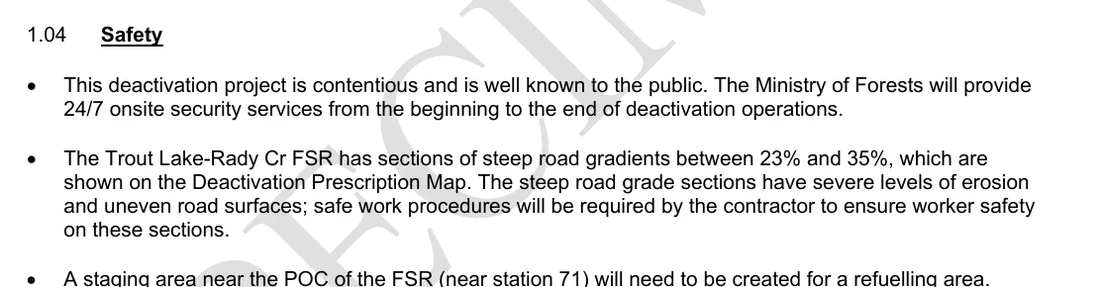
Page 3 of the tender, under “Overview of the Works Required”, sits between the elevation range and the list of the contractor’s duties. The Ministry put it in writing itself: “This deactivation project is contentious and well known to the public. The Ministry of Forests will provide 24/7 onsite security services for the entire duration of deactivation operations.”01
The same sentence is carried into the contract the winning bidder signs. There it is given a heading, and the heading is the tell.
What it shows
The heading is Safety. The public’s reaction is the first bullet under it. The second is a 35 per cent grade with severe erosion that can put an excavator down a mountain. This district filed the people who use the Rady Creek road under the same heading as the hazard that can kill the operator — and put them first. That is a choice about how to see your own public, and somebody made it.
That was not a slip of the pen. Page 4 of the tender sets out the “Known Field Safety Hazards on this Contract” — four of them. Dangerous trees. Soil mass movement. Grades of 25 to 35 per cent. And, second on the list, ahead of the landslides, “Members of the public/public disobeying signage”.01
This deactivation project is contentious and well known to the public.
Ministry of Forests · tender EN27DSE008, page 3 · 9 September 2026
Two facts, both of them documents, neither of them in dispute. Parmar’s ministry has budgeted for round-the-clock security because it judges this project contentious with the public. And in five years it has not held a single consultation meeting with that public. Budgeting for the public is not consulting the public. A ministry that can fund guards for the entire duration of the works can find an afternoon for a meeting, and the only reason it has not is that it does not intend to.
Section 02The meetings that did not happen
In June 2021 the district offered a meeting. Tara DeCourcy, District Manager of the Selkirk Natural Resource District, wrote: “I am able to meet with the club, if a representative could get in touch with me I will try to find a time.” The Trout Lake Recreational Club took her at her word and answered two hours and nineteen minutes later with five dates to walk the road together — 29 June, or 6, 7, 8 or 9 July. DeCourcy took seven days to answer, and the answer was no: “as much as I would love to meet you on site I just won’t have the time to do so.” A video call was offered in its place — if the club would organise it.04
Two hours and nineteen minutes against seven days. That is the whole relationship in one exchange, and it is the closest anyone has come in five years. A separate request that same month — to meet the person who prescribed the works and find a plan that deactivated the road and kept access — produced no meeting either; the prescriber’s name reached the club a year later, on a document. In October 2021 the district postponed the work and told everyone who had written in that this “will allow for further consultation and discussions to be conducted if needed with interested stakeholders.” That was the undertaking, in writing. Five years on, the number of meetings held under it is zero.04
0
Consultation meetings held with the Trout Lake Recreational Club or the community, 2021 to today
24/7
Onsite security services the Ministry of Forests has committed to fund for the duration of the works
14%
Share of their road maintenance requests districts were funded at in 2019/20
Now widen the lens, because the Selkirk district did not invent any of this. In November 2020 the Auditor General of British Columbia audited how the Province manages its 58,000 kilometres of forest service road and concluded that the Ministry was not maintaining them to its own policies. Districts were funded at 14 per cent of what they asked for in 2019/20 — between 14 and 20 per cent across the three years audited — and $8.9 million of high-priority maintenance on priority roads was left unfunded in that single year. Seven of the eight districts sampled held no historical inspection data; two held no maintenance records at all. The Ministry’s own internal audit had found the same failures in 2008.05
Read that last sentence again. The Ministry identified these failures itself, in 2008, and twelve years later its own Auditor General found them untouched. There is a word for an organisation that diagnoses its own defect and then does nothing about it for twelve years, and the word is not underfunded. This is what incompetence looks like when it is documented rather than alleged: not a bad day, not a hard file — a decade of knowing exactly what was wrong and not fixing it. Every district in this province has been handed the consequences. Selkirk is simply the one holding an excavator this month.
Because that is what the shortfall does. Decline to maintain a road for two decades and it erodes. Cite the erosion as the reason it must be destroyed. Then find, promptly, the money nobody could find for the maintenance. The Auditor General sets out the mechanism plainly: districts that cannot maintain a road to the wilderness standard are directed to consider closure and deactivation — while the same audit records that there is no trigger and no timeline, and that a forest service road can remain open indefinitely if it is maintained.05 Nobody in this story had to decide that the Rady Creek road should be destroyed. It was enough to refuse, for long enough, to keep it. That is a policy that converts the Ministry’s own failure into the public’s loss, automatically, with nobody’s signature on the outcome.
Section 03The instruction inside the engineering report
The re-issued package carries a forty-two page geotechnical prescription, dated 8 September 2026. Its opening line names the official who commissioned it: “At the request of Michael Ferguson, RFT, of the Ministry of Forests – Selkirk Natural Resource District…”03
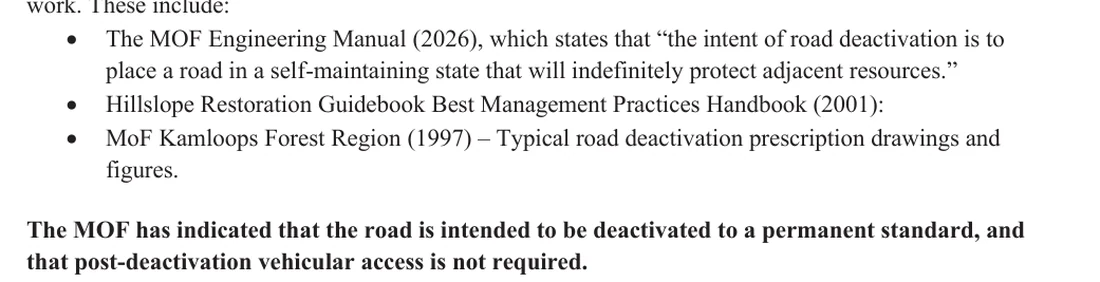
Four pages in, the report records what it was told before it began. Not what it found on the ground. What it was handed.
What it shows
In the report’s own bold: “The MOF has indicated that the road is intended to be deactivated to a permanent standard, and that post-deactivation vehicular access is not required.” Read the verb. Indicated. The end of vehicle access is not something the engineers concluded from the ground. It is what they were told before they wrote a word. That is not a finding. That is an order.
What that order costs the public is on page 9, in the passage covering the switchback between waypoints 16 and 18. The works, it says, “will result in loss of vehicle access along the alignment, including All Terrain Vehicle (ATV) access.” And then, immediately: “It may be possible to cut a narrow ATV trail across the recontoured road surface at the time of deactivation works, however, the excess material generated from constructing the trail will need to be transported to a suitable waste site. This will result in an increased cost for the works above that of the prescribed recontouring.”03

Read that again
Keeping a trail for quads over this stretch is possible. The Ministry’s own engineers say so, unprompted, in the document the Ministry paid for. The obstacle they name is not stability. Not landslide risk. Not fish habitat. Not law. It is that it costs more.
Nobody has published how much more. Nobody asked the public whether it would rather have the trail than the saving. And the one organisation that did put something on the record — the Quad Riders ATV Association of BC, which answered the deactivation referral in writing on 27 February 2020 — got a reply from the logging company, not from government. That letter is not in anything released to us. What the record shows is that the concern existed, in writing, six years ago, and that Recreation Sites and Trails BC, copied on the thread, never answered it in anything released to us.06
Section 04The names that were painted out
There is one more thing in that file. The detail matters exactly as far as it goes, and no further — overstating it is the one thing that would let this district off.
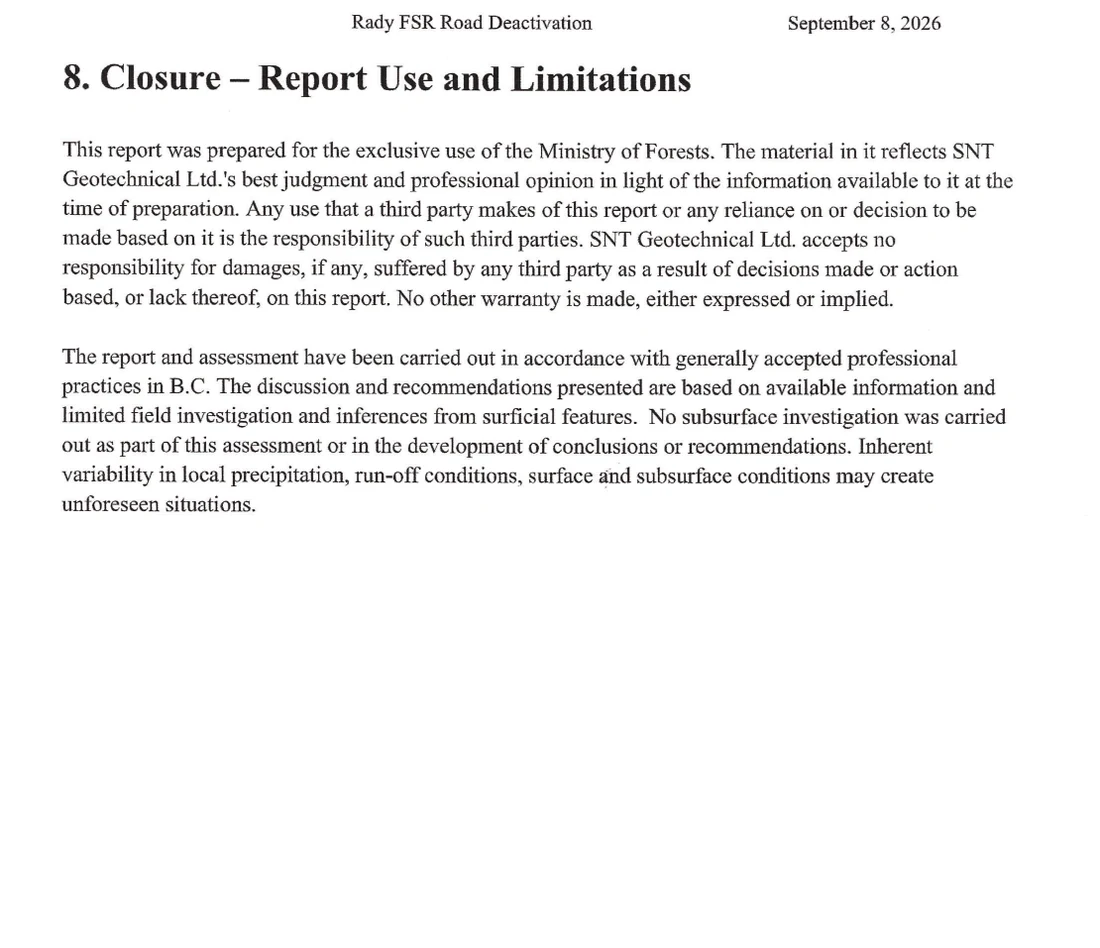
The prescription is a sealed professional document. Under the Ministry’s own Engineering Manual, quoted on the report’s page 2, a Qualified Registered Professional “must prepare, sign, and seal” a deactivation prescription, and the report states it is “intended to meet this requirement.” The page that would prove the requirement was met is page 19. Here is page 19, exactly as it was distributed to bidders.
What it shows
The signature block is blank. Underneath that white space, in the file itself, are a wet signature, the hand-date “Sept 8, 2026” and the seal of Ryan Williams, P.Geo., #45161, with Tim Giles, P.Geo. as reviewer, both of SNT Geotechnical Ltd. of Nelson. The consultant’s logo in the page header is covered the same way, as is the firm’s letterhead on the cover page and the title block of the map. The covers are opaque white boxes laid over the document; they delete nothing. Any reader can lift them in a minute with free tools. We did.
The cover page of the prescription, as distributed, therefore carries one piece of branding: the Ministry of Forests. The firm that wrote it, its address, its logo and its distribution line are behind white rectangles. The document’s own properties record that this PDF was manufactured on 9 September 2026 — the day after it was sealed, and the day the tender went up.03
Nothing released records who applied those covers. Ryan Williams sealed the report himself — the act by which a professional takes personal liability for a document — and two separate checks found the work throughout to be his own. Nothing was taken from him; his name was simply painted over before the public saw it. The fact is the whole of our claim, and the fact is damning enough: a sealed professional prescription was issued in a public tender with the professional’s name, seal and firm covered up — by a ministry whose own manual, quoted two pages earlier in the same report, requires that document to be prepared, signed and sealed. They wrote the rule. They distributed the document with the rule’s proof painted out. The district could answer that in one sentence, and nobody has been able to put the question, because this district has built no process in which it could be asked.
Section 05The clock
None of this is retrospective. The contract is not awarded. Sealed tenders are received at the Selkirk Resource District office in Nelson until 1:00 PM on 24 September 2026, at which point they are opened in private.01 Until that hour, every number in this piece describes a thing that has not happened yet and can still be stopped.
Five years. One formal postponement. A written undertaking to consult. Zero meetings. What this district produced instead is a tender that calls the public contentious and funds security against them for the entire duration of the works. And it is not an outlier: it is a ministry that has been told by the Auditor General it is failing its own policies, told by its own internal audit twelve years before that, and has changed nothing. That ministry answers to Ravi Parmar. Every decision that could still change the outcome — award the contract or don’t, instruct that vehicular access is not required or don’t, designate the route as recreation or don’t — belongs to an office-holder with a published address.
- Hon. Ravi Parmar, Minister of Forests — FOR.Minister@gov.bc.ca. The instruction that post-deactivation vehicular access is not required came from his ministry. It can be changed by his ministry.
- Selkirk Natural Resource District office — FOR.SelkirkDistrictOffice@gov.bc.ca, 250-825-1100. The statutory decision sits here.
- Hon. Tamara Davidson, Minister of Environment and Parks — ENV.Minister@gov.bc.ca. Recreation Sites and Trails BC reports to her, and it is the one agency that could have designated these routes as recreation.
- Hon. Anne Kang, Minister of Tourism, Arts, Culture and Sport — TACS.Minister@gov.bc.ca. Every use the Rady Creek road still has is a recreation use. The ministry that owns the recreation economy has no part in the decision to remove it.
- Tennessee Trent, Regional Director, Recreation Sites and Trails BC — he was copied on the 2 March 2020 message in which the licensee offered to transfer road sections to any group willing to assume the liability. No reply from his agency appears in the record.
- The tender itself — questions on contract EN27DSE008 go to Jordan Pyette, Senior Engineering Technologist, as published on page 1 of the package.
So ask them the question the file cannot answer. The Ministry’s own engineers wrote that a narrow ATV trail across the recontoured surface may be possible, and that the only reason to skip it is cost. What is the number? Publish it, and let the public decide whether it is worth paying — which is, after all, precisely the consultation this district promised in writing in October 2021 and has not held since. If the answer is that nobody ever worked it out, say that instead. Either answer is an indictment.
Minister Parmar, you inherited a ministry your own auditor says is not meeting its own standards. You cannot fix twelve years in thirteen days. You can stop this one road going out from under fifty people who asked, in writing, five years ago, to be allowed to talk about it. Pause the Rady Creek deactivation.
Share this story
Ten images carrying this story on their own — the figure, the quotation and the document each one comes from. Made to be posted.


Slide 1 of 10
Suggested caption
The Ministry of Forests will pay for round-the-clock guards at Rady Creek. It has never once paid for a meeting with the people who use the road.
Its own tender calls the project “contentious and well known to the public.” It budgeted security accordingly. In five years the same file records zero consultation meetings.
In June 2021 the club answered in 2 hours 19 minutes with five dates to walk the road together. The District Manager took seven days to decline: “I just won’t have the time to do so.” In October 2021 the district postponed the work and wrote that this “will allow for further consultation and discussions to be conducted.” None has taken place since.
This is not one district having a bad decade. The Auditor General found this ministry funding its districts at fourteen cents on the dollar, $8.9 million of high-priority maintenance unfunded in a single year, and seven of the eight districts its auditor sampled unable to produce an inspection record. An internal audit found the same failures in 2008. Twelve years later nothing had been fixed.
That is the ministry Ravi Parmar runs, and the policy behind this tender is province-wide: a district that cannot afford a road is directed to consider deactivating it. Starve the road, then cite the starvation.
Bids close 1:00 PM, 24 September 2026. Nothing is signed.
The public asked to be heard before an irreversible decision. They did not ask for incompetence or conflict.
Ravi Parmar — pause the Rady Creek deactivation now. Meet the people your own contract calls contentious.
backcountry.cx/editorials/selkirk-district-office/
#BCpoli #PublicLand #RadyCreek #Kootenays #ForestServiceRoad
Sources
- ↩↩↩↩Invitation to Tender, contract EN27DSE008, “Trout Lake-Rady Cr FSR Deactivation 0.0km to 4.4km”, Ministry of Forests, Selkirk Resource District, 1907 Ridgewood Road, Nelson. Pages 1, 3 and 4. Issued 9 September 2026 via BC Bid opportunity 233877; closing 1:00 PM local time, 24 September 2026.
- ↩Ministry of Forests Minor Works Contract, file 10005-40/EN27DSE008, Schedule A – Services, clause 1.04 “Safety”, page 5. Issued with the tender package as the specimen contract, 9 September 2026.
- ↩↩↩“Rady Forest Service Road (FSR) Road Deactivation Prescription”, report number 26.510.01.01.16, dated 8 September 2026, prepared for the Ministry of Forests – Selkirk Natural Resource District, 845 Columbia Avenue, Castlegar. Pages 2, 3, 4, 9 and 19, and the PDF’s own document properties (created 9 September 2026). Issued with the tender package. The Province publishes this report itself, as “Trout Lake Rady-Creek FSR Deactivation Prescription and Map”, on the Selkirk district road safety page. https://www2.gov.bc.ca/assets/gov/farming-natural-resources-and-industry/natural-resource-use/resource-roads/local-road-safety-information/selkirk/trout_lake_rady_creek_deactivation_prescription_map.pdf
- ↩↩Correspondence between the Selkirk Natural Resource District and the Trout Lake Recreational Club, June and October 2021, published in full with the Rady Creek document archive at saverady.com, sections 05 and 10.
- ↩↩Office of the Auditor General of British Columbia, Management of Forest Service Roads, November 2020. The conclusion that the ministry was not maintaining forest service roads to its own policies, and the 58,000 km network, at page 11 and exhibits 4–6; the funding shares at exhibits 8–9; the unfunded maintenance, district record-keeping and the direction to consider closure and deactivation at pages 23, 35, 38, 40 and 47. The 2008 internal ministry audit is cited within it; that audit itself is not in anything released to us. https://www.oag.bc.ca/app/uploads/sites/963/2024/08/OAGBC-20210119-Management-Forest-Service-Roads_RPT.pdf
- ↩Road Permit R07745 deactivation referral correspondence, January to March 2020: Cooper Creek Cedar’s referral of 14 January 2020; the covering e-mail of 27 February 2020 from Kim Smith, General Manager, Quad Riders ATV Association of BC, attaching the association’s letter of response; and the company’s reply of 2 March 2020, copied to John Hawkings and to Tennessee Trent, Regional Director, Recreation Sites and Trails BC. Published with the Rady Creek document archive at saverady.com, section 03. The ATVBC letter itself is not in anything released to us.