
EDITORIAL · THE RECORD
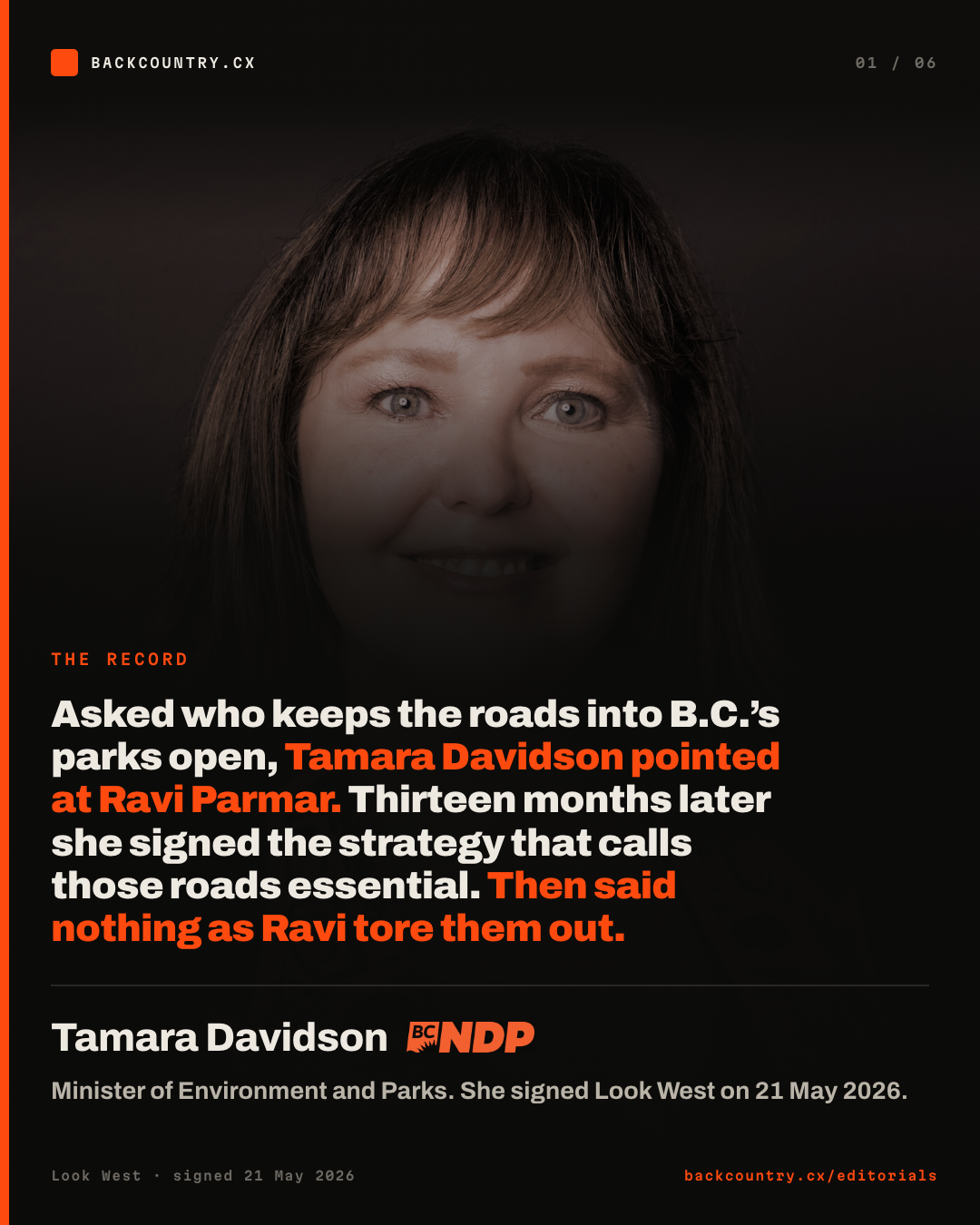
Asked who keeps the roads into B.C.’s parks open, Tamara Davidson pointed at Ravi Parmar. Thirteen months later she signed the strategy that calls those roads essential. Then said nothing as Ravi tore them out.
Most of British Columbia’s backcountry is reached on resource roads — the gravel roads built for logging that the public then drives to reach lakes, trailheads, cabins and hot springs. In May 2026 the Province published a strategy saying the rural economy depends on them and that the industry money which has always maintained them is disappearing. The minister who signed that strategy is Tamara Davidson, and thirteen months earlier she had told the Legislature those roads were the Ministry of Forests’ responsibility, not hers. Since then her own agency has refused one of them, and the Ministry of Forests has begun tearing them out.

- Appointed
- 18 November 2024
- Signed the strategy
- 21 May 2026
- Her ministry holds
- BC Parks, and Recreation Sites and Trails BC
- Her agency refused the road
- 19 August 2026
- Her mandate letter
- 16 January 2025 · five priorities
- Lead ministry for Target 8
- none named
01 Two ministers, two days, and the road into Rady Creek
Two people in this government already answer for the Trout Lake–Rady Creek forest service road. Ravi Parmar’s Ministry of Forests has put its deactivation out to contract. Brittny Anderson is Minister of State for Local Governments and Rural Communities — a post that sits in the Office of the Premier rather than under a line ministry — and no public statement by her on this road has surfaced. This piece is about the six who are left, and about the Premier who tells all of them what their job is.
It begins eighteen months ago, in an estimates debate on Tamara Davidson’s own ministry budget, with a question nobody has answered since.
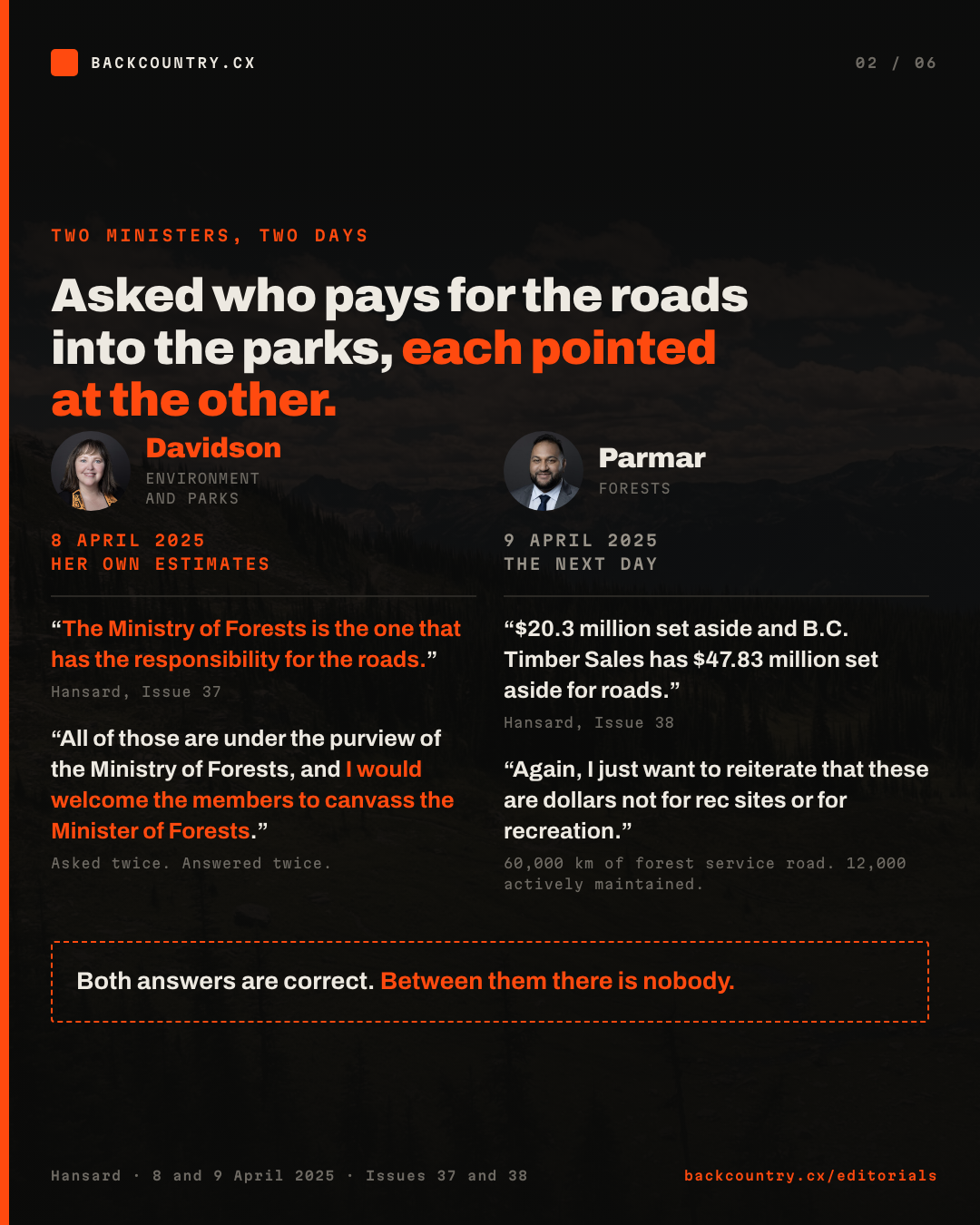
8 April 2025. The Ministry of Environment and Parks estimates had spent the afternoon on liquefied natural gas proponents and on a bridge into Cathedral Park that a fire destroyed in 2023, and Donegal Wilson, the member for Boundary-Similkameen, had just got the minister to confirm that the Province would pay for its replacement. Then she changed the subject to the roads, and she did not put it in general terms. She put the terms of the deal on the record: recreation clubs being asked to become the road maintenance agreement holder, to put down a $10,000 deposit, to invest $50,000 in a bridge in partnership with the Province, and then to carry the liability of that road long term — on agreements that take five to seven years to put in place.8

“I do want to switch again and talk about roads. I know that road access to our B.C. parks, recreation sites and trails continues to be a challenge in this province… We make investments in the infrastructure and the trails, yet we’re continuing to lose the roads to them, and they need to be included in the budgets, going forward. Is there going to be funding in the budget for access trails to parks, rec sites and trails?”
The minister’s answer carried no budget line. It carried the name of the Ministry of Forests.

“The Ministry of Forests is the one that has the responsibility for the roads. Most of the time, the roads have been constructed for a specific purpose, which is for forestry. We do work closely with the Ministry of Forests to balance and to make recommendations to prioritize and identify roads that are leading into rec sites and trails…”
Wilson pressed, and named the places: the Kakwa Park access, limited for years; the McBride bridge; the road into Allan Creek at Valemount. “My inbox is full of businesses in McBride that are struggling from losing access to McBride.” If the Province intended to hand these roads to volunteers, would it extend its own insurance to them, or were the clubs to find liability cover for road maintenance themselves? Five minutes later, at 4:35 p.m., the minister answered again, and closed the door with an invitation.8
“To answer the question, the Ministry of Forests has the statutory responsibility for the road maintenance, and they also include the securities and the financial arrangements. All of those are under the purview of the Ministry of Forests, and I would welcome the members to canvass the Minister of Forests.”
That was the end of it. Trevor Halford thanked his colleague for canvassing the issue and took the committee back to liquefied natural gas. The roads had held the Ministry of Environment and Parks’ estimates for five minutes.8
The next day, Wilson did exactly as she had been invited to do.
“Staying on the same theme around recreation and road access, while we do appreciate that Rec Sites and Trails is no longer within your ministry, just about every access to a park or recreation site in the province does involve a forestry road to get there. What specific budget has the province allocated in this fiscal year for the maintenance and repair of forestry roads to provide access to recreation sites, trails and B.C. parks?”

“In our capital budget, the integrated resource operations division has $20.3 million set aside and B.C. Timber Sales has $47.83 million set aside for roads. Again, I just want to reiterate that these are dollars not for rec sites or for recreation.”
Wilson then said out loud what the previous twenty-four hours had been: “I asked this of the Ministry of Environment yesterday and was brought here to the Ministry of Forests. I was told this bridge is yours.” The bridge was above McBride, the Ministry of Forests’ own engineers had removed it on safety grounds, and the McBride Big Country Snowmobile Association needed it back. Parmar replied that he was “not going to send the member back to the Ministry of Environment and Parks” — and then explained that the trails she meant “live within the Ministry of Environment and Parks” and that “Rec Sites and Trails doesn’t exist in the Ministry of Forests.”9
The money for a McBride bridge arrived thirteen months later, and out of neither of those two budgets. On 21 May 2026 the Province gave the McBride Big Country Snowmobile Association almost $400,000 for a new bridge re-establishing access to the Renshaw snowmobile area — from the Rural Economic Diversification Infrastructure Plan, which belongs to a third ministry again, Jobs and Economic Growth. It was announced in the news release that launched the Outdoor Recreation Strategy.17
Two ministers, consecutive days, on the record
The minister who owns the recreation sites says the roads belong to Forests. The minister who owns the roads says his road money is not for recreation. Both answers are correct. Both were given in the Legislature’s own estimates debates, twenty-four hours apart.
Between those two answers there is a sixty-thousand-kilometre network and nobody standing on it. Parmar put the number on the record in the same sitting: the Ministry of Forests maintains approximately 60,000 kilometres of forest service roads, of which roughly 12,000 are actively maintained.9
02 Thirteen months later she signed a strategy saying the same thing
On 21 May 2026 the Province published Look West: B.C.’s Outdoor Recreation Strategy — 36 pages, seventeen numbered targets, and a name borrowed from the Premier’s Stronger BC, Look West economic strategy. The Minister’s Message at page 4 is signed Honourable Tamara Davidson, Minister of Environment and Parks.1
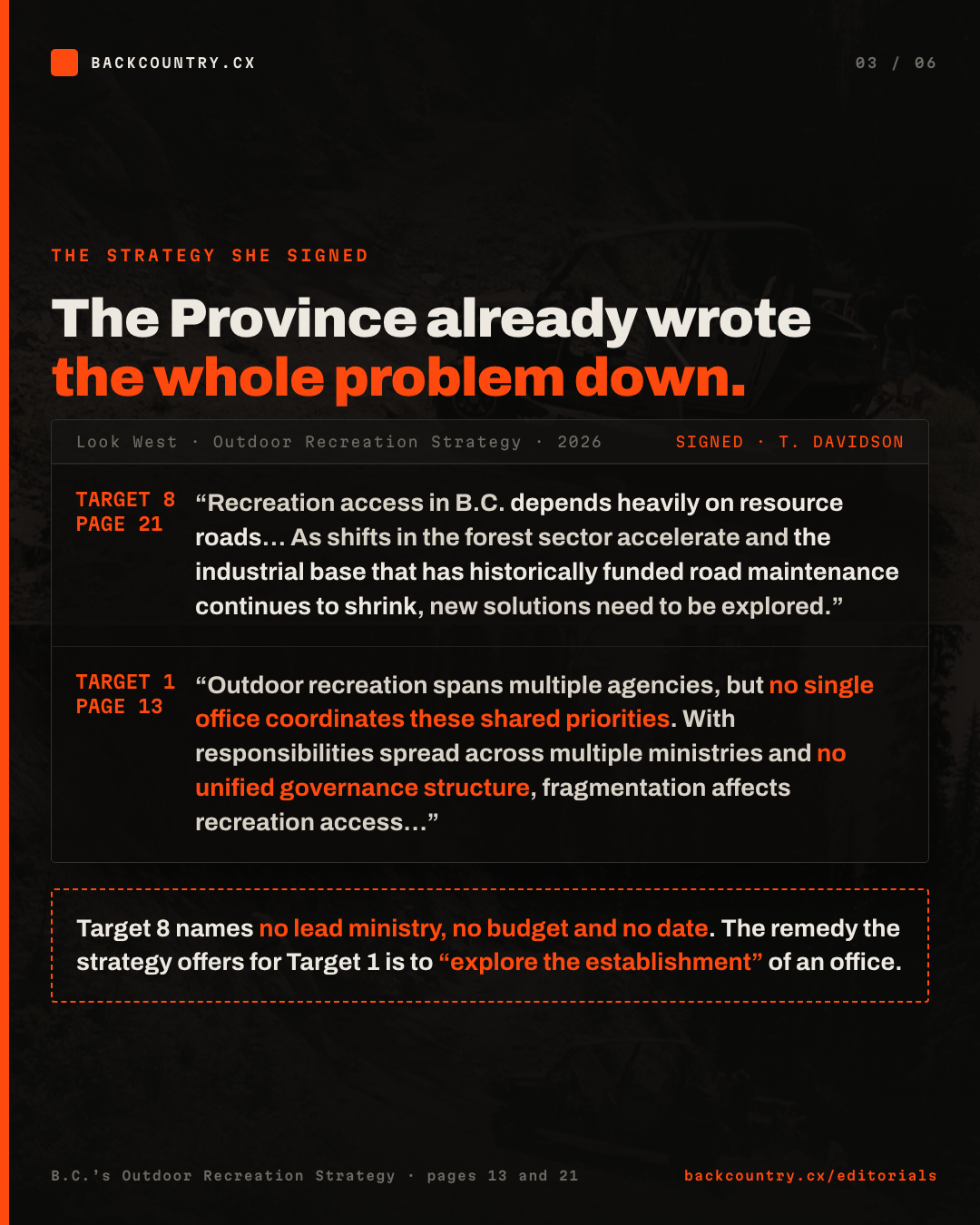
One of the seventeen targets is about the roads. Target 8, at page 21, is “a modernized framework for high-value recreation access and resource roads.” Read its reasoning next to the question Wilson had asked thirteen months earlier. The strategy asks the same question, and this time a minister has signed the page the question is printed on.
Recreation access in B.C. depends heavily on resource roads, which provide the primary routes into much of the province’s backcountry. These roads were built and maintained largely to support forestry and other resource industries, but they now serve a much broader public role, providing access to rural communities and high-value recreation sites across Crown land. As shifts in the forest sector accelerate and the industrial base that has historically funded road maintenance continues to shrink, new solutions need to be explored.
The Province had been told this in its own Legislature. Its answer, more than a year on, was that new solutions need to be explored.
Thirteen pages earlier, the strategy is blunter about why nothing moves. Target 1 puts the question, and then answers itself.1
Outdoor recreation spans multiple agencies, but no single office coordinates these shared priorities. With responsibilities spread across multiple ministries and no unified governance structure, fragmentation affects recreation access, investment and prevents alignment with broader objectives and shared interests.
Its remedy, in the same box, is to “explore the establishment of a coordinating Office of Outdoor Recreation.” The thing already in place is listed as “a recently formed cross-ministry Outdoor Recreation Committee” — a body the strategy neither names, staffs nor dates.
Fifteen of the seventeen targets carry three boxes: what’s next, what’s in place, and why this matters. Target 8 has only two. Nothing is in place, and Target 8 names no lead ministry, no budget line and no delivery date.1


One more absence runs through the whole document. The strategy names the Ministry of Tourism, Arts, Culture and Sport, and it names Davidson’s own Ministry of Environment and Parks. It never once names the Ministry of Forests. Where it says “forest” it means the forest industry, the forest sector, or a private landowner — Mosaic Forest Management, the Cumberland Community Forest. The ministry that holds all 60,000 kilometres of forest service road, the ministry Davidson herself had pointed to in Hansard thirteen months earlier, does not appear in the strategy written to coordinate them.1
Nor does it appear in the launch. The news release of that morning, datelined Kamloops, carries quotes from Davidson, from the then Minister of Jobs and Economic Growth, Ravi Kahlon, who put outdoor recreation at $4.8 billion a year and more than 1,400 businesses, and from the Parliamentary Secretary for Rural Development, Steve Morissette. Not one of them mentions a road.17
03 Ninety days later, Recreation Sites and Trails BC refused the Rady Creek road
The Trout Lake Recreational Club was not asking the Province for money. It was asking to be allowed to keep the road. It applied to Recreation Sites and Trails BC for a formal partnership agreement over the Trout Lake–Rady Creek corridor, offering to assume the liability itself and to stand up a sustainable insurance structure for the corridor.13
Recreation Sites and Trails BC is an agency of Tamara Davidson’s Ministry of Environment and Parks, and three of the Province’s own documents say so. The strategy’s Target 7 records that in 2023 BC Parks and Recreation Sites and Trails BC “were aligned under the same ministry.” Davidson’s service plan opens by saying her ministry “administers the province’s parks and protected areas, and recreation sites and trails.” And her ministry’s own news release of 26 May 2026 describes the Off-Road Vehicle Trail Fund as “a user-funded program administered by Recreation Sites and Trails BC.”1211
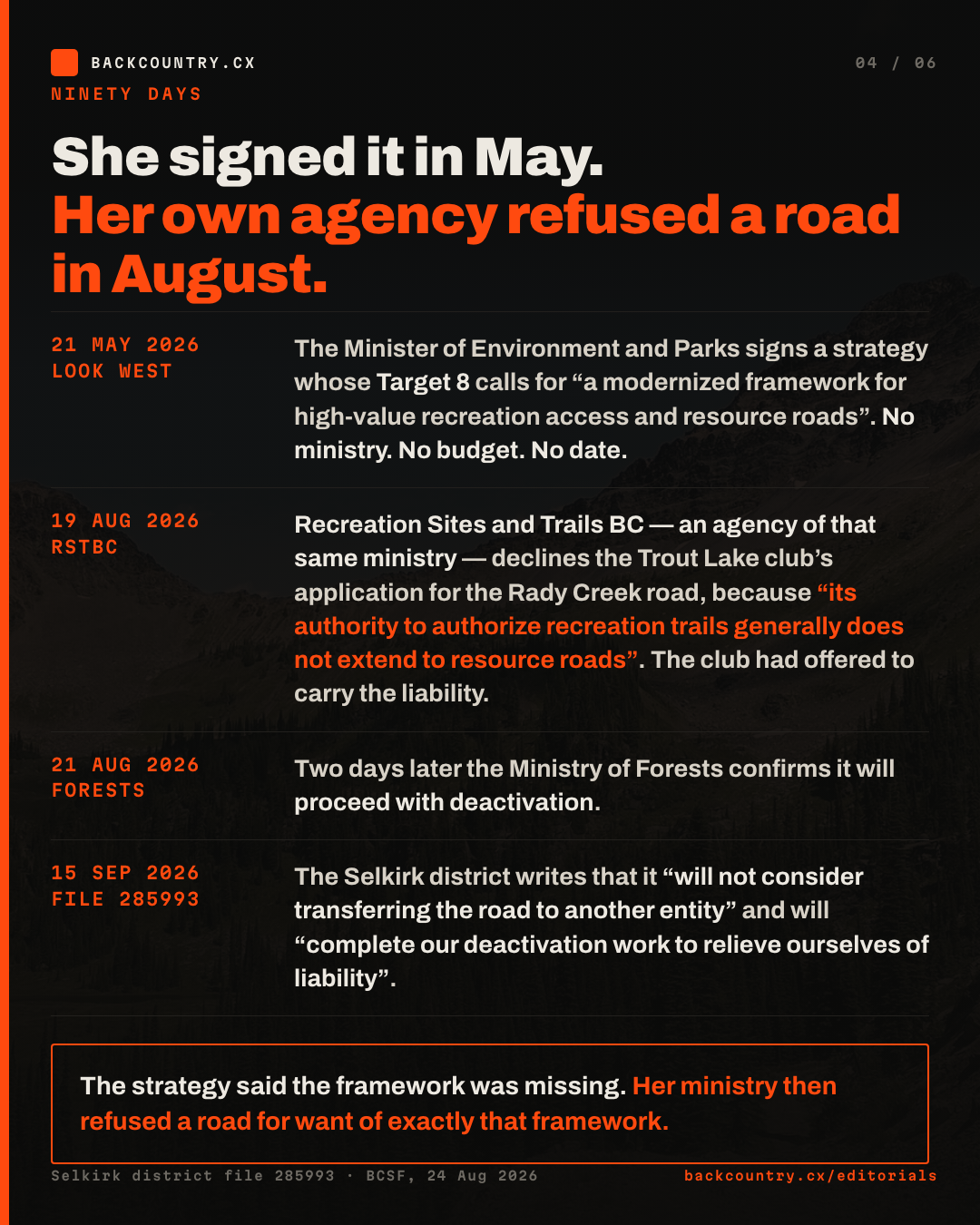
21 May 2026 · the strategy
Target 8 calls for a modernised framework for recreation access and resource roads. No ministry, no budget, no date. Look West, page 21 1
19 August 2026 · ninety days later
Recreation Sites and Trails BC declines the club’s application because “its authority to authorize recreation trails generally does not extend to resource roads such as Forest Service Roads.” As the BC Snowmobile Federation records it, 24 August 2026 12
21 August 2026 · two days after that
The Ministry of Forests confirms it intends to proceed with deactivation. BC Snowmobile Federation, 24 August 2026 12
15 September 2026 · file 285993
Charlene Strelaeff, District Manager of the Selkirk Natural Resource District, writes that the Ministry “will not consider transferring the road to another entity” and will “complete our deactivation work to relieve ourselves of liability.” Selkirk Natural Resource District, held on file 15
22 September 2026
An unnamed Ministry of Forests spokesperson tells CBC: “At this time, the decision for deactivation is final.” Once the road has been destroyed and re-sloped, the Ministry says, an organisation may apply for a licence of occupation under the Land Act — from a third ministry again, Randene Neill’s Water, Land and Resource Stewardship. CBC, 22 September 2026 14
The refusal is the strategy’s own diagnosis arriving as a decision. Target 8 of Look West said the framework governing recreation access and resource roads had to be modernised. Ninety days later Recreation Sites and Trails BC — the agency that would have used that framework — turned down the Trout Lake–Rady Creek forest service road, because no such framework exists. Tamara Davidson signed the page Target 8 is printed on, and her own agency then refused a road for want of the very thing that page said was missing.
Read the alternative twice. The club may take the corridor on after the road has been destroyed and re-sloped, not instead of. The pathway guarantees the loss it is offered as a remedy for.14
That the application went to Environment and Parks rather than to Forests is not an accident of filing. It is the split Davidson described in Hansard: the trail is hers, the Rady Creek road is Ravi Parmar’s, and what the Trout Lake Recreational Club applied for is a trail laid along that road.
04 What the Premier actually asked her to do
A mandate letter is the Premier’s written instruction to a minister: the list that minister will be held to. Every ministry reprints its own as an appendix to its service plan, so what follows is the document rather than a summary of it.
Tamara Davidson’s is dated 16 January 2025 — twelve weeks before the Hansard exchange above — and gives her five priorities.2
Office of the Premier to the Honourable Tamara Davidson, Minister of Environment and Parks · 16 January 2025 · reprinted as Appendix A to the Ministry of Environment and Parks 2026/27–2028/29 Service Plan
- Work with the Minister of Finance to review all existing Ministry of Environment and Parks programs and initiatives to ensure programs remain relevant, are efficient, grow the economy, and help keep costs low for British Columbians. This is important in the context of current Provincial budget constraints.
- Find ways to increase access for families to British Columbia’s parks in a cost-efficient manner.
- Work across ministries and with Indigenous leadership and business leaders to support work to recognize Indigenous rights and title, protect our precious environment for future generations, and support predictable and sustainable economic growth.
- Direct the Environmental Assessment Office to work with key permitting ministries to develop specific measures that will expedite authorizations and permitting for major projects. Bring proposed measures forward for Cabinet review within six months.
- Support BC’s energy transition and climate targets by directing the Environmental Assessment Office to proceed with the exemption of wind power from Environmental Assessment Act provisions. Further, exempt other relevant classes of projects from environmental assessment.
Three of the five are about speeding up industrial permitting or cutting her ministry’s costs. One exempts whole classes of project from environmental assessment. Her single instruction on access is about parks, and it is qualified by price — increase access for families to British Columbia’s parks in a cost-efficient manner. A forest service road is not a park.
Now put the fourth priority beside the target she signed sixteen months later. One of the two has a clock on it.
What the Premier put a deadline on
Direct the Environmental Assessment Office to develop measures that will expedite authorizations and permitting for major projects, and bring them to Cabinet.
Within six months Mandate letter, 16 January 2025 2What the same minister signed, with no deadline
Target 8 — a modernized framework for high-value recreation access and resource roads, for a network the strategy says the rural economy depends on.
No date. No budget. No ministry. Look West, page 21, 21 May 2026 1The letter predates the strategy, so it could not have named Target 8. That is the point rather than the excuse. In the twenty months since it was written, nothing has been issued that puts Target 8 into anybody’s job, and the strategy that created the target named nobody to carry it.
Her ministry’s own plan is where the gap is sharpest. Its Goal 2 is “sound management of protected areas system, recreation site and trail networks” — the goal that covers everything at the end of the road. It is the only one of the ministry’s three goals with no performance measure at all. The plan says so plainly: “the ministry is finalizing a new performance measure this year for Goal 2… the first survey with this updated methodology is expected to be conducted in mid-2026.” There is no baseline and no target.2
And the division that runs it is being cut. The Conservation and Recreation Division falls from $98.936 million to $93.018 million, a reduction of $5.918 million, and is then held flat for three years.2
“Outdoor recreation is increasingly recognized as essential to our well-being, community connection and regional economic development.”
That release is the only place in her ministry’s 2026 output where a forest service road appears. It awards $25,000 to the Valemount and Area Recreation Development Association “to contribute to a much larger bridge repair, led by the Ministry of Forests, in the Clemina Creek area,” and says the money “helps keep a forest service road connection open to a managed trail system.” The same release records what the fund is: “a user-funded program… supported by ICBC off-road vehicle registration fees,” administered by Recreation Sites and Trails BC.11
So the whole of this ministry’s money on a forest service road connection in 2026 was riders’ own registration fees, topping up a bridge repair Ravi Parmar’s Ministry of Forests was already leading. Set against the Conservation and Recreation Division’s $93 million, the entire ORV Trail Fund — $500,000 across 24 projects — is about half of one per cent, and it is not the ministry’s money.211
05 The rest of the table, and what each one was given
Four more ministers hold a piece of this road, and the Premier writes all of their instructions. Randene Neill holds the Crown land it crosses and the Land Act licence the Ministry of Forests offers as a consolation. Anne Kang markets the backcountry those roads lead into. Brenda Bailey runs the fund that pays for trails. Christine Boyle is the minister to whom the regional districts at either end of the road answer. What follows is not what any of them failed to say. It is what each of them was told to do, in the Premier’s own words, taken from the mandate letters their ministries reprint in their own service plans.

Her ministry holds Crown land, the Land Act and land-use planning — which is where Target 8’s second instruction would have to be carried out: “plan for and secure key lands that enable recreation opportunities such as trailheads, campgrounds and access routes.” It is also her ministry that administers the Land Act licence of occupation the Ministry of Forests says the Trout Lake Recreational Club may apply for once the road has been destroyed and re-sloped.
Her mandate letter of 16 January 2025 gives her nine priorities: the cost review, permitting timing, large-scale land-use and critical-mineral agreements “in a manner that expedites permits,” drought and water allocation, balancing land use across energy, technology, tourism and resource development, land use planning, mining exploration in the northwest, critical ecosystems, and salmon habitat.
“Continue land use planning with First Nations, industry, and local communities.”Mandate letter, 16 January 2025. Industry is named. Recreation access is not, and neither is a road. 3

She holds Tourism, and the Province’s published target is to double tourism revenue to $48 billion by 2036. In April 2026 she said, in a release about backcountry permitting, that “B.C.’s natural beauty and access to the outdoors are a major reason visitors choose our province.” 24
Her mandate letter of 17 July 2025 gives her nine priorities: the cost review, recreation centres and sports fields, fairs and festivals, film and television, tourism as a pillar of the economy, amateur sport, the Invictus Games and the 2026 FIFA World Cup, and liquor and cannabis regulation for tourism products.
“Leverage the opportunities provided by the Invictus Games, the FIFA World Cup in 2026 and other major event bid proposals to maximize the economic development and tourism impact of major events across the province.”Mandate letter, 17 July 2025. The nearest her instructions come to the backcountry is “BC’s unmatched geography.” What a visitor reaches that geography on is never mentioned. 4

Her ministry runs REDIP, the fund that pays for trails and trailheads. Its own service plan measures the programme at 740 jobs a year against a $15 million annual allocation — against roughly $39 million a year over the programme’s first four — and sets a second measure for “REDIP funded projects that help communities respond to major economic shifts.” The major economic shift Target 8 describes is the one taking this road away. It is also the fund that paid for the McBride bridge neither road budget would: almost $400,000 to the McBride Big Country Snowmobile Association on 21 May 2026, thirteen months after Donegal Wilson was sent from one ministry to the other looking for that money. 17
She took the portfolio on 14 August 2026. Her mandate letter of that date is, from the word “congratulations” onward, character-for-character identical to Ravi Kahlon’s of 25 November 2025 — the same thirty bullets in the same order. Only the date and the name changed.
“In partnership with the Parliamentary Secretary for Rural Development, ensure government initiatives consider and deliver economic growth and benefits for rural and urban communities.”The seventeenth and last priority, and the entire rural instruction given to the ministry that holds the rural chequebook. 5

She is the minister for Municipal Affairs — the portfolio to which every regional district answers. This corridor runs through two of them: Trout Lake itself sits in Electoral Area B of the Columbia Shuswap Regional District, and Gerrard and Poplar Creek, thirty kilometres down the same valley, are in Electoral Area D of the Regional District of Central Kootenay. Neither of them covers all of the road. 26
Local government has been asking for this in the formal channel for sixteen years. In 2010 the Regional District of Central Kootenay carried a resolution at the Union of BC Municipalities convention asking the Province to develop a programme of basic rural road maintenance and to tell remote communities and regional districts which rural roads are maintained and which are not; the membership endorsed it. In 2020 the Village of Slocan, inside that same regional district, carried another, resolving that roads into provincial parks “be designated as public roads and maintained as such.” The Province’s written reply was that its engineering budget does not cover road repairs for BC Parks access, and that it was working with the Ministry of Transportation and Infrastructure and BC Parks to identify which resource roads could be maintained and to assign responsibility to the most suitable ministry. That was six years before Target 8 said the same thing. 26
Her own mandate letter of 17 July 2025 gives her thirteen priorities, and every one of them is housing. Her ministry’s three service-plan goals are well-governed communities and affordable housing, supports for people at risk of homelessness, and fair regulatory systems. Nothing in its 5,951 words is addressed to a rural road, or to what a regional district is supposed to do when one is taken out.
“Work with local governments to achieve housing targets and address concerns related to infrastructure.”Mandate letter, 17 July 2025 — her only local-government instruction, and it is about housing targets. 6

He writes all of them. Every letter quoted on this page opens “congratulations on your appointment” and closes over his signature, and a mandate letter is the only instrument that turns a government’s intention into somebody’s job.
His own service plan sets out the government’s priorities in a single sentence: making B.C. into Canada’s economic powerhouse, creating good jobs and reducing costs for families, strengthening health care, and making neighbourhoods and communities safer. Public land is in none of them. Neither is the strategy his Minister of Environment and Parks signed.
Across seven letters to the ministers and secretaries whose portfolios this road runs through, not one mentions a resource road, a forest service road, or backcountry access.Office of the Premier 2026/27–2028/29 Service Plan, the six mandate letters, and Steve Morissette’s appointment letter, each read in full 25
Nothing reaches the road from the Forests side either. Ravi Parmar’s eight mandate priorities are the sector crisis, a review of BC Timber Sales, forest landscape planning tables, value-added products, permits for industry, “a sustainable land base to enable harvest of 45,000,000 cubic meters per year,” community forests and softwood lumber. The minister who told the Legislature his road budget is “not for rec sites or for recreation” was himself given no instruction about a road.7
06 The parliamentary secretary for rural development was never given a job
There is a seventh person, and his case is the clearest of all, because the documents are short enough to read in full.
Steve Morissette is the Parliamentary Secretary for Rural Development and the MLA for Kootenay-Monashee — the Kootenays, the same corner of the province this road is in. On 21 May 2026 the Province gave him a quote in the news release that launched the Outdoor Recreation Strategy, alongside Tamara Davidson and the then Minister of Jobs and Economic Growth, Ravi Kahlon. It begins exactly where you would hope, and then goes somewhere else.17

“Outdoor recreation is such a draw for people, both here in the Kootenays and in rural communities across the province. The College of the Rockies, and especially the KORE program, are helping lead innovation in sustainability and skills when it comes to creating, repairing and upcycling outdoor gear.”
On the day the Province published a strategy saying the road network that carries the public into the backcountry is collapsing, the contribution of the Parliamentary Secretary for Rural Development was about repairing gear.
That is less his failing than the job’s. He has never been given one. His letter from the Premier is dated 18 November 2024, runs to 593 words, and contains no priorities at all — not a rural priority, not any priority. It is not even a mandate letter: on the Province’s own cabinet page every minister’s link reads “mandate letter” and his reads “Premier’s appointment letter.”18
Office of the Premier to Steve Morissette, MLA · 18 November 2024 · 593 words, no priority bullets
- “Congratulations on your appointment as Parliamentary Secretary for Rural Development in the Ministry of Finance.”
- “In the coming weeks, Ministers will receive specific mandate expectations laying out priorities for action… These mandate letters will also provide additional direction regarding your role supporting the Minister.”
The direction was deferred to a letter that never came. Rural development sits in the Ministry of Finance, and the only instruction Morissette has ever been given is one clause in a letter written to somebody else — Ravi Kahlon’s mandate letter as Minister of Jobs and Economic Growth, dated 25 November 2025. Set that clause against the other parliamentary secretary assigned four lines further down the same page.5
“In partnership with the Parliamentary Secretary for Rural Development, ensure government initiatives consider and deliver economic growth and benefits for rural and urban communities.”
The whole assignment. One subordinate clause, no subject, and “rural and urban” together so that nothing in it is specifically rural.Nothing further.
No second task, no named strategy, no named country, no method. That one clause is the entire instruction he has ever been given.“Engage with BC businesses to better understand the challenges and opportunities they see in bringing their products to international markets and support you as you work to enhance and expand BC’s Trade Diversification Strategy.”
A named task and a named strategy. The letter assigns the office and never names its holder, which is why there is no face in this column.“Use their personal experience and skills with Korean language and culture to expand our trading opportunities with South Korea and invite and host Korean delegations in British Columbia.”
A named country and a named method.The asymmetry is not an accident of drafting, because the office itself carries nothing. The Constitution Act gives parliamentary secretaries one section, and this is the whole of it.19
12 The Lieutenant Governor in Council may appoint members of the Legislative Assembly to be parliamentary secretaries to members of the Executive Council.
One sentence. It grants a power of appointment to the Lieutenant Governor in Council and no power whatever to the person appointed — no duties, no functions, no budget, no delegated authority. The sections on either side of it do confer real powers: section 13 lets government establish and disestablish ministries and transfer duties between them. A parliamentary secretary sits outside all of that.19
07 What six ministers signed up to deliver, and the duty none of them took
A service plan is a ministry’s own statement, signed by its minister under the Budget Transparency and Accountability Act, of what it will deliver and how it will be measured. The signature is not a formality. Each plan opens with the minister’s own sentence — “I am accountable for the basis on which the plan has been prepared” — and each one then names goals, objectives and numbered targets for the three years to 2028/29. Six plans cover every ministry this road touches. What follows is what each minister put his or her name to, in the plan’s own words, beside the number that plan will be judged against.
Goal 4 is “Sustainable Forest Stewardship for All Values.” Goal 1 is “Economic Benefits and Resilience for All People in British Columbia,” carried by Objective 1.2 — “Ensure a stable land base that provides a predictable fibre supply and supports a strong and sustainable forest economy” — and Objective 1.3, “Provide integrated, coordinated and timely delivery of permitting services to citizens, clients and businesses.”
1,350,000 m³ of B.C. Timber Sales volume auctioned to the value-added sector in 2026/27. 90 per cent of cutting permits issued within 25 business days. 45,000,000 trees planted a year and 25,000 hectares fertilised.
“All values” is measured in trees planted and hectares fertilised. The ministry that holds every one of the 60,000 kilometres of forest service road carries no target on any of them. 7
Goal 2 is “Sound management of protected areas system, recreation site and trail networks,” and Objective 2.1 commits her to “provide high-quality responsible recreation experiences through sound management of the protected areas system, recreation sites and trail networks.” It is the only goal or objective in the six plans that names recreation at all, and it ends at the trailhead.
Goal 2 has no performance measure at all: the plan says one is being finalised and that the first survey is “expected to be conducted in mid-2026.” The ministry’s one Goal 1 measure is per-capita municipal solid waste disposal — 460 kg per person in 2026/27, falling to 440 by 2028/29.
The goal that covers everything at the end of the road is the only one in the plan with no baseline and no target. 2
Objective 1.2, “Advance and modernize Land Use Planning (LUP) for sustainable natural resource management”; Objective 1.3, reconciliation “through the transfer of agreed-upon land”; and Objective 2.3, “Advance permitting solutions that increases predictability, transparency and public trust in the permitting regime.”
202 land parcels transferred in 2026/27, rising to 322 by 2028/29. The existing-use groundwater caseload cut to 2,000 files in 2026/27 and to zero the year after — a measure the plan’s own footnote says “aligns with B.C.’s Look West strategy.”
The ministry that holds Crown land and the Land Act can put a named strategy, a file count and a finish date on groundwater licensing. 3
Goal 1, “British Columbia’s tourism economy is resilient and growing sustainably,” under Objective 1.1, “Support the sustainable growth of the tourism sector.” Goal 3 is “Ensure accessible, safe and inclusive sport opportunities for all British Columbians.”
Tourism revenue up 5 per cent in each of the next two years and 6 per cent in 2028/29, from a forecast of $24.2 billion. 32,000 children from under-represented groups reached through targeted sport programs. 40 communities hosting sport events.
A visitor economy committed to growing by more than a billion dollars a year, and nothing signed about what a visitor drives in on. 4
Goal 1 is “a competitive and resilient British Columbia economy that attracts investment, diversifies exports, supports high-impact trade and investment initiatives while protecting and advancing access to global markets.” That is what this plan means by access, and it says so in the goal itself.
116 export deals worth $100 million. $363 million of inbound investment facilitated. 740 jobs a year through provincial investment programs, the plan naming the Rural Economic Diversification Infrastructure Plan as the example, on a $15 million annual allocation.
REDIP is the fund that builds trails and trailheads, and it is measured in jobs. Brenda Bailey took this portfolio on 14 August 2026, six months after Ravi Kahlon signed the plan she inherited. 5
Goal 1 is “People in British Columbia live in strong, sustainable and well-governed communities, where they have access to attainable and affordable housing,” under Objective 1.2, “Monitor and maintain local governments’ financial sustainability, ensuring they can meet the service needs of their communities, now and into the future.”
4,000 affordable and supportive homes completed in 2026/27. Between 40 and 59 municipalities assigned housing targets. The Municipal Finance Authority’s AAA credit rating held every year to 2028/29.
The minister to whom every regional district answers — including the Regional District of Central Kootenay, which raised this road — commits to their solvency and their borrowing rate. 6
All six plans were read in full from bcbudget.gov.bc.ca, extracted with pdftotext; 22,991 words between them. The Forests plan comes out at 3,728 words and the Tourism plan at 3,603, which are the figures an earlier independent read of those two produced, so the text is whole rather than silently truncated.
The duty none of the six signed
Keeping a resource road open for public recreation, or replacing that access when the road is destroyed. Six ministers each committed to things a reader can check against a number — cubic metres, permit days, land parcels, groundwater files, percentage points of tourism revenue, housing completions, a credit rating. Not one of the six carries a goal, an objective or a measure that would keep a forest service road open to the public.
The nearest any of them comes is Objective 2.1 of the Environment and Parks plan, which reaches the recreation site and the trail and stops there — and it is attached to the one goal in that plan with no measure. The Minister of Environment and Parks told the Legislature why in April 2025, before she signed any of this: “the Ministry of Forests is the one that has the responsibility for the roads.” The Ministry of Forests signed a plan that measures timber, permits and seedlings. 278
The Environment and Parks plan does not name the Outdoor Recreation Strategy anywhere, which the dates explain: the plan was signed on 2 February 2026 and the strategy was published on 21 May. What the dates do not explain is the three years the plan runs. It sets targets through 2028/29, and the road is in none of them.2
08 A full parliament, and the two subjects that disappeared from it
The Legislative Assembly keeps an index of what its members actually raise. It is compiled from the transcript, session by session, and it is a fair record of what a parliament spent its time on.10
| Indexed Hansard entries, 43rd Parliament | Entries |
|---|---|
| Brenda Bailey 264 in the 2025 session, 116 in 2026 | 380 |
| Christine Boyle 48 in the 2025 session, 223 in 2026 | 271 |
| David Eby 67 in the 2025 session, 56 in 2026 | 123 |
| Steve Morissette 12 in the 2025 session, 47 in 2026 | 59 |
| All four, both sessions | 833 |
| Of those, on recreation access, resource roads, forest service roads, backcountry or Crown land the only near-hit is a reference to the 2026 B.C. Winter Games in the city of Trail | 0 |
Read from the official Members and Subject indexes for both sessions of the 43rd Parliament, reached through the Legislative Assembly’s own document service. The full-text search at search.leg.bc.ca cannot be used — it fails on a certificate name mismatch — so the indexes are the route. They are compiled by the Assembly itself.
Two subject headings vanished between the two sessions. The 2025 index carries a heading for Back-country recreation and a heading for Snowmobiles. The 2026 index carries neither. A subject index is built from what members raise, so a heading that disappears means the subject stopped being raised.10
Two ministers did speak to the subject, and what each of them said is worth having in full.
On 8 May 2025, in oral questions, under the agenda heading Back-Country Land Use in Columbia Valley and Kootenays, Scott McInnis — the member for Columbia River-Revelstoke, the riding this road is actually in — asked the Minister of Water, Land and Resource Stewardship to explain to “prospectors, hunters and everyday back-country users why their access is being cut off at an alarming rate.”10
“Back-country use is not being turned off at an alarming rate — in fact, not at all.”
“Our job as government is to get people to fall in love with nature… The very last thing we’re going to do is turn the back country off from folks who love to use it.”
Fifteen months later the Province put a contract out to destroy a road into the backcountry of the riding the question came from.
On 13 April 2026, in her own estimates, Anne Kang was asked the most direct question any minister has been asked about this. Jeremy Valeriote put the numbers on the table — mountain biking worth $26 million a year to Squamish, visiting climbers another $21 million, and the trails they come for built and maintained by volunteer non-profits — and asked whether her ministry would fund the people doing the work it advertises.10
“Our ministry does work very closely with the Ministry of Environment and Parks. Within that ministry, there is a branch called the recreation sites and trails branch, which works very closely with communities on such issues the member across has described… So we will continue to work with my colleague in Environment and Parks. With that, I move that the committee rise, report progress and ask leave to sit again.”
That is the answer in full. The question was whether she would fund them; the answer named another minister’s branch and moved adjournment. It is also her only substantive statement on trails or recreation access in the whole parliament. The only oral question the Minister of Tourism answered in the entire 2026 session was about who received FIFA World Cup tickets.10
Each of them answered inside their own half of the problem. Randene Neill, asked about back-country access being cut off, answered about getting people to fall in love with nature. Ravi Parmar, asked about recreation access, answered with a capital budget that is “not for rec sites or for recreation.” Anne Kang, asked to fund the volunteers, named a branch inside Tamara Davidson’s ministry.10 Getting both halves of the answer took Donegal Wilson two estimates debates on two consecutive days, and the two halves still do not meet.89
And this road is in Hansard exactly once. Not from a minister, and not in the index. On 12 March 2026, in the Ministry of Forests estimates, about 3:40 in the afternoon, Donegal Wilson asked why a road that could carry a “use at your own risk” sign has to be destroyed instead, and then named one.10
“The one that does come to mind for me is Rady Creek out of Trout Lake. I think that is one where we’re looking at a complete re-slope, replant. The hazard, I believe, is some unstable slope. It is a mining road that has been there 120 years. Recreation has been using it for all of that time… It is an important recreation infrastructure for the community of Trout Lake.”
Ravi Parmar’s answer, a moment earlier, was the sentence the whole of this turns on: “Liability continues to exist as long as that road is activated.”10 Section 3.1 of the Occupiers Liability Act has said otherwise since 25 June 2012, when it deemed every user of a resource road to have assumed all the risks.21
Outside that one exchange, the Province has never said the words in public. A search of the government news index for “Rady Creek” returns nothing, against working controls — “Incomappleux” returns four and “Trout Lake” twenty-four.23 Six weeks before the Parliament rose, Scott McInnis tabled a petition from 1,500 people opposed to deactivating the neighbouring Incomappleux forest service road.10
09 A legislature committee already recommended protecting these roads — in her ministry’s own chapter of the Budget 2027 report
The Legislature has already written the recommendation. On 11 August 2026 the Select Standing Committee on Finance and Government Services transmitted its report on the Budget 2027 consultation — 122 pages, and 81 recommendations drawn from what the public and the recreation sector put to the Committee. Two of the 81 are about exactly this, and the Committee printed them in the Environment and Parks chapter, at page 33, and again in the summary at page 107. They are numbered 16 and 17.16
16. Review and strengthen British Columbia’s parks and recreation funding model to provide predictable, dedicated funding that supports sector organizations and infrastructure, aligned with tourism priorities.
17. Provide dedicated funding to assess and protect high-value recreation access roads prior to deactivation where recreation, tourism, emergency access, or community value remains.
Rady Creek is not named anywhere in that report. Recommendation 17 is general policy written from sector submissions, and it is stronger for that: the Committee was describing a pattern, and this road is one instance of the pattern.16 The dates are what give the recommendation its force.
11 August 2026
The Committee recommends dedicated funding to protect high-value recreation access roads before deactivation. Report on the Budget 2027 Consultation, p. 33 16
24 September 2026
The deactivation contract for this road closes to bidders, with the work required complete by 1 November 2026. BC Bid opportunity 233877 22
Spring 2027
Budget 2027 is tabled — the first moment at which a recommendation about protecting roads before deactivation could be funded. The road has been gone for five months.
10 Two documents from one government that cannot both be true
Put the two sides of the same government in one place. On the left, what Tamara Davidson signed on 21 May 2026 and what her own agency decided ninety days later. On the right, what Ravi Parmar’s ministry has put in writing about this kind of road: a district FAQ in April 2025, Charlene Strelaeff’s letter of 15 September 2026, and a statement to CBC a week after that letter.
“Recreation access in B.C. depends heavily on resource roads, which provide the primary routes into much of the province’s backcountry.”
Look West, Target 8, page 21 1“Sustain and manage recreation access to ensure it is planned for and supported as essential recreation infrastructure.”
Look West, the ACCESS goal, page 20 1Her agency declines the road because “its authority to authorize recreation trails generally does not extend to resource roads such as Forest Service Roads.”
Recreation Sites and Trails BC, 19 August 2026, as the BC Snowmobile Federation records it 12“FSR’s are designed and built for industrial use, not public access.”
Selkirk Natural Resource District, Incomappleux FAQ, April 2025 15The Ministry “will not consider transferring the road to another entity” and will “complete our deactivation work to relieve ourselves of liability.”
Charlene Strelaeff, District Manager, Selkirk Natural Resource District, file 285993, 15 September 2026 15“At this time, the decision for deactivation is final.” Once the road is destroyed and re-sloped, an organisation may apply for a licence of occupation under the Land Act.
An unnamed Ministry of Forests spokesperson to CBC, 22 September 2026 14Both columns are the Province. One says recreation access is essential infrastructure that depends on resource roads. The other says resource roads are not for public access and this one is coming out. Neither Davidson nor Parmar has been made to answer for the other, because no document requires either of them to.
11 What a government that meant the strategy would do
None of this needs a new idea. The Province has already written the diagnosis, the remedy and the funding recommendation. What has never been written is the line that makes one person answer for it.
Three things, each of which fits in a sentence
One. Give Target 8 a lead ministry, a budget line and a delivery date, in the first mandate letters and service plans the next government writes. A target with no owner is not a plan, and the strategy says so itself in Target 1.
Two. Give Recreation Sites and Trails BC the authority its own refusal says it lacks, so a partnership agreement can cover a resource road corridor directly — instead of requiring the road to be destroyed first and a Land Act licence applied for afterwards.
Three. Stop deactivating roads for liability alone while that framework is written. Since 25 June 2012, section 3.1 of the Occupiers Liability Act has deemed every user of a resource road to have assumed all risks. The liability said to force these decisions was legislated away fourteen years ago, under a government release headlined More backcountry roads to be kept open.21
The writ was issued on 22 September 2026 and the vote is on 24 October. Every minister on this page is in caretaker, and two of them — Brenda Bailey and Ravi Kahlon — are leaving politics.20 So the ask is not about a personnel decision. It is about the first set of mandate letters the next Premier signs, whoever that turns out to be, because that is the document in which this either becomes somebody’s job or stays nobody’s.
Eighteen months ago Donegal Wilson asked Tamara Davidson whether there would be money in the budget for the roads into the parks, the recreation sites and the trails. Davidson answered that the roads are the Ministry of Forests’ responsibility. The next day Ravi Parmar gave the figures, $20.3 million and $47.83 million, and said they are “not for rec sites or for recreation.” Nothing has been written down since that would make either answer different today.
12 Ask them who owns the roads into the backcountry
One letter, to the minister who signed it and the five whose own documents are in it.
It quotes the two passages from her own strategy, the refusal her own agency issued ninety days later, and the recommendation the Legislature already printed in her ministry’s chapter. Then it asks three questions, each answerable yes or no.
The letter runs past what a mail link can carry, so the clipboard does the work. Copy it, open the mail window, paste.
- Copy the letter
- Open your mail app — the addresses and subject are filled in
- Paste and send
Minister Davidson,
(copied to the Minister of Water, Land and Resource Stewardship, the Minister of Tourism, Arts, Culture and Sport, the Minister of Jobs and Economic Growth, the Minister of Housing and Municipal Affairs, and the Minister of Forests)
On 21 May 2026 the Province published Look West: B.C.'s Outdoor Recreation Strategy. The Minister's Message on page 4 is signed in your name, as Minister of Environment and Parks. I am writing to you about two passages in it and about what your own ministry did three months later.
WHAT YOU SIGNED
Target 8, page 21, is "A modernized framework for high-value recreation access and resource roads." Its "why this matters" section reads:
"Recreation access in B.C. depends heavily on resource roads, which provide the primary routes into much of the province's backcountry. These roads were built and maintained largely to support forestry and other resource industries, but they now serve a much broader public role, providing access to rural communities and high-value recreation sites across Crown land. As shifts in the forest sector accelerate and the industrial base that has historically funded road maintenance continues to shrink, new solutions need to be explored."
Target 1, page 13, is blunter still about why nothing happens:
"Outdoor recreation spans multiple agencies, but no single office coordinates these shared priorities. With responsibilities spread across multiple ministries and no unified governance structure, fragmentation affects recreation access, investment and prevents alignment with broader objectives and shared interests."
That is the Province, in a document you signed, stating that recreation access depends on resource roads and that nobody in government owns the problem. The strategy's own remedy for it is to "Explore the establishment of a coordinating Office of Outdoor Recreation." Explore.
YOU WERE ASKED THIS DIRECTLY, THIRTEEN MONTHS BEFORE YOU SIGNED IT
On 8 April 2025, in your own estimates, Donegal Wilson asked you a budget question: "Is there going to be funding in the budget for access trails to parks, rec sites and trails?" She had just said that recreation clubs were being asked to take on road maintenance agreements, and that "we're continuing to lose the roads."
You answered: "The Ministry of Forests is the one that has the responsibility for the roads." Pressed a second time, you answered: "All of those are under the purview of the Ministry of Forests, and I would welcome the members to canvass the Minister of Forests."
The next day she did. In the Ministry of Forests estimates on 9 April 2025, Minister Parmar gave the figures - $20.3 million in the integrated resource operations capital budget and $47.83 million at BC Timber Sales - and added: "Again, I just want to reiterate that these are dollars not for rec sites or for recreation."
Both of those answers are correct. That is the problem. Your ministry owns the recreation sites and the trails; his ministry owns the roads and says its road money is not for recreation. Between those two correct answers sit the 60,000 kilometres of forest service road that Minister Parmar described in the same sitting, and no minister at all.
WHAT YOUR OWN MINISTRY THEN DID
Recreation Sites and Trails BC is an agency of your ministry. The Trout Lake Recreational Club applied to it to take on the Trout Lake-Rady Creek Forest Service Road, offering to carry the liability and insure the corridor.
On the morning of 19 August 2026 that application was declined. The reason given, as the BC Snowmobile Federation records it, was that the agency's "authority to authorize recreation trails generally does not extend to resource roads such as Forest Service Roads."
Target 8 says the framework for recreation access and resource roads has to be modernised. Ninety days later Recreation Sites and Trails BC refused this road because that framework does not exist. The strategy diagnosed the gap and the ministry that published it then fell into it.
Two days after the refusal, the Ministry of Forests confirmed it would proceed with deactivation. On 15 September Charlene Strelaeff, District Manager of the Selkirk Natural Resource District, wrote on file 285993 that the Ministry "will not consider transferring the road to another entity" and would "complete our deactivation work to relieve ourselves of liability." On 22 September an unnamed Ministry of Forests spokesperson told CBC: "At this time, the decision for deactivation is final." The Ministry's alternative is a Land Act licence of occupation, from Minister Neill's Ministry of Water, Land and Resource Stewardship, available only after the road has been destroyed and re-sloped.
WHAT THE STRATEGY LEAVES OUT
The strategy names the Ministry of Tourism, Arts, Culture and Sport. It names the Ministry of Environment and Parks. In its entire text it never once names the Ministry of Forests - the ministry that holds the forest service roads Target 8 is about, and the one that is removing this one. A coordination strategy that omits the ministry whose decision is at issue is not a coordination strategy.
THE LEGISLATURE ALREADY ASKED FOR THIS
The Select Standing Committee on Finance and Government Services put it in your ministry's chapter. Recommendation 17 of the Report on the Budget 2027 Consultation, August 2026, page 33:
"Provide dedicated funding to assess and protect high-value recreation access roads prior to deactivation where recreation, tourism, emergency access, or community value remains."
The deactivation contract, BC Bid opportunity 233877, closed on 24 September 2026 and requires the work to be complete by 1 November 2026. Budget 2027 lands in spring 2027. The recommendation arrives months after the thing it was meant to prevent.
WHAT I AM ASKING FOR
Three commitments. Each is a yes or a no, each is short enough to answer on a doorstep, and each can be read back to you in a year:
1. Will Target 8 be given a named lead ministry, a budget line and a delivery date in the first mandate letters and service plans your government writes? A target with no owner is not a plan, and your own strategy says so in Target 1.
2. Will Recreation Sites and Trails BC be given the authority its own refusal says it lacks - so that a partnership agreement can cover a resource road corridor directly, instead of requiring the road to be destroyed first and a Land Act licence applied for afterwards? The present sequence guarantees the loss it is meant to manage.
3. Will you commit that no forest service road is deactivated for liability reasons alone while that framework is being written? Section 3.1 of the Occupiers Liability Act has deemed every user of a resource road to have assumed all risks since 25 June 2012. The liability said to force these decisions was legislated away fourteen years ago, under a government news release headlined "More backcountry roads to be kept open."
Mandate letters are written by the Premier. If the answer to the first question is that this belongs to someone else, I would like to know who, and I would like it to be in writing somewhere that obliges them.
Every document named above is public. The full working, with each source named, is here:
https://backcountry.cx/editorials/the-rest-of-the-cabinet/
Two further pieces set out what a transfer framework would have to contain, and the record of the minister who holds the road:
https://backcountry.cx/editorials/resource-road-organization/
https://backcountry.cx/editorials/ravi-parmar-fact-check-rady-creek/
I would like an answer before I vote.
If the mail window does not open
Copy the addresses and the letter and paste them into whatever you use. Every address above is the Province’s own published ministerial desk, read from news.gov.bc.ca on 5 October 2026.
Share this story
Six images carrying this story on their own — the two ministers who pointed at each other, the strategy’s own admission, the ninety days, the rest of the cabinet and what each was given, and the ask. Made to be posted.



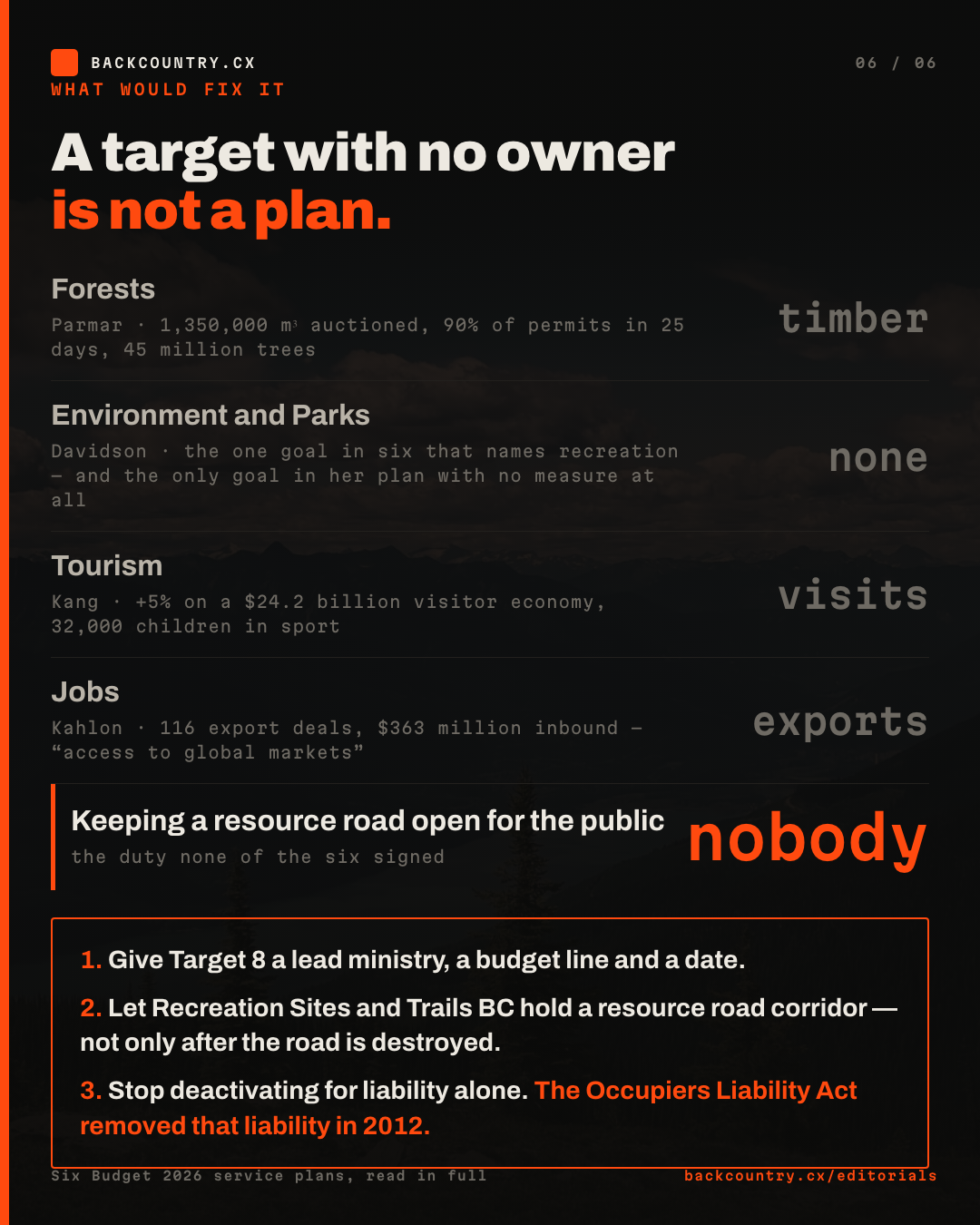
Suggested caption
In April 2025 an MLA asked the Minister of Environment and Parks a budget question: will there be money for the roads into B.C.’s parks, recreation sites and trails?
Her answer: “The Ministry of Forests is the one that has the responsibility for the roads… I would welcome the members to canvass the Minister of Forests.”
The next day he did. The Minister of Forests gave the figures — $20.3 million and $47.83 million of road capital — and added: “these are dollars not for rec sites or for recreation.”
Two ministers, twenty-four hours apart, each pointing at the other. Between them sit 60,000 kilometres of forest service road.
Thirteen months later the same minister signed B.C.’s Outdoor Recreation Strategy. Target 8 says recreation access “depends heavily on resource roads.” Target 1 says, in the Province’s own words, that “no single office coordinates these shared priorities.” The remedy offered is to explore setting one up.
Ninety days after that, Recreation Sites and Trails BC — an agency of her own ministry — refused the Trout Lake club’s application for the Rady Creek road, because its authority does not extend to resource roads. Two days later the Ministry of Forests confirmed deactivation.
A mandate letter is the only document that turns a government’s intention into somebody’s job. Six ministers hold a portfolio this road runs through. Not one of their letters mentions a resource road. Neither do their service plans: six signed statements of exactly what each ministry will deliver by 2028/29, measured in cubic metres, permit days, land parcels, tourism revenue and housing completions. A road is in none of them.
The strategy never names the Ministry of Forests at all — the ministry that holds every forest service road in the province, and is removing this one.
Ask the next Premier to put Target 8 in a mandate letter, with an owner, a budget and a date.
backcountry.cx/editorials/the-rest-of-the-cabinet/
#BCpoli #PublicLand #Kootenays #ResourceRoads #Outdoors
Sources
- ↩ Ministry of Environment and Parks, Look West: B.C.’s Outdoor Recreation Strategy, published 21 May 2026 — 36 pages, with a Minister’s Message at page 4 signed “Honourable Tamara Davidson, Minister of Environment and Parks.” Target 8 at page 21, “A modernized framework for high-value recreation access and resource roads”; Target 1 at page 13 and its “no single office coordinates these shared priorities” passage; the ACCESS goal at page 20; and Target 7 recording that BC Parks and Recreation Sites and Trails BC “were aligned under the same ministry” in 2023. Targets 3 and 8 are the only two of the seventeen with no “what’s in place” section. The Ministry of Forests is not named anywhere in the document. Link
- ↩ Ministry of Environment and Parks 2026/27–2028/29 Service Plan, Budget 2026, accountability statement signed by Tamara Davidson, 2 February 2026 — the ministry overview, the three goals and their objectives, the note that a Goal 2 performance measure is still being finalised, the Conservation and Recreation Division falling from $98.936 million to $93.018 million, and Appendix A, her mandate letter of 16 January 2025 reprinted in full. Link
- ↩ Ministry of Water, Land and Resource Stewardship 2026/27–2028/29 Service Plan, signed by Randene Neill, 6 February 2026 — the three goals and nine objectives, including Objective 1.2, “Advance and modernize Land Use Planning,” and Appendix B, her mandate letter of 16 January 2025. Link
- ↩ Ministry of Tourism, Arts, Culture and Sport 2026/27–2028/29 Service Plan, signed by Anne Kang, 6 February 2026 — 3,603 words, “tourism” forty times, “recreation” twice, and Appendix B, her mandate letter of 17 July 2025. Link
- ↩ Ministry of Jobs and Economic Growth 2026/27–2028/29 Service Plan, signed by Ravi Kahlon, 5 February 2026 — performance measures 1.c and 3.c on REDIP, the 740-jobs target and the “$15M annual program allocation between FY25/26 and FY28/29,” and Appendix B, the mandate letter of 25 November 2025 carrying both the Parliamentary Secretary for Rural Development clause and the Parliamentary Secretary for Trade assignment. Link
- ↩ Ministry of Housing and Municipal Affairs 2026/27–2028/29 Service Plan, signed by Christine Boyle, 6 February 2026 — 5,951 words, the three goals, and Appendix B, her mandate letter of 17 July 2025 with its thirteen housing priorities. The word “rural” does not appear in the document. Link
- ↩ Ministry of Forests 2026/27–2028/29 Service Plan, signed by Ravi Parmar, 6 February 2026 — 3,728 words, and Appendix B, his mandate letter of 16 January 2025 with its eight priorities, including the 45,000,000 cubic metre land base. Neither document contains the word “road.” Link
- ↩ Hansard, 8 April 2025, Issue 37 — First Session, 43rd Parliament, afternoon sitting, the estimates debate for the Ministry of Environment and Parks, 4:30–4:35 p.m. Donegal Wilson’s question on road access to parks, recreation sites and trails, and the minister’s two answers, the second closing “I would welcome the members to canvass the Minister of Forests.” She is attributed in the transcript as Hon. Laanas / Tamara Davidson. Hansard is set in two columns; the quotations here were taken from a page-half extraction, because a plain layout extraction interleaves the columns and produces sentences nobody said. Link
- ↩ Hansard, 9 April 2025, Issue 38 — the Ministry of Forests estimates the following day, 7:45 p.m. Donegal Wilson puts the same question to the Minister of Forests; Ravi Parmar gives the $20.3 million integrated resource operations and $47.83 million BC Timber Sales road capital figures and says “these are dollars not for rec sites or for recreation.” The same sitting carries his statement that the Ministry maintains “approximately 60,000 kilometres” of forest service roads, “roughly 12,000” of them actively. Link
- ↩ Hansard indexes and transcripts, 43rd Parliament, through the Legislative Assembly’s own document service at api.lims.leg.bc.ca/hdms/ — the Members and Subject indexes for both sessions, which carry the per-member entry counts, the Back-country recreation and Snowmobiles headings present in 2025 and absent in 2026, and the sittings quoted here: Randene Neill in oral questions, 8 May 2025, Issue 59, 10:50 a.m., under the agenda heading Back-Country Land Use in Columbia Valley and Kootenays; Anne Kang in estimates, 13 April 2026, Issue 150, Section C; and Donegal Wilson naming Rady Creek in Forests estimates, 12 March 2026, Issue 141, about 3:40 p.m. The full-text search at search.leg.bc.ca cannot be used — its certificate does not match the hostname. Link
- ↩ BC Gov News release 2026ENV0026-000592, 26 May 2026, Ministry of Environment and Parks — the 2026 Off-Road Vehicle Trail Fund. Tamara Davidson’s quote; the $25,000 to the Valemount and Area Recreation Development Association “to contribute to a much larger bridge repair, led by the Ministry of Forests”; and the statement that the fund is “a user-funded program administered by Recreation Sites and Trails BC… supported by ICBC off-road vehicle registration fees.” $500,000 across 24 projects. Link
- ↩ BC Snowmobile Federation, Nicole Matei, “BC Wants to Grow Outdoor Recreation. So Why Are We Removing Access?”, 24 August 2026 — the sentence this page relies on: “Recreation Sites and Trails BC stated they declined the Trout Lake Recreational Club’s application because its authority to authorize recreation trails generally does not extend to resource roads such as Forest Service Roads.” This is the federation’s account of what the agency stated. No decision letter is public and nobody at the agency is named. The date of 19 August 2026 is the morning after a CTV report of 18 August recorded the application as still under review, and two days before the Ministry confirmed deactivation. Link
- ↩ BC Snowmobile Federation, Nicole Matei, “Rady Creek Road: A Test Case for the Future of Recreation Access in BC”, 13 July 2026 — that the Trout Lake Recreational Club submitted “a formal partnership agreement application under the Ministry of Environment and Parks,” under which it “would collaborate with the province to assume liability and establish a sustainable insurance structure to manage the corridor.” Link
- ↩ CBC, Jacqueline Gelineau, 22 September 2026 — an unnamed Ministry of Forests spokesperson: “At this time, the decision for deactivation is final,” and the Ministry’s statement that once decommissioning and re-sloping are complete, organisations may apply for a licence of occupation under the Land Act. Link
- ↩ Selkirk Natural Resource District, Ministry of Forests. The Incomappleux FAQ of April 2025: “FSR’s are designed and built for industrial use, not public access.” And the letter of 15 September 2026 from Charlene Strelaeff, District Manager, file 285993, which states that the Ministry “will not consider transferring the road to another entity” and will “complete our deactivation work to relieve ourselves of liability.” The letter is a document held on file rather than a published record.
- ↩ Select Standing Committee on Finance and Government Services, Report on the Budget 2027 Consultation, Second Report, Second Session, 43rd Parliament — 122 pages, 81 recommendations, transmittal letter dated 11 August 2026. Recommendations 16 and 17 appear in the Environment and Parks chapter at page 33 and again in the summary at page 107. Rady Creek is not named anywhere in the report. Link
- ↩ BC Gov News release 2026ENV0024-000574, 21 May 2026 — the launch of the Outdoor Recreation Strategy. Steve Morissette’s quote in full, including the College of the Rockies and the KORE programme’s work “creating, repairing and upcycling outdoor gear”; the then Minister of Jobs and Economic Growth on outdoor recreation contributing “$4.8 billion annually”; and almost $400,000 of REDIP money to the McBride Big Country Snowmobile Association for the Renshaw bridge. The release does not contain the word “road.” Link
- ↩ Office of the Premier to Steve Morissette, MLA, 18 November 2024 — two pages, 593 words, opening “Congratulations on your appointment as Parliamentary Secretary for Rural Development in the Ministry of Finance,” and deferring his direction to mandate letters that would “provide additional direction regarding your role.” It contains no priority bullets. On the Province’s own cabinet page every minister is listed with a “mandate letter” and he is listed with a “Premier’s appointment letter.” Link
- ↩ Constitution Act, RSBC 1996, c. 66, section 12, current to 22 September 2026 — the section on parliamentary secretaries, quoted here in full. It confers a power of appointment on the Lieutenant Governor in Council and no duty, function, budget or delegated authority on the appointee. Compare section 13, which does let government establish and disestablish ministries and transfer duties between them. Link
- ↩ BC Gov News release 2026PREM0057-000949, 14 August 2026 — the cabinet change moving Ravi Kahlon to Health and Brenda Bailey to Jobs and Economic Growth. Bailey’s mandate letter of that date is, from the word “congratulations” onward, character-for-character identical to Kahlon’s of 25 November 2025 — the same thirty bullets in the same order. Both ministers announced in September 2026 that they are not seeking re-election. Link
- ↩ Occupiers Liability Act, RSBC 1996, c. 337, section 3.1 — enacted by the Forests, Lands and Natural Resource Operations Statutes Amendment Act, 2012, S.B.C. 2012 c. 14 s. 15, and brought into force 25 June 2012 by O.C. 468/2012. It deems every user of a resource road to have assumed all risks. No regulation has ever been made under the Act to narrow it. The Province announced the change under the headline “More backcountry roads to be kept open.” Link
- ↩ BC Bid opportunity 233877, “Trout Lake Rady-Cr Forest Service Road deactivation” — closing 24 September 2026 at 1:00 p.m. Pacific, with the work required to be complete by 1 November 2026.
- ↩ BC Gov News search index, queried directly. A query with no matches renders the literal string “No results found.”, so a null is a true zero rather than a parse failure. “Road deactivation” returns one release in the index’s entire history — 2012FOR0149-001257, a Chilcotin moose management agreement of 30 August 2012. “Recreation access” returns one, 2015FLNR0216-001213, “Lost Creek Road closure affects local recreation access,” 30 July 2015. “Outdoor Recreation Strategy” returns one, its own launch; “Look West” returns 148. “Rady Creek” returns none, against working controls of four for “Incomappleux” and twenty-four for “Trout Lake.” The index is frozen for the election period, which the site states on every page. Link
- ↩ BC Gov News release 2026TACS0002-000212, 4 March 2026 — the Look West Tourism Sector Action Plan, which “sets a target to double tourism revenue to $48 billion by 2036.” The Premier’s own Look West Update, 2026PREM0020-000479, 29 April 2026, says of the same plan that it “aims to double revenues to $46 billion by 2036” — two figures eight weeks apart for one plan, and neither release states what is being doubled from. Anne Kang’s “access to the outdoors” quote is in 2026WLRS0020-000388, 9 April 2026, the Adventure Tourism Hub release. Link
- ↩ Office of the Premier 2026/27–2028/29 Service Plan, signed by David Eby, 4 February 2026 — the government’s own statement of its priorities at Objective 1.1: “making B.C. into Canada’s economic powerhouse, creating good jobs and reducing costs for families, strengthening health care, and making our neighbourhoods and communities safer.” Its three performance measures are all expressed as 100 per cent. Link
- ↩ Union of BC Municipalities resolutions database, and the two regional districts this corridor runs through. Resolution B19 (2010), Rural Roads Access Maintenance Standards, sponsored by the Regional District of Central Kootenay, convention decision Endorsed — asking the Province for an improved programme of basic rural road maintenance and for remote communities and regional districts to be told which rural roads are maintained and which are not. Resolution EB21 (2020), Access to Provincial Parks, sponsored by the Village of Slocan, convention decision Endorsed — resolving that access roads to provincial parks “be designated as public roads and maintained as such”; the Province’s recorded response states that its engineering budget does not cover road repairs for BC Parks access and that it is working with the Ministry of Transportation and Infrastructure and BC Parks to identify which resource roads can be maintained and to assign responsibility to the most suitable ministry. On the geography: Trout Lake is an unincorporated community of Columbia Shuswap Regional District Electoral Area B (Revelstoke Rural), and Gerrard and Poplar Creek, down the same valley, are in Regional District of Central Kootenay Electoral Area D. Link