
EDITORIAL · THE AUDIT
The ministry told its auditor the deactivation rules were fixed. Then it tendered Rady Creek.
In 2020 the Auditor General of British Columbia audited every kilometre of the province’s forest service road network and concluded the Ministry of Forests was not managing it to its own policies. Nine recommendations followed. Five years on, the ministry has reported two of them complete: the one covering the rules for deactivating roads, and the one covering the money for roads that carry communities and recreation. This is that audit, finding by finding — and then one 4.4-kilometre road.
Almost everything written about Rady Creek turns on one document, and almost nobody has read it. The Auditor General’s audit of forest service roads is fifty-six pages long, it is five years old, and it describes in the ministry’s own data exactly how a public road ends up being removed rather than repaired. It is not a document about Trout Lake. It is the document that explains Trout Lake.
So here it is in full: what was audited, what was found, what was recommended, what the ministry said it had done about it, and what all of that means for 4.4 kilometres of road above a village of fifty people. Every figure below is the auditor’s or the ministry’s, with the page it sits on.
Section 01What was actually audited
Management of Forest Service Roads is dated 29 November 2020, and was released on 19 January 2021. It was conducted under section 11(8) of the Auditor General Act, it covered the period 2016 to 2019, and it was transmitted to the Speaker of the Legislative Assembly over the signature of Michael Pickup, Auditor General, in January 2021.01 The body audited was the Ministry of Forests, Lands, Natural Resource Operations and Rural Development — the ministry that is today the Ministry of Forests. Same Engineering Branch, same natural resource districts, same funding policy.
The audit asked one question: did the ministry manage safety and environmental risks by inspecting, maintaining and deactivating forest service roads as required by legislation and policy? The answer, printed three times in the report’s own front matter, was no.
We concluded that the Ministry… did not manage safety and environmental risks on FSRs in accordance with its policies.
Office of the Auditor General of British Columbia · Management of Forest Service Roads, p. 25
One limit on that conclusion belongs up front, because it also limits everything built on it. The auditor says plainly: “We did not assess in the field whether roads were safe and environmentally sound.”01 This is an audit of records, data and policy compliance. It does not say a bridge is about to fail. It says the ministry could not demonstrate it knew.
Section 02The network, and the category Rady Creek falls into
British Columbia has approximately 58,000 kilometres of forest service road. The natural resource districts are responsible for 38,000 kilometres of it and BC Timber Sales for 20,000; around 30,000 kilometres of the total is maintained by industrial road use permit holders rather than by the ministry directly.01
Inside that network sits a smaller category, and it is the one that matters here. The audit defines it at page 23:
FSRs that provide access for communities (of 50 or more year-round residents), rural residences or “high-value” forest recreation sites and trails or “important” recreational areas… are financially capitalized by the ministry. These FSRs are referred to as “capital roads.”… They are therefore unlikely to be deactivated by the ministry and require continual maintenance.
Management of Forest Service Roads, p. 23 · approximately 12,000 km of the network02
Read the test rather than the label. Fifty or more year-round residents. Or rural residences. Or high-value recreation sites and trails. Trout Lake’s own recreation club counts just over fifty full-time residents, and the corridor above it is the way in to the area’s recreation. That is two of the three limbs of a test written by the ministry now paying to remove the Rady Creek road.13
Whether the ministry has in fact designated this road as a capital road is a question only its own register answers, and that register is not public. The question is worth putting to it directly, because on the ministry’s own definition a road like this one is unlikely to be deactivated.
Section 03The money: a rising ask against a flat cheque
Districts do not set their own maintenance budgets. They identify what their forest service roads need, request it, and the Engineering Branch allocates. The audit put three years of those requests beside three years of those allocations.
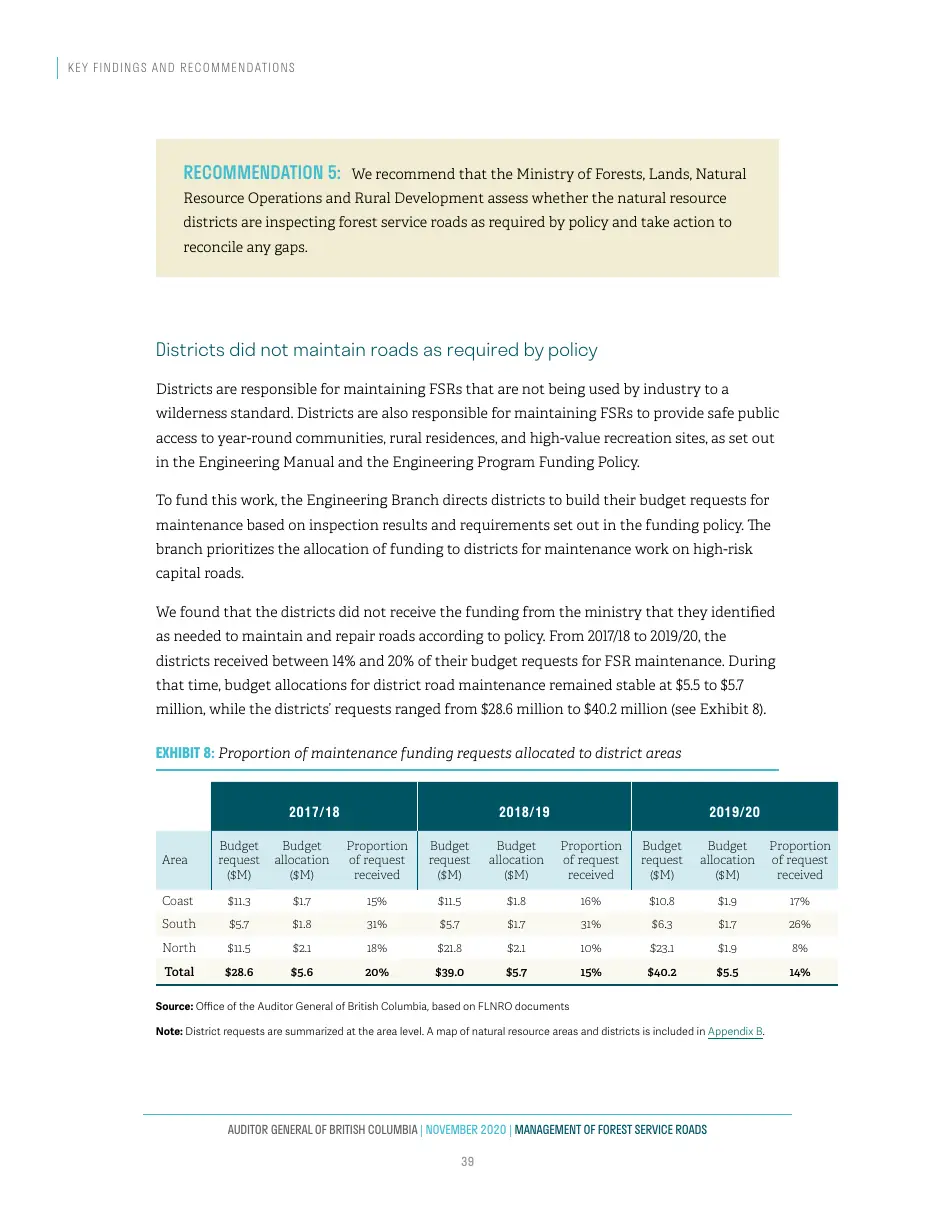
What districts asked for to maintain forest roads, and what they were given
Office of the Auditor General of British Columbia, Management of Forest Service Roads · Exhibit 8, p. 39. Figures are area totals; districts are summarised at area level in the source.03
The request rose by 41 per cent across three years. The allocation moved by $100,000, and moved down. In 2019/20 the districts received 14 per cent of what they had told the ministry the roads needed.03
That is the figure most often quoted from this audit, and on its own it is the least useful one in it, because it says nothing about what the money was for.
Section 04What the money was for
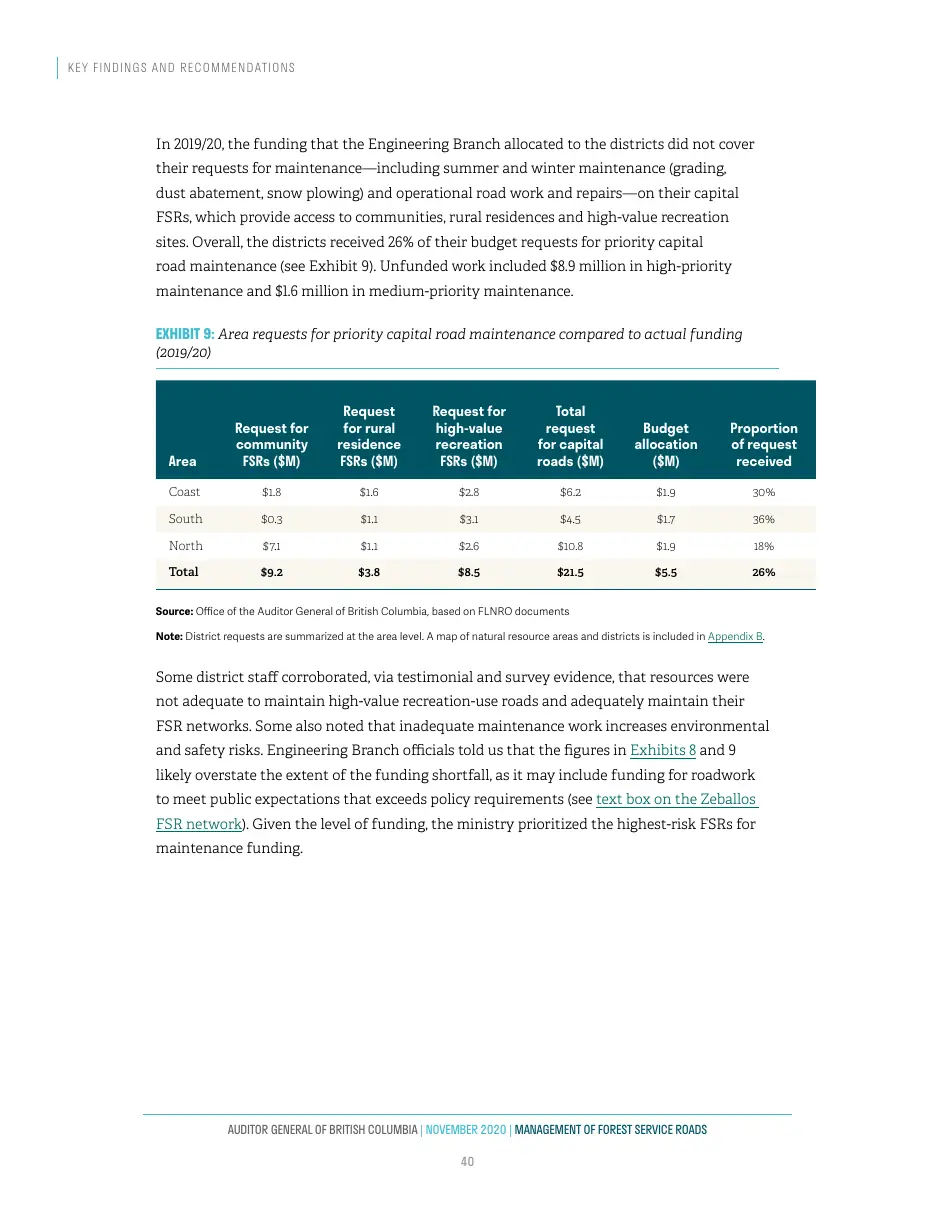
Exhibit 9 breaks the 2019/20 capital-road request into its three parts — the roads that carry communities, the roads that carry rural residences, and the roads that carry recreation.
The 2019/20 request for priority capital roads, by what the road carries
Exhibit 9, p. 40. Unfunded work included $8.9 million in high-priority maintenance and $1.6 million in medium-priority maintenance.04
High-value recreation roads accounted for $8.5 million of a $21.5 million request — forty per cent of it, and within $700,000 of the community-access category. Recreation is not a fringe of this programme. It is most of it. The whole capital-road request was funded at 26 per cent.
Break the same exhibit down by area and the picture sharpens again.
The same request, by natural resource area
Exhibit 9, p. 40. The South area contains the Selkirk Natural Resource District, which holds the Rady Creek file.04
In the South — the area that contains the district now tendering Rady Creek — the single largest category of capital-road request was not community access and was not rural residences. It was high-value recreation, at $3.1 million of a $4.5 million ask. The area received $1.7 million against it.04
What it shows
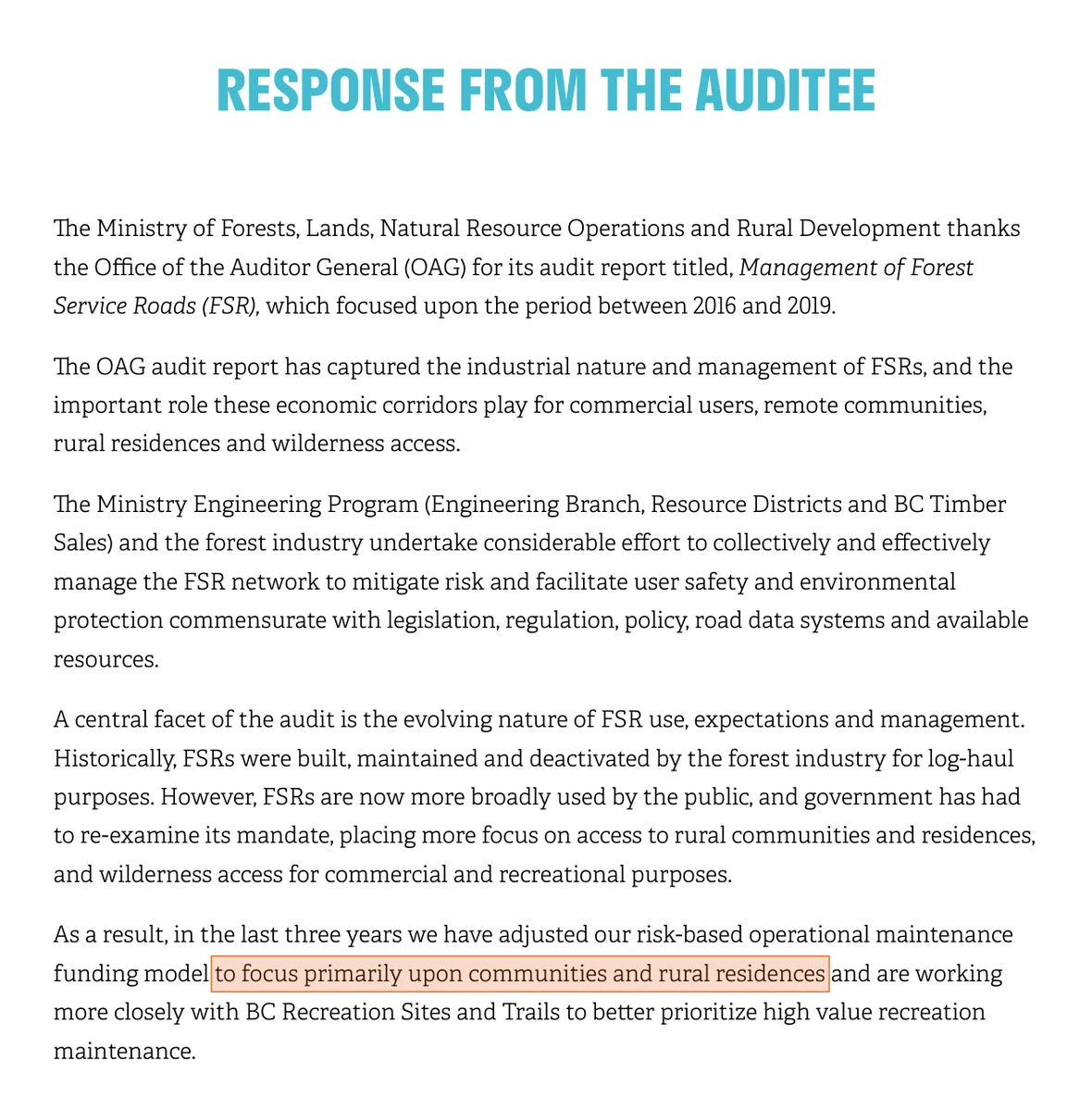
The ministry was invited to answer inside the report, and it did. In the same response that accepts that forest service roads “are now more broadly used by the public,” it states that it has “adjusted our risk-based operational maintenance funding model to focus primarily upon communities and rural residences.” Communities and rural residences are the first two limbs of the capital-road test. High-value recreation is the third — and it was $8.5 million of the $21.5 million the districts asked for. Told it was not maintaining these roads, the ministry moved recreation down the list.
Section 05Six thousand six hundred and forty structures
Money is abstract. Bridges are not. There are 6,640 crossing structures on the province’s forest service roads — bridges, major culverts and log culverts — and 6,569 of them sit on active crossing sites. The audit followed each one through the ministry’s own Corporate Bridge Registry.05
What the ministry’s own bridge registry showed
Exhibits 3–6, pp. 31–35. Inspection coverage is measured across 2009–2019; repair and replacement status is as at 1 and 30 May 2019.05
Three of those rows deserve reading twice. High-priority repairs were overdue on 3,178 structures — 48 per cent of every crossing structure in the province — by an average of 851 days. Replacement was overdue on 583 by an average of five years. And on 585 active structures the ministry had reduced the load rating, which is the engineering way of saying a bridge can no longer carry what it was built to carry.05
Seventy-two structures had not been inspected at all in ten years, despite no access obstacle — no boat, no helicopter, nothing to stop anyone driving to them.05
Section 06Who these roads actually carry
The audit is unusually direct about what is riding on all this, and it is not timber.
70
Motor vehicle deaths on logging roads, 2010 to 2018, on BC Coroners Service data
499
Motor vehicle accidents on forestry roads, 2012 to 2016, reported by police and compiled by ICBC
420 km
The Finlay FSR — sole road access for two First Nations, and their only land escape route in flood or wildfire
The seventy deaths and the 499 accidents are at page 21. On the same page, the auditor records that “an all-terrain vehicle accident on the Foley Creek FSR near Chilliwack resulted in two fatalities.”06
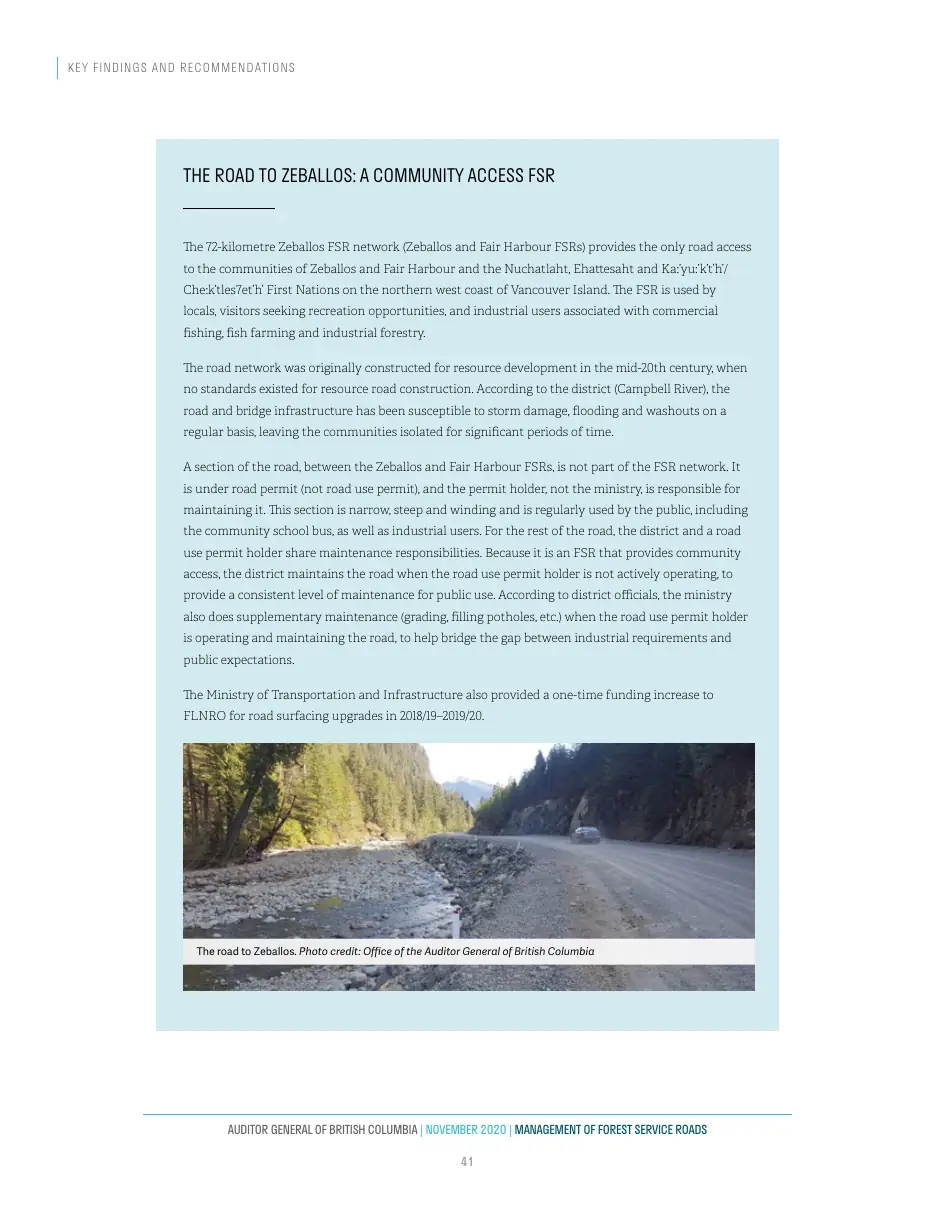
At page 19 it describes the Finlay FSR, the longest in British Columbia at around 420 kilometres: the only road access to the remote Kwadacha and Tsay Keh Dene Nations, and “the only land-based escape route in the event of flooding or wildfires.” At page 41 it describes the Zeballos and Fair Harbour network — the only road access for two communities and three First Nations — where washouts have left those communities “isolated for significant periods of time,” and where the steep, narrow linking section carrying the community school bus sits under a road permit the ministry does not maintain at all.07
And then the gap the Auditor General put to legislators himself, as the second of three questions he suggested they ask government: how will the ministry balance public expectations to keep forest service roads safe for public use, “with a mandate that does not require it do so”?14 Forest legislation requires permit holders to keep these roads safe for industrial purposes. It does not require anyone to make them safe for the public that drives them.
Section 07The filing cabinet
The auditor sampled eight of the province’s twenty-three natural resource districts. Six tracked maintenance at varying levels of detail in Excel spreadsheets. Two kept no tracking of any kind, which the report states means there was no record of required maintenance being completed. Of the responsibility-designation lists reviewed, one had last been updated in 2010, another in 2013, and two in 2014.08
None of this was news to the ministry. The audit records that its findings are “consistent with the findings from a 2008 Internal Audit & Advisory Services report — that documentation processes were informal and inconsistent, and that the ministry couldn’t ensure that risks were mitigated.” Twelve years, and the same finding.08
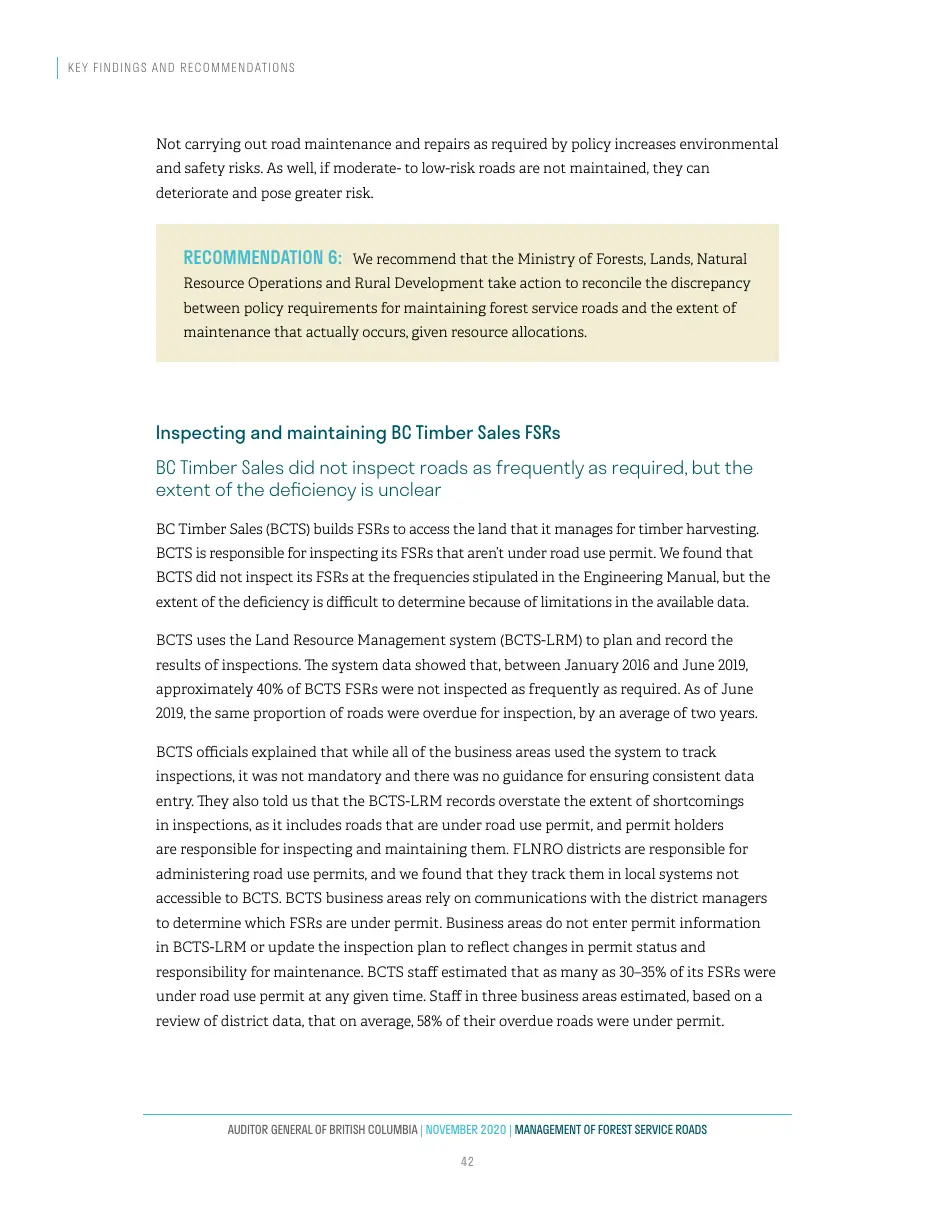
On the ministry’s own trading arm, BC Timber Sales, the audit found approximately 40 per cent of roads not inspected as frequently as required, and its system showing only 43 per cent of planned maintenance activities completed between January 2016 and June 2019. One business area had entered no planned maintenance at all; another had completed four per cent of its.09
Section 08What the deactivation rules actually say
This is the part of the audit nobody quotes, and it is the part that decides Rady Creek.
Three rules govern when a forest service road is destroyed, and the audit sets out all three.10
First, deactivation is never mandatory. In the auditor’s words: “there is no trigger or timeline for deactivation. FSRs can remain open indefinitely if they are maintained as wilderness roads.” There is no clock on the Rady Creek road. Nothing in policy requires that it be removed this year, or ever.
Second, the Engineering Manual requires the deactivation decision to weigh future access. When no longer required, roads “will be deactivated in a planned manner that considers future access needs, road user safety, cost efficiency and values at risk of damage or loss.” Future access needs is not a courtesy. It is a required input, and it cannot be weighed by a district that has held no meeting with the people whose access it is.
Third, the funding policy turns the shortfall into the reason. The Engineering Program Funding Policy “advises districts to deactivate roads that they are unable to maintain at the wilderness standard in order to mitigate risks and manage roads within available maintenance funding.” Read that beside Exhibit 8. The ministry funds fourteen cents on the dollar, and its own policy then treats being unable to maintain the road as grounds to remove it.
And there is a fourth line, in the auditor’s description of what deactivation physically is, which sits awkwardly beside what is planned at Rady Creek:
Road deactivation includes removing bridges and stream culverts, stabilizing the road prism, and barricading the road surface width in a clearly visible manner to prevent access by motor vehicles (other than all-terrain vehicles).
Management of Forest Service Roads, p. 47
The Auditor General’s description of deactivation preserves ATV access. So did Cooper Creek Cedar, the logging company that built the road, which said on its way out that it would “attempt to maintain at minimum ATV access.” The prescription for Rady Creek does not.13
Finally, the scale. Deactivation by districts is a small programme, and the audit measures it.
Six years of deactivation, against one tender
Districts and BC Timber Sales, since 2016/17, at p. 47. Rady Creek is 4,395 m under tender EN27DSE008. Over the same period the network held steady, from 57,158 km in 2016 to 57,419 km in 2019.10
One tender, on one road above one village — the Rady Creek road above Trout Lake — is 3.8 per cent of everything the province’s twenty-three districts deactivated in six years.
Section 09Nine recommendations, and where they stand
The audit made nine recommendations — six to the ministry, two to BC Timber Sales, one on road use permit oversight. The ministry’s responses are printed in the report itself, and they are not uniform: four are accepted outright, and four accept only “the intent of the recommendation.”11
Five years later, the Office of the Auditor General published its October 2025 follow-up, reviewing the ministry’s own progress report as at 31 March 2025. Of the nine, five are complete and four are not.12
01
Make forest service road information complete, accurate and accessible
Complete
02
Plan to inspect and maintain bridges and major culverts per policy
Complete
03
Reconcile the Engineering Manual and the funding policy — inspection frequency, maintenance scheduling, closing and deactivating roads
Complete
04
Enable districts to track inspections and maintenance accurately and consistently
Not complete
05
Assess whether districts are inspecting roads as required, and reconcile the gaps
Not complete
06
Reconcile the gap between what policy requires for maintenance and what actually happens, given resource allocations
Complete
07
BC Timber Sales: track inspections and maintenance accurately and consistently
Not complete
08
BC Timber Sales: assess whether it is inspecting and maintaining as required
Not complete
09
Support effective oversight of roads under road use permits
Complete
Status as reported by the ministry as at 31 March 2025 and reviewed by the Office of the Auditor General, whose review report for this audit is dated 14 July 2025. The four outstanding recommendations are each marked “intend to complete,” with anticipated dates running from September 2025 to 2026.12
Section 10Marked complete
Of the five closed, two are the two that decide what happens at Trout Lake. Both were closed on the ministry’s own account of its own work, and both are worth reading in the ministry’s own words.
Recommendation 3 — the deactivation rules. Marked complete as of 30 November 2022. The ministry reported that it had “reviewed and reconciled the discrepancies between the Engineering Manual and Engineering Program Funding Policy,” and that this had “eliminated the conflicting guidance for FSR inspection frequency, timing of maintenance works and deactivation.” The policy was renamed the Engineering Roads Funding Policy.12
So on the ministry’s own account, the rules governing when a public road is destroyed have been consistent and unconflicted since November 2022. Rady Creek was prescribed, tendered, and re-tendered after that date.
Recommendation 6 — the money. This was the auditor’s instruction to reconcile the gap between what policy requires for maintenance and what the ministry actually does, given what it allocates. It is the starve-then-cite loop, named by the auditor and handed back to the ministry to fix. It is marked complete, on this basis:
As of November 30, 2022, the Ministry has secured or requested funding needed to undertake the $21.5 Million of maintenance on priority capital forest service roads that provide access to communities, rural residences and high value recreation sites in 2022/23.
Ministry of Forests progress report, in the Office of the Auditor General’s October 2025 follow-up, p. 4912
Two things about that sentence. The first is the figure: $21.5 million is exactly the capital-road request from Exhibit 9 — the one the audit recorded being funded at $5.5 million. The second is the verb. Secured or requested. Requesting the money is what the districts were already doing in 2017/18, 2018/19 and 2019/20, when they received twenty, fifteen and fourteen per cent of it. A recommendation about the distance between asking and receiving is reported closed by a sentence that does not say which one happened.
Section 11Rady Creek, against the audit
Set the tender beside the document, line for line.
—
A road serving a community of fifty-plus year-round residents and the area’s recreation is, on the ministry’s definition, unlikely to be deactivated
Tendered for removal
—
Deactivation has no trigger and no timeline; a road may remain open indefinitely at wilderness standard
Deadline of 1 November
—
The deactivation decision must consider future access needs
No meetings in five years
—
Deactivation prevents access by motor vehicles other than all-terrain vehicles
ATV access ends
—
High-value recreation was $3.1M of the South area’s $4.5M capital request
Funded at 36%
None of that is a legal finding, and none of it is an allegation. It is the ministry’s own audit, its own policy and its own tender, put side by side. On every line the document points one way and the contract goes the other.
There is one more sentence in the audit that explains why this keeps happening, and it comes from ministry officials rather than from the auditor. Districts can close or restrict roads where maintenance obligations are not met. They rarely do:
officials told us that closing roads is not ideal and rarely happens because of economic and social pressure to keep them open.
Management of Forest Service Roads, p. 4514
Pressure from the public keeps roads open. That is the ministry’s own description of the force it is working against. At Rady Creek the same district wrote into its tender that the project is “contentious and well known to the public,” budgeted round-the-clock security against that public, and held no meeting with it.13 Handled that way, the pressure never has to be answered. It only has to be guarded.
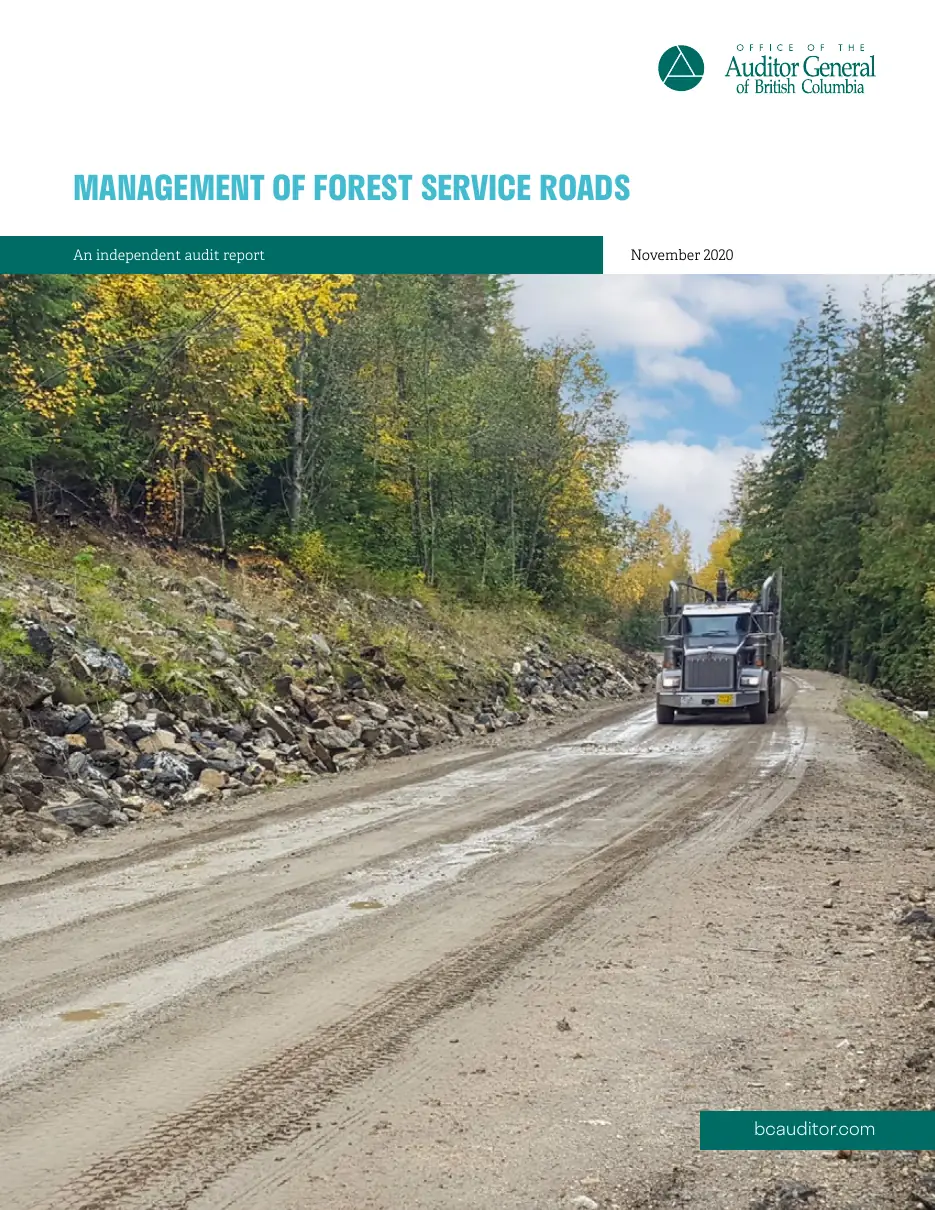
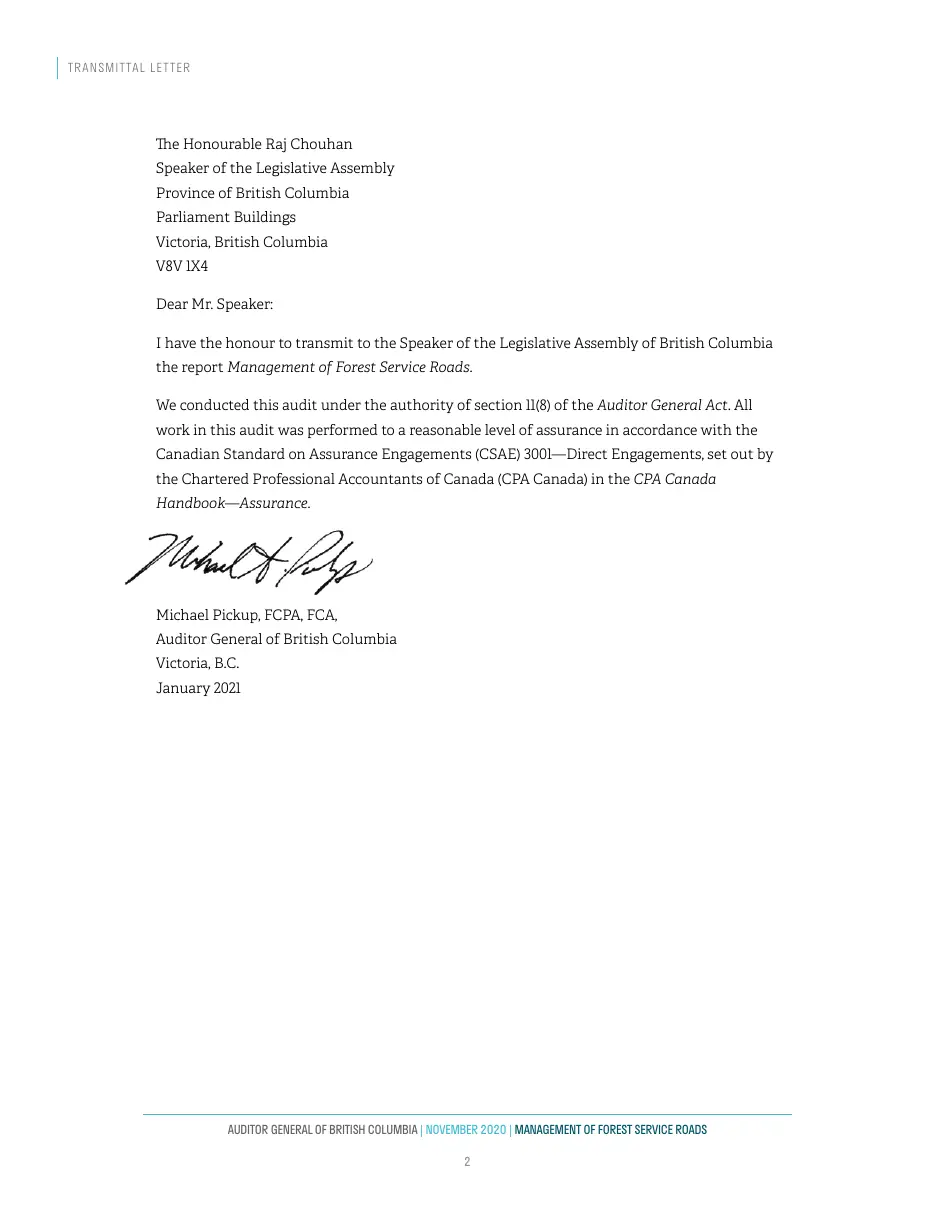
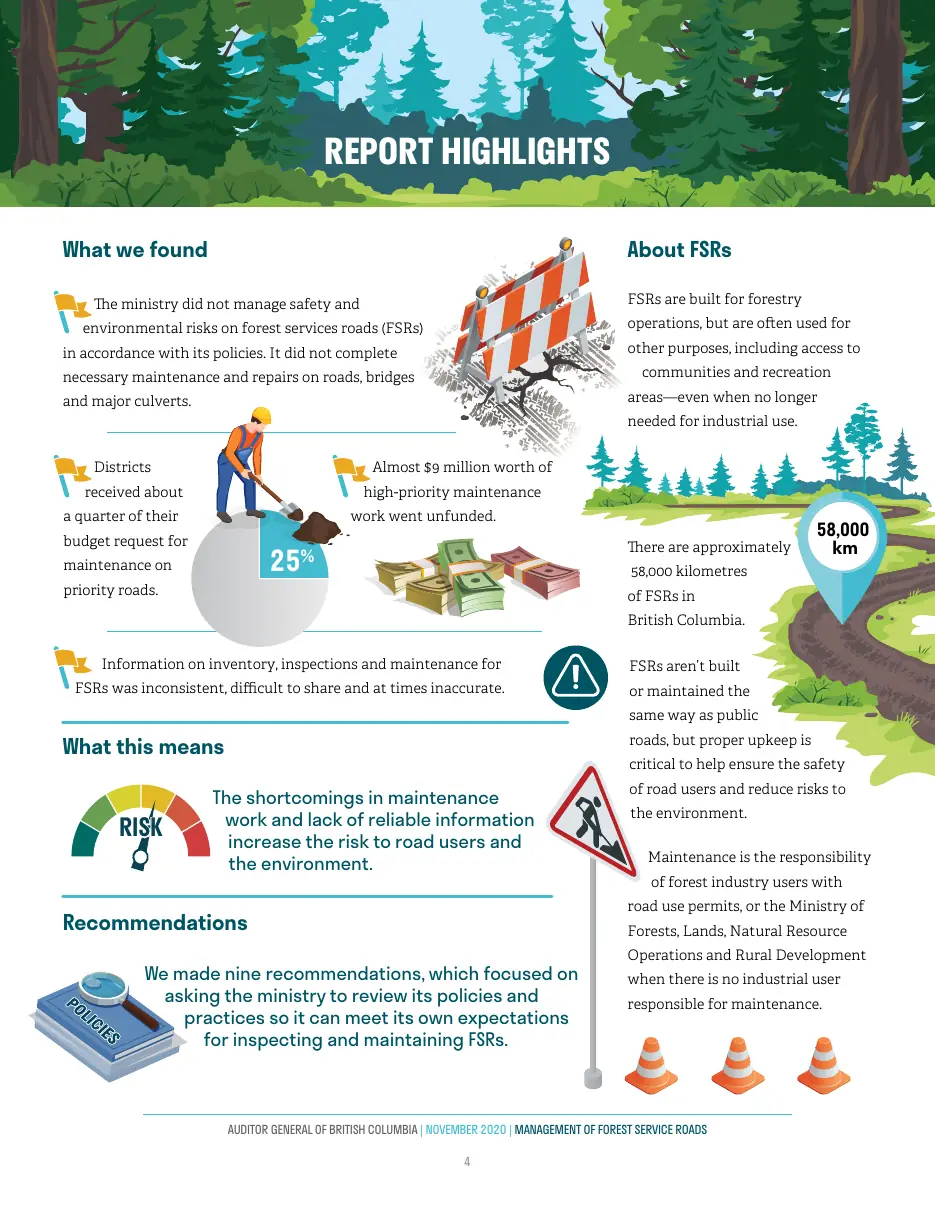
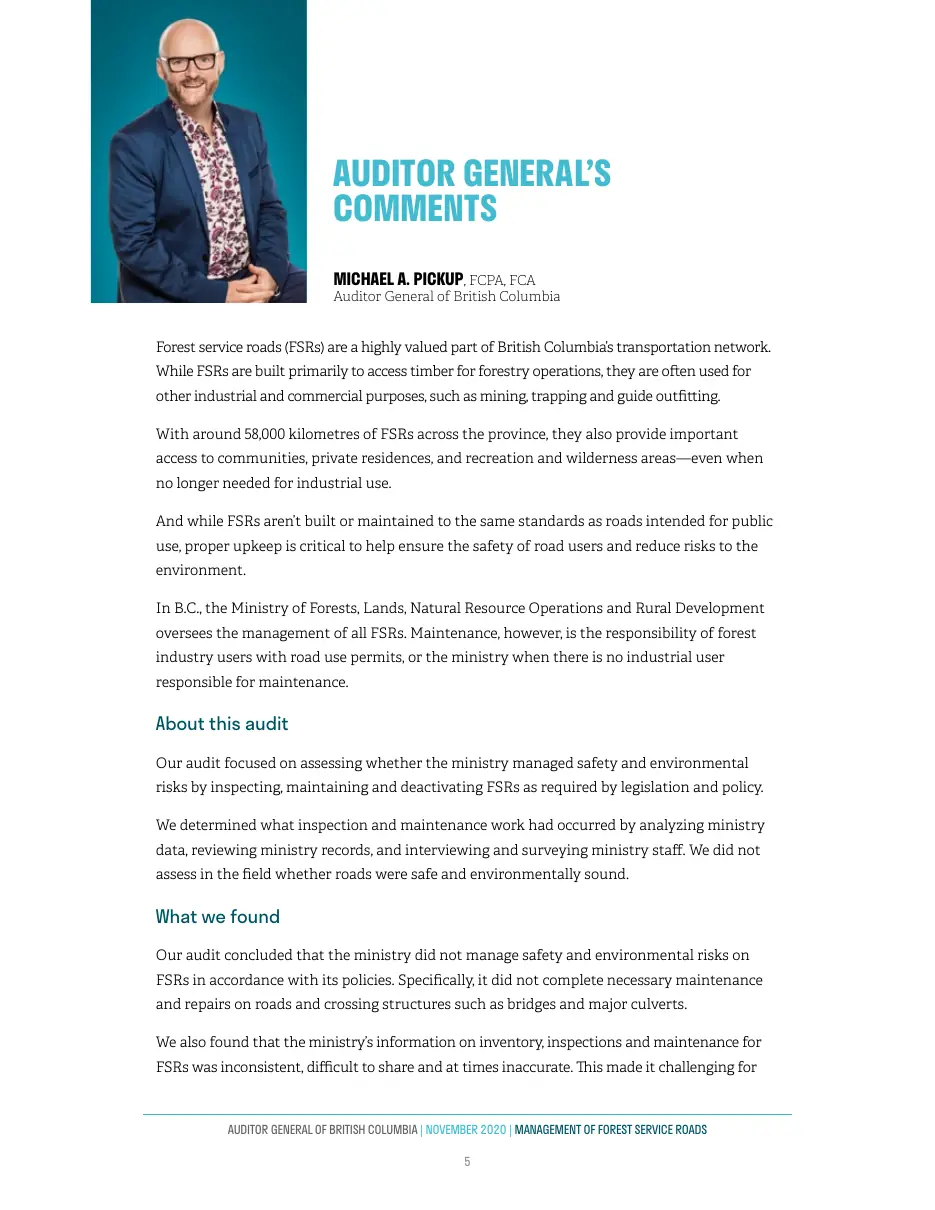
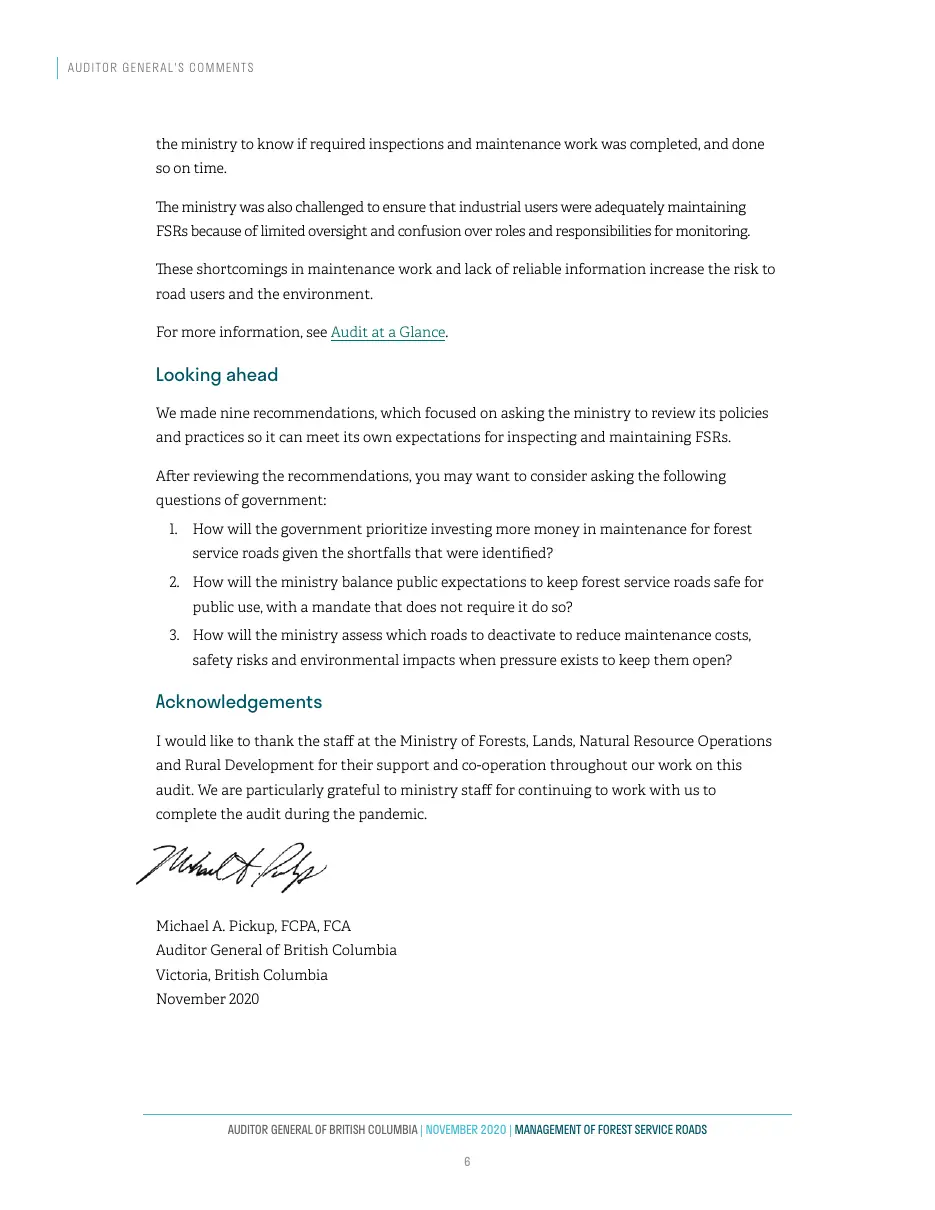
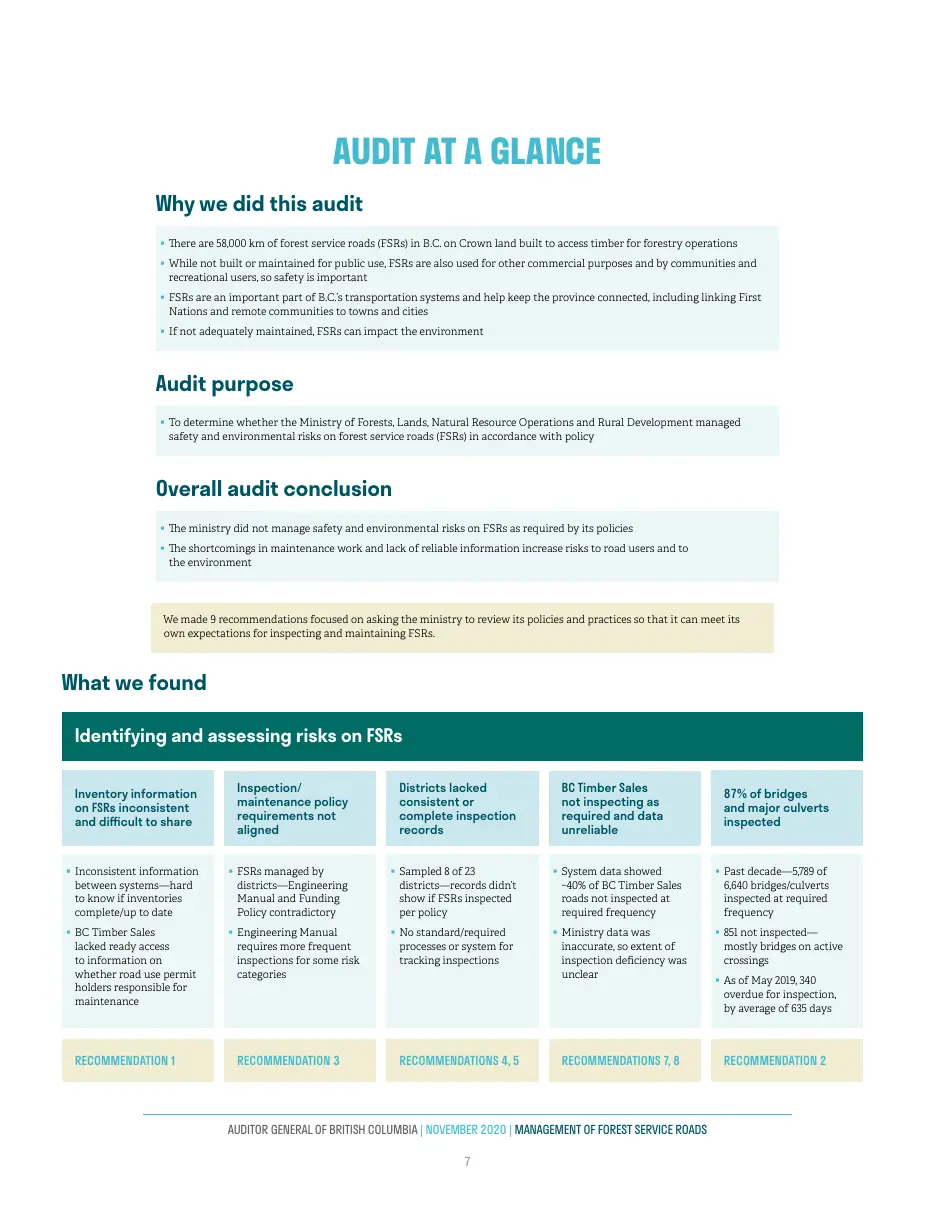
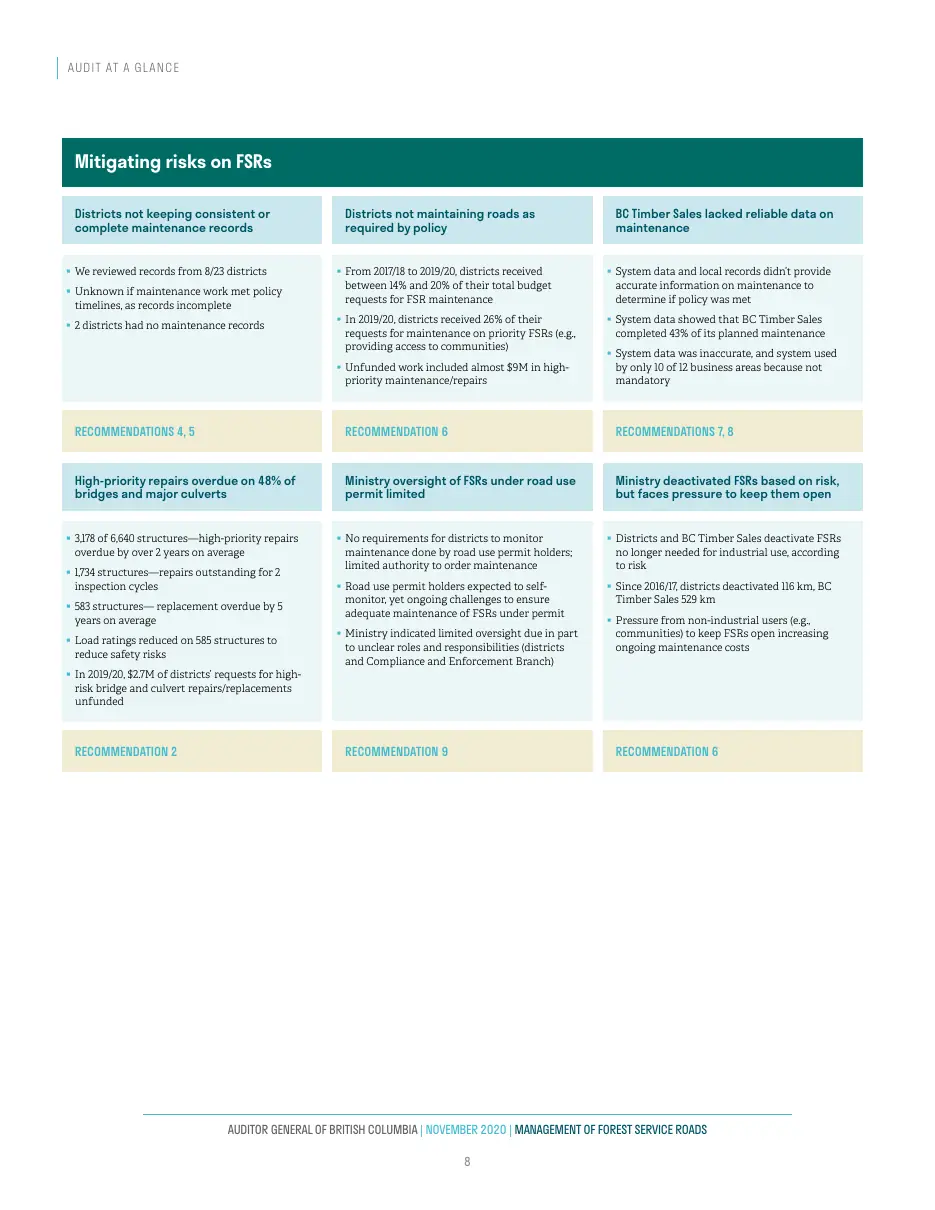
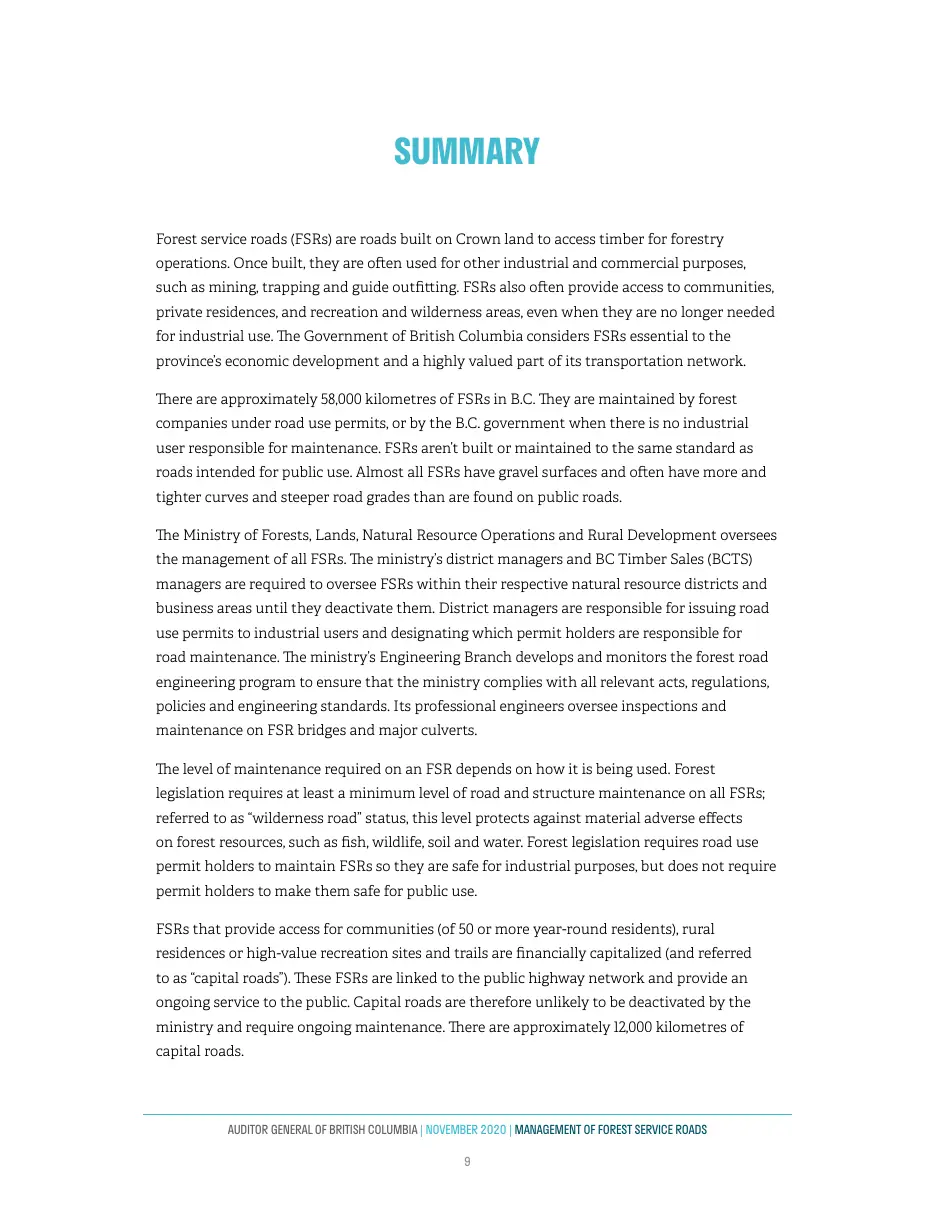
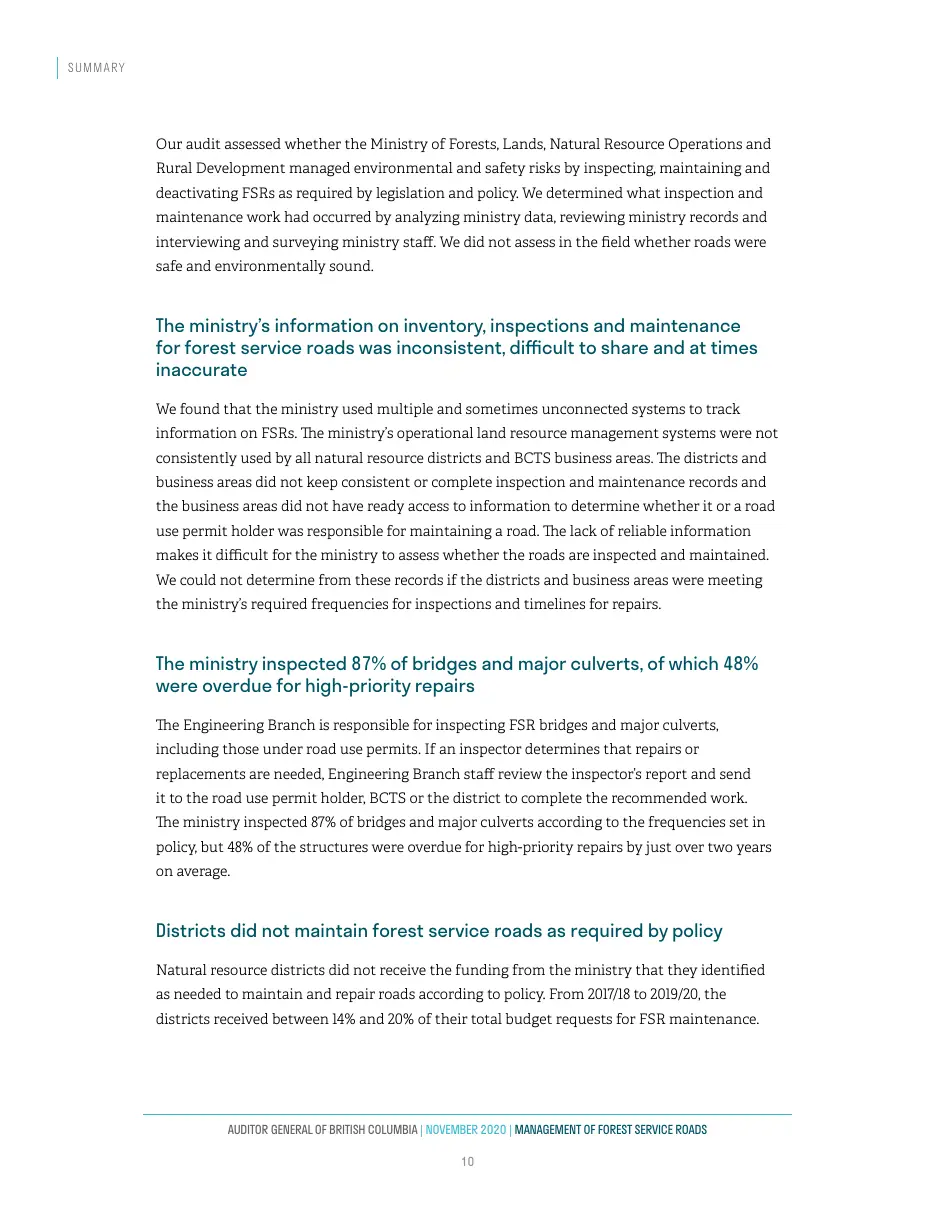
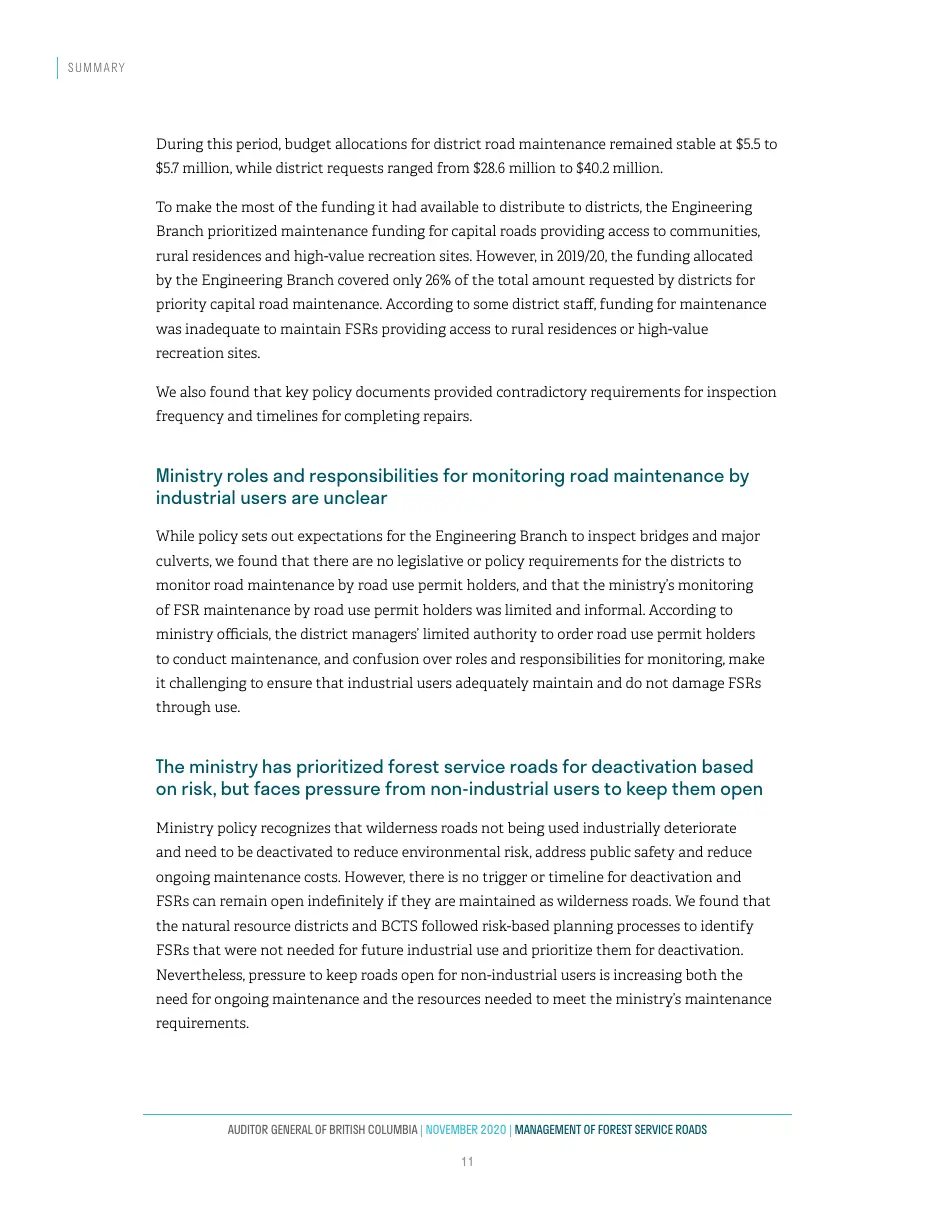
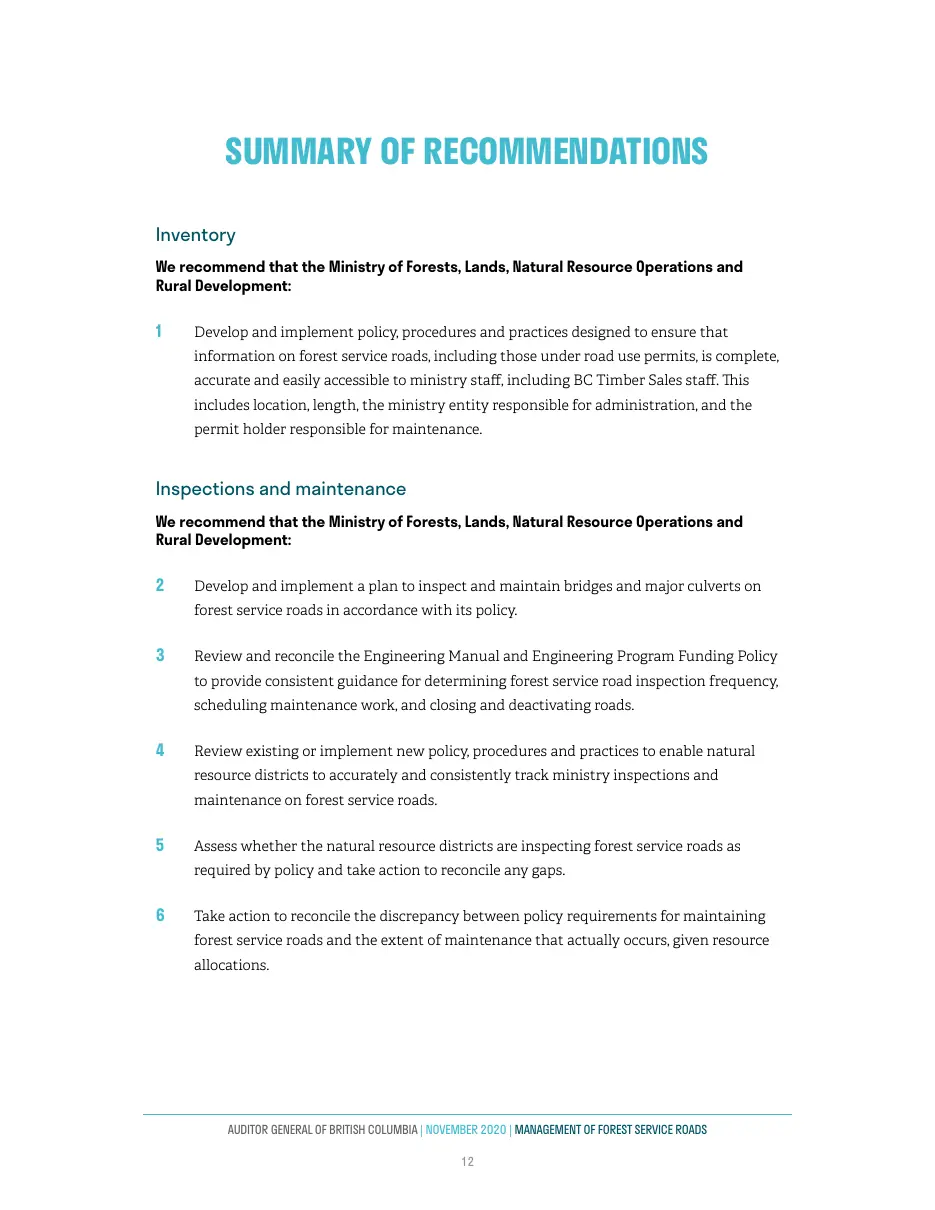
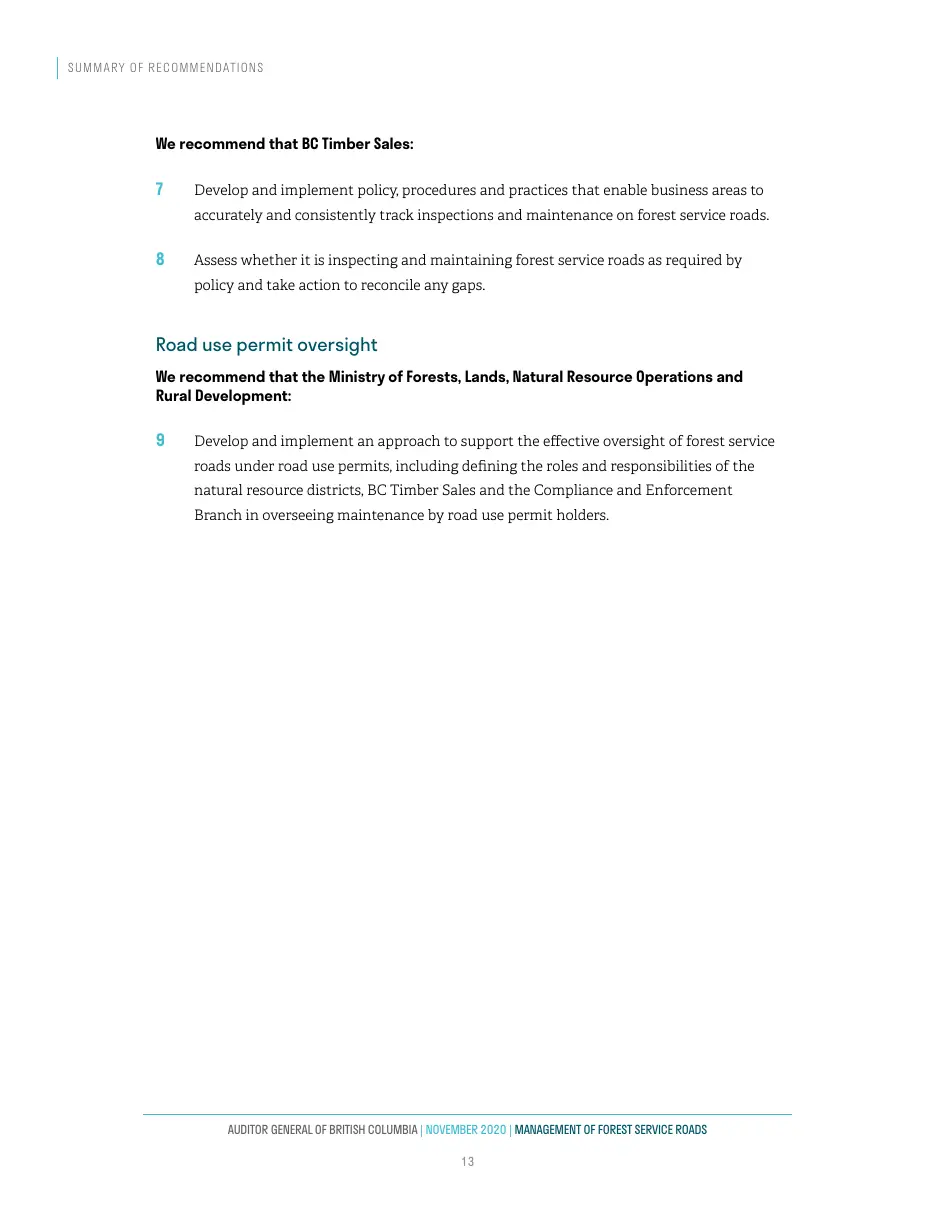
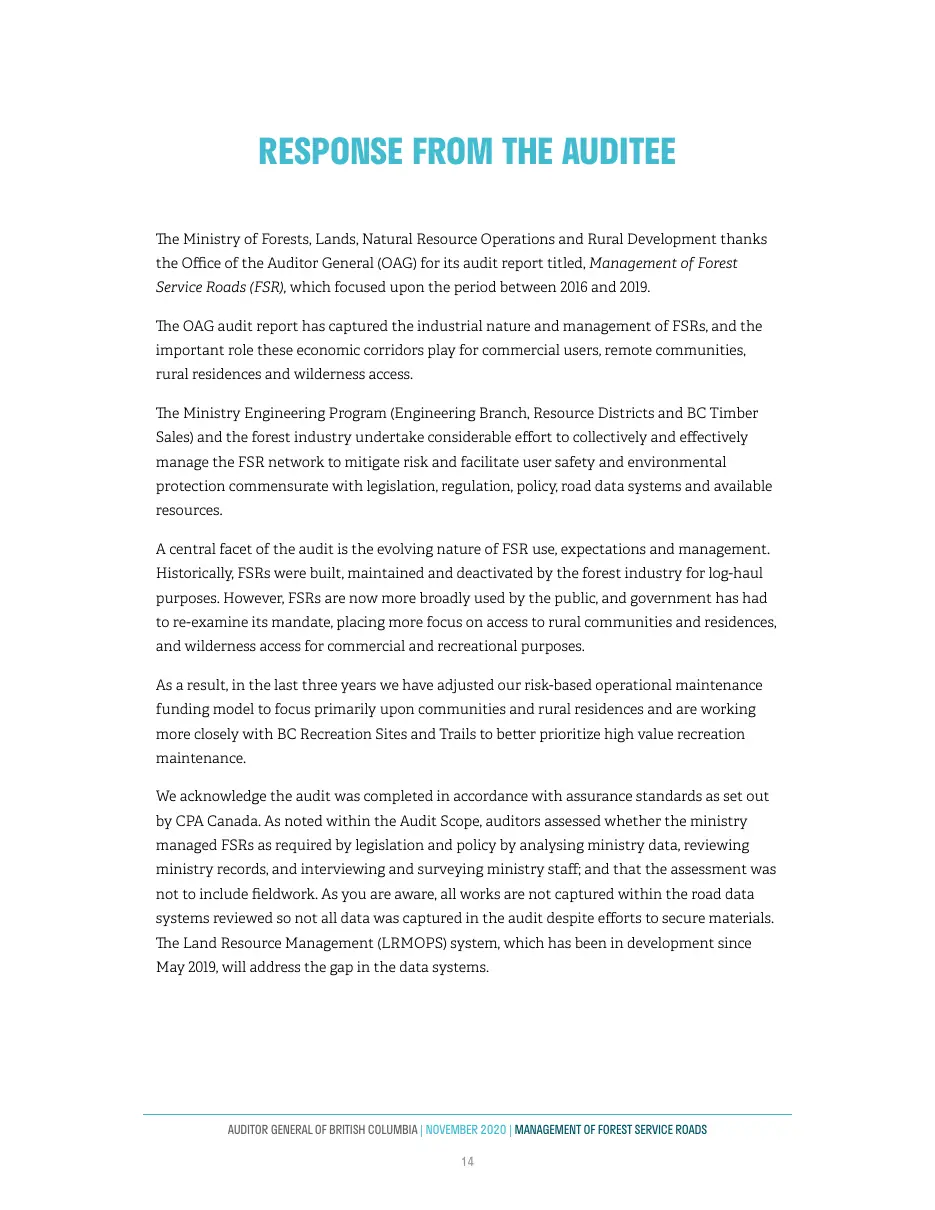
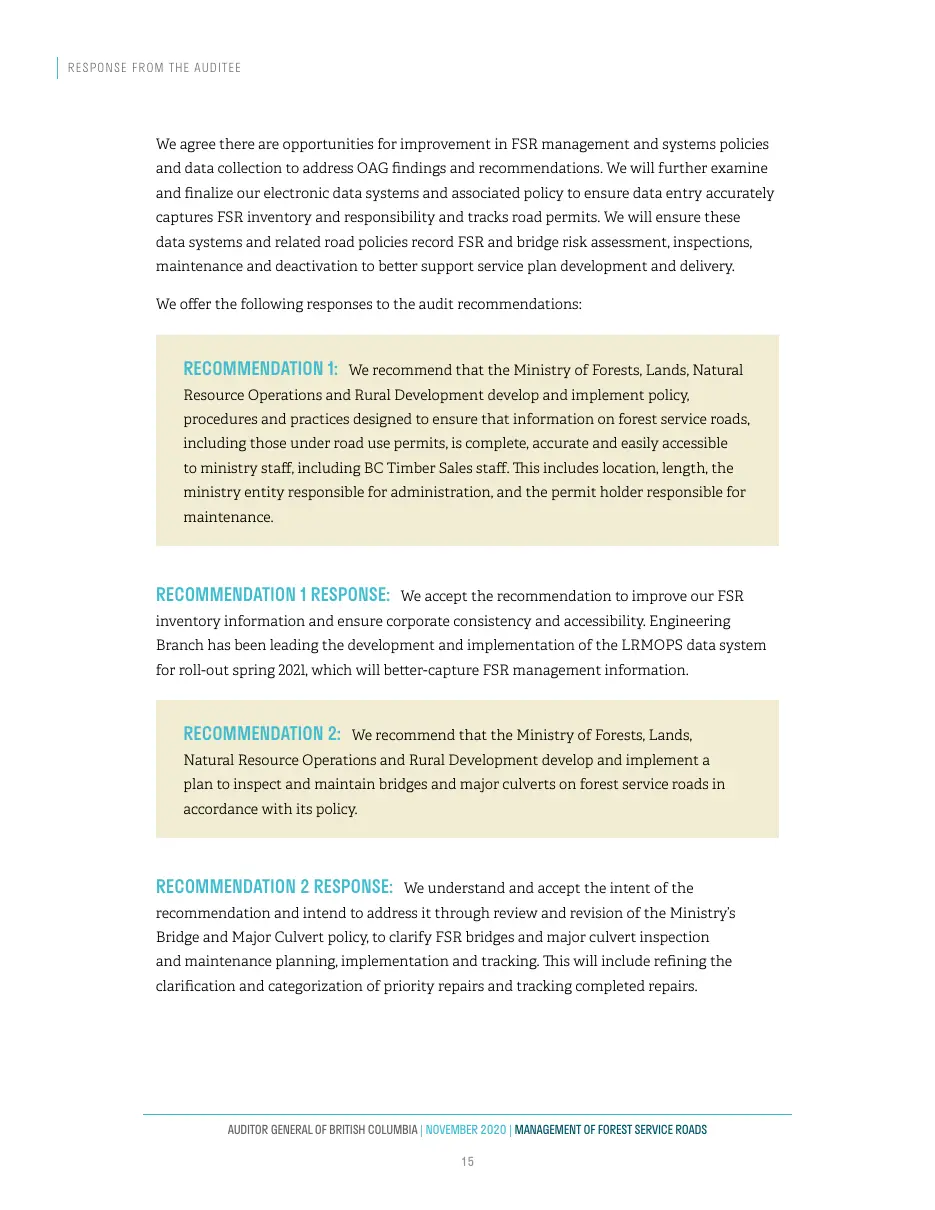
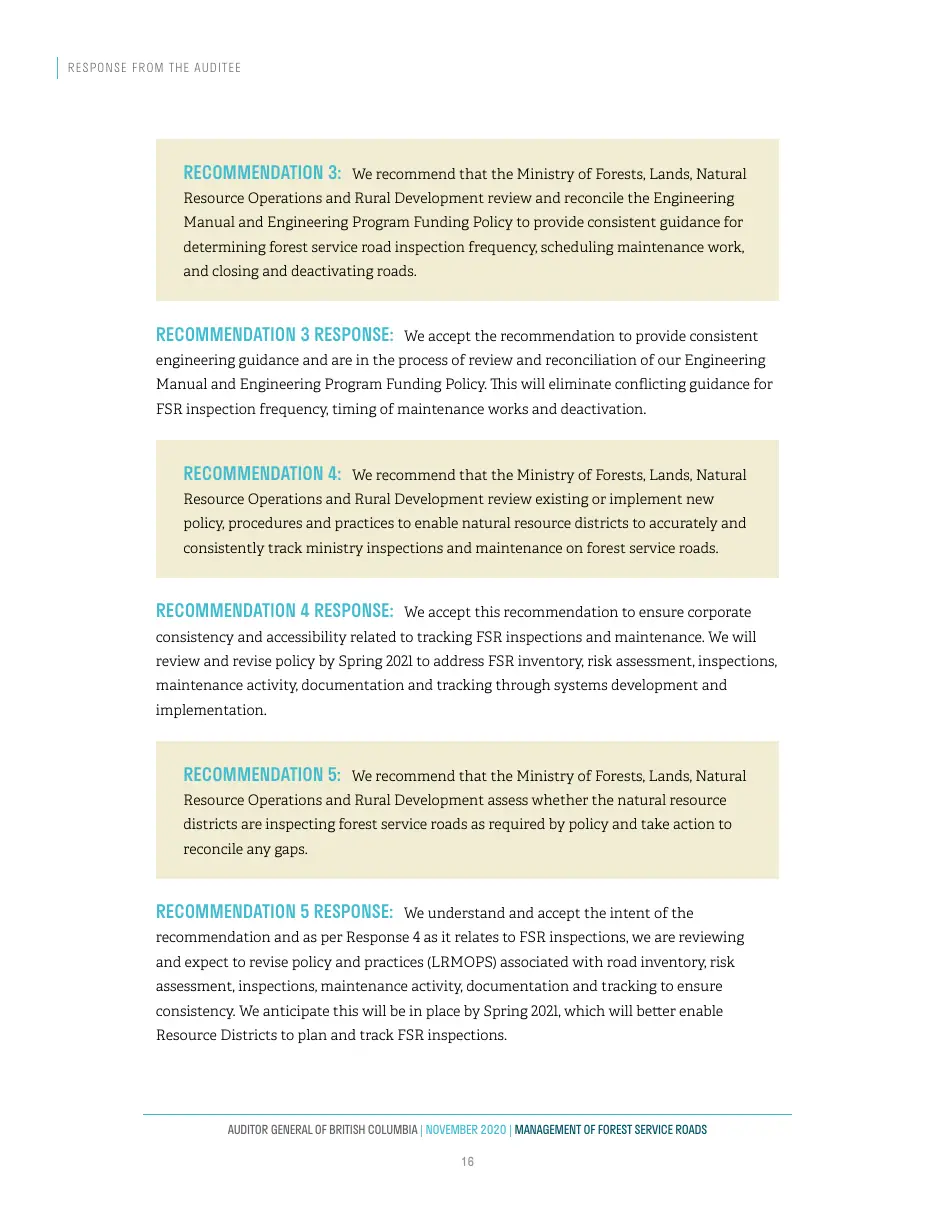
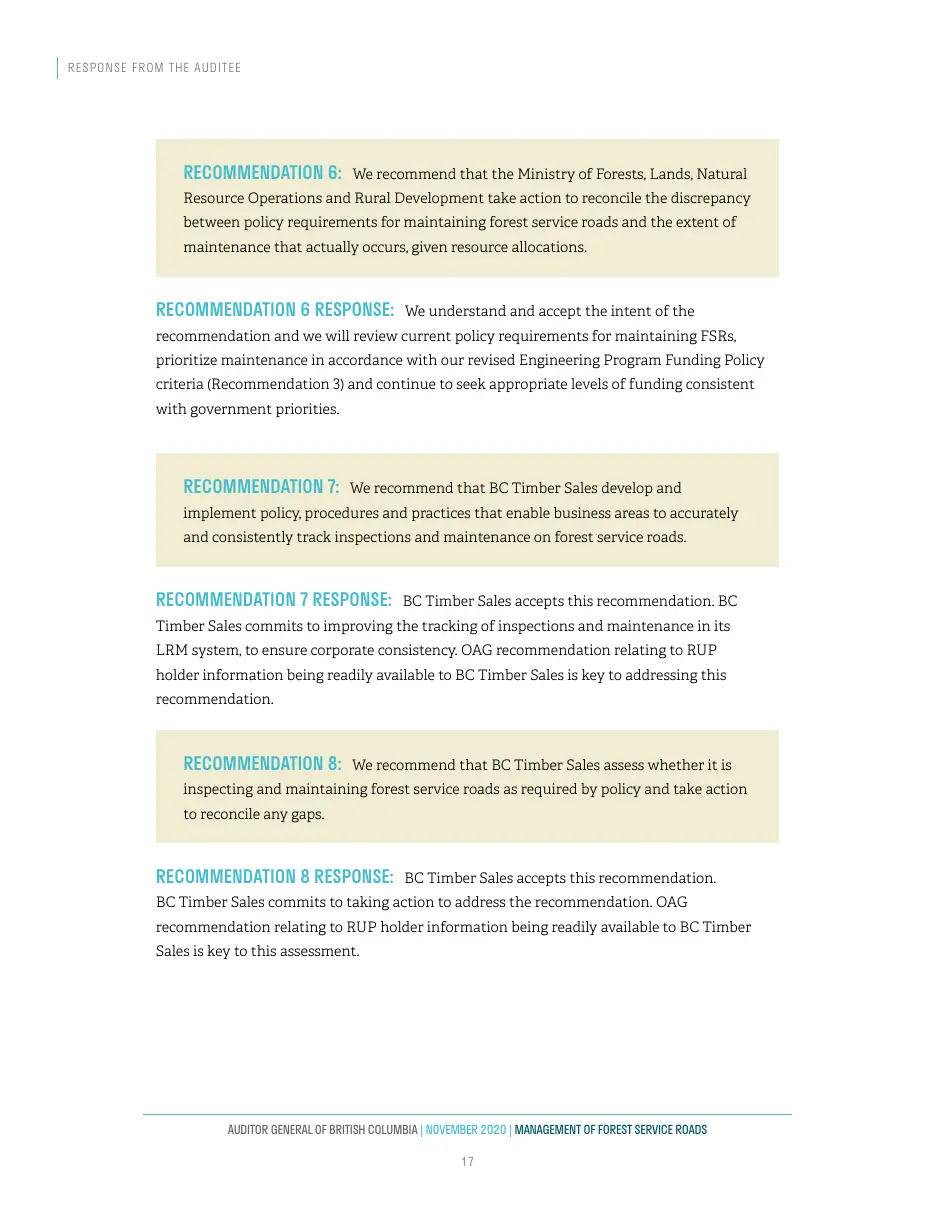
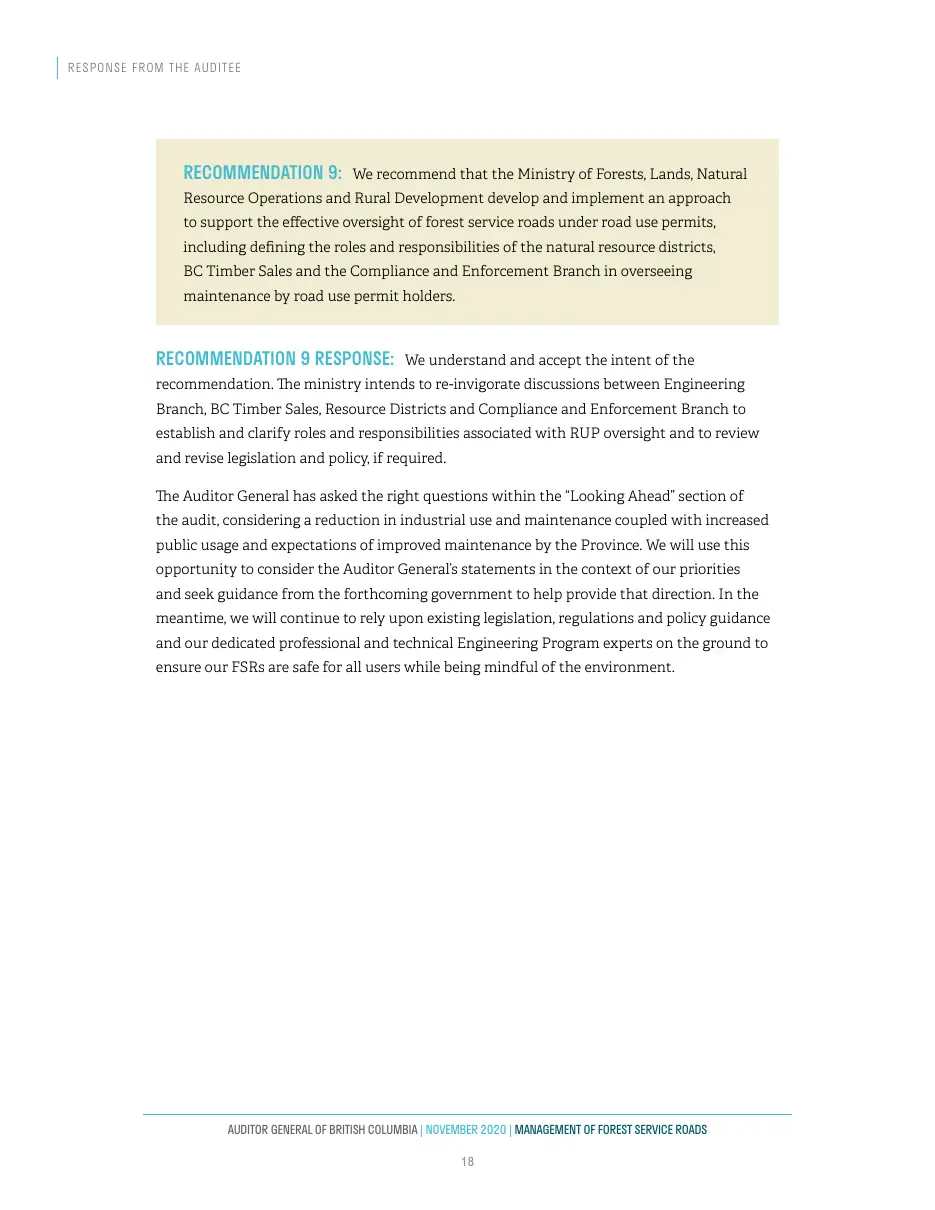
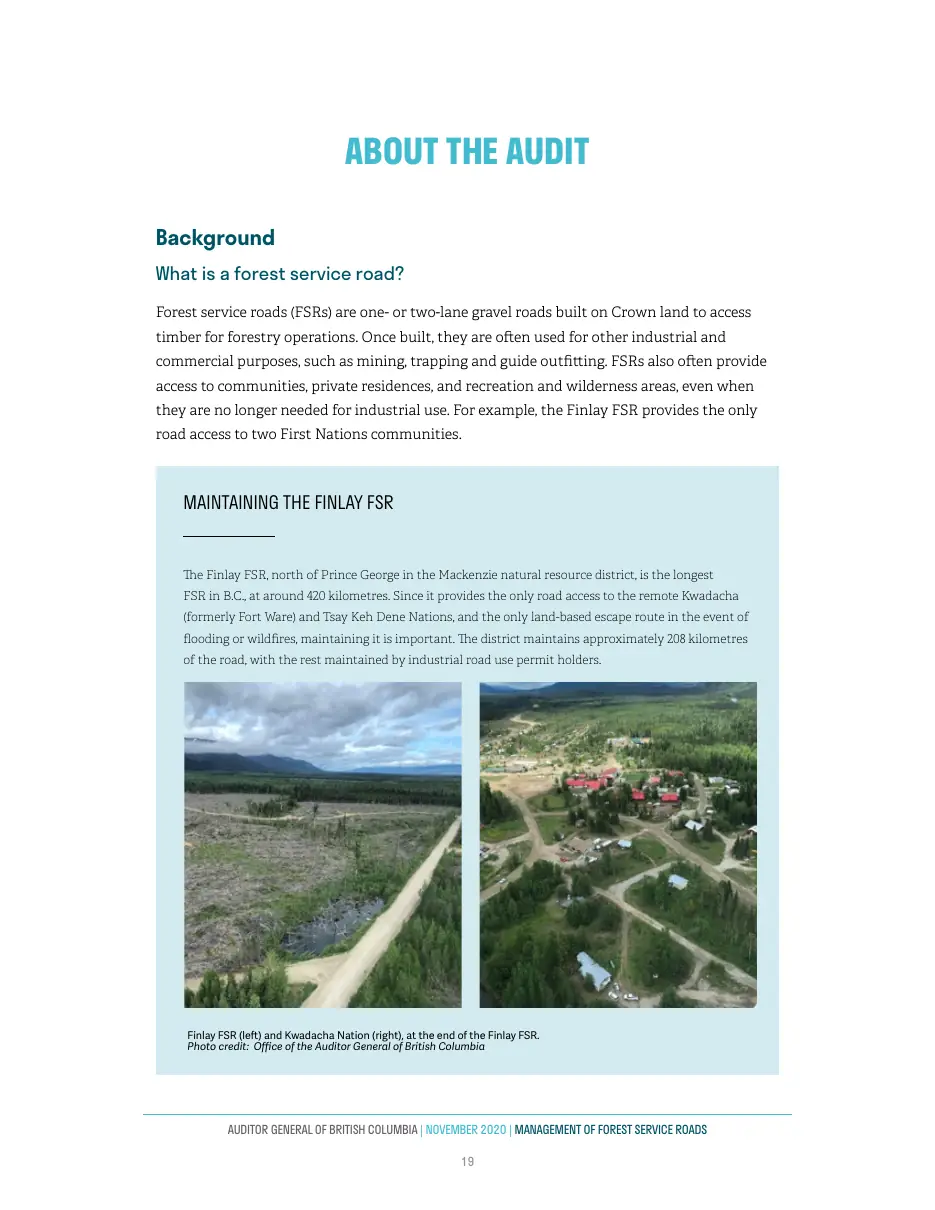
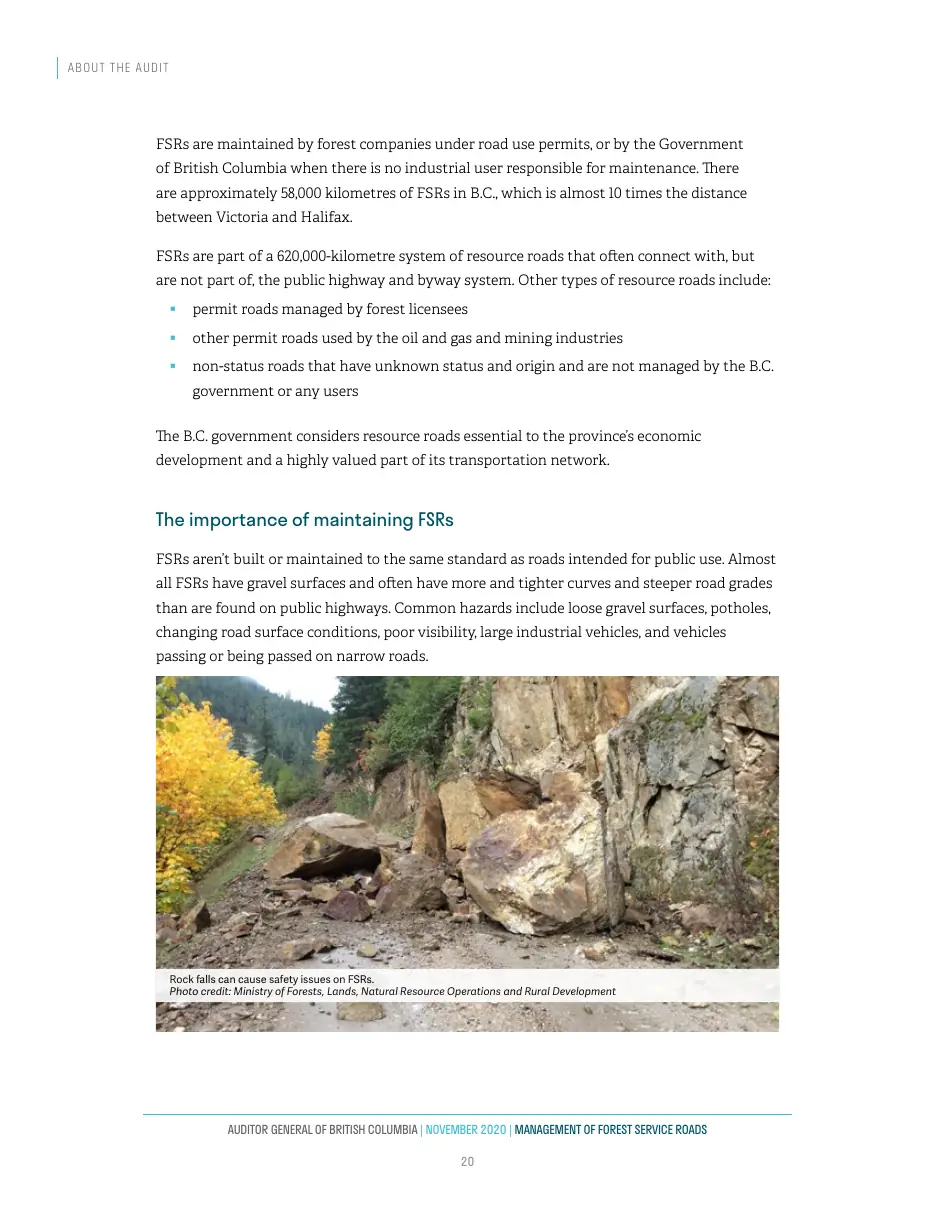
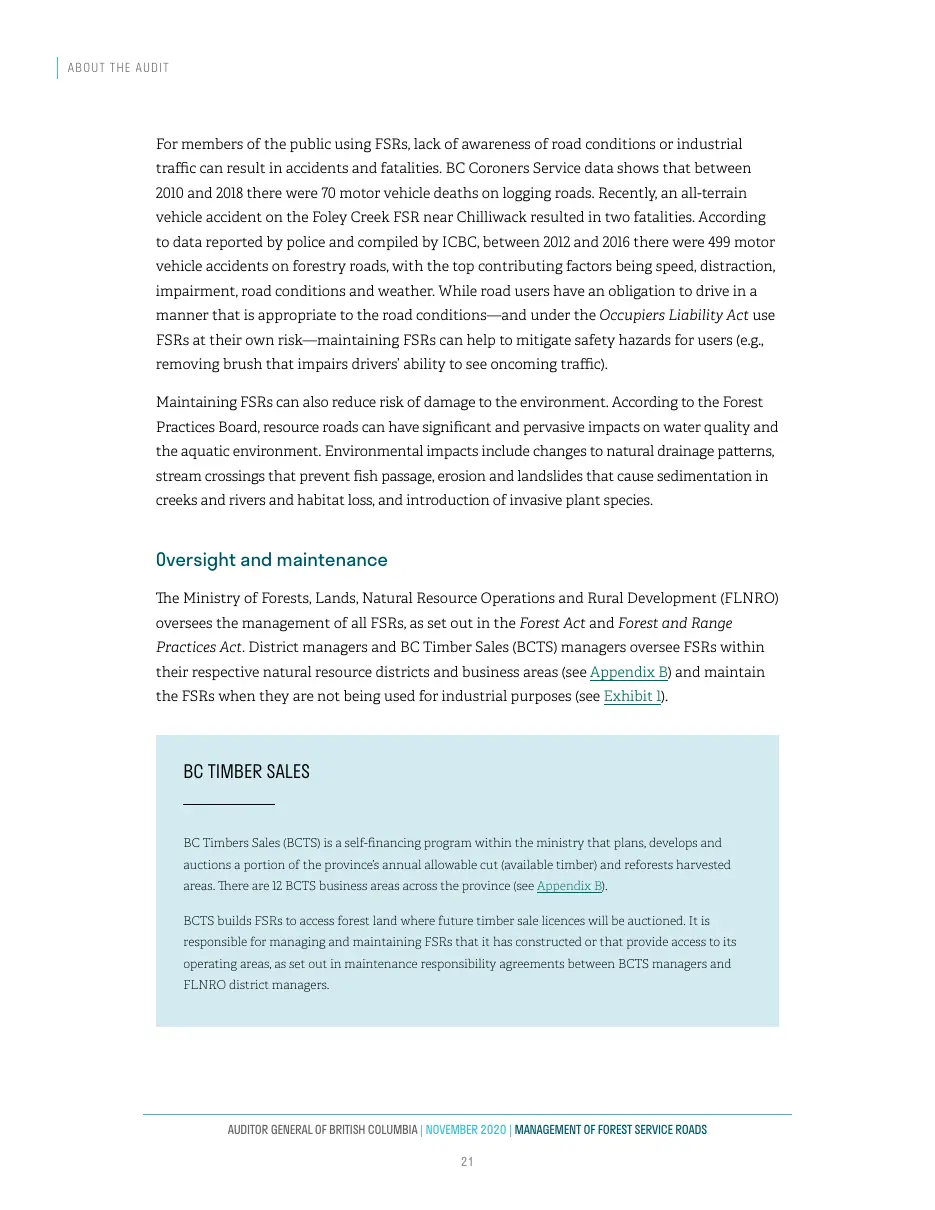
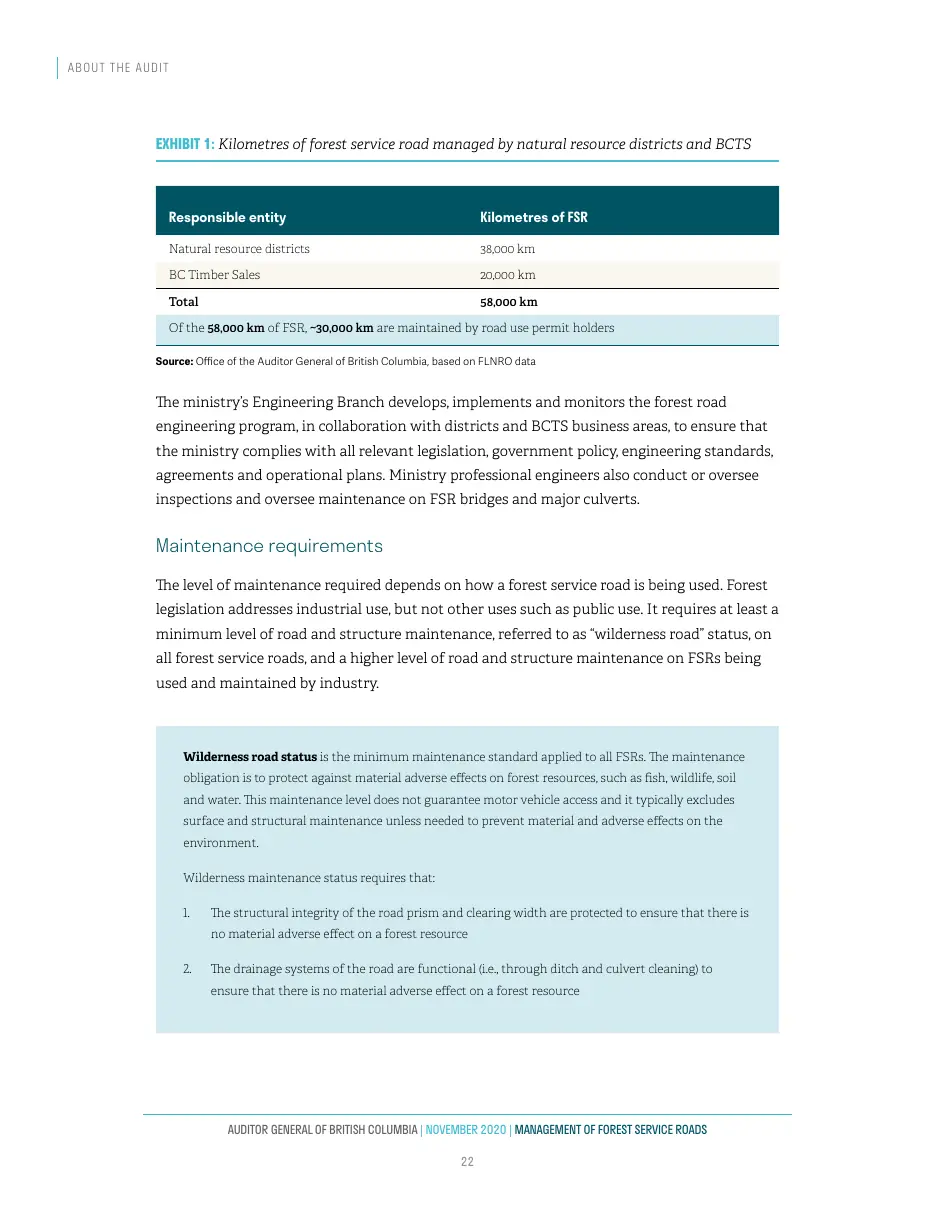
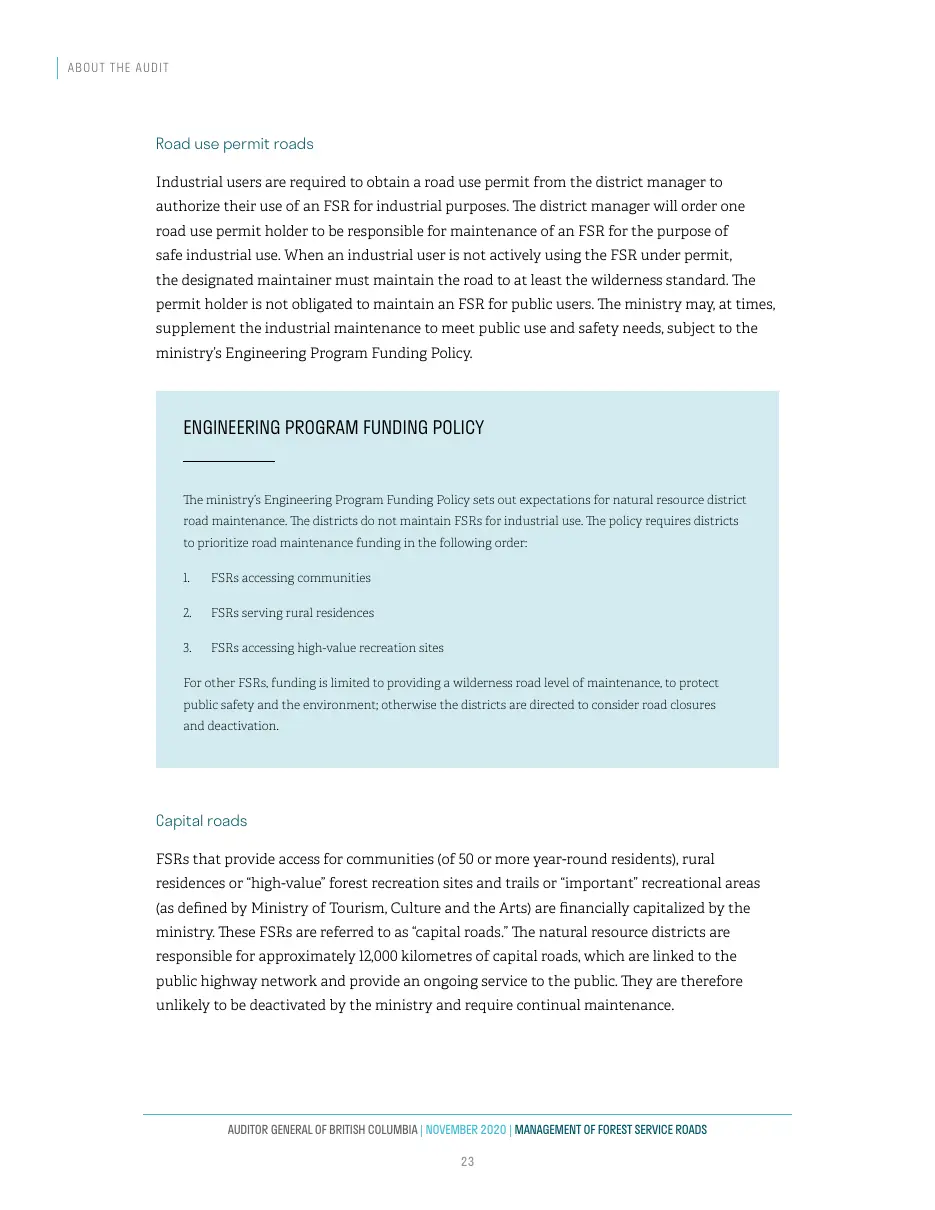
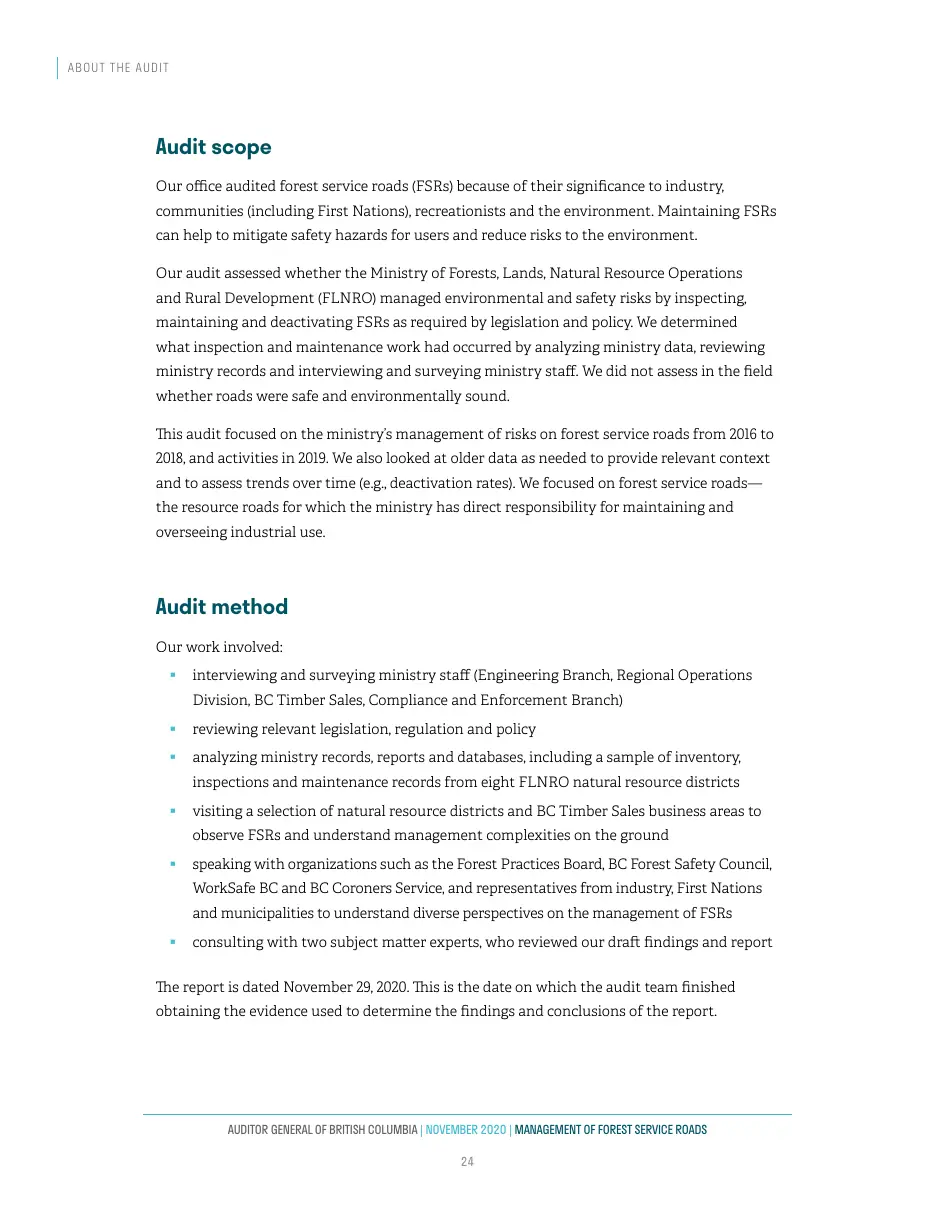
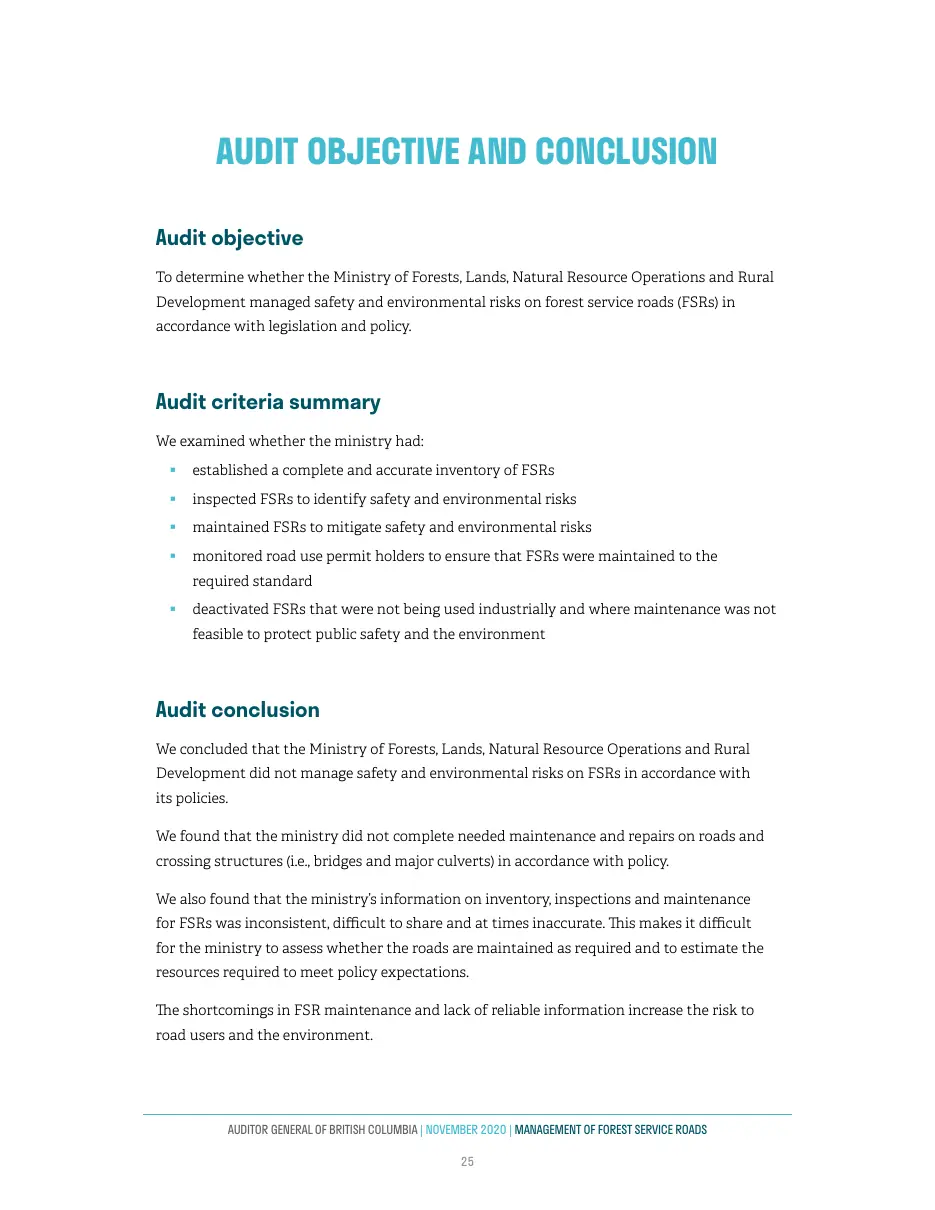
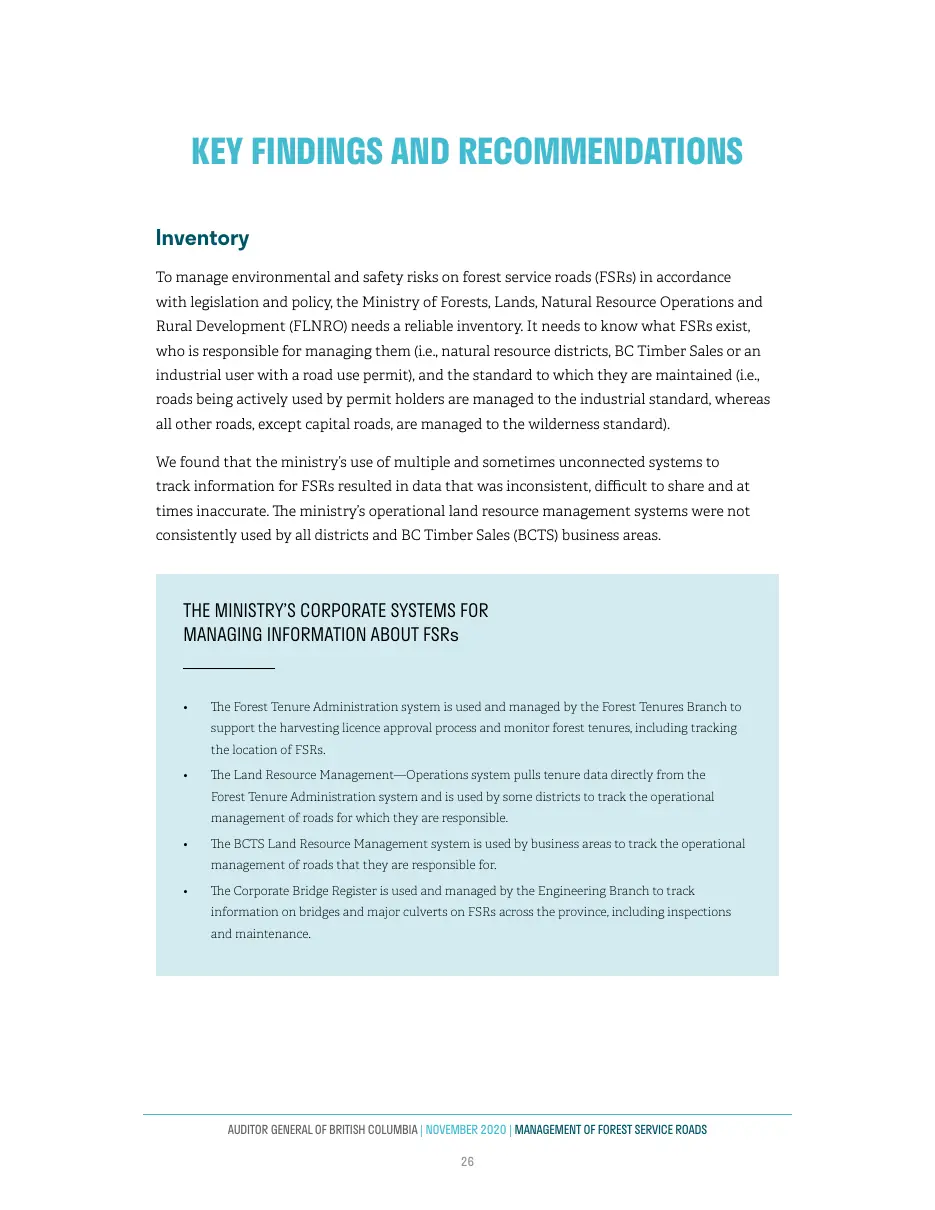
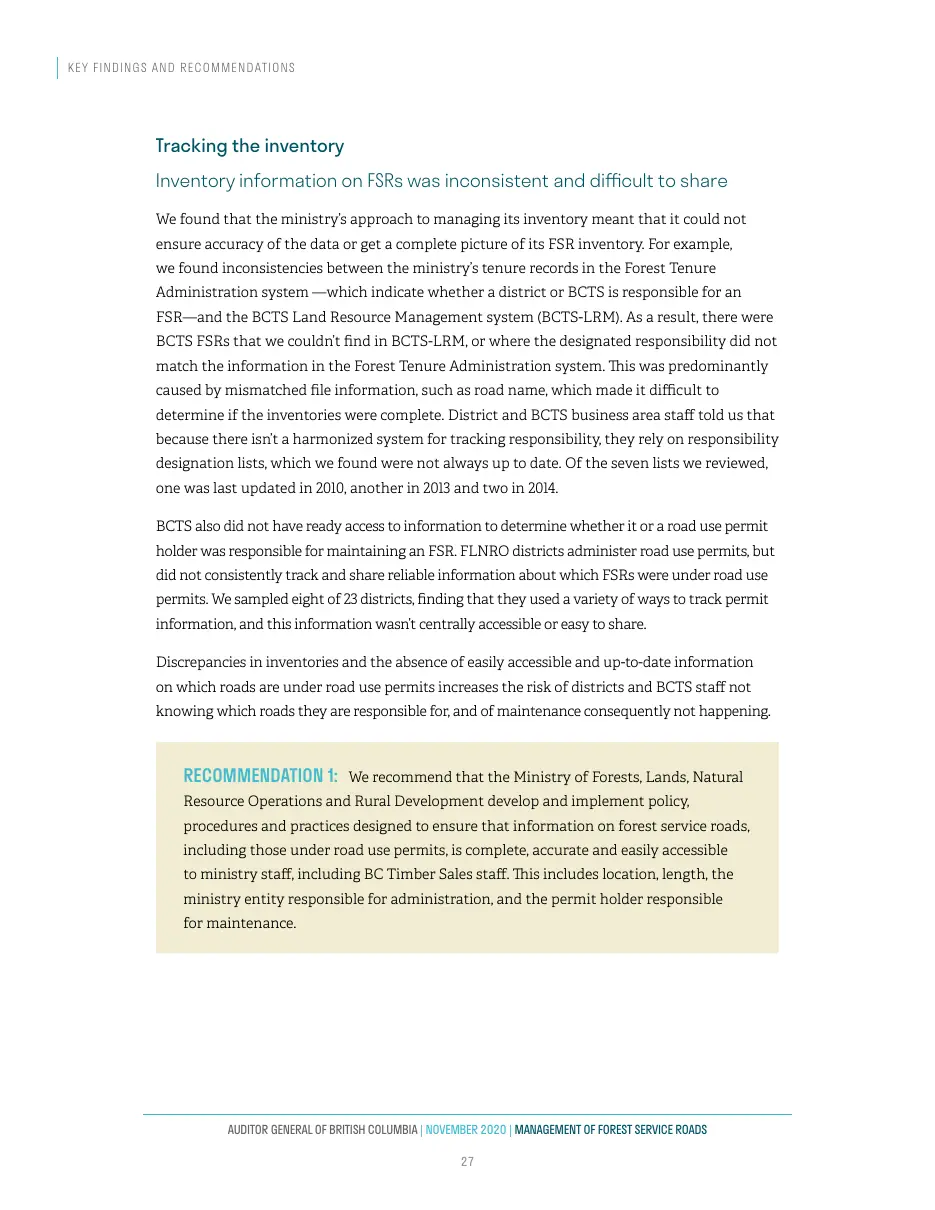
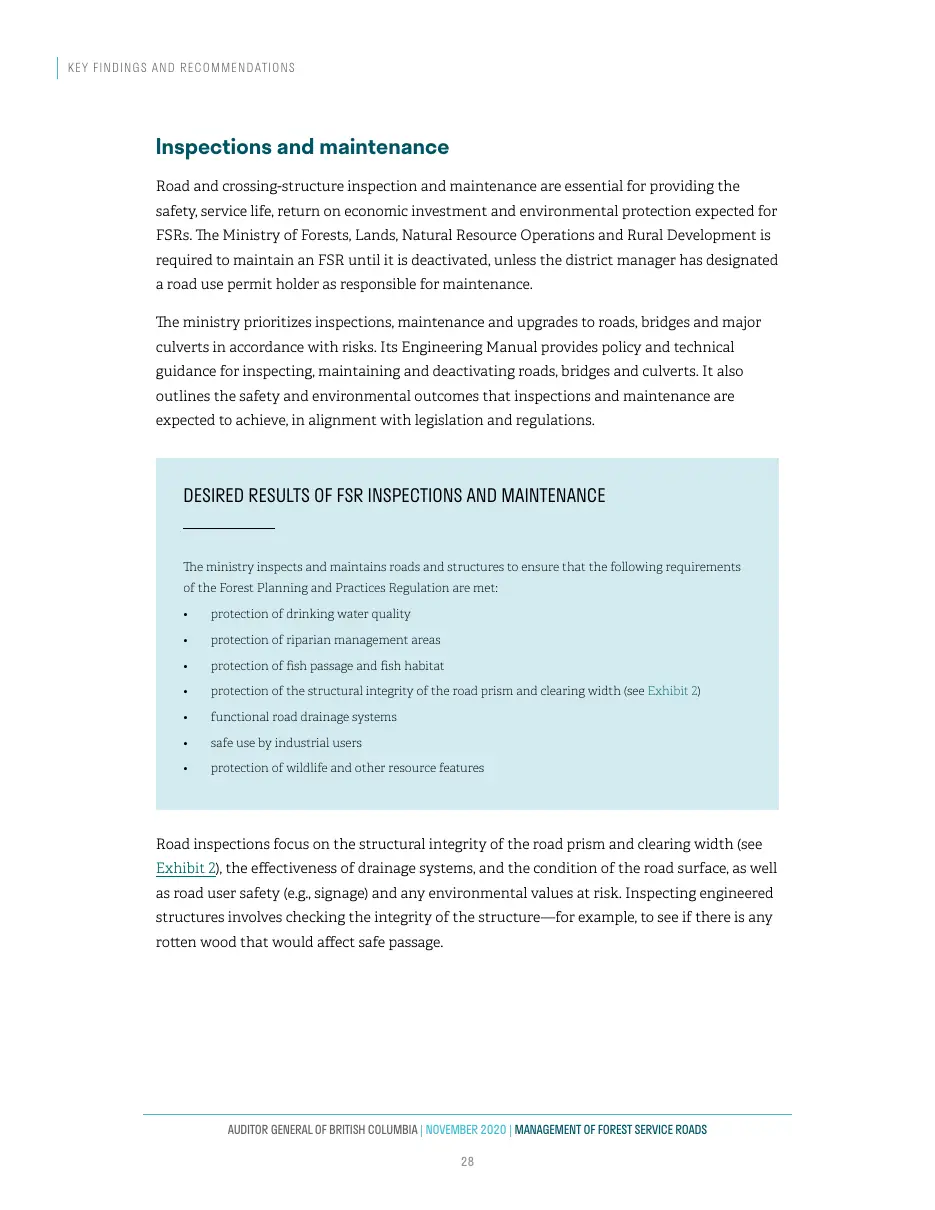
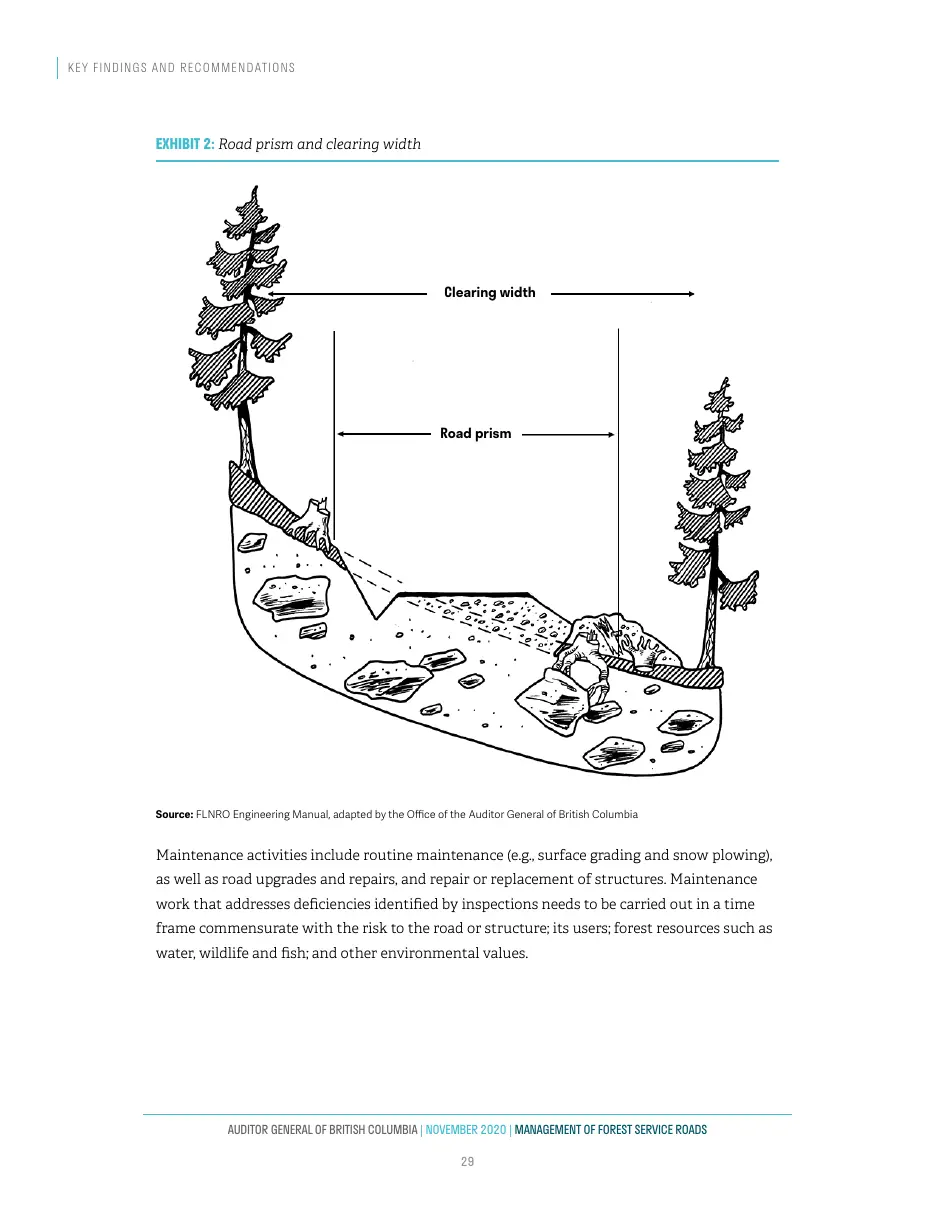
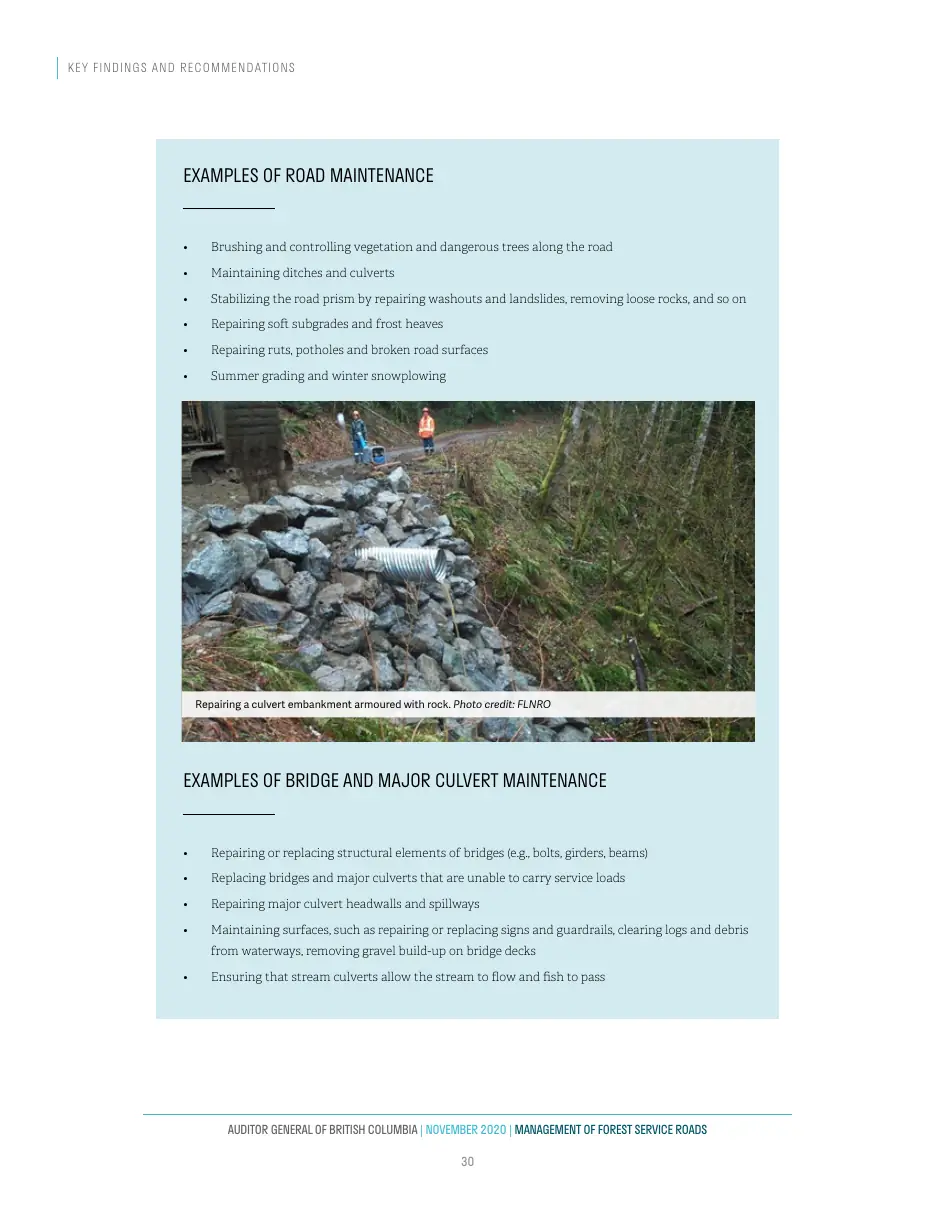
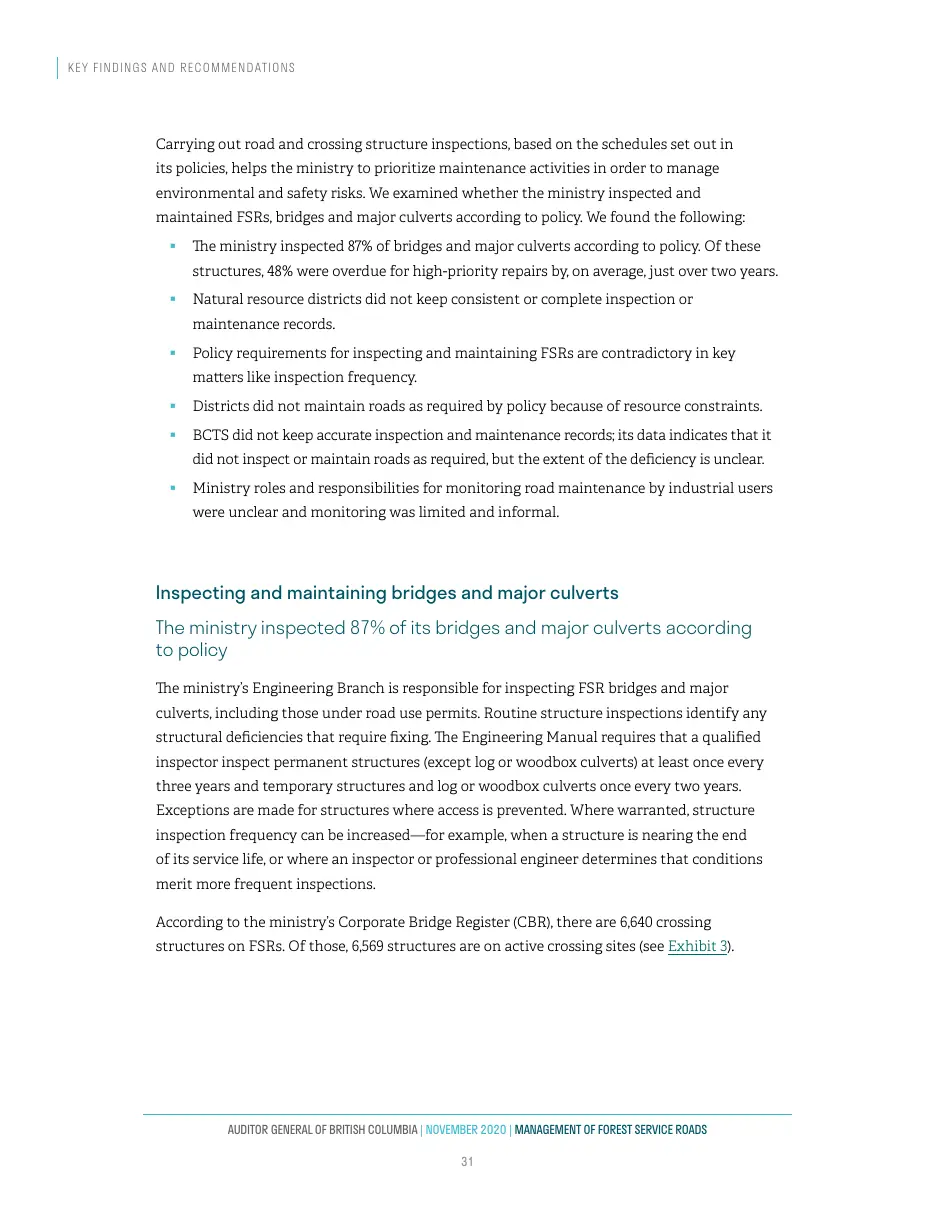
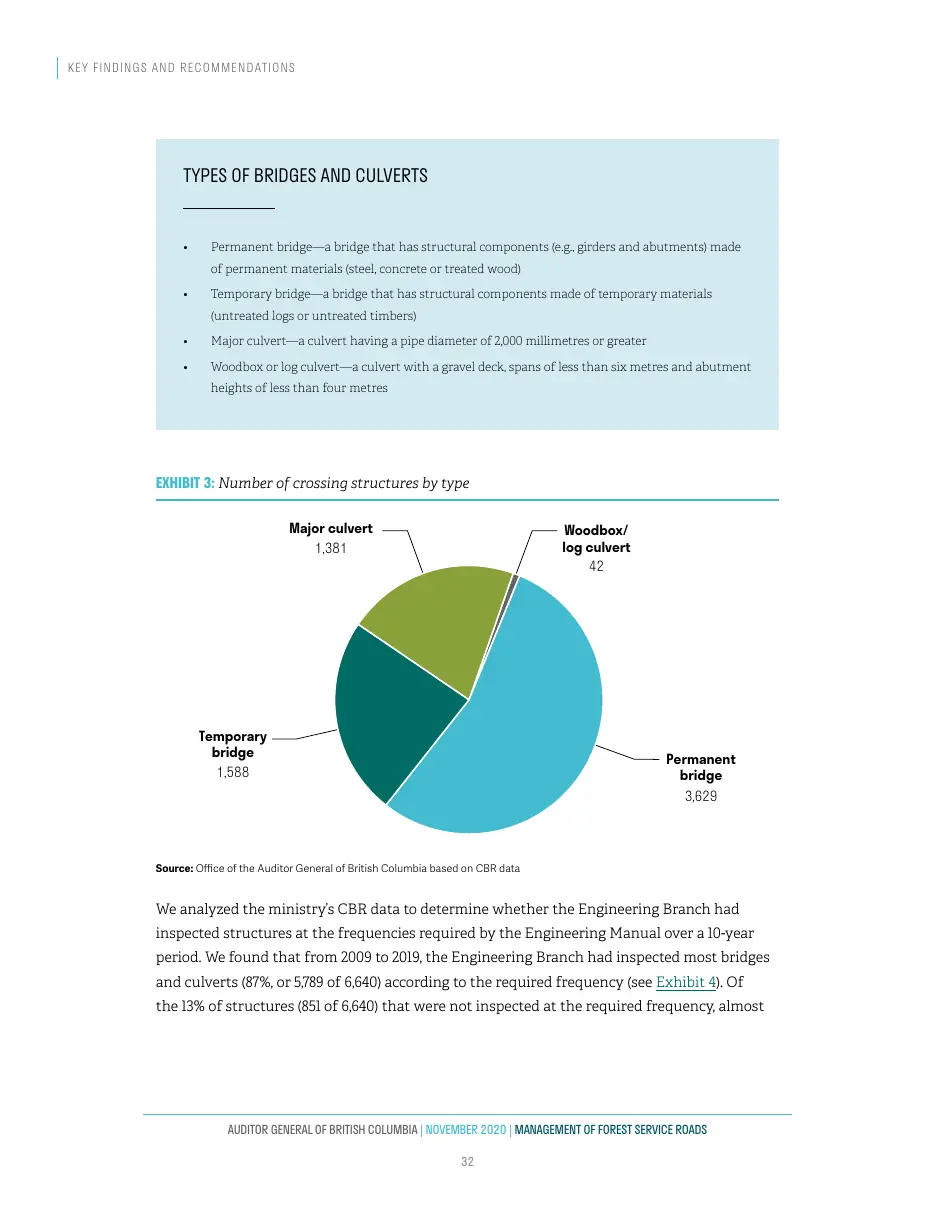
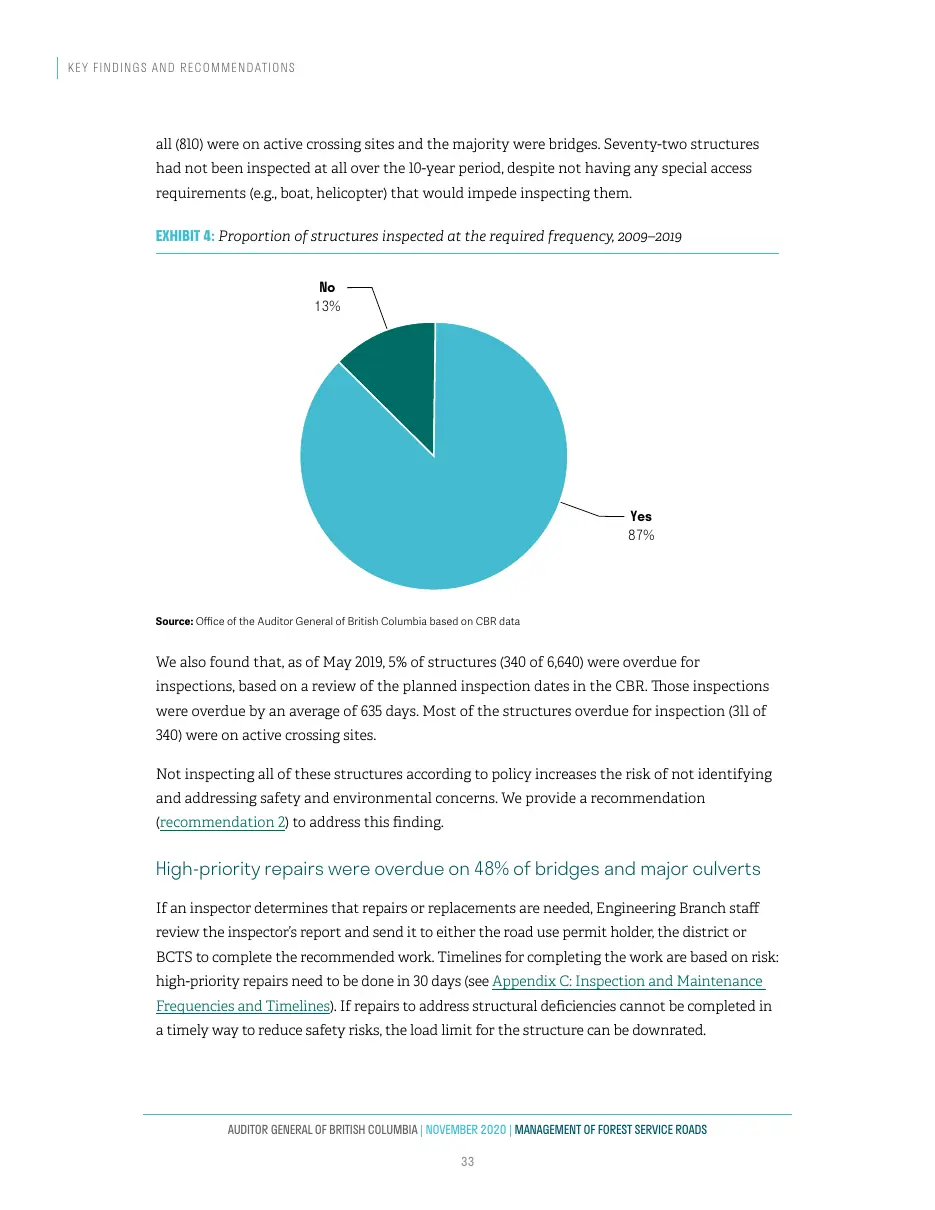
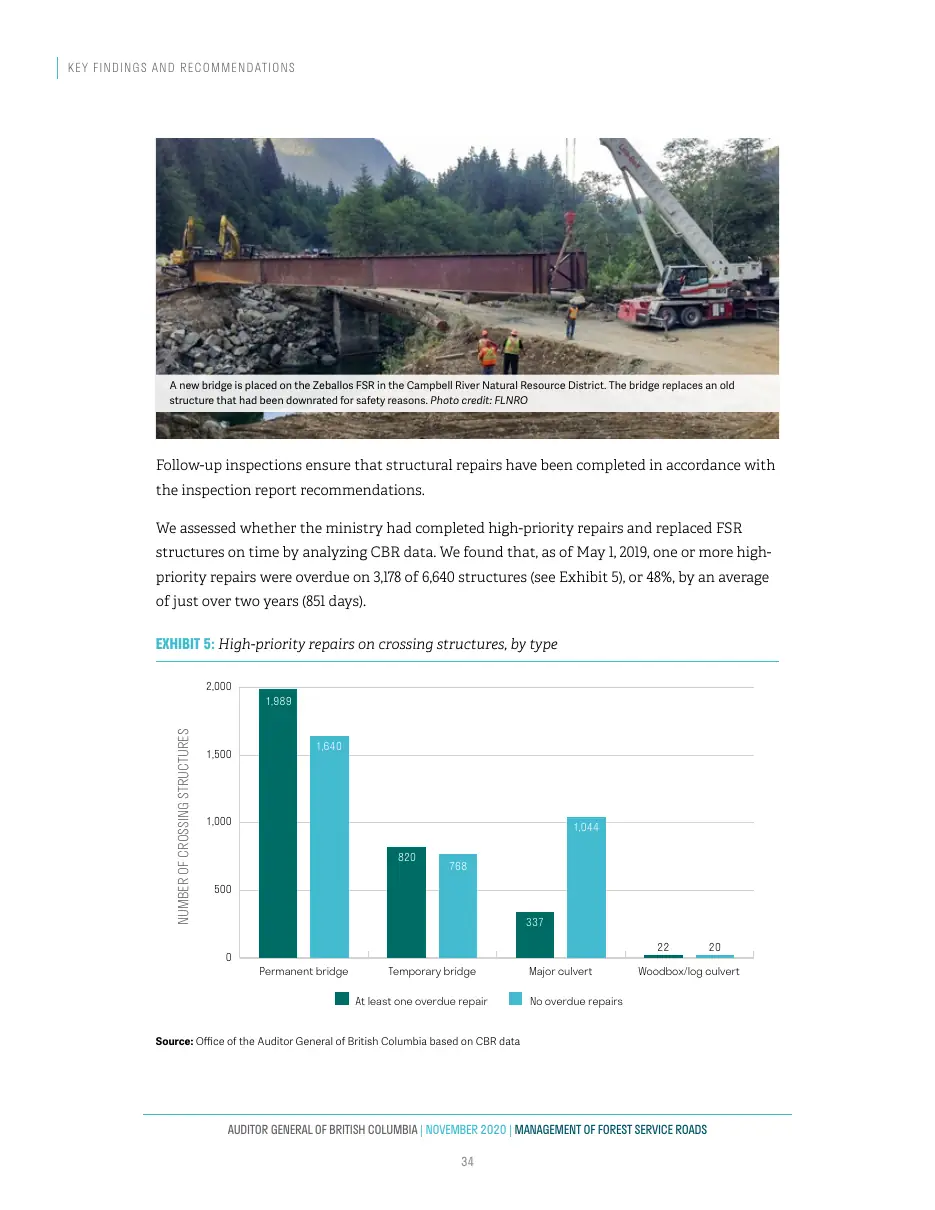
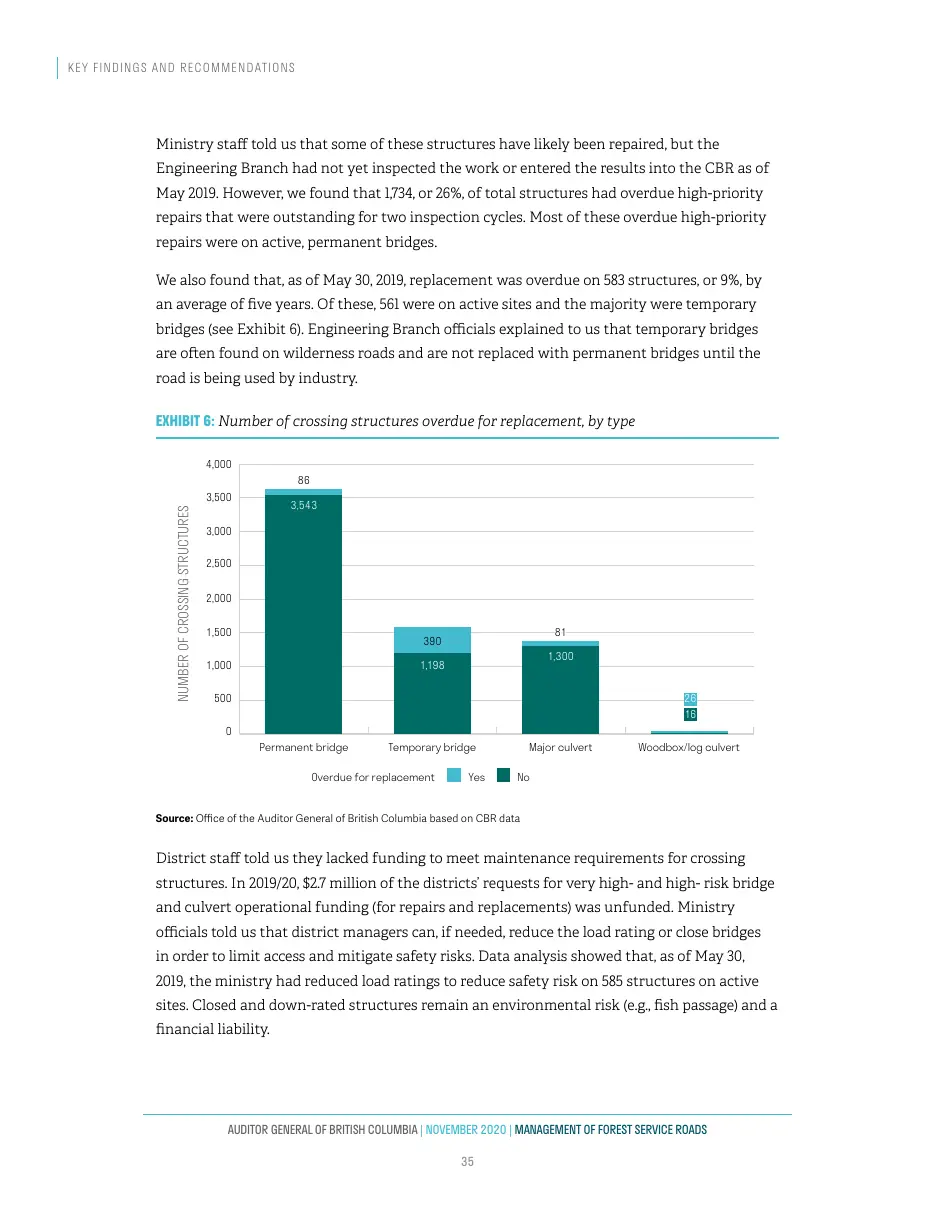
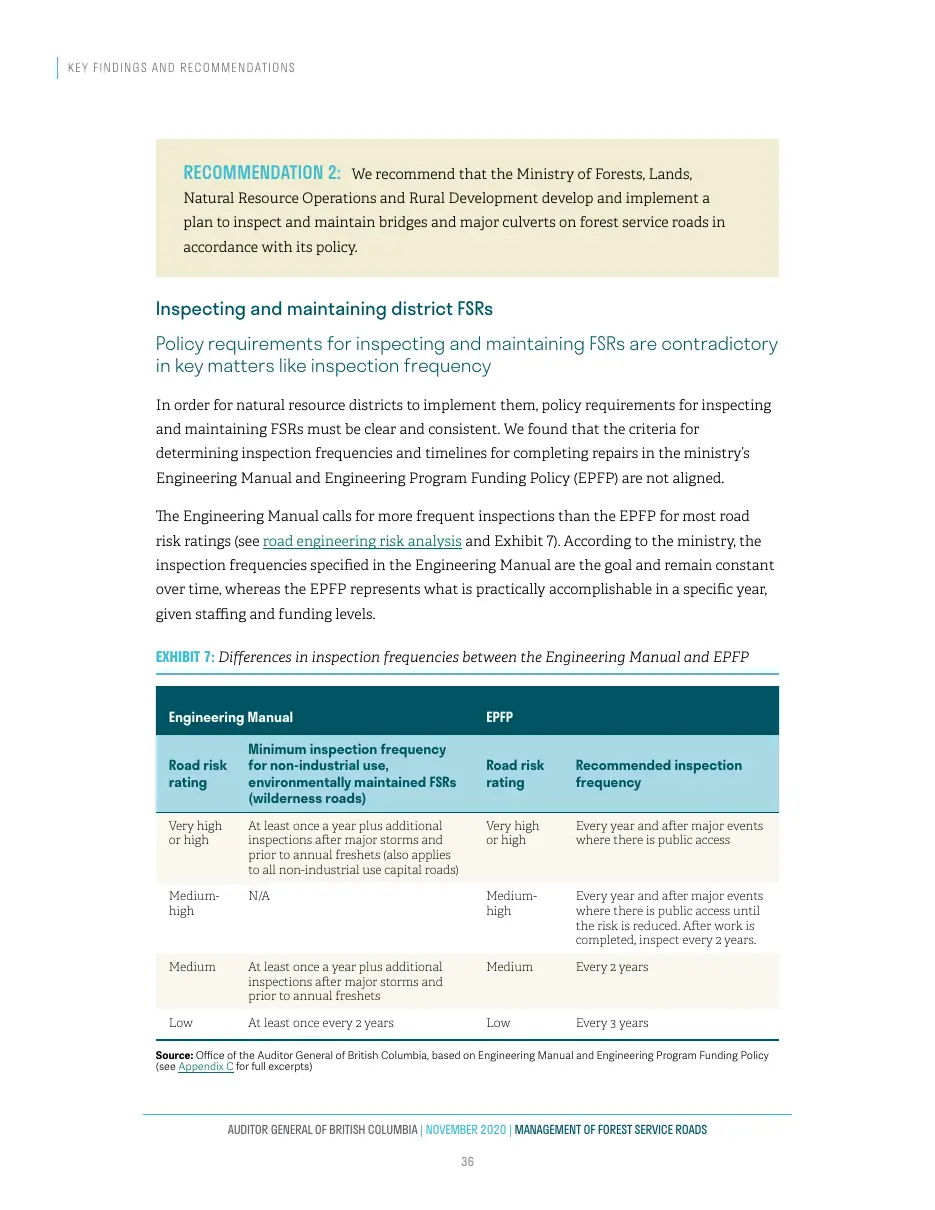
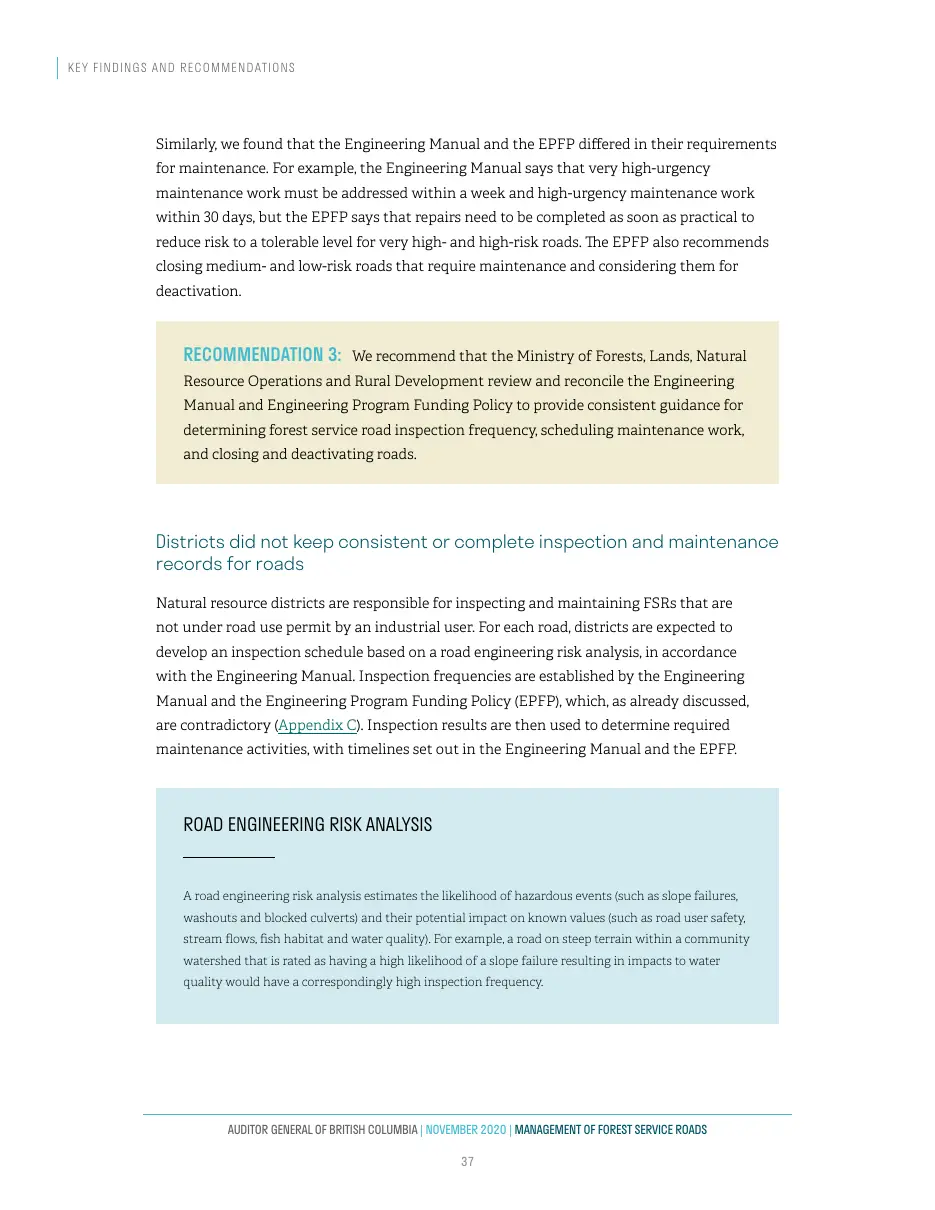
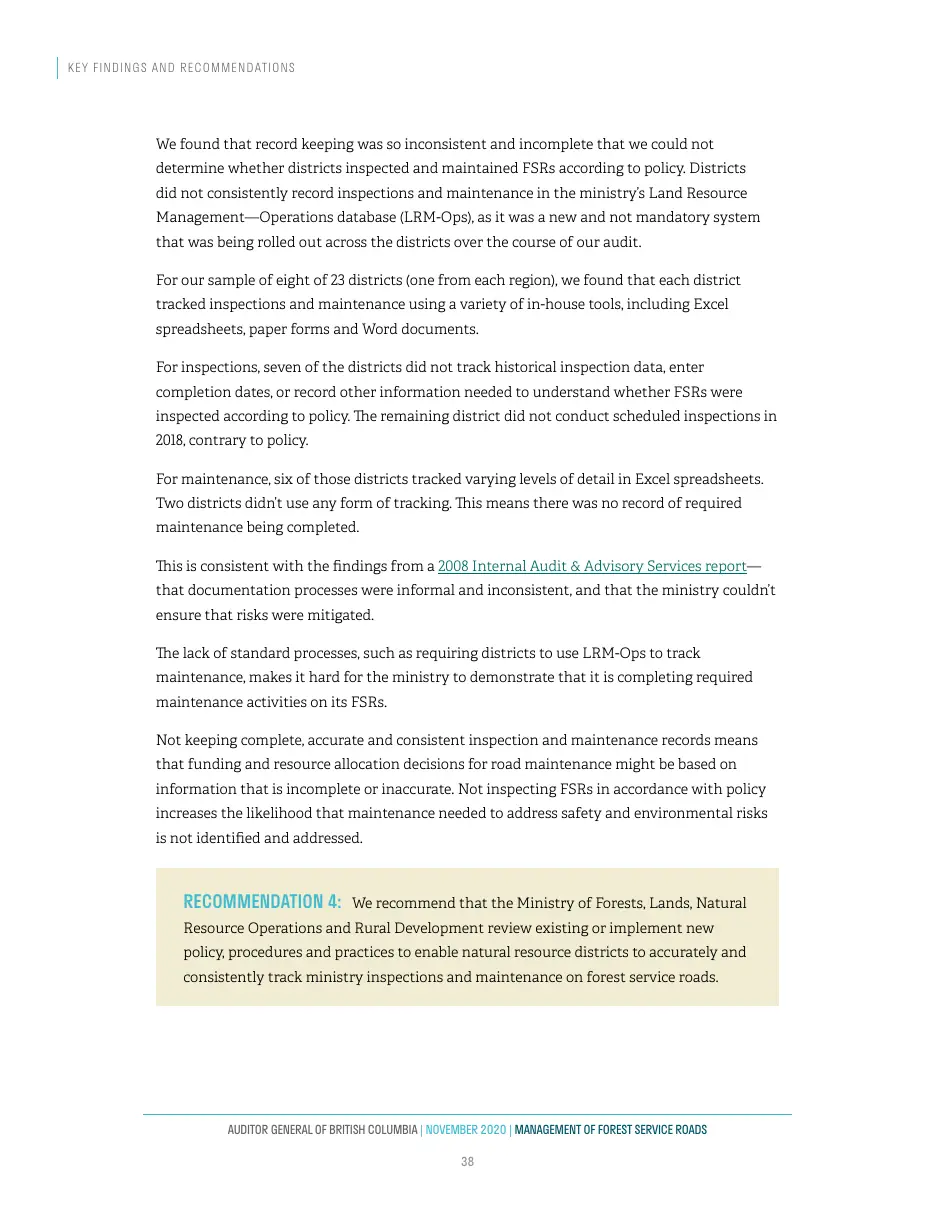
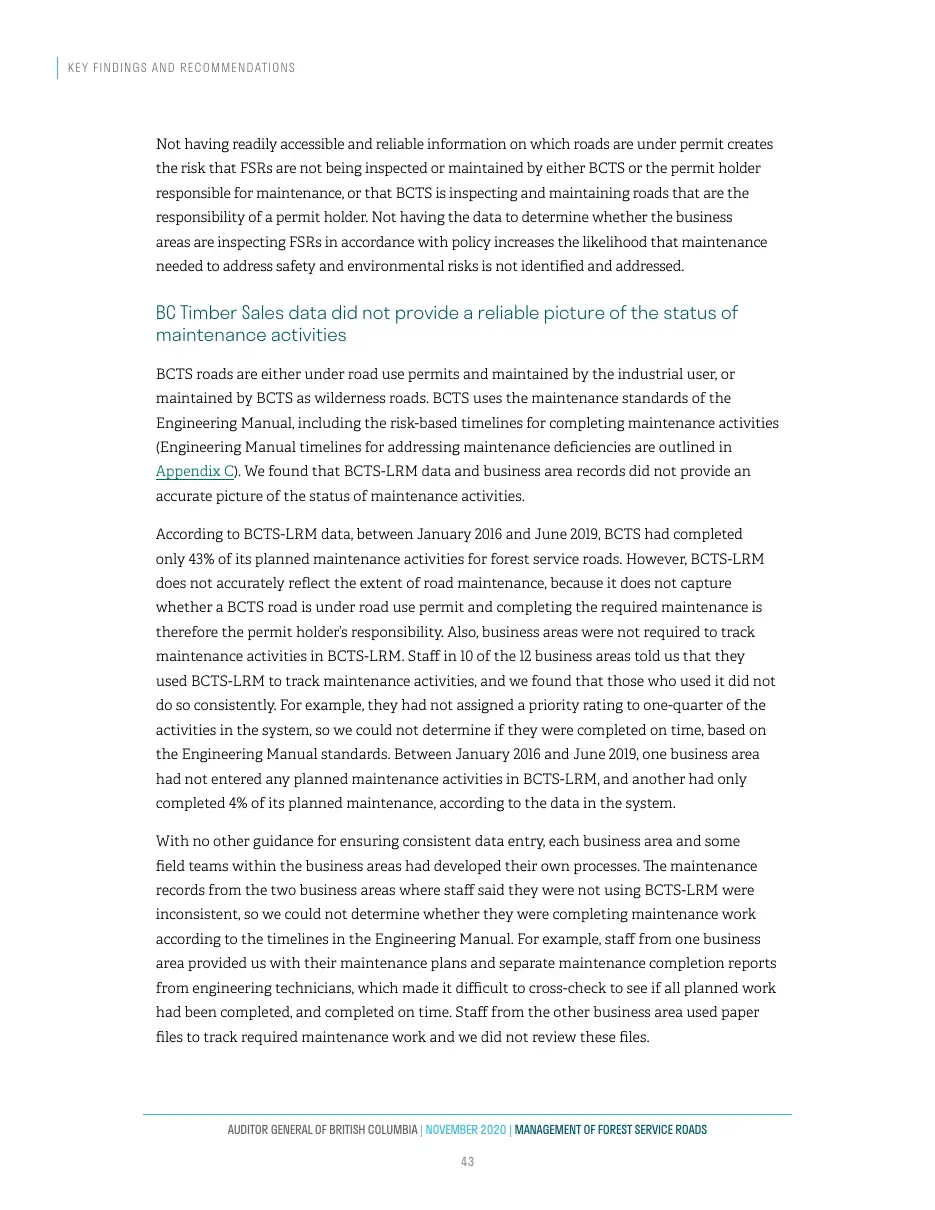
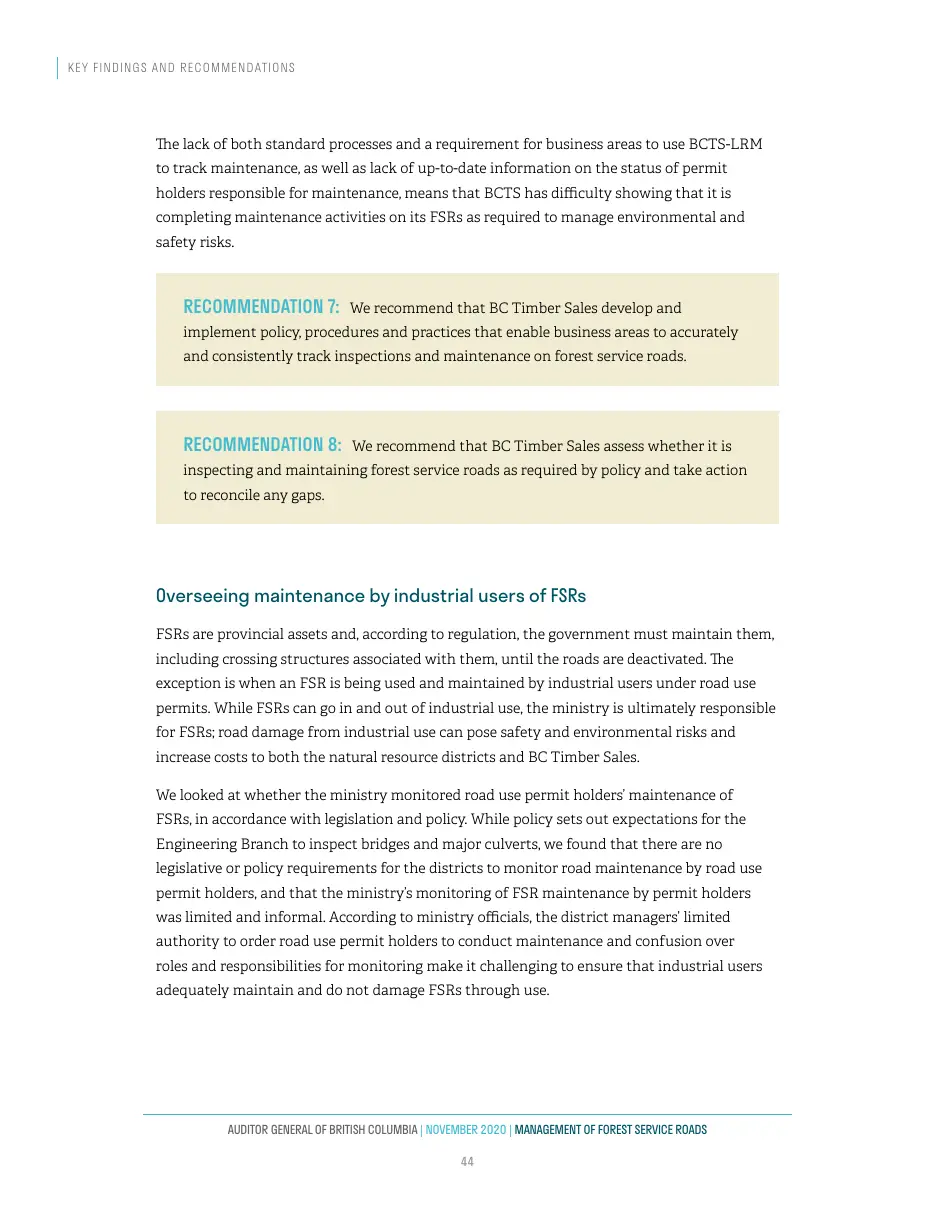
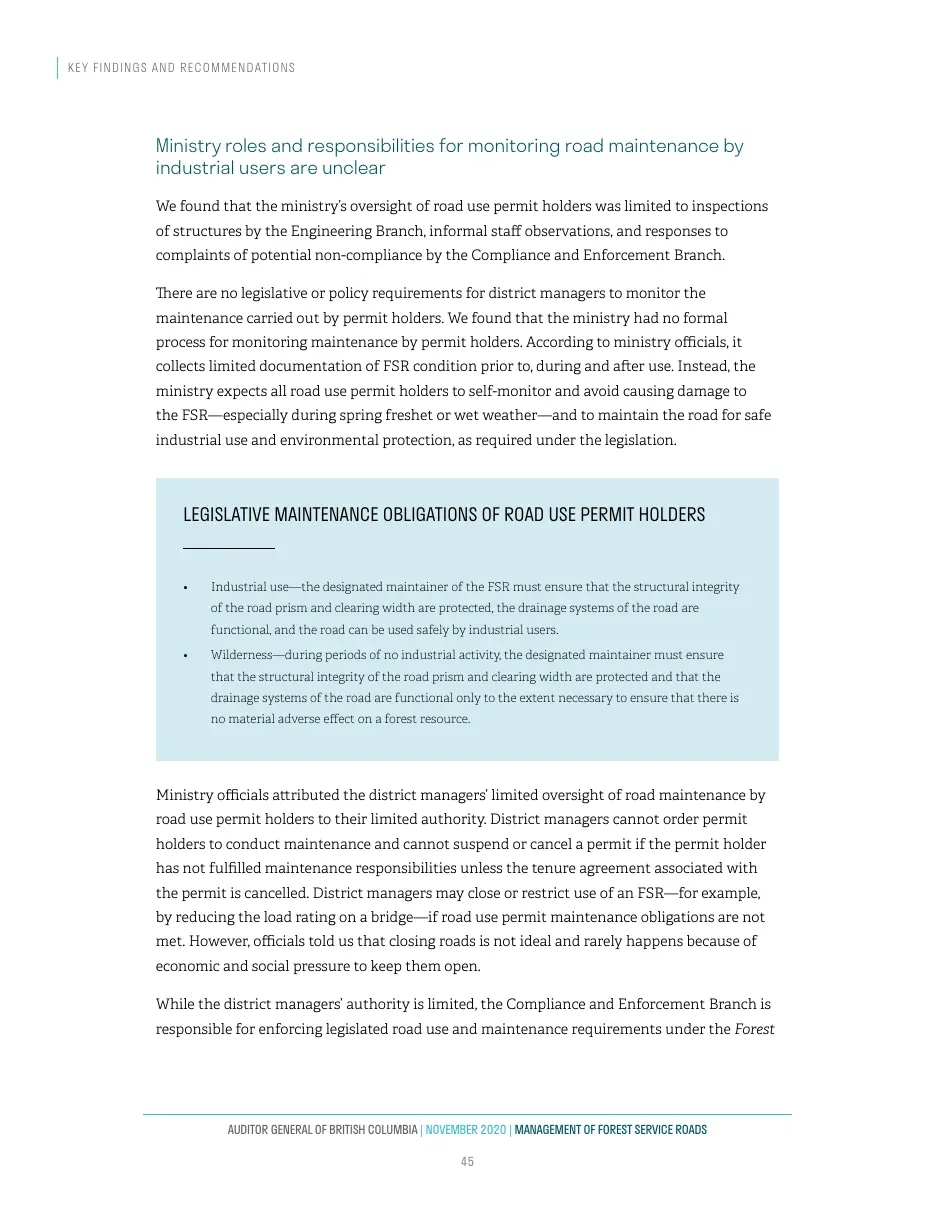
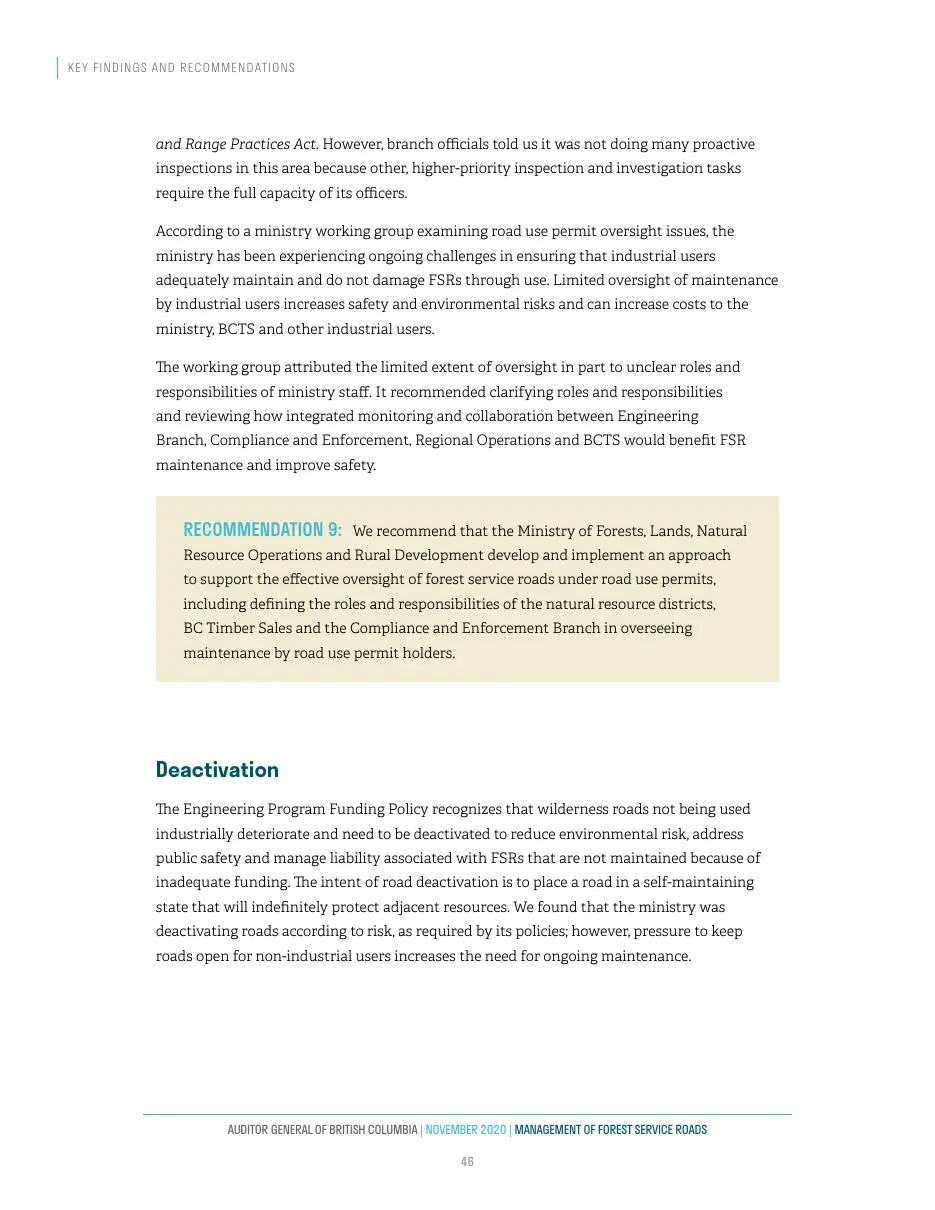
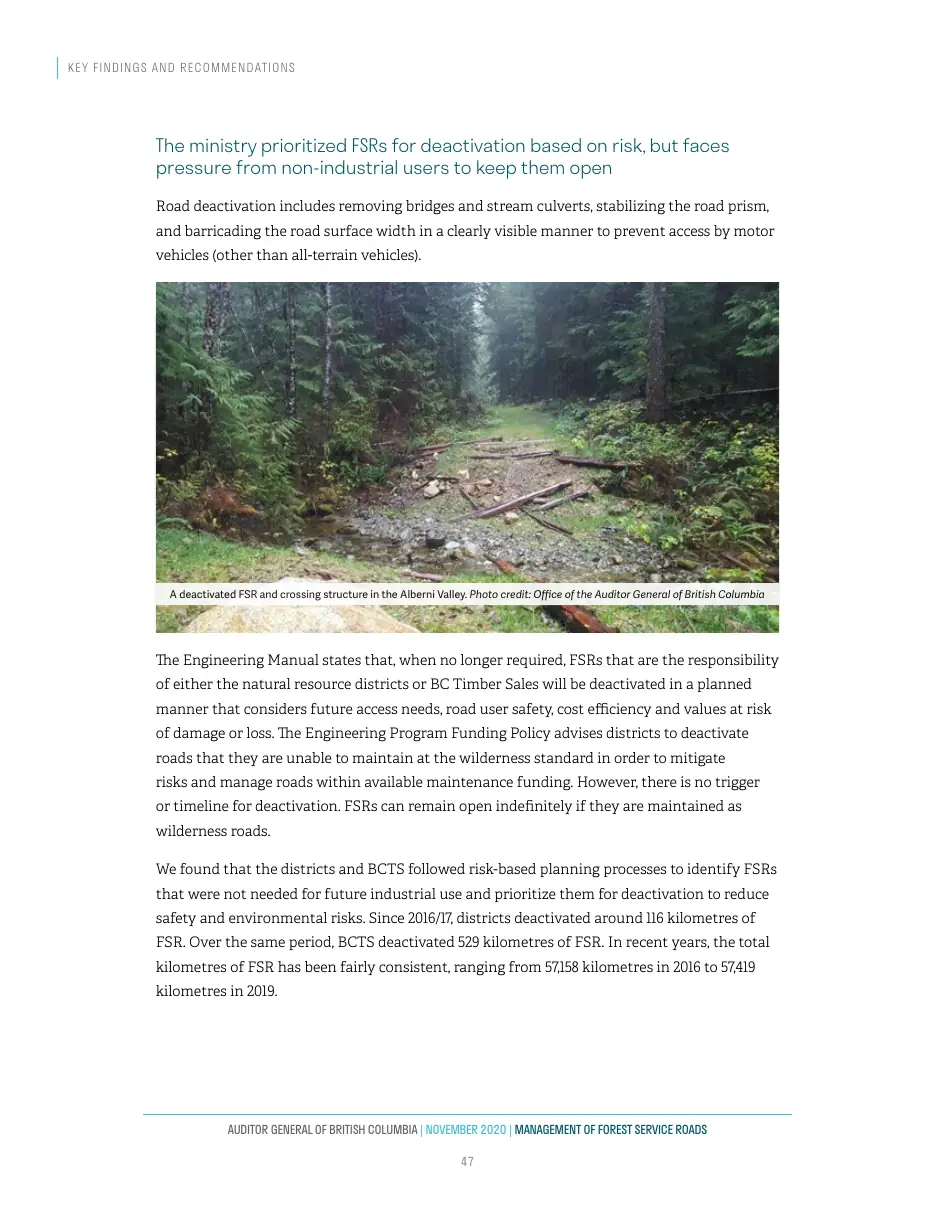
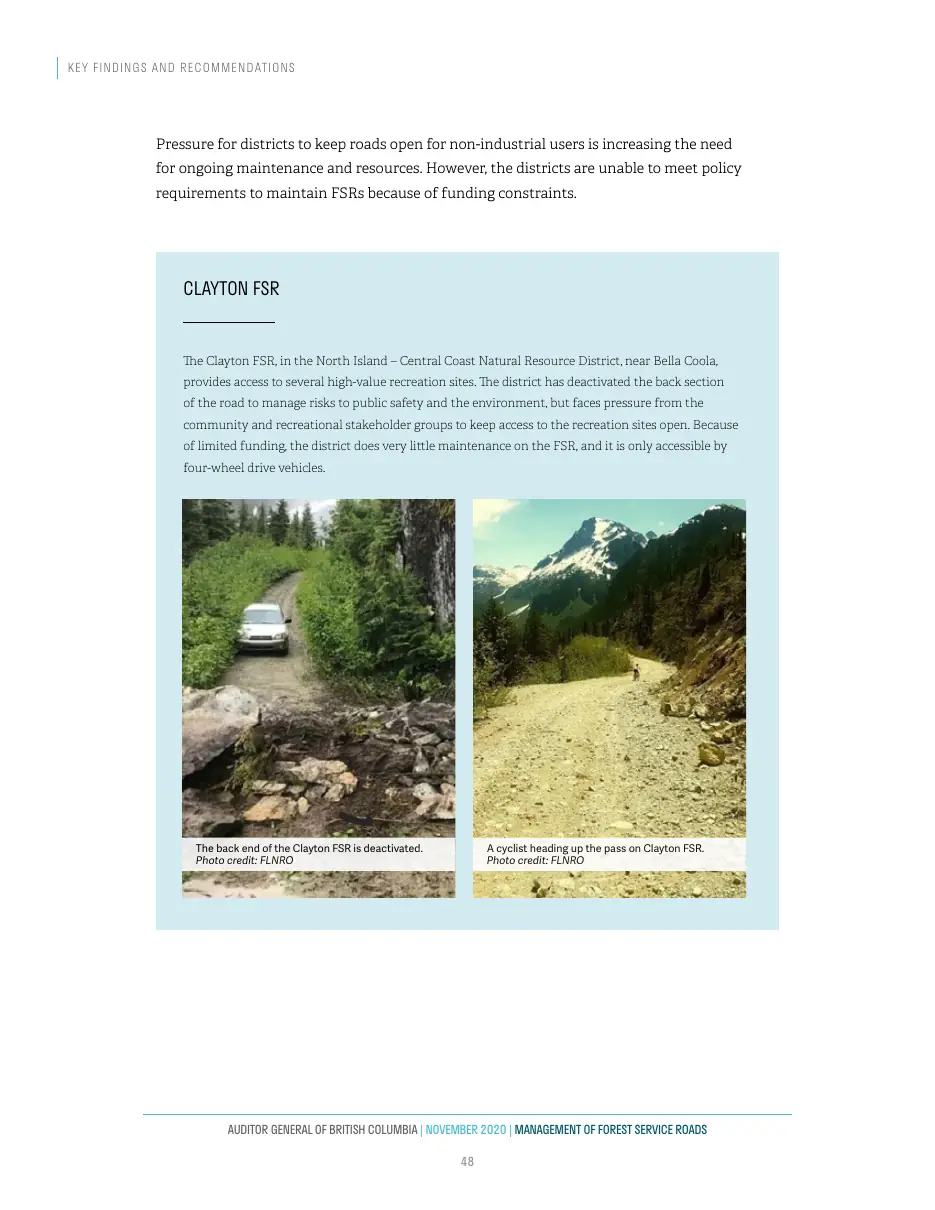
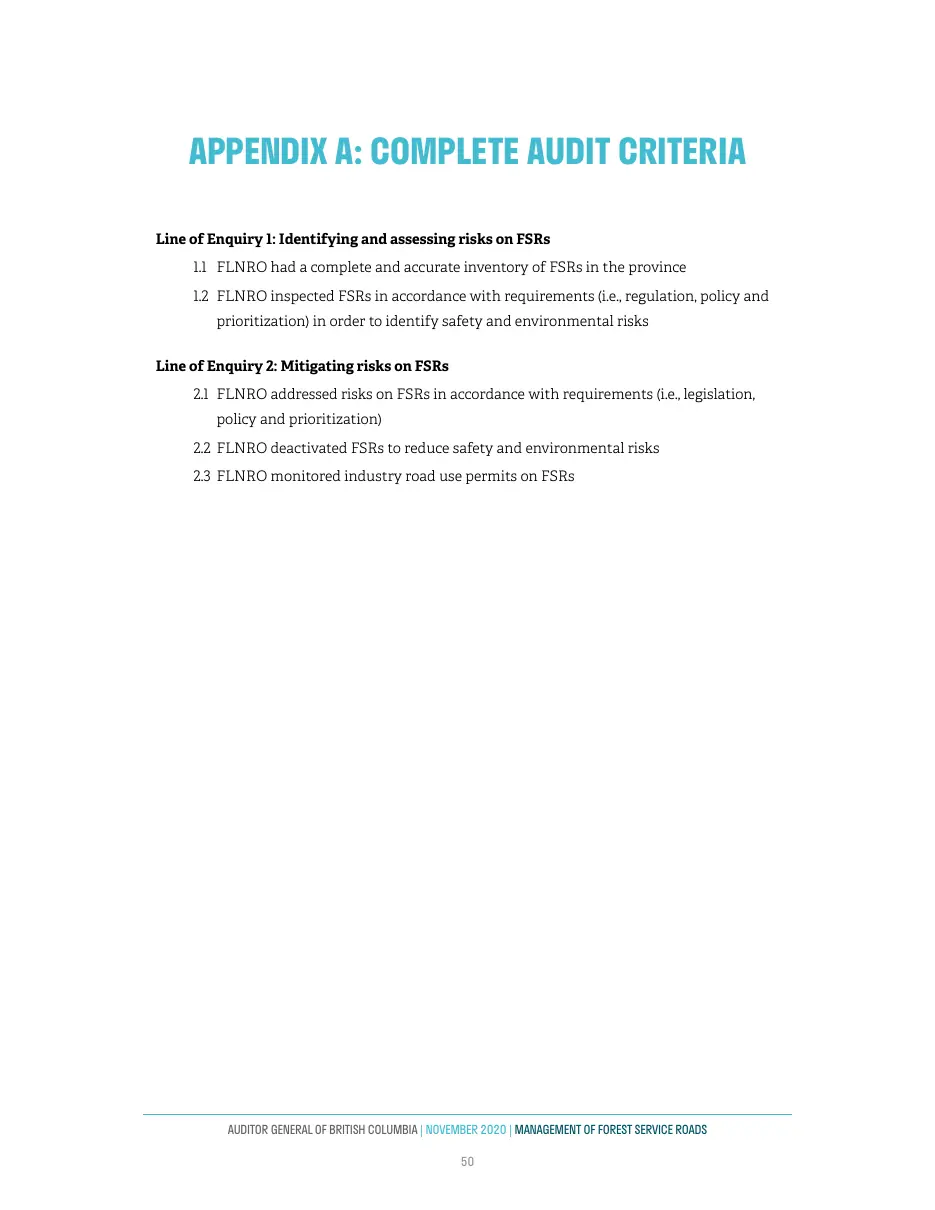
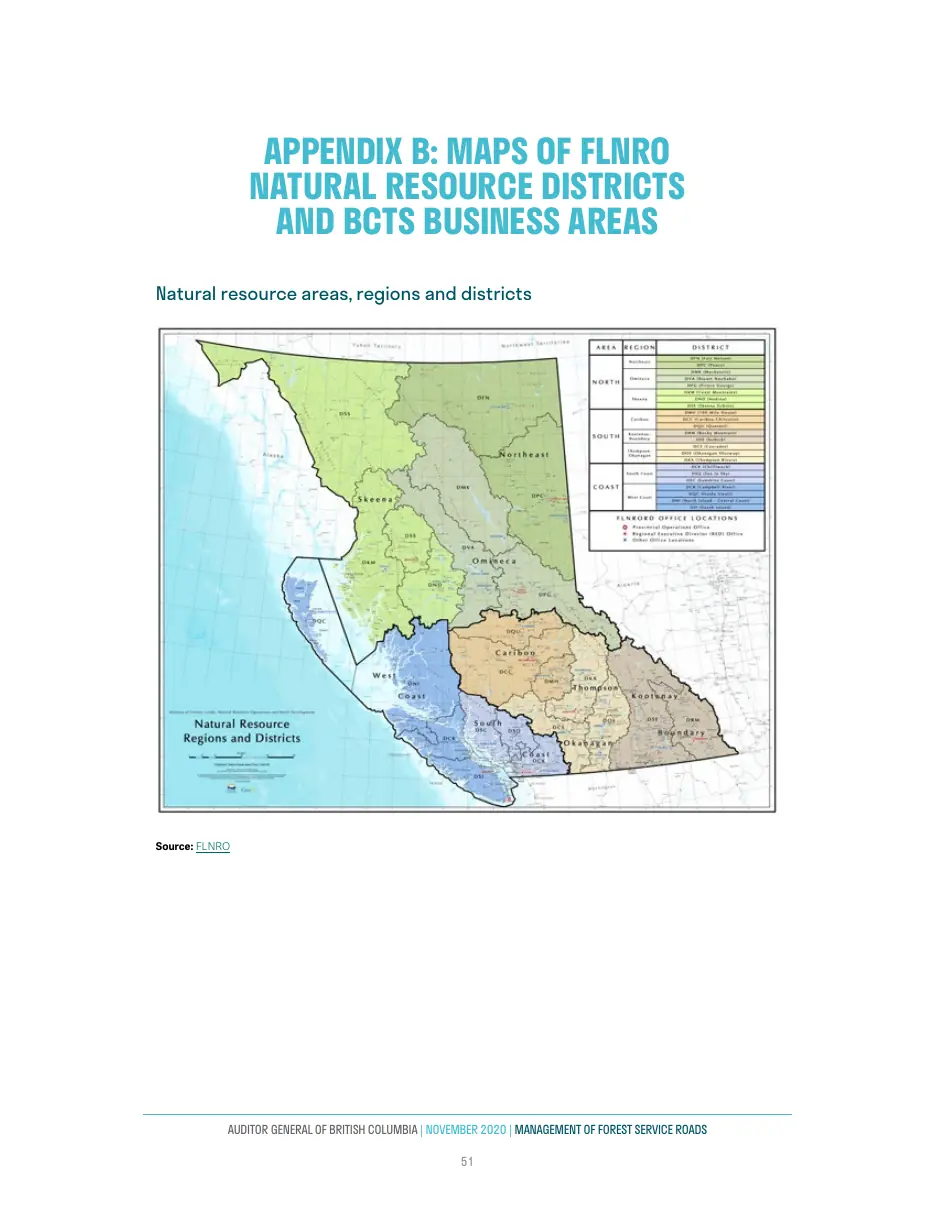
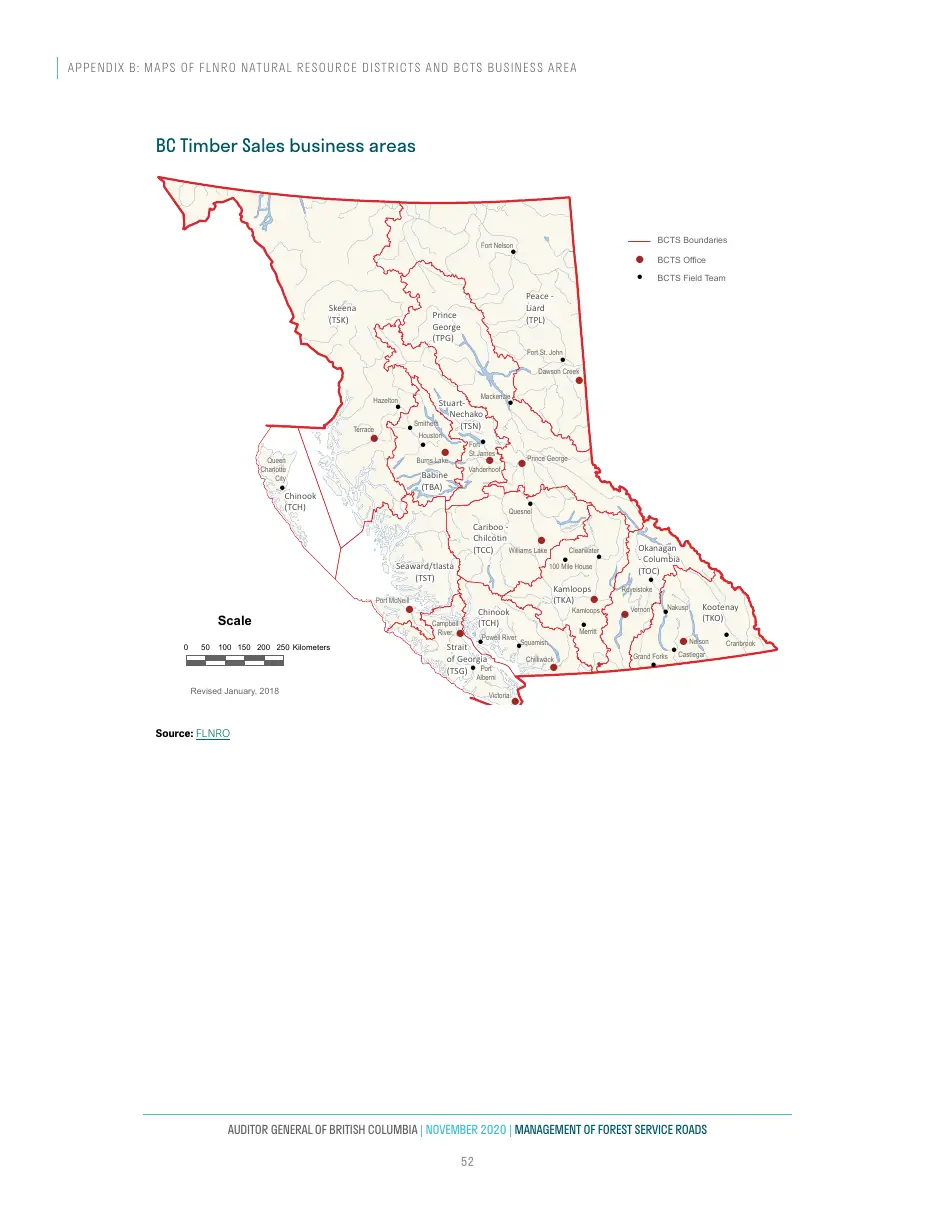
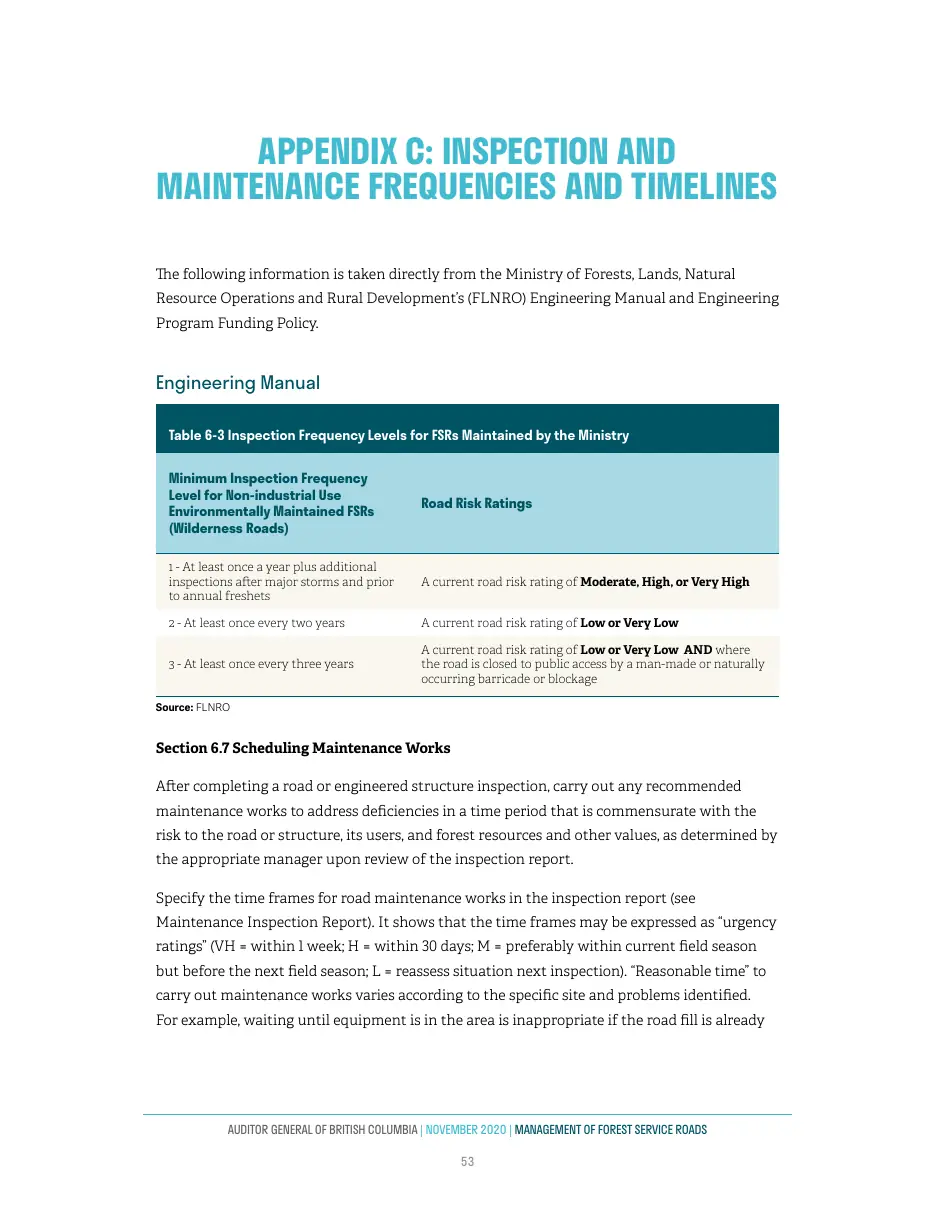
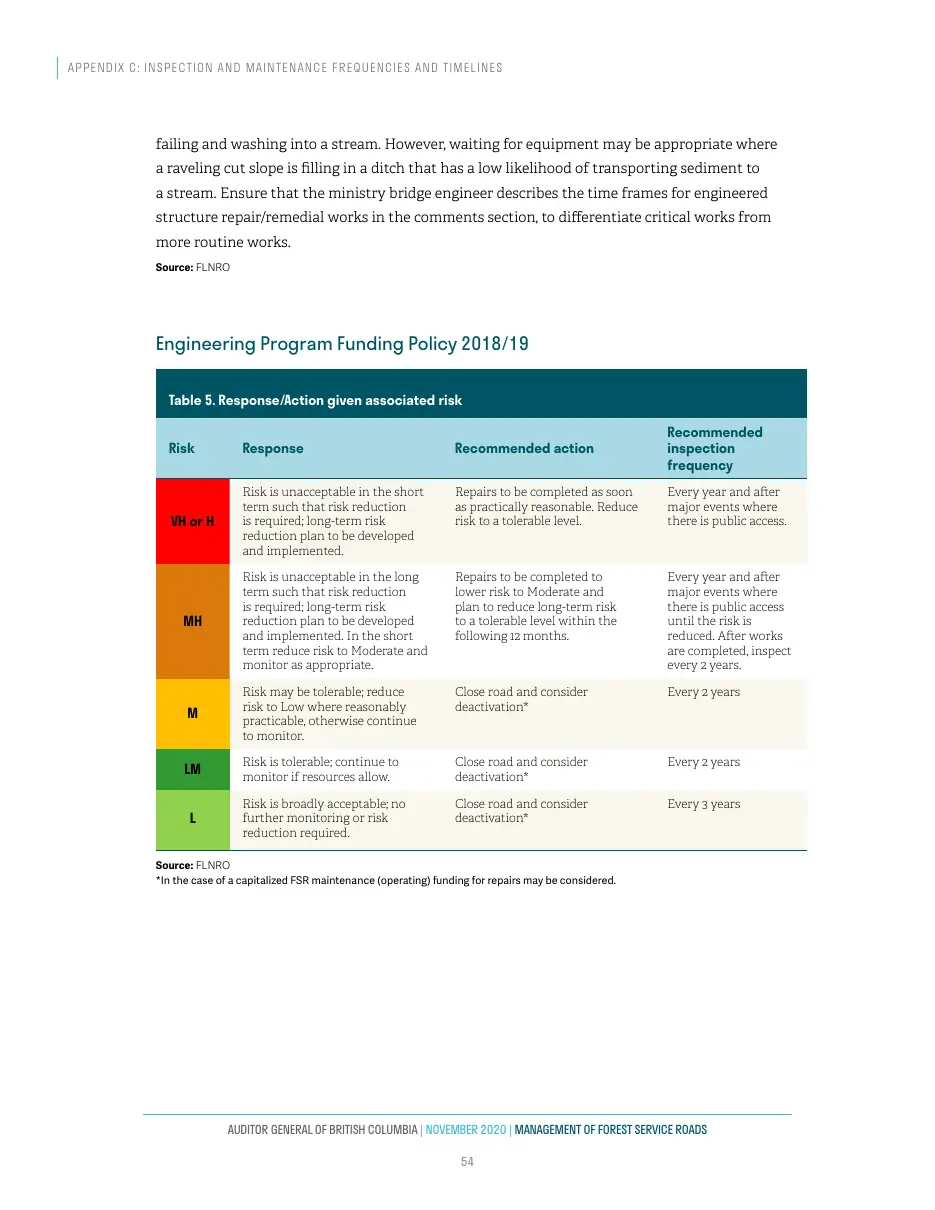

Scroll it. Every figure quoted above is on a page in this panel. The conclusion is at p. 25, the ministry’s own response at pp. 14–18, the funding exhibits at pp. 39–40 and the deactivation rules at pp. 46–47. Download the original PDF — it is byte-identical to the copy on the Auditor General’s own site, which no longer serves it at its published address.
Section 12The question the Auditor General left behind
Michael Pickup closed his comments by suggesting three questions legislators might put to government. The third was this:
How will the ministry assess which roads to deactivate to reduce maintenance costs, safety risks and environmental impacts when pressure exists to keep them open?
Auditor General’s comments, Management of Forest Service Roads, p. 601
That question was asked in November 2020 and has never been answered in public. The Selkirk Natural Resource District answered it in practice on 9 September 2026, with a twenty-seven page tender, a contractor, a fixed completion date, a security budget and no meetings.
Minister Parmar’s ministry told the Auditor General that the rules for deactivating roads were reconciled and consistent as of November 2022, and that the money for roads carrying communities and recreation had been secured or requested. Rady Creek is what those two closed recommendations produce on the ground. If that is the system working as intended, the audit that produced it deserves reopening. If it is not, one road can be paused with one sentence while the difference is worked out.
Pause the Rady Creek deactivation. Publish the capital-road designation for the Trout Lake–Rady Creek forest service road, and the record of what the district considered under “future access needs.” Bids close at 1:00 PM on 24 September 2026.
Share this story
Six images carrying this story on their own — the figure, the claim and the page of the audit each one comes from. Made to be posted.


Slide 1 of 6
Suggested caption
The Auditor General audited every kilometre of BC’s forest service road network and found the Ministry of Forests was not managing it to its own policies.
58,000 km. Districts asked for $40.2M to maintain it. They got $5.5M — fourteen cents on the dollar.
High-priority repairs overdue on 3,178 of 6,640 bridges and culverts, by an average of 851 days. Replacement overdue on 583 more by five years. Load ratings cut on 585.
70 people died in motor vehicle crashes on logging roads between 2010 and 2018.
Recreation access was $8.5M of a $21.5M capital request. In the South — the area that holds the Rady Creek file — it was the single largest category.
The ministry’s own rule: a road serving fifty year-round residents or high-value recreation is “unlikely to be deactivated” and requires continual maintenance.
Rady Creek serves both.
Nine recommendations. The ministry has since reported complete the one covering deactivation rules, and the one covering recreation funding — the latter on the basis it had “secured or requested” the money.
Requesting it is what the districts were already doing when they got 14%.
Deactivation has no trigger and no timeline. A road can stay open indefinitely. The decision must weigh future access needs. No meetings have been held with the public in five years.
The audit’s own definition of deactivation keeps ATV access. The Rady Creek prescription ends it.
Bids close 1:00 PM, 24 September 2026.
backcountry.cx/editorials/auditor-general-road-audit/
#BCpoli #PublicLand #RadyCreek #Kootenays #ForestServiceRoad
Sources
- ↩↩↩↩Office of the Auditor General of British Columbia, Management of Forest Service Roads. An independent audit report, dated November 2020 (the report itself records the date as 29 November 2020, p. 24), transmitted to Speaker Raj Chouhan over the signature of Michael Pickup, Auditor General, in January 2021, and released 19 January 2021. Conducted under s. 11(8) of the Auditor General Act; audit period 2016 to 2019. The conclusion that the ministry “did not manage safety and environmental risks on FSRs in accordance with its policies” at pp. 5, 7, 9 and 25. The limitation “We did not assess in the field whether roads were safe and environmentally sound” at pp. 5 and 24. The three questions for government, including the third on deactivation under pressure to keep roads open, at p. 6. Network totals and Exhibit 1 at pp. 9 and 22. A copy is mirrored here, because the Auditor General’s former domain no longer serves it. https://www.oag.bc.ca/app/uploads/sites/963/2024/08/OAGBC-20210119-Management-Forest-Service-Roads_RPT.pdf
- ↩Capital roads. The definition, the approximately 12,000 km the districts are responsible for, and the finding that such roads are “unlikely to be deactivated by the ministry and require continual maintenance” — Management of Forest Service Roads, p. 23, with the summary form at p. 9. The test is access for communities of 50 or more year-round residents, rural residences, or “high-value” forest recreation sites and trails or “important” recreational areas as defined by the Ministry of Tourism, Culture and the Arts. https://www.oag.bc.ca/app/uploads/sites/963/2024/08/OAGBC-20210119-Management-Forest-Service-Roads_RPT.pdf
- ↩↩Exhibit 8, Proportion of maintenance funding requests allocated to district areas, p. 39. 2017/18 $28.6M requested against $5.6M allocated (20%); 2018/19 $39.0M against $5.7M (15%); 2019/20 $40.2M against $5.5M (14%), with Coast, South and North rows beneath each. The accompanying finding that “From 2017/18 to 2019/20, the districts received between 14% and 20% of their budget requests for FSR maintenance” is on the same page. Requests are summarised at area level in the source, not by district. https://www.oag.bc.ca/app/uploads/sites/963/2024/08/OAGBC-20210119-Management-Forest-Service-Roads_RPT.pdf
- ↩↩↩Exhibit 9, Area requests for priority capital road maintenance compared to actual funding (2019/20), p. 40. Community FSRs $9.2M, rural residence FSRs $3.8M, high-value recreation FSRs $8.5M, a total capital request of $21.5M against a $5.5M allocation, or 26 per cent. By area: Coast $6.2M requested and $1.9M allocated (30%); South $4.5M and $1.7M (36%), of which $3.1M of the request was high-value recreation; North $10.8M and $1.9M (18%). The $8.9M of unfunded high-priority maintenance and $1.6M of medium-priority maintenance are stated in the text immediately above the exhibit. The $2.7M of unfunded high-risk bridge and culvert repair requests is at p. 35 and, in the shorter form used here, at p. 8. https://www.oag.bc.ca/app/uploads/sites/963/2024/08/OAGBC-20210119-Management-Forest-Service-Roads_RPT.pdf
- ↩↩↩↩Crossing structures. Exhibits 3–6 and the surrounding findings, pp. 31–35. The 6,640 structures and the 6,569 on active crossing sites at p. 31; inspection at the required frequency for 87 per cent, or 5,789 of 6,640, across 2009–2019, with 851 not inspected, 810 of those on active crossings and 72 never inspected at all, at pp. 32–33; the 340 structures overdue for inspection by an average of 635 days, as at May 2019, at p. 33; high-priority repairs overdue on 3,178 of 6,640 structures, or 48 per cent, by an average of 851 days as at 1 May 2019, at p. 34; the 1,734 structures (26 per cent) overdue for two inspection cycles, the 583 (9 per cent) overdue for replacement by an average of five years as at 30 May 2019, and the 585 active structures with load ratings reduced, at p. 35. https://www.oag.bc.ca/app/uploads/sites/963/2024/08/OAGBC-20210119-Management-Forest-Service-Roads_RPT.pdf
- ↩Public safety on forest service roads. Management of Forest Service Roads, p. 21. BC Coroners Service data showing 70 motor vehicle deaths on logging roads between 2010 and 2018; the all-terrain vehicle accident on the Foley Creek FSR near Chilliwack that “resulted in two fatalities”; and 499 motor vehicle accidents on forestry roads between 2012 and 2016, reported by police and compiled by ICBC, with speed, distraction, impairment, road conditions and weather as the top contributing factors. The same page carries the Forest Practices Board’s findings on the environmental effects of resource roads. https://www.oag.bc.ca/app/uploads/sites/963/2024/08/OAGBC-20210119-Management-Forest-Service-Roads_RPT.pdf
- ↩Sole-access roads. The Finlay FSR, the longest in the province at around 420 km, providing the only road access to the Kwadacha and Tsay Keh Dene Nations and “the only land-based escape route in the event of flooding or wildfires,” at p. 19; the Zeballos and Fair Harbour network, the only road access for two communities and the Nuchatlaht, Ehattesaht and Ka:’yu:’k’t’h’/Che:k’tles7et’h’ First Nations, where storm damage and washouts have left those communities “isolated for significant periods of time” and the linking section carrying the community school bus is under a road permit the ministry does not maintain, at p. 41. https://www.oag.bc.ca/app/uploads/sites/963/2024/08/OAGBC-20210119-Management-Forest-Service-Roads_RPT.pdf
- ↩↩District record-keeping. The sample of eight of 23 districts, the six tracking maintenance in Excel at varying levels of detail, and the two that “didn’t use any form of tracking,” at p. 38, together with the finding that this is “consistent with the findings from a 2008 Internal Audit & Advisory Services report — that documentation processes were informal and inconsistent, and that the ministry couldn’t ensure that risks were mitigated.” The responsibility-designation lists last updated in 2010, 2013 and 2014 are at p. 27. https://www.oag.bc.ca/app/uploads/sites/963/2024/08/OAGBC-20210119-Management-Forest-Service-Roads_RPT.pdf
- ↩BC Timber Sales. Approximately 40 per cent of its forest service roads not inspected as frequently as required between January 2016 and June 2019, at p. 42; the 43 per cent of planned maintenance activities recorded as completed over the same period, the business area that had entered no planned maintenance at all and the one that had completed four per cent, at p. 43. The audit notes separately that staff in 10 of the 12 business areas said they used the BCTS-LRM system to track maintenance; that count is not the denominator of the 43 per cent. https://www.oag.bc.ca/app/uploads/sites/963/2024/08/OAGBC-20210119-Management-Forest-Service-Roads_RPT.pdf
- ↩↩Deactivation. Management of Forest Service Roads, pp. 46–47. The physical definition, including “barricading the road surface width in a clearly visible manner to prevent access by motor vehicles (other than all-terrain vehicles)”; the Engineering Manual requirement that roads be deactivated “in a planned manner that considers future access needs, road user safety, cost efficiency and values at risk of damage or loss”; the Engineering Program Funding Policy advice to deactivate roads districts “are unable to maintain at the wilderness standard”; the finding that “there is no trigger or timeline for deactivation” and that roads “can remain open indefinitely if they are maintained as wilderness roads”; the 116 km deactivated by districts and 529 km by BC Timber Sales since 2016/17; and the network holding at 57,158 km in 2016 to 57,419 km in 2019. The shorter statement of the same findings is at p. 11. https://www.oag.bc.ca/app/uploads/sites/963/2024/08/OAGBC-20210119-Management-Forest-Service-Roads_RPT.pdf
- ↩The nine recommendations at pp. 12–13, and the Response from the auditee at pp. 14–18. Recommendations 1, 3, 4 and 7 are accepted outright; recommendations 2, 5, 6 and 9 are accepted as to “the intent of the recommendation”; recommendation 8 is accepted by BC Timber Sales. Recommendations 7 and 8 are addressed to BC Timber Sales rather than to the ministry. https://www.oag.bc.ca/app/uploads/sites/963/2024/08/OAGBC-20210119-Management-Forest-Service-Roads_RPT.pdf
- ↩↩↩↩Office of the Auditor General of British Columbia, Annual Follow-up Report: Status of Performance Audit Recommendations (2019–2023), October 2025. The summary table recording this audit as nine recommendations, five complete and four not complete, at p. 40. The Ministry of Forests progress report and the Office’s review of it at pp. 46–50, with status as at 31 March 2025 and the review report for this audit dated 14 July 2025, signed Sheila Dodds, Acting Auditor General. Recommendation 3 marked complete, rolled over as of 30 November 2022, with the policy renamed the Engineering Roads Funding Policy, at p. 48. Recommendation 6 marked complete, with the ministry’s statement that it “has secured or requested funding needed to undertake the $21.5 Million of maintenance on priority capital forest service roads,” at p. 49. Recommendations 4, 5, 7 and 8 are each marked “Not completed (Intend to complete),” with anticipated completion dates from 30 September 2025 to 2026. https://www.oag.bc.ca/app/uploads/sites/963/2025/10/OAGBC-202510-AFR-final-RPT.pdf
- ↩↩↩The Rady Creek record. Invitation to Tender EN27DSE008, Trout Lake–Rady Creek FSR deactivation, BC Bid opportunity 233877, issued 9 September 2026 and closing at 1:00 PM on 24 September 2026, covering 4,395 m of road; the sentence “This deactivation project is contentious and well known to the public” and the 24/7 security undertaking at package p. 3; the Trout Lake Recreational Club’s count of just over fifty full-time residents; and the Cooper Creek Cedar referral of 2 March 2020 in which the company stated it “will attempt to maintain at minimum ATV access.” Published in full with the documents at saverady.com, and set out in our earlier editorials on the district and on the recreation economy. https://saverady.com/
- ↩↩The mandate gap. The Auditor General’s second question to government, on balancing public expectations to keep roads safe for public use “with a mandate that does not require it do so,” at p. 6; the finding that forest legislation requires permit holders to maintain roads for industrial purposes but “does not require permit holders to make them safe for public use” at p. 9, with “The permit holder is not obligated to maintain an FSR for public users” at p. 23; and ministry officials’ statement that “closing roads is not ideal and rarely happens because of economic and social pressure to keep them open” at p. 45. https://www.oag.bc.ca/app/uploads/sites/963/2024/08/OAGBC-20210119-Management-Forest-Service-Roads_RPT.pdf