
EDITORIAL · THE FACT CHECK
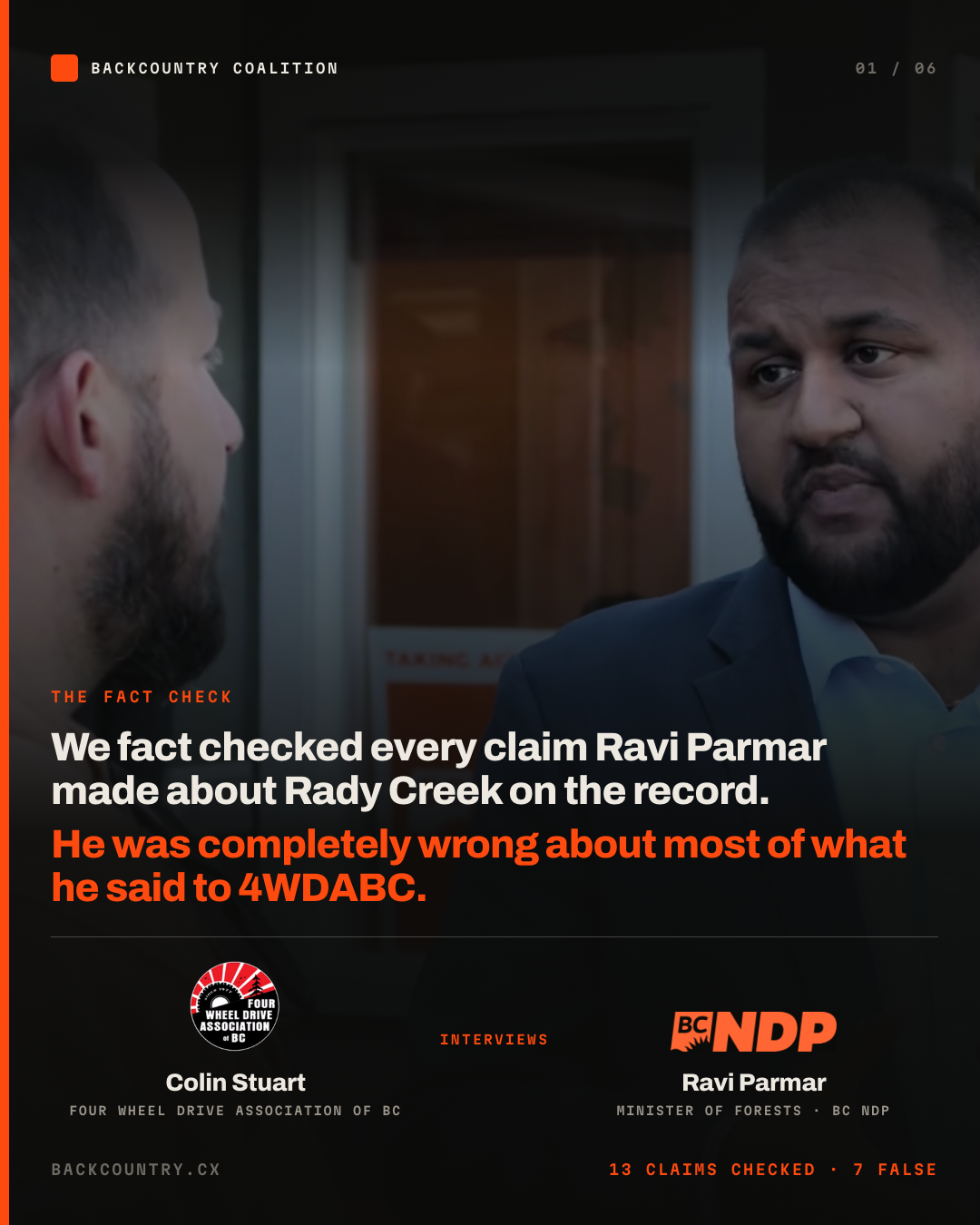
We fact checked every claim Ravi Parmar made about Rady Creek on the record. The truth is, as expected, he was completely wrong about most of what he said to 4WDABC.
On 28 September a group from the Four Wheel Drive Association of BC drove to the Langford campaign office of Ravi Parmar and got him on camera for nine minutes. It is the first time the Minister of Forests has answered for the Rady Creek deactivation in public, after three provincial recreation bodies wrote to him across nineteen weeks and none of them got a reply. We transcribed all of it and checked every claim against the statutes, the Ministry’s own records and the district’s own correspondence. The video is at the top so you can judge it yourself.
Nine minutes, outdoors, on the record. We have put the whole recording at the top of this page because the point of a fact check is that you can check it too. Every section below opens at the moment the words were said.
Source 01: 4WDABC, “4WDABC meets with Ravi Parmar,” published 28 September 2026. The channel’s own description records the meeting as a convoy “to Langford to the campaign office of Ravi Parmar.”
The scoreboardThirteen claims, checked
We checked every substantive statement he made about Rady Creek Road, the statutes, the money and his own office. Seven do not survive contact with the record. Two are true — and one of those is the statement that does the most damage to the deactivation he came to defend.
| 11 | DID NOT HOLD | 7 false · 3 misleading · 1 self-contradictory |
| 2 | HELD UP | the road network, and mining |
| 1 | NOT SCORED | a promise — recorded and dated, checkable on 1 November |
| 2/13 | Claims that survived checkingThirteen scored across the thirteen sections — one section makes two separate claims. The promise is excluded because it cannot yet be right or wrong. | 15%F |
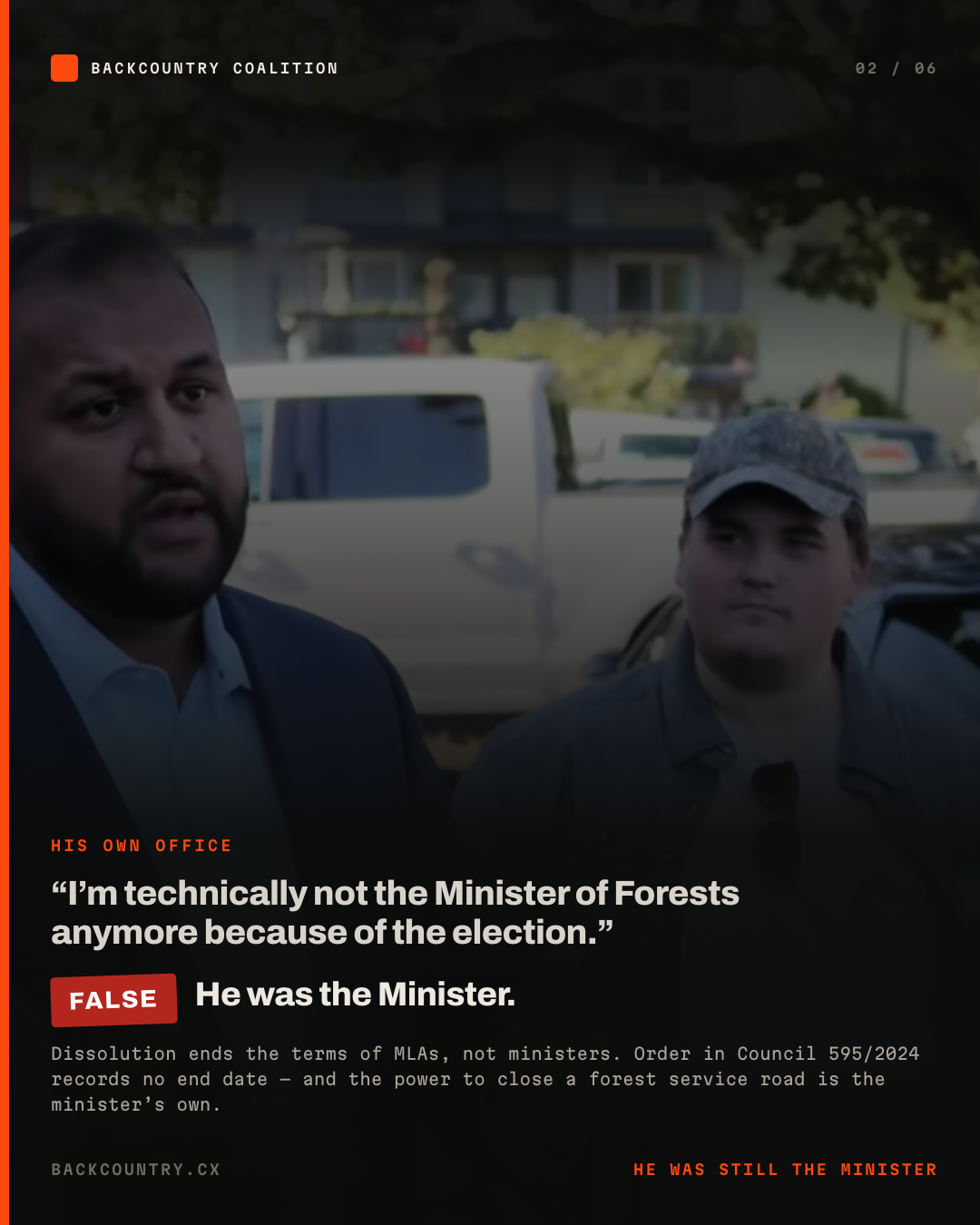
Claim 01“I’m technically not the Minister of Forests anymore”
“I have 60,000 kilometres worth of forest service roads, and I should add, I’m technically not the Minister of Forests anymore because of the election, so I think this is going to be a bigger issue for whoever forms government next.”
Ravi Parmar · 0:13
The check
Dissolution ends the terms of MLAs. It does not end a minister’s office. The Province’s own guide, Managing Records During an Election, revised 21 September 2026 — the day before the writ — states it plainly: “While MLAs no longer hold office once the election writs are issued, ministers continue as members of Executive Council (Cabinet) until a new Cabinet is sworn in.”
He was appointed Minister of Forests by Order in Council 595/2024 on 18 November 2024. The Legislative Assembly members database records that appointment with no end date. The Province’s cabinet page, last updated 8 September 2026, still lists him in the post, with no note about the election.
The 2024 precedent settles it. That writ was issued 21 September and the new Executive Council was not sworn in until 18 November — the outgoing ministers held office across all 58 days.
It matters because of who holds the power. Forest Act s.121(9)(a): “The minister may, by notice… discontinue and close a right of way or forest service road.” That power did not move on 22 September. The accurate sentence was available to him: I am no longer an MLA, but I am still the Minister of Forests. The two halves have opposite consequences for a constituent asking him to act.
He was the Minister of Forests when he said he was not.
Rating:FALSE
Claim 02“$11 million budget to maintain those roads”
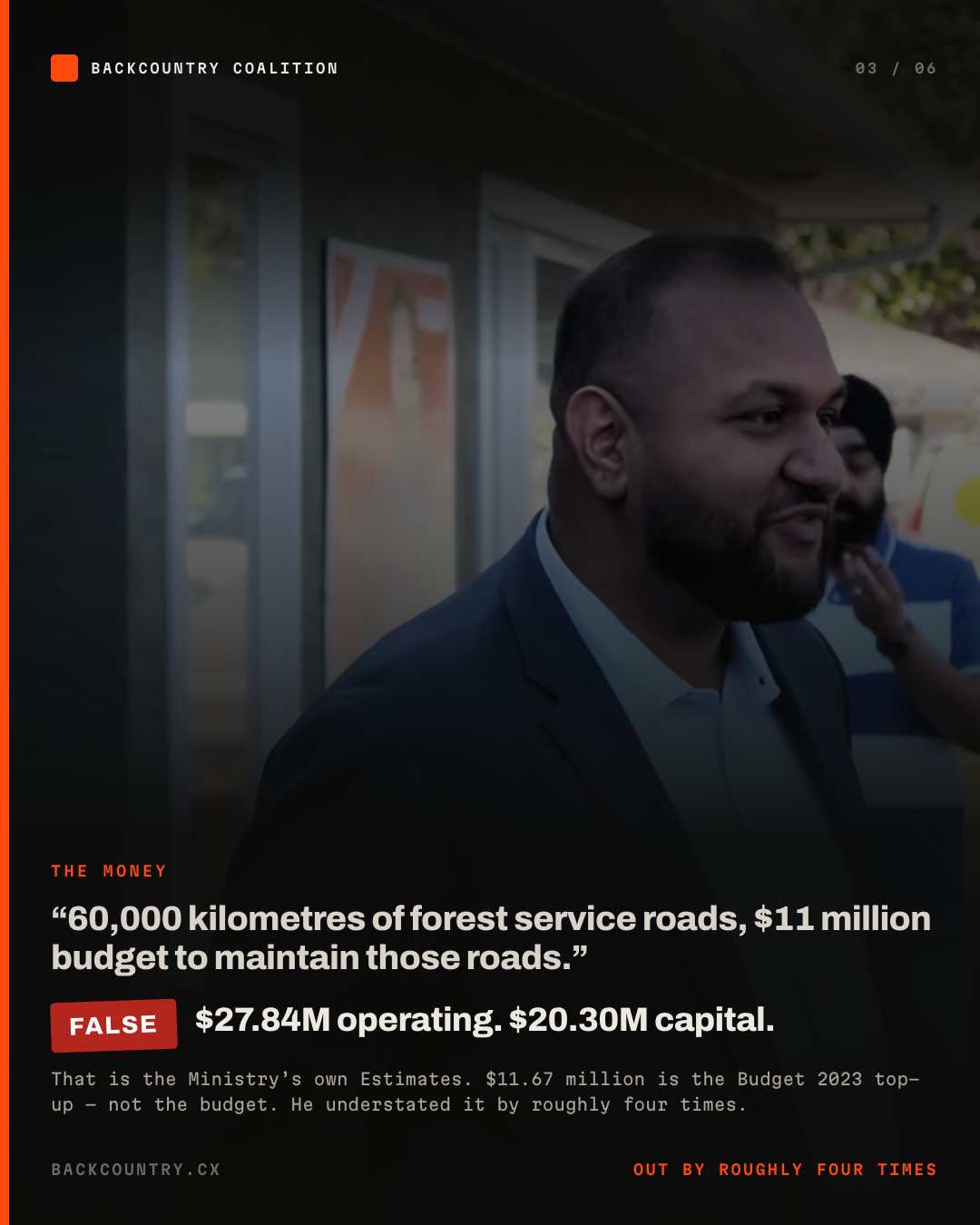
“60,000 kilometres of forest service roads, $11 million budget to maintain those roads, and the biggest challenge that we face is with the contraction of the forest industry, who typically has been maintaining those roads.”
Ravi Parmar · 0:24
The check
The road figure is right, and he used the right category. The Ministry of Forests’ Engineering Manual of 25 May 2026 opens: “a network of approximately 60,000 km of Forest Service Roads (FSRs) in the province, including approximately 6,000 bridges and Major Culverts.” Most speakers confuse this with the ~620,000 km of all resource roads. He did not.
The budget figure is not. The Ministry of Forests’ road lines in the current Estimates are $27.84 million operating (standard object 72, Non-Capital Roads and Bridges, Vote 30) and $20.30 million capital — $48.1 million together, before BC Timber Sales’ $42.7 million statutory capital. No published budget line of $11 million for forest service road maintenance exists in any year.
There is one number in the record that rounds to his. Budget 2023 added “$35 million in operating funding” for forest service roads over three years — $11.67 million a year. That is the increment, not the budget. It is visible landing in the Estimates as an $11.4 million jump between 2022/23 and 2023/24.
So the most likely explanation is a briefing note misread: the top-up quoted as the whole. Either way the figure understates his own ministry’s road spending by a factor of about four — and he used it to explain why Rady Creek Road cannot be kept.
He understated his own ministry’s road budget by roughly four times, while citing it as the reason Rady Creek Road must go.
Rating:60,000 km — TRUE$11 million — FALSE
Claim 03“You could take over Rady Creek Road if you wanted to”
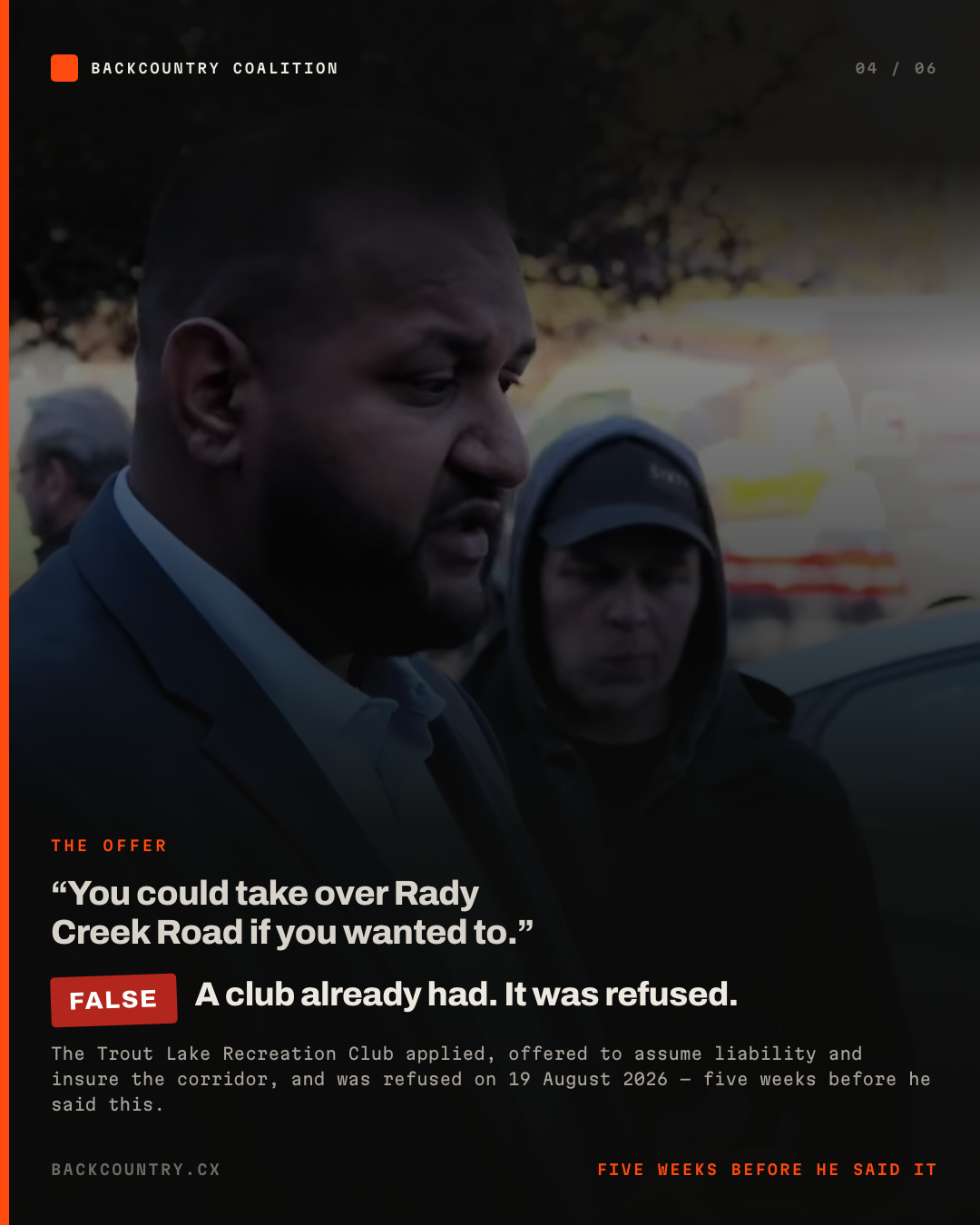
“As part of the transition that we need to do, we clearly have to look at amending the legislation, because right now you could, as a Four Wheel Drive Association of BC, you could take over Rady Creek Road if you wanted to.”
Ravi Parmar · 1:27
The check
A club already tried. The Trout Lake Recreation Club applied to take on the corridor — and, as the BC Snowmobile Federation records it, offered to “collaborate with the province to assume liability and establish a sustainable insurance structure to manage the corridor.” It was refused on 19 August 2026. The stated ground was not standards, not money, not capacity: Recreation Sites and Trails BC “declined… because its authority to authorize recreation trails generally does not extend to resource roads such as Forest Service Roads.”
There is no door, and the chain is closed at every link. A road may be maintained only if authorised under the Act (FPPR s.79(1)). On a forest service road the duty is the Crown’s: “the government must maintain a forest service road… until the road is deactivated” (s.79(3)). The only transfer route runs to “the holder of a road use permit” (s.79(4)) — and a road use permit issues only to an “eligible holder,” defined by Forest Act s.114 as someone with a right to harvest timber. The one route open to a non-harvester is a permit “for a natural resource development purpose” (s.119.6(2)), which FRPA s.21.1(1) defines as developing or transporting a natural resource other than timber. Recreation is not one.
His own ministry has said so, in the future tense. The Ministry of Forests’ Natural Resource Road Act FAQ lists what a future Act would do: “Support non-industrial maintainers taking on responsibility for roads no longer required by industry.” You do not promise to enable a thing that is already possible.
The one real instrument — an FS 1205 Forest Service Road Maintenance Agreement — authorises “routine” surface work, “grading, brushing, or snow plowing,” at no cost to the Ministry of Forests. It transfers nothing, carries no responsibility for the state of Rady Creek Road, and does not stop a deactivation.
The thing he says they could simply do had already been formally refused, five weeks earlier, on grounds that had nothing to do with standards.
Rating:FALSE
Claim 04“The standards… require a logging truck”
“The standards that are in the legislation speak to maintaining a road to a standard that requires a forestry company vehicle of some sort, whether it’s a logging truck or something else going by.”
Ravi Parmar · 1:11
The check
The duty he is describing is real: FPPR s.79(6)(c) requires that “the road can be used safely by industrial users.” He has stated the general rule and left out the exception that governs this exact road.
The very next section switches it off. FPPR s.81, “Wilderness roads”: if a forest service road “is not being used by industrial users” then paragraphs (a) and (b) apply only so far as needed to protect forest resources, and “section 79(6)(c) does not apply to that road.” The logging-truck standard ends by operation of the regulation the moment industrial use ends.
The Forest Practices Board puts the effect in plain terms: a wilderness road must be maintained “only to the extent necessary to ensure there is no material adverse effect on a forest resource,” and “there is no requirement that the road be safe for use by industrial users (or any non-industrial user, including members of the public).”
This is not a technicality — it is how most of the network is already held. The Board found that of forestry road-permit roads, “currently over three quarters” are kept as wilderness roads rather than deactivated, and the Auditor General found “no trigger or timeline for deactivation. FSRs can remain open indefinitely if they are maintained as wilderness roads.”
He says the legislation forces a standard nobody needs. The Forest Planning and Practices Regulation already contains the lower standard, and the Province uses it on tens of thousands of kilometres. What is missing is not a lower standard. It is a decision to apply it here.
The lower standard he says the law lacks is in the regulation, one section later, and most of BC’s network already runs on it.
Rating:FALSE
Claim 05“I’m not the decision maker… it’s an engineer”
“I’m not the decision maker that closes the road. It’s an engineer, and they’re bound by their credential to be able to take a look at the road. And if it’s deemed unsafe, move forward with decommissioning. Me involving myself would be me essentially going over a statutory decision maker.”
Ravi Parmar · 2:41
The check
No engineer is a statutory decision maker for this, anywhere in BC law. The Professional Governance Act confers a reserved title and conduct duties. It confers no power over Crown land and no power to decide anything for government.
The named actor in every relevant provision is the District Manager or the Minister of Forests. FRPA s.22.2 — where road use would endanger public safety — gives the power to “the district manager, for a forest service road… [who] may… close the road or restrict its use.” Forest Act s.121(9)(a) gives discontinuance and closure to “the minister.” The district’s own intake form for this file carries the printed field “AUTHORIZATION TYPE: District Manager responsible / Forest Service Road.”
The professional code assumes the opposite of what he claims. The Professional Governance Act requires every code of ethics to include a duty to “present clearly to employers and clients the possible consequences if professional decisions or judgments are overruled or disregarded.” A profession whose members can be overruled advises. It does not decide.
And on Rady Creek Road the professional went the other way. The 2026 prescription offered to preserve a narrow ATV trail across the recontoured surface, at increased cost. The Ministry of Forests’ answer is set in bold in its own report: “post-deactivation vehicular access is not required.” The direction ran from the client to the professional.
He can direct the delegate, and the statute says so twice. Forest Act s.1.1(1): the Minister of Forests may delegate a power “including a quasi-judicial power or duty” and may “provide directions that are binding on the delegate… and vary or revoke a delegation or direction.” FRPA s.120.1(4) repeats it. FRPA s.120.1(3) provides that the Act applies to the delegate “as if the delegate were the minister.”
And the delegation asked him for something smaller than any of that. They asked him to pause a procurement — a tender his own ministry issued and had not yet awarded. Declining to award is an administrative act. It touches no adjudication, no party’s rights and no reviewable determination; a deactivation decision is not among the determinations FRPA s.80(1) makes reviewable, and the Forest Practices Board has confirmed “there is no formal avenue for appealing the decision to deactivate a road.”
He described a chain of authority that does not exist. An engineer writes a prescription; a District Manager decides — as the delegate of the Minister of Forests, under directions that minister may give in writing.
Rating:FALSE
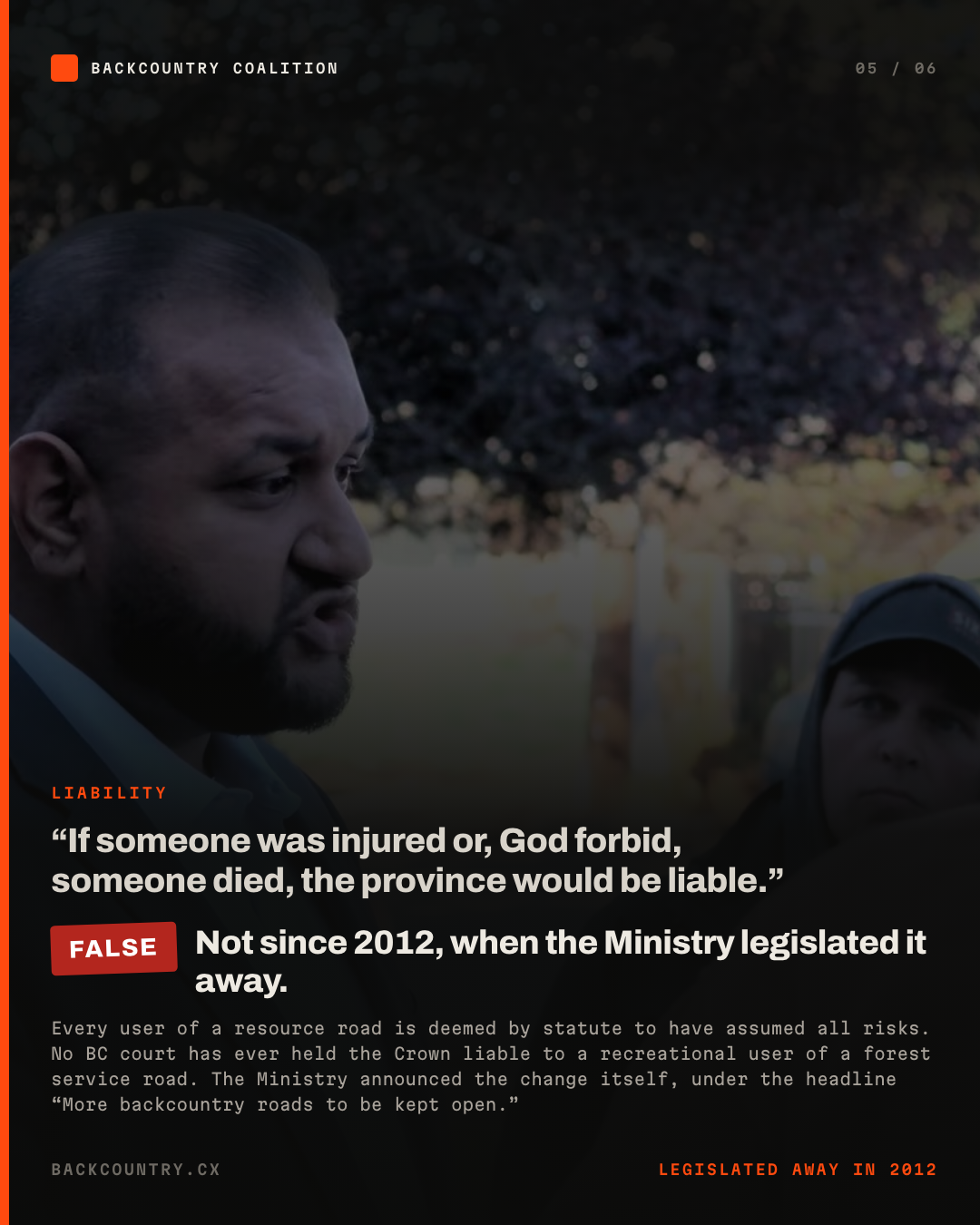
Claim 06“If someone… died, the province would be liable”
“It’s the liability piece. The province, because it’s a provincial road, takes on responsibility. So if someone was injured or, God forbid, someone died, the province would be liable for that.”
Ravi Parmar · 2:37
The check
The premise is inverted. A road’s provincial character is what puts it inside the shield, not outside it. The Occupiers Liability Act defines a “resource road” as a road on Crown land used by motor vehicles, expressly excluding municipal and provincial public highways — those are the roads that carry the ordinary duty.
Since 25 June 2012 the answer has been statutory. Occupiers Liability Act s.3.1: a person who uses a resource road “is deemed to have willingly assumed all risks,” and a “limited liability entity” — a term the Act defines to include “the government” — owes only the duty in s.3(3): not to “create a danger with intent to do harm” and not to “act with reckless disregard.” Being injured on the road does not make the Province liable. Dying on it does not either.
The Province has already won this exact case, over a death. In Marklinger v. British Columbia, 2026 BCSC 710 — decided five months before this meeting — a woman was killed by a falling tree on a BC recreational trail. The Court found “a dearth of records” and that “the record keeping… is lacking,” held that maintaining those records was an operational activity with no policy immunity, and still dismissed the claim: the conduct did not reach reckless disregard.
No BC court has ever held the Crown liable to a recreational user of a forest service road. Across roughly thirty-five years of the BC Supreme Court and Court of Appeal record, three judgments sit at the intersection of forest service roads and occupiers’ liability, and none reached a ruling on the merits. The Auditor General states the position flatly: users “under the Occupiers Liability Act use FSRs at their own risk.”
And the Ministry of Forests, now invoking liability, is the one that legislated it away — on purpose, to stop this happening. Its news release of 28 June 2012 was headlined “More backcountry roads to be kept open,” and said the amendments were made “to help prevent resource road closures.” The bulletin that March listed the objective: “Reduce the number of resource roads that are closed due to concerns regarding third party liability.”
The shield he says the Province lacks was built fourteen years ago, names the government explicitly, and was enacted for the express purpose of keeping these roads open.
Rating:FALSE
Claim 07“They get decommissioned very quickly” — and “back in 2021”
“The other thing that kept coming up was when these roads get decommissioned, they get decommissioned very quickly… But it’s a bit unfair for the community that has just kind of handed a sentence like this has to happen.”
Ravi Parmar · 3:44
“But as you know, my understanding is that road was to be decommissioned back in 2021. And it’s taken from that point to this point to get where they are.”
Ravi Parmar · 8:07
The check
Four minutes apart, he says roads are decommissioned “very quickly” and that this one has been running since 2021. Both cannot describe the same file.
Neither describes the district’s actual practice, which is deliberately about a year. The Selkirk engineering technician wrote in 2022 that she was “trying to get a year ahead of the actual planned deactivation works.” The district’s live page shows Heights FSR and Sitkum Creek FSR both posted in July 2026 for deactivation about mid-2027. Rady was posted 13 November 2025 for works completed by 1 November 2026 — about eleven and a half months.
The 2021 date is wrong, and wrong in a revealing way. The prescription reads “Date Prescribed: October 7, 2020.” What happened in 2021 was not the decision to deactivate. It was the decision to remove ATV access — recorded on 11 May 2021 in an email that says access would be removed “as a result of the referral process and Selkirk Resource Management discussions,” thirteen days after the same officer told the same recipients that “every effort will be made to maintain ATV access.”
And his own timeline refutes his own legal claim. If deactivation were compulsory the moment an engineer finds a road unsafe — as he says at 2:47 — it could not then sit for five years waiting on a tender. A mandatory safety closure does not wait half a decade.
The concession inside it is worth keeping: “it’s a bit unfair for the community.” He is right. That is an argument for using the powers he says he does not have.
Sources 27
Both halves cannot be true — and the five-year timeline he cites is itself evidence against the compulsory-closure story he told four minutes earlier.
Rating:SELF-CONTRADICTORY
Claim 08“Mining is still a big opportunity there”
“Mining is still a big opportunity there. I know mining companies are very interested…”
Ravi Parmar · 3:14
The check
This is the most factually solid statement he made, and it is the one that does the most damage to the Rady Creek deactivation he is defending.
The corridor is not being closed because access to that ground has stopped having value. It is being closed to one kind of user. Mineral tenure is acquired and held online, and a claim holder retains the right to access their claim. Recreation has no equivalent standing anywhere in the statute.
Mackenzie’s own UBCM resolution — endorsed by the membership in September 2025 — names the same asymmetry from the other end, warning that road closures stop “tourism, industrial activities such as mining, fighting forest fires.”
So the Province’s position on Rady Creek Road, stated in one breath: too unsafe and too expensive to keep open for the public, and simultaneously a live opportunity for industry. Both can be administered at once because the statutes give one of them a mechanism and the other nothing.
Sources 18
True — and it concedes that what is being withdrawn is not access to the ground, but public access to it.
Rating:TRUE
Claim 09The Mackenzie “test case”
“We had an issue in Mackenzie where this was very similar. There’s a gentleman by the name of Peter Kyllo… And so Peter came to me at a UBCM meeting two years ago saying, I want to take on the maintenance of this road. And we kind of used it as a bit of a test case for how challenging and how difficult that is.”
Ravi Parmar · 5:30
The check
The meeting could not have happened when he says. Peter Kyllo is a councillor of the District of Mackenzie — not its mayor, and not the Shuswap MLA of the same surname. He lost the October 2022 election and entered council by by-election on 16 November 2024, declared 18 November. Parmar was appointed Minister of Forests on 18 November 2024. At UBCM 2024 neither man held the office he would have needed: Kyllo was a private citizen, and the Minister of Forests at that convention was Bruce Ralston. The only workable reading is UBCM 2025 — one year ago, not two.
Mackenzie’s documented ask is the opposite of the one he describes. Resolution 2025-EB68, “Forest Service Road Closures,” sponsored by Mackenzie and endorsed by the UBCM membership, asks “that local government be fully consulted and actively engaged in decision-making processes prior to any ministry action regarding the closure of forest service roads.” It is a request to be consulted before closure. It is not an offer to take on maintenance.
No test case exists in the public record. No pilot, agreement, funding or program under which Mackenzie took on resource-road maintenance can be found, and Mackenzie’s own district road-safety page carries no deactivation entries — there is no road there to run one on.
What the resolution actually produced was a non-answer. The Ministry of Forests’ published response: it “is committed to improving communication with local governments… This includes exploring options for maintaining access.” Improved communication and exploring options. No devolution, no pilot.
The ask is also not new. The UBCM resolutions committee records members endorsing versions of it in 2008, 2010, 2013, 2015, 2017, 2020 and 2024. At the 2026 convention he had just attended, three more were tabled and each was ruled existing policy.
Sources 19
A request to be consulted, described as an offer to take on road maintenance — and a “test case” that does not appear anywhere in the record.
Rating:FALSE
Claim 10“We can’t really do anything until the election’s over”
“The current issue is we’re in an election and we can’t really do anything until the election’s over.”
Ravi Parmar · 5:10
The check
The caretaker convention is real, and it restrains a specific thing. The Province’s own guide: during the interregnum government avoids “major policy initiatives” and “new contracts or undertakings that would bind an incoming government.”
The same paragraph concedes the point. “While Cabinet members and Deputy Ministers (DMs) are legally able to make ministerial decisions during these periods, in practice all major actions and decisions are deferred and only routine ministry business continues.” It is convention, not law, and it carries no legal sanction.
Note which way it cuts. The convention’s purpose is to stop a caretaker government binding its successor. Awarding a contract that will barricade a public road by 1 November is the act that binds. Pausing an unawarded tender is the act that preserves the incoming government’s choice.
And the sequence matters: his ministry told CBC on 22 September that “the decision for deactivation is final,” the tender closed on 24 September, and the writ was issued on 22 September. The position was fixed before the convention he now cites began to apply.
Sources 22
The convention exists to stop a departing government tying its successor’s hands. Here it is being cited to justify the one act that does.
Rating:MISLEADING
Claim 11“I don’t think I fully have appreciated how big your industry is”
“I don’t think I fully have appreciated how big your industry is. And so it certainly has been an eye-opener the last number of weeks… most of the information I get is from the ministry and it just seems like there’s some friction between officials and yourselves. And I’m not sure why that is.”
Ravi Parmar · 7:02
The check
Three provincial recreation bodies wrote to him by name before this meeting. ATVBC and the Public Land Use Society on 15 May 2026, asking for a stop-work order and a reply within seven days. The BC Snowmobile Federation on 6 July. The Outdoor Recreation Council of BC on 4 August, on behalf of “more than 130 organizational members and, through them, over 200,000 British Columbians.”
No published reply to any of them exists. ATVBC put it in a press release on 4 June: “We are shocked and disappointed that the Minister of Forests has not provided a substantive response to the coalition.” The executive director of another says on the record: “they’ve never picked up the phone, they’ve never called me, I’ve never had a conversation with them.”
His own government published the number he says he did not have. Look West: B.C.’s Outdoor Recreation Strategy, May 2026, is an entire provincial strategy on this sector — and names the cause: “as… the industrial base that has historically funded road maintenance continues to shrink, new solutions need to be explored.”
On the “friction” he says he cannot explain: his ministry declined a CBC interview on this road, and the district manager wrote to the Trout Lake club on 27 November 2025, “I am unable to participate in a meeting with your group.” The same office’s stakeholder list — licensees, miners, tenure holders, trappers, guide outfitters, landowners — has no place on it for a recreation organisation.
The first documented occasion on which the Minister of Forests met a recreation delegation face to face is day seven of an election campaign, in his own campaign office.
Not a failure of information. Three letters, nineteen weeks, and no reply — then a meeting once the writ was out.
Rating:MISLEADING
Claim 12“Reach out… to the Selkirk district office”
“My suggestion to you would be that the next appropriate step… is to reach out, I believe to the Selkirk district office in that case, and to be able to have a conversation.”
Ravi Parmar · 7:49
The check
It is the right office in principle — the file lives there and the District Manager sits there. In fact the referral is circular.
That office had already declined to meet them. District Manager to the Trout Lake club, 27 November 2025: “I am unable to participate in a meeting with your group.”
And it had already refused the transfer, in writing, thirteen days before this meeting. To the BC Snowmobile Federation, 15 September 2026: “The Ministry of Forests will not consider transferring the road to another entity due to significant safety concerns and environmental concerns and will complete our deactivation work to relieve ourselves of liability.”
So Parmar sent a delegation to the office that had refused to meet them, to ask for a transfer that office had refused in writing a fortnight earlier — while saying he could not intervene because that office had decided.
Sources 25
Sent to the one office that had already said no to both the meeting and the transfer.
Rating:MISLEADING
Claim 13“I’ve asked my team to start looking into it”
“I’ve asked my team to start looking into it. It’s enough of an issue that’s coming up that I think it requires that.”
Ravi Parmar · 5:23
“One of the things that we’re hoping to use is AI to be able to actually have a website and maybe an interactive map that shows—”
Ravi Parmar · 4:06
The check
These are commitments, not claims, and we are not scoring them as lies. We are recording them so they can be checked.
Both need their dates kept beside them. “Starting to look into it” was said on 28 September. His ministry had told CBC on 22 September that “the decision for deactivation is final,” and the tender it would have to stop closed on 24 September. The looking began after the deciding ended.
The interactive map has no trace in any public document — no budget line, no procurement, no service-plan item.
He also said: “if my party is successful, I’d certainly be interested if I’m back as Minister of Forests, to having those conversations.” He cannot promise the portfolio — appointment to cabinet is the Premier’s prerogative — and his conditional is correct. The trackable item is the interest, not the office.
The test is simple and it is dated. Does anything — a letter, a hold on the award, a direction under Forest Act s.1.1(1) — appear in the record before the barricade goes in on 1 November 2026?
Recorded, dated, and checkable on 1 November.
Rating:PROMISE — TRACKED
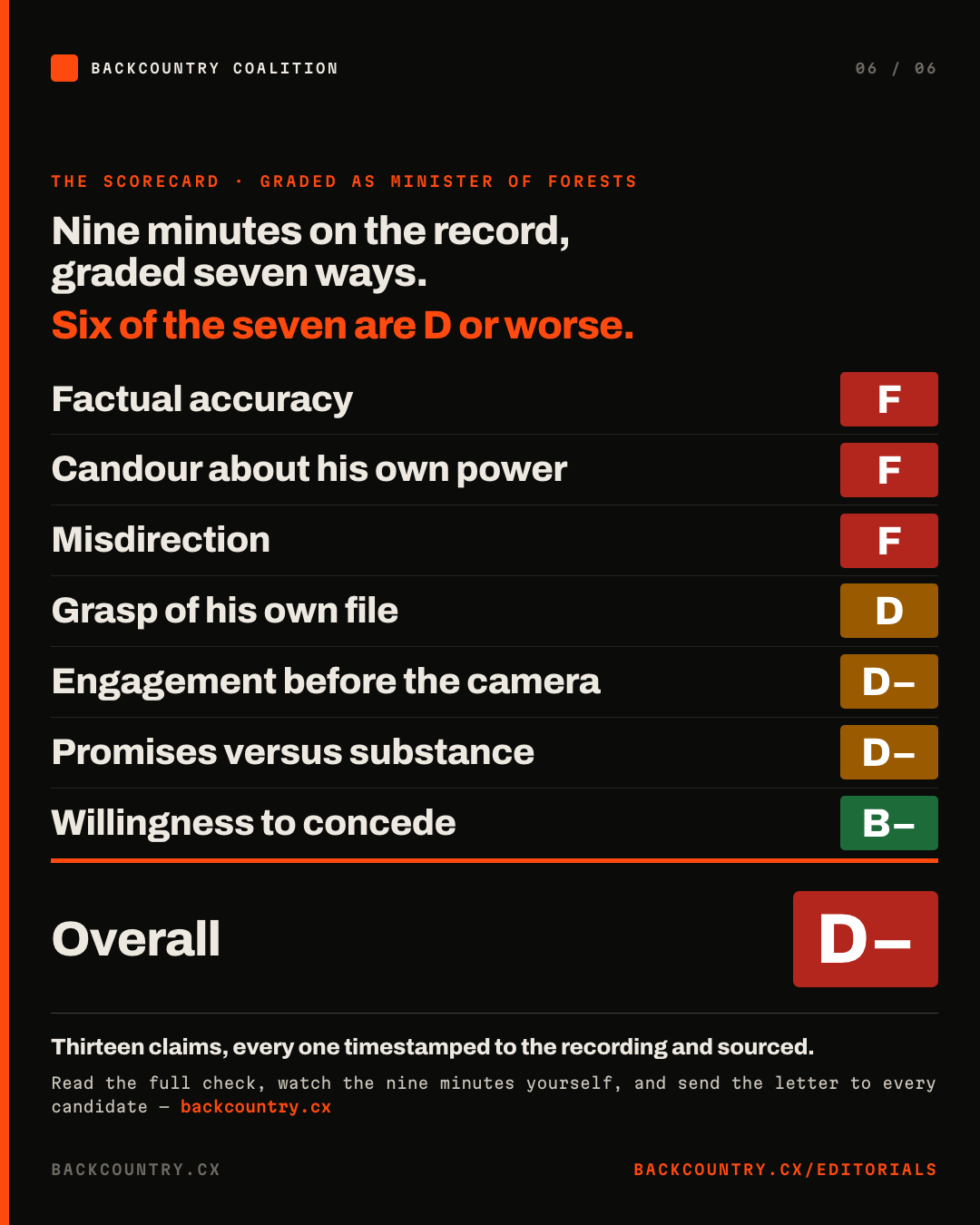
The scorecardNine minutes, graded
Counting verdicts tells you what he said. It does not tell you how he answered. These are the measures that matter when the person in front of you holds the office that can stop the thing you came about — and every grade below is tied to the claims checked above, not to an impression.
| F | Factual accuracyThirteen sections, thirteen scored claims — one section makes two. Seven false, three misleading, one self-contradictory, two true. The road-network figure was right; the budget attached to it was out by about four times. |
| F | Candour about his own powerHe opened by saying he was “technically not the Minister of Forests anymore.” He was — OIC 595/2024, no end date — and the power to discontinue and close a forest service road is the minister’s own. He then said directing the decision-maker would be overstepping; the Forest Act says in terms that he may direct the delegate in writing. |
| F | MisdirectionThree deflections, each to somewhere he was not. To an engineer, who holds no statutory authority over a road. To the election, which restrains binding your successor — not pausing an unawarded tender. And to the Selkirk district office, which had refused to meet the club and, thirteen days before this meeting, refused the transfer in writing. |
| D | Grasp of his own fileHe named the road network correctly where most get it wrong. He was then wrong on the budget, wrong that the law forces a logging-truck standard (section 81 switches it off), wrong about who decides, wrong that the Province carries the liability, and a year out on the date. |
| D− | Engagement before the cameraThree provincial recreation bodies wrote to him by name across nineteen weeks. No published reply to any of them. The first time he met a recreation delegation face to face was day seven of an election campaign, in his own campaign office. He did stand there and answer for nine minutes. |
| D− | Promises versus substance“I’ve asked my team to start looking into it” — six days after his ministry told CBC the decision was final, four days after the tender closed. An AI map with no budget line, no procurement and no service-plan item. And an interest in talking conditional on being re-appointed. |
| B− | Willingness to concedeHis best measure, and it is genuine. Unprompted, he said mining is still a live opportunity on that ground — the one statement that most damages the decision he came to defend. He called the process “a bit unfair for the community.” He admitted he had not appreciated the sector’s size, and that he could not explain the friction with his own officials. |
Overall: D−. Not because he was hostile — he was courteous, and he took a meeting nobody made him take. Because on the four things a minister is actually for — knowing the file, holding the power, using it, and saying so plainly — he was wrong, and the record was available to him in his own ministry’s documents.
In fairnessWhat he got right
A fact check that only finds one kind of answer is not a fact check. Four things he said are correct, and the piece is stronger for saying so.
The road network figure is right, and he used the right category. Approximately 60,000 kilometres of forest service roads, carrying roughly 6,000 bridges and major culverts. Most people arguing about this confuse it with the roughly 620,000 kilometres of all resource roads in the province. He did not.
A minister genuinely should not direct the outcome of a quasi-judicial decision. The instinct is real and it matters. It simply does not attach to this decision, which has no hearing, no parties, no requirement to give reasons and no appeal.
There is a real professional duty to hold public safety paramount. He is right that a credentialed professional carries a binding obligation. He is wrong only about what it obliges them to do: advise, and record the consequences when they are overruled.
Mining is a live opportunity on that ground. True, and stated without prompting. It is also the sentence that most clearly exposes what is actually happening, which is why we have given it a section of its own.
And one more, which is not a fact but is worth recording: he took the meeting. Nobody made him stand in a parking lot for nine minutes and answer questions on camera. Three letters from three provincial organisations produced nothing for nineteen weeks; a group that drove to his office got further in nine minutes than any of them did in four months. That is a finding about how access works in British Columbia, and it is not to his credit — but the standing there and answering is.
The findingEvery one of these was a choice, and he described them as constraints
Read the thirteen answers together and a single shape appears. A budget four times larger than the one he quoted. A lower legal standard that already exists, one section further down the same regulation. A liability shield the Province built fourteen years ago for the express purpose of keeping these roads open, under which it has never once been held liable to a recreational user, and under which it won a case involving a death five months before this meeting. A decision maker who is not an engineer but a District Manager, exercising the Minister of Forests’ own power, under a delegation that minister may direct in writing. A club that had already offered to carry the liability and been refused on grounds that had nothing to do with any of it.
None of those is a constraint. Every one is a decision that has been taken, and that could be taken differently, by the office he was holding while he explained that he no longer held it.
He is right that the community was handed a sentence. He was, at that moment, the person who could have suspended it.
Minister, you told them the engineer decides. The engineer offered to leave the trail open. Your ministry wrote “not required” in bold, in its own report.
Take actionPut it to them before the vote
Write to them·Every party·Take five minutes
The letter is already written. It just needs your name on it.
He answered on camera six days into a campaign, and most of what he said does not survive checking. Everyone asking for your vote should have to say whether they accept that — and whether they will pause the tender that barricades Rady Creek Road on 1 November, before the next Legislature even sits.
It goes to the Minister of Forests and every BC NDP campaign we have an address for, copying all four opposition parties — 51 recipients and 44 copied — so none of them can say they were not told. No mail link can carry that many addresses and a letter this long, so the steps below do it in the order that works. The last act is yours, not a button on this page.
- 01Press Open your email app — a draft opens, already addressed to the Minister of Forests and one desk at each party
- 02Come back and press Copy all addresses, then paste them into To and Cc to reach all 95
- 03Press Copy the full letter, paste it over the placeholder, add your own line — and send it yourself
To the Minister of Forests, and to every candidate seeking a seat in this election,
On 28 September 2026, six days into the campaign, a delegation from the Four Wheel Drive Association of BC met Ravi Parmar at his Langford campaign office and recorded the conversation. It is nine minutes long and it is public:
https://www.youtube.com/watch?v=EH-wynyEk8U
We transcribed it and checked every claim he made against the statutes, the Estimates and his own ministry's records. Thirteen claims were scored. Eleven did not hold: seven false, three misleading, one that contradicts itself four minutes later. Two held up. The full check, with each claim timestamped to the recording and each finding sourced, is here:
https://backcountry.cx/editorials/ravi-parmar-fact-check-rady-creek/
The four that matter most:
1. HE SAID HE WAS NO LONGER THE MINISTER. "I'm technically not the Minister of Forests anymore because of the election." He was. Dissolution ends the terms of MLAs, not ministers - the Province's own election guide states that ministers continue in Cabinet until a new one is sworn in, and Order in Council 595/2024 records no end date. The power to discontinue and close a forest service road is the minister's own, under section 121(9) of the Forest Act. It did not move on 22 September.
2. THE BUDGET IS OUT BY ABOUT FOUR TIMES. He said "$11 million budget to maintain those roads." The Estimates show $27.84 million operating and $20.30 million capital for the Ministry of Forests' roads. $11.67 million is the Budget 2023 increment, not the budget.
3. THE CLUB HE SAID COULD TAKE THE ROAD OVER HAD ALREADY BEEN REFUSED. He said "you could take over Rady Creek Road if you wanted to." The Trout Lake Recreation Club had applied, had offered to assume liability and insure the corridor, and was refused on 19 August 2026 - five weeks earlier - because Recreation Sites and Trails BC's authority to designate trails does not reach a road.
4. THE LIABILITY HE SAYS FORCES HIS HAND WAS LEGISLATED AWAY IN 2012. He said "if someone was injured or, God forbid, someone died, the province would be liable." Since 25 June 2012, section 3.1 of the Occupiers Liability Act has deemed every user of a resource road to have assumed all risks, and names the government a limited liability entity. The Ministry of Forests announced that amendment itself, under the headline "More backcountry roads to be kept open."
WHY THIS IS AN ELECTION ISSUE, AND WHY IT HAS NOT BEEN TREATED AS ONE
Three provincial recreation bodies wrote to the Minister of Forests by name before this meeting - ATV/BC and the Public Land Use Society on 15 May, the BC Snowmobile Federation on 6 July, and the Outdoor Recreation Council of BC, which represents more than 130 organisations, on 4 August. Not one published reply exists. The first time the minister answered a recreation delegation face to face was in his own campaign office, six days into the writ.
On 22 September his ministry told CBC the deactivation decision was "final." On 24 September the tender closed. The barricade is due by 1 November 2026 - before the next Legislature sits.
This is not a local grievance. Twenty-two roads in the Selkirk district alone are posted closed or for deactivation, and every one of them is public. The Union of BC Municipalities has endorsed resolutions on forest service road closures repeatedly since 2008, most recently 2025-EB68, sponsored by Mackenzie and endorsed by the membership.
WHAT WE ARE ASKING EACH OF YOU TO SAY OUT LOUD
The Minister of Forests put the next Parliament on the hook himself: "I think this is going to be a bigger issue for whoever forms government next." It is the one thing he said that we agree with, and it is why this letter goes to every party rather than only to the government. Whoever forms the next government inherits Rady Creek Road and the twenty-two like it. The parties that do not form it inherit the job of holding that government to what it said during the campaign. We are writing that record now, while all of you are still asking.
So we are asking for a commitment, not a comment. Two sentences. Each is a yes or a no, each fits in a doorstep answer, and each can be read back to you in a year:
"I commit to public access to public land - that no public road on public land is closed to the public without a published reason, a named decision maker, and notice to the people who use it."
"I commit to reforming how the Ministry of Forests handles resource roads, so that a road is not demolished by default because no agency was ever made responsible for keeping it open."
Say yes, or say no and say why. Both are answers we can print. Silence is the only response that is not.
Then four specifics, in the order they stop being possible:
1. ACCEPT OR DISPUTE THE FOUR FINDINGS. Say plainly whether you accept them. Each is checkable and each is sourced to the recording and to the record. If you dispute one, name which one and say on what.
2. PAUSE THE AWARD OF TENDER EN27DSE008. No award and no barricade until the next Legislature can consider it. Declining to award a tender is an administrative act - it touches no party's rights and no reviewable determination, and it is the smallest thing anyone in this file has asked for. Rady Creek Road can be destroyed before the House sits. It cannot be put back after.
3. CLOSE THE LEGISLATIVE GAP THE MINISTER OF FORESTS HIMSELF DESCRIBED. He said "we clearly have to look at amending the legislation." It was drafted once already - Bill 30, the Resource Road Act, 2008, read once and removed from the legislative agenda. Eighteen years on there is still no route by which a recreation group can hold a road, which is why the Trout Lake club was refused. Say what your party will do about that, and in which session.
4. ENDORSE THE MECHANISM, OR NAME A BETTER ONE. We are not only objecting. On 24 September the coalition sent an open letter to candidates and to the organisations whose members use these roads:
https://backcountry.cx/memos/memo-003.html
Kim Reeves, Past President of the Four Wheel Drive Association of BC, answered it with a mechanism rather than an opinion, and it is the subject of the editorial we publish next:
https://backcountry.cx/editorials/resource-road-organization/
When a commercial maintainer wants out of a road, the engineering record and the demolition money the law already requires it to spend transfer to a body that keeps the road open instead of tearing it out. It is not new money and it needs no appropriation to begin: it is money already owed by a named party, and today it is spent destroying a public asset. Read it, and either endorse it or tell us what you would put in its place. A no with a reason is a position. Nothing is not.
[If you use these roads, say so here: which ones, how long you have used them, and what losing them costs you. One paragraph in your own words carries more weight than everything above.]
Send the whole thing
Both halves travel by clipboard, because no mail link can carry 95 addresses and a letter this long. Copy the addresses into To and Cc, copy the letter over the placeholder, then send it yourself.
Share this story
Six images carrying this story on their own — the cover, the four claims that matter most and the scorecard. Made to be posted.


Slide 1 of 6
Suggested caption
On 28 September a group from the Four Wheel Drive Association of BC drove to Ravi Parmar’s campaign office in Langford and got him on camera for nine minutes about the Rady Creek deactivation. It is the first time the Minister of Forests has answered for it in public. We transcribed all of it and checked thirteen claims against the statutes, the Estimates and his own ministry’s files.
He told them he was “technically not the Minister of Forests anymore because of the election.” He was. Dissolution ends the terms of MLAs, not ministers — the Province’s own election guide says ministers continue in Cabinet until a new one is sworn in, and the statutory power to close a forest service road is the minister’s.
He said the budget to maintain 60,000 kilometres is $11 million. The Estimates show $27.84 million operating and $20.30 million capital. The kilometres were right; the money was out by about four times.
He said a four-wheel drive association could take over Rady Creek Road if it wanted to. The Trout Lake Recreation Club had already applied, already offered to assume liability and insure the corridor, and was refused five weeks earlier — because Recreation Sites and Trails BC’s power to authorise trails does not reach a road.
He said the legislation forces a logging-truck standard. Section 81 of the Forest Planning and Practices Regulation switches that off once industrial use ends. He said an engineer decides and he cannot intervene. No engineer holds statutory authority over a road; a District Manager does, as the Minister of Forests’ own delegate.
And he said that if someone died the province would be liable. Since 2012 every user of a resource road has been deemed by statute to have assumed all risks. The Ministry of Forests announced that change under the headline “More backcountry roads to be kept open.”
One thing he said was true without qualification: mining is still a big opportunity there.
backcountry.cx/editorials/ravi-parmar-fact-check-rady-creek/
#BCpoli #PublicLand #Kootenays #RadyCreek #ResourceRoads
Sources
- ↩ 4WDABC, “4WDABC meets with Ravi Parmar,” published 28 September 2026. The recording checked throughout this page. Link
- ↩ Occupiers Liability Act, RSBC 1996 c.337, ss.1, 3(3), 3.1 and 8 — the “resource road” definition, the deemed assumption of all risks, and “limited liability entity” naming the government. In force 25 June 2012. Link
- ↩ Marklinger v. British Columbia, 2026 BCSC 710 — a death on a BC recreational trail; record keeping found “lacking” and held operational; claim dismissed for want of reckless disregard. Link
- ↩ Chisholm v. Valemount Forest Products Ltd., 2025 BCCA 48 — the s.3.1 question expressly left for trial at para. 38. Link
- ↩ Forest Planning and Practices Regulation, BC Reg 14/2004, s.79 (maintenance, and the government’s duty to maintain until deactivated), s.81 (wilderness roads) and s.82 (deactivation works, including the all-terrain vehicle exception). Link
- ↩ Forest Act, RSBC 1996 c.157 — s.1.1(1) (delegation, and binding directions to the delegate), ss.114, 115, 119.5 and 119.6 (road permits and eligible holders), s.121(9) (the minister’s power to discontinue and close). Link
- ↩ Forest and Range Practices Act, SBC 2002 c.69 — s.1 (“minister” includes the minister’s delegate), s.21.1 (natural resource development purpose), s.22.2 (the district manager’s power to close or restrict), s.80(1) (the exhaustive list of reviewable determinations), s.120.1 (delegation and binding directions). Link
- ↩ Professional Governance Act, SBC 2018 c.47, s.57(2) — the mandatory code of ethics, including the duty to present the consequences when professional judgment is “overruled or disregarded.” Link
- ↩ Ministry of Forests, Engineering Manual, 25 May 2026, Preface p.ii — “approximately 60,000 km of Forest Service Roads… including approximately 6,000 bridges and Major Culverts.”
- ↩ Auditor General of British Columbia, Management of Forest Service Roads, November 2020 — pp.21, 28, 39–40, 46–48 and Exhibits 8 and 9. Districts received 14–20% of their maintenance requests; $8.9M of high-priority work unfunded in 2019/20 alone. Link
- ↩ Forest Practices Board, Access Management in British Columbia: Issues and Opportunities, FPB/SR/49, April 2015 — pp.9, 20, 22, 30 and §4.4 (no formal avenue to appeal a deactivation decision). Link
- ↩ Estimates and Supplement to the Estimates, Ministry of Forests, Vote 30, 2021/22 to 2026/27 — standard object 72, Non-Capital Roads and Bridges ($27.84M), and Roads, Bridges and Ferries capital ($20.30M).
- ↩ Budget and Fiscal Plan 2023/24–2025/26, Table 1.2.5 p.20 and p.24 — the $35M operating and $14M capital forest service road additions, i.e. $11.67M a year.
- ↩ Order in Council 595/2024, approved 18 November 2024 — “Honourable Ravi Parmar — Forests.” Legislative Assembly members database records no end date.
- ↩ Government Information Management, Managing Records During an Election, revised 21 September 2026 — ministers continue as members of Executive Council until a new Cabinet is sworn in; ministers remain “legally able to make ministerial decisions.”
- ↩ Bill 30 — 2008, Resource Road Act, first reading only; and the Ministry’s Natural Resource Road Act FAQ, Q15 and Q21 — a future Act “will… support non-industrial maintainers taking on responsibility for roads,” and “Bill 30 was removed from the legislative agenda following first reading.”
- ↩ Ministry of Forests, FAQ — Incomappleux Forest Service Road Deactivation, April 2025, file 11250-30/3397, Q14 — the Selkirk district “is going to continue with our deactivation plans regardless of if an application is made under the Land Act.”
- ↩ UBCM Resolution 2025-EB68, “Forest Service Road Closures,” sponsor District of Mackenzie, endorsed 26 September 2025, with the Ministry of Forests’ published response. Link
- ↩ District of Mackenzie, Mayor and Council, 2022–2026 term — Councillor Peter Kyllo; by-election 16 November 2024, declared 18 November 2024. Link
- ↩ BC Gov News, “More backcountry roads to be kept open,” 28 June 2012, and the Ministry Information Bulletin of 7 March 2012 — the 2012 amendments were made “to help prevent resource road closures.”
- ↩ Ministry of Environment and Parks, Look West: B.C.’s Outdoor Recreation Strategy, May 2026, p.21 and Target 8.
- ↩ CBC News, Jacqueline Gelineau, 22 September 2026 — the Ministry declined an interview and stated “At this time, the decision for deactivation is final.” Link
- ↩ BC Snowmobile Federation, “Rady Creek Road: A Test Case,” 13 July 2026, and “BC wants to grow outdoor recreation, so why are we removing access,” 24 August 2026 — the Trout Lake club’s application, its offer to assume liability, and the Recreation Sites and Trails BC refusal. Link
- ↩ Outdoor Recreation Council of BC, Louise Pedersen, letter to the Minister of Forests, 4 August 2026; ATV/BC and Public Land Use Society, 15 May 2026 and press release 4 June 2026; BCSF escalation 6 July 2026.
- ↩ Selkirk Natural Resource District correspondence — District Manager to the Trout Lake Recreational Club, 27 November 2025 (“I am unable to participate in a meeting with your group”); District Manager to the BC Snowmobile Federation, file 285993, 15 September 2026 (“will not consider transferring the road… to relieve ourselves of liability”).
- ↩ Rady Forest Service Road deactivation prescription, “Date Prescribed: October 7, 2020,” and its 11 May 2021 revision; stakeholder notifications of 28 April and 11 May 2021; and the 2026 prescription 26.510.01.01.16 recording that “post-deactivation vehicular access is not required.”
- ↩ Invitation to Tender EN27DSE008, “Trout Lake Rady-Cr Forest Service Road deactivation,” BC Bid opportunity 233877 — issued 9 September 2026, closed 24 September 2026, completion required by 1 November 2026.