
EDITORIAL · THE REASONS
It was never the caribou. The Ministry of Forests said so itself, in writing, in 2021.
In May 2021 the Selkirk Natural Resource District told industry that caribou habitat outranked public access on the Rady Creek road. In October it told the public the decision was “not based on the importance of the habitat for Caribou recovery.” Both statements are in writing, five months apart, from the same office. Since then the same district has given at least seven different reasons for destroying the same 4.4 kilometres of public road.
Ask why the Trout Lake–Rady Creek Forest Service Road is being destroyed and you will be told about caribou. It is the reason that travels furthest, because it is the one that sounds least like a choice. Protecting mountain caribou would be a defensible thing for a government to do.
This government has not managed it. As this is written, the Province is deciding whether to carry on with recovery for this herd in its own range, move the penned animals to a breeding centre in Alberta, or stop maternity penning and predator management altogether.18
None of that has anything to do with this road. And on this road, the Ministry of Forests does not make the caribou claim at all. It withdrew it five years ago, in writing, to the public, and it has never reinstated it. What it has done instead is offer a different reason roughly every time it is asked.
Section 01Two Selkirk District sentences on Rady Creek, five months apart
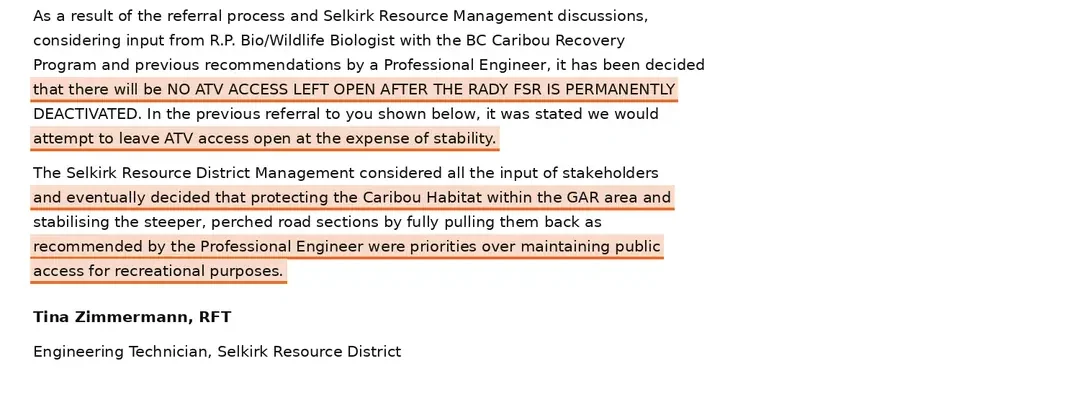
On 11 May 2021, Bettina Zimmermann — who signs as Tina Zimmermann, RFT, Engineering Technician, Selkirk Resource District — wrote to the people the district treated as stakeholders on the Rady Creek road. The subject line was an amendment to the deactivation works. The content was a reversal.01
What it shows
The district decided “that protecting the Caribou Habitat within the GAR area” and stabilising the perched sections “were priorities over maintaining public access for recreational purposes,” with input from a wildlife biologist with the BC Caribou Recovery Program. Caribou is named first. This is the caribou reason, given by the district, in its own words.
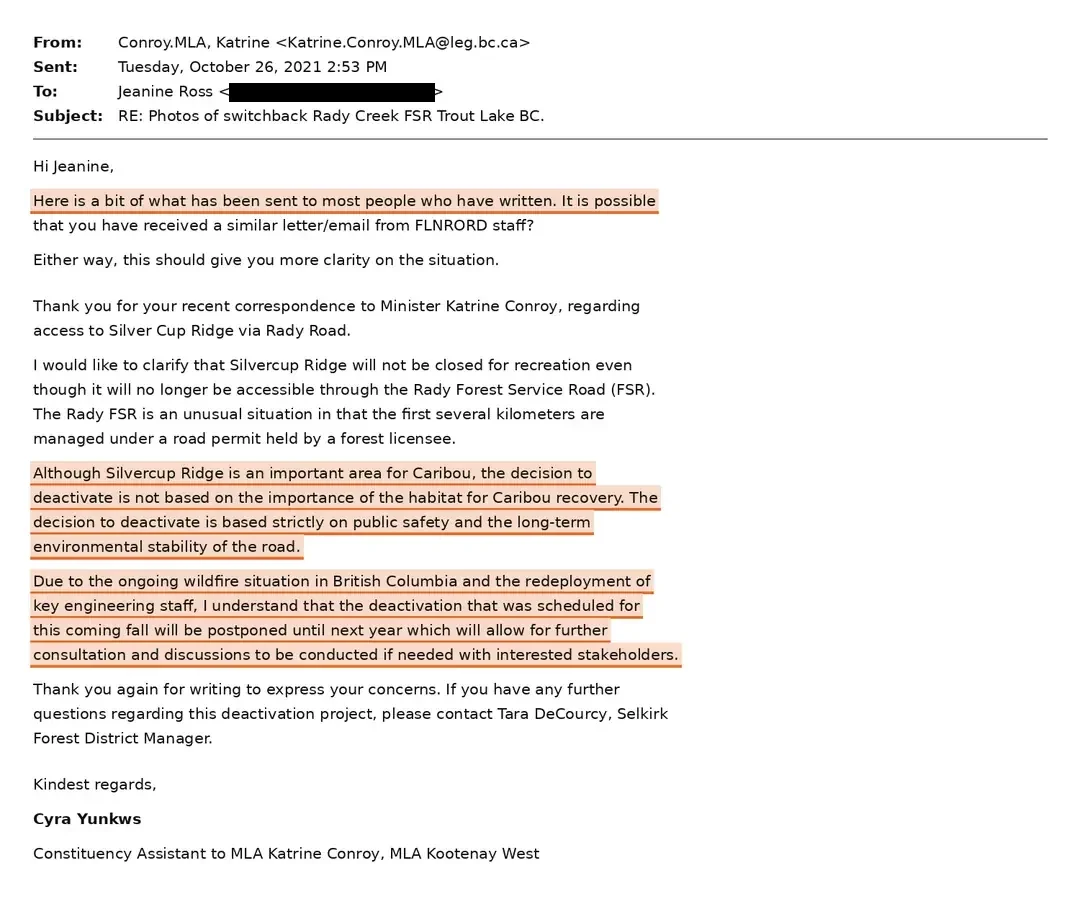
On 26 October 2021 the ministry’s answer to the public went out through the constituency office of Katrine Conroy, then Minister of Forests. The covering note says what it is: “a bit of what has been sent to most people who have written.” It is not a private reply. It is the standard answer.02
What it shows
“Although Silvercup Ridge is an important area for Caribou, the decision to deactivate is not based on the importance of the habitat for Caribou recovery. The decision to deactivate is based strictly on public safety and the long-term environmental stability of the road.” The same letter promises the work will be postponed “which will allow for further consultation and discussions to be conducted if needed with interested stakeholders.”
Those two passages cannot both be the reason. One of them was given to industry and to two private residents; the other was given to every member of the public who took the trouble to write a letter. The second is the one the Ministry of Forests chose to put its name to in public, and it says caribou is not why.
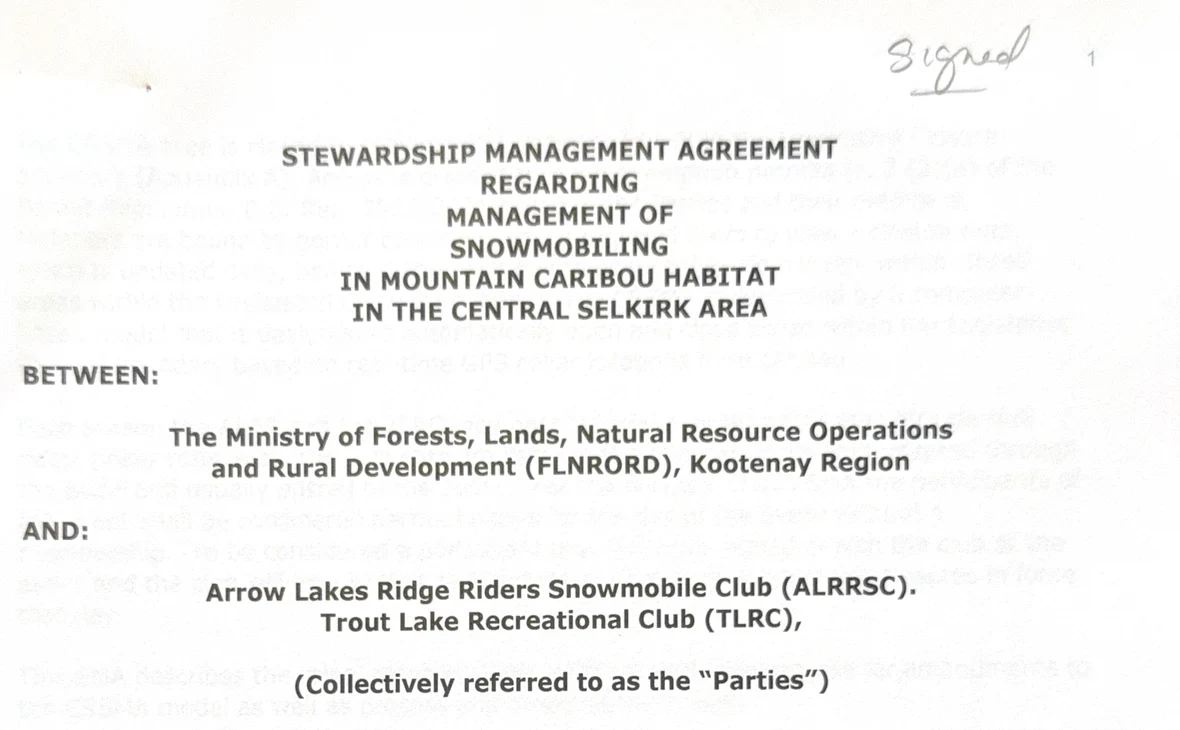
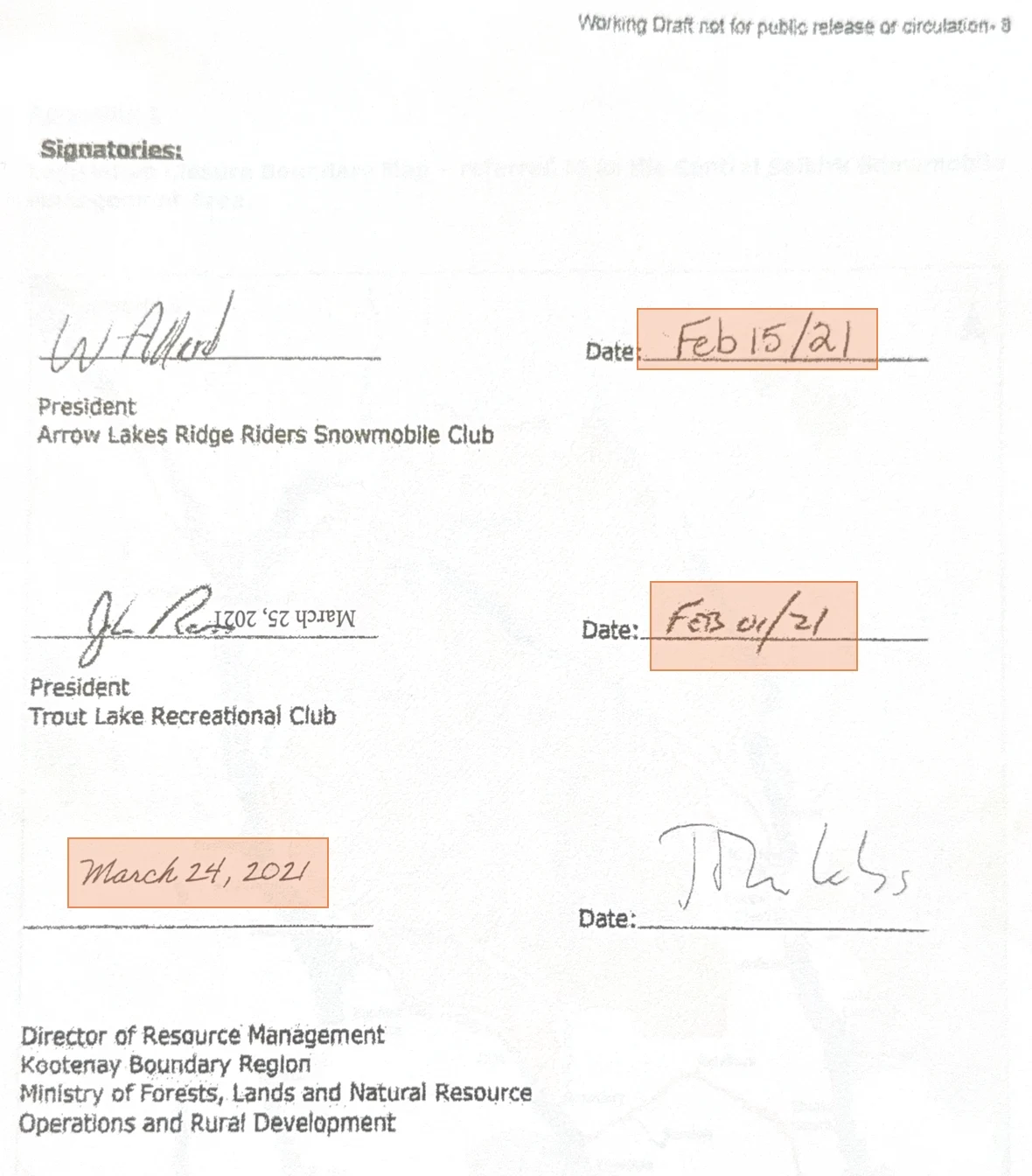
Nothing here argues that caribou do not matter, and the people who use this road have already proved they think otherwise. In February 2021 the two Trout Lake clubs signed a stewardship agreement with the Ministry of Forests and gave up riding area in caribou habitat. The parties to it are the Ministry and the two volunteer clubs, and nobody else.03
What it shows
The two Trout Lake clubs signed on 4 and 15 February 2021. The Ministry of Forests countersigned on 24 March 2021, more than a month later. Under it the clubs gave up terrain in caribou habitat and took on the compliance work, on an adaptive model that opens and closes ground using collar data from the herd. At no point in that negotiation was anyone told the road was going — the Province later stated that “the status of the Rady Forest Service Road was unknown at the time the SMA was negotiated.” Three months after countersigning, the clubs learned the road was to be removed, and not from the Ministry.
So the people who ride the Rady Creek road gave ground for caribou, in writing, and were not told that the access they were bargaining around was already being taken. The point in this piece is narrower still, and it is the Ministry of Forests’ own: caribou is not the reason it gives for removing Rady Creek.
Section 02B.C.’s caribou programme says it did not identify Rady Creek
There is a way to settle this that does not depend on reading two ministry letters against each other. Ask the caribou programme.
In October 2023 The Narwhal put the question to Aaron Reid, a provincial caribou biologist, for a story about backcountry roads being closed in the name of wildlife. Rady Creek was one of the roads it was about. His answer was one sentence.15
The caribou program didn’t identify that road.
Aaron Reid, caribou biologist, Province of British Columbia · The Narwhal, 30 October 2023
The same article goes further, and it is worth quoting exactly: Reid “says he didn’t ask for those roads to be closed in the name of caribou; the decision had already been made by the time it got to him.” And on what actually drives these closures: “It wasn’t a decision driven primarily by ecological concerns; the province closes roads that are no longer being used for industry based on one reason above all others: liability.”15
In the same story, a government spokesperson confirmed that “the primary reason the Rady Creek and Healy Creek roads are being shut down is public safety.”15
So the position is not in doubt and never has been. The biologist responsible for caribou in this region says the caribou programme did not identify the Rady Creek road and that the decision reached him already made. The Ministry of Forests’ standard letter to the public says the decision is not based on caribou habitat. The ministry’s spokesperson to a national outlet says the same. Three independent statements, three audiences, one answer.
The only document that puts caribou at the centre of this decision is an email from a district engineering technician to six private addresses, and it was written thirteen days after the same person promised the opposite.
There is a postscript to that, and it is happening now. On 27 August 2026 the Arrow Lakes Caribou Society — which runs the maternity pen for this herd near Nakusp — announced that it was holding fifteen caribou in the pen past their usual July release at the request of the Ministry of Water, Land and Resource Stewardship, to allow for First Nations consultation and a decision on three options: continue the recovery programme in the herd’s native range, transfer the penned animals to the Jasper National Park Conservation Breeding Centre in Alberta, or release them with no further maternity penning or predator management. The decision was expected in mid-September — now.18
On 1 June 2026 the Syilx Okanagan Nation petitioned the federal government for an Emergency Protection Order covering southern mountain caribou in its territory.18
So while one arm of this government weighs whether to give up on the herd or move it to Alberta, another is spending money to destroy a road it told the public was not being destroyed for caribou — on the strength of an email that said it was.
Section 03Thirteen days between keeping ATV access on Rady Creek and ending it
The caribou reason has a birthday, and it is worth knowing how recent it was.
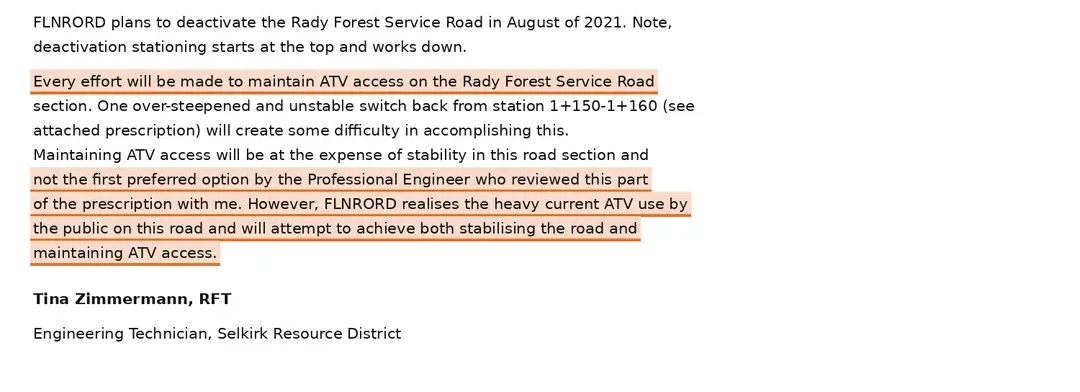
Two weeks before that 11 May email, the same author wrote to the same list with the opposite position.
What it shows
“Every effort will be made to maintain ATV access on the Rady Forest Service Road section… FLNRORD realises the heavy current ATV use by the public on this road and will attempt to achieve both stabilising the road and maintaining ATV access.” Note also what is called unstable: one over-steepened switchback, station 1+150 to 1+160. Ten metres.
Thirteen days separate “every effort will be made to maintain ATV access” from “NO ATV ACCESS LEFT OPEN.” Nothing on the ground changed in those thirteen days. No survey was run, no report was commissioned, no slide occurred. The 11 May email says so itself, acknowledging the reversal in the previous breath: “In the previous referral to you shown below, it was stated we would attempt to leave ATV access open at the expense of stability.”01
What changed was the paperwork. The deactivation prescription for Rady Creek is dated 7 October 2020, and its header then read “Access Level Remaining after Deact: ATV.” Its instructions told the operator to “pull as much fill as possible while still leaving an elevated ATV trail on inside” and to “construct ATV’able barricade.” The header on the copy that governs the work today reads “NO ACCESS.” The file’s own embedded properties record it as printed 27 April 2021 and modified 11 May 2021 — the same day as the email.04
The outcome was not reached. It was substituted, and the caribou were brought in to carry it.
Section 04Who Selkirk District told about Rady Creek, and who it left off the list
The 11 May email went to six addresses. None of them was a government address. None of them was the Trout Lake Recreational Club — the organisation whose members use this road, and which had signed the caribou stewardship agreement with this ministry three months earlier. Recreation Sites and Trails BC, the one agency that could have designated these routes for recreation, was not on it either.01
The list was a heli-ski operator, a province-wide off-road riders’ organisation, a guest ranch, a wood products company, and two private residents. That is who was told the Rady Creek decision was about caribou. The people who actually ride the road learned it was going from a third party.
Five months later the public got the opposite answer, and got it at scale. The question the Ministry of Forests has never answered is which group it was telling the truth to.
Section 05Seven reasons for destroying Rady Creek, and who gave each one
Seven reasons have been given for destroying Rady Creek since 2020. They are not variations on a theme; several are incompatible with each other, and every one of them is answered somewhere else in the Ministry of Forests’ own record.
Mike Kit, RPF — harvesting supervisor, Cooper Creek Cedar To a recreation organisation, copied to two ministry officials · 2 March 2020 · the licensee, not the ministry
Cooper Creek Cedar “no longer has operable tenure within the areas that these roads access due to harvesting restrictions imposed to preserve Caribou Habitat.”
What the record showsRead the sentence precisely. The tenure was not cancelled and the Rady Creek road is not mentioned: the areas these roads reach were no longer operable — no longer economic to work — under harvesting restrictions the Province imposed. That is a statement about how the Ministry of Forests and Water, Land and Resource Stewardship manage the land base, and what that management costs the industry operating on it. It is not a reason to destroy a public road, and the company did not offer it as one. In the same message it said it “will attempt to maintain at minimum ATV access” and that it “would be willing to transfer any road sections under our Road Permit to stakeholder groups that would like to assume liability.” Cooper Creek Cedar offered to hand the road over. Nobody took it up.05
Garth Wiggill — Regional Executive Director, Kootenay Boundary To a provincial recreation federation, copied to the Minister of Forests · 22 June 2021 · Ref 264788
Because the logging licensee is giving up the Rady Creek road permit, “the FSR must be deactivated at this time to prevent future environmental liability.”
What the record showsThe Auditor General of British Columbia examined this exact question and found the opposite: “there is no trigger or timeline for deactivation. FSRs can remain open indefinitely if they are maintained as wilderness roads.” Nothing compelled removal in 2021, and nothing compels it now.06
Tina Zimmermann, RFT — Engineering Technician, Selkirk Resource District To six private addresses · 11 May 2021
“Protecting the Caribou Habitat within the GAR area” and stabilising the perched sections “were priorities over maintaining public access for recreational purposes.”
What the record showsWithdrawn by the Ministry of Forests itself five months later, to the public, in writing: the decision “is not based on the importance of the habitat for Caribou recovery.” Two positions, one office, and only one of them was ever said out loud to the people who use Rady Creek.02
Garth Wiggill, then repeated to the public and again in 2026 22 June 2021, 26 October 2021, and still in circulation in 2026
“Deactivation on the Rady FSR was prescribed by a professional engineer.”
What the record showsThe Rady Creek prescription names no engineer. It names “Prescriber: B. Zimmermann, RFT” — a Registered Forest Technologist — and the signature and date lines beneath it are both blank. Asked directly for the engineer’s report, the District Manager replied that there isn’t one. Three different credentials have been given for the same single review; the person has never been named.07
The Ministry of Forests’ standard reply to the public Circulated via the Minister of Forests’ constituency office · 26 October 2021, and repeated since
The Rady Creek decision “is based strictly on public safety and the long-term environmental stability of the road.”
What the record showsThe Ministry of Forests’ own Rady Creek prescription scoped all 4,395 metres and, in ninety-three rows, called the road unstable in one place. In April 2021 that place was ten metres, stations 1+150 to 1+160. On the current document it is 42 metres — 0.96 per cent of the road. A safety case for removing the other 99 per cent has never been published.04
Julia Podealuk, RFT — Ministry of Forests, Selkirk Resource District To the logging licensee · 17 November 2025
Rady Creek “is not needed for industrial purposes and no longer meets the Engineering Branch funding policy.”
What the record showsThe Auditor General found the Ministry of Forests funding its districts at 14 cents on the dollar and its own policy then treating the inability to maintain a road as grounds to remove it. Meanwhile the Trout Lake Recreational Club applied in April 2026 to do the upkeep itself, costed in volunteer hours rather than dollars, and was refused on 19 August 2026 — three weeks before the removal went out to tender.06
Ministry of Forests — statement to Black Press Media Published 15 August 2026
“Once an FSR is no longer required for industrial use, it is deactivated.”
What the record showsThat is not the policy. The Auditor General examined it and found the opposite: deactivation has no trigger and no timeline, and a road may stay open indefinitely at the wilderness standard. The Ministry of Forests’ own category of “capital road” — roads serving fifty or more year-round residents, rural residences or high-value recreation — is described in the audit as “unlikely to be deactivated… and require ongoing maintenance.”17
Read down the ledger and the pattern is not a ministry defending a decision. It is a ministry looking for a decision that will hold. When caribou stopped working, safety arrived. When safety was traced to forty-two metres, the engineer arrived. When the engineer could not be produced, the funding policy arrived.
Section 06Three credentials for one Rady Creek switchback, and no report
The claim that an engineer prescribed the Rady Creek deactivation is the one the Ministry of Forests has repeated most often in public, and it is the easiest to check.
It has been described three ways by two officials. To a provincial recreation federation and to the Minister of Forests’ office, Garth Wiggill called it “a professional engineer.” To the Trout Lake Recreational Club, District Manager Tara DeCourcy called it “the recommendations of a geotechnical engineer.” In her own briefing note up the chain to Wiggill, she called it “the recommendations of a professional geoscientist.”07 Those are three different regulated credentials. Whichever it was, the review covered one switchback — not the whole of Rady Creek, and not the prescription.
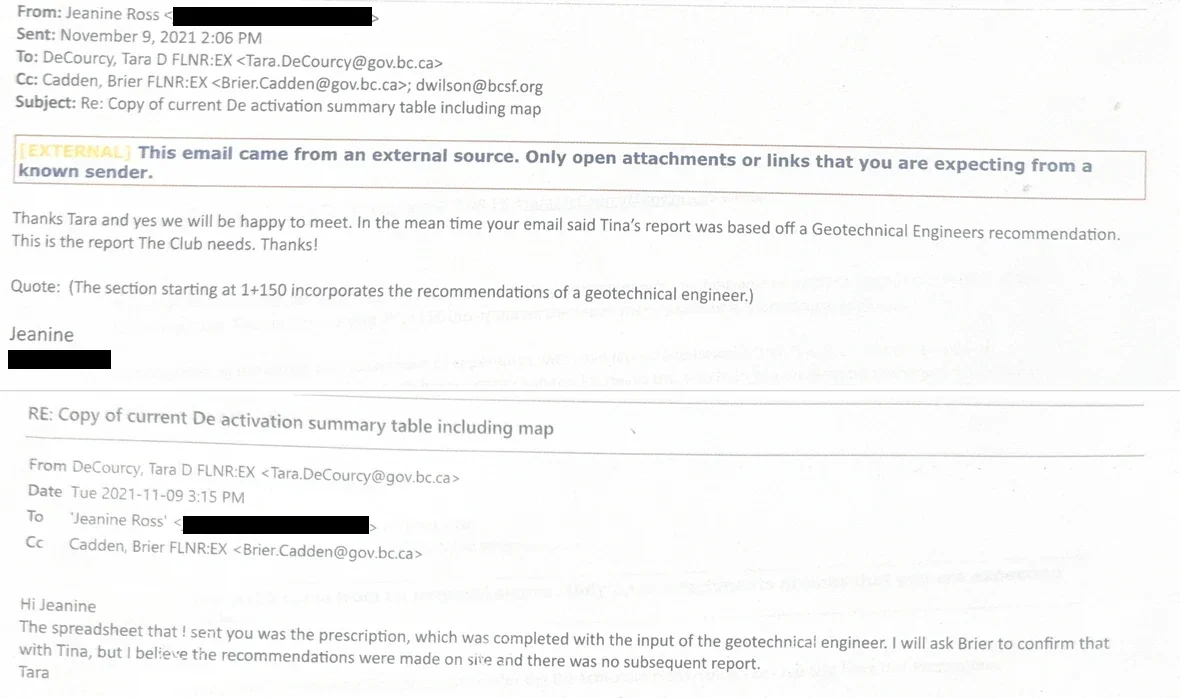
On 9 November 2021 Jeanine Ross of the Trout Lake Recreational Club asked for the engineer’s report by name. “This is the report The Club needs.” Sixty-nine minutes later she had her answer.
What it shows
“I will ask Brier to confirm that with Tina, but I believe the recommendations were made on site and there was no subsequent report.” Four months after the prescription was transmitted, asked directly for the engineering behind it, the District Manager does not produce it, does not name the engineer, and is not certain it exists. No confirmation from anyone appears anywhere in the released record.
There is a report now. It was commissioned in 2026, five years later, from a different professional — a geoscientist, not an engineer — and nothing in its forty-two pages mentions the 2021 review. Its own background list records the Ministry of Forests’ earlier Rady Creek deactivation document as “not dated.” It also records the instruction it was given before anyone walked the ground: “The MOF has indicated that the road is intended to be deactivated to a permanent standard, and that post-deactivation vehicular access is not required.”08
That is not an engineer reaching a conclusion. That is a conclusion being handed to an engineer.
Section 07Selkirk District would not walk Rady Creek with the Trout Lake club
All of this could have been settled on the ground in an afternoon, and the Trout Lake Recreational Club said so.
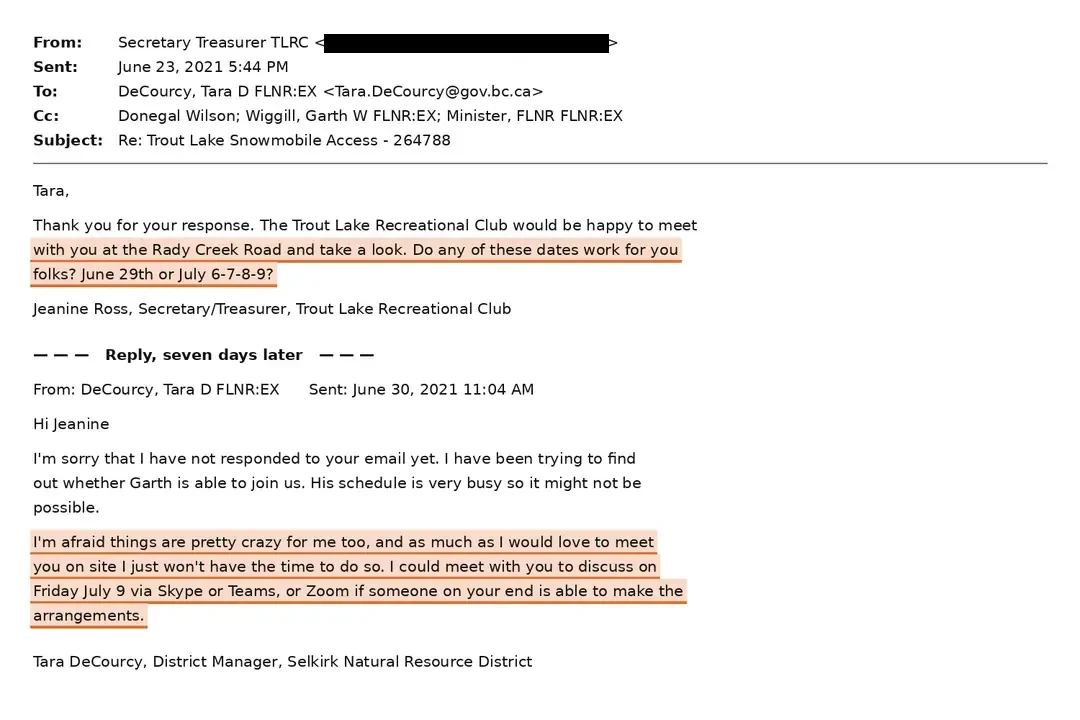
On 23 June 2021 at 3:25 PM, District Manager Tara DeCourcy offered a meeting, with the Regional Executive Director present: “I am able to meet with the club, if a representative could get in touch with me I will try to find a time that Garth and I are available.” Garth is Garth Wiggill, the Regional Executive Director.09
What it shows
The Trout Lake Recreational Club answered Selkirk District’s own offer in two hours and nineteen minutes, with five dates: “The Trout Lake Recreational Club would be happy to meet with you at the Rady Creek Road and take a look. Do any of these dates work for you folks? June 29th or July 6-7-8-9?” Seven days later: “I’m afraid things are pretty crazy for me too, and as much as I would love to meet you on site I just won’t have the time to do so. I could meet with you to discuss on Friday July 9 via Skype or Teams, or Zoom if someone on your end is able to make the arrangements.” The Regional Executive Director could not come either — “His schedule is very busy so it might not be possible.” Both messages are copied to the Minister of Forests.
Two hours and nineteen minutes against seven days. That is the whole relationship in one exchange, and it is the closest anyone has come in five years. In the same month a provincial recreation federation asked to meet the prescribing engineer and review the plan, with the stated goal of deactivating Rady Creek and keeping access. That meeting never happened either. The prescriber’s name reached the club a year later, on a document.09
An official who will not spend an afternoon on a road is not in a position to tell the public that Rady Creek is too dangerous to keep. Nobody from this district has ever walked it with the people who use it. And the refusal was not buried in a private exchange: the Minister of Forests was copied on both messages, so the department knew in June 2021 that its district would not go and look.
Section 08“Just create a stock response” — the district on the Rady Creek letters
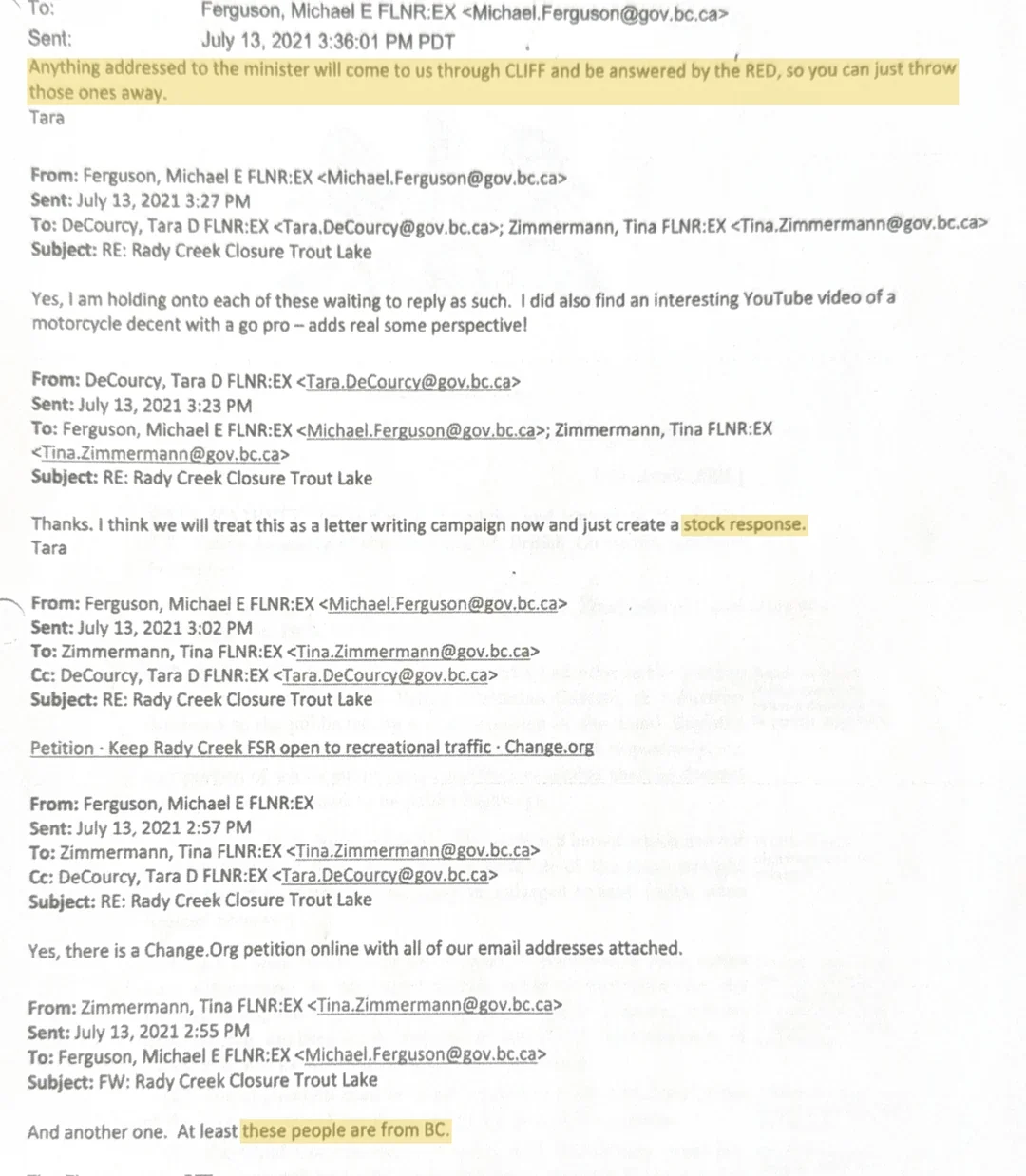
Two weeks after declining to walk Rady Creek, the same Selkirk District officials discussed what to do about the people writing in. The thread was released under freedom of information, at pages 428 and 429 of a 1,410-page package.10
What it shows
Forwarding an objection at 2:55 PM, Tina Zimmermann writes: “And another one. At least these people are from BC.” At 3:23 PM Tara DeCourcy replies: “I think we will treat this as a letter writing campaign now and just create a stock response.” At 3:36 PM she adds: “Anything addressed to the minister will come to us through CLIFF and be answered by the RED, so you can just throw those ones away.”
CLIFF is the government’s correspondence tracking system and the RED is the Regional Executive Director, so the sentence is capable of an innocent reading: the district’s own copies are surplus because the answer is written elsewhere. What is not open to interpretation is the posture. Three months of public objection had produced, by 13 July 2021, a decision to stop reading and start issuing.
The stock response is the document in Exhibit 02. It is the one that says caribou is not the reason, that says an engineer prescribed the work, and that promises consultation. Of those three statements, one contradicts the district’s own email, one could not be produced when asked for, and one has never happened.
Section 09Selkirk District documents five deactivations. Rady Creek is the sixth.
Here is the part that decides whether any of the above is carelessness.
Thirty kilometres from Rady Creek the same district office is deactivating another forest service road — the Incomappleux, FSR 3397. Same district, same years, same decision-maker. Whether that removal is the right call is contested too, and plenty of people in this valley say it is not. The comparison here is narrower: what the district published about it.11
Incomappleux FSR 3397
Selkirk Natural Resource District · file 11250-30/3397
- A published Frequently Asked Questions document
- Mailed notice, three years running
- A newspaper advertisement
- A formal comment period
- Draft prescriptions released for review
Rady Creek FSR 0321.02
Selkirk Natural Resource District · file 11250-30/0321.02
- No FAQ
- No mailed notice
- No advertisement
- No comment period
- A map and a data file, sent to a lumber company
It is not an isolated comparison. In July 2022 the same prescriber who wrote the Rady Creek document posted field signs a year ahead of works on four other roads in this district — Blazed, Jersey, Heights and Akokli — each with a written comment deadline and a fact sheet at the district front desk. Rady Creek is not on that list. The district’s published listing for the Heights road even states plainly that “there will be no ATV access after completion of deactivation” and that “notice of proposed deactivation signage has been posted.”12
And it is not two roads. The Province publishes a live list of every deactivation this district has in hand. On the day this was written it carried six, and it is worth reading as a set, because the district documents five of them and does not document the sixth.19
| Road | What the district published | Works |
|---|---|---|
| Incomappleux FSR 3397 posted 3 Nov 2025 |
Draft prescriptions for Branches 01, 03 and 04; two prescription map PDFs; a bridge deactivation appendix; a published FAQ. Branch 02 drafts “will be posted once available.” | planning |
| Heights FSR 0237.04 posted 6 Jul 2026 |
“Notice of proposed deactivation signage has been posted” — a year ahead — and a written warning that “there will be no ATV access after completion of deactivation.” | Jul 2027 |
| Sitkum Creek FSR 0235.01 posted 6 Jul 2026 |
“Notice of proposed deactivation signage has been posted” — a year ahead. | Jun 2027 |
| Kuskanax Creek FSR 0042.05 posted 3 Nov 2025 |
Planning underway, and an alternative stated on the record: the road “may be fully rehabbed if incremental funding is available.” | 2026 |
| Tangiers River FSR 6139.01 Oct 2020 |
Already deactivated. A 2002 complaint to the Forest Practices Board about this same watershed came from a trapper who said bridge removal would cut off his access. | done |
| Trout Lake–Rady Creek FSR 0321.02 posted 13 Nov 2025 |
One sentence: “Road has been posted for deactivation in the field. Deactivation planned for 2026.” No prescription. No map. No FAQ. No comment period. | 2026 |
Five roads get documents, maps, signage a year ahead, a published FAQ, or an alternative to destruction written into the record. The sixth gets a sentence and a contractor. The sixth is the one where people wrote in.
The same page carries the other half of the picture. Under closures and restrictions it lists road after road shut to the public and left there — Bayonne Creek, Blaeberry, Big Mouth, Burrell–McFarlane, Burrell–Tenderloin, Goat/Kamma Creek, Halfway River North, Idaho Lookout, Leake Creek, Powder Creek, Rendell Creek, Wilson Creek West, Woodbury Fletcher — most of them carrying the same four words: “No planned repair date.” One of them, Goat Range Park Branch FSR 7051.02, sits four and a half kilometres from Trout Lake and is the way into the Healy Creek watershed — the other road named alongside Rady Creek when this was reported nationally in 2023. It has been closed at its first bridge since June 2025 for “deteriorated bridge deck conditions,” with no planned repair date.19
That is what the Auditor General’s fourteen cents on the dollar looks like in one district: a network of public roads closed because the structures on them were never repaired, and a deactivation programme that converts the consequence into a permanent removal. The cheapest way to stop being liable for a bridge is to delete the road that needs it.
So this district can publish an FAQ. It can put draft prescriptions and maps on a public web page. It can post signs a year ahead and tell people in writing that access will end. It did all of that on other roads, in the same years, under the same management. None of that makes those removals right — it makes them visible, and visible in time for somebody to object.
It did none of it here. That is not a resourcing problem and it is not an oversight. It is a different standard, applied to Rady Creek, and the only thing that distinguishes it from the others is that people objected to it.
There is no law that required the district to consult here, and that is the point rather than the defence. The Forest Practices Board established it twenty-one years ago, in a special report on access management: “The deactivation of existing roads does not require a permit, or any public or other resource user consultation.” The Board found that “many people want input on decisions to develop new roads, restrict public access, and whether to maintain or deactivate existing roads,” and recommended that government legislate to “address the lack of consultation on creating and deactivating roads.” It asked for a progress report by 31 December 2006.16
Two decades later there is still no duty to consult, which means every one of those five steps on the Incomappleux was discretionary. The district chose to do them there. It chose not to do them here. The absence of a legal obligation does not make the difference innocent — it makes it deliberate.
Nor is this the first time the Board has been asked about a road in this district. In 2002 a trapper complained that deactivation in the Tangier River and Woolsey Creek watersheds, including removal of a bridge, would cut off safe access to his registered trapline and that he had not been given enough time. In 2018 the Board investigated road maintenance at Little Cayuse Creek and found that “government enforcement was not appropriate” because it had not done sufficient work to establish whether the licensee had complied with the law.16
The Trout Lake Recreational Club has asked the Forest Practices Board to look at Rady Creek. The Board has confirmed it “has received multiple submissions” which “are being assessed through the Board’s public complaints process” — while noting that it “cannot direct the Province to keep the road open, pause the work or make a particular recreational-access decision.” No Board report on Rady Creek has been published.13
Section 10Who let Selkirk District run Rady Creek this way
A district office can behave like this for five years only if nobody above it is checking.
In November 2020 the Auditor General of British Columbia audited the whole forest service road network and concluded that the Ministry of Forests “did not manage safety and environmental risks on FSRs in accordance with its policies.” He found districts funded at 14 per cent of what they asked for, high-priority repairs overdue on 3,178 of 6,640 crossing structures, and seven of eight districts sampled unable to produce an inspection record. Nine recommendations followed. Five years on, four are still not complete — and the two that are closed are the one covering the rules for deactivating roads and the one covering the money for roads carrying recreation.06 Both were reported complete by the ministry itself. Rady Creek is what those two closed recommendations produce on the ground.
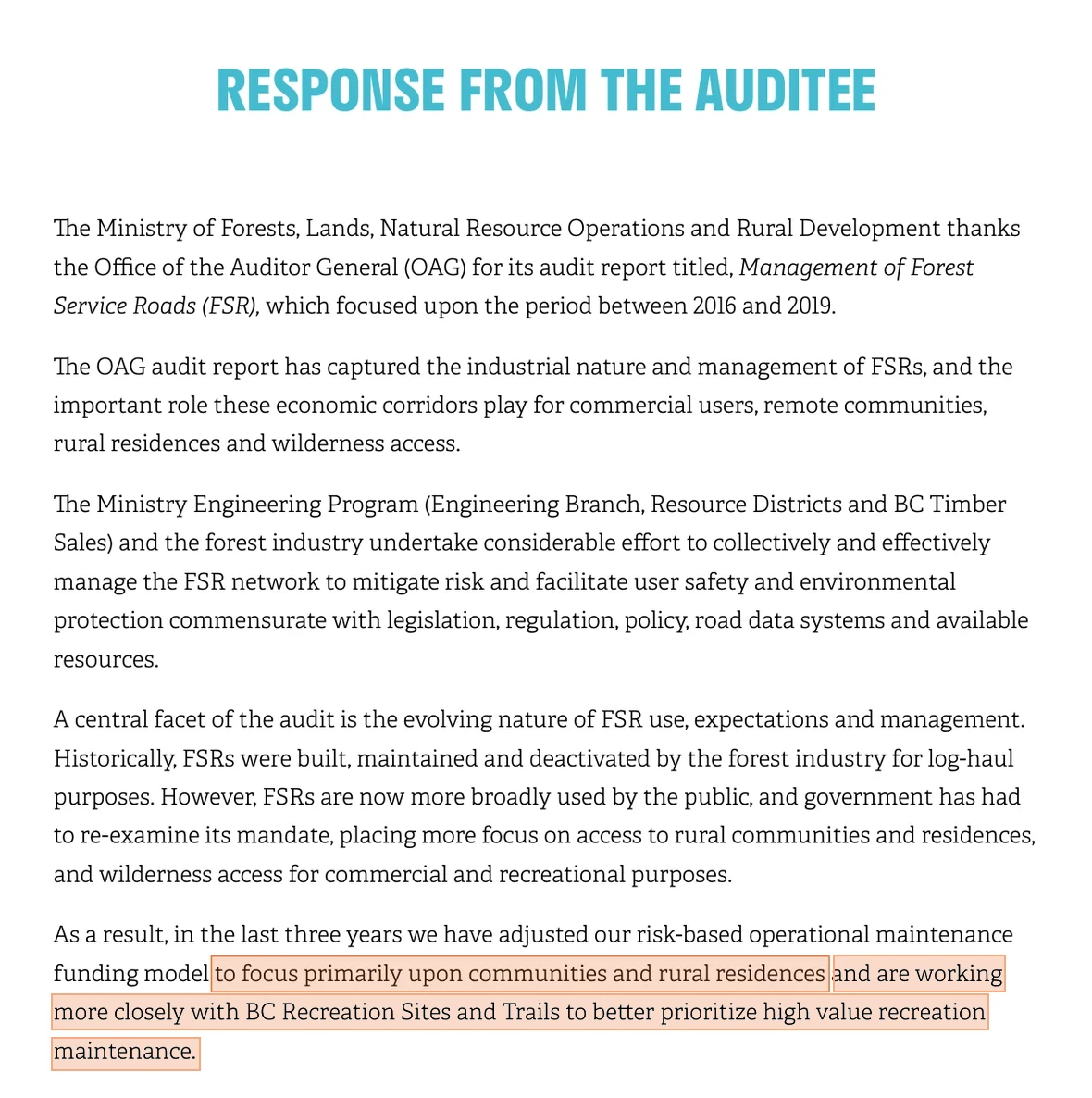
The direction was not invented in Nelson. It is printed inside the audit itself, in the Ministry of Forests’ own response to the Auditor General.
What it shows
Read the whole sentence, because the second half is a promise. The Ministry of Forests tells its auditor it has “adjusted our risk-based operational maintenance funding model to focus primarily upon communities and rural residences” — the first two limbs of the capital-road test — “and are working more closely with BC Recreation Sites and Trails to better prioritize high value recreation maintenance.” High-value recreation is the third limb, and it was $8.5 million of the $21.5 million the districts asked for that year.
That is the commitment. At Rady Creek the district did the opposite of it: it excluded recreation groups from the people it would treat as stakeholders, and when the Trout Lake Recreational Club applied to Recreation Sites and Trails BC to take the road on itself, the application was refused — three weeks before the removal went out to tender. Whatever “working more closely” means, it did not happen here.13
That is the instruction. What Selkirk has added to it is the part the ministry never wrote down: run the process where nobody objects, and skip it where they do. The district that published draft prescriptions, maps and an FAQ for the Incomappleux, and posted signs a year ahead on Heights and Sitkum, gave Rady Creek one sentence on a web page and a tender. Both behaviours come out of the same office, in the same years, under the same managers.
On 4 September 2026, fifteen forest-sector organisations wrote to Premier David Eby asking for a crisis group “led by the Premier’s Office.” They did not write to the Minister of Forests. He appears on page five, first of eight ministers copied in.14 When an industry writes past a minister to his boss, it has already answered the question of whether he is running the file.
Ravi Parmar has been Minister of Forests since 18 November 2024. The Rady Creek tender was re-issued on 9 September 2026, under his signature authority, by a district that told the public one thing and industry another, that could not produce the engineering it cited, that would not walk the road, that decided to “throw those ones away,” and that has run a full public process on four other roads in the same years.
He asked for this portfolio. He can stop Rady Creek with one sentence while the rest of it is examined. He has not. A minister who will not correct a district that has given seven different reasons for the same decision is not overseeing that district — he is relying on it not being read.
Ravi Parmar should resign as Minister of Forests. Before he does, he can do one useful thing: pause the Rady Creek deactivation, publish the engineering the ministry has cited since 2021, and give this road the same documents his own district put on a public web page for the Incomappleux. The tender closes on 24 September; once a contractor is engaged the machines are scheduled before the snow, which is why that sentence has to come before then rather than after.
Share this story
Six images carrying the Rady Creek reasons on their own — the document, the date and the name behind each one. Made to be posted.


Slide 1 of 6
Suggested caption
Ask why the Rady Creek forest service road is being destroyed and you will be told about caribou.
The Ministry of Forests does not make that claim. It withdrew it in writing in 2021.
11 May 2021, to industry: protecting “the Caribou Habitat within the GAR area” was a priority “over maintaining public access for recreational purposes.”
26 October 2021, to the public: the Rady Creek decision “is not based on the importance of the habitat for Caribou recovery” — “strictly on public safety.”
Both are in writing. Both are from the same office. Only one was said out loud to the people who use Rady Creek.
Thirteen days separate “every effort will be made to maintain ATV access” from “NO ATV ACCESS LEFT OPEN.” Nothing on the ground changed. The prescription header did.
Seven reasons have now been given: the licensee’s harvesting restrictions, environmental liability, caribou, a professional engineer, public safety, the funding policy, and no longer being needed for industry.
The engineer has three different credentials across three documents and has never been named. Asked for that report, the District Manager wrote: “there was no subsequent report.”
Rady Creek is called unstable in one place — 42 metres of 4,395. Nought point nine six per cent.
In June 2021 the District Manager offered to meet. The Trout Lake Recreational Club answered in 2 hours 19 minutes with five dates to walk Rady Creek. Seven days later: “I just won’t have the time to do so.”
In July 2021, internally: “just create a stock response” and “anything addressed to the minister… you can just throw those ones away.”
Thirty kilometres away the same district is deactivating another road, and for that one it published an FAQ, mailed notice three years running, ran a newspaper advertisement, held a comment period and released draft prescriptions for review.
Rady Creek got a map and a data file, sent to a lumber company.
backcountry.cx/editorials/it-was-never-the-caribou/
#BCpoli #PublicLand #RadyCreek #Kootenays #Caribou
Sources
- ↩↩↩The 28 April and 11 May 2021 notifications. Tina (Bettina) Zimmermann, RFT, Engineering Technician, Selkirk Resource District — two emails to the same stakeholder list. 28 April 2021, subject “Stakeholder Notification of Permanent Deactivation of Rady Forest Service Road, Trout Lake Area”: “Every effort will be made to maintain ATV access on the Rady Forest Service Road section… One over-steepened and unstable switch back from station 1+150-1+160 (see attached prescription) will create some difficulty in accomplishing this… FLNRORD realises the heavy current ATV use by the public on this road and will attempt to achieve both stabilising the road and maintaining ATV access.” 11 May 2021, subject “Amendment to Permanent Deactivation works on Rady Forest Service Road, Trout Lake Area”: “it has been decided that there will be NO ATV ACCESS LEFT OPEN AFTER THE RADY FSR IS PERMANENTLY DEACTIVATED. In the previous referral to you shown below, it was stated we would attempt to leave ATV access open at the expense of stability. The Selkirk Resource District Management considered all the input of stakeholders and eventually decided that protecting the Caribou Habitat within the GAR area and stabilising the steeper, perched road sections by fully pulling them back as recommended by the Professional Engineer were priorities over maintaining public access for recreational purposes.” The 11 May list is six private addresses — a heli-ski operator, a province-wide off-road riders’ organisation, a guest ranch, a wood products company and two residents. The recipients are cropped from Exhibit 03 as published here. Both emails are held by the Trout Lake Recreational Club and published in full with the rest of the record at saverady.com. https://saverady.com/
- ↩↩The stock answer sent to most people who wrote. Ministry of Forests response circulated by the constituency office of the Hon. Katrine Conroy, then Minister of Forests, to Jeanine Ross, Secretary-Treasurer of the Trout Lake Recreational Club, 26 October 2021. The covering line reads “Here is a bit of what has been sent to most people who have written.” The passages quoted: “Although Silvercup Ridge is an important area for Caribou, the decision to deactivate is not based on the importance of the habitat for Caribou recovery. The decision to deactivate is based strictly on public safety and the long-term environmental stability of the road”; “Deactivation on the Rady FSR was prescribed by a professional engineer”; and the postponement “which will allow for further consultation and discussions to be conducted if needed with interested stakeholders.” Held by the Trout Lake Recreational Club.
- ↩The agreement the clubs signed, and what they gave up. Stewardship Management Agreement, snowmobiling in mountain caribou habitat, Central Selkirk — between the Ministry (FLNRORD, Kootenay Region) and two volunteer clubs, and nobody else. Signed by the clubs on 4 and 15 February 2021 and countersigned by the Ministry on 24 March 2021. The clubs gave up riding area in caribou habitat under it. The Ministry later stated that “the status of the Rady Forest Service Road was unknown at the time the SMA was negotiated.”
- ↩↩Rady Creek deactivation prescription, 7 October 2020. Rady Creek deactivation prescription — the Ministry’s own summary workbook. Date prescribed 7 October 2020. The original header reads “Access Level Remaining after Deact: ATV”, with row instructions to “pull as much fill as possible while still leaving an elevated ATV trail on inside” and to “construct ATV’able barricade”; the copy that governs the current work reads “NO ACCESS”. The file’s embedded properties record it printed 27 April 2021 and modified 11 May 2021, and its author and last-saved-by as “Zimmermann, Tina FLNR:EX”. The signature block reads “Prescriber: B. Zimmermann, RFT” above “Date Signed:”, and both rules are blank on every copy released to the club. B. Zimmermann is Bettina Zimmermann, who signs as Tina. Across ninety-three rows the prescription identifies one unstable location: ten metres at stations 1+150 to 1+160 in the April 2021 description, 42 metres at stations 1+150 to 1+192 on the current document, against a total length of 4,395 metres.
- ↩Mike Kit, Cooper Creek Cedar — the licensee’s referral. Mike Kit, RPF, harvesting supervisor, Cooper Creek Cedar, to the general manager of a recreation organisation, copied to two ministry officials, 2 March 2020 — circulated as part of the company’s own referral. The company “no longer has operable tenure within the areas that these roads access due to harvesting restrictions imposed to preserve Caribou Habitat,” its objective was “to deactivate road sections to a standard that will relieve Cooper Creek Cedar of the liability associated with the Road Permit,” it “will attempt to maintain at minimum ATV access,” and it “would be willing to transfer any road sections under our Road Permit to stakeholder groups that would like to assume liability.” Cooper Creek Cedar is a forest licensee, not a public body.
- ↩↩↩Auditor General, Management of Forest Service Roads. Office of the Auditor General of British Columbia, Management of Forest Service Roads, report dated 29 November 2020, released 19 January 2021 — the conclusion that the ministry “did not manage safety and environmental risks on FSRs in accordance with its policies” at pp. 5, 7, 9 and 25; districts funded at 14 per cent of their request in 2019/20 at Exhibit 8, p. 39; high-priority repairs overdue on 3,178 of 6,640 crossing structures at p. 34; the eight-of-23 district sample and the 2008 internal audit at p. 38; and “there is no trigger or timeline for deactivation. FSRs can remain open indefinitely if they are maintained as wilderness roads” at p. 47. Recommendation status from the Office’s October 2025 Annual Follow-up Report, pp. 40 and 46–50: five of nine complete and four not complete as at 31 March 2025, with Recommendations 3 and 6 among those reported complete. Both reports and the full breakdown are in our editorial on the audit, which carries all 56 pages on the page. https://www.oag.bc.ca/app/uploads/sites/963/2024/08/OAGBC-20210119-Management-Forest-Service-Roads_RPT.pdf
- ↩↩Wiggill and DeCourcy on the prescription, June to November 2021. The engineering claims, in four documents. 22 June 2021 — Garth Wiggill, Regional Executive Director, Kootenay Boundary, to the executive director of a provincial recreation federation, copied to the Minister of Forests, Ref 264788: “Deactivation on the Rady FSR was prescribed by a professional engineer,” and “the FSR must be deactivated at this time to prevent future environmental liability.” 6 July 2021 — Tara DeCourcy, RPF, District Manager, Briefing Note for Information to Wiggill: “The district engineering technician created a deactivation prescription with the recommendations of a professional geoscientist for one particularly unstable section.” 12 July 2021 — DeCourcy to the club: “The section starting at 1+150 incorporates the recommendations of a geotechnical engineer,” and “This was completed by our engineering technician… It is not within my scope of practice to amend her prescription.” 9 November 2021 — DeCourcy to Jeanine Ross, 69 minutes after being asked for the report: “I will ask Brier to confirm that with Tina, but I believe the recommendations were made on site and there was no subsequent report.” No confirmation from anyone appears in the released record, and the 2021 reviewer has never been named.
- ↩SNT Geotechnical, Rady FSR Road Deactivation Prescription. Rady FSR Road Deactivation Prescription, report 26.510.01.01.16, SNT Geotechnical Ltd. of Nelson, 42 pages, dated 8 September 2026 and issued with tender EN27DSE008 the following day. Commissioned by Michael Ferguson, RFT, of the Ministry of Forests — Selkirk Natural Resource District, and resting on a walking traverse by Ryan Williams, P.Geo., on 18 August 2026. At p. 5: “The MOF has indicated that the road is intended to be deactivated to a permanent standard, and that post-deactivation vehicular access is not required.” Its background list records the Ministry’s earlier deactivation document as “not dated,” and nothing in it refers to the 2021 review. It is a geoscientist’s report, not an engineer’s. The Province publishes this report itself, as “Trout Lake Rady-Creek FSR Deactivation Prescription and Map”, on the Selkirk district road safety page. https://www2.gov.bc.ca/assets/gov/farming-natural-resources-and-industry/natural-resource-use/resource-roads/local-road-safety-information/selkirk/trout_lake_rady_creek_deactivation_prescription_map.pdf
- ↩↩DeCourcy and the club’s five dates, June–July 2021. The meeting that did not happen. 23 June 2021, 3:25 PM — Tara DeCourcy: “I am able to meet with the club, if a representative could get in touch with me I will try to find a time that Garth and I are available.” The club answered two hours and nineteen minutes later with five dates to walk the road — 29 June, or 6, 7, 8 or 9 July. 30 June 2021, seven days after the club’s reply — DeCourcy: “as much as I would love to meet you on site I just won’t have the time to do so,” offering a video call if the club would organise it. Separately, on 22 June 2021, a provincial recreation federation asked to meet the prescribing engineer and review the plan with the stated goal of deactivating the road and keeping access; that meeting never took place, and the prescriber’s name reached the club a year later on the document itself.
- ↩The “letter writing campaign” thread, 13 July 2021. Internal email thread, Selkirk Resource District, 13 July 2021, released under freedom of information at pages 428–429 of a 1,410-page package. 2:55 PM, Tina Zimmermann forwarding an objection: “And another one. At least these people are from BC.” 3:02 PM, Michael Ferguson: “Yes, there is a Change.Org petition online with all of our email addresses attached.” 3:23 PM, Tara DeCourcy: “Thanks. I think we will treat this as a letter writing campaign now and just create a stock response.” 3:27 PM, Ferguson: “Yes, I am holding onto each of these waiting to reply as such.” 3:36 PM, DeCourcy: “Anything addressed to the minister will come to us through CLIFF and be answered by the RED, so you can just throw those ones away.” CLIFF is the provincial correspondence tracking system; RED is the Regional Executive Director.
- ↩Incomappleux FSR 3397 — the published deactivation process. Frequently Asked Questions — Incomappleux Forest Service Road Deactivation, Ministry of Forests, April 2025, file 11250-30/3397 — the published FAQ for the deactivation of FSR 3397, roughly thirty kilometres from Rady Creek and in the same district. The process it records: a published FAQ, mailed notice in three successive years, a newspaper advertisement, a formal comment period and draft prescriptions released for review. The road was closed in 2005, gated in 2017 and slated for deactivation from 2021. The Rady Creek file, 11250-30/0321.02, carries none of those steps. https://www2.gov.bc.ca/assets/gov/farming-natural-resources-and-industry/natural-resource-use/resource-roads/local-road-safety-information/selkirk/faq_document_for_incomappleux_deactivation.pdf
- ↩The notices posted on Blazed, Jersey, Heights and Akokli. Selkirk Natural Resource District deactivation notices, July 2022 onward — field signs posted a year ahead of works, each with a written comment deadline and a fact sheet at the district office, on Blazed Creek FSR 9178.01, Jersey FSR 9178.02, Heights FSR 0237.04 and Akokli FSR 0188.02, prepared by the same prescriber who wrote the Rady Creek document. The district’s published listing for the Heights road states that it “is planned for deactivation in approximately July 2027… Due to the extent of existing terrain instabilities, there will be no ATV access after completion of deactivation. Notice of proposed deactivation signage has been posted.” Rady Creek does not appear on that list. https://www2.gov.bc.ca/gov/content/industry/natural-resource-use/resource-roads/local-road-safety-information/selkirk-natural-resource-district-road-safety-information
- ↩↩What the Forest Practices Board can and cannot do. Forest Practices Board — the Board’s published statement on Rady Creek Forest Service Road records that it “has received multiple submissions” which “are being assessed through the Board’s public complaints process,” that it can assess compliance with the Forest and Range Practices Act including “forest practices associated with road deactivation,” and that “It cannot direct the Province to keep the road open, pause the work or make a particular recreational-access decision.” The Trout Lake Recreational Club filed seven grounds of opposition with the district on 20 November 2025 and copied the Board.
- ↩The forest-sector letter, 4 September 2026. Letter to Premier David Eby from fifteen forest-sector organisations, 4 September 2026, asking for a crisis group “led by the Premier’s Office.” The Minister of Forests is not an addressee; he appears on page five, first of eight ministers copied. Set out in full in our editorial on the minister’s record. Ravi Parmar was appointed Minister of Forests on 18 November 2024. https://cofi.org/joint-letter-to-premier-eby/
- ↩↩↩Loved to death — The Narwhal. Jimmy Thomson, “Loved to death: the unpopular prospect of closing backcountry roads to save wildlife,” The Narwhal, 30 October 2023 — reporting on the Rady Creek and Healy Creek deactivations. Aaron Reid, a provincial caribou biologist: “The caribou program didn’t identify that road.” The article records that Reid “says he didn’t ask for those roads to be closed in the name of caribou; the decision had already been made by the time it got to him,” and that “It wasn’t a decision driven primarily by ecological concerns; the province closes roads that are no longer being used for industry based on one reason above all others: liability.” It also states that “a government spokesperson confirmed the primary reason the Rady Creek and Healy Creek roads are being shut down is public safety.” The same piece records that the Rady Creek road “was built in the early 20th century by local miners to access gold and silver at the top of the ridge.” https://thenarwhal.ca/bc-forestry-roads-close-backcountry/
- ↩↩Special Report FPB/SR/23 and two earlier district complaints. Forest Practices Board. Access Management in British Columbia: Issues and Opportunities, Special Report FPB/SR/23, December 2005 — “The deactivation of existing roads does not require a permit, or any public or other resource user consultation. Even where access management plans are prepared, they are not legally binding… Many people want input on decisions to develop new roads, restrict public access, and whether to maintain or deactivate existing roads”; and “a forest licensee can deactivate an existing road without referral to the district manager, and without any consultation with other road users or with the public.” Recommendation 1: government “should proceed expeditiously with the ongoing development of legislation to streamline and integrate the resource road use regulatory framework. The new legislation should address the lack of consultation on creating and deactivating roads,” with a progress report requested by 31 December 2006. Earlier matters in the same district: Closing letter — Tangier River Road Deactivation, 1 November 2002, on a complaint of 17 October 2002 that deactivation in the Tangier River and Woolsey Creek watersheds, including removal of a bridge, would prevent a trapper safely accessing his registered trapline; and Road Maintenance at Little Cayuse Creek, complaint investigation FPB/IRC/216, June 2018 — “Government enforcement was not appropriate because it did not do sufficient work to determine if Interfor complied with section 79 of the Forest Planning and Practices Regulation.” https://www.bcfpb.ca/wp-content/uploads/2016/04/SR23-Access-Management-in-BC.pdf
- ↩Evert Lindquist, Black Press Media, 15 August 2026. Evert Lindquist, “Residents, stakeholders unite to stop deactivation of valued forest road near Trout Lake,” Black Press Media, 15 August 2026 — carrying the Ministry of Forests statement: “Once an FSR is no longer required for industrial use, it is deactivated,” and “Deactivation is done to relieve the permit or tenure holder of their ongoing obligation to maintain roads and associated structures.” Answered by the Auditor General’s finding that “there is no trigger or timeline for deactivation” and by the capital-road definition, both at source 06 above. The Province’s own Selkirk Natural Resource District road safety listing records: “Trout Lake Rady-Creek FSR 0321.02 (Nov 13, 2025) — Road has been posted for deactivation in the field. Deactivation planned for 2026.” https://nelsonstar.com/2026/08/15/residents-stakeholders-unite-to-stop-deactivation-of-valued-forest-road-near-trout-lake/
- ↩↩↩Arrow Lakes Caribou Society on the penned herd. The decision now before government. Arrow Lakes Caribou Society, “Central Selkirk Caribou to Remain in Pen Until Mid-September,” 27 August 2026 — “The Arrow Lakes Caribou Society is holding the 15 caribou in the Central Selkirk Caribou Maternity Pen at the request of the Ministry of Water, Land, and Resource Stewardship until mid-September… This holding period is to allow for First Nations consultation and a decision to be made on three potential management options for this herd moving forward.” The three options are quoted there in full, including “Transferring the penned Central Selkirk caribou to the Jasper National Park Conservation Breeding Centre” and “Releasing the penned caribou back into the Central Selkirk herd range with no further maternity penning or predator management.” The Society is a project partner, not the decision-maker; no government release on the hold or the options has been published. The Syilx Okanagan Nation petitioned Canada for an Emergency Protection Order on 1 June 2026. A Mountain Caribou Summit hosted by the Sinixt Confederacy took place at Nakusp on 9 July 2026, attended by the Shuswap/Staltsin Band, the Ktunaxa and members of the Okanagan Nation Alliance. https://arrowlakescaribousociety.com/2026/08/27/central-selkirk-caribou-to-remain-in-pen-until-mid-september/
- ↩↩The six roads on the district’s deactivation list. Province of British Columbia, Selkirk Natural Resource District road safety information, last updated 16 September 2026 — the district’s own live listing. Under Road deactivations it carries six roads. Incomappleux FSR 3397 (3 November 2025): “Draft prescriptions have been developed for Branches 01, 03 and 04. A map of the planned work and deactivation prescription can be reviewed,” with two prescription map PDFs, a bridge deactivation appendix and a published FAQ linked from the page, and “Draft deactivation prescriptions for Branch 02 are being developed and will be posted once available.” Heights FSR 0237.04 (6 July 2026): planned for July 2027, “Due to the extent of existing terrain instabilities, there will be no ATV access after completion of deactivation. Notice of proposed deactivation signage has been posted.” Sitkum Creek FSR 0235.01 (6 July 2026): planned for June 2027, “Notice of proposed deactivation signage has been posted.” Kuskanax Creek Section Two FSR 0042.05 (3 November 2025): “Deactivation planning is underway for 2026 field season. Road may be fully rehabbed if incremental funding is available.” Tangiers River FSR 6139.01 (October 2020): “Road closed at 0.0 km. Has been deactivated.” And Trout Lake Rady-Creek FSR 0321.02 (13 November 2025), in full: “Road has been posted for deactivation in the field. Deactivation planned for 2026.” The same page’s closures list carries Bayonne Creek, Blaeberry, Big Mouth, Burrell–McFarlane, Burrell–Tenderloin, Goat/Kamma Creek, Halfway River North, Idaho Lookout, Leake Creek, Powder Creek, Rendell Creek, Wilson Creek West and Woodbury Fletcher, most with the words “No planned repair date.” Goat Range Park Br FSR 7051.02 is described as “approximately 4.5km southeast of Trout Lake,” providing “access into the Healy Creek watershed,” closed since 13 June 2025 at its 0.0 km bridge “due to deteriorated bridge deck conditions. No planned repair date.” Healy Creek is the road named alongside Rady Creek in The Narwhal, source 15 above. https://www2.gov.bc.ca/gov/content/industry/natural-resource-use/resource-roads/local-road-safety-information/selkirk-natural-resource-district-road-safety-information