
EDITORIAL · RADY FSR DEACTIVATION PRESCRIPTION 26.510.01.01.16
Meet the man who’s trying to destroy Rady Creek; Michael Ferguson and his crusade at the Selkirk District to attack public access to public land. The only question left is; Why, Mike?
Michael Ferguson has been a Registered Forest Technologist for eighteen years. Registrant RFT-1624. Ministry of Forests, Selkirk Natural Resource District, out of the office at 45 Columbia Avenue in Castlegar, business telephone (778) 364-1184 — all of it published by his own regulator because the Professional Governance Act requires it. On the public register he declares that his practice includes Forest Roads and Transportation and Supervising, Directing and Advising Forest Plans, Practices and Professionals. In June 2021 Tina Zimmermann, RFT, of the same district sent him the Rady deactivation file. In July 2022, on a chain with Darren Henshaw, Brent Farrell and Grant Walton, copied to District Manager Tara DeCourcy, RPF, he wrote that the public’s questions should go to somebody else. In September 2026 he asked a consultant for the prescription that ends the road — and the page it was sealed on was issued to bidders with the seal painted over, five years too late. So we decided to research all of the records to answer one specific question…Mike, why hide your name from a document you commissioned to destroy Rady Creek?
Forty-two pages arrived at the Selkirk district office on 8 September 2026, and they end the road above Trout Lake for good. The work is cross-ditching along its length, and one hundred and fifteen metres where the road is pulled into the hillside and the hillside put back. That hundred and fifteen metres is enough. On page two the document sets out the rule it was built to satisfy: a qualified registered professional must prepare, sign, and seal a road deactivation prescription. Then skip forty pages to the back of it, where a report of this kind is signed off. Page nineteen was printed onto paper and scanned back in — the one thing you do to a page somebody has to sign and seal. In the copy the Province issued to bidders it is blank. Underneath, still in the file, are a professional seal, a signature and a hand-written date — and fifty-three white rectangles put there to stop you seeing them.01
Section 01Eighteen years on the register, and the only four days that are written down
None of what follows is hidden, and none of it is hidden because he chose to publish it. Section 31(3) of the Professional Governance Act compels a regulator to put its registrants on a public list — name, employer, office, telephone — so that the people whose roads they prescribe are able to find them. The law assumed someone would look. Almost nobody ever has. Here is what has been sitting there the whole time.
Forest Professionals BC carries him as RFT-1624, practising Registered Forest Technologist, in good standing since 25 January 2008. Employer: Ministry of Forests. Office: 45 Columbia Avenue, Castlegar. Telephone: (778) 364-1184. Eighteen years, and a road file that now runs to five.02
One more thing the record settles, which no news report about any of these roads has ever managed. Michael Ferguson’s job title is Engineering Officer. Not a technician, not an assistant — one of three posts reporting directly to the District Manager, and the one that owns roads. In February 2017 the same directory recorded him as Engineering Specialist in the district’s Nelson engineering unit.18
That took some finding, because the Province closed the directory that says so. Until this year anyone could look up a public servant — name, title, office, telephone. The site now returns a notice that members of the public are no longer able to access individual employee contact details.
The dataset behind it reports zero resources. The last public copy was captured on 9 April 2026 and is still retrievable, and the telephone number against his name in it — (778) 364-1184 — matches the number his own regulator publishes, digit for digit.18
the District Engineering Officer will act under their authority— the District Manager’s. The rest is the directory’s own grouping, not a stated chain of command. Michael Ferguson is not a junior officer in this district. He is one of three posts reporting to the District Manager, and roads are his.18
He declares three areas of practice on that register, and he wrote them himself. Forest Resources Contract Management and Administration. Forest Roads and Transportation. And Supervising, Directing and Advising Forest Plans, Practices and Professionals. Roads are his stated field, and so is directing other professionals. Neither of those is a characterisation anyone has hung on him; both are claims he made to his own regulator, and both are load-bearing in what follows.
Complaints about Rady Creek FSR do exist. On 29 September 2026, five days after the tender to destroy the road closed, a member of the public filed a formal complaint with the Forest Practices Board. He uses the road year round — motorcycle and truck spring to fall, snowmobile in winter — and he spent his thirtieth birthday camped at the top of it. His complaint asks the Board for one thing:
I want to file a formal complaint regarding Rady Creek FSR in the Selkirk district.
I use this road year round. By motorcycle or truck spring-fall and by snowmobile in the winter. I celebrated my 30th birthday with friends truck camping up at the ridge-top of Rady Creek. I have a property in Ferguson just above Trout Lake and I can see how important the historical road access to the mountains in this area is for the local economy.
I’m very disappointed by the amount of tax payers money funding the potential deactivation and the rate that the Kootenay Lake Forestry Office is slating roads to be deactivated without proper consultation.
I am asking the Forest Practices Board to examine whether recreation users and affected stakeholders were properly identified, heard and considered before this road was ordered deactivated.
Nelson, BC
FPBoard@bcfpb.ca at 16:47 UTC on 29 September 2026 — five days after the tender to destroy Rady Creek FSR closed — and copied to this coalition. Transcribed in full as received. The complainant’s name and email address are withheld: he wrote to a public board, not to a newspaper, and he has not been asked.The failure he is complaining about was not an accident. It was a decision, and the decision has a name on it. The public did not go unheard because the district was overstretched, or because a form went astray. Somebody was asked, in writing, where the public’s questions about Rady Creek FSR should be sent. That somebody was Michael Ferguson, in July 2022, on the very email chain that opened the deactivation referral. His answer was one sentence long, and what it said was: send them to someone else.
That is the officer whose declared practice areas are forest roads and directing other professionals, routing the public away from himself four years before he commissioned the document that ends their road. The consultation gap now before the Forest Practices Board is not an accident of process. It is the outcome of a choice that was made, in writing, at 9:52 in the morning on 11 July 2022.
Whether recreation users were properly identified, heard and considered is now formally before the Board. But the Board reviews forest practices — it does not regulate registrants, and it cannot order a road kept open. The complaint that would reach the man is a different complaint to a different body, and it has never been filed.
The body that does regulate registrants is Forest Professionals BC, and against Michael Ferguson its file is empty. The register cannot tell you why. Forest Professionals BC keeps a discipline history against a registrant for the life of that individual, so an empty file means either that nothing has ever been done, or that nobody has ever found the door. Consider what finding the door has required: eighteen years of deactivating public roads in the Kootenays with no notice to the people who drive them, no published route for objecting to a registrant, and a government staff directory that has now been shut to the public entirely. An empty register is not a character reference. It is a count of how many people got through.
Against that background, the documentary record on the Rady Forest Service Road runs to four moments across five years.
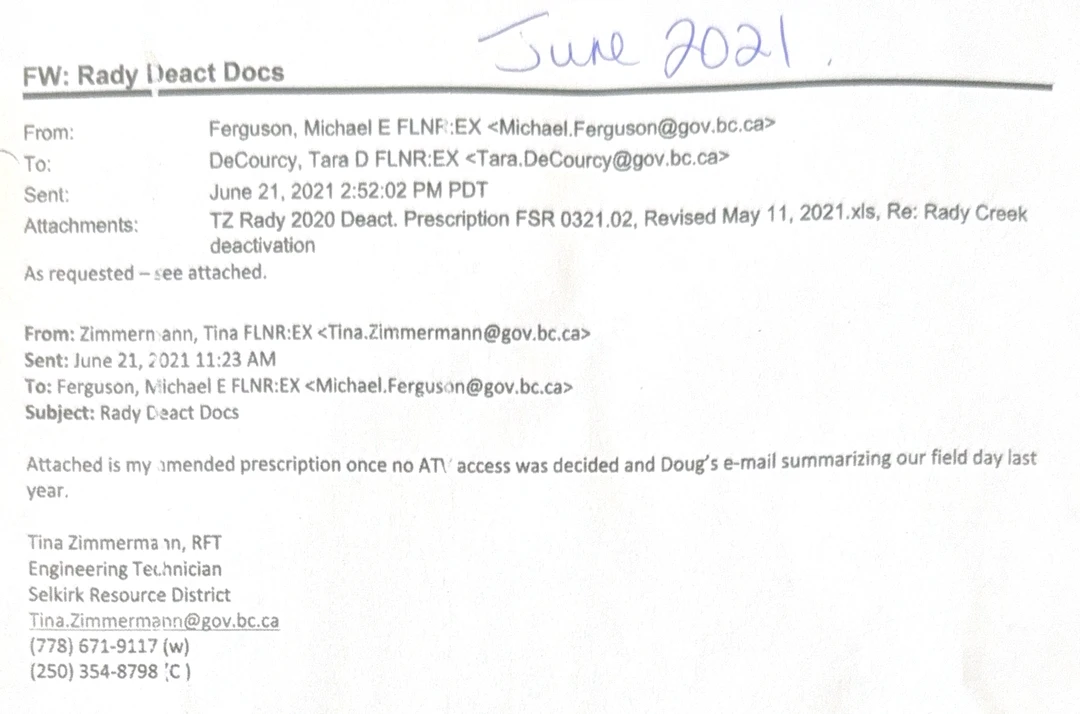
On 21 June 2021, Tina Zimmermann, RFT, of the same district, emailed him under the subject “Rady Deact Docs,” attaching the 2020 deactivation prescription for the road. It sits at page 378 of the district’s records release.10
On 6 July 2022, Zimmermann opened the deactivation referral process in an email to Ferguson, Darren Henshaw and Brent Farrell, copied to District Manager Tara D. DeCourcy, RPF, under the subject “Sample Deactivation Referral Fact Sheet to start deactivation process.”10
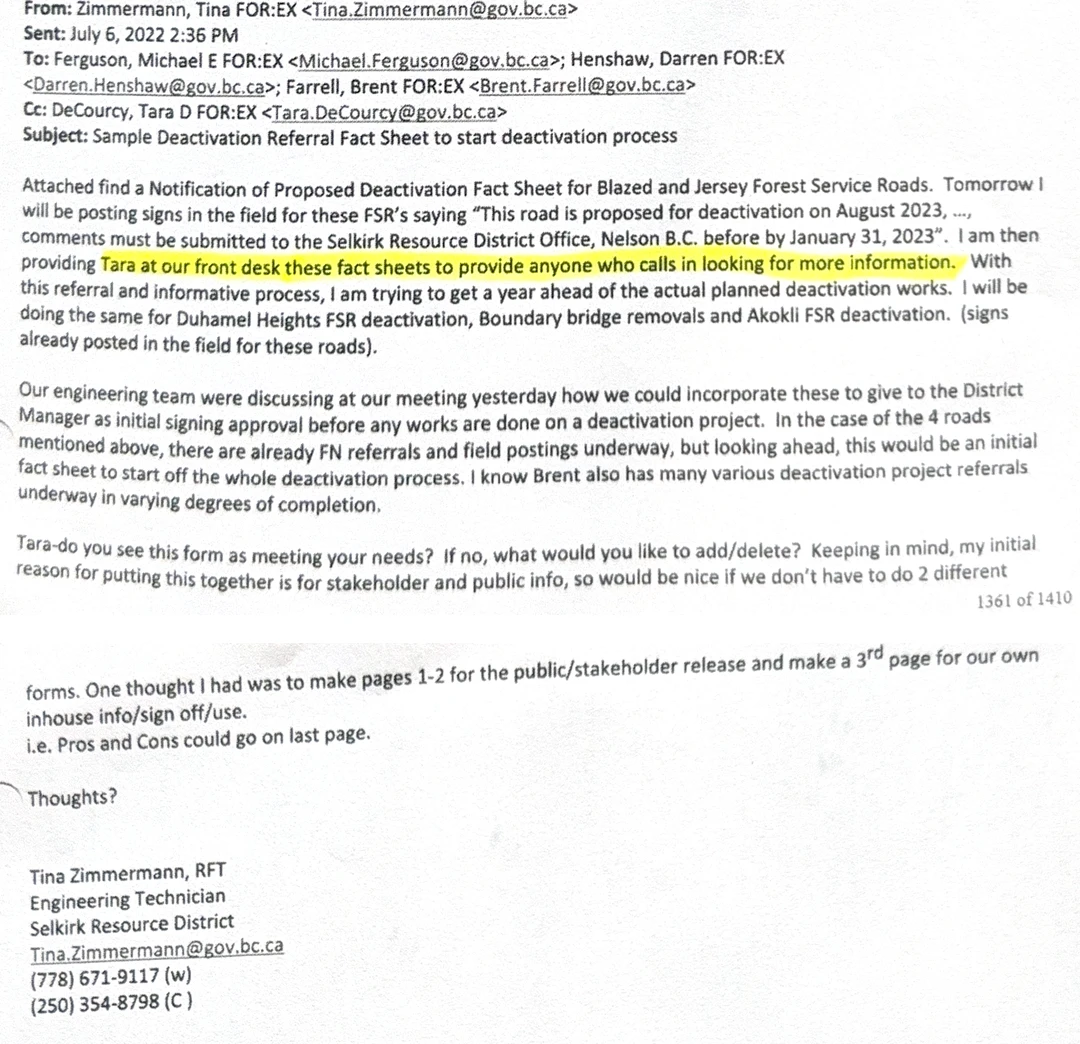
That email is worth reading past its subject line, because it is the clearest description anybody in the Selkirk district has ever put in writing of how the public gets consulted about losing a road. Zimmermann is a registered forest technologist and the district’s engineering technician, and she sets the process out step by step:
Attached find a Notification of Proposed Deactivation Fact Sheet for Blazed and Jersey Forest Service Roads. Tomorrow I will be posting signs in the field for these FSR’s saying “This road is proposed for deactivation on August 2023, …, comments must be submitted to the Selkirk Resource District Office, Nelson B.C. before by January 31, 2023”. I am then providing Tara at our front desk these fact sheets to provide anyone who calls in looking for more information.
10
That is the consultation. A sign nailed up at the side of a road that is about to be destroyed, seen only by somebody already driving it, and a stack of fact sheets left at a front desk for anyone who happens to telephone. No meeting, no mailing, no notice to a single club or resident. And five days later, on the same chain, the officer asked where those telephone calls should go answers: somewhere else.
The same email also says how much of this was running at once. Zimmermann is doing Blazed and Jersey, and the same for Duhamel Heights FSR deactivation, Boundary bridge removals and Akokli FSR deactivation. (signs already posted in the field for these roads)
— four more roads already signed before the email was sent. She adds that a colleague also has many various deactivation project referrals underway in varying degrees of completion.
And she explains what the fact sheets are ultimately for: Our engineering team were discussing at our meeting yesterday how we could incorporate these to give to the District Manager as initial signing approval before any works are done on a deactivation project.
10
So the document that tells the District Manager the public has been consulted is the same document that was left at the front desk. The sign in the field is the notice, the fact sheet is the record, and the record is what the approval rests on. Nobody in this chain has to have spoken to a single member of the public for the file to read as complete.
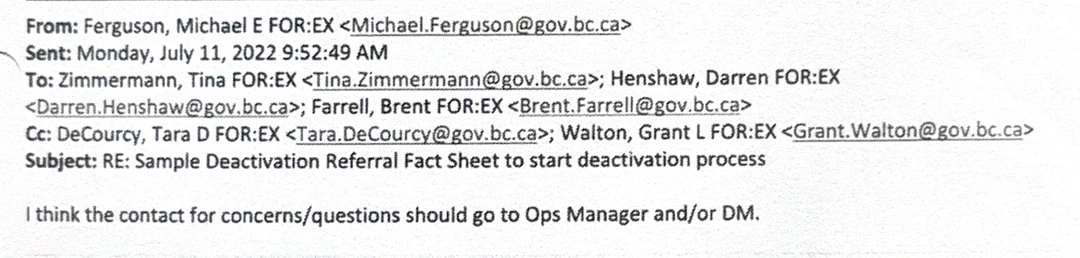
On 11 July 2022 at 9:52:49 in the morning, he replied to all of them and added Grant L. Walton to the copy list. His entire recorded contribution to the question of how the public would be handled is one sentence.
And on 8 September 2026, SNT Geotechnical Ltd. delivered forty-two pages that end Rady Creek FSR permanently. The file’s own metadata names its author as Thomas Chalmers. The fieldwork was Ryan Williams, P.Geo., for one day. The registrant left carrying professional responsibility for it is Jordan Pyette, RFT-2122. And the first line of substance in the document names the man who asked for it. Michael Ferguson.01
Section 02No district in British Columbia has more public roads than Selkirk. That is why Selkirk is the district with roads on a list.
Every road tenure section in the province sits in one public dataset, and it can be counted district by district. Counted that way, Selkirk comes first. The Selkirk Natural Resource District holds 7,594 kilometres of active public forest service road across 1,578 sections, and that is more than any of the other twenty-two natural resource districts in British Columbia. Second is Okanagan Shuswap, at 6,022 kilometres — Selkirk stands a quarter clear of it. Thompson Rivers holds 4,940. Prince George, sixth, holds 3,253.06
A second number decides how much the first one matters. Set this district’s industry roads against its public ones and the answer comes back 8.0 industry road permit sections for every public forest service road section — 12,547 against 1,578. That is the second-lowest ratio of the twenty-three districts, and the gap to the rest of the province is not close. Campbell River runs 27.2 industry sections for every public one. Stuart Nechako runs 34.1, Mackenzie 34.8, North Island 38.0, Haida Gwaii 44.1, Prince George 50.8, and Peace 102.5. Everywhere else the public road is a thin seam through somebody else’s network. Only Skeena Stikine is proportionally more public than Selkirk, at 7.5 — and Skeena Stikine holds 1,852 kilometres of public road against Selkirk’s 7,594. Selkirk is the only district in British Columbia that sits at both ends at once: near the bottom of the ratio and at the very top of the absolute. It holds 13.5 per cent of every kilometre of public forest service road left in the province — three times an even share.06
There is a defence available to the Ministry of Forests at this point, so it is worth taking off the table first. On the share of its public forest service road already retired, Selkirk sits nowhere near the front of the province: 20.8% — 424 sections, 935 kilometres — which is eighteenth of twenty-three. Measured that way the district is unremarkable, and the ministry is entitled to say so. That is the point. Selkirk is unremarkable only because it still has something left to take.
Read the districts ahead of it on that measure and the pattern is not restraint. It is depletion. Haida Gwaii has retired 88.1% of its public forest service road and has 289 kilometres of it left. North Island-Central Coast has retired 76.7%. Campbell River 62.2%, Peace 56.7%, Stuart Nechako 53.1%, Nadina 51.7%. Those districts stopped producing complaints about road deactivation years ago, and no policy changed to make that happen. The access is gone. There is nobody left up those valleys to lose anything.
Rady Creek is one of six. The Selkirk district publishes that list itself, and as of 18 September 2026 it reads: Rady Creek FSR. Sitkum Creek FSR 0235 01. Heights FSR 0237 04, in the Duhamel Creek watershed, with a note that there will be no ATV access after completion. Incomappleux FSR 3397. Incomappleux River FSR 3397.01, gated and barricaded at kilometre zero. And Idaho Lookout FSR 3108.01, shut since June 2020 on a decision promised for “winter 2025” that has never been made.05
Six roads, and every one of them is a public forest service road — the category the Province holds in its own name, for everyone. Against them stand this district’s 12,547 industry road permit sections, 17,349 kilometres of road held by companies. Not one metre of it is on any list.0506
The Ministry of Forests will reach for a defence here, so take it away from them now. It will say Selkirk is unremarkable — that on the share of its roads retired it sits at 20.8%, eighteenth of twenty-three. That is true and it is the point. Selkirk still has something to take. North Island has already retired 76.7% of its public roads. Haida Gwaii 88.1%. Those districts stopped generating complaints years ago, and not because anybody changed their mind — because there is nothing left up there to drive to.
One more number deserves to be refused in public. Of Selkirk’s forest service road retirements, 89% fall after January 2008. That looks like a finding until the same query runs elsewhere — Stuart Nechako is 100% after 2008, Campbell River 99%, North Island 98%. The concentration is provincial. It records when a database was populated, not when anybody changed what they do, and it will not be used here to suggest otherwise.
There is a harder reason no figure above names a person. The Province publishes twenty-six fields for every road section in British Columbia. Not one of them is a name. No public dataset in this province records which official decided which road — which means the only place individual responsibility appears at all is on the face of documents like the one in Exhibit 01.
Section 03Twenty-two roads, and every one of them is public
The Selkirk district publishes its own list, and it is longer than Rady Creek. As of the page’s last update on 18 September 2026 it carries twenty-two roads that the public can no longer drive to the end of — seven posted for permanent deactivation, fifteen closed behind a barricade with no repair date. Set against them are this district’s 12,547 industry road permit sections, 17,349 kilometres held by companies. Not one metre of industry road appears on any list.
One honest qualification belongs here, because the Ministry of Forests will reach for it. Search the tenure register for road sections marked retired and industry comes back with far more of them — 5,710 kilometres against the public network’s 935. That sounds like the opposite of everything above, and it is not, because the word is doing two different jobs. When an industry road permit is retired, a company’s tenure has lapsed: the road is still there, and the next permit holder drives it. When a public forest service road is deactivated, an excavator goes in and the road is physically taken apart. One is a piece of paper expiring. The other is a road ceasing to exist. The district’s published deactivation list is where the second thing gets done, and every entry on it is public.0506
Posted for permanent deactivation
| Road | Posted | What the district says | Km |
|---|---|---|---|
| Heights FSR0237.04 · Duhamel Creek | 6 Jul 2026 | Deactivation about July 2027, the entire road. “There will be no ATV access after completion of deactivation.” Closed again 28 Aug 2026 for landslide concerns. | 6.7 |
| Incomappleux FSR3397 · all four branches | 3 Nov 2025 | “Closed due to risk to public safety. Plans are underway to deactivate.” Draft prescriptions written for Branches 01, 03 and 04. | 39.6 |
| Incomappleux River FSR3397.01 | 2024 | “Gated and barricaded” at kilometre zero. Deactivation planning underway. | 24.2 |
| Sitkum Creek FSR0235.01 · km 2.9–6.8 | 6 Jul 2026 | Deactivation about June 2027. No reason is given on the page. | 3.9 |
| Trout Lake–Rady Creek FSR0321.02 | 13 Nov 2025 | “Posted for deactivation in the field.” Prescription 26.510.01.01.16 followed on 8 September 2026. | 4.4 |
| Kuskanax Creek Section Two0042.05 | 3 Nov 2025 | Planning underway for the 2026 field season. The two adjoining sections were already retired in March 2020. | 6.7 |
| Tangiers River FSR6139.01 · and .02 | Oct 2020 | “Has been deactivated.” The only one of the twenty-two the tenure register actually records as retired. | 8.4 |
Closed behind a barricade · “no planned repair date”
| Road | Closed | Reason given | Km cut off |
|---|---|---|---|
| Blaeberry FSR7507.01 · closed at km 5.4 | date not stated | Bridge removal. No repair date. The David Thompson Trail, Cairnes Creek and Split Creek all sit beyond it, and the district offers an alternate route to none of them. | 36.0 |
| Big Mouth FSR7764.01 · km 0.5 | 17 Jun 2026 | Multiple box culvert failures. | 30.9 |
| Halfway River North FSR0176.01 · km 4.5 | 1 Jun 2017 | Washout. Barricaded. Nine years and counting. | 14.2 |
| Powder Creek FSR7475.01 · km 12.3 | 15 Jun 2021 | Damaged bridge N7-137. Powder Beach sits just beyond it. | 12.9 |
| Goat / Kamma Creek FSR0052.03 · km 25.5 of route | 6 Jun 2025 | Deteriorated deck on bridge N7-082, closed to all traffic. | 11.5 |
| Burrell–McFarlane Creek0099.03 · km 2.5 | 19 Jun 2018 | Culvert washout. | 10.4 |
| Idaho Lookout FSR3108.01 · km 1.5 | 1 Jun 2020 | Fill-slope failures and culvert washout. A decision was promised for “winter 2025” and has never been made. | 10.3 |
| Woodbury Fletcher FSR0198.02 · km 3.7 | 29 May 2026 | Sink hole at 3.7 km, slump at 5 km. “No vehicular access beyond 3.7km.” | 9.1 |
| Bayonne Creek FSR3933.01 · km 4.0 | 6 Jul 2026 | Bridge “load rated to 0 tonnes by a Professional Engineer.” | 8.6 |
| Burrell–Tenderloin FSR0099.02 · km 6.9 | 15 Jun 2021 | Culvert washout. Barricaded. | 5.5 |
| Wilson Creek West0035.02 · km 6.0 | 2015 | Fill-slope failure. ATV access only — eleven years. | 4.5 |
| Rendell Creek FSR9267.01 · km 9.0 | 15 Jun 2021 | Culvert washout. Barricaded. | 3.6 |
| Blazed Creek9178.01 · km 0.8–3.5 | 20 Jul 2020 | Closed indefinitely. Bypass offered on the far side of the valley. | 2.7 |
| Leake Creek FSR0125.02 · entire length | 11 May 2026 | Washouts and landslides. “No public access is permitted.” | 1.3 |
| Goat Range Park Branch FSR7051.02 · km 0.0 | 13 Jun 2025 | Deteriorated deck on bridge N7-266, closed to all traffic at the first bridge. | 0.9 |
That is 232 kilometres of public road the public cannot drive, on top of the 691 kilometres this district has already retired since 2015. Nine hundred and twenty-two kilometres gone or going, out of a network of 7,594.06
And there is a bookkeeping detail in that list worth stopping on. Of the twenty-two roads above, the Province’s tenure register records exactly one as retired. The other twenty-one are still filed as active public forest service road. Anybody measuring how much access British Columbia has lost by counting retirements in the official register — a journalist, an auditor, a minister — counts none of these 232 kilometres at all. Those twenty-one are gone on the ground and present in the file.06
Numbers do not convey what a barricade does, so take the clearest one. The lookout on Idaho Peak was built in 1940. It is on the Canadian Register of Historic Places, listed nationally on 9 December 2020 and by the regional district that April — and among the character-defining elements the listing protects is, in its own words, Idaho Peak Forest Service Road access
. The Idaho Peak road washed out on 31 May 2020: six weeks after the local designation, seven months before the national one. It has never been repaired.16
With the Idaho Peak road open, the lookout was a 3.4-kilometre return walk with 276 metres of climb from the parking area at the road’s end. It has been shut at kilometre 1.5 since June 2020, which adds ten kilometres and about nine hundred metres of climbing each way. Except that nobody may do it: the Province has closed the site to walkers as well. Its own record reads The Idaho Peak is closed.(no vehicle or foot traffic). The site and trail are both closed while repairs are being completed to ensure public safety.
06
On the same page, in the field a visitor actually reads, the status of the site is given as Open. The repairs the notice describes are not under way either — in July 2026 the Ministry of Forests said it was still considering all options.
Those options were published in January 2025: a new bridge with 4.3 kilometres of new road; a bridge with ten kilometres and fourteen switchbacks; a bridge with 8.7 kilometres and fifteen; repairing the road that exists, which would require buying private land because the road as built trespasses across it; or permanent closure. Not one of the five carries a cost estimate, which is the number that would let anybody outside the ministry judge between them.16
And there is a tier below all of this, which is where most of this district’s recreation lives. A trail can be formally designated and active in the Province’s tenure register while being absent from the public website entirely — the record carries a flag that keeps it out of the published layer, and the public lookup returns a 404. Every one of the Sitkum Creek bike trails is in that state, and the stretch of road posted for deactivation is the stretch that serves them. So are the Bayonne trail, Arkansas Lake, Wilson Creek Falls, Rendell Creek, the Powder Creek access trail and the Fourtynine Creek trails. They exist in the register that decides whether a road is worth keeping, and they do not exist on the website a resident would check. When the Ministry of Forests says a road has no designated recreation value, that is the register it is reading from, and you cannot read it back.06
Section 04There is a written rule for which roads get destroyed, and Rady Creek is on the wrong side of it
The question the headline asks has an answer, and it is not a mystery. It is a signed ministry policy that has been in force, under one title or another, since 2004. It is called the Engineering Program Funding Policy, it decides which forest service roads get money and which get a prescription, and it has never been published. The version quoted here is the signed fiscal 2019 edition, twenty-two pages, produced on ministry letterhead.12
It opens by ranking what the Province will pay to keep. Four categories, in order: roads that reach communities, roads that serve rural residences, high value recreation sites, and legislative requirements. Then it says what happens to everything else.

Read that last clause again, because it is the whole business: a wilderness road needs to be deactivated to reduce environmental risk and address public safety unless an industrial user assumes the maintenance obligations from the Ministry.
A road survives if a logging company wants it. Nothing in the sentence turns on whether anybody lives up it, hunts up it, rides up it or has used it for forty years. The public is not a party to the test.12
Five pages on, the policy stops describing and starts instructing.

And the status those roads are held at carries a line that should be read by anyone who has been told a deactivation is about safety. Wilderness Road is a designation under s.81 of the Forest Planning and Practices Regulation, and the policy is explicit about what it does not include.

Then there is the money, and the money is the part that decides outcomes. Maintenance comes out of a district’s annual operating allocation, which the policy describes throughout as insufficient — roads go unfunded due to limited resources
. Deactivation does not come out of that budget at all. It has its own separate pot, called liability funding, and it behaves differently: Liability funds are used for FSR deactivation and non-status road remediation projects that have been approved and booked as a liability… the funds for a booked project are available for five years for completion of the works.
12
None of this is a private reading of a leaked document. The Auditor General of British Columbia audited exactly this policy and published its findings in November 2020, and the arithmetic she found is the reason the list in the last section exists.13
Over the three years she examined, the Province’s natural resource districts asked for between $28.6 million and $40.2 million a year to maintain forest service roads. They were given $5.5 to $5.7 million. That is fourteen to twenty per cent of what they said those roads needed — and the shortfall is not theoretical: the Auditor General counted almost $9 million of work the districts had themselves ranked high priority going unfunded.13
She also quoted the policy’s instruction in its own words, and it is the same sentence as the page above: For other FSRs, funding is limited to providing a wilderness road level of maintenance, to protect public safety and the environment; otherwise the districts are directed to consider road closures and deactivation.
Her summary of what that means in practice is one line: the policy advises districts to deactivate roads that they are unable to maintain at the wilderness standard in order to mitigate risks and manage roads within available maintenance funding.
13
And there is one table in the policy that decides more than the rest of it together. Roads are ranked by risk, and each rank carries a recommended action. For roads rated moderate risk, the recommendation is Close road and consider deactivation.
For low-moderate, the same. And for roads rated low risk — the safest category the policy has — the recommendation is still Close road and consider deactivation.
A footnote offers the only way out: In the case of a capitalized FSR maintenance (operating) funding for repairs may be considered.
Capitalized roads can be repaired. The rest are closed whether they are dangerous or not.13
That is the answer to why a road with, in the engineer’s own words, a low landslide incidence is being destroyed. Safety is the reason given. Funding is the reason recorded.
There is one more place the money shows itself, and it is in how the work gets bought. British Columbia requires a construction contract to be competed — posted on BC Bid, or at minimum three written quotes — and above $100,000 the BC Bid posting is mandatory. Against that sits a box in the ministry’s own financial system labelled “Under $25,000”, offered as a reason to award a contract without competing it at all. In August 2020 alone, the Ministry of Forests used that box 107 times — more than every other justification it has, including sole source and emergency, combined.14
The Province’s own internal auditors looked at that box and did not like what they found. Reviewing sixty-seven direct awards across three ministries, this one among them, Internal Audit and Advisory Services recorded that ministries were using conditions not explicitly permitted in the CPPM
, named services and construction under $25,000
as one of them, and found it often interpreted as a threshold to direct award without justification.
Those awards were 35 per cent of the total value sampled. The auditors’ own summary of the cost: directly awarded contracts bypass the open, competitive processes that promote transparency and accountability of public money.
15
Two rows from that single month are road deactivations in this region. One reads “UPPER LARDEAU ROAD DE-ACTIVATION,” awarded without competition at $6,050.73 under the Under $25,000
criterion. The other reads “Caribou/GAR Tsar Road Deactivation,” $193,649.00, direct-awarded on a Sole source
justification — nearly double the figure above which a BC Bid posting is mandatory. Its reference number is EN21DSE026: the same DSE series, from the same Regional Operations South office, as EN27DSE008, the tender to destroy Rady Creek.14
Neither of those is proof of wrongdoing, and this page does not offer them as one. A sole-source award can be entirely proper where only one contractor can do the work — and on the Caribou/GAR road the company that received it may well have held the tenure. What is missing is the written justification, which the Ministry of Forests holds and has not published. That document has a file number now, and anyone can ask for it.
One line in the regulations makes the Heights notice worth reading twice. When a road is deactivated, s.82(1)(a) of the Forest Planning and Practices Regulation requires it to be barricaded to prevent access by motor vehicles, other than all-terrain vehicles.
Quad access is not a concession the Ministry of Forests grants. It is the statutory default, written into the rule that governs deactivation itself.
Which means that when the district posted Heights FSR with the words there will be no ATV access after completion of deactivation
, it was not describing what deactivation does. It was describing a decision to go further than deactivation requires. The same is true at Rady Creek, where the prescription leaves six of seven segments intact and takes out 115 metres — and where the engineer wrote that a narrow ATV trail across the recontoured surface may be possible
, at an increased cost, and the Ministry of Forests answered that post-deactivation vehicular access is not required.
In both cases the regulation’s default was the cheaper option, and in both cases somebody chose against it.
So a district officer who wants to keep a road is competing for money that is not there, and a district officer who wants to remove one is drawing on money that is ring-fenced and held open for five years. That is not a conspiracy. It is a budget line, written down, signed, and applied to every road in British Columbia.
Which is what makes this district the one with roads on a list. Selkirk holds 7,594 kilometres of public forest service road, more than any of the other twenty-two districts, and almost the least industry road relative to public road of any of them. Under the rule on page two, those two facts are the same fact: the more of your network is public and the less of it a company wants, the more of it has nobody to assume the maintenance obligations. Selkirk is not being singled out. Selkirk is the district where this policy bites hardest, and six public roads are the result.06
None of which decides anything on its own, and this is where the policy stops being an explanation and starts being a choice. It does not order a district to destroy a road. It says closure should be considered
, and that the district manager may submit for liability funding for deactivation
. Considered. May. The document that ends Rady Creek was not issued because a rule compelled it; it was issued because somebody in the Selkirk district read a discretion and exercised it in one direction. Michael Ferguson requested that prescription. The policy gave him a lever. It did not pull it.
One last thing about this document, which you are reading because a resident sent it to us. The policy contains a note about what the public is allowed to see of it: A public version in the form of a one page ‘facts sheet’ can be provided by the Engineering Branch to share with various road users and the public. This ‘facts sheet’ has been approved by the Government Communications and Public Engagement group for distribution.
Twenty-two pages decide which roads live. One page, cleared by communications staff, is the version written for you.12
Section 05A name on page two, and the rule on the same page
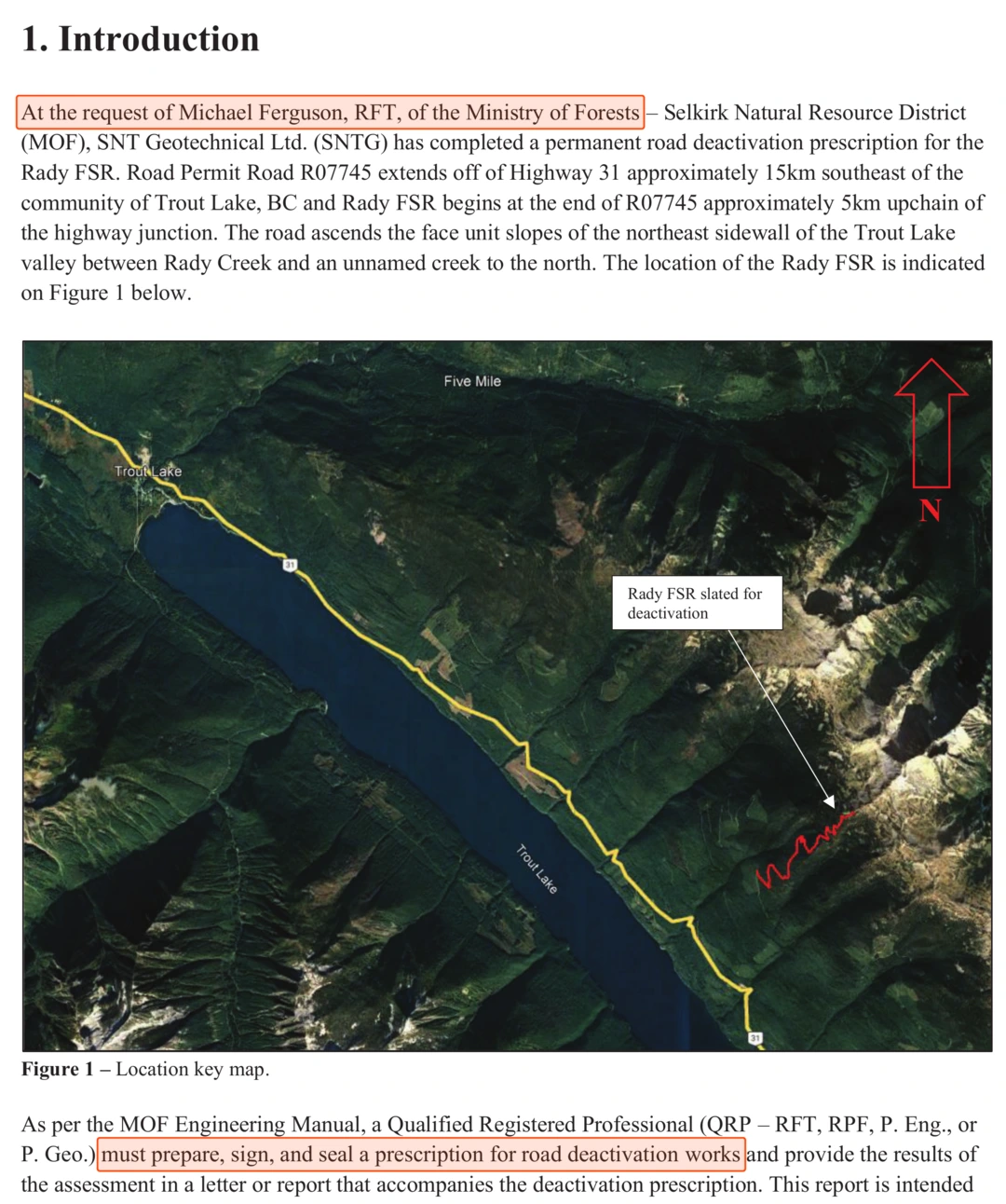
The document that ends Rady Creek is forty-two pages, dated 8 September 2026, report number 26.510.01.01.16. It is not hidden. It sits on the Province’s own web server, linked from the district’s public page, under a filename that calls it a map.01 Its second page opens by naming the officer who asked for it.
Nine lines further down the same page, the prescription states the rule it exists to satisfy.
Section 06A different name on page four
Two pages later the prescription says who answers for it, and it is not the man who asked.
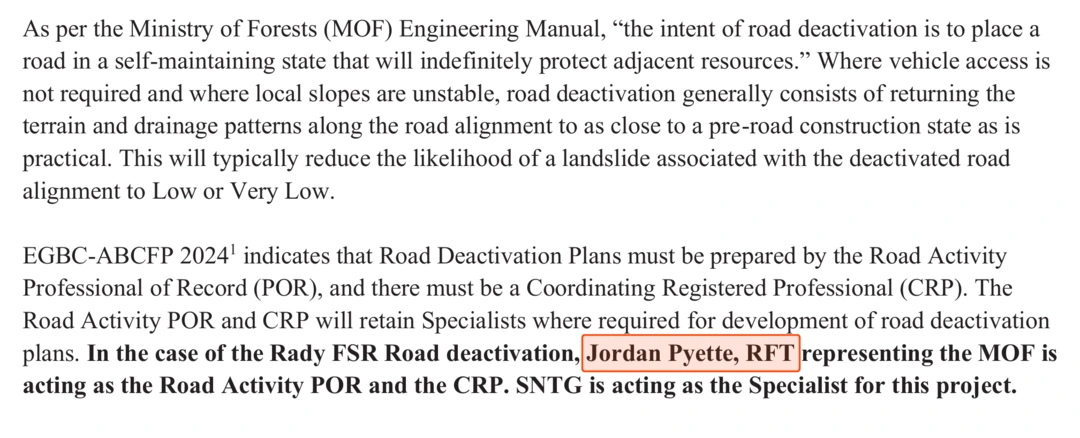
So the file reads: Ferguson requests it, Pyette answers for it. Jordan Pyette is RFT-2122, registered since 2 March 2012, working out of the district office at 1907 Ridgewood Road in Nelson — a different office from Ferguson’s, sixty kilometres away.02 The fieldwork was a third man and a single day: Ryan Williams, P.Geo. walked Rady Creek FSR on 18 August 2026. The prescription calls it “a walking traverse.”
And then there is what the prescription actually prescribes, which almost nobody reads. Rady Creek FSR is broken into seven segments. For six of the seven, the instruction is to cross-ditch and leave the road prism intact
— the roadbed stays where it is. One segment is different. Between waypoints 16 and 18, over an approximate section length = 115m
, the prescription calls for pullback and recontour
: the road is pulled into the hillside and the hillside put back. That 115 metres is what ends vehicle access along all 4.4 kilometres of it, and the prescription says so in terms — the work will result in loss of vehicle access along the alignment, including All Terrain Vehicle (ATV) access.
01
And then the engineer offered a way out, unprompted — and the Ministry of Forests refused it.
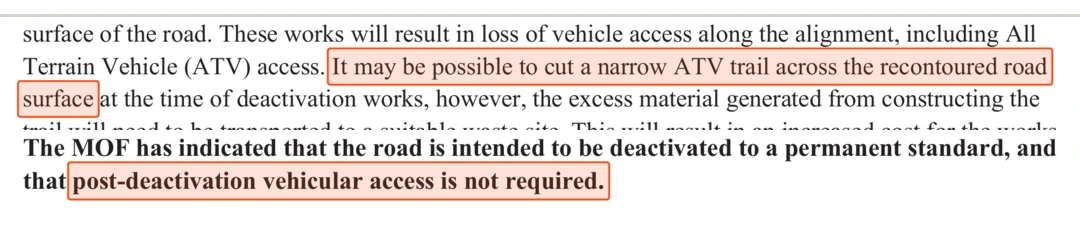
That instruction is not engineering. It is a decision, and it came from the Ministry of Forests. The same report finds that on the slope in question the landslide incidence on the face unit slope appears to be low.
It lists what is at risk from the road — fish habitat in Rady Creek, Highway 31 seventeen hundred metres downslope, Trout Lake at two thousand four hundred. Public access does not appear on the list, and neither does recreation. Ferguson asked for a permanent deactivation, and a permanent deactivation is what 115 metres of pullback buys.
Forty-two pages. Three people in the entire document. One day on the ground.
There is one more thing about this document, and it is the reason this page exists. Open the Province’s own file and not one of those names is on the screen.
They are all still in the file. They can be pulled out of the text layer in a single command. What has been done is that white rectangles have been drawn over them — fifty-three of them across forty-two pages, in the document’s own separation colourspace at zero tint, which renders as paper rather than as ink. They sit over Michael Ferguson’s name on page two. Over the consultant’s name beside it. Over Jordan Pyette’s name on page four. Over the professional seal, the wet signature and the hand-written date on page nineteen. Over the reviewing geoscientist. Over the firm’s letterhead on nearly every page, its address, its telephone number and its permit number.
This is not a font problem and it is not a rendering fault, and the document proves that itself. If it were either, it would fail everywhere the same way. It does not. On one page the consultant’s name appears twice, in plain sight, uncovered — because that page is a scan, and the scan’s own paragraphs are pixels rather than text. Whoever applied the covers worked through the text layer and the logos and did not touch the image. The covering is selective, and a selective covering is a choice.
And the choice is not a formatting one. Forest Professionals BC Bylaw 8-2 makes identification of professional responsibility mandatory — identity, professional designation, signature and date. The document was prepared so that it satisfied that rule. Then, somewhere between the consultant’s office and the public web server, every one of those four things was painted out of the copy the public and the bidders were given. A document that ends a public road was issued with the people answerable for it covered over. Section 07 shows what is underneath, and how it was recovered.
Section 07The seal was on the page, and it was painted over before anyone saw it
One page in this report is not like the other forty-one. Page 19 — Section 8, “Closure – Report Use and Limitations” — is the only page in the body with no text layer at all. Every other page came straight out of the word processor. This one was printed onto paper and scanned back in, which is a thing people do for exactly one reason.
Nobody prints and scans a page of liability boilerplate for fun. There is exactly one reason to take a page out of a word processor, put it on paper, and photograph it back into a PDF, and that reason is to get ink on it. Someone in this chain prepared the signature page. Then the document went out with the signature page blank.
So we went looking for the ink, and it is there. A scanned page inside a PDF is stored as an image. Anything drawn on top of that image is a separate instruction. Pull the image out and the instructions fall away. One command does it:
pdfimages -f 20 -l 20 -png prescription.pdf out
What comes back is a 2544 × 3296 scan of the page as it stood before anyone altered it. Was it altered to cover someone’s tracks? If not, why was it altered at all?
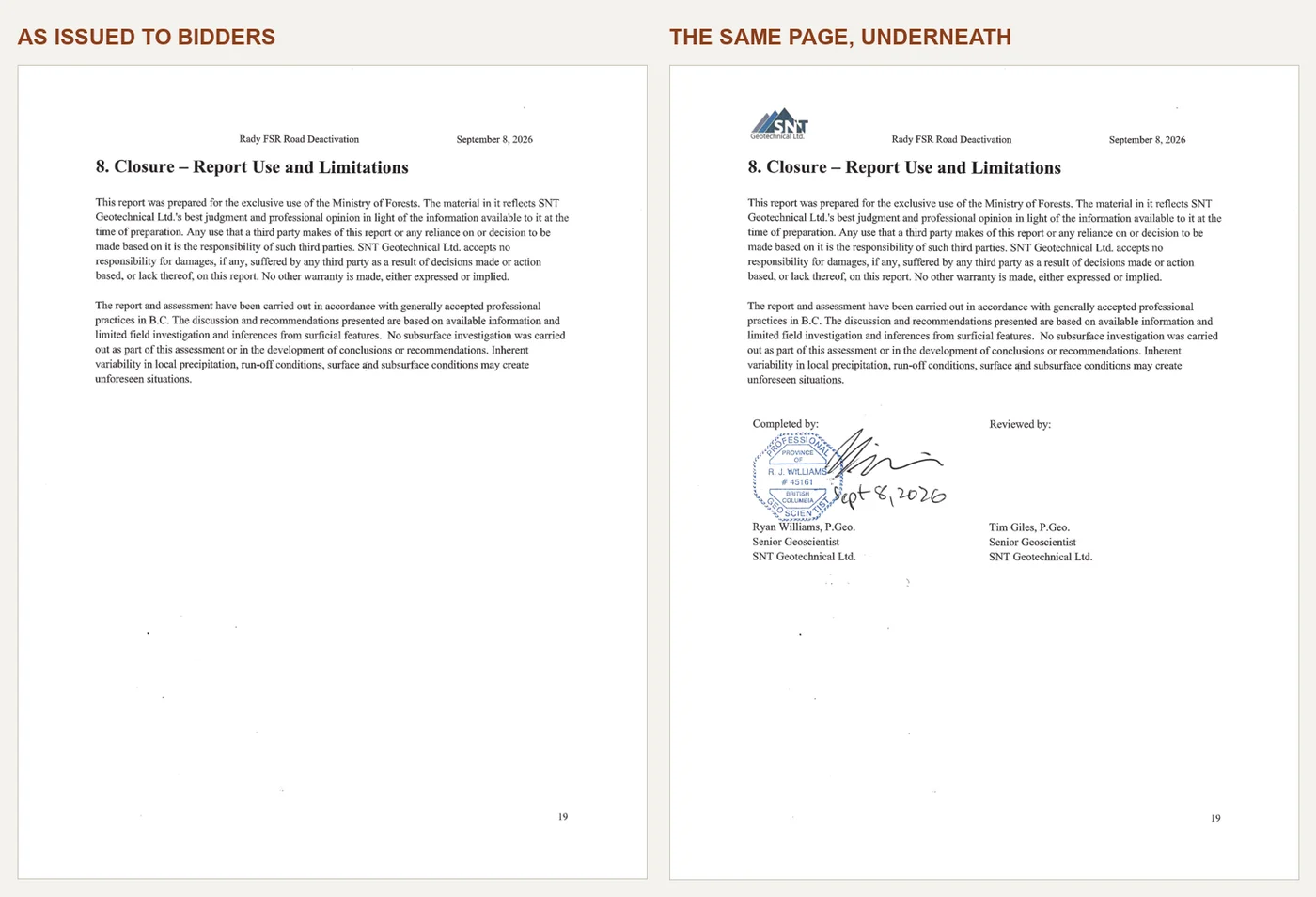
The prescription was sealed, signed, dated and peer-reviewed by two professional geoscientists — and the copy the Province put out to tender has every bit of that painted over. Fifty-three rectangles are drawn across the forty-two pages, in the document’s own separation colourspace at zero tint, which renders as paper rather than ink. Thirty-seven of them sit over the firm’s letterhead, on nearly every page; fifteen sit over text, which is every human name in the document; one is a legitimate label backing, and here they sit over the whole signature block.
The file’s metadata names its author as Thomas Chalmers at the consulting firm, and it passed through the Selkirk district and BC Bid procurement before the public saw it. What is not in dispute is who asked for it and who took delivery. Michael Ferguson commissioned this prescription. His name is in it, and his name is under one of the white rectangles. He is the official who can say why. Three weeks on, nobody has asked him.
Section 08Two forest technologists own a geoscience document, and the geoscientist who sealed it is the one they covered
Michael Ferguson is a Registered Forest Technologist. Not a professional engineer — Exhibit 01 says so in the same sentence that names him, and the distinction decides which regulator answers for him.
It also raises the question this document does not answer. The prescription classes itself as geotechnical work: SNT Geotechnical Ltd. wrote it, and the only person who set foot on Rady Creek FSR was Ryan Williams, P.Geo., a professional geoscientist, for one day. Yet the Professional of Record — the registrant who carries it — is Jordan Pyette, RFT, a forest technologist. A forest technologist is answerable for a geotechnical prescription on terrain the prescription itself describes as unstable, commissioned by a second forest technologist whose declared practice is directing other professionals. Two forest technologists own a geoscience document, and the geoscientist owns one day of walking. That is a question for both regulators, and it is on the face of the document.
A man whose declared practice is directing professionals does not get to be the one person in the file nobody can hold to it. Is this the conduct of a professional operating in good faith, or of someone covering their tracks?
The Ministry of Forests has one answer ready to all of this, and it is worth taking off the table before it is offered. It will say that a forest professional is not obliged to seal anything. Its own Engineering Manual sets out that asymmetry:03
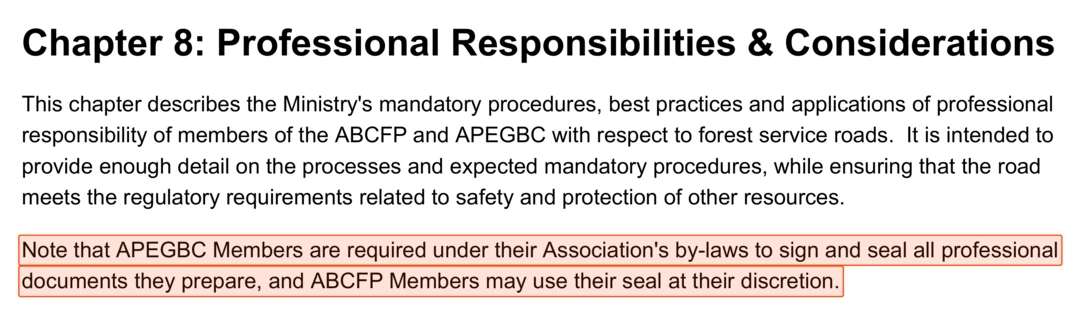
And the Ministry of Forests cannot reach for that defence here, because this prescription was not authored by a forest professional. It was authored by Ryan Williams, P.Geo., a professional geoscientist, at a geotechnical consultancy. Geoscientists are regulated by Engineers and Geoscientists BC, and for them sealing a professional document is not discretionary. He sealed it. His registrant number is on the page, his signature runs across the seal, and he dated it by hand on the day the prescription is dated.04
Of course a seal was required. The seal was required, the seal was obtained, and the seal was then hidden from the people the road belongs to. The question the Ministry of Forests has to answer is why it is withholding information from the public.
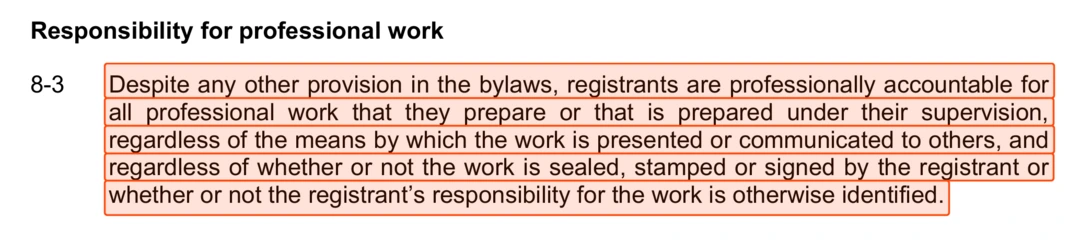
What is not optional is who answers. Bylaw 8-3 exists to close precisely this door:
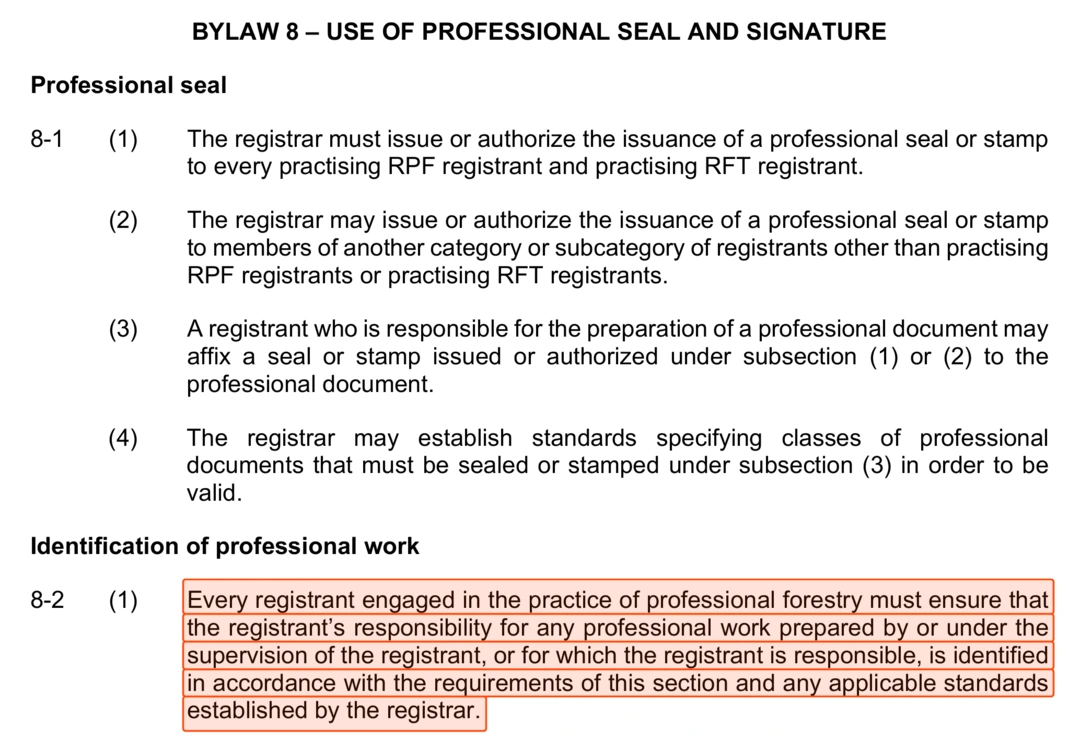
And Bylaw 8-2 requires something the published document does not contain. Every registrant must ensure their responsibility for professional work is identified — confirming identity, professional designation, signature, and the date of the work. The seal is discretionary. The identification is mandatory. On the copy the Province has published, there is neither.
So here is the position, plainly. A qualified professional sealed this document, and the version the public and the bidders were given has that seal painted over. Michael Ferguson declares on the public register that his practice includes Supervising, Directing and Advising Forest Plans, Practices and Professionals. He told his regulator that directing other professionals is his job. He then commissioned a prescription that ends a public road, had a second registrant named as the one who answers for it, and the copy that went out has the sealing professional’s name, signature, seal and date removed from view along with the firm that employed him. A man whose declared practice is directing professionals does not get to be the one person in the file nobody can hold to it.
Section 09The ministry’s own prescription kept the quad trail. Then somebody decided it would not.
The consultant’s 2026 report lists what it worked from, and one item is the district’s own earlier prescription for Rady Creek FSR. The consultant records that it carries no date.

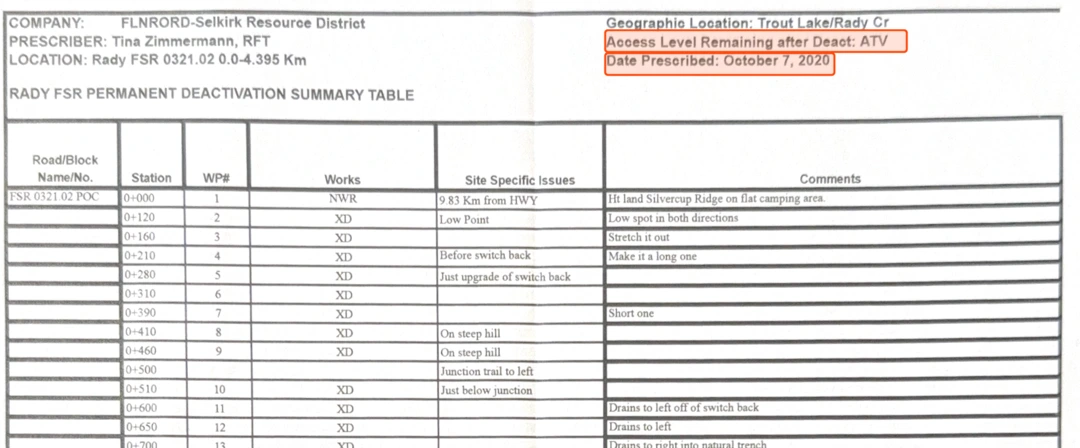
It is dated. It reads Date Prescribed: October 7, 2020
on its face. It was not hard to find either, once you stop looking for a PDF: the ministry’s prescription is a spreadsheet, and its file properties name its author as Tina Zimmermann of the Selkirk district. Michael Ferguson was sent it in 2021 under the filename TZ Rady 2020 Deact. Prescription FSR 0321.02, Revised May 11, 2021.xls
. He received the document, and five years later commissioned the 2026 prescription that calls it undated.19
And it says something the 2026 report does not. Across the top of the October 2020 original, in the Ministry of Forests’ own field, is the line: Access Level Remaining after Deact: ATV
.19
The 2020 prescription did not merely permit a quad trail. It engineered one in. It prescribes three water bars along the alignment, and at chainage 4+840, waypoint 91, the instruction reads Construct ATV’able barricade
— a barricade built so a quad can pass it, which is exactly what s.82 of the regulation contemplates.19
On 11 May 2021 the file was revised, and all four of those entries were deleted. The three water bars: gone. The ATV’able barricade: replaced with Place Deact signage, re-contour will act as a barricade
. Pull-back was extended. The email that carried the revision does not present this as engineering. It presents it as a decision that engineering was then made to serve:
“it has been decided that there will be NO ATV ACCESS… In the previous referral to you shown below, it was stated we would attempt to leave ATV access open at the expense of stability.”
Read that second clause again. The district’s own position in 2020 was that ATV access could be kept, and that keeping it cost some stability. In 2021 that trade was reversed. Nobody has ever published who made that call, or why.19
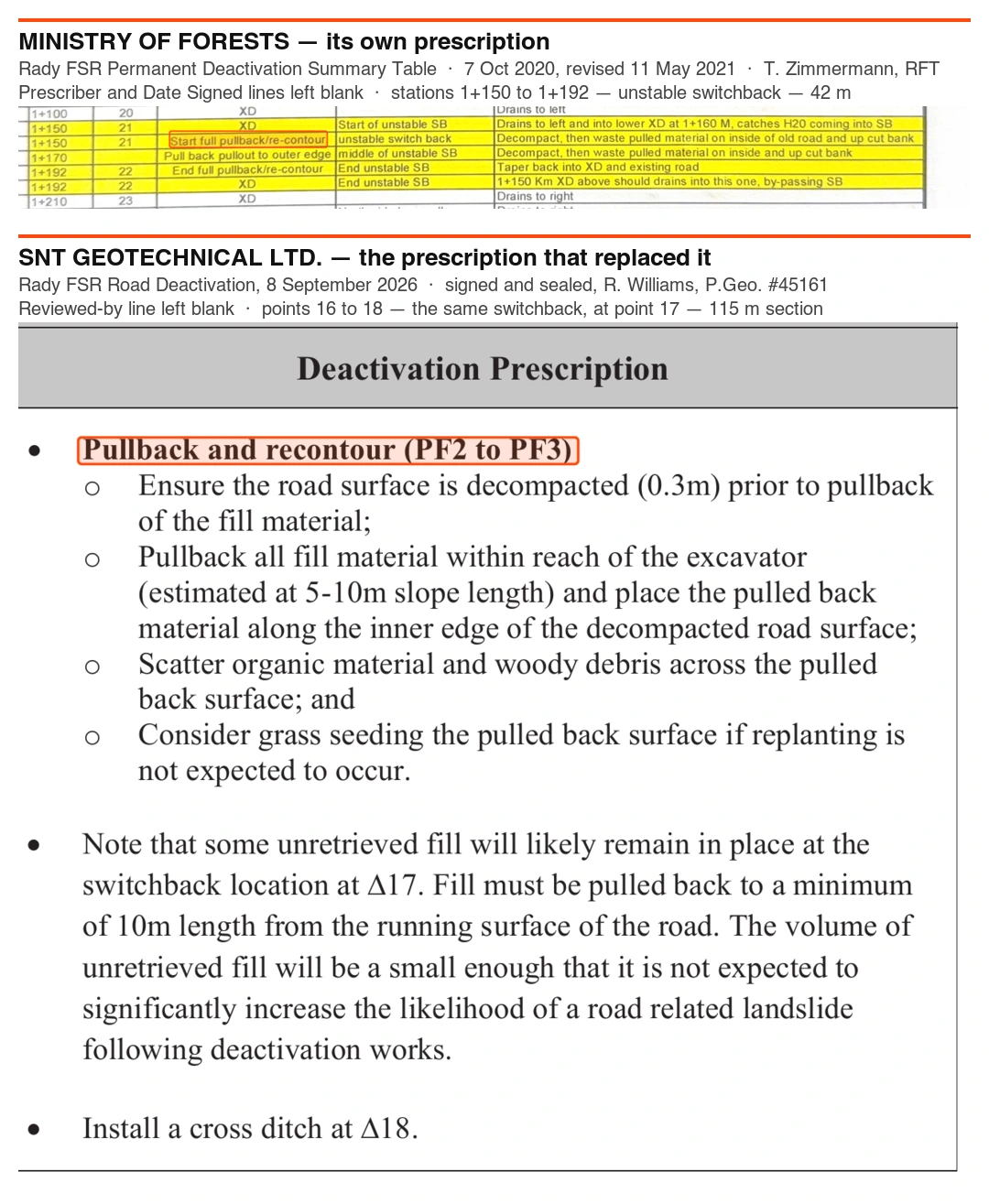
The same road, prescribed three times
| Ministry of Forests 7 Oct 2020 | Ministry of Forests revised 11 May 2021 | SNT Geotechnical 8 Sep 2026 | |
|---|---|---|---|
| Access left for the public | ATV | NO ACCESS | “post-deactivation vehicular access is not required” |
| What ends the road | “Construct ATV’able barricade” | “Place Deact signage, re-contour will act as a barricade” | 115 m of pullback and recontour |
| Water bars | 3 | 0 | 0 |
| Waypoints | 91 | 91 | 71 |
| Cross ditches | 76 | 74 | 68 |
| Pull-back prescribed | 270 m | 362 m | a 115 m section19 |
| Bridges or culverts removed | none | none | none |
| Signed | ruled blank | ruled blank | signed by hand |
| Sealed | no seal anywhere | no seal anywhere | P.Geo. seal #45161 — covered in the issued copy |
| Dated | 7 October 2020 | 7 October 2020, revised 11 May 2021 | 8 September 2026 |
| Written by | Tina Zimmermann, RFT | Tina Zimmermann, RFT | Ryan Williams, P.Geo. |
| Ministry contact / requester | “Mike Ferguson, Resource Officer-Engineering” | “Mike Ferguson, Resource Officer-Engineering” | “At the request of Michael Ferguson, RFT” |
Read the top row across. The Ministry of Forests’ own engineering technician prescribed Rady Creek FSR twice, and between the two versions the public lost everything. Not because the ground changed — the second version is dated seven months after the first and no new fieldwork is recorded — but because, in the words of the email that carried it, it has been decided that there will be NO ATV ACCESS.
Five years later a consultant was paid to write it a third time, and by then nobody needed to decide anything: the ministry simply told the engineer that access is not required.
And read the bottom two rows. The same man is the ministry’s contact on all three documents. In 2021 he is named on the amendment as Mike Ferguson, Resource Officer-Engineering, Selkirk Resource District-Castlegar.
In 2026 the consultant’s report opens At the request of Michael Ferguson, RFT.
He was there when the quad trail was engineered in, there when it was taken out, and there when a geoscientist was hired to finish it.19
None of that comparison should have been possible, and very nearly was not. The Province published its own earlier prescription for Rady Creek FSR on the district’s website, at deactivation_prescription_map_-_trout_lake-rady_fsr.pdf. That address now returns 404. The filename is still sitting in the search index, pointing at nothing. The Internet Archive never captured it. The page it vanished from is edited in place, with no version history and no machine-readable record of what it used to say.05
The reason the two versions can be set beside the 2026 report at all is that copies got out of the Ministry of Forests before the file came down. The District Manager released the prescription to the Trout Lake Recreational Club in July 2021, and the club kept it. Both versions appear again, photographed, at pages 379 to 381 of the district’s records release. And the Province left one thread hanging: its own waypoint file for this prescription, rady_creek_fsr_deactivation_prescription.kmz, carrying all 81 points, is still retrievable from the same asset path today.19
So every document quoted on this page has been downloaded, checksummed with SHA-256 and archived off the Province’s servers — the 2020 prescription, the 2021 revision, the 2026 report, the funding policy, the bylaws, the tender and the released emails. Not as a precaution against anything hypothetical. The file that would have contradicted the consultant is the one that is already gone.
There is one more thing the Trout Lake Recreational Club found out, and it is the reason all of this matters rather than merely being untidy.
The Ministry of Forests’ prescription says of its most dangerous stretch — the switchback at 1+150, the one the 2026 report would later recontour — that it incorporates the recommendations of a geotechnical engineer
. In November 2021 the Trout Lake Recreational Club wrote to the District Manager and asked for that engineer’s report. It is a reasonable request. If a public road is being destroyed on geotechnical advice, the advice is the document that justifies it.
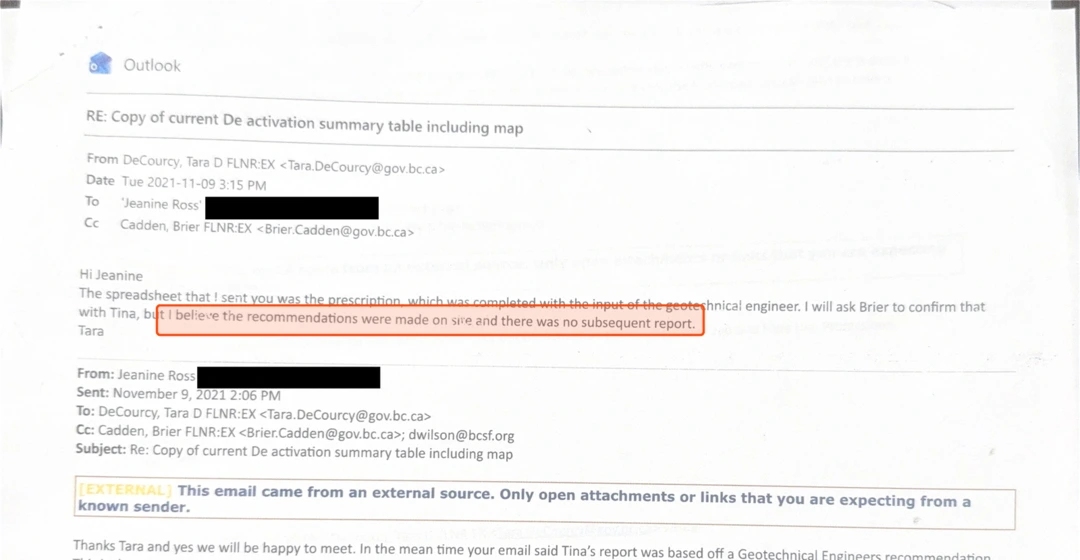
So this is what the Province had, going into 2026. An unsigned, unsealed spreadsheet, written by an engineering technician, resting on advice a geotechnical engineer gave out loud on a hillside and never put in writing. On the strength of that, a road was posted for permanent deactivation in November 2025 and the excavators went to tender.
And then a geotechnical consultant was paid to produce forty-two sealed pages about the same switchback — dated 8 September 2026, ten months after the sign went up, one day before the tender carrying it was re-issued. The written expert opinion did not justify the deactivation decision. It arrived afterwards, to stand behind one that had already been made.20
And the Province’s is no longer the only engineering opinion on Rady Creek FSR.
An independent geotechnical assessment of the Rady Forest Service Road has been commissioned outside government and is complete. It does not support deactivating this road. It sets out a regime for maintaining it instead. The assessment is not ours to release and this page does not reproduce it — but its existence disposes of the premise the Ministry of Forests has been working from, which is that there is no alternative to destroying the road.21
Set that against what the Ministry of Forests actually holds. It has published no written geotechnical assessment of this road at all. Its own District Manager confirmed in writing on 9 November 2021 that the advice behind the 2020 prescription was given on site and that there was no subsequent report.
The forty-two sealed pages arrived five years later, after the decision was posted in the field, one day before the tender carrying them was re-issued.
So there are two engineering opinions on this slope and they do not agree. One was commissioned by the officer who wanted Rady Creek FSR gone, after he had already posted it for removal. The other was commissioned by people who wanted to know whether it could be kept. Only one of them has been paid for out of the public purse, and it is not the one that answers the question.
Set the two documents side by side and the shape of the change is arithmetic. The Ministry of Forests’ prescription ran to 91 waypoints over 4,395 metres; the consultant’s runs to 71 over 3,980. Cross ditches fall from seventy-six to sixty-eight. Water bars fall from three to none. And one row is identical in both, and is the row the ministry’s public case rests on: neither prescription removes a single bridge or culvert, because there are none on this road to remove.19
One last thing about the Ministry of Forests’ own prescription, in a piece about who signs for what. Both versions carry the lines Prescriber: B. Zimmermann, RFT
and Date Signed:
— and in both versions the space after each is a ruled blank. The district’s own prescription for destroying this road was never signed at all.19
Section 10The prescription was written after the deactivation decision, and released into a tender that was already running
Put the dates in a line and the order of events is the finding.
Rady Creek FSR was posted for deactivation in the field on 13 November 2025, and the district’s page said the work was planned for 2026. The excavators went out to tender. Then, ten months after the decision was already posted on a sign at the roadside, the document that establishes the work is justified was produced: SNT Geotechnical’s prescription, dated 8 September 2026. The very next day, 9 September, tender EN27DSE008 was re-issued with that prescription attached. Bids closed on 24 September at 1:00 PM Pacific, and the contract requires the road barricaded and the work complete by 1 November 2026.17
The engineering did not lead the deactivation decision. It was commissioned after the decision was made and inserted into a procurement that was already running. A prescription is supposed to be the document that answers whether a road should be destroyed and how. This one arrived after the sign went up, after the first tender, and one day before the re-tender that carried it to bidders.
Asked about it two weeks later, the Ministry of Forests declined an interview and sent a written statement instead. It contained one sentence that settles what the consultation was for: At this time, the decision for deactivation is final.
17
The same statement sets out the schedule and one remarkable line item. Rady Creek FSR is to be barricaded by 1 November 2026. And because the project is, in the Ministry of Forests’ own word, contentious, it will provide 24/7 on-site security services for the entire duration of the deactivation operations. There is money to guard the excavators from the public for as long as the work takes. There was no money to hold a meeting with them.17
And then the last detail, which is the whole of the Ministry of Forests’ thinking in one sentence. Once the road has been destroyed, the statement says, organizations can apply for a licence of occupation under the Land Act to rebuild a trail in the area. The Engineering Manual says the same thing in its own way: where permanent recreational use is intended, the procedure is to cancel the FSR status
and then apply
to Recreation Sites and Trails BC for a trail under s.56 of the Forest and Range Practices Act. You have to lose the road before you are allowed to ask for the trail — and deactivation is what happens in between.1703
A hundred and fifteen metres of pullback, on a slope the engineer found to have a low landslide incidence, on a road built in 1901, ends it. The prescription was requested by Michael Ferguson. The barricade goes up in five weeks.
Section 11The complaint that reaches the man has never been filed. Anyone can file it.
Every thread in this piece runs back to one desk.
Michael Ferguson is the Selkirk district’s Engineering Officer — one of three posts reporting to the District Manager, and the one that owns roads. On the public register he declares his practice as Forest Roads and Transportation and Supervising, Directing and Advising Forest Plans, Practices and Professionals. Directing other professionals is not incidental to his job. It is what he tells his regulator he does.
In June 2021 he was sent the Rady prescription under a covering note that said it had been amended once no ATV access was decided
, and he forwarded it to the District Manager the same afternoon. In July 2022, asked on the deactivation chain where the public’s questions about this road should go, he answered that they should go to somebody else. In September 2026 he commissioned the forty-two pages that end it. He was there when the quad trail was engineered in, there when it was taken out, and there when a geoscientist was hired to finish the job.
And the document he commissioned reached the public with every name on it painted out — his own, the Professional of Record’s, the geoscientist’s seal, the reviewer’s, the firm’s. FPBC Bylaw 8-2 does not make that optional. A registrant must ensure
that responsibility for professional work is identified
. And Bylaw 8-3 closes the escape route in advance: a registrant is accountable regardless of whether or not the work is sealed, stamped or signed… or whether or not the registrant’s responsibility for the work is otherwise identified.
A man whose declared practice is directing other professionals does not get to be the one person in the file nobody can hold to it. That is the complaint. It is not about whether a road should be closed — the regulator has no power over that and would refuse it. It is about whether the officer who commissioned a professional document, and the registrant who took responsibility for it, met the standard their own regulator sets.
And there is a second ground, which goes to ethics rather than paperwork. Forest Professionals BC binds every registrant to a Code of Ethical and Professional Conduct. Standard 2 governs independence, and its final clause is the one that matters at Rady Creek.
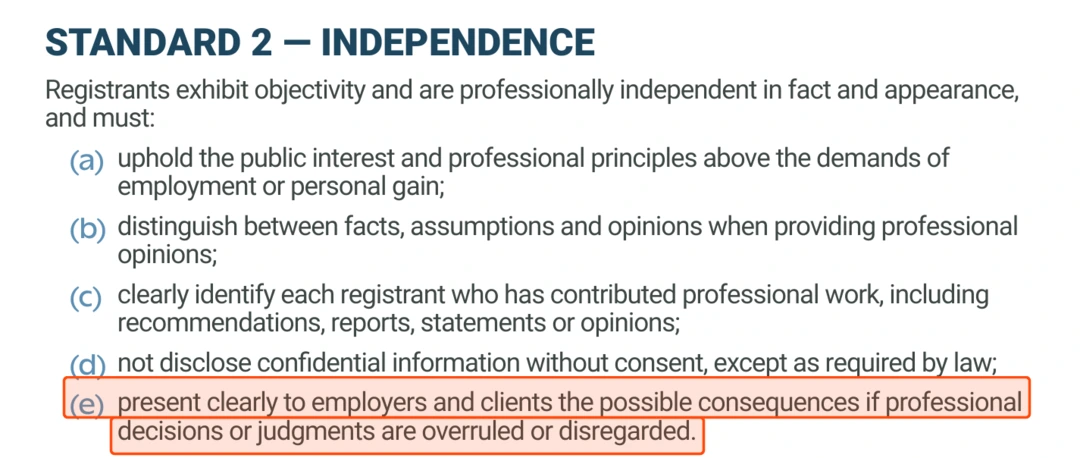
Professional judgment on Rady Creek FSR was overruled twice, and both times it is recorded. In 2020 the district’s own prescription kept the quad trail, and its authors accepted that they were doing so at the expense of stability
— a professional judgment, written down. In May 2021 it was reversed, and the email says how: it has been decided that there will be NO ATV ACCESS.
Not assessed. Decided. Then in 2026 the geoscientist wrote that an ATV trail across the recontoured surface may be possible
at an increased cost, and the Ministry of Forests answered that access is not required.
So the question for the regulator is narrow and answerable. When these professionals’ judgments were overruled, were the consequences presented clearly — and to whom? Not to the Trout Lake Recreational Club, which had to ask twice for a report that turned out never to have been written. Not to the four hundred people who use Rady Creek FSR. The public is not the registrant’s client, and that is precisely why the regulator, and not the Ministry of Forests, is the body that has to answer this.
Nobody has ever asked. Eighteen years on the register and the file is empty — not because the conduct was examined and cleared, but because no member of the public has ever found the door. It is one form, it takes ten minutes, and any person may file it.
So that is the case. Here is how it gets put to the people who can act on it.
The Forest Practices Board cannot order a road kept open and does not regulate registrants. Forest Professionals BC does, and its rule on who may complain is one line. Bylaw 12-2(1): “Any person may deliver a complaint, in writing, to the registrar.” Not an affected party. Not a resident of the Kootenays. Any person.11
There is no limitation period. Nothing in the Professional Governance Act or in Bylaw 12 puts a clock on how far back a complaint can reach, and s.65(5) keeps a registrant inside the regulator’s jurisdiction even if they resign. Complaints go through the online portal at fpbc.ca.
What a complaint has to contain. Bylaw 12-2(2) requires it to allege conduct which, if proven, would amount to incompetent performance of professional forestry, professional misconduct, conduct unbecoming, or a breach of the Professional Governance Act or bylaws. A footnote to that bylaw is worth knowing: there is no requirement to identify which bylaw you think was breached. You describe what happened.
And here are the particulars to quote. The prescription is 26.510.01.01.16, dated 8 September 2026, issued with BC Bid tender EN27DSE008. It was commissioned by Michael Ferguson, RFT-1624. The registrant recorded in it as Professional of Record and Coordinating Registered Professional is Jordan Pyette, RFT-2122. A complaint that carries that report number is investigable. One that does not is dismissible.
Write it yourself. Bylaw 12-2(3) lets the registrar throw out anything trivial, vexatious, made in bad faith, an abuse of process, or carrying “insufficient information or particulars to allow an investigation to proceed.” Five hundred identical letters is that. One person writing plainly about a document with a number on it is not. If you use Rady Creek FSR, say so, say how, and say what its loss costs you.
File a complaint·Forest Professionals BC·Take ten minutes
The complaint is already written. It just needs your name on it.
This goes to two regulators, because the document does. Forest Professionals BC is the only body that can require a registered forest professional to answer for their own work — the Ministry of Forests cannot discipline its own officer, and the Forest Practices Board has no power over registrants at all. Engineers and Geoscientists BC regulates the geoscientist whose seal was covered and the firm that holds the permit to practise. Any person may file with either. You do not have to live in the Kootenays or have ever driven Rady Creek FSR.
The letter below sets out eight facts the Registrar can check against the document itself, four grounds under the bylaws and the code of ethics, and four things the public is asking for. It is copied to the Forest Practices Board, the Minister of Forests and the Superintendent of Professional Governance, so no one of them can quietly decide it belongs to somebody else.
- 01Press Open your email app — a draft opens, addressed to both regulators
- 02Come back and press Copy all addresses, then paste them into To and Cc
- 03Press Copy the full letter, paste it over the placeholder, add what Rady Creek FSR is to you — and send it yourself
To the Registrar, Forest Professionals BC, and to the Complaints Department, Engineers and Geoscientists BC,
I am filing a complaint under Bylaw 12-2(1) against two registrants of this College. They are responsible for a professional document that will permanently destroy a public forest service road built in 1901, and the copy the Province put into the hands of contractors and published to the public does not identify a single professional anywhere in its forty-two pages.
The registrants. Michael Ferguson, RFT-1624, Engineering Officer, Selkirk Natural Resource District, who commissioned the document. Jordan Pyette, RFT-2122, named in the document as Road Activity Professional of Record and Coordinating Registered Professional.
This complaint reaches two regulators, because the document does. Mr Ferguson and Mr Pyette are registrants of Forest Professionals BC. The seal that was covered is a professional geoscientist’s, and the firm that prepared the prescription, SNT Geotechnical Ltd., holds an Engineers and Geoscientists BC permit to practise, number 1001083, which is itself covered in the issued copy. I am sending the same facts to both bodies so that neither has to decide whether they belong to the other.
For Engineers and Geoscientists BC specifically. I make no allegation against R. J. Williams, P.Geo. #45161, whose seal, signature and date appear to have been properly applied, nor against the reviewing geoscientist. My concern is the opposite: their work was sealed correctly and then distributed with the seal removed. I ask EGBC to consider whether a sealed professional document bearing its registrant’s seal may be republished by a client in a form where the seal, the signature, the date, the reviewer and the permit number are all obscured, and what obligation the permit holder has when that occurs. Engineers and Geoscientists BC treats a firm as a registrant in its own right, so this limb of the complaint concerns SNT Geotechnical Ltd. as permit holder, number 1001083, and not only the individuals named.
The document. Rady FSR Road Deactivation Prescription, report 26.510.01.01.16, dated 8 September 2026, prepared by SNT Geotechnical Ltd. for the Ministry of Forests and issued to contractors with BC Bid tender EN27DSE008. It is published on the Province’s own website.
The facts I ask you to verify.
1. The document’s opening sentence names Mr Ferguson as the officer at whose request it was prepared, and a later section names Mr Pyette as Professional of Record and Coordinating Registered Professional.
2. The document states its own requirement: a Qualified Registered Professional “must prepare, sign, and seal” a prescription for road deactivation works.
3. In the copy the Province published and issued to bidders, no professional is identified anywhere in forty-two pages — no seal, no signature, no date of signature, no reviewing professional, no consulting firm, and neither registrant’s name.
4. Those elements are in the file. They are covered by white rectangles drawn in the document’s own separation colourspace at zero tint, which render as paper. Removing them recovers a professional seal, a signature written across it, a hand-written date of 8 September 2026, and a second reviewing professional.
5. The covering is selective rather than a rendering fault: on one page the consultant’s name appears uncovered in scanned body text while the identical name is covered wherever it occurs in the text layer.
6. The Ministry of Forests’ own earlier prescription for the Rady FSR, dated 7 October 2020, retained all-terrain vehicle access and recorded that it did so “at the expense of stability.” It was revised on 11 May 2021 and the covering email states: “it has been decided that there will be NO ATV ACCESS.” Mr Ferguson was sent that revision on 21 June 2021 and forwarded it to the District Manager the same afternoon.
7. The 2026 document states that the Ministry of Forests’ earlier prescription “is not dated.” It carries the date 7 October 2020 on its face, and the file Mr Ferguson received in 2021 carried its revision date in the filename.
8. On 9 November 2021 the District Manager advised the local recreation club that the geotechnical input behind that earlier prescription was given on site and that “there was no subsequent report.”
The grounds.
(a) Bylaw 8-2. A registrant must ensure that responsibility for professional work is identified. On the document as issued, it is not.
(b) Bylaw 8-3. Registrants remain accountable regardless of whether the work is sealed, stamped or signed, or whether responsibility is otherwise identified. I ask who is accountable for the document in the condition it was released.
(c) Standard 2(e), Code of Ethical and Professional Conduct. Professional judgment on the Rady FSR was overruled twice on the record — in 2021 when ATV access was removed by decision, and in 2026 when the consulting geoscientist advised that an ATV trail “may be possible” at additional cost and the Ministry of Forests replied that access “is not required.” I ask whether the consequences were presented clearly, and to whom.
(d) Accuracy. Whether a professional document may describe a superseded prescription as undated when the registrant who commissioned it held a dated copy.
What I am formally requesting.
This is not a request for the College to reverse a road-closure decision. That is outside its jurisdiction and I am not asking for it. What is squarely inside its jurisdiction is whether two of its registrants may put their names to a document that ends public access and then release it in a condition where no name can be read. I am formally requesting that the College:
1. Investigate both named registrants under Bylaw 12-2(2) for professional misconduct, conduct unbecoming, and breach of Bylaws 8-2 and 8-3.
2. Establish who applied the covering, on whose instruction, and at what point between the consultant’s office and the Province’s web server it was applied.
3. Rule on whether a document issued in that condition can satisfy Bylaw 8-2 at all — because if it can, the bylaw means nothing.
4. Publish the outcome. This document was published. The public is entitled to know whether the conduct behind it met the standard the College sets.
The public did not get a meeting, a mailing, or a name. The Ministry of Forests has stated that the deactivation decision is final and has budgeted round-the-clock security against the people who use the Rady FSR. The College is the only body left that can require the people responsible to account for their own professional work.
The evidence. Every document relied on above is linked below. Engineers and Geoscientists BC asks for exactly this — “links to websites containing the relevant documents and information.” Nothing is withheld and nothing requires a request to me.
Each was downloaded and archived with a SHA-256 checksum when it was found, and the copies below are held independently of the Province’s servers. That was not a precaution against something hypothetical.
The Ministry of Forests’ own earlier prescription for the Rady FSR was published at deactivation_prescription_map_-_trout_lake-rady_fsr.pdf. That address now returns 404, the filename is still in the search index pointing at nothing, and the Internet Archive never captured it. The BC Government Directory, which records Mr Ferguson’s job title, has since been closed to the public. I can put the earlier prescription in front of you only because a copy was released to a local recreation club in July 2021 and kept.
The document complained of
Rady FSR Road Deactivation Prescription, report 26.510.01.01.16, 8 September 2026, as published by the Province — the copy in which no professional is identified
https://www2.gov.bc.ca/assets/gov/farming-natural-resources-and-industry/natural-resource-use/resource-roads/local-road-safety-information/selkirk/trout_lake_rady_creek_deactivation_prescription_map.pdf
The same prescription as issued to bidders with tender EN27DSE008
https://drive.google.com/file/d/1j99SRpTahMSJ16ZC_l7BOu7zOuKg3B01/view
Tender EN27DSE008, Offer Form and Quoted Price Schedule
https://drive.google.com/file/d/1Tq9Nio1y7gMSQfXUZxnZ6bQQq0ljzRKH/view
Tender EN27DSE008, wet weather shutdown criteria
https://drive.google.com/file/d/1pCKXuZQyano5_BIHf6uYDVApU2wnjS1_/view
Tender EN27DSE008, 2025 site photographs and inspection
https://drive.google.com/file/d/1i9oAG-MI9XOxT-6WLaebZDOZ2LWugVft/view
The Province’s own prescription waypoint file, 81 waypoints, still served from the district’s asset path
https://www2.gov.bc.ca/assets/gov/farming-natural-resources-and-industry/natural-resource-use/resource-roads/local-road-safety-information/selkirk/rady_creek_fsr_deactivation_prescription.kmz
The Ministry of Forests’ own earlier prescription, which the 2026 report calls undated
Rady FSR 0321.02 permanent deactivation summary table, prescribed 7 October 2020, revised 11 May 2021. Prescriber recorded as B. Zimmermann, RFT; the signature and date lines are ruled blanks in both versions
https://drive.google.com/file/d/1fm9GSw7ph92Rb0p0xiJ65ohMVRg4JhMD/view
Both versions side by side as released — the 7 October 2020 original headed ’Access Level Remaining after Deact: ATV’ against the 11 May 2021 revision, ’NO ACCESS’
https://drive.google.com/file/d/1Ce_iDGGS6Kbd8biebJym_z-6eRnxQIId/view
Rady Creek deactivation project map, 1:30,000, 26 April 2021
https://drive.google.com/file/d/1HnYIO5l8jhhW6JCbMb3QIGO8fySpthNh/view
The correspondence
11 May 2021, amendment to the deactivation works: ’it has been decided that there will be NO ATV ACCESS’
https://drive.google.com/file/d/10nyzTxXAcPC8pB6cpzW-cfiynqUYUkDU/view
21 June 2021, Zimmermann to Ferguson: ’Attached is my amended prescription once no ATV access was decided.’ Forwarded by Mr Ferguson to the District Manager the same afternoon
https://drive.google.com/file/d/11_Qhj_w87T3H2fXVVFtgFgf9TqLz-ACe/view
6 July 2021, District Manager’s briefing note on s.56 FRPA and a Land Act offer for this road
https://drive.google.com/file/d/1Ef55LGaK82uHY4nfJ_PLeEvffzC2_pHh/view
12 July 2021 transmittal and the reply of 9 November 2021: ’I believe the recommendations were made on site and there was no subsequent report’
https://drive.google.com/file/d/1PwT2AsuefgYN0-Swdxu8Jg7lZUDqWieI/view
Mr Ferguson’s fact sheet setting out three alternatives to deactivation, and the released district emails including his of 11 July 2022
https://drive.google.com/file/d/17gXOQYIqEvW73q3DvLbUC6j1KE5IzxPW/view
17 November 2025, deactivation notification to the road permit holder
https://drive.google.com/file/d/1glM44nxQdip5J3JndDRxeL1BNTV7Wt-V/view
27 November 2025, the District Manager’s response to the Trout Lake Recreational Club
https://drive.google.com/file/d/1LeyoWbB01fO7vvycnGmz83Ek0ixKAtjW/view
14 January 2020, the earlier deactivation referral chain for this road
https://drive.google.com/file/d/1W90EkuBhyJ5UpS84kY-9GTBgZZh9-NsF/view
The policy that decides which roads are kept
Engineering Program Funding Policy, signed fiscal 2019 edition — not published by the Province
https://drive.google.com/file/d/1XlzP_3bmsb0z16-cekMzEzGQ_ag_SXj6/view
Engineering Program Funding Policy, fiscal 2015/16 edition
https://drive.google.com/file/d/1DvvZnWZNpSwK0bglXGT5_yiJFX0Dws6v/view
Office of the Auditor General of British Columbia, Management of Forest Service Roads, November 2020 — Appendix C reproduces the policy and its risk table
https://www.oag.bc.ca/app/uploads/sites/963/2024/08/OAGBC-20210119-Management-Forest-Service-Roads_RPT.pdf
The rules relied on
Forest Professionals BC Bylaw 8, Use of Professional Seal and Signature, consolidated 11 December 2024
https://www.fpbc.ca/wp-content/uploads/2024/12/2024-12-11-FPBC-Bylaws-BYLAW-8-USE-OF-PROFESSIONAL-SEAL-AND-SIGNATURE.pdf
Forest Professionals BC Bylaw 12, Complaints, Investigations and Discipline
https://www.fpbc.ca/wp-content/uploads/2024/12/2024-12-11-FPBC-Bylaws-BYLAW-12-COMPLAINTS-INVESTIGATIONS-AND-DISCIPLINE.pdf
Forest Professionals BC Code of Ethical and Professional Conduct
https://www.fpbc.ca/wp-content/uploads/2024/12/2024-12-11-FPBC-Bylaws-BYLAW-9-STANDARDS-OF-ETHICAL-AND-PROFESSIONAL-CONDUCT.pdf
Selkirk Natural Resource District road safety information, the page that lists every road posted closed or for deactivation
https://www2.gov.bc.ca/gov/content/industry/natural-resource-use/resource-roads/local-road-safety-information/selkirk-natural-resource-district-road-safety-information
Everything together
The full documentary record, with the covering removed — the recovered seal and signature, the three-way comparison of the prescriptions, and the covering as it appears in the published file
https://backcountry.cx/editorials/michael-ferguson-jordan-pyette-rady-creek/
I am one of the people who use the Rady FSR. I am not asking the College to reverse a decision about it — I am asking whether the registrants who prepared, commissioned and issued the document that ends it met the standards the College sets, and I am asking to be told what you find.
Thank you for your time.
Send the whole thing
A mail link can carry about two thousand characters. This complaint is fourteen thousand, and its seventeen source documents are the reason it is worth reading. So the full letter travels by clipboard, not by link.
- Copy the full letter below. Everything in the window above comes with it, including every document link.
- Open your mail app — the Send button fills in both regulators, all seven people copied, and the subject line.
- Select all and paste. The letter that opens is a placeholder that tells you to do exactly this. Replace it.
The button opens your own mail app with this already written and addressed to both regulators. Change it — one person writing plainly about a document with a number on it carries more weight than five hundred identical letters, and Bylaw 12-2(3) lets the registrar bin the identical ones. A complaint cannot be withdrawn once it is submitted. If the button does nothing, the two addresses are complaints@fpbc.ca and complaints@egbc.ca.
Section 12Five weeks
Rady Creek FSR was built in 1901, by miners, with hand tools. It has been driven for a hundred and twenty-five years. The Province has now given itself until 1 November 2026 to make sure it cannot be driven again, and has budgeted round-the-clock security for the duration, because — in its own word, in its own tender — the project is contentious.
Nothing on this page asks anyone to believe a conspiracy. Every document quoted here was written by the Province, or released by it, or published on its own web server. What they show, laid end to end, is narrower and worse than a conspiracy.
A decision was made first and the engineering was commissioned afterwards. Rady Creek FSR was posted for deactivation in the field in November 2025; the prescription that justifies it is dated ten months later, one day before the tender carrying it was re-issued. The Ministry of Forests’ own earlier prescription kept the quad trail and said so cost stability; that was reversed by decision, not by survey, and the officer who was sent the reversal forwarded it upward the same afternoon. When the Trout Lake Recreational Club asked to see the geotechnical report behind any of it, the District Manager told them there wasn’t one.
And the document that ends it went out with every name on it painted over — the officer who asked for it, the registrant answerable for it, the geoscientist who sealed it, the reviewer, and the firm. Fifty-three rectangles, in the file’s own separation colourspace, at zero tint. The rule that says a registrant’s responsibility must
be identified is on page two of the bylaws. It is not a technicality and it is not an accident of software.
There is no mechanism left that stops this. The Forest Practices Board cannot order a road kept open. The lobbying registry is barred by statute from recording anything said to a district officer. The staff directory that would tell you who he is has been closed to the public. The Ministry of Forests has said the decision is final and declined to be interviewed. The only door still open is the one marked professional conduct, and it opens from the outside — by any person, in writing, with a report number.
That is the whole of what this page is for. Not to stop a road being destroyed; it is too late for that, and the regulators have no power over it anyway. It is to make sure that when it is gone, there is a file somewhere with the names in it that aren’t hidden from the public intentionally.
But most importantly, we can now answer the one question we started with…
Why, Mike? Why hide your name from a document you commissioned to destroy Rady Creek?
Share this story
Six images carrying this story on their own — the man, the painted-out seal, the reversal, the list and the complaint. Made to be posted.


Slide 1 of 6
Suggested caption
Michael Ferguson is the Engineering Officer of the Selkirk Natural Resource District. In September 2026 he commissioned the forty-two-page prescription that ends the Rady Forest Service Road above Trout Lake — cross-ditched along its length, and one hundred and fifteen metres pulled into the hillside.
Page nineteen is where a report of this kind is signed and sealed. In the copy the Province issued to bidders it is blank. Underneath, still in the file, are the seal of R. J. Williams, P.Geo., registrant #45161, his signature written across it and a hand-written date of 8 September 2026.
Fifty-three white rectangles were drawn over the document in its own separation colourspace at zero tint, so they render as paper rather than as ink. Thirty-seven sit over the firm’s letterhead, fifteen sit over text, and one backs a label. Michael Ferguson’s own name is under one of them.
He is RFT-1624, on the public register since 25 January 2008, and he declared his practice areas himself: forest roads and transportation, and directing other professionals.
The Ministry of Forests’ own prescription for the Rady FSR, dated 7 October 2020, kept ATV access and recorded that it did so “at the expense of stability.” The revision of 11 May 2021 deleted the ATV’able barricade and all three water bars. The covering email says why: “it has been decided that there will be NO ATV ACCESS.” Not assessed. Decided.
Twenty-two roads in this district are posted closed or for deactivation — seven for permanent deactivation, fifteen behind a barricade with no repair date. Every one of them is a public forest service road. Not one metre of the district’s 12,547 industry road permit sections is on any list.
The barricade goes up 1 November 2026. The Ministry of Forests says the deactivation decision is final, and it has budgeted 24/7 on-site security for the entire duration of the works, because the project is, in its own word, contentious.
The complaint to Forest Professionals BC and Engineers and Geoscientists BC is already written and addressed. It needs your name on it.
backcountry.cx/editorials/michael-ferguson-jordan-pyette-rady-creek/
#BCpoli #PublicLand #Kootenays #TroutLake
Sources
- Rady Forest Service Road — Road Deactivation Prescription, SNT Geotechnical Ltd., report 26.510.01.01.16, 8 September 2026, 42pp. Published by the Province at
www2.gov.bc.ca/assets/gov/farming-natural-resources-and-industry/natural-resource-use/resource-roads/local-road-safety-information/selkirk/trout_lake_rady_creek_deactivation_prescription_map.pdf. Archived with SHA-256 checksum 30 September 2026. ↩ - Forest Professionals BC public registrant directory, records RFT-1624 and RFT-2122, read 29 September 2026. The register is public under the Professional Governance Act s.31(3) and FPBC Bylaw 13-2. Its terms of use forbid compiling or reproducing the register, so individual facts are cited here and no table of registrants is reproduced. ↩
- Ministry of Forests Engineering Manual, Chapter 8, “Professional Responsibilities & Considerations.” ↩
- Forest Professionals BC Bylaw 8, “Use of Professional Seal and Signature,” consolidated 11 December 2024, clauses 8-1, 8-2 and 8-3. ↩
- Selkirk Natural Resource District road safety information, Province of British Columbia, stating “Last updated on September 18, 2026.” Edited in place with no version history; full capture archived 30 September 2026. The 404 on the superseded prescription was confirmed twice; the Internet Archive returns no snapshot. ↩
- BC Data Catalogue, Forest Tenure Road Section Lines, layer
WHSE_FOREST_TENURE.FTEN_ROAD_SECTION_LINES_SVW, queried by district code 30 September 2026. All figures are exact feature counts returned by the Province’s own WFS service across all twenty-three natural resource districts. ↩ - Selkirk Resource District records release, internal email, 11 July 2022, 9:52:49 AM. ↩
- Forest Professionals BC Bylaw 12, “Complaints and Discipline,” clauses 12-2(1), 12-2(2) and 12-2(3); Professional Governance Act SBC 2018 c.47 ss.65 and 65(5). Complaint portal at fpbc.ca. ↩
- Engineering Program Funding Policy, Ministry of Forests, Lands, Natural Resource Operations and Rural Development. Signed fiscal 2019 edition, 22pp, created 8 January 2018; and the fiscal 2015/16 edition, 21pp, created 18 December 2014, whose own file metadata still carries the title “Fiscal 2004-2005 Maintenance and Deactivation Funding Policy.” Neither edition is published on any government website. Both were provided to the Backcountry Coalition by a correspondent and are archived with SHA-256 checksums. Quotations are from the signed 2019 edition at pages 2, 6, 7 and 13. ↩
- Office of the Auditor General of British Columbia, Management of Forest Service Roads, November 2020. Appendix C reproduces the Engineering Program Funding Policy 2018/19 and its risk table. Budget figures are the Auditor General’s, covering 2017/18 to 2019/20. The policy was subsequently renamed the Engineering Roads Funding Policy, recorded in the Auditor General’s annual follow-up report of July 2023. ↩
- Directly Awarded Contracts, Ministry of Forests, Lands, Natural Resource Operations and Rural Development, monthly disclosures published under Directive 03-2016 (Freedom of Information and Protection of Privacy Act s.71.1, effective 21 November 2016), which requires every directly awarded contract to be published regardless of value. Counts and quotations are from the August 2020 and November 2020 disclosures, tallied directly from the published files. ↩
- Internal Audit & Advisory Services, Province of British Columbia, Review of Direct Award Procurement, sampling 67 directly awarded contracts totalling $5.98 million across three ministries including the Ministry of Forests, Lands, Natural Resource Operations and Rural Development. Procurement thresholds are from the Core Policy and Procedures Manual, Chapter 6, as it stood in March 2021 and as amended 28 August 2025. ↩
- Canadian Register of Historic Places, Idaho Peak Lookout, listing 22697; Regional District of Central Kootenay Area H Community Heritage Register, 16 April 2020; national listing 9 December 2020. Access options and the ministry’s July 2026 position are from the Selkirk Natural Resource District’s published Idaho Lookout material and contemporaneous local reporting. ↩
- CBC News, “Outdoor recreation community frustrated with latest B.C. forest road closure,” Jacqueline Gelineau, 22 September 2026. The Ministry of Forests declined an interview and provided a written statement, from which the quoted passages are taken. The 8 September 2026 tender date and the 1 November 2026 barricade date are as reported there and are consistent with the prescription’s own date and with BC Bid tender EN27DSE008. ↩
- BC Government Directory (Government Telephone Directory Service) public extract,
BCGOV_directory_people.csv, captured 9 April 2026, andBCGOV_directory.xml, captured 14 February 2017. Both are openly licensed Province of British Columbia extracts recovered from the Internet Archive; the live directory and its dataset have since been closed to the public. Titles are as recorded in those extracts. The directory records org-unit membership and title but no supervisor field, so reporting lines other than the one stated in the Engineering Program Funding Policy are inferred from unit structure, not asserted by the source. ↩ - Ministry of Forests deactivation prescription for Rady FSR 0321.02, Microsoft Excel workbook, “Date Prescribed: October 7, 2020”, revised 11 May 2021; file properties name the author as Tina Zimmermann, FLNR. Held in two independent copies — the workbook itself, and photographed pages of both versions released at pages 379–381 of the Selkirk district records release. The Province’s own prescription waypoint file,
rady_creek_fsr_deactivation_prescription.kmz, carrying 81 waypoints, remains retrievable from the district’s asset path. All three archived with SHA-256 checksums 30 September 2026. Figures are exact counts from the two workbook versions. Note that pull-back distances are not directly comparable between the two documents: the ministry’s are summed linear runs, the consultant’s is a section length within which pull-back is prescribed. ↩ - Email thread, Trout Lake Recreational Club and the Selkirk Natural Resource District, 9 July 2021 to 9 November 2021, released by the club. Includes the District Manager’s transmittal of the prescription and map on 12 July 2021 and her reply of 9 November 2021 at 3:15 PM. Personal telephone numbers and a private email address were redacted by the club before release and are reproduced here as redacted. Archived with SHA-256 checksum 30 September 2026. ↩
- An independent geotechnical assessment of the Rady Forest Service Road, commissioned outside government and completed September 2026. It is not reproduced here and its commissioning party is not named at their request. The Ministry of Forests has published no written geotechnical assessment of this road, and its District Manager confirmed on 9 November 2021 that the advice behind the 2020 prescription was given on site and that “there was no subsequent report.” ↩