
EDITORIAL · THE FORGOTTEN LAW
So, why is the NDP lying about liability at Rady Creek if they already passed a law to stop roads being closed over liability in 2012?
Buckle up, folks. This one is thick, but it’s a laugh, and you are not going to believe where it ends up. In 1974 an NDP government passed a law about who owes what to people who come onto your land. In 2012 the Liberals bolted a section onto it covering resource roads: drive up one, and the law deems you to have accepted the risk. The Ministry of Forests asked for that section. The minister announced it under the headline “More backcountry roads to be kept open.” It has been in force fourteen years and not one regulation has ever narrowed it. They must have forgotten — because the same ministry is now destroying the Trout Lake–Rady Creek forest service road, and the reason it gives is liability.Now it’s time we make them remember.
There is a particular kind of public argument that survives only because nobody checks it. At Rady Creek that argument is liability — and the answer to it has been sitting in plain sight since 2012, in a single section of the Occupiers Liability Act. The Ministry of Forests asked for that section. The Province announced it when it came into force, and said its purpose was to keep backcountry roads open. Then everybody appears to have forgotten it.
Arguments like this get repeated at meetings. They appear in letters. They are said with enough confidence, for long enough, that everyone on both sides starts treating them as the fixed point around which the rest of the discussion has to move.
At Rady Creek that fixed point is liability. The district has told the public for five years that the road must be destroyed because the Crown cannot carry the risk of people driving on it. Every conversation since has been an argument about how to work around that problem — who might take the road on, who might insure it, who might sign what.
Nobody in those conversations seems to have read the Occupiers Liability Act.
The Legislature answered this exact question in 2012.
It answered it in the direction the public wanted. And it did so because the Ministry of Forests asked.
This piece is about one provision: section 3.1 of the Occupiers Liability Act. What it says, where it came from, what the Province told the public it was for, and what happened on the handful of occasions somebody actually sued over an accident on a forest service road. We will also tell you plainly what this law does not do, and where our own argument has limits — because a case that only works if you skip the awkward parts is not a case.
Section 01The Province wrote down why roads get closed, then legislated to stop it.
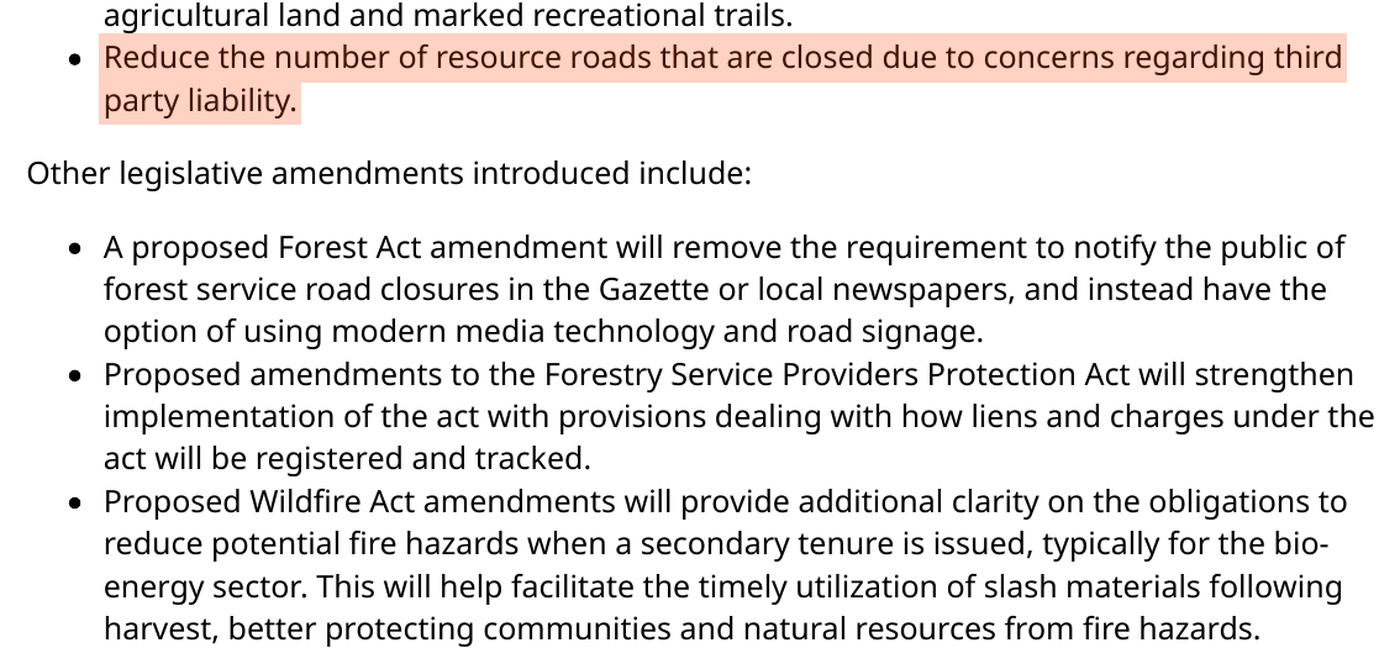
On 7 March 2012 the Ministry of Forests, Lands and Natural Resource Operations issued an information bulletin describing a package of amendments it was introducing that day. Among them were changes to the Occupiers Liability Act. The bulletin set out what those changes were meant to achieve, in a two-item list.
The second item reads:01
Ministry information bulletin · 7 March 2012
Reduce the number of resource roads that are closed due to concerns regarding third party liability.
That is the Province’s own statement of purpose, published by the ministry, in advance, in writing. Not an interpretation. Not an inference we have drawn. The stated reason for the law was to stop resource roads being closed over liability.
On 28 June 2012, three days after the provisions came into force, the ministry issued a second release confirming they were operative. It described the effect this way:02
Ministry news release · 28 June 2012
The amendments will help keep more backcountry roads open by establishing that people using resource roads of their own accord do so substantially at their own risk.
And the responsible minister, the Hon. Steve Thomson, was quoted in the same release:02
Hon. Steve Thomson, Minister of Forests · 28 June 2012
Reducing the possibility of injury-related lawsuits will encourage road maintainers to keep roads open and preserve access to B.C.’s wilderness areas.
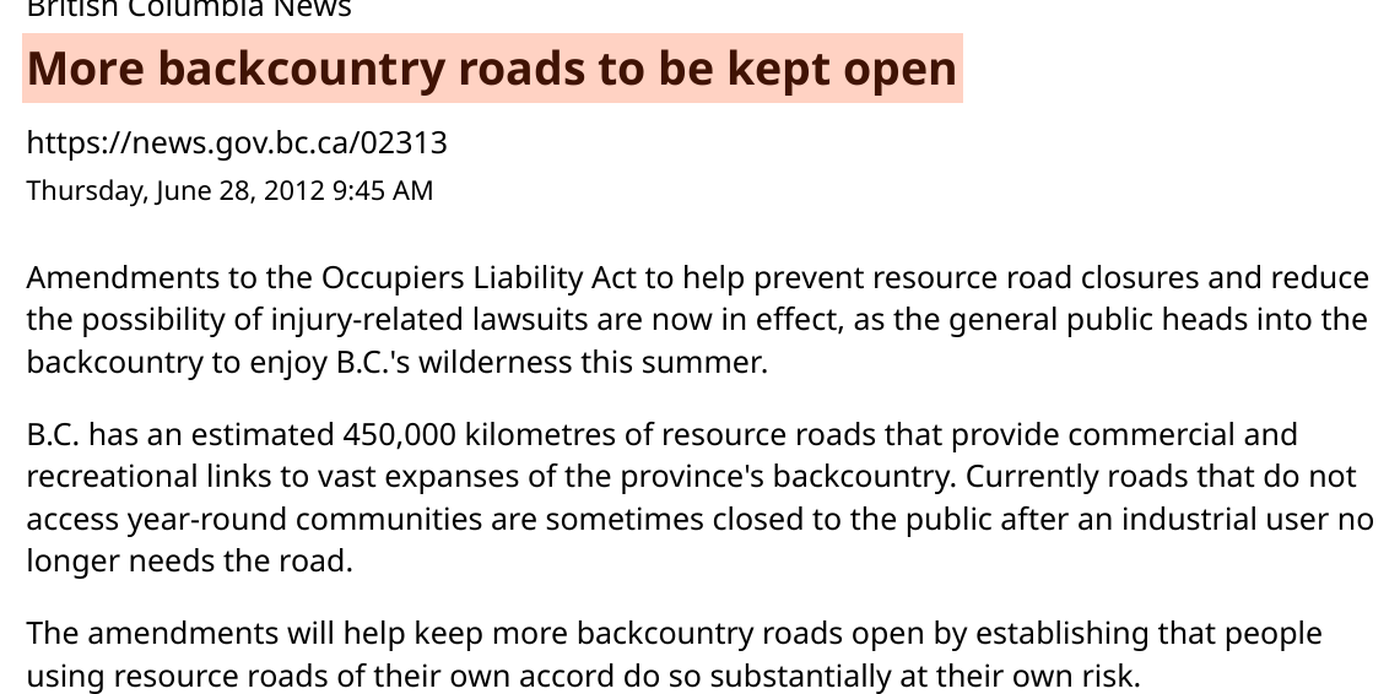
The minister who introduced it was the Hon. Steve Thomson, Minister of Forests, Lands and Natural Resource Operations in Christy Clark’s BC Liberal government. The release announcing it went out under the headline “More backcountry roads to be kept open.”02
In the House at second reading, Thomson described the precise behaviour the law was aimed at:24
Hansard · second reading · 16 April 2012
Currently, due to third-party liability concerns, both the Crown and the company responsible for road maintenance are influenced to close resource roads after their active use ends.
At committee stage he was blunter still about what the amendment was for. It would, he said, “create a disincentive to close a road strictly because of the liability issues” — and if closure was being driven by liability alone, the reduced duty was meant to be “an incentive to keep the roads open and to have less closures.”24
He was also asked, directly, whether the change protected government itself. Norm Macdonald put the question; the answer is on the record:24
Hansard · committee stage · 26 April 2012
N. Macdonald: do these amendments limit liability for government as well?
Hon. S. Thomson: … the answer is yes. It limits government liability to the resource road in the same way, if the government is the maintainer of that road.
And note who the government put forward as the people asking for it. Not a forest company. The release quotes the ATV Association of BC and the BC Wildlife Federation — and nobody from industry at all.02 The constituency this law was written for is the same constituency now being told that Rady Creek has to be destroyed.
Read it together and the position is unambiguous. The Province identified liability fear as a cause of road closures. It legislated to remove it. It announced that it had done so. And it did all of that at the request of backcountry users.
Fourteen years later, a district office of the same ministry is closing a road and giving liability as the reason.
Section 02Two words do all the work: “deemed” and “all”
Here is the operative provision in full. It is short.03
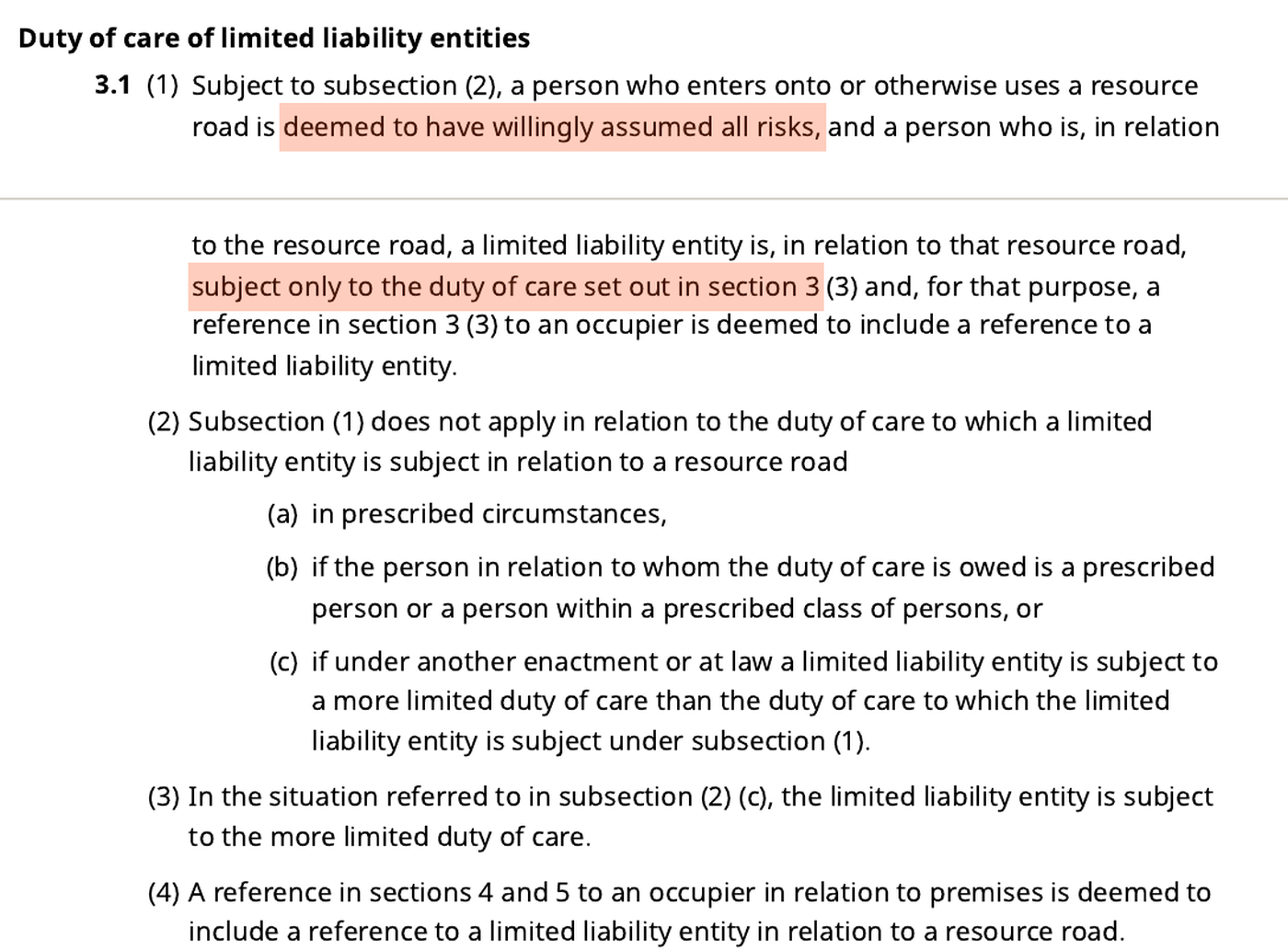
Two things are happening in that sentence, and both matter.
The first is the deeming. A person who uses a resource road is deemed to have willingly assumed all risks. Not presumed, subject to rebuttal. Deemed. They do not have to be warned, they do not have to sign anything, and they do not have to know the road is rough. The assumption of risk is supplied by the statute itself, as a matter of law, the moment they drive onto it.
The second is the duty that survives. Section 3(3) is the floor of British Columbia’s occupiers’ liability law:03
Occupiers Liability Act · s. 3(3) — the surviving duty
(3) … an occupier has no duty of care to a person in respect of risks willingly assumed by that person other than a duty not to
(a) create a danger with intent to do harm to the person or damage to the person’s property, or
(b) act with reckless disregard to the safety of the person or the integrity of the person’s property.
So on a resource road the Crown does not owe road users reasonable care. It owes them two things only: not to booby-trap the road on purpose, and not to behave with reckless disregard for their safety. Ordinary negligence — a culvert that should have been replaced, a washout nobody got to, a sign that was never posted — is not enough.
And note who carries that reduced duty. The Act defines a “limited liability entity” as the maintainer of the road and the government.04 The shield is not something the Crown has to argue its way into. The statute hands it to the Crown by name.
There is no condition-of-road qualifier anywhere in it. A rough, ungraded, unmaintained resource road carries exactly the same minimal duty as a graded one.
This is the point most often missed. The shield attaches to the road’s legal character, not its physical state. Letting a road deteriorate does not increase the Crown’s exposure under this section, because the section never asked about condition in the first place.
Do not take our word for any of it. Here is the entire Act, as BC Laws publishes it. Section 3.1 is on page 3.27
Section 03The Province already says yes — in its own court filings
Everything above turns on whether a forest service road is a “resource road” for the purposes of the Act. The definition, also added in 2012, reads:04
Occupiers Liability Act · s. 1 — definition
“resource road” means any road or portion of a road that is (a) on Crown land, and (b) used or intended for use by motor vehicles, but does not include a municipal highway or a provincial public highway…
A forest service road is on Crown land — that is in the definition of a forest service road itself, under the Forest Act.05 It is used by motor vehicles. And it is not a provincial public highway, because the Forest and Range Practices Act blocks the route by which public spending would otherwise turn it into one:05
Forest and Range Practices Act · s. 24
24 (1) Section 42 (1) of the Transportation Act does not apply to public money spent on the following: (a) a forest service road…
(2) A road referred to in subsection (1) does not become a public highway under the common law as result of public money being spent on the road.
On the face of the statutes, a forest service road is a resource road. But we do not need to rest on our own reading, because the Province has already taken a position on this question in open court.
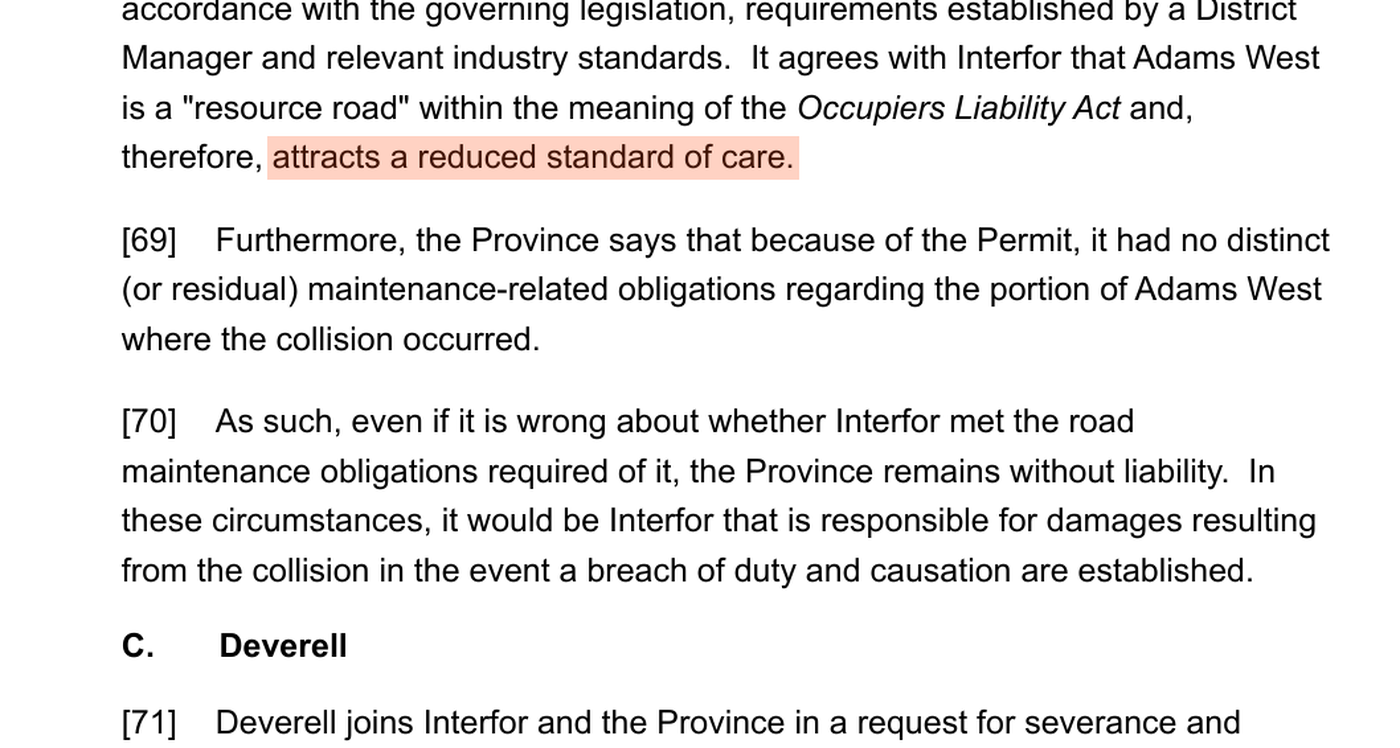
In Oviatt v. Masi, a 2018 proceeding in the Supreme Court of British Columbia arising from a collision at kilometre 61 of the Adams West Forest Service Road, the licensee argued it was the maintainer of a resource road and therefore a limited liability entity owing only the reduced duty. The Province agreed. The judgment records its position at paragraph 68:06
Oviatt v. Masi, 2018 BCSC 930 · para. 68
It agrees … Adams West is a “resource road” … and, therefore, attracts a reduced standard of care.
It went further still, arguing that because of the road use permit it had no residual maintenance obligation at all. The plaintiff was the only party disputing that the section applied.06
The Province has told a judge that a forest service road is a resource road carrying the lowest duty the law recognises. It tells the public that forest service roads are an unmanageable liability. Both statements cannot be true.
Section 04Section 3.1 has two escape hatches, and neither has been opened in fourteen years.
Parliamentary drafters rarely hand out an unqualified shield, and they did not here. Section 3.1(2) provides three ways the reduced duty can be switched off. Two of them require a regulation: the duty does not apply “in prescribed circumstances”, or where the injured person is “a prescribed person or a person within a prescribed class of persons”. The third, 3.1(2)(c), applies where some other law imposes an even more limited duty — and subsection (3) then applies that lower duty instead.03
Look carefully at the shape of that. Two valves that can only be opened by regulation, and a third that can only push the duty further down. There is no judicial discretion on the face of the provision, and no route by which the duty goes back up.
So the obvious question: has any regulation ever been made?
No. There is no regulation under the Occupiers Liability Act at all. We checked the BC Laws node for the Act, which lists the Act and its legislative-change tables and nothing else — no regulations node. We ran the same check against a neighbouring Act in the same series, which does carry a regulations node listing seven instruments, so the absence is meaningful rather than a display quirk. A direct request for the equivalent regulation path returns zero documents.07
There is a further wrinkle that makes the point sharper. The regulation-making power itself, section 10, was created by the very same 2012 amendment and came into force on the very same day. Before 25 June 2012 the Act had no regulation-making power. Since then, it has never been used.07
The Legislature built two doors out of this shield and has not opened either one in fourteen years.
There is a detail here that deserves more attention than it has ever had. As introduced on 7 March 2012, the bill named the people those doors were for. The original s. 3.1(2) carved out two classes by name: workers required to be on the road, and passengers being transported by the maintainer. At committee stage on 26 April both were struck out and replaced with the empty language that stands today — “in prescribed circumstances” and “a prescribed person”. The Journals record the bill “reported complete with amendment”. Thomson explained a different amendment he moved that day and said nothing about this one.25
Two named protections became two blank hooks, and no government since has hung anything on them.
The consultation had promised more, too. The Province’s own October 2011 discussion paper proposed keeping liability alive where a hazard was created “intentionally or negligently”. The enacted section drops negligence entirely.26 And that same paper said precisely what the policy was for:26
Ministry discussion paper · Framework Policy 8 · October 2011
This policy will encourage government to allow more roads to remain open for public use (instead of being deactivated) when the designated maintainer no longer requires the road.
That sentence was written by the Province, about deactivation, fifteen years before a district office in the Kootenays started deactivating a road and blaming liability for it.
Section 05Where section 3.1 came from, and who has touched it since
To understand why nobody in the Kootenays has heard of section 3.1, it helps to know that the Act it sits in is seventy years of borrowed English law, adjusted four times, and never once in the direction of the people using the land.
1951. In England, the House of Lords decided London Graving Dock v. Horton. An invitee who knew about a danger could be met with that knowledge as a complete answer to his claim. It went badly, and the condemnation was widespread.28
1954. England’s Law Reform Committee reported. Its recommendation was that an occupier should owe a single “common duty of care” to everyone coming onto the premises by invitation or permission — replacing the old sliding scale with one standard.28
1957. The English Occupiers’ Liability Act enacted it. Be precise about what it did: it equalised the duty owed to invitees and licensees. It did not abolish the categories, and it left trespassers outside altogether — England did not deal with them until 1984.28
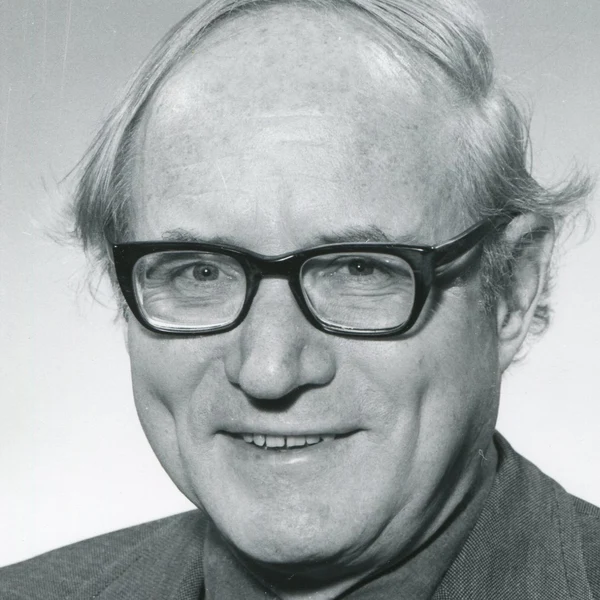
Alex Macdonald
Attorney General. Took Bill 4, the Occupiers’ Liability Act, through committee on 24 April 1974.
NDP · Barrett government
BC NDP History Group, CC BY 2.0, via Wikimedia Commons
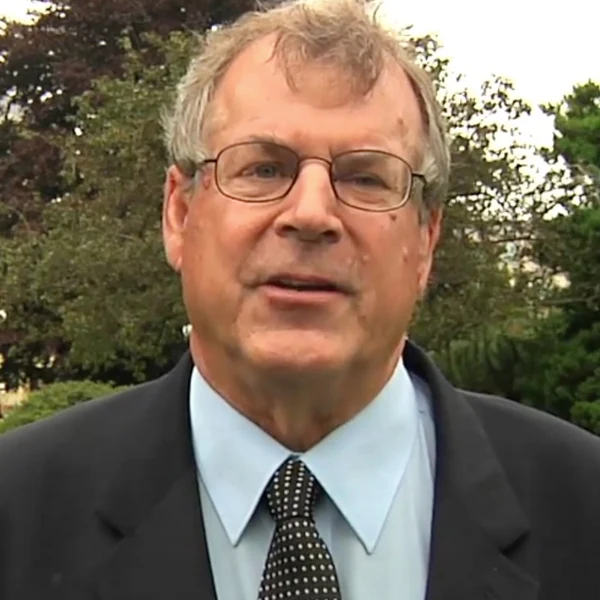
Steve Thomson
Minister of Forests, Lands and Natural Resource Operations. Introduced Bill 26, which created section 3.1, on 7 March 2012.
BC Liberal · Clark government
Province of British Columbia, CC BY-SA 3.0, via Wikimedia Commons

Christy Clark
Premier when section 3.1 was introduced, passed and brought into force in 2012.
BC Liberal · Premier 2011–2017
CityCaucus.com, CC BY 2.0, via Wikimedia Commons. Photographed 2010, before taking office.
1974. British Columbia adopted it as Bill 4, the Occupiers’ Liability Act, under Premier Dave Barrett’s NDP government. Attorney General Alex Macdonald took it through committee on 24 April 1974; it was read a third time on 30 April and received Royal Assent on 3 May 1974 as chapter 60.29
The borrowing is provable rather than assumed: BC’s duty provision shares twenty-three consecutive words with the English section. But the scope came from somewhere else again. BC lifted it near-verbatim from the Occupiers’ Liability (Scotland) Act 1960, which is why British Columbia’s Act reaches any person, trespassers included — something England still has not done.29
Two things about that 1974 sitting are worth knowing, and we went and read it to find them.
The first is that nobody debated it. The committee record for Bill 4 reads, in its entirety on the substance: “Sections 1 to 7 inclusive approved.” Not one member rose to discuss what the province was doing to seventy years of entrant law.29
The second is what the one amendment did. The only change moved to Bill 4 that afternoon stood in Macdonald’s own name, and it was this:29
Order paper · committee of the whole · 24 April 1974
Section 8, subsection (2), line 4: By adding, at the end, the words “, or to an industrial road as defined in the Industrial Transportation Act.”
The very first amendment ever made to this Act, moved by an NDP Attorney General on its way through the House, was to take a category of road out of it. Roads have been being carved out of the Occupiers Liability Act since the day it was written.
Roads under the Forest Act were placed outside the Act from the beginning too. They were not removed later by some hostile government. They have never been inside it.29
1998. The first cut. The duty was reduced for rural premises used for forestry or range, for vacant and forested land, and for marked recreational trails — the provisions at s. 3(3.2) and s. 3(3.3) quoted earlier. It was carried by the Hon. Cathy McGregor, Minister of Environment, Lands and Parks, in an NDP government.30
2012. The second cut, and the one that covers Rady Creek. Section 3.1, resource roads, BC Liberal, Hon. Steve Thomson. And read what the Province said it was doing: the amendments worked by “aligning liability limitations with existing liability limitations on rural agricultural land and marked recreational trails.”01
The Liberals did not invent the technique in 2012. They pointed an NDP technique from 1998 at forest service roads. Both halves of this shield were built by governments that have since told the public the shield does not exist.
And the Opposition in 2012 was not asleep. We went through every sitting of that debate. Four New Democrat members spoke to the Occupiers Liability Act clauses, and not one of them opposed it.34
Hansard · Bill 26 · April 2012 — the Opposition on the liability clauses
Bill Routley: “a good-news day” — and, separately, “encouraged by the work”.
Doug Routley: “that is helpful”.
Michael Sather: “largely positive”.
Norm Macdonald set out the intent-and-recklessness floor accurately, and called the bill “benign”.
Norm Macdonald also asked the question that settles the matter. He wanted to know whether the change protected government as well as licensees. He was told, on the floor of the House, that it did.24
One New Democrat did raise a concern, and it is worth recording precisely because it runs the other way: Michael Sather worried that the law would leave too many roads open, and that wildlife might be over-exploited as a result.34 Nobody in that chamber was worried about backcountry users losing their recourse. The Opposition’s anxiety was that the roads would stay.
And there was never a vote against it. We checked this properly, because it is the kind of claim that ought to be checked. The Journals of that session carry a “Motions on Division” index listing every motion the House divided on — Bills 3, 6, 9, 10, 15, 18, 20, 21, 33, 36, 44, 46, 47, 49, 53, 54 and 56. Bill 26 is not in it. In the same sittings the Opposition did divide the House, on Bill 21, so they plainly knew how. Third reading of Bill 26 passed by leave — unanimous consent, which any single member could have denied by objecting.35
There is no list of who voted for this, and there never can be, because nobody voted against it. The New Democrats did not divide the House. They let it pass by consent, and called it a good-news day.
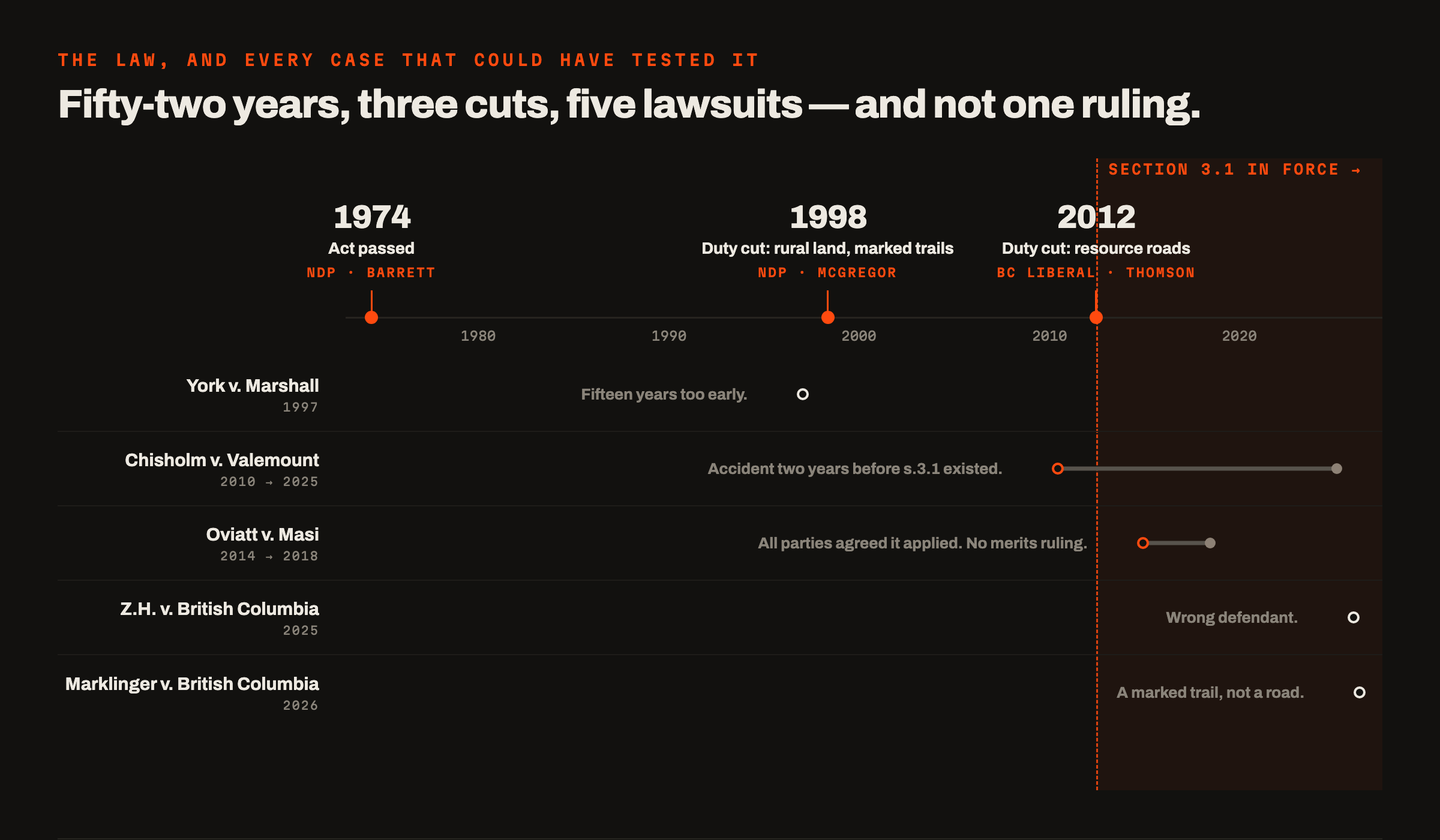
There is one more fact in that sequence worth sitting with. No government of any party has raised this duty since 1974. Every single amendment in fifty-two years has moved in one direction.
Section 06The half of the bargain nobody kept
Here is the part that should make anyone who uses these roads genuinely angry, and it comes from the law reform record rather than from us.
England made the same cut British Columbia made. Under the Countryside and Rights of Way Act 2000, people exercising the right to roam are moved out of the 1957 Act entirely and down to the near-trespasser standard — the same intent-and-recklessness residue British Columbia left behind in s. 3(3).31
But England bought that cut. The same Act that lowered the duty created a statutory right to roam. The public gave up the right to sue, and got in exchange a legal right to be there.31
British Columbia was sold the identical trade. The province’s own 1994 law-reform work proposed that recreational users accept the risk “in return for being allowed greater access”.32
The risk was legislated in 1998. It was legislated again, for roads, in 2012.
The access was never legislated at all. Not in 1998, not in 2012, not since. British Columbians took on the risk and never received the right they were told they were buying with it.
Which is what makes the Rady Creek position so hard to stomach. The public’s side of that bargain is fully performed — every user of that road is deemed by statute to have accepted the risk of using it, whether they know it or not. The Crown’s side was never delivered. And now the Crown proposes to destroy the road, citing the very exposure the public already absorbed on its behalf.
Two footnotes of honesty on this section. Lawyers have described these reduced-duty provisions as retrenchment — one BC practitioner wrote that what survives is “the common law duty of care to trespassers ie. there is no liability for negligent conduct”, and Alberta’s Law Reform Institute called carve-outs of this kind “a move back towards the type of complex, stratified system that existed at common law”.33 But the same practitioner argued the opposite to a parks audience three years later, so treat it as informed opinion rather than settled view. And on s. 3.1 specifically, there is no legal commentary at all. Not one client bulletin, not one article, not one note. In fourteen years nobody in the profession has written about it.
Section 07Five lawsuits, and section 3.1 has never lost — because it has never been asked.
A law is only worth what it does when tested. We went looking for every reported British Columbia decision in which somebody injured on a forest service road sued the Province, a licensee or a road maintainer. Here is what exists.
Chisholm v. Valemount Forest Products Ltd.
On 16 June 2010, Leonard Chisholm was riding a motorcycle on the Canoe West Forest Service Road near Valemount and struck a log lying on the roadway. He sued the Province and the licensee in negligence for failing to maintain the road safely.08
In December 2023 the Supreme Court of British Columbia summarily dismissed the claim against the Province, holding it immune under section 24(3) of the Industrial Roads Act. In February 2025 the Court of Appeal set that dismissal aside. The immunity reaches only “industrial roads”, and a road under the Forest Act is expressly excluded from that definition. The Crown’s immunity argument failed.08
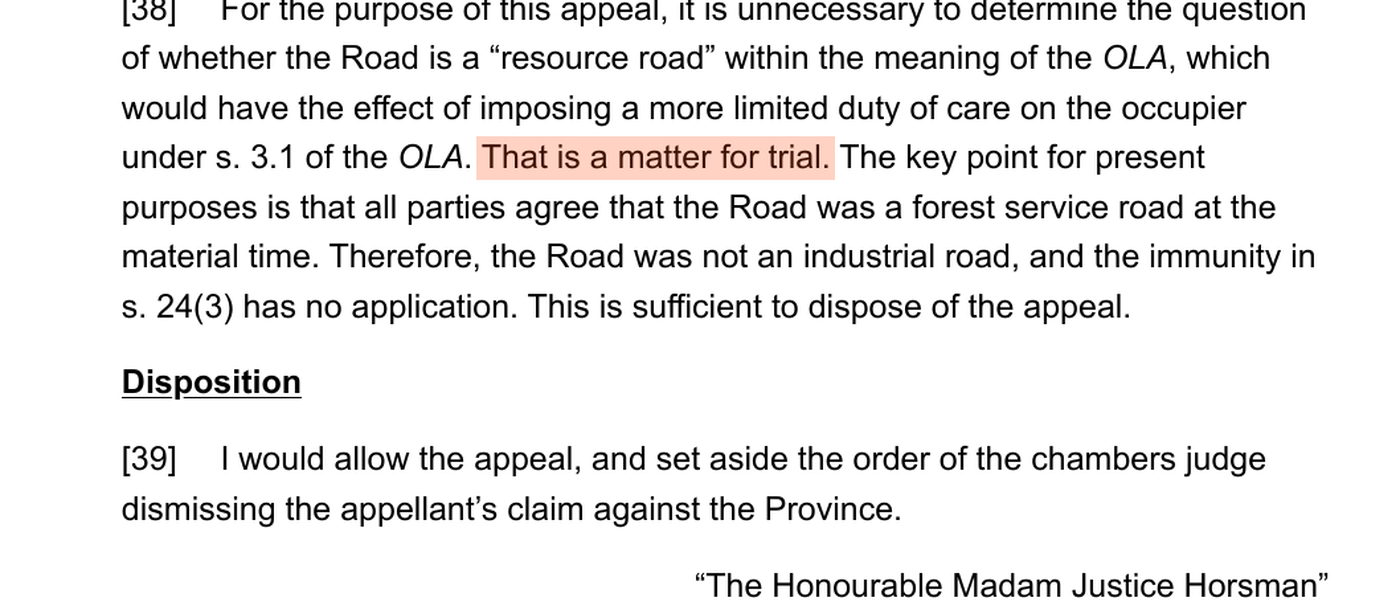
Now the sentence that matters most for this piece. The Court of Appeal was invited to decide whether a forest service road is a “resource road”, “which would have the effect of imposing a more limited duty of care on the occupier under s. 3.1 of the OLA.” It declined. “That is a matter for trial.”08
And there is a reason section 3.1 was never going to decide Chisholm in any event. The accident happened on 16 June 2010. Section 3.1 did not come into force until 25 June 2012 — two years and nine days later. The shield did not exist on the day the log was lying on that road. The case was fought on Industrial Roads Act immunity instead, and the Crown lost that argument.08
Note the timeline as well. The accident was in 2010. The action was commenced in 2012. It took thirteen years to produce a summary judgment, which was then overturned. That is what litigating one of these actually looks like.
Oviatt v. Masi
The 2018 Adams West case described above. Every party, including the Province, proceeded on the footing that the road was a resource road attracting the reduced duty. The severance and summary trial applications were dismissed. There was no ruling on the merits, and so no judicial decision on the question everyone had assumed the answer to.06
Z.H. v. British Columbia (Transportation and Infrastructure)
The only judgment we found that is squarely about deactivation. A proposed class proceeding arising from a mudslide off an improperly deactivated resource road above the Duffey Lake Road, brought against the Province and a highway maintenance contractor. Certification was dismissed in December 2025. The pleadings disclosed no cause of action because the Ministry of Transportation “cannot owe a duty to deactivate a resource road because it lacks the power or authority to deactivate or inspect these roads” — the duty has to attach to the body that holds the statutory power.09
The case failed on the identity of the defendant, not on the merits of deactivation. But note what the Crown pleaded in it, recorded at paragraph 26: that the deactivation power “contains a limitation on liability for damages arising from this power” under the Forest and Range Practices Act and the Forest Act.09
York v. Marshall
The oldest of them, from January 1997, and the template every road authority has used since. A washout on the Blue Mountain forest service road network above Maple Ridge caused a collision injuring two plaintiffs. The Occupiers Liability Act was pleaded for failure to warn. The District of Maple Ridge got out: no duty of care and no proximity, because it “never assumed any responsibility for the inspection, maintenance or repair” of the network and “did not have authority to lock the gate.”10
Marklinger v. British Columbia
Not a road case, but the most instructive of the five on what the lowered duty is actually worth. Monica Marklinger was killed by a falling tree on the Ripple Rock Trail. The Province conceded a duty of care but argued the standard was lowered by section 3(3.3)(c), the marked-recreational-trail provision, so liability required proof of reckless disregard.11
The claim was dismissed in April 2026. The judge found “almost a complete dearth of documentation regarding the assessments of the Trail” and urged the ministry to keep proper danger-tree records — and still held that this fell short of reckless disregard, record-keeping decisions being policy-level.
A death. An acknowledged documentation failure. A judicial rebuke. And no liability. That is the standard the Crown already enjoys on any premises where the reduced duty applies.
Section 08Where our own case gets weaker, said out loud
Here is the part a weaker piece would leave out.
No reported decision of the Supreme Court of British Columbia or the Court of Appeal has ever applied or interpreted section 3.1. Chisholm expressly left the question for trial, and the accident there pre-dated the section anyway. In Oviatt every party but the plaintiff assumed the answer, including the Province, and the case ended without a ruling. The shield has been on the books for fourteen years and has never been tested to judgment.12
Here is the whole of it, case by case, since this is the question we are asked most often. In Chisholm the section did not apply because the accident was two years too early. In Oviatt it applied by common consent and the case ended before anyone ruled. In Z.H. the claim failed on the identity of the defendant. In York the events long pre-dated the section. And Marklinger was a marked recreational trail under section 3(3.3)(c), not a resource road under 3.1. The Act has not been beaten in court. It has simply never been put to the question.
There is also one loose thread we should name rather than leave for somebody else to find. In Pierre v. Miller, a 2010 decision, the court held that a forest service road is not a highway for Motor Vehicle Act purposes — but remarked, at paragraph 14, that such a road does fall within section 42 of the Transportation Act “by virtue of the expenditure of public funds”. That judgment never cites Forest and Range Practices Act s. 24, which blocks exactly that route.18 It is a stray remark in a case about something else, and the statute is against it. But it is the seed of the argument a plaintiff would run, and anyone relying on section 3.1 should know it exists. Worth noting too that the common-law backstop in FRPA s. 24(2) only arrived on 25 November 2021 — nine years after section 3.1 itself.
No court has blessed this provision. What the record shows is that the Province has argued for it, that the ministry asked for it, that its stated purpose was to keep roads open, and that nobody — in fourteen years — has narrowed it by regulation.
Three more limits we will state rather than bury.
A thin reported-judgment record is not proof that nobody sues. The court databases exclude the Provincial Court, and they exclude settlements and discontinuances, which is where most personal-injury litigation actually ends. The honest formulation is “no reported case” — never “nobody has ever sued.”
People do get hurt and killed on these roads. The Auditor General’s 2020 report records 70 motor vehicle deaths on logging roads between 2010 and 2018, attributed to unpublished BC Coroners Service data with no source given, and 499 accidents between 2012 and 2016 from ICBC. The absence of successful claims is a statement about the law, not about whether harm occurs.13
And deactivation does not make the exposure vanish. The Ministry of Forests’ own Engineering Manual says deactivation “transfers responsibility for terrain stability to the Crown rather than the Ministry”, and warns that deactivation can itself create liability by orphaning tenures and access.14 There is also a real argument — and we flag it as our inference, not a holding — that a barricaded corridor is no longer “used or intended for use by motor vehicles”, which would push it out of the resource-road definition altogether and forfeit the strongest shield the Crown holds.
If that inference is right, deactivation is not merely unnecessary as a liability measure. It is counterproductive as one.
Section 09The Ministry of Forests bought a report to find the danger at Rady Creek. It found none.
Liability arguments about a road come in two halves. The first is whether the Crown can be sued if somebody is hurt on it. That is what section 3.1 answers. The second is whether the road itself presents a hazard — to the terrain, to the watercourse, to what sits below it.
At Rady Creek, the Ministry of Forests commissioned a 42-page geotechnical prescription dated 8 September 2026, mid-tender, after five years of citing engineering it had never produced. We have written about how that document was published and what was painted out of it elsewhere.15 What matters here is what it found.
It does not say the road is unsafe. It finds no road-related landslide across a 58-year air-photo record. It lists four elements at risk, of which none is a person. It declines to perform a risk assessment at all. And on six of seven sections it prescribes leaving the road prism intact.15
We want to be precise about what that does and does not establish, because it is easy to overstate. A geotechnical report is not a liability waiver and does not confer legal immunity on anybody. What it does is remove the factual premise. You cannot manage away a terrain hazard by citing a professional report that declined to find one.
Take the two halves together. On the legal exposure, the Legislature already reduced the Crown’s duty to the floor and has never narrowed it. On the physical hazard, the ministry’s own geoscientist went looking and prescribed leaving the road in place. What is left of the reason?
Section 10Destroying the Trout Lake–Rady Creek road is the only thing here that creates liability
Everything so far has been about a risk the Crown does not carry. Now turn it around, because this is the part the Ministry of Forests has written down itself and apparently not read.
We went through the Ministry of Forests’ own Engineering Manual looking for liability. The word appears eight times in the entire document. In the chapter on deactivation it appears exactly once — and it is not describing a liability that deactivation cures. It is describing one that deactivation creates.37
Ministry of Forests · Engineering Manual § 7.3.3
When an FSR provides the sole or primary access to upstream road permits, private land, or other resource tenures, additional obligations apply to avoid orphaning tenures or creating unintended access and liability issues.
And the manual is equally clear about where the exposure goes once the machines leave:37
Ministry of Forests · Engineering Manual § 7.3.5, “Legal Status After Deactivation”
Once an FSR is fully deactivated and all legal steps for discontinuance and closure are complete, the road: • Reverts to vacant Crown land or provincial forest; • No longer has road status; • Transfers responsibility for terrain stability to the Crown rather than the Ministry.
The exposure is not extinguished. It is moved from one part of government to another — and the part it moves to is the part with no road, no budget line and no inspection duty.
Then there is the physical fact of what deactivation does to the ground. The Rady Creek prescription is not a gate and a sign. It specifies 754 metres of road-fill pullback, 238 metres of recontouring, three swales, two waterbars and 61 cross ditches cut across the running surface.38
People do not stop going up there. They walk it, ride it, sled it and hunt off it, as they have for decades. What changes is that they will be doing it across sixty-one excavated trenches and seven hundred and fifty metres of pulled-back sidehill, on terrain the ministry has just finished disturbing — ground its own geoscientist reports has produced no road-related landslide in fifty-eight years of air photographs.15
And here is the legal sting in it. Section 3.1 protects a resource road — defined as a road “used or intended for use by motor vehicles”. Barricade the corridor, pull the fill and take the road status away, and there is a serious argument that what remains is no longer a resource road at all. If that is right, deactivation does not just fail to remove the Crown’s exposure. It throws away the strongest statutory shield the Crown has. We flag that as our reading of the definition rather than a decided point — no court has ruled on it, as with everything else in this Act.14
There is one more document worth putting beside all this. The Engineering Manual does address the Occupiers Liability Act substantively, once, and what it prescribes is not destruction:37
Ministry of Forests · Engineering Manual § 6.4.3, “Conducting Road Inspections”
FSRs must be maintained in accordance with forest legislation to protect forest resources and other values, while also ensuring that road users are reasonably safe in accordance with the Occupiers Liability Act.
The ministry’s own manual names maintenance as the answer to occupiers’ liability, and names deactivation as a thing that creates liability. The Selkirk district has it precisely backwards.
So the position at Rady Creek, stated plainly. The road as it stands carries a statutory shield, a reduced duty, and a fifty-eight-year record of not failing. The road as they propose to leave it carries sixty-one fresh trenches, freshly disturbed ground, terrain stability formally handed to the Crown, and — quite possibly — no shield at all.
They are not removing a liability. They are manufacturing one, with a public tender, at public expense.
And the instrument that fixes it already exists: the FSR Maintenance Agreement
Here is what makes the deactivation choice indefensible rather than merely wrong. If the district’s worry really is the burden of holding a road it no longer needs, the Ministry of Forests has a form for that. It is called an FSR Maintenance Agreement — form FS1205, and the Engineering Manual describes it like this:39
Ministry of Forests · Engineering Manual § 1.2.4.7, p. 84
When the wilderness level of maintenance is not sufficient for commercial or public user, that user may request authorization to perform routine surface maintenance through a Forest Service Road Maintenance Agreement (FS1205). This agreement permits the user to undertake incremental maintenance at no cost to the Ministry.
Read that against everything above and the comparison is not close.
An FSR with somebody maintaining it under an agreement stays a resource road. Section 3.1 keeps applying. And the shield does not just cover the Crown — the Act defines a “maintainer” as the person “obligated or authorized under an enactment to maintain the resource road”, and makes every maintainer a limited liability entity in its own right.04
The club or association that takes on a 1205 is not accepting the Crown’s risk. It walks into the same statutory shield the Crown has — the s. 3(3) floor, nothing more. That is what the Act does, and it is the single most useful sentence in it for anybody trying to save a road.
So line the three states up against each other, on the Act’s own terms:40
What each state actually costs the Crown
Maintained under a 1205. Still a resource road. Crown and maintainer both protected by s. 3.1. Maintenance performed, in the manual’s words, at no cost to the ministry. Road stays.
Left as a wilderness road. Still a resource road. Crown protected by s. 3.1, identically. The duty to keep it safe for industrial use disappears altogether once industrial use stops. Road stays. Nothing in the Act makes this state riskier for the Crown than the one above it.
Deactivated. No longer a road. Section 3.1 arguably gone. Terrain stability formally transferred to the Crown. Sixty-one cross ditches and 754 metres of pulled-back fill that the Crown itself created, on ground the public still walks. Road gone. Cost to the public purse: the tender.
And note what is not on that list: any provision requiring the Crown to deactivate anything. There is none. The statutory duty runs the other way — the government must maintain a forest service road “until the road is deactivated”. Deactivation is the event that ends the obligation. It has never been an obligation itself.40
Which leaves the Selkirk district holding a road it says it cannot afford to be liable for, refusing an instrument that would transfer the work at no cost, and paying a contractor to move the road into the only state where its liability protection is in doubt.
Nobody has to consult before that happens. Nobody has to consider a 1205 first. Nobody has to write down why the offer was refused. That, and not liability, is the thing that actually needs fixing — and it is the ask we set out in Section 12.
Section 11Every other province fixed resource-road liability. Most of them fixed it harder.
If you only read British Columbia, you might conclude that resource-road liability is a genuinely hard problem that no government has cracked. It is worth knowing how wrong that is.
Saskatchewan does not even have an occupiers’ liability statute — the last common-law province without one. It gets to the same place through its Forest Resources Management Act, which immunises the Crown for “disrepair or non-repair” of a licensee road, of any road in the provincial forest, and — note this — of “a road closed pursuant to section 58.”19
Manitoba goes further than British Columbia in the bluntest way available: it switches the duty regime off entirely for the Crown on public roads and recreational trails.19
Ontario bars the action itself. Its Public Lands Act forecloses every civil claim “in respect of misfeasance, non-feasance, nuisance or negligence in connection with the construction, maintenance, repair, stopping up, closing or decommissioning of a road”. Those last words were added in December 2019. Ontario has legislated away both the liability of keeping a road open and the liability of destroying one.20
Quebec, which cannot use the assumed-risk technique at all because its Civil Code forbids excluding liability for bodily injury, simply killed the claim by statute: no damages action lies against the State by a road user for defective construction, improvement, repair or maintenance.21
Alberta deems recreational users of public land to have assumed the risk, overriding its own Occupiers’ Liability Act, and adds an automatic Crown indemnity by regulation.22
On liability, British Columbia is not behind anybody. It sits in the middle of a pack in which every single province has decided that road users carry their own risk. This is the settled Canadian answer, and B.C. reached it fourteen years ago.
Which ought to end the argument. It does not, because the thing British Columbia is actually missing is not a shield.
Section 12Nobody is ever required to decide. That is the whole problem.
Go back through those provinces and look at what happens before a road is destroyed.
In Ontario, road decommissioning is not an administrative act somebody performs. It is a recorded decision inside a forest management plan. The planning manual requires the Ministry to state its management intent for every road as one of a fixed set — maintain it for public use, maintain it through a third party, or decommission it — inside a plan that goes through four staged public consultations. Any person may request a formal review of a specific decision in that plan, and receives a written decision, with rationale.20
In Quebec, decommissioning a road on State land requires the Minister’s authorisation, and destroying one without that authorisation is an offence carrying a fine. Adding or substantially modifying road infrastructure triggers mandatory public consultation, and the report of that consultation is made public by the Minister.21
In Alberta, a closure order is unenforceable until it is registered and publicly available.22
Now British Columbia. The Minister of Forests may exempt a road from deactivation. The same minister may establish the corridor as a recreation trail. A district may place a road on wilderness status and leave it open indefinitely. Every one of those powers exists. Every one of them is a bare discretion.
There is no right to apply. No duty to consider an application. No timeline. No published procedure. No duty to give reasons. No appeal. And therefore, at Rady Creek, no decision — only an outcome.
That is the whole problem, and it is worth being precise about why it matters. A community cannot trigger a deactivation decision, because there is no mechanism to trigger. It cannot read the decision, because none has to be written down. It cannot appeal the decision, because there is nothing to appeal against. And it cannot test the reason given, because nothing anywhere obliges anybody to state one that survives contact with the statute.
So “liability” endures as a stated reason for one reason only: nothing in British Columbia law forces it to be tested. Section 3.1 has answered it since 2012. But a correct answer is worthless in a system where no question is ever formally put.
The remedy is not a new statute, and we are not asking for one. British Columbia already compels a published, comment-bearing operational map and a written account of how public comments were addressed — for roads that are to be built.23 The machinery exists. It has simply never been pointed at the destruction of a road, only at its creation. Extending it is a content amendment to an existing obligation, not new legislation, and it could be done this session.
Until it is, every road in this province sits exactly where Rady Creek sits: protected by a liability shield nobody invokes, destroyed for a reason nobody has to defend, by a decision nobody has to make in writing.
Section 13So what is actually left of the reason?
Strip out the liability story and something still remains. The Auditor General set out the real causal chain in 2020: roads get deactivated to manage liability associated with roads that are not maintained because of inadequate funding.13 Underfunding sits upstream of everything. “Liability” enters the chain at the end, as the language used to describe a budget problem.
That is a real problem and it deserves a real answer. But it is a different problem from the one the public has been given, and it has a lawful, cheaper solution that does not require destroying the road. Wilderness road status under the Forest Planning and Practices Regulation removes the industrial-user safety duty entirely and reduces the remaining obligations to what is needed to protect forest resources. The Engineering Manual describes wilderness roads as able to continue providing limited access for recreation. The Auditor General records that these roads can remain open indefinitely on that footing.16
And the Ministry of Forests’ own December 2025 public FAQ answers the question directly:17
Ministry FAQ · December 2025
Do all unmaintained FSRs have to be deactivated? No.
So when the Selkirk District says it “is obligated to relieve itself of liability”, that statement is not supported by any provision we can find, and it is contradicted by the ministry’s own published policy.
We wanted to know whether that was the ministry’s position or one district’s. So we went and counted. We pulled every PDF published from the road pages of all twenty-three of British Columbia’s natural resource districts — 223 documents — and searched every one of them for liability.36
Six mention it. Four of those are disclaimers and map legends. One is a bridge inspector’s note. And one — exactly one — gives liability as a reason to deactivate a road.
Of 223 published documents across all twenty-three districts in British Columbia, the Selkirk district is the only office in the province telling the public that liability requires a road to be destroyed.
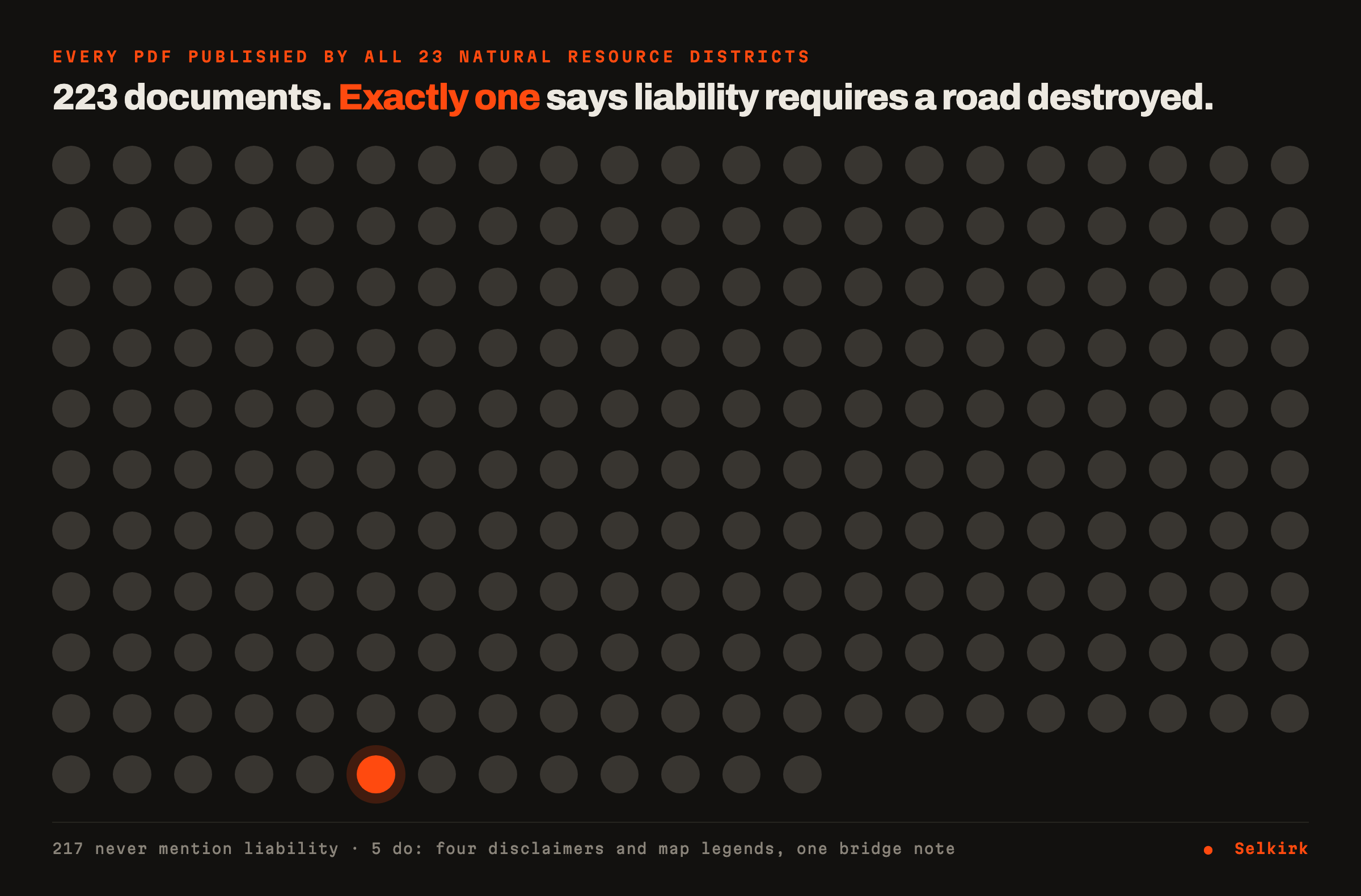
This is not provincial policy being applied in the Kootenays. No minister has ever said it — not in the Legislature, not in a news release, not since at least 2018. The only ministerial statements on resource-road liability that exist anywhere run in the opposite direction, and you have already read them.36
It is one district office, saying something no other district office in British Columbia says, about a law that says the opposite.
None of this is hidden. The Occupiers Liability Act is on BC Laws. The bulletins are on the government news site. The cases are in the public court databases. The FAQ is on a ministry web page. Every document in this piece was available to anybody who went looking — including the officials who have spent five years telling this community the opposite.
Section 14So let us put the names to the Trout Lake–Rady Creek deactivation
The Selkirk Natural Resource District. You are the only district office in British Columbia making this claim. Not one of the other twenty-two says it. You have told this community for five years that you are “obligated to relieve” yourself of a liability that the Legislature removed in 2012, that your own Engineering Manual says maintenance answers, that your own ministry’s FAQ says does not require deactivation, and that your own geoscientist went up that road and could not find. You are not applying a policy. You are alone.
Minister Ravi Parmar. This was your ministry. Not one minister — not you, not your predecessor, not anybody since at least 2018 — has ever stood up and said liability requires a forest service road to be destroyed. We looked. It is not in Hansard and it is not in a news release. Which means a district office under your authority has been telling British Columbians something no minister of the Crown has been willing to say out loud. You can correct that in a sentence. Until you do, the silence is doing the work, and the road comes out on your watch.
And the New Democratic Party. Your government wrote this Act in 1974. Your government cut the duty for rural land and recreational trails in 1998. When the Liberals extended that same cut to resource roads in 2012, your members rose in the House and called it “a good-news day”, “helpful”, “largely positive”, “benign”. You did not divide the House. You let it pass by unanimous consent. The only worry any of you put on the record was that the law might leave too many roads open.
You got the law you asked for. It has been in force for fourteen years. And now a district office in your ministry is destroying a road for exactly the reason your own legislation exists to defeat.
We are not asking anyone to take our word for it. Everything above is a government document, a court judgment or a statute, and every one of them is linked at the bottom of this page. Read them and decide for yourselves whether the reason you have been given for the destruction of the Trout Lake–Rady Creek forest service road is a true one.
Then ask the only question that still matters, and ask it of somebody prepared to put their name underneath the answer:
If section 3.1 does not cover the Trout Lake–Rady Creek forest service road, which word in it fails?
Nobody has answered it. Not in five years of letters, not in the tender package, not in forty-two pages of geotechnical assessment bought after the bidding had already opened.
The Trout Lake–Rady Creek road is still standing this morning. Nothing has been dug. No contract has been awarded. Every option set out above remains open to the people with the power to take them, and not one of them requires a change in the law, a line in a budget, or anybody’s permission.
The Minister of Forests can say one sentence. The Selkirk district can accept a 1205. Neither is difficult and neither is novel — both were sitting in the ministry’s own filing cabinet before any of this began.
But if the machines go up that road anyway, let it be understood precisely what happened, because it will not be what this community was told.
It will not have been liability. This province removed that in 2012, at the request of backcountry users, under a government headline reading “More backcountry roads to be kept open”. No regulation has narrowed it in the fourteen years since. The ministry’s own manual names maintenance as the answer and warns that deactivation is what creates exposure. The ministry’s own FAQ says unmaintained roads do not have to be deactivated. The ministry’s own geoscientist walked that ground and found no failure in fifty-eight years. And twenty-two other district offices in British Columbia manage never to say any of it.
Take liability out of the story and what is left is not a legal obligation. It is a decision. Somebody chose this — somebody with a name, in an office, on a salary paid by the people whose road it is.
That decision is now on the public record, in an election year, with every document behind it published beneath this sentence. Read them. Send them to the person who wants your vote. Ask them the question at the top of this page and watch what they do with it.
They forgot the law. That much we can forgive; it is a small section in an Act nobody opens.
The next step is that the public will be forced to test the liability that the Ministry of Forests introduced by deactivation, in trial at the Supreme Court.
Share this story
Six images carrying this story on their own — the statute, the release, the judgment and the count. Made to be posted.


Slide 1 of 6
Suggested caption
In 2012 British Columbia passed a law for the express purpose of stopping resource roads being closed over liability. The Ministry of Forests asked for it. Minister Steve Thomson announced it under the headline “More backcountry roads to be kept open.”
An NDP government wrote the Occupiers Liability Act in 1974. An NDP government cut the duty again in 1998. When the Liberals extended that cut to roads in 2012, NDP members called it a good-news day and did not divide the House.
We read every PDF published by all 23 natural resource districts — 223 documents. Exactly one gives liability as a reason to destroy a road. It is Selkirk, and it is destroying Rady Creek.
Their own Engineering Manual says deactivation is what creates liability.
backcountry.cx/editorials/the-law-everyone-forgot/
#BCpoli #PublicLand #RadyCreek #Kootenays
Sources
- ↩↩Ministry of Forests, Lands and Natural Resource Operations, Information Bulletin, 7 March 2012. “Amendments updating a number of resource-related acts were introduced today, including changes to the Occupiers Liability Act that will reduce liability concerns arising from the public use of resource roads.” The stated purposes are given as a two-item list, the second of which reads “Reduce the number of resource roads that are closed due to concerns regarding third party liability.” https://news.gov.bc.ca/releases/2012FOR0025-000249
- ↩↩↩↩Ministry of Forests, Lands and Natural Resource Operations, News Release, 28 June 2012 — issued three days after commencement. Source for “The amendments will help keep more backcountry roads open by establishing that people using resource roads of their own accord do so substantially at their own risk” and for the quotation from the Hon. Steve Thomson, then Minister of Forests, Lands and Natural Resource Operations. https://news.gov.bc.ca/releases/2012FOR0101-000949
- ↩↩↩Occupiers Liability Act, RSBC 1996 c. 337, ss. 3(3) and 3.1, BC Laws consolidation current to 15 September 2026. Section 3.1 was enacted by the Forests, Lands and Natural Resource Operations Statutes Amendment Act, 2012, S.B.C. 2012 c. 14 s. 15, third reading 26 April 2012, Royal Assent 14 May 2012, brought into force 25 June 2012 by O.C. 468/2012 / B.C. Reg. 153/2012, deposited 25 June 2012 and published in BC Gazette Part II, Vol. 55 No. 13, 3 July 2012. The third-reading text was checked against the enacted bound statute and the current consolidation and is identical; s. 3.1 has not been amended since. Note that B.C. Reg. 153/2012 is a commencement regulation made under s. 19 of the amending Act — it is not a regulation made under the Occupiers Liability Act, and at least one secondary summary gets this wrong. https://www.bclaws.gov.bc.ca/civix/document/id/complete/statreg/96337_01
- ↩↩↩Occupiers Liability Act s. 1, definitions of “resource road”, “limited liability entity” and “maintainer”, all inserted by S.B.C. 2012 c. 14 s. 13, in force 25 June 2012. “Limited liability entity” is defined as “(a) the maintainer, if any, of the resource road; (b) the government”. The definition of “resource road” contains no condition, maintenance-standard, signage or safety qualifier.
- ↩↩Forest Act, RSBC 1996 c. 157, s. 1 (“forest service road” means a road on Crown land that is declared under this Act or the former Act to be a forest service road) and Forest and Range Practices Act, SBC 2002 c. 69, s. 24, which disapplies Transportation Act s. 42(1) to public money spent on a forest service road and provides that such a road does not become a public highway at common law as a result. Together these establish limb (a) of the “resource road” definition and close the “provincial public highway” exclusion.
- ↩↩↩Oviatt v. Masi, 2018 BCSC 930 (Supreme Court of British Columbia, Kamloops, 7 June 2018). Injury in a 10 December 2014 collision with a tractor-trailer at km 61 of the Adams West Forest Service Road. The licensee argued it was the “maintainer” of a “resource road” and therefore a “limited liability entity” owing only the s. 3(3) duty; the Province agreed that Adams West is a resource road attracting a reduced standard of care and further asserted no residual maintenance obligation by reason of the road use permit. The severance and summary trial applications were dismissed; there was no ruling on the merits. https://www.bccourts.ca/jdb-txt/sc/18/09/2018BCSC0930.htm
- ↩↩Verified negative: no regulation has ever been made under the Occupiers Liability Act. Confirmed three ways. (i) The BC Laws node for c. 337 contains four items — the Act, the two Tables of Legislative Changes and the Point in Time — and no “Regulations” node. (ii) Control comparison: the sibling Offence Act node does carry a Regulations node listing seven regulations, so BC Laws surfaces regulations under their enabling Act and the absence is meaningful. (iii) A direct request for the equivalent regulation path returns the generic fallback page with zero document links, against seven for the control. The regulation-making power itself, s. 10, was created by S.B.C. 2012 c. 14 s. 17 and commenced the same day as s. 3.1; before 25 June 2012 the Act had no regulation-making power at all. https://www.bclaws.gov.bc.ca/civix/content/complete/statreg/667588372/96337/
- ↩↩↩↩Chisholm v. Valemount Forest Products Ltd., 2025 BCCA 48 (Court of Appeal for British Columbia, 18 February 2025), allowing an appeal from 2023 BCSC 2242 (20 December 2023). Motorcycle collision with a log on the Canoe West Forest Service Road, 16 June 2010; action commenced 2012. The chambers judge had dismissed the claim against the Province on Industrial Roads Act s. 24(3) immunity; the Court of Appeal set that aside, holding the immunity reaches only “industrial roads” and that a road under the Forest Act is expressly excluded from that definition. At para. 38 the Court declined to decide whether a forest service road is a “resource road”, “which would have the effect of imposing a more limited duty of care on the occupier under s. 3.1 of the OLA. That is a matter for trial.” https://www.bccourts.ca/jdb-txt/ca/25/00/2025BCCA0048.htm
- ↩↩Z.H. v. British Columbia (Transportation and Infrastructure), 2025 BCSC 2544 (23 December 2025). Proposed class proceeding arising from a mudslide off an improperly deactivated resource road above Highway 99 (Duffey Lake Road), against the Province and a highway maintenance contractor, with forest licensees third-partied. Certification dismissed; the pleadings disclosed no cause of action because the Ministry of Transportation “cannot owe a duty to deactivate a resource road because it lacks the power or authority to deactivate or inspect these roads”. The Crown’s position on the statutory limitation of liability for damages arising from the deactivation power is recorded at para. 26. https://www.bccourts.ca/jdb-txt/sc/25/25/2025BCSC2544cor1.htm
- ↩York v. Marshall, Supreme Court of British Columbia, 16 January 1997. Washout on the Blue Mountain forest service road network above Maple Ridge; the Province, the District of Maple Ridge and a private company were sued, with the Occupiers Liability Act pleaded for failure to warn. The District’s application succeeded — no duty of care and no proximity, because it “never assumed any responsibility for the inspection, maintenance or repair” of the network and “did not have authority to lock the gate.” The claim against the private company proceeded. https://www.bccourts.ca/jdb-txt/sc/97/00/s97-0062.txt
- ↩Marklinger v. British Columbia, 2026 BCSC 710 (Kamloops, 21 April 2026). Death caused by a falling tree on the Ripple Rock Trail. The Province and two ministries conceded a duty of care but argued the standard was lowered by Occupiers Liability Act s. 3(3.3)(c), the marked-recreational-trail category, so that liability required proof of reckless disregard. Claim dismissed. The judge found “almost a complete dearth of documentation regarding the assessments of the Trail” and urged the ministry to keep proper danger-tree records, while holding that this fell short of reckless disregard, documentation decisions being policy-level. Included here as the clearest available illustration of what the reduced duty means in practice; it is a recreational-trail case, not a resource-road case. https://www.bccourts.ca/jdb-txt/sc/26/07/2026BCSC0710.htm
- ↩The untested state of s. 3.1, stated as a verified negative. No reported British Columbia decision has decided whether a forest service road is a “resource road” under s. 3.1: Chisholm (2025 BCCA 48 at para. 38) expressly left it for trial, and in Oviatt every party including the Province assumed it without a ruling. No reported case has applied the s. 3(3.3)(b) rural-premises category to a forest service road. No reported wrongful-death claim arising from a deactivated forest service road exists; the only deactivation injury case found, Z.H., failed at certification on a wrong-defendant point. Readers should also note that the reported-judgment record excludes the Provincial Court, settlements and discontinuances, which is where most personal-injury litigation ends — the correct claim is “no reported case”, not “nobody has sued”.
- ↩↩Office of the Auditor General of British Columbia, Forest Service Roads: Public Safety and Environmental Risks, November 2020. The 70 motor vehicle deaths on logging roads for 2010 to 2018 and the 499 accidents for 2012 to 2016 are recorded at p. 21; the deaths figure is attributed there to unpublished BC Coroners Service data with no source given, and the ICBC accident figure is separately footnoted. It should be cited that way and never as a published finding of the BC Coroners Service. The same report records the causal chain relied on in Section 08: that roads are deactivated to manage liability associated with roads not maintained because of inadequate funding.
- ↩↩Ministry of Forests, Engineering Manual, § 7.3.5 and § 7.3.3. Section 7.3.5 records that deactivation “transfers responsibility for terrain stability to the Crown rather than the Ministry”; § 7.3.3 warns that deactivation can create liability by orphaning tenures and access. The further proposition in the same paragraph — that a barricaded corridor may fall outside the “resource road” definition and so forfeit the s. 3.1 shield — is our inference from the statutory text and is labelled as such in the body. No court has decided it.
- ↩↩↩SNT Geotechnical Ltd., Rady FSR Road Deactivation Prescription, report 26.510.01.01.16, 8 September 2026, 42 pp. Commissioned by the Ministry of Forests after the tender had opened. The report finds no road-related landslide across a 58-year air-photo record, lists four elements at risk of which none is a person, declines to perform a risk assessment, and prescribes leaving the road prism intact on six of seven sections. Held on file; the circumstances of its publication and redaction are set out in The prescription they did not want.
- ↩Forest Planning and Practices Regulation, B.C. Reg. 14/2004, s. 81 (wilderness road status), which removes the industrial-user safety duty and reduces the remaining prism and drainage obligations to what is necessary to protect forest resources; the Ministry Engineering Manual definition of wilderness roads as able to “continue to provide limited access for recreation”; and the Auditor General’s November 2020 record that forest service roads can remain open indefinitely on that footing. See also FRPA s. 23.3, which permits the minister to exempt a holder from a deactivation obligation on considerations including public safety and impacts on communities.
- ↩Pierre v. Miller, 2010 BCSC 812. Held that a forest service road is not a “highway” for the purposes of the Motor Vehicle Act and the Insurance (Motor Vehicle) Act; but at para. 14 remarks that such a road does fall within Transportation Act s. 42 “by virtue of the expenditure of public funds”. The judgment does not cite Forest and Range Practices Act s. 24, which disapplies s. 42(1) to public money spent on a forest service road. Included here because it is the strongest available seed of a contrary argument and we would rather name it than have it found for us; note that FRPA s. 24(2), the common-law backstop, came into force on 25 November 2021, whereas the s. 42 disapplication in s. 24(1) has run since 31 December 2004.
- ↩Ministry of Forests, Safety on Resource Roads & Natural Resource Road Act FAQ, December 2025. Answers the question “Do all unmaintained FSRs have to be deactivated?” with “No.” The Selkirk District statement that it “is obligated to relieve itself of liability” is quoted and sourced in The Selkirk District office.
- ↩↩Saskatchewan and Manitoba. Saskatchewan has no occupiers’ liability statute — the last common-law province without one — and reaches an equivalent result through The Forest Resources Management Act, S.S. 1996 c. F-19.1, s. 91, which immunises the Crown in respect of “disrepair or non-repair” of a licensee road, of a road in the provincial forest, and of “a road closed pursuant to section 58”. Manitoba’s Occupiers’ Liability Act, C.C.S.M. c. O8, s. 8(2), disapplies the Act’s duty regime to the Crown in respect of public roads and recreational trails. Both verified against the consolidated statutes, retrieved 23 September 2026.
- ↩↩Ontario. Public Lands Act, R.S.O. 1990 c. P.43, s. 50(1) bars any civil action against the Crown “in respect of misfeasance, non-feasance, nuisance or negligence in connection with the construction, maintenance, repair, stopping up, closing or decommissioning of a road”; the words “stopping up, closing or decommissioning” were added effective 10 December 2019. On process: Crown Forest Sustainability Act, 1994, S.O. 1994 c. 25, s. 8 requires a forest management plan for every management unit, and the legally approved Forest Management Planning Manual (2017), Part A s. 1.3.6.7 and form FMP-18, require each road’s use management strategy to record a management intent of “MNRF maintain”, “transfer of responsibility to a third party”, “decommission” or “no longer maintain”, inside a plan subject to four staged public consultations and a two-stage issue-resolution process under which any person may request a formal review of a specific decision and receives a written decision with rationale. Verified against the consolidated statute.
- ↩↩Quebec. Code civil du Québec arts. 1474 and 1477 prevent the assumed-risk technique used in British Columbia and Alberta, so Quebec bars the claim directly: Loi sur les terres du domaine de l’État s. 59 (1987) and Loi sur l’aménagement durable du territoire forestier s. 43 extinguish any damages action by a road user for defective construction, improvement, repair or maintenance. On process: LADTF s. 41 requires the Minister’s authorisation to decommission a multi-use road on State land, s. 233(2°) makes doing so without authorisation an offence punishable by a fine of $500 to $10,000, and ss. 57 and 59 require public consultation on the addition or substantial modification of road infrastructure, with the consultation report made public by the Minister. Quebec’s own official English rendering of fermeture is “decommissioning”, so the comparison with British Columbia is exact rather than approximate. Verified against the consolidated statute. Note for balance: Quebec’s physical closure standard is as destructive as B.C.’s — RADF s. 81 requires bridge and culvert removal and 250 m of reforestation. The difference is not the earthworks. It is whether the decision is authorised, recorded, consultable and prosecutable when taken without authority.
- ↩↩Alberta. Public Lands Act, R.S.A. 2000 c. P-40, s. 71.5 deems recreational users of public land to have willingly assumed all risks and overrides the Occupiers’ Liability Act for that access, supported by Occupiers’ Liability Act s. 6.1 and an automatic Crown indemnity under the Public Lands Administration Regulation s. 24. On process: PLAR ss. 96–97 provide that a director’s closure order is not enforceable until it is registered and publicly available. Verified against the consolidated regulation. One caution, since Alberta is often held up as a model: its Trails Act contains no liability provision of any kind, no regulation has ever been made under it, and the Crown is deliberately not an additional insured on the published trail agreements.
- ↩The British Columbia machinery that already exists. Forest and Range Practices Act s. 2.38 and s. 15.1 already require a published, comment-bearing operational map and a written account of how comments received were addressed — but the obligation attaches to roads that are to be constructed, not to roads that are to be deactivated. Extending the same requirement to deactivation is an amendment to the content of an existing duty rather than a new statutory scheme. See also FRPA s. 23.3 (ministerial exemption from a deactivation obligation, on considerations including public safety and impacts on communities) and s. 56(1)(a) (establishment of a recreation trail), both of which are bare discretions carrying no application right, no timeline, no published procedure and no duty to give reasons.
- ↩↩↩↩Hansard, 39th Parliament, 4th Session. Second reading of Bill 26, Monday 16 April 2012 (afternoon), pp. 10661–62, Hon. S. Thomson: “Currently, due to third-party liability concerns, both the Crown and the company responsible for road maintenance are influenced to close resource roads after their active use ends.” Committee stage, Thursday 26 April 2012 (afternoon), p. 11202, for “create a disincentive to close a road strictly because of the liability issues”, for the exchange with N. Macdonald confirming the limit applies to government, and for the minister’s attribution of the request to “user groups, industry … as part of the recommendations that come out of the UBCM”. That last attribution is the minister’s characterisation and we have not been able to corroborate it: no UBCM resolution between 2008 and 2012 asking for a resource-road liability limit could be found in UBCM’s own resolutions database. A later UBCM resolution points to a 2010 UBCM/Province Joint Resource Roads and Communities Committee report, which we could not locate. Treat the UBCM origin as attributed, not established.
- ↩Bill 26 as introduced, against Bill 26 as enacted. The third-reading text (26 April 2012) and the enacted statute are identical, but both differ from the bill as introduced on 7 March 2012: the original s. 3.1(2) named two excluded classes — workers required to be on the road, and passengers being transported by the maintainer — and both were removed at committee stage on 26 April and replaced by the “prescribed circumstances” and “prescribed person” formulations that remain. The Journals record the bill “reported complete with amendment”. The minister spoke to a separate amendment moved the same day and did not address this one on the record. Read with source 07: because no regulation has ever been made under the Act, neither replacement hook has ever been given content.
- ↩↩Ministry of Forests, Lands and Natural Resource Operations, Natural Resource Road Act — Discussion Paper, October 2011, 16 pp. Framework Policy 8, “Use at Own Risk”, p. 8: “Unless a designated maintainer or the government has intentionally or negligently created a hazard that causes another user injury or vehicle damage, there will be no recourse compensation. This policy will encourage government to allow more roads to remain open for public use (instead of being deactivated) when the designated maintainer no longer requires the road.” The enacted s. 3.1 drops the negligence limb entirely, leaving only intent and reckless disregard. The Province recorded over 90 organisational submissions and more than 4,000 individual comments on the wider framework. https://www2.gov.bc.ca/assets/gov/farming-natural-resources-and-industry/natural-resource-use/resource-roads/discussion-paper.pdf
- ↩The embedded copy of the Act. The full consolidation shown above was printed from the BC Laws page for RSBC 1996 c. 337 on 25 September 2026 and mirrored so that this page cites a fixed document rather than one that can change without notice. Six pages; s. 3.1 begins on page 3. The authoritative version remains the BC Laws consolidation, linked at source 03; where the two ever differ, BC Laws governs.
- ↩↩↩The English reform. London Graving Dock Co. v. Horton [1951] A.C. 737 (HL) is the decision that prompted it. England’s Law Reform Committee, Third Report (1954), Cmd 9305, at ¶78, recommended that “the occupier of premises should owe a duty (‘the common duty of care’) to every person coming upon the premises at his invitation or by his permission”, following what the New South Wales Law Reform Commission (Working Paper 3, 1969) described as widespread condemnation of the formalistic approach in Horton. Enacted as the Occupiers’ Liability Act 1957 (UK), c. 31. Stated precisely, because the looser version is wrong: the 1957 Act equalised the duty owed to invitees and licensees; it did not abolish the common-law categories, and it did not deal with trespassers, who were left until the Occupiers’ Liability Act 1984 (UK). The Alberta Institute of Law Research and Reform made the same observation in 1969. The Cmd 9305 text itself was read through the NSW LRC working paper rather than in the original.
- ↩↩↩↩↩British Columbia’s adoption, 1974 — read from the original Hansard. Occupiers’ Liability Act, S.B.C. 1974, c. 60, Royal Assent 3 May 1974, under Premier Dave Barrett (BC New Democratic, 15 September 1972 – 22 December 1975, per the Legislative Library of British Columbia’s Premiers of British Columbia). Bill 4 confirmed from three independent primary attestations in the Hansard of the 30th Parliament, 4th Session: committee stage, Wednesday 24 April 1974, afternoon sitting, p. 2486 (“Committee on Bill 4… OCCUPIERS’ LIABILITY ACT… Sections 1 to 7 inclusive approved… Bill 4, Occupiers’ Liability Act, reported complete with amendments”); the order-paper amendment notice in the appendix to that sitting (“The Hon. A. B. Macdonald to move, in Committee of the Whole on Bill (No. 4) intituled Occupiers’ Liability Act”), which is the source of the industrial-road amendment quoted in the body; and third reading, Tuesday 30 April 1974, night sitting, p. 2674 (“Bill 4 read a third time and passed”). Royal Assent recorded Friday 3 May 1974, morning sitting. Macdonald is styled Hon. A. B. Macdonald (Attorney-General) throughout the session. Two honest limits. First, that Macdonald moved second reading is not verified: no first or second reading for Bill 4 — or for its companion Bills 2, 3, 5 and 6 in the same Attorney-General law-reform package — survives in the retrievable archive, and a page-continuity audit of all 156 sitting documents locates the gap at pp. 2066–2106, a 1 April 1974 night sitting absent from the online record. It would have to be read from the printed Hansard. Second, and for the same reason, no statement of the Act’s purpose by any member could be found anywhere in the 1974 or 1973 sessions — the words “invitee”, “licensee” and “trespasser” never appear in connection with the bill. We therefore do not attribute any purpose statement to Hansard. The English descent is established from the enacted words instead: BC’s duty provision shares twenty-three consecutive words with s. 2(2) of the English 1957 Act, while its scope follows ss. 2(1)–(2) of the Occupiers’ Liability (Scotland) Act 1960 almost verbatim, which is why the BC Act reaches any person including trespassers. Roads under the Forest Act have been outside the BC Act since 1974. https://lims.leg.bc.ca/hdms/file/Debates/30th4th/30p_04s_740424p.htm
- ↩The 1998 reduction. Occupiers Liability Amendment Act, 1998, Bill 16, Royal Assent 13 May 1998, which inserted s. 3(3.2) and s. 3(3.3) — the reduced duty for premises used for agriculture, for rural premises used for forestry or range, for vacant, undeveloped, forested or wilderness premises, for private roads reasonably marked, for marked recreational trails, and for utility corridors. Carried by the Hon. Cathy McGregor, Minister of Environment, Lands and Parks, in an NDP government; confirmed from the face of the bill at third reading. This is the provision the Province’s own 7 March 2012 bulletin (source 01) identifies as the model the resource-road amendment was aligned with.
- ↩↩England’s version of the same trade. Countryside and Rights of Way Act 2000 (UK), s. 13, removes persons exercising the right of access from the Occupiers’ Liability Act 1957 and applies the 1984 Act’s lower standard instead — materially the same intent-and-recklessness residue British Columbia retained in s. 3(3). The distinguishing feature is s. 2(1) of the same Act, which creates the statutory right of access over open country and registered common land. England reduced the duty and simultaneously granted the right of entry. British Columbia did the first without the second.
- ↩The British Columbia bargain, as it was put at the time. British Columbia law-reform work of 1994 proposed the reduced duty for recreational entrants on the express footing that users would accept the risk “in return for being allowed greater access”. No corresponding statutory right of access to Crown land was ever enacted — not in the 1998 amendments, not in the 2012 amendments, and not since. Forest and Range Practices Act s. 22.2(1) permits free public travel on forest service roads, but it is a permission the Crown may remove, not a right the public holds against it.
- ↩What lawyers have said, and what they have not. David Hay, writing in 2007, described the residual standard as “the common law duty of care to trespassers ie. there is no liability for negligent conduct”. The Alberta Law Reform Institute, Final Report 81 (2000), characterised carve-outs of this type as “a move back towards the type of complex, stratified system that existed at common law”. Weigh both with this caveat: the same practitioner advanced substantially the opposite position to a parks audience in 2010, so these are informed professional views rather than a settled consensus. On s. 3.1 itself the finding is a clean negative: a search for law-firm bulletins, insurance commentary, journal articles and practice notes returned nothing at all. In fourteen years no published legal commentary on the resource-road provision could be located. Separately, CanLII returned HTTP 403 throughout this research and was not bypassed; the BC Law Reform Commission’s 1980 report and several paywalled texts could not be read.
- ↩↩The Opposition’s own words on Bill 26. Hansard, 39th Parliament, 4th Session: Bill Routley at p. 11202 (“a good-news day”) and p. 10666 (“encouraged by the work”); Doug Routley at p. 10768 (“that is helpful”); Michael Sather at p. 10682 (“largely positive”); Norm Macdonald at pp. 10664–65, describing the intent-and-recklessness standard accurately and characterising the bill as “benign”. Sather’s recorded reservation concerned the prospect of more roads remaining open and consequent pressure on wildlife, not the reduction in the duty of care. Two members who spoke in the same debate — Bob Simpson and Vicki Huntington — sat as Independents and are not counted here as New Democrats.
- ↩The absence of a division, established rather than assumed. The Journals of the 39th Parliament, 4th Session carry a session-wide index headed “Motions on Division”, listing every motion on which the House divided in that session: Bills 3, 6, 9, 10, 15, 18, 20, 21, 33, 36, 44, 46, 47, 49, 53, 54 and 56. Bill 26 does not appear. As a control, the Opposition divided the House on Bill 21 during the same sittings as Bill 26’s second reading, so the absence reflects a choice rather than an inability. Third reading of Bill 26 was taken by leave, which requires unanimous consent and which any single member could have refused. Consequently no name-level record of who supported Bill 26 exists. Where the House does divide, the Journals print full Yeas and Nays lists by name; none was printed here because none was called. We will not reconstruct such a list from party membership, because that would be invention rather than record.
- ↩↩The province-wide count, and the absence of any ministerial statement. Every PDF linked from the road and road-safety pages of all twenty-three natural resource districts was retrieved and searched — 223 documents, each with a verified www2.gov.bc.ca source URL. Six contain the string “liabil”. Four are not rationales at all: two Prince George map legends carrying a “Liabilities” layer, a Stuart-Nechako disclaimer (“The Government of BC and its agents accept no liability for any decisions or assumptions based on the inspection reports”), and an FPInnovations load-limit boilerplate disclaimer. One is a Cascades field bridge-inspection note recommending removal on liability grounds. The sixth, and the only policy-level statement that liability requires deactivation, is the Selkirk district’s own FAQ. Separately: no minister has given liability as a reason to deactivate a road since at least 1 January 2024 — confirmed against the Hansard subject indexes for the 42nd Parliament 5th Session and the 43rd Parliament 1st and 2nd Sessions, which include Section A estimates — and a search of the government news service returns nothing pairing roads and liability after 2018. The rationale appears only at district level: the Selkirk FAQ and the District Manager’s letter of 15 September 2026. One item excluded deliberately: a September 2024 item advising tenure holders to “minimize your liabilities — if you no longer need a road, stabilize/deactivate it” is not a government source. It is the Transportation Safety section of Forest Safety News, published by the BC Forest Safety Council through an industry advisory group, addressed to licensees, and the liability it discusses is washout and terrain risk rather than injury to a road user. Its provenance in our files could not be traced to a retrieval URL in this research, so it is recorded as unverified as to source and is not relied on.
- ↩↩↩Ministry of Forests, Engineering Manual — the liability counts and the three passages quoted. The word “liability” occurs eight times in the whole manual; within the deactivation chapter it occurs once, at § 7.3.3, and there it describes liability arising from deactivation: “When an FSR provides the sole or primary access to upstream road permits, private land, or other resource tenures, additional obligations apply to avoid orphaning tenures or creating unintended access and liability issues.” § 7.3.5, “Legal Status After Deactivation”, records that a fully deactivated road “Reverts to vacant Crown land or provincial forest”, “No longer has road status”, and “Transfers responsibility for terrain stability to the Crown rather than the Ministry.” § 6.4.3, “Conducting Road Inspections”, is the manual’s only substantive treatment of the Occupiers Liability Act and prescribes maintenance: FSRs “must be maintained in accordance with forest legislation … while also ensuring that road users are reasonably safe in accordance with the Occupiers Liability Act.”
- ↩The physical works specified for Rady Creek. Road Deactivation Prescription for: Trout Lake-Rady Cr FSR 0321 02: 0.0km to 4.376km, Ministry of Forests, Selkirk Resource District, 13 pages, issued in the bid package for invitation to tender EN27DSE008. Its Deactivation Quantities Table records road-fill pullback (3–6 m reach) 754 m, recontouring 238 m, 3 swales, 2 waterbars, 61 cross ditches, bridge removals 0, culvert removals 0, and a total length to deactivate of 4,376 m. Held on file; set out in full in The prescription they did not want.
- ↩The FSR Maintenance Agreement, form FS1205. Ministry of Forests, Engineering Manual § 1.2.4.7, p. 84: “When the wilderness level of maintenance is not sufficient for commercial or public user, that user may request authorization to perform routine surface maintenance through a Forest Service Road Maintenance Agreement (FS1205). This agreement permits the user to undertake incremental maintenance at no cost to the Ministry. … Entering into an agreement does not transfer the role of CRP from the District or BCTS to the Contractor, unless this is a condition specified in the agreement. The CRP and RAPOR remain professionally responsible for work carried out under the agreement.” Note the two features that matter here: the instrument is expressly available to a public user, not only a commercial one; and professional responsibility for the works stays with the ministry’s own certified professionals rather than passing to the volunteer. A blank FS1205 template issued by the ministry is held on file.
- ↩↩The three states compared, and the absence of any duty to deactivate. The comparison follows from provisions set out earlier in these sources: a maintained or unmaintained forest service road remains a “resource road” under Occupiers Liability Act s. 1 because the definition turns on Crown land and vehicular use, not on standard of repair, so s. 3.1 applies identically to both (sources 03 and 04); a maintainer under an agreement is itself a “limited liability entity” (source 04); and a deactivated, barricaded corridor arguably falls outside the definition altogether (source 14, flagged there as our reading, not a decided point). On the maintenance standard: Forest Planning and Practices Regulation s. 79(3) provides that “the government must maintain a forest service road … until the road is deactivated”, s. 79(4) allows the minister to order a road use permit holder to assume that responsibility, and s. 81 reduces the standard for a wilderness road to what is necessary to protect forest resources — the Forest Practices Board recording that such a road need be maintained “only to the extent necessary to ensure there is no material adverse effect on a forest resource” (FPB/SR/49, p. 22). No provision anywhere in British Columbia law requires the Crown to deactivate a forest service road. Deactivation is the event that terminates the maintenance duty; it is not itself a duty.