
EDITORIAL · THE 2026 ELECTION
On public land and rural recreation, the cowboy beats the city slicker — and it isn’t close.
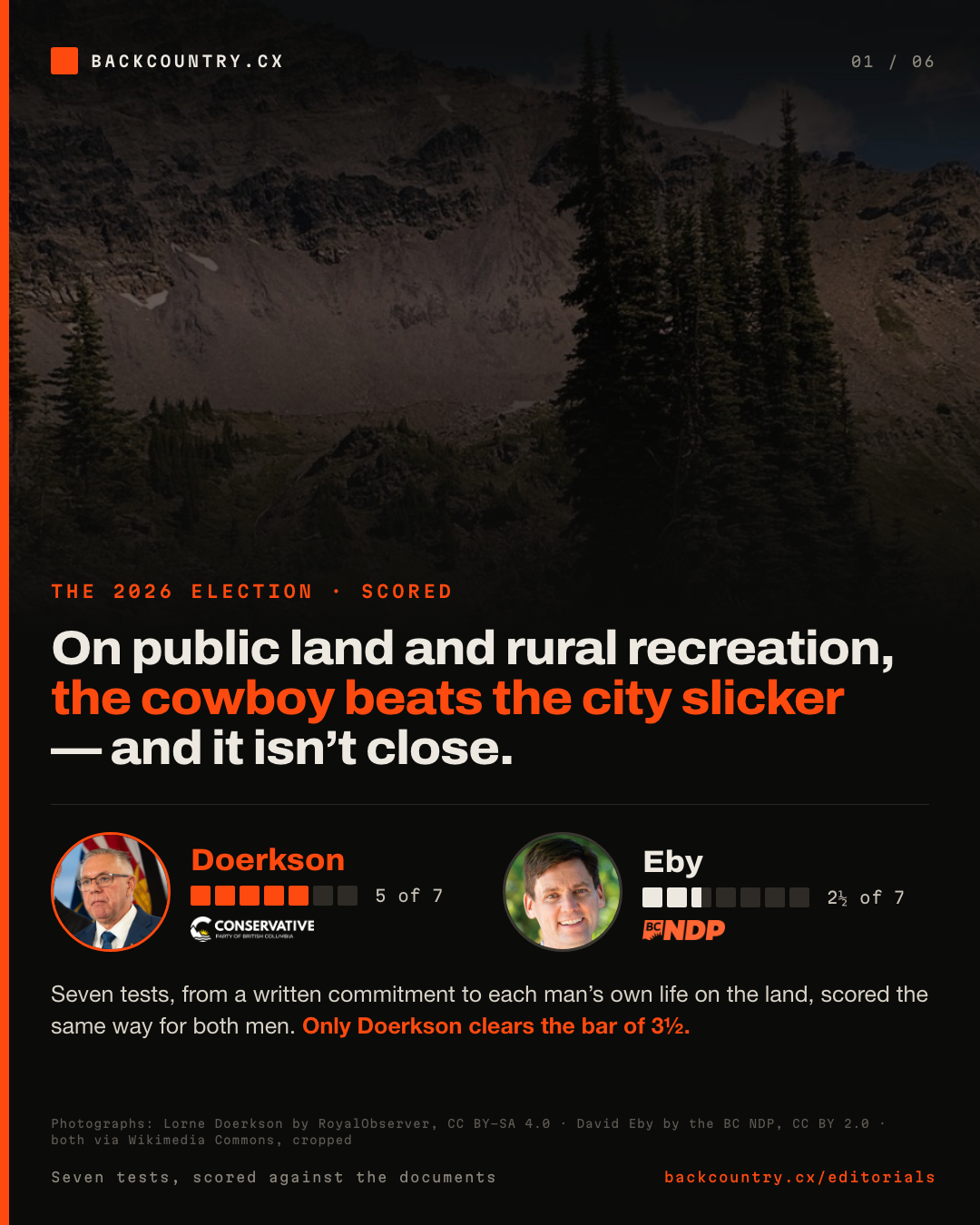
Seven tests on keeping public land open, applied in the same words to both men, weigh each man’s life on the land as well as his words in the House. Lorne Doerkson, a former bareback rider and rodeo announcer who calls himself an outdoorsman, has spent five years pressing the Legislature about the roads into the Cariboo-Chilcotin.29 David Eby, a Vancouver human rights lawyer, holds every lever that could keep those roads open, and his government is removing them.3012 Doerkson scores five of seven points and Eby scores two and a half, with three and a half needed to clear the bar.
01 Doerkson is an outdoorsman who has pressed for backcountry access since 2021, and Eby has addressed it once in this parliament
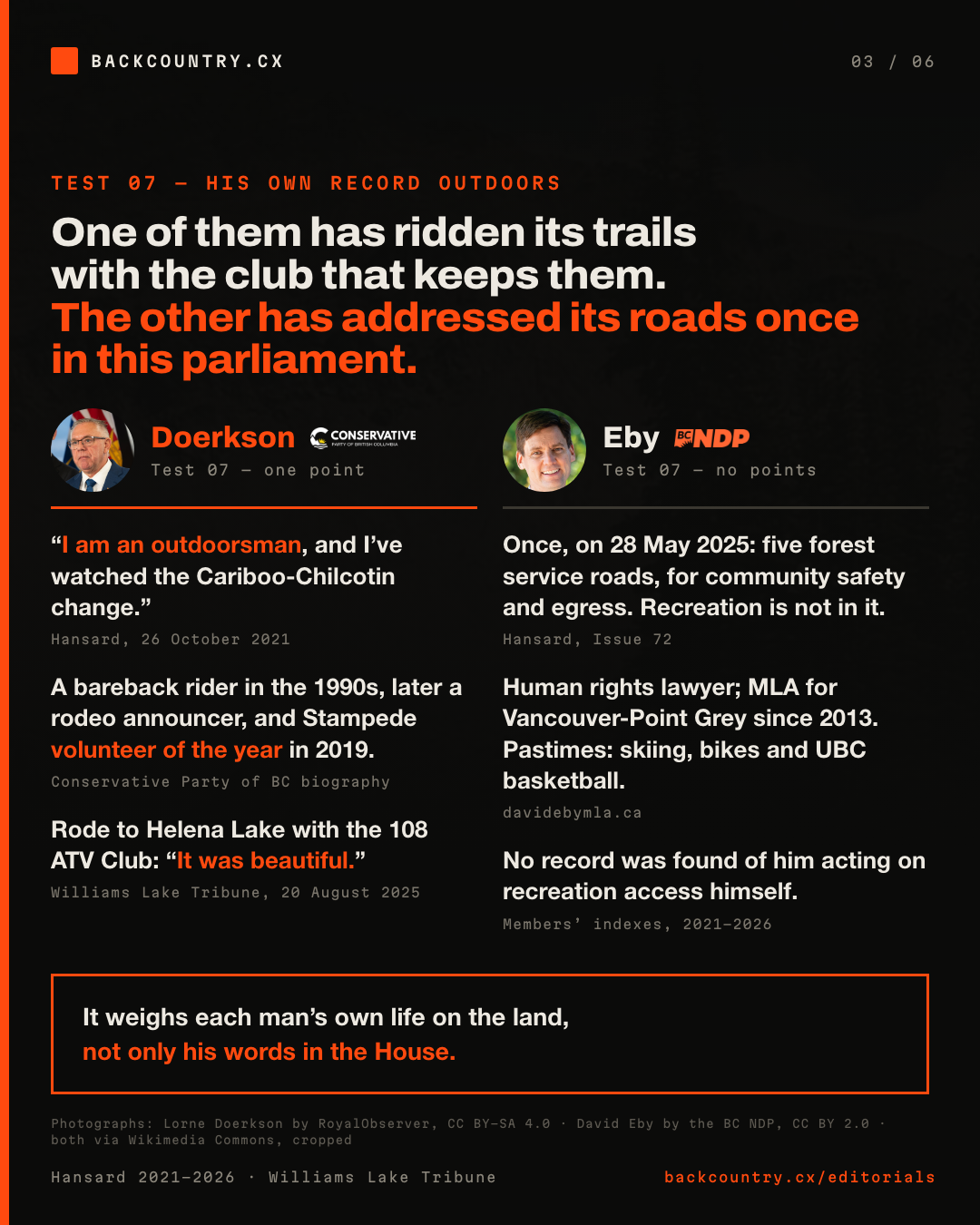
Start with the two men, because on this question their lives could hardly sit further apart, and the scoring in §04 weighs each man’s background, interests and culture on the land, not only his words in the House. On 26 October 2021 Lorne Doerkson stood in the Legislature and said, “I am an outdoorsman, and I’ve watched the Cariboo-Chilcotin change over the last number of years.”22 In the five years since, he has asked a minister whether new forest service roads would come with money to maintain them, warned that unmarked deactivation trenches could kill someone, told the House about a friend badly hurt in one while snowmobiling into the back country, and tabled petitions from residents whose roads were breaking up, one of them by now “impassable.”232426 David Eby has addressed the roads that carry the public onto Crown land once in this parliament, on 28 May 2025, for community safety and egress rather than recreation.08

 Interim leader, Conservative Party of BC · MLA for Cariboo-Chilcotin since 2020
- In the Cariboo
- Close to thirty years, in Williams Lake
- Before politics
- Black Press newspapers until 2011, then financial planning
- In the saddle
- Bareback rodeo rider in the 1990s, later a rodeo announcer
- Access, in the House
- Raised in 2021, 2023, 2024, 2025 and 2026
The record behind that sentence is a rural one. Doerkson has lived close to thirty years in the communities he represents, and he spent nearly two decades at Black Press newspapers, until 2011, before moving into financial planning.29 In the 1990s he rode bareback, and a horse called Kung Fu once threw him hard enough to knock him out, burst an eardrum, dislocate his shoulder and break his collarbone.29 Describing the fire seasons of 2010, 2017 and 2021 to the House, he recalled how, ahead of a fire “coming at us from all angles,” people at the Williams Lake Stampede grounds filled borrowed stock waterers so the horses brought there would have water. He also told the House that his Rotary club and a noon-hour Rotary club raised money for three trailers for the West Chilcotin, each carrying a water cube and hose that any truck could tow to a fire.29
He has also put his own hours into the ground in question. In August 2025 the 108 ATV Club took politicians around the Gold Rush Snowmobile Trail on its MLA Ride, and Doerkson rode with them to Helena Lake and came back to the 100 Mile House Snowmobile Club with his face covered in dried mud. “It was beautiful,” he said, and the conversation out there was “about multi-use trail and having some respect out in the bush for other users on the landscape.”27 In May 2025 he spoke in the House against section 18 of Bill 14, warning that it could upend the Crown leases and tenures that ranchers, guide-outfitters and trappers depend on. In his column in the Williams Lake Tribune he wrote that the bill let “guide outfitter, hunting, angling, and other Wildlife Act licenses” be suspended or cancelled, and he called for “protections for licensed hunters, anglers, and guide outfitters.”28
On the roads themselves, the record is specific. In committee on Bill 23 in November 2021 he asked whether some roads might be left open rather than all deactivated, whether anything new would warn people about the tank traps and boulders behind “very near misses” in his riding, and whether declaring forest service roads would bring “any new investments or more money for the maintenance of those forest service roads.”23 On 6 November 2023 he told the House, “I really am concerned with access to all of our parks,” and that “we’ve actually put some of the access at risk by deactivating roads and deactivating bridges.”24 In April 2024 he and the member for Cariboo North met BC Wildfire over as many as seventeen roads due for deactivation in their two ridings.25 In February 2025 he named the 2000 road at Big Creek, and in October 2025 and April 2026 he tabled three road petitions from his riding, the last of them for the Canim Lake South and Mahood Lake roads: “This road has become impassable.”0726
That record has two limits, and both belong beside it. Most of what he said about deactivation was said as a BC Liberal and BC United member, before he crossed to the Conservatives on 31 May 2024.15 And he has said nothing on the record about the 556 kilometres of road that BC Timber Sales is scheduled to deactivate in his own riding.12

 Premier of British Columbia since 18 November 2022 · leader, BC NDP · MLA for Vancouver-Point Grey since 2013
- Before politics
- Human rights lawyer; executive director, BC Civil Liberties Association
- His own free time
- Skiing, riding bikes and UBC basketball games
- Access, in the House
- Once in this parliament, 28 May 2025, for community egress
- Recreation access, his own record
- No public record found
Eby’s documented record on the same ground is short. He came to politics as a human rights lawyer and executive director of the BC Civil Liberties Association, and he has represented Vancouver-Point Grey since 2013. His constituency biography says he spends his free time skiing, riding bikes and going to UBC Thunderbird basketball games with his family.30 His one answer on resource roads committed money to five forest service roads serving ten First Nations communities and gave safety and egress as the reason; recreation is not in it.08 On 21 February 2024, in the exchange in which the Leader of the Opposition raised the Land Act concerns of “people who access the back country,” Eby’s answer addressed reconciliation and the courts’ decisions on Indigenous rights rather than recreation access. No public record was found of him acting on recreation access to Crown land in his own name, in the House or outside it.30
That contrast is the heart of the result, and it is not the whole of it. Eby’s government wrote the problem down and put some money near it, and Doerkson’s party has never priced its promise. The seven tests in §04 weigh all of it, in the same words for both men.
02 This piece scores two men on one question, because neither party has published a platform
This is a head-to-head. Two men want to run British Columbia, and on 24 October one of them will. We judge them here on one subject and one only — public access to public land, and specifically the resource roads that are how anybody actually reaches it — and we end with a ranking and a winner.
The obvious way to run that contest would be to read the two platforms. That is not available: neither party has published one. The BC NDP has no platform page, and its launch release of 22 September says the party “will roll out details of the plan to respond to the trade war over the campaign.”17 What it publishes instead is a nine-pillar page called “Action for You”, written in the past tense, whose only use of the word access about land is the heading “More access to B.C. Parks” — the park estate, reached on a paved highway, which is not the ground this is about.03 The Conservative Party of BC published six campaign commitments between 5 and 6 October and has no platform document behind them.02
So the scoring is done against what each man’s side has actually put its name to: party declarations, government strategies, budgets quoted in the House, bills, caucus releases and the public record of what each of them said when he had the floor. Every test is stated in §04, and every score carries the document it was read from. A verdict with no scoring under it is worth nothing, so the scoring comes first and the verdict falls out of it.
One thing this contest is not. It is not a claim that either man is unusual. Nominations closed at 1 p.m. on 3 October 2026 with 355 people accepted across the province’s 93 electoral districts; the Conservative Party of BC is contesting every one of them and the BC NDP is one short, in Peace River North.01 Almost none of those 355 has said anything about this either. What makes these two answerable is that one of them is going to be premier.
Conservative Party of BC93 of 93 · complete slate
BC NDP92 of 93 · one seat not contested
Behind the two majors the ballot thins quickly. The BC Green Party is running in 73 districts, CentreBC in 35 and OneBC in 33; everything else is in single figures. Eight candidates carry no party label at all and seven are registered Independents. Only two of these parties can form a government, which is why only two leaders are scored.
03 The two men arrive from opposite directions, so every test is written to fit both
One of these two will be sworn in as premier within weeks of 24 October, and they arrive from opposite directions. David Eby has governed for four years and carries a whole provincial record. Lorne Doerkson has led his party since 21 September, the day before the writ was issued.15
That asymmetry is the hardest problem in scoring them, and it is handled in the tests rather than apologised for in the prose. A premier has a government, a budget and a Crown agency; an opposition leader has a party document, a caucus and a seat. So each test below is written to be answerable by both — a commitment is a commitment whether it is a party declaration or a government strategy, money is money whether it is budgeted or promised, and a record in the House is the same floor for a backbencher and a premier. Where one man can only be scored on a smaller instrument, that is stated in the line itself.
 Interim leader, Conservative Party of BC · MLA, Cariboo-ChilcotinFirst elected 2020. Crossed from BC United to the Conservative Party on 31 May 2024. Appointed interim leader 21 September 2026; his party’s own site now drops the qualifier.
What he brings to the question
A riding that is almost entirely reached on gravel. Cariboo-Chilcotin is roughly 42,000 square kilometres of country where the road is the access, and he has represented it for six years.
Elections BC final candidate list · first elected October 202001A party document that commits a future Conservative government to guaranteed access to public lands and wild areas, adopted by the party sixteen months before he became its leader.
Policy Declaration, Nanaimo, 1 March 2025, §11.12(a)13A caucus that has argued this case well, and in which the arguing was done by other people — Donegal Wilson in committee, Scott McInnis with a petition, and Kerry-Lynne Findlay with the promise, seven weeks before she resigned.
Hansard, 12 March 2026 · 28 May 2026 · Conservative Caucus of BC, 31 July 202614A personal record on access that goes back to 2021: deactivation trenches, maintenance money, access to parks, and a ride up the Gold Rush Snowmobile Trail with the 108 ATV Club.
Hansard, 2021–2026 · Williams Lake Tribune, 20 August 20252427Against it: since November 2024 he has sat as Assistant Deputy Speaker, in the chair, where a member does not debate. He has held no policy critic portfolio in the Conservative caucus, and his one Crown-land bill governs who gets Crown land rather than who maintains the road that leads to it.
Bill M 247 – 2026, first reading 26 May 202616 Premier of British Columbia · leader, BC NDP · MLA, Vancouver-Point GreySworn in as British Columbia’s 37th premier on 18 November 2022. Called this election on 22 September 2026, two years ahead of the fixed date in October 2028.
What he brings to the question
The machinery. Every lever that could fix this is inside his government: the Ministry of Forests holds the roads, BC Timber Sales builds and removes them, and the Forest Act is the instrument either way.
Province of British Columbia, Cariboo-Chilcotin road safety information, read 6 October 202612The only document in the province that states the problem plainly, and his government published it. Look West: B.C.’s Outdoor Recreation Strategy, 21 May 2026, says recreation access “depends heavily on resource roads” and that the industry which paid for them is shrinking.
Target 8, page 21, Minister’s Message signed by Tamara Davidson04Four years of budgets, and some of the money has reached this ground. He has personally committed increases to forest road maintenance and capital in the House.
Hansard, 28 May 2025, Issue 72, 72B:165508Against it: the same government is removing the roads. The schedule in the Opposition leader’s riding is executed by his Crown agency under his minister, and his minister has defended it in the House.
Hansard, 12 March 2026, Issue 14110Photographs · Lorne Doerkson at a campaign announcement, 28 September 2026, by RoyalObserver, Wikimedia Commons, CC BY-SA 4.0 · David Eby, 2022, by the BC NDP via Flickr, Wikimedia Commons, CC BY 2.0. Both cropped.
04 Seven tests decide the score, and each is applied in the same words to both men
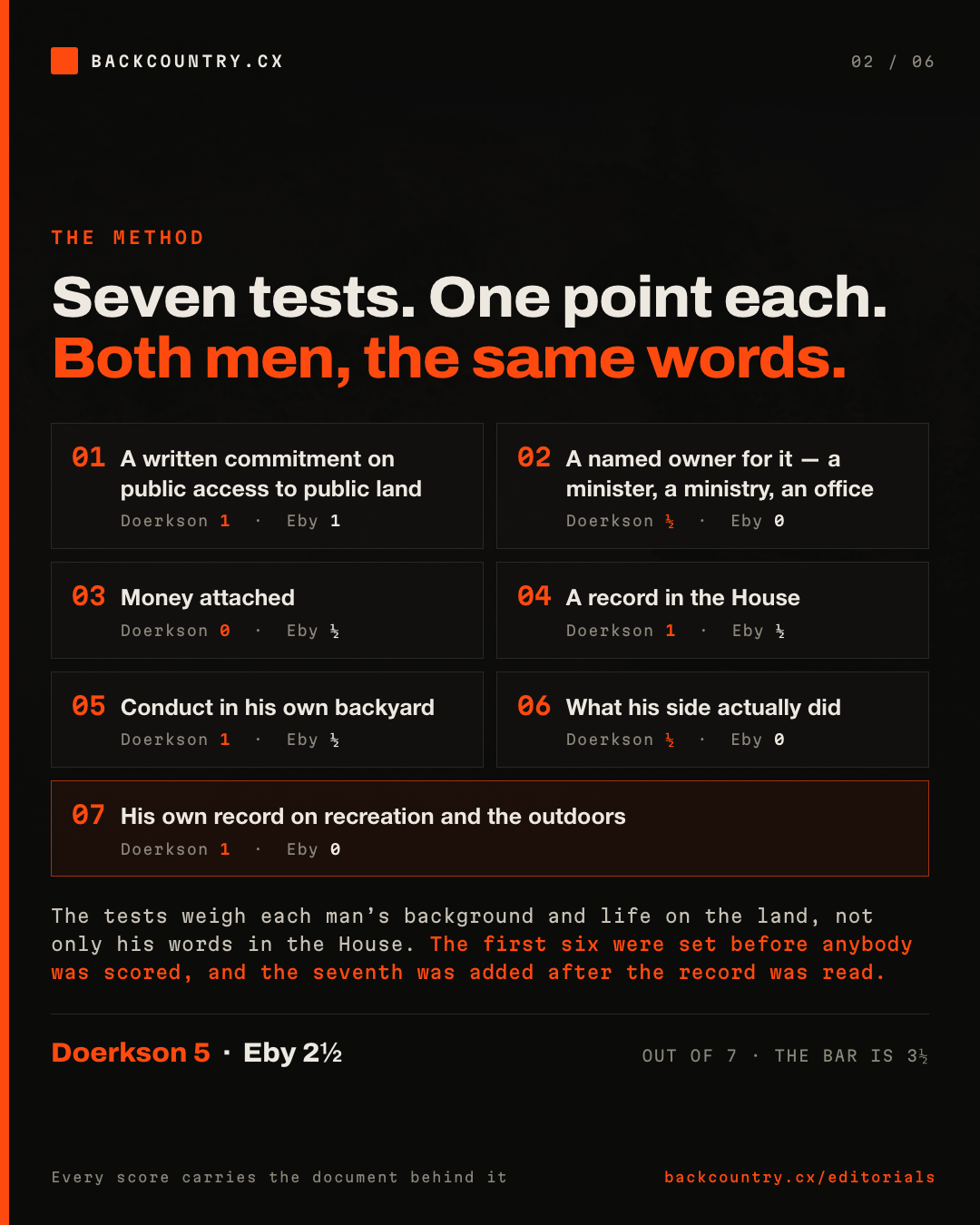
Here are the tests in full, before a point is awarded to anybody. Each is worth one point, each is scored the same way for both men, and each is applied to a document or a transcript named under the line. Where a score is half rather than whole, the reason is given in the same block as the evidence. The tests weigh each man’s background, interests and lived culture on the land, not only his words in the House: the Hansard record is one input, under test 04, and not the frame. The first six tests were set before either man was scored. The seventh was added once the full record had been read, because the six had no place for a leader’s own record on recreation and the outdoors, and it is applied to both men in the same words.31 Seven points are available, one for each test, and the bar is half of them, 3½.
MLA, Cariboo-ChilcotinDavid EbyBC NDP
Premier · MLA, Vancouver-Point Grey
A written commitment
How it is scored. One point if a document published by the party, or by the government the leader runs, commits in its own words to public access on public land. Half if the only commitment is about the park estate or about one activity. Nothing if none exists.
1of one
His party has one, in writing, and it was adopted long before the campaign. The Policy Declaration presented to the Conservative annual general meeting in Nanaimo on 1 March 2025 says at §11.12(a): “Public Access: British Columbians deserve guaranteed access to public lands and wild areas, including hunting and fishing rights. It’s part of who we are.” At §11.13(g) the party commits to ensure there is “open access through a variety of methods for hunting, fishing and trapping on all provincial Crown lands.”
Read from the party’s own PDF, 21 pages, 19 articles. It is a standing commitment of the party he now leads, and it counts in full. Policy Declaration, 1 March 2025, §11.12(a) and §11.13(g), page 1313
1of one
His government has one, and on the substance it is the sharper of the two, because it names the thing that actually carries the access. Target 8 of Look West: B.C.’s Outdoor Recreation Strategy, published 21 May 2026, is “A modernized framework for high-value recreation access and resource roads,” and it is the only target of the seventeen that names the roads.
Its own reasoning goes further than anything the Conservative document says: recreation access “depends heavily on resource roads”, and as shifts in the forest sector accelerate and “the industrial base that has historically funded road maintenance continues to shrink, new solutions need to be explored.” No Conservative document states the problem at all. Target 8, page 21, and the Minister’s Message signed by Tamara Davidson, Minister of Environment and Parks04
A named owner
How it is scored. One point if that commitment names the minister, ministry or office that has to deliver it. Half if it names a body but stops short of making it responsible. Nothing if it names nobody.
½of one
§11.13(g) does name a body, and it names the right one. The commitment is to be delivered “in co-operation with the BC Forest Service” — the organisation that actually holds the roads. That is the correct address, and it is also the limit of the assignment: co-operation is not responsibility, and no minister, portfolio or office is attached to it.
The place a party’s road obligations are supposed to land is Article 13, Transportation, and it was read in full. It commits to eleven named bridge and highway projects — a new Okanagan Lake crossing, the Taylor Bridge across the Peace, the Red Bridge in Kamloops, Highway 19 at Nanaimo, Highway 97, six lanes to Chilliwack, Brunette Avenue, the Pattullo, the Ironworkers Memorial, the George Massey Tunnel and local upgrades — then ferries, SkyTrain, regional rail and ICBC. No resource road is among them. Half a point for naming the agency, nothing more for making it answerable. Policy Declaration, §11.13(g), page 13; Article 13, §13.01 to §13.07, pages 15–1713
0of one
Target 8 names nobody at all. It carries no lead ministry, no office and no official, and that is not an oversight of drafting — the same document diagnoses why. Target 1 records that “outdoor recreation spans multiple agencies, but no single office coordinates these shared priorities,” and its remedy is to “explore the establishment of a coordinating Office of Outdoor Recreation.” The strategy proposes to look into creating an owner, and it stops short of naming one.
The ministry that does hold the roads is Forests, and its own Service Plan for 2026/27 to 2028/29 sets out no commitment on recreation access, resource roads or deactivation. Four years in government, a published strategy, and the job is assigned to no one. Nothing. Target 8, page 21, and Target 1, page 1304 · Ministry of Forests Service Plan 2026/27–2028/2905
Money attached
How it is scored. One point for a figure committed to recreation access on resource roads. Half for money on recreation that does not reach the roads, or money on roads that is stated not to be for recreation. Nothing if no figure exists.
0of one
No figure is attached to either access clause, and the money that is in the declaration is pointed somewhere else: recovering the $9 billion of softwood duties held in the United States, and replacing stumpage with a tax on the end product.
The party’s live plan page on 6 October carries six commitments — Safe Streets for BC, Keep Emergency Rooms Open, the BC Energy Superpower Plan, the Wildfire Action Plan, No PST on Canadian Alcohol and No New Taxes. Not one of the six reaches land, access or roads, and the last of them is a constraint on revenue rather than a commitment to spend. Nothing. conservativebc.ca “Our Plan”, six items dated 5 and 6 October 2026, read 6 October02 · Policy Declaration §11.04–§11.05, pages 11–1213
½of one
Money exists, it is his, and it is counted here in full before anything is taken off it. On 28 May 2025 he answered for the Babine Lake and Suskwa resource roads himself: forest road maintenance up $3.2 million to $9.6 million across the three-year fiscal plan, forest base capital up $5.5 million to $16.5 million, and $12 million in one-time funding so First Nations could maintain their own roads. On 9 April 2025 his Minister of Environment and Parks set out “$21.59 million invested over five years for the recreation site strategy, as well as $23.8 million in base capital… and $3.34 million in maintenance for Rec Sites and Trails.”
What stops it being a full point is his own Minister of Forests drawing a line through it in the same parliament. Asked what budget keeps forestry roads passable to recreation sites, trails and parks, Ravi Parmar named $20.3 million in the integrated resource operations division and $47.83 million at BC Timber Sales, and then said of both: “I just want to reiterate that these are dollars not for rec sites or for recreation.” Money on the roads that is stated not to be for recreation, and money on recreation that does not reach the roads. Half a point. Hansard, 28 May 2025, Issue 72, 72B:165508 · Hansard, 9 April 2025, Issue 38, 38A:1555 and 38A:194509
A record in the House
How it is scored. The whole of what the man himself said on public access to public land in the 43rd Parliament. One point if he put the problem to a minister and pressed it, or committed his party to a remedy. Half for one substantive intervention. Nothing if he never raised it.
1of one
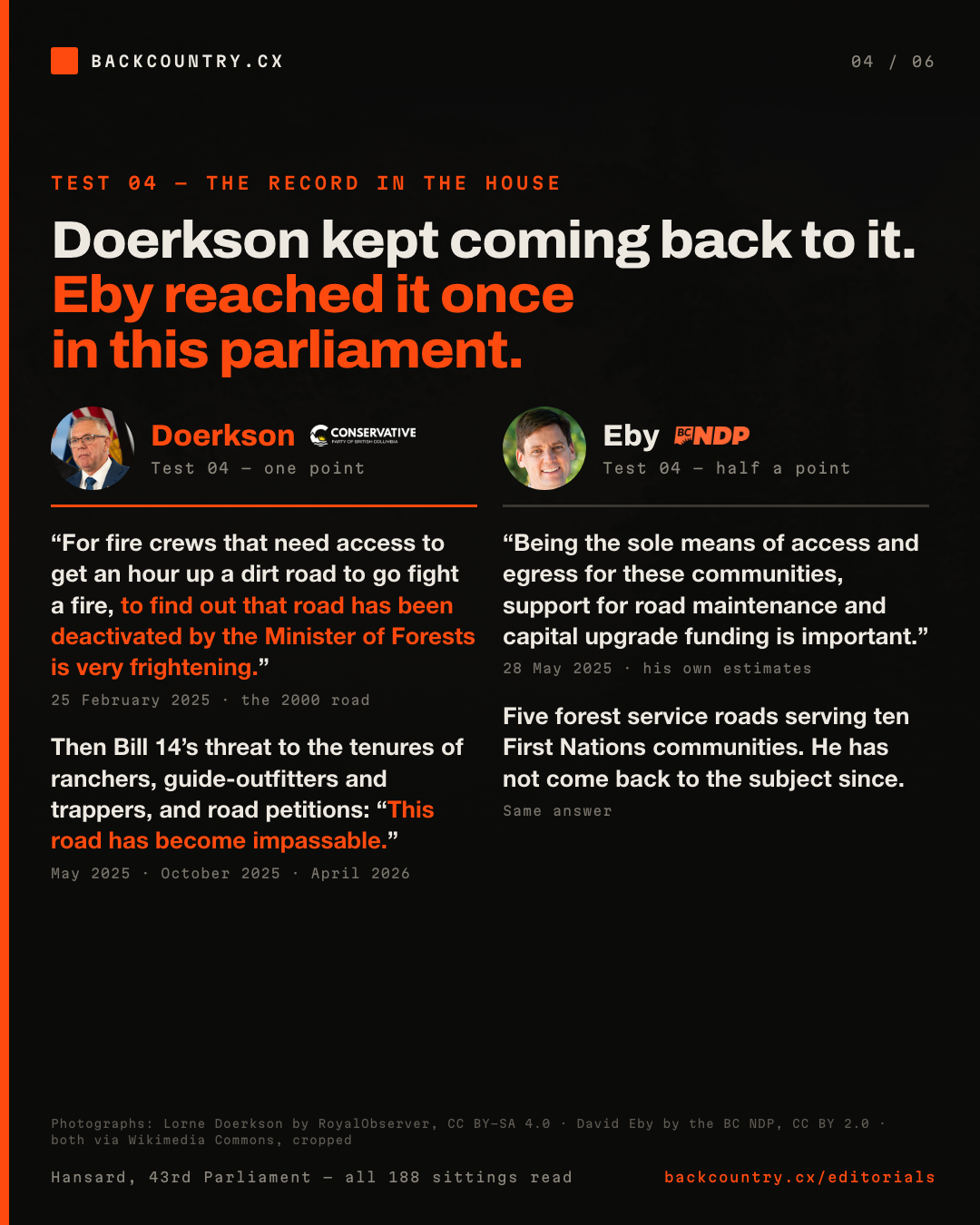
He reached the subject first on 25 February 2025 in the throne speech debate, and what he said was specific rather than general. He described a town hall at Big Creek where sixty or seventy people came out over the 2000 road, which has served a community for decades and may stop being serviced “because of a non-use of a tenure,” and he told the House he believed he had written to the minister about it. Then:
“For ranchers that need access to high-consequence dams and for fire crews that need access to get an hour up a dirt road to go fight a fire, to find out that road has been deactivated by the Minister of Forests is very frightening.”
He also put the case against himself in the same breath — “I know that there are two parts to this argument. I know that there are many people that feel that we don’t want to have all that access” — which is the mark of a member who has actually had the argument.
He came back to it. On 14 May 2025 he spoke against section 18 of Bill 14, which he warned could upend the Crown leases and tenures held by ranchers, guide-outfitters and trappers, and told the House he had raised it with the Minister of Energy. On 21 October 2025 and 14 April 2026 he tabled three petitions from his riding over failing roads, the last of them for the Canim Lake South and Mahood Lake roads: “This road has become impassable.” He put the problem to ministers and pressed it. One point. Hansard, 25 February 2025, Issue 9, 9B:165007 · Hansard, 14 May 2025, Issue 6528 · Hansard, 21 October 2025 and 14 April 202626 · every sitting of the 43rd Parliament read11
½of one
He reached it once as well, on 28 May 2025, answering for his own estimates. Asked to commit to repairs on the Babine Lake and Suskwa resource roads, he gave the money, and he gave the frame it sits in:
“The Minister of Forests is responsible for forestry roads, many of which serve small rural communities and First Nations communities. Obviously, being the sole means of access and egress for these communities, support for road maintenance and capital upgrade funding is important.” The work he named was five key forest service roads “that access ten First Nations communities, making them safer for community members, ambulances, service vehicles and school buses.”
Community safety and egress, which is a real reason and the right one for those five roads. Recreation is not in the answer, and he has not come back to the subject in the House since. Half a point. Hansard, 28 May 2025, Issue 72, 72B:165508 · every sitting of the 43rd Parliament read11
Conduct in his own backyard
How it is scored. One point if he has acted to keep roads open in the country he personally answers for — his riding, or the government he leads. Half if he has raised it there. Nothing if the record read shows no such act.
1of one
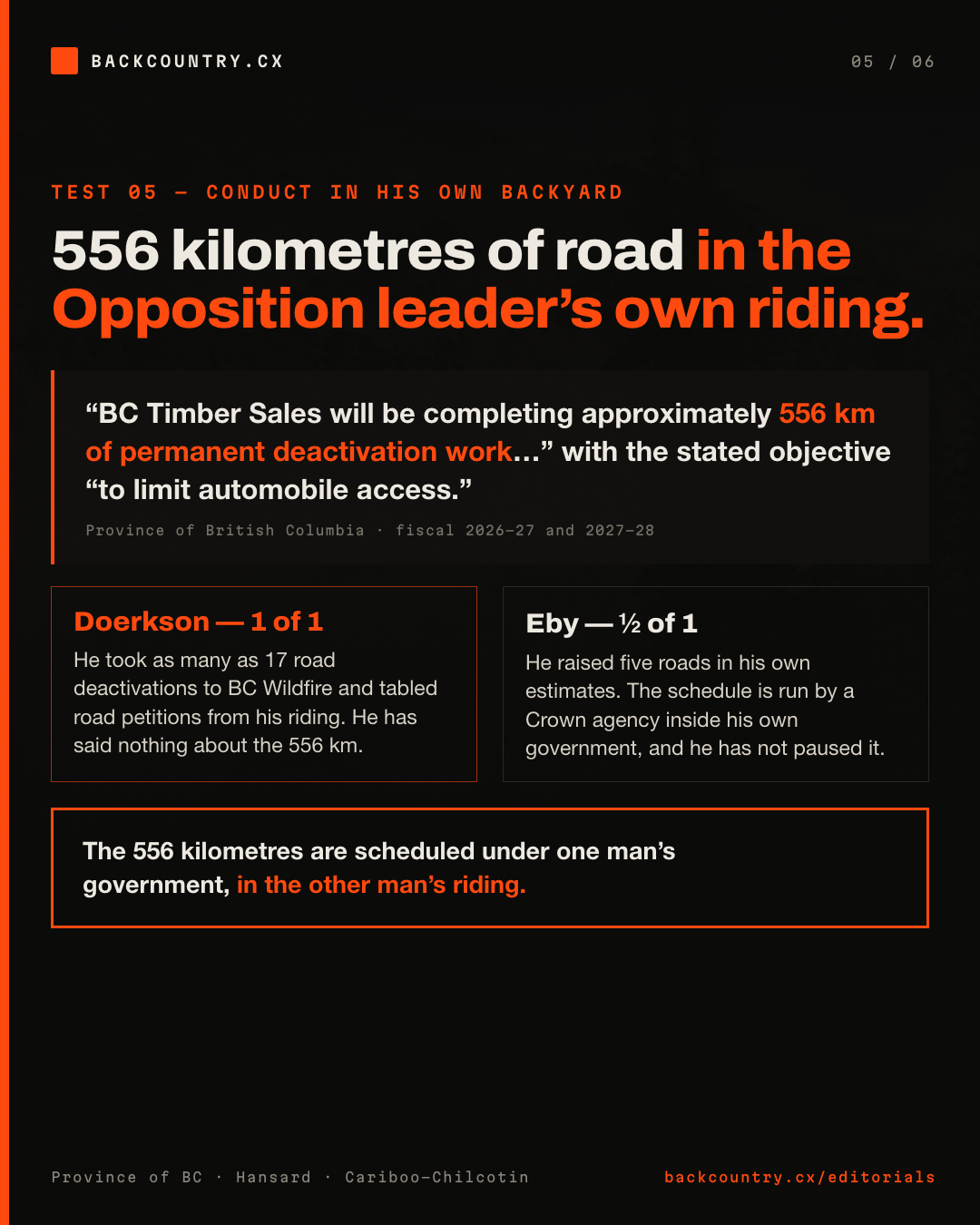
The largest scheduled removal of road in the province is in the district he represents. The Province’s own Cariboo-Chilcotin page, last updated 3 June 2026, carries it: under section 121(9) of the Forest Act, BC Timber Sales “will be completing approximately 556 km of permanent deactivation work” across the 2026–27 and 2027–28 fiscal years. The stated objective is to put the road in a self-maintaining state, to prevent degradation of water resources, and “to limit automobile access.” The only way to keep one is to apply “to have the tenure and maintenance obligations reassigned to you and pay a security deposit.”
That notice has been public for four months, and no statement by him about it appears in the 188 sittings of the 43rd Parliament, on his candidate page or among his party’s six published commitments. The rule, though, asks whether he has acted to keep roads open in the country he answers for, and he has. In April 2024 he and the member for Cariboo North took the deactivation of as many as seventeen roads to BC Wildfire, over fire crews’ access. In February 2025 he carried the Big Creek town hall over the 2000 road into the House, and in October 2025 and April 2026 he tabled petitions from Spout Lake, 103 Mile and Canim Lake residents whose roads had fallen into disrepair over the years.250726
Some of those are public roads rather than resource roads, and all of them carry the people of his riding out onto the land. One point, and the 556 kilometres remain the largest unanswered question in his record. Province of British Columbia, Cariboo-Chilcotin road safety information, read 6 October 202612 · conservativebc.ca candidate page, read 6 October 202602
½of one
The schedule is his government’s. BC Timber Sales is a Crown agency inside his Ministry of Forests, and s.121(9) of the Forest Act is the power being used. His minister was put the exact question in the House on 12 March 2026 by the member for Boundary-Similkameen — why a road of high recreation value cannot simply be signed “use at your own risk” instead of being re-sloped, replanted and stripped of its bridges — and the answer did not move. Deactivation “has less to do with liability and more to do with the environmental standards,” and “liability continues to exist as long as that road is activated.”
Asked what a private landowner reached by a forest service road should expect, the same minister said: “Without a doubt, any private property owner should know if there is an FSR, that it may not be guaranteed forever. Without a doubt, there’s buyer beware.” Since 25 June 2012, section 3.1 of the Occupiers Liability Act has deemed every user of a resource road to have willingly assumed the risks and named the government a limited liability entity. The Premier has neither paused the schedule nor qualified his minister.
He has raised the roads of the government he leads once, on 28 May 2025, and committed money there to five forest service roads.08 Across the rest of his Ministry of Forests the act on the record is removal. Half a point, for raising it, and not the point for keeping roads open. Hansard, 12 March 2026, Issue 141, 141C:153510 · Occupiers Liability Act, RSBC 1996 c.337, s.3.106
What his side actually did
How it is scored. One point if his caucus or his government, in the last year, did things that kept public access on resource roads open. Half if the record cuts both ways. Nothing if its actions ran against it.
½of one
His caucus produced the clearest promise on resource roads anyone has made in this cycle, on 31 July 2026: “A B.C. Conservative government will reactivate any unnecessary closures and will repair roads where necessary to provide access to the citizens of B.C. who own and share them.” That is a real commitment and it is the right one. It is also not his. Those are Kerry-Lynne Findlay’s words, written while she led the party; she resigned the leadership on 20 September and is not a candidate on 24 October. He has not repeated them in his own name.
The substantive work in his caucus belongs to other members too. Donegal Wilson, the Conservative candidate in Boundary-Similkameen, is the one member of the 43rd Parliament who put Target 8’s own phrase — “high-value recreation roads” — to the Minister of Forests, and she named the example: “a mining road that has been there 120 years. Recreation has been using it for all of that time.” Scott McInnis tabled a petition of 1,500 names against the Incomappleux deactivation on 28 May 2026. The caucus did the work; the leader has not taken it up. Half a point. Conservative Caucus of BC, 31 July 202614 · Hansard, 12 March 2026, Issue 14110 · Hansard, 28 May 2026, Issue 18711
0of one
His government wrote the problem down in May and kept removing the roads through the summer. Target 8 has had no owner, no budget line and no completion date from the day it was published, and nothing between publication and the writ changed that.
What was funded belongs beside it rather than left out. The strategy launch of 21 May 2026 carried about $400,000 for a bridge on the Renshaw snowmobile trail — real work, re-establishing access, and the only funded access item announced that day. The off-road vehicle trail fund is in its ninth year at up to $500,000 a year, run with volunteer clubs and paid out of riders’ own ICBC registration fees rather than general revenue. This year $25,000 of it went to a bridge repair led by the Ministry of Forests at Clemina Creek, which, in the ministry’s words, “helps keep a forest service road connection open to a managed trail system.” Set all of that against a network the Minister of Forests put at roughly 60,000 kilometres, of which about 14,000 provide access to communities or recreation.
The contrast that settles the line is inside his own government. The Working Forest Landscape Model of 27 August 2026 has three named zones, an annual harvest target of 45 million cubic metres, two ministers quoted and a date for the first test areas — an owner, a number and a deadline, which are the three things Target 8 has never had. His government can assign this work. It has assigned it to the cut and not to the access. Nothing. BC Gov News 2026ENV0026-000592 and 2026FOR0033-00098918 · Hansard, 16 November 2021, Issue 130, for the network figures11
His own record on recreation and the outdoors
How it is scored. Added after the record was read, and applied in the same words to both men. This is the test that weighs a man’s background, interests and lived culture on the land. One point if his own life and his record in office show a sustained, first-hand stake in the public’s recreational way onto public land, in the Legislature, in his community or on the ground. Half if it shows only once. Nothing if none is found at all.
1of one
His is the record of a man who uses the ground. He rode bareback in the 1990s, later announced rodeos, and was voted the Williams Lake Stampede’s volunteer of the year in 2019.29 He told the House in 2021 that he is an outdoorsman, questioned the deactivation rules in Bill 23 clause by clause, and asked whether new forest service roads would come with money to maintain them. In 2023 he said he was “concerned with access to all of our parks”, described a friend hurt in a tank trap while snowmobiling into the back country, and told the House how his Rotary club raised money for fire-water trailers for the West Chilcotin. In 2024 he took as many as seventeen road deactivations to BC Wildfire, and in 2025 he wrote in his newspaper column for the hunting, angling and guide-outfitter licences that Bill 14 put at risk.
On the ground, he rode the Gold Rush Snowmobile Trail to Helena Lake with the 108 ATV Club in August 2025, on an MLA Ride run by the club that maintains the trail with Recreation Sites and Trails BC, and came back talking about multi-use trails and respect for other users in the bush. Most of the Legislature record predates his move to the Conservatives, and none of it commits money. It is still the sustained, first-hand record this test asks for. One point. Hansard, 26 October 202122 · 15–16 November 202123 · 6 November 202324 · 2 April 202425 · Bill 14, May 202528 · Williams Lake Tribune, 20 August 202527
0of one
No record of his own on recreation access was found. He came to politics as a human rights lawyer, he has represented Vancouver-Point Grey since 2013, and his constituency biography lists skiing, riding bikes and UBC basketball games as his pastimes. Nothing in that biography, or in his record in office, ties him to the resource roads that carry the public into the back country. His one answer on resource roads, on 28 May 2025, was about safety and egress for ten First Nations communities, recreation is not in it, and it is already scored under tests 03 and 04.
His government has published a recreation strategy and funds recreation sites and trails, and those are scored under tests 01, 03 and 06 as the acts of his side. This test asks what the man has lived and done himself, on the land and in office. Nothing. Hansard, 28 May 2025, Issue 7208 · the members’ indexes, 2018 to 2026, and his constituency biography30
05 Doerkson leads with 5 of 7 to Eby’s 2½, and only he clears the bar
The result
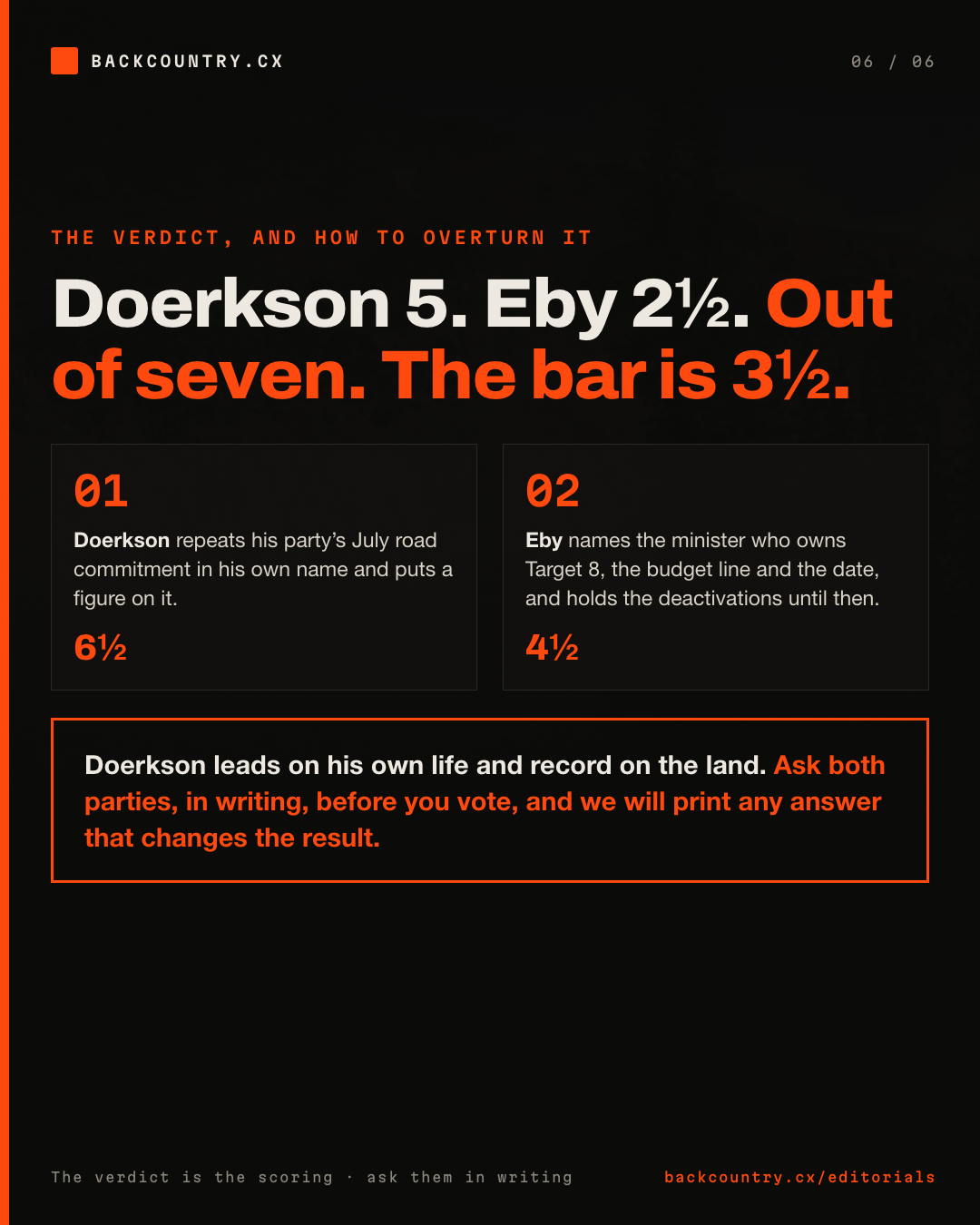
Lorne Doerkson leads, 5 to 2½, out of 7. He clears the bar by a point and a half, and Eby finishes a full point short of it.
The result turns on the two men themselves. Doerkson has spent five years asking about the roads, the trenches and the trails that carry people into the back country, and he has ridden them. Eby has addressed them once in this parliament, for community egress, and has no record of his own on recreation access. Those three tests — the House, his own riding and his own record — account for two of the two and a half points between them. The rest is the half point on a named owner and the half point on his caucus’s work, less the half point that Eby takes back on money, where his government has a budget and Doerkson’s party has no figure.
It is a clear win and not a clean one. Doerkson’s party has a commitment with no money attached, the road promise in its name is Kerry-Lynne Findlay’s and not yet his, and 556 kilometres are scheduled for deactivation in his own riding without a word from him. Eby, for his part, has the budget, the ministry and the Crown agency, and has used them to publish a description of the problem and a schedule for making it worse.
In our view, Doerkson’s life on the land is what this job needs. A premier who has ridden in the rodeo, ridden the trails with the club that keeps them and stood up for the hunters, anglers and guide-outfitters of his riding knows what a closed road costs the people who use it. The scores above reflect that, and the verdict follows from them.
The two parties split the question between paper and practice
The scoring above is of two men, because a leader is who a voter is actually offered. The parties behind them do not finish in the same order, and the reason is worth stating.
On paper, the Conservative Party of BC
Has the only standing written commitment either party has ever made to public access on Crown land — §11.12 and §11.13(g) of its Policy Declaration, adopted 1 March 2025, promising “guaranteed access to public lands and wild areas” and open access “on all provincial Crown lands”. It hands delivery to the BC Forest Service and gives it no budget, no deadline and no mechanism; its eleven-item transportation article is bridges and highways and does not mention a resource road.
In government, the BC NDP
Is the only one of the two that has written down what the problem actually is — Target 8 of its own Outdoor Recreation Strategy — and the only one that has put real money anywhere near it. It is also the one removing the roads: the same government’s Ministry of Forests says its road money is “not for rec sites or for recreation”, and 556 kilometres are scheduled for deactivation under its own agency.
On public access, the Conservative Party of BC is the more favourable of the two on paper and the BC NDP is the more consequential in practice — and practice is currently running against the thing both of them say they want. A promise with no mechanism has never closed a road. A strategy with no owner has not kept one open.The parties, on the documents scored above
What would change the result is stated here in advance
A ranking that cannot be overturned by evidence is not a ranking. Both of these routes are open before 24 October, and the arithmetic is the table above with a few cells moved.
Lorne Doerkson — 5 to 6½
Repeat his party’s own July commitment in his own name, and put a figure on it for recreation access on resource roads. That is test 06 to a full point and test 03 to a full point, and it puts him at 6½ of 7.
Tests 03 and 06David Eby — 2½ to 4½
Name the minister who owns Target 8, the budget line that pays for it and the date the framework exists, and hold the deactivation schedule until it does. That is test 02 to a full point, test 05 to a full point and test 06 to a half, and it puts him at 4½ of 7 — past the bar, and still half a point behind the man who beats him today.
Tests 02, 05 and 06The two routes do not land on the same number, and the reason is the seventh test. Eby can win back the policy tests with decisions only a premier can make. A life on the land is built over years, and Doerkson has spent decades building his, in the saddle, on the trails and in the House.
06 The bar is fair, because other members cleared it in the same parliament
A bar is worth checking before it is published, because a standard nobody could meet says more about the standard than about the men. This one is met by sitting members of the same chamber, in the same parliament.
The clearest example is Donegal Wilson, the member for Boundary-Similkameen and the Conservative candidate there on 24 October. On 12 March 2026 she put the government’s own phrase back to the Minister of Forests and asked the question the strategy exists to answer: why, when a road has recreation value, the choice is a full re-slope and replant rather than a sign.10
“I want to talk a little bit about high-value recreation roads… Why can’t high-value recreation infrastructure just use the ‘Use at your own risk’? Why do we have to take it out?”
Donegal Wilson, Committee of Supply, Ministry of Forests estimates, 12 March 2026, Issue 141, 141C:1535
That is one member, without a ministry or a budget, doing in a single afternoon what neither leader has done in this parliament: naming the category of high-value recreation roads, naming an example, and making a minister answer for it. Scott McInnis, the member for Columbia River-Revelstoke, tabled a petition of 1,500 names against the Incomappleux deactivation on 28 May 2026. Across the whole of the 43rd Parliament, twenty-nine members reached resource roads, forest service roads or deactivation on the floor at least once, and at least twenty-five of them are candidates on 24 October.11 The bar is not set above what a member of this legislature can reach.
What makes the two leaders answerable to a higher standard than those members is the document their government and their opposition were both handed. On 21 May 2026 the Ministry of Environment and Parks published Look West: B.C.’s Outdoor Recreation Strategy, seventeen targets with a Minister’s Message signed by Tamara Davidson. Target 8 concedes the whole case:04
“Recreation access in B.C. depends heavily on resource roads, which provide the primary routes into much of the province’s backcountry… As shifts in the forest sector accelerate and the industrial base that has historically funded road maintenance continues to shrink, new solutions need to be explored.”
Target 8, Look West: B.C.’s Outdoor Recreation Strategy, page 21, 21 May 2026
Every target in the document is printed to the same three-part template — what’s next, what’s in place, why this matters. Target 8 has two of the three. There is no what’s in place under it, because there is nothing in place. Target 9, on the facing page, is a booking website, and the booking website has one.
Target 8
A modernized framework for high-value recreation access and resource roads.
- What’s next
- “Advance a coordinated policy, planning and management approach that responds to shifts in forest and industrial recreation road management and is grounded in strong partnerships.”
- What’s in place
- No such section is printed under Target 8.
- Why this matters
- “Recreation access in B.C. depends heavily on resource roads… As shifts in the forest sector accelerate and the industrial base that has historically funded road maintenance continues to shrink, new solutions need to be explored.”
Target 9 — the control
A centralized outdoor recreation digital experience for visitors to BC Parks and Recreation Sites and Trails BC.
- What’s next
- “Integrate BC Parks and Recreation Sites and Trails BC information, inventory and reservations into a single, unified system.”
- What’s in place
- “Recent updates to the BC Parks camping reservation system, ongoing development and improvements as well as a refreshed Recreation Sites and Trails BC website.”
- Why this matters
- “Friendlier, more centralized access that reduces booking stress.”
Target 8 was never debated. In the whole of the 43rd Parliament the strategy was named on the floor exactly once, by the minister who signed it, introducing two visitors to the House on 12 March 2026, and no member ever put Target 8 to a minister by name.11 A commitment with no owner is the one that gets cut first, and this one was never even argued about.
So the question put to both leaders in §04 is narrower and harder than a promise to care about the backcountry. Which minister owns this file, what does the budget line say, and what is the completion date?
07 Every riding and every candidate is listed here by name
This is the full field: 93 Conservative candidates and 92 New Democrats across 93 districts, and beside them every Green, every CentreBC and OneBC candidate, every smaller party and every independent — 355 names, exactly as Elections BC publishes them. Find your riding on the map and it gives you its whole ballot. If you want to put the two questions at the end of this piece to the people asking for your vote, these are their names.01
93 districts, 355 candidates
The Conservative Party of BC is the only party with a candidate in every one of them. The BC NDP has 92; the riding it is not contesting is Peace River North, which the map outlines in orange.
The same 93 districts as a list — all 355 candidates, every party, every riding
Abbotsford SouthABS
3 candidates on the ballot
- Leah BallantyneBC NDP
- Bruce BanmanConservative Party
- Robin RoyOneBC
Abbotsford WestABW
3 candidates on the ballot
- Gurpreet ChahalCentreBC
- Jules CôtéBC NDP
- Korky NeufeldConservative Party
Abbotsford-MissionABM
5 candidates on the ballot
- Pam AlexisBC NDP
- Virender DassOneBC
- Lakhwinder JhajCentreBC
- Darryl KroppConservative Party
- Jeff MondsLibertarian
Boundary-SimilkameenBDS
3 candidates on the ballot
- Keith PomeroyOneBC
- Roly RussellBC NDP
- Donegal WilsonConservative Party
Bulkley Valley-StikineBLS
3 candidates on the ballot
- Frankie AbelBC NDP
- Ed EwaldChristian Heritage Party of BC
- Sharon HartwellConservative Party
Burnaby CentreBNC
4 candidates on the ballot
- Joshua DomnichConservative Party
- Vikas GautamCentreBC
- Anne KangBC NDP
- Shila TaheriBC Green Party
Burnaby EastBNE
4 candidates on the ballot
- Rohini Reah AroraBC NDP
- De DingOneBC
- Javad ShushtarianBC Green Party
- Peter SiConservative Party
Burnaby NorthBNO
3 candidates on the ballot
- Simon ChandlerConservative Party
- Maddy Kennedy-ParrottBC Green Party
- Janet RoutledgeBC NDP
Burnaby South-MetrotownBNS
4 candidates on the ballot
- Paul ChoiBC NDP
- Bryan FocklerBC Green Party
- Andrew RoseOneBC
- David XieConservative Party
Burnaby-New WestminsterBNN
3 candidates on the ballot
- Raj ChouhanBC NDP
- Greg DePacoBC Green Party
- Joe LatamConservative Party
Cariboo-ChilcotinCBC
3 candidates on the ballot
- Kathryn AskewBC NDP
- Lorne DoerksonConservative Party
- Douglas GookBC Green Party
Chilliwack NorthCHN
3 candidates on the ballot
- Dan GriceCentreBC
- Heather MaahsConservative Party
- Adila ShaukatBC NDP
Chilliwack-Cultus LakeCHC
2 candidates on the ballot
- Kelli PaddonBC NDP
- A'aliya WarbusConservative Party
Columbia River-RevelstokeCLR
3 candidates on the ballot
- Andrea DunlopBC NDP
- Scott McInnisConservative Party
- Rana NelsonBC Green Party
Coquitlam-Burke MountainCQB
4 candidates on the ballot
- Kaden MannCentreBC
- Valerie MorrisonBC Green Party
- Ryan PetersonConservative Party
- Jodie WickensBC NDP
Coquitlam-MaillardvilleCQM
3 candidates on the ballot
- Jennifer BlatherwickBC NDP
- Matt LiangConservative Party
- Nicola SpurlingBC Green Party
Courtenay-ComoxCRC
4 candidates on the ballot
- Will Cole-HamiltonBC NDP
- Jason CookCentreBC
- Brennan DayConservative Party
- Jay Van OostdamBC Green Party
Cowichan ValleyCWV
4 candidates on the ballot
- Bert ChenConservative Party
- James ChumsaCommunist Party of BC
- Justin DouglasBC Green Party
- Debra ToporowskiBC NDP
Delta NorthDLN
3 candidates on the ballot
- Monica MohanConservative Party
- Kuldeep RangiCentreBC
- Todd SchierlingBC NDP
Delta SouthDLS
4 candidates on the ballot
- Skadi GreenBC Green Party
- Jason McCormickBC NDP
- Jim McMurtryOneBC
- Ian PatonConservative Party
Esquimalt-ColwoodESC
4 candidates on the ballot
- Sidney ColesBC Green Party
- Dave JohnstonConservative Party
- Darlene RotchfordBC NDP
- Sid TobiasCentreBC
Fraser-NicolaFRN
3 candidates on the ballot
- Jason LeboeBC NDP
- Tony LuckConservative Party
- Patrick MichellBC Green Party
Juan de Fuca-MalahatJFM
5 candidates on the ballot
- Jeff BrownChristian Heritage Party of BC
- David EvansBC Green Party
- Shane FriesenOneBC
- Mike HicksConservative Party
- Dana LajeunesseBC NDP
Kamloops CentreKAC
5 candidates on the ballot
- Annelise BeachBC Green Party
- Rocky McAfeeOneBC
- Peter MilobarConservative Party
- Thaelo ProctorIndependent
- Mike WislaBC NDP
Kamloops-North ThompsonKAN
3 candidates on the ballot
- Kory ClarkBC NDP
- Deborah FriesenOneBC
- Ward StamerConservative Party
Kelowna CentreKEC
3 candidates on the ballot
- Bill DesrosiersOneBC
- Kristina LoewenConservative Party
- Loyal WooldridgeBC NDP
Kelowna-Lake Country-ColdstreamKLC
4 candidates on the ballot
- Binny BoparaiBC NDP
- Carter MochinskiBC Green Party
- Pavneet SinghConservative Party
- Alexandra WrightOneBC
Kelowna-MissionKLM
4 candidates on the ballot
- Gavin DewConservative Party
- Saoirse MacKinnonBC Green Party
- Abraham NordineOneBC
- Miriam RycroftBC NDP
Kootenay CentralKOC
4 candidates on the ballot
- Brittny AndersonBC NDP
- Nicole CharlwoodBC Green Party
- Hunter CorrigalOneBC
- Gordon SkulnecConservative Party
Kootenay-MonasheeKOM
4 candidates on the ballot
- Stephen HillOneBC
- Connie LarochelleBC Green Party
- Warren MirkoConservative Party
- Steve MorissetteBC NDP
Kootenay-RockiesKOR
5 candidates on the ballot
- Norma BlissettBC NDP
- Pete DavisConservative Party
- Keenan DennehyBC Green Party
- Paul HeywoodCentreBC
- AJ WolfeOneBC
Ladysmith-OceansideLAO
3 candidates on the ballot
- Stephanie HigginsonBC NDP
- Kris McNicholConservative Party
- Charlene SmylieBC Green Party
Langford-HighlandsLFH
6 candidates on the ballot
- Sean FlynnCentreBC
- Christian McCayChristian Heritage Party of BC
- Christopher MoonBC Green Party
- Ravi ParmarBC NDP
- Cindy ScottConservative Party
- Alex ThurlbornIndependent
Langley-AbbotsfordLLA
5 candidates on the ballot
- Harman BhanguConservative Party
- Shelly JanOneBC
- Alex JoehlLibertarian
- Erin OsborneBC NDP
- Melissa SnazellBC Green Party
Langley-Walnut GroveLWG
4 candidates on the ballot
- Holly IsaacBC NDP
- Sam MeyerBC Green Party
- Misty Van PoptaConservative Party
- Kyle StevensonCentreBC
Langley-WillowbrookLWI
3 candidates on the ballot
- Shubham JoshiOneBC
- Andrew MercierBC NDP
- Jody ToorConservative Party
Maple Ridge EastMAE
4 candidates on the ballot
- Hudson CampbellBC NDP
- Chris HatchwellIndependent
- Daniel KiteBC Green Party
- Lawrence MokConservative Party
Maple Ridge-Pitt MeadowsMAP
4 candidates on the ballot
- Lisa BeareBC NDP
- Susan EinarssonOneBC
- Doug MorneauConservative Party
- Jordan SimmonsCentreBC
Mid Island-Pacific RimMPR
3 candidates on the ballot
- Joshua DahlingConservative Party
- Gracie MacDonaldBC Green Party
- Josie OsborneBC NDP
Nanaimo-Gabriola IslandNAI
3 candidates on the ballot
- Mark MacDonaldConservative Party
- Sheila MalcolmsonBC NDP
- Anna Mary McKenzieBC Green Party
Nanaimo-LantzvilleNAL
4 candidates on the ballot
- George AndersonBC NDP
- Kelsey PringleConservative Party
- Pepper SaltmanCommunist Party of BC
- Sharleen WeatherleyBC Green Party
Nechako LakesNEC
3 candidates on the ballot
- Diane BlackConservative Party
- Jesse GervaisBC NDP
- Clint LambertUnaffiliated
New Westminster-CoquitlamNMC
4 candidates on the ballot
- Maureen CurranBC Green Party
- Michele LauConservative Party
- Gerry LenoskiUnaffiliated
- Jennifer WhitesideBC NDP
North Coast-Haida GwaiiNOH
3 candidates on the ballot
- Tamara DavidsonBC NDP
- Rodney ProskiwConservative Party
- Francis RacyBC Green Party
North IslandNOI
4 candidates on the ballot
- Anna KindyConservative Party
- Richard LambertIndependent
- Sara LopezBC NDP
- Benjamin OlssonBC Green Party
North Vancouver-LonsdaleNVL
3 candidates on the ballot
- Joshua A Singer JohnsonBC Green Party
- Bowinn MaBC NDP
- Trevor WithersConservative Party
North Vancouver-SeymourNVS
5 candidates on the ballot
- Lynne BlockConservative Party
- Susie ChantBC NDP
- Lori ClimenhagaCentreBC
- Ben HoltBC Green Party
- Frederick ThieleOneBC
Oak Bay-Gordon HeadOBG
4 candidates on the ballot
- Andrew AppletonBC Green Party
- Diana GibsonBC NDP
- Stan SiposConservative Party
- Andrew WeaverCentreBC
Peace River NorthPCN
2 candidates on the ballot
- Jordan KealyIndependent
- Curtis WhitfordConservative Party
- No candidateBC NDP
Peace River SouthPCS
3 candidates on the ballot
- Marsha Rose DufresneBC NDP
- Larry NeufeldConservative Party
- Helen ScottUnaffiliated
Penticton-SummerlandPES
4 candidates on the ballot
- Bradley Sean BartschBC Green Party
- Tracy St ClaireConservative Party
- Warren HammOneBC
- Tina LeeBC NDP
Port CoquitlamPOC
5 candidates on the ballot
- Keenan AdamsConservative Party
- Lee-Ann BatesUnaffiliated
- Lewis C. DahlbyLibertarian
- Mike FarnworthBC NDP
- Stephanie HendyBC Green Party
Port Moody-BurquitlamPOM
4 candidates on the ballot
- Wei ChouBC Green Party
- Rick GlumacBC NDP
- John McEwenConservative Party
- Freddy RawjiCentreBC
Powell River-Sunshine CoastPOR
3 candidates on the ballot
- John HendersonConservative Party
- Griffin Leonard LeaBC Green Party
- Randene NeillBC NDP
Prince George-MackenziePRM
3 candidates on the ballot
- Kiel GiddensConservative Party
- Ian McMahonBC NDP
- Teri YoungBC Green Party
Prince George-North CaribooPRO
3 candidates on the ballot
- Denice BarduaBC NDP
- Sheldon ClareConservative Party
- Randy ThompsonBC Green Party
Prince George-ValemountPRV
4 candidates on the ballot
- Rosalyn BirdConservative Party
- Carol BourqueBC NDP
- Jodie CaplingBC Green Party
- Mitchell LukoniOneBC
Richmond CentreRCC
4 candidates on the ballot
- Lawrence ChenCWP
- Calvin DangBC Green Party
- Sacha PeterConservative Party
- Henry YaoBC NDP
Richmond-BridgeportRCB
2 candidates on the ballot
- Linda LiBC NDP
- Teresa WatConservative Party
Richmond-QueensboroughRCQ
3 candidates on the ballot
- Luc BurnsBC Green Party
- Dhar GrewalBC NDP
- Steve KoonerConservative Party
Richmond-StevestonRCS
5 candidates on the ballot
- Robert EvansIndependent
- Bruce KongBC NDP
- Barry WoskCentreBC
- Keenan YangCWP
- Gordon ZhangConservative Party
Saanich North and the IslandsSAN
4 candidates on the ballot
- Kala BrysonBC NDP
- Emily LowanBC Green Party
- Richard SmithCentreBC
- Ryan WindsorConservative Party
Saanich SouthSAS
3 candidates on the ballot
- Lisa LapointeBC Green Party
- Cathie OunstedConservative Party
- Richard ZussmanBC NDP
Salmon Arm-ShuswapSHU
5 candidates on the ballot
- Gloria MorganBC NDP
- Barbara PreschOneBC
- Denise ReimerCentreBC
- Jed WiebeBC Green Party
- David L WilliamsConservative Party
SkeenaSKE
4 candidates on the ballot
- Nick GottliebBC Green Party
- Claire RattéeConservative Party
- Larry Eugene TaylorOneBC
- Sarah ZimmermanBC NDP
Surrey City CentreSRC
4 candidates on the ballot
- Amna ShahBC NDP
- Raman SharmaCentreBC
- Zeeshan WahlaConservative Party
- Oliver WildfongOneBC
Surrey NorthSUN
6 candidates on the ballot
- Jag BhandariUnaffiliated
- Parm BhandolCentreBC
- Mandeep Singh DhaliwalConservative Party
- Yudhbir GillBC Green Party
- Tanya GuptaOneBC
- Sahib ThindBC NDP
Surrey SouthSUS
5 candidates on the ballot
- Denis R HurtubiseUnaffiliated
- Megan KnightConservative Party
- Bill McConnellBC Green Party
- Elenore SturkoCentreBC
- Parik TahlanBC NDP
Surrey-CloverdaleSRD
5 candidates on the ballot
- Nicholas CartmellConservative Party
- Sargy ChimaCentreBC
- Stephen DooleyBC NDP
- Travis MarchenskiOneBC
- Pat McCutcheonBC Green Party
Surrey-FleetwoodSRF
5 candidates on the ballot
- Tim BinnemaBC Green Party
- Jagrup BrarBC NDP
- Paul BrarCentreBC
- Carolyn HofbauerOneBC
- Garry PurewalConservative Party
Surrey-GuildfordSRG
4 candidates on the ballot
- Garry BeggBC NDP
- Jodi MurphyBC Green Party
- Garry ThindConservative Party
- James YaroshukUnaffiliated
Surrey-NewtonSRN
3 candidates on the ballot
- Harj DhaliwalConservative Party
- Harman Preet SinghCentreBC
- Jessie SunnerBC NDP
Surrey-PanoramaSUP
4 candidates on the ballot
- Manav ManroCentreBC
- Nolen ScottBC Green Party
- Jinny SimsBC NDP
- Bryan TepperConservative Party
Surrey-Serpentine RiverSUR
5 candidates on the ballot
- Judy HigginbothamCentreBC
- Todd HolowchakOneBC
- Sikander KangBC NDP
- Errol PovahFreedom Party of BC
- Jessy SahotaConservative Party
Surrey-White RockSWR
6 candidates on the ballot
- Kevin DiakiwIndependent
- Trevor HalfordConservative Party
- Amanda JamesOneBC
- Christine KinnieBC Green Party
- Waqas RanaCentreBC
- Darryl WalkerBC NDP
Vancouver-FraserviewVFV
3 candidates on the ballot
- Francoise RaunetBC Green Party
- Deep SandhuConservative Party
- Aman SinghBC NDP
Vancouver-HastingsVHA
6 candidates on the ballot
- Christian BosioCentreBC
- Kimball CariouCommunist Party of BC
- Kyra PhilbertBC Green Party
- Niki SharmaBC NDP
- Phyllis TangConservative Party
- Phil WebbLibertarian
Vancouver-KensingtonVKE
3 candidates on the ballot
- Mable ElmoreBC NDP
- Adam HawkBC Green Party
- Aron LageriConservative Party
Vancouver-LangaraVLA
4 candidates on the ballot
- John AtoyebiBC Green Party
- Alan BeesleyCentreBC
- Sunita DhirBC NDP
- Jaime SteinConservative Party
Vancouver-Little MountainVLM
3 candidates on the ballot
- Christine BoyleBC NDP
- Sarah MacLeodBC Green Party
- Alex MuirConservative Party
Vancouver-Point GreyVNP
4 candidates on the ballot
- Michael DavisCentreBC
- David EbyBC NDP
- Alex McMillanConservative Party
- Beatrice SharpeBC Green Party
Vancouver-QuilchenaVNQ
5 candidates on the ballot
- Carson BindaConservative Party
- Dallas BrodieOneBC
- Douglas CourtemancheBC Green Party
- Petra KuretCentreBC
- Callista RyanBC NDP
Vancouver-RenfrewVNR
4 candidates on the ballot
- Adrian DixBC NDP
- Rebecca HaberBC Green Party
- Tom IkonomouConservative Party
- Lisa PrescottCentreBC
Vancouver-South GranvilleVNS
5 candidates on the ballot
- Maria J CruzBC Green Party
- Lara HonradoBC NDP
- Lisa PhillipsConservative Party
- Colin SmithCentreBC
- Salvatore VetroOneBC
Vancouver-StrathconaVNT
4 candidates on the ballot
- Amanda BurrowsBC NDP
- Robert CrooksCommunist Party of BC
- Jordan Zheng McIntoshConservative Party
- Tanya WebkingBC Green Party
Vancouver-West EndVNW
3 candidates on the ballot
- Spencer Chandra HerbertBC NDP
- Scott MacDonaldBC Green Party
- Dion WeisnerConservative Party
Vancouver-YaletownVNY
5 candidates on the ballot
- Sam ChandolaCentreBC
- Margareta DovgalConservative Party
- Priyan SamarakooneBC Green Party
- Timothy WebsterUnaffiliated
- Terry YungBC NDP
Vernon-LumbyVRL
4 candidates on the ballot
- Kevin ActonConservative Party
- Chantel GibbsOneBC
- Harwinder SandhuBC NDP
- Blair VisscherBC Green Party
Victoria-Beacon HillVTB
3 candidates on the ballot
- Joachim AgouConservative Party
- Grace LoreBC NDP
- Rajinder S. SahotaBC Green Party
Victoria-Swan LakeVTS
3 candidates on the ballot
- Carolyn HoweBC Green Party
- Nina KriegerBC NDP
- Tim TaylorConservative Party
West Kelowna-PeachlandWKP
3 candidates on the ballot
- Adam FrankBC Green Party
- Macklin McCallConservative Party
- George MorganBC NDP
West Vancouver-CapilanoWVC
4 candidates on the ballot
- Honieh BarzegariBC NDP
- Naomi ChocykOneBC
- Caroline ElliottConservative Party
- Arwa ShurabBC Green Party
West Vancouver-Sea to SkyWVS
4 candidates on the ballot
- Ayla DumaisConservative Party
- Michelle LivajaBC NDP
- Jeremy ValerioteBC Green Party
- Dan WoodCentreBC
Candidates are Elections BC’s candidate list, all 355 of them, read into this page from the file and not retyped. Boundaries are the current Provincial Electoral Districts of British Columbia published in the BC Data Catalogue — the 93-district set that replaced the old 87 at this election — drawn in BC Albers, which is equal-area, so every riding is the right size against every other one. The three-letter labels on the crowded parts of the map are Elections BC’s district codes, and each one appears beside its district’s name in the list above.
355 candidates in all. The other registered parties on the ballot are the BC Green Party (73), CentreBC (35), OneBC (33), the Libertarian Party (4), the Communist Party of BC (4), the Christian Heritage Party of BC (3), CWP (2) and the Freedom Party of BC (1), together with 7 registered Independents and 8 candidates who appear on the ballot with no affiliation beside their name. Every one of them is on the map above, and named in the list under it.
Elections BC publishes two documents, and only one of them is the candidate list. The financial-agent report it also publishes held 286 of the 355 accepted nominations at 08:00 on 5 October, because a candidate appears in it once their financial-agent filing has been processed. A table built from that report would show an 87-candidate Conservative slate and an 89-candidate New Democrat one, and would drop Hunter Corrigal from Kootenay Central and Alex Thurlborn from Langford-Highlands — two of the ballots printed later on this page. The map above and the list under it are built from the candidate list, which is the record of who is on the ballot.
08 The two ministers who hold the file are on these ballots
The Minister of Forests says nothing happens until the election is over
On 28 September 2026 a group from the Four Wheel Drive Association of BC went to Ravi Parmar’s campaign office in Langford and recorded nine minutes with him. Asked about the Rady Creek deactivation, the Minister of Forests said:19
“The current issue is we’re in an election and we can’t really do anything until the election’s over.”
Ravi Parmar, Minister of Forests, 28 September 2026, at 5:10 of the recording
Take him at his word and the consequence is plain: the election is the decision point. He is seeking re-election in Langford-Highlands, a riding on southern Vancouver Island that runs from the Langford suburbs up into the Highlands and the Sooke Hills. Five other people are asking for the same job.
Langford-Highlands
 Ravi Parmar — Minister of Forests, BC NDP
- Sean FlynnCentreBC
- Christian McCayChristian Heritage Party of BC
- Christopher MoonBC Green Party
- Ravi ParmarBC NDP
- Cindy ScottConservative Party
- Alex ThurlbornIndependent
The minister whose portfolio is rural communities represents the riding beside Rady Creek
Brittny Anderson is Minister of State for Local Governments and Rural Communities, appointed 18 November 2024. It is the one seat at the cabinet table whose entire subject is rural British Columbia, and she holds it from Kootenay Central — Nelson, Kaslo, Nakusp, Creston and the lower Lardeau.20
Her mandate letter from the Premier, dated 16 January 2025, runs to three pages and two specific instructions. Across the whole document the words recreation, road, trail, tourism and forest do not appear, and the four uses of “access” are about housing and health care.20
Across the 43rd Parliament she appears in the Hansard index 39 times, and 35 of those are introductions by members. The four substantive entries are a consumer-protection bill, a members’ statement about a former mayor of Hazelton, the budget debate and an environmental-assessment bill. None concerns recreation, trails, access or roads, and the word “Rady” appears in no Hansard index of that parliament at all.20
One correction that matters, because the obvious story is the wrong one: the Rady Creek road is not in her riding. The gazetted mouth of Rady Creek falls in Columbia River-Revelstoke, which Scott McInnis holds for the Conservative Party by 670 votes and which Andrea Dunlop is contesting again for the BC NDP. Rady Creek and Gerrard sit nine kilometres apart on the same map sheet, on opposite sides of the district line.21
Kootenay Central
 Brittny Anderson — Minister of State for Local Governments and Rural Communities, BC NDP
- Brittny AndersonBC NDP
- Nicole CharlwoodBC Green Party
- Hunter CorrigalOneBC
- Gordon SkulnecConservative Party
09 Ask both of them the same two questions before you vote
A campaign promise obliges nobody after polling day. A named portfolio, a budget line and a date can be read back in a year, which is why those three are what the scoring in §04 rewards. The letter below asks the same two questions of both parties, because one of them will be sworn in and will inherit a strategy that says the problem is real and gives it no owner — and because an answer from either side is the one thing that would move the result.
- Copy the letter.
- Open your email, addresses and subject already filled in.
- Paste, edit, send. Better in your words than ours.
Then ask your own candidates. The roster above has every name for both parties. Elections BC does not publish candidates’ email addresses — the contact in its candidate file is a financial agent, appointed to handle money — so the way to reach a candidate is the campaign office, a doorstep, or an all-candidates meeting. The two addresses below are the ones that each party publishes for itself.
To the BC NDP and the Conservative Party of BC,
I am a voter who reaches public land on forest service roads, and I am writing to both of you with the same two questions before 24 October.
The Province's own Outdoor Recreation Strategy, published on 21 May 2026, sets out seventeen targets. Target 8 is "a modernized framework for high-value recreation access and resource roads." Under "why this matters" it says: "Recreation access in B.C. depends heavily on resource roads... As shifts in the forest sector accelerate and the industrial base that has historically funded road maintenance continues to shrink, new solutions need to be explored."
That is the Province writing down, in its own strategy, that the thing paying to keep these roads open is going away. Target 8 names no lead ministry, no budget and no completion date, and unlike the targets around it, it carries no "what's in place" section at all.
Meanwhile the Ministry of Forests is deactivating roads. The Selkirk Natural Resource District's public FAQ on the Incomappleux road, dated April 2025, says the district will continue deactivating "because it is obligated to relieve itself of liability," and that "The province cannot release liability through the use of a sign." On 22 September 2026 the Ministry told CBC News of the Rady Forest Service Road: "At this time, the decision for deactivation is final."
So, two questions, and I would like them answered in writing before election day.
1. Which minister will own recreation access on resource roads in the next government, what budget line pays for it, and by what date will the framework Target 8 promises actually exist? "A ministry will look at it" is not an answer. A named portfolio, a number and a date is.
2. Will you commit that no public road will be deactivated for liability reasons alone while that framework is being written? Section 3.1 of the Occupiers Liability Act, in force since 25 June 2012, already deems every user of a resource road to have willingly assumed the risks. If liability is the reason a road is being destroyed, the reason does not survive reading the statute.
I am asking both of you the same thing on purpose. One of you will form a government on 24 October, and whichever one it is will inherit a strategy that says this problem is real and assigns it to nobody.
Please reply with a yes or a no to each question.
If the buttons above did not work
Copy the letter and the addresses by hand and paste them into a new message. Everything you need is on this page — nothing is hidden behind a form and we do not collect your address.
Share this story
Six images carrying the whole contest on their own — the result, the seven tests, the two men’s own records on access, what each of them said when he had the floor, the 556 kilometres scheduled in one leader’s own riding, and what would change the verdict. Made to be posted.


Suggested caption
On public land and rural recreation, the cowboy beats the city slicker — and it isn’t close. Lorne Doerkson scores five of seven and David Eby two and a half. British Columbia votes on 24 October, and we scored the two men who could be premier on one subject: public access to public land, and the resource roads that are how anybody actually reaches it.
Seven tests, one point each, in the same words for both men. A written commitment. A named owner for it. Money attached. A record in the House. Conduct in his own backyard. What his side actually did. His own record on recreation and the outdoors.
Lorne Doerkson 5. David Eby 2½. The bar is 3½. Only Doerkson clears it.
The difference is the two men themselves, and the tests weigh their lives on the land as well as their words. Doerkson, a former bareback rider and rodeo announcer, told the Legislature in 2021, “I am an outdoorsman.” Since then he has questioned road deactivations, asked for maintenance money, warned about tank traps, tabled petitions for roads that had become impassable and ridden the Gold Rush Snowmobile Trail with the 108 ATV Club. Eby has addressed these roads once in this parliament, for community egress, and no record of his own on recreation access turned up.
Doerkson’s gaps are printed too. His party has never priced its promise, and 556 kilometres of road are scheduled for deactivation in his own riding without a word from him. Eby’s government wrote the problem down in Target 8 of its recreation strategy, and it gave the target no minister, no budget and no date.
What would change the result is printed as well. Ask both parties, in writing, before you vote.
Every test, every score and the document behind it: backcountry.cx/editorials/where-the-parties-stand/
#BCpoli #BCelection #PublicLand #ResourceRoads #Backcountry
Sources
- ↩ Elections BC, 2026 Provincial General Election — Candidate List, retrieved 5 October 2026. The page states: “The list below shows the final candidates for the 2026 Provincial General Election. Candidate nominations closed at 1 p.m. on October 3, 2026.” Every name, party and district on this page is read directly from the published CSV at elections.bc.ca/2026election/2026-provincial-general-election-candidates.csv — 355 rows, 93 districts, Conservative Party 93, BC NDP 92. The separate financial-agent report held 286 of those nominations at 08:00 on 5 October and is not the candidate list. Corroborated by The Canadian Press, 4 October 2026, which reports the same slate counts from Elections BC. Link
- ↩ Conservative Party of BC, “Our Plan”, read 6 October 2026 — six commitments, dated 5 and 6 October 2026: Safe Streets for BC, Keep Emergency Rooms Open, the BC Energy Superpower Plan, the Wildfire Action Plan, No PST on Canadian Alcohol and No New Taxes. None concerns land, access or resource roads. The party’s earlier /our-platform/ page, which read “coming soon” through late September, is no longer online. The candidate page for Lorne Doerkson on the same site was read in full on 6 October 2026 and carries biography only, with no reference to land, roads or access. Link
- ↩ BC NDP, “Action for You”, read 6 October 2026 — nine pillars under the banner “explore how we’re making progress,” with Pillar 8 carrying the whole of the party’s land content and the heading “More access to B.C. Parks.” That heading is defined entirely as the park estate: “nearly 1,050 provincial parks, recreation areas, conservancies, ecological reserves and protected areas… over 2,000 new campsites since 2017.” The site publishes no platform or plan page, and the absence is established from its published navigation. Link
- ↩ Ministry of Environment and Parks, Look West: B.C.’s Outdoor Recreation Strategy, published 21 May 2026, 36 pages, Minister’s Message signed by the Honourable Tamara Davidson — Target 8, “A modernized framework for high-value recreation access and resource roads,” page 21, with the passage on the shrinking industrial base. Target 1, page 13: “Outdoor recreation spans multiple agencies, but no single office coordinates these shared priorities,” with a commitment to “explore the establishment of a coordinating Office of Outdoor Recreation.” Seventeen targets in all; Target 8 and Target 3 are the only two printed without a “what’s in place” section, and Target 9 on the facing page carries one. Nine of the seventeen name no actor at all. Note that there are two documents called Look West: this one, and the Premier’s economic plan, which is a different document and is not cited here. Link
- ↩ Ministry of Forests, Service Plan 2026/27 – 2028/29, read in full — it sets out no commitment on recreation access, forest service roads, resource roads or deactivation. The ministry that holds the roads does not carry the job in its own plan. Link
- ↩ Occupiers Liability Act, RSBC 1996 c.337, s.3.1 — in force 25 June 2012. Every user of a resource road is deemed to have willingly assumed all risks, and the government is named a limited liability entity. The Province announced it under the headline “More backcountry roads to be kept open.” Link
- ↩ Hansard, 25 February 2025, Issue 9, 9B:1650 — Lorne Doerkson in the throne speech debate, on the 2000 road at Big Creek and the town hall it drew, and: “for ranchers that need access to high-consequence dams and for fire crews that need access to get an hour up a dirt road to go fight a fire, to find out that road has been deactivated by the Minister of Forests is very frightening.” Read from the Legislative Assembly’s own transcript. It is the only turn of the 43rd Parliament in which he named resource roads, forest service roads or deactivation; his Bill 14 speech and his road petitions are sources 28 and 26. Link
- ↩ Hansard, 28 May 2025, Issue 72, 72B:1655 — David Eby, answering in his own estimates on the Babine Lake and Suskwa resource roads: “The Minister of Forests is responsible for forestry roads… being the sole means of access and egress for these communities, support for road maintenance and capital upgrade funding is important,” with forest road maintenance up $3.2 million to $9.6 million and forest base capital up $5.5 million to $16.5 million across the three-year fiscal plan, $12 million in one-time funding through the Ministry of Indigenous Relations and Reconciliation, and five forest service roads serving ten First Nations communities. This is the whole of what he said on the subject in the 43rd Parliament. Link
- ↩ Hansard, 9 April 2025, Issue 38 — at 38A:1945, Minister of Forests Ravi Parmar, answering Donegal Wilson on what budget keeps forestry roads passable to recreation sites, trails and parks: $20.3 million in the integrated resource operations division and $47.83 million at BC Timber Sales, “and I just want to reiterate that these are dollars not for rec sites or for recreation.” At 38A:1555, Minister of Environment and Parks Tamara Davidson, answering Jeremy Valeriote: “$21.59 million invested over five years for the recreation site strategy, as well as $23.8 million in base capital, $1.2 million for accessibility, $7.1 million in maintenance and $3.34 million in maintenance for Rec Sites and Trails.” Link
- ↩ Hansard, 12 March 2026, Issue 141, 141C:1535 — Donegal Wilson, member for Boundary-Similkameen, in Ministry of Forests estimates: “I want to talk a little bit about high-value recreation roads… Why can’t high-value recreation infrastructure just use the ‘Use at your own risk’? Why do we have to take it out?” and, on the example she named, “a mining road that has been there 120 years. Recreation has been using it for all of that time.” Minister Ravi Parmar in reply: deactivation “has less to do with liability and more to do with the environmental standards,” “liability continues to exist as long as that road is activated,” and, on private landowners reached by a forest service road, “without a doubt, any private property owner should know if there is an FSR, that it may not be guaranteed forever. Without a doubt, there’s buyer beware.” Link
- ↩ The legislative record, read in full. All 188 sittings of the 43rd Parliament were read as the Assembly’s own transcripts and every speaking turn attributed to its member. Lorne Doerkson took the floor 146 times and reached resource roads, forest service roads or deactivation in one of them; David Eby took it 541 times and reached them in one. Twenty-nine members reached the subject at least once, matched name by name against the Elections BC list: twenty-five are candidates on 24 October, three are not (Kelly Greene, David Williams and John Rustad), and one could not be resolved because the transcript renders that member’s name incompletely. The Outdoor Recreation Strategy was named on the floor once in the whole parliament — by Tamara Davidson on 12 March 2026, introducing two visitors — and Target 8 was never put to a minister by name. Scott McInnis tabled the 1,500-signature Incomappleux petition on 28 May 2026 at 187B:1120. The 60,000-kilometre and 14,000-kilometre network figures are the Minister of Forests’ own, Hansard, 16 November 2021, Issue 130. Link
- ↩ Province of British Columbia, Cariboo-Chilcotin road safety information, last updated 3 June 2026, read 6 October 2026 — “BCTS Road Deactivation Project #1 (fiscal years 2026-2027 and 2027-2028)”: approximately 556 km of permanent deactivation work under s.121(9) of the Forest Act, with the stated objective of putting roads in a self-maintaining state, preventing degradation of water resources and “to limit automobile access,” and the reassignment condition — apply “to have the tenure and maintenance obligations reassigned to you and pay a security deposit. Roads not reassigned to new tenures will be permanently deactivated.” This is scheduled work across two fiscal years, not work already completed. Link
- ↩ Conservative Party of BC, Policy Declaration, 21 pages, 19 articles, headed “to be presented at the Annual General Meeting at Nanaimo, BC, on March 1, 2025” — read in full from the party’s own PDF. §11.12(a) and §11.13(g) on public access and open access on provincial Crown lands, page 13; §11.04 and §11.05 on forestry, pages 11–12; Article 13, Transportation, §13.01 to §13.07, pages 15–17, read in full: eleven named bridge and highway projects, then ferries, transit, regional rail, ICBC and TransLink, and no resource road among them. The Ministry of Forests position the declaration would have to work against is on the record in the Selkirk district’s own Incomappleux FAQ of April 2025: “FSR’s are designed and built for industrial use, not public access.” Link
- ↩ Conservative Caucus of British Columbia, “NDP Denies Access to Public Lands”, 31 July 2026 — Kerry-Lynne Findlay, then leader of the Conservative Party of BC: “A B.C. Conservative government will reactivate any unnecessary closures and will repair roads where necessary to provide access to the citizens of B.C. who own and share them.” Donegal Wilson, then Shadow Minister for Water, Land, Fisheries and Wildlife Management, on resource roads being “far more than forestry infrastructure”; Scott McInnis on the permanent closure of the Incomappleux Forest Service Road. Findlay resigned the leadership on 20 September 2026 and is not a candidate on 24 October. Wilson is the Conservative candidate in Boundary-Similkameen and McInnis in Columbia River-Revelstoke. The caucus site is a Legislative Assembly resource and the Assembly is dissolved; the release is held in the Internet Archive snapshot of 31 August 2026. Link
- ↩ Lorne Doerkson’s leadership. CBC News, Karin Larsen, 21 September 2026: the party “has appointed Lorne Doerkson as interim leader”; he “was recommended by the remaining members of the Conservative caucus and approved by the party’s board of directors”; Kerry-Lynne Findlay “stepped down on Sunday”, 20 September. The Canadian Press, Wolfgang Depner, 23 September 2026: 13 legislators left the caucus in Findlay’s final weeks, and amending the party constitution to keep him takes a two-thirds vote of members at a general meeting. Article 12.02 of that constitution bars an interim leader from being a leadership candidate; it does not bar him from being premier, and Elections BC told The Globe and Mail that the Election Act leaves the selection process to the party. He crossed from BC United on 31 May 2024 and has been Assistant Deputy Speaker since 21 November 2024. His party’s own site described him as leader, without the qualifier, when it was read on 6 October 2026. Link
- ↩ Bill M 247 – 2026, Crown Land and Financial Transparency Act, 43rd Parliament, 2nd Session, first reading 26 May 2026, sponsored by Lorne Doerkson — notice to any affected person before a disposition of Crown land, an annual public report of all dispositions by 30 April, and a special committee to consider an oversight authority or a compensation mechanism. It governs who receives Crown land, not who maintains the way in. Link
- ↩ BC NDP campaign releases, 22 September to 5 October 2026, read in full — the launch, health-worker recruitment, “Built in B.C. and Canada” procurement, the speculation and unsold-condo taxes, critical minerals and the Port of Prince Rupert, the 10-cent fuel-tax cut, the grocery price guard, wildfire support and the income-tax increase on the top brackets. None concerns access to Crown land. The launch release states that the party “will roll out details of the plan to respond to the trade war over the campaign.” The fixed date the election was called ahead of is set by section 23(2) of the Constitution Act, RSBC 1996 c.66: the third Saturday in October of the fourth calendar year after the last general election, which after 19 October 2024 is 21 October 2028. The releases index serves only its twelve most recent items, so releases dated 26, 27, 29 and 30 September could not be retrieved and are not accounted for here. Link
- ↩ BC Gov News release 2026ENV0026-000592, 26 May 2026 — the Off-Road Vehicle Trail Fund: up to $500,000 across 24 projects in 2026, its ninth year, more than $2.5 million and 184 projects since 2017, “a user-funded program… supported by ICBC off-road vehicle registration fees,” including $25,000 to the Valemount and Area Recreation Development Association toward “a much larger bridge repair, led by the Ministry of Forests, in the Clemina Creek area,” which “helps keep a forest service road connection open to a managed trail system.” The outdoor recreation strategy launch of 21 May 2026, release 2026ENV0024-000574, carried about $400,000 for the Renshaw Snowmobile Trail System revitalisation — a bridge re-establishing access, and the only funded access item announced that day. The Working Forest Landscape Model, with its three zones, its 45-million-cubic-metre annual harvest and its dated first test areas, is release 2026FOR0033-000989, 27 August 2026. Link
- ↩ Ravi Parmar, Minister of Forests, recorded at his Langford campaign office by members of the Four Wheel Drive Association of BC, 28 September 2026, at 5:10 of the recording. The full nine-minute exchange is transcribed and checked claim by claim in our own earlier piece. Link
- ↩ Brittny Anderson. BC Gov News release 2024PREM0067-001590, 18 November 2024 — the cabinet appointment naming her Minister of State for Local Governments and Rural Communities. Her mandate letter from the Premier, 16 January 2025, three pages, read in full: two specific instructions, both about acting as a point of contact for local governments, with no reference to recreation, roads, trails, tourism or forests, and its four uses of “access” all about housing and health care. Across the 43rd Parliament she appears in the Hansard index 39 times, 35 of them under “Introductions by members”; the four substantive entries are Bill 4, a members’ statement on Alice Maitland, the budget debate and Bill 15. Link
- ↩ Province of British Columbia gazetted electoral boundaries, layer EBC_PROV_ELECTORAL_DIST_SVW, boundary set 11, gazetted 7 December 2023, 93 districts — the gazetted mouth of Rady Creek falls in Columbia River-Revelstoke (district 271), not Kootenay Central. Confirmed a second way against the forest tenure road layer: road 0321 section 02, “TROUT LAKE-RADY CR,” 4,396 metres, all 724 of its points in the same district, with Nelson and Revelstoke run as controls. The 2024 result there was 8,768 to 8,098, a margin of 670 votes. Link
- ↩ Hansard, 26 October 2021, Issue 116, 116B:1525 — Lorne Doerkson, then a BC Liberal member, at second reading of Bill 23, the Forests Statutes Amendment Act, 2021: “I am an outdoorsman, and I’ve watched the Cariboo-Chilcotin change over the last number of years,” on deadfall “in our backwoods, in our backcountry,” and on deactivation: “It’s not just about access. The way that these roads are deactivated can oftentimes be dangerous… If it’s not marked… it could honestly end in loss of life.” Link
- ↩ Hansard, 15 and 16 November 2021, Issues 128 and 130 — Lorne Doerkson in Committee of the Whole on Bill 23: why the minister would not specify a date for deactivation; “might some of these roads be left open, or will they all be deactivated?”; whether anything new would bring “more early warning to these types of deactivations, whether it’s a tank trap or whether it’s large rocks, boulders,” raised in his riding “by people who have had very near misses”; and at 130B:1640, “will the ministry be complementing this responsibility with any new investments or more money for the maintenance of those forest service roads?” Link
- ↩ Hansard, 6 November 2023, Issue 356, at 3:40 p.m. — Lorne Doerkson, then a BC United member, at second reading of Bill 42, the Miscellaneous Statutes Amendment Act (No. 3), 2023: “I really am concerned with access to all of our parks… we’ve actually put some of the access at risk by deactivating roads and deactivating bridges,” and “I have a friend who was hurt quite seriously in… a tank trap, which is a deactivation of a road, where that individual actually had an accident while snowmobiling and trying to access the back country.” Link
- ↩ Hansard, 2 April 2024, Issue 402, at 11:20 a.m. — Lorne Doerkson in estimates for the Ministry of Emergency Management and Climate Readiness: “The member for Cariboo North and I did have a meeting with B.C. Wildfire just last week… It’s actually a concern of getting up what could be as many as 17 roads deactivated in Cariboo-Chilcotin and Cariboo North in the coming year.” Link
- ↩ Road petitions tabled by Lorne Doerkson. Hansard, 21 October 2025, Issue 84, at 11:05 a.m.: a petition from 64 residents on the Spout Lake Road and a petition from 103 residents of the 103 Mile area “calling for long-overdue repairs and proper maintenance of their roads.” Hansard, 14 April 2026, Issue 151, at 10:55 a.m.: a petition from 94 residents “demanding improvements to the Canim Lake South Road and Mahood Lake Road. This road has become impassable.” These are public roads rather than resource roads. The 100 Mile Free Press, Misha Mustaqeem, 10 November 2025, reports the first two petitions and the ministry’s reply. Earlier, on 7 May 2021, he co-signed with three other Cariboo members a letter to the Minister of Transportation demanding that the region’s roads be repaired (Williams Lake Tribune, Cassidy Dankochik). Link
- ↩ Williams Lake Tribune / 100 Mile Free Press, Patrick Davies, “‘It was beautiful’: Politicians take to the back country with 108 ATV Club”, 20 August 2025 — the club’s MLA Ride of 14 to 16 August 2025 on the Gold Rush Snowmobile Trail, which the club maintains with Recreation Sites and Trails BC; Doerkson rode to Helena Lake and returned “with a face covered in dried mud”; his words: “It was beautiful,” “the conversation is about multi-use trail and having some respect out in the bush for other users on the landscape,” and “I enjoyed the heck out of it.” Link
- ↩ Bill 14, the Renewable Energy Projects (Streamlined Permitting) Act. Hansard, 14 May 2025, Issue 65, from 4:45 p.m.: Lorne Doerkson at second reading: “So when we refer to concerns in Bill 14, specifically under section 18 of this bill, it does draw a lot of concern. Now, I’ve talked to the Minister of Energy about this”; “I do have concerns with respect to anything that could just upend any kind of a lease or any kind of a contractual agreement that we have right now under that clause 18”; and “it’s not just ranchers. It’s not just guide-outfitters… trappers are concerned out there.” The speech does not mention hunting or angling licences; the column does. Lorne Doerkson, “MLA’s Corner: NDP overreach threatens guide outfitting, fishing, trapping in Cariboo-Chilcotin,” Williams Lake Tribune, 18 May 2025: “Under Bill 14, guide outfitter, hunting, angling, and other Wildlife Act licenses can be suspended or cancelled indefinitely,” and a call to amend it “ensuring protections for licensed hunters, anglers, and guide outfitters.” Link
- ↩ Lorne Doerkson’s background. Conservative Party of BC candidate biography, read 9 October 2026: “a long-time Cariboo resident who has spent close to thirty years in the communities he represents,” newspaper publisher and financial planner, rodeo announcer, “voted Stampede volunteer of the year in 2019,” and a riding of mill towns and ranches; he has been MLA for Cariboo-Chilcotin since the 2020 election. Black Press, Mark Page, “Former rodeo rider Doerkson seeks to buck-off Eby in B.C. election,” 24 September 2026: a bareback rodeo rider in the 1990s, thrown by a horse named Kung Fu, and “nearly two decades working for Black Press-owned newspapers, up to 2011.” Hansard, 4 October 2023, Issue 333, at second reading of Bill 31, the Emergency and Disaster Management Act: at 5:10 p.m., after “in 2017, 2010, 2021, the things that were solutions were thought up by local people,” “At the Williams Lake Stampede grounds… in advance of that fire coming at us from all angles, we were able to fill up stock waterers that we borrowed… so that in the moment that we did not have water, we had water accessible for horses”; and at 6:45 p.m., “My Rotary club, in conjunction with a noonhour Rotary club, raised money to provide three trailers for the West Chilcotin… They had a water cube on them. They had hose… Any truck could go grab this and take it to a fire zone.” Link
- ↩ David Eby’s record on recreation access. His constituency biography at davidebymla.ca, held in the Internet Archive snapshot of 18 May 2026 while the Assembly is dissolved: “David Eby is the provincial government representative (MLA) for Vancouver-Point Grey, first elected in 2013”; before that he was “the Executive Director of the BC Civil Liberties Association”; “an award-winning human rights lawyer”; and “When he’s not working, David spends his free time skiing, riding bikes, and going to UBC Thunderbird basketball games with his family.” The BC NDP’s own biography describes his work “in Vancouver’s Downtown Eastside as a human rights lawyer.” Hansard, 21 February 2024, Issue 378, oral questions on “Crown Land Legislation and Consultation Process”: John Rustad raised the concern “from people who access the back country,” and Eby, rising later in the exchange, answered on reconciliation, the Blueberry River and Mineral Tenure Act decisions and Tsilhqot’in title. The members’ indexes of every session from 2021 to 2026 were read for his entries on roads, recreation, trails, hunting, fishing, parks, the back country and Crown land; his 15 April 2025 answer on rural road maintenance is about highways. Doerkson’s whole tenure, from his election in 2020, was read. Eby’s members’ indexes for 2018, 2019 and 2020 were also read and show no entry on recreation access; those for 2013 to 2017 could not be retrieved from the Assembly’s archive. His swearing-in as premier on 18 November 2022 is BC Gov News release 2022PREM0088-001737. Link
- ↩ How the tests were built. The scorecard weighs each leader’s background, interests and lived culture on the land, as well as his words in the House. The count of access terms in Hansard is one input, under test 04, and it is not the frame. The first six tests were set before either man was scored. Test 07, his own record on recreation and the outdoors, was added once the record had been read, because the six had no place for what a man has lived and done himself on the land; it is applied in the same words to both men and scores Doerkson 1 and Eby 0. The totals are Doerkson 5 of 7 and Eby 2½ of 7, with the bar at 3½. Link
- ↩ Selkirk Natural Resource District, Ministry of Forests, Frequently Asked Questions – Incomappleux Forest Service Road Deactivation, April 2025, file 11250-30/3397: the district “is going to continue with our deactivation plans regardless of if an application is made under the Land Act, because it is obligated to relieve itself of liability,” and “The province cannot release liability through the use of a sign.” Read 9 October 2026. Link
- ↩ CBC News, Jacqueline Gelineau, 22 September 2026, on the Rady Forest Service Road at Trout Lake: a Ministry of Forests spokesperson, in a written statement, “At this time, the decision for deactivation is final.” Link