
EDITORIAL · THE MINISTER
Ravi Parmar — A Legacy of Failed Leadership at the Ministry of Forests
Ravi Parmar is a career political staffer who has never worked a day in the forest industry. For twenty-two months he has been in charge of it. In that time the forests of British Columbia have gone from earning the province $1.3 billion a year to a forecast $521 million, twenty-one mills have shut, fifteen thousand people have lost their jobs, and his own ministry has missed three of the seven targets it set itself.

Ask who Ravi Parmar is and the honest answer is this: a thirty-one-year-old who has spent his entire working life in politics, whose only previous contact with forestry was sixteen months as a political aide in the minister’s office, and who asked Premier David Eby to put him in charge of the industry anyway. He got it on 18 November 2024. He said he wanted to restore confidence in the sector.
Two years is not long enough to fix British Columbia’s forest industry. It is long enough to find out whether a minister can do the job. Here is what the Province’s own documents say happened on his watch.
Forest revenue to the treasury fell to about forty per cent of its 2020/21 level, with no recovery anywhere in his government’s own forecast. Twenty-one mills closed. More than fifteen thousand people lost their jobs, two thousand of them in his first full year. His ministry missed three of the seven targets it set for itself, including forest landscape plans, where the target was two and the number delivered was zero — in a report he signed personally. The Auditor General’s 2020 finding that this ministry does not maintain its own roads — an issue its internal auditors had already raised in 2008 — was still only five recommendations of nine complete at the last follow-up. And the Old Growth Technical Advisory Panel wrote to tell him its deferrals are failing.
Not one of the measures that decides whether this industry survives has improved under Ravi Parmar — not revenue, not harvest, not mills, not jobs. That is the whole of his legacy at the Ministry of Forests, and it took two years to build.
01He had never worked in a forest
Start with the thing nobody in Victoria will say out loud.
Parmar’s early record is real and it is impressive. In 2011, aged sixteen, he decided Belmont Secondary in Langford was not fit to be in — a leaking roof, asbestos in the walls, mould in the lockers, floors taped together. He wrote a petition, carried it to more than 1,700 signatures, and walked his classmates out in dust masks. His MLA, John Horgan, took it into the legislature. That Halloween the Minister of Education came to Belmont and announced two new schools. Both were built.01 He was a trustee at twenty, the youngest in Canada, and chaired the board at twenty-two, the youngest in the province.02
A sixteen-year-old who forces a government to build two schools is a serious person. But a school board is not a forest industry, and at some point somebody should have asked what the rest of the résumé actually qualified him to run.
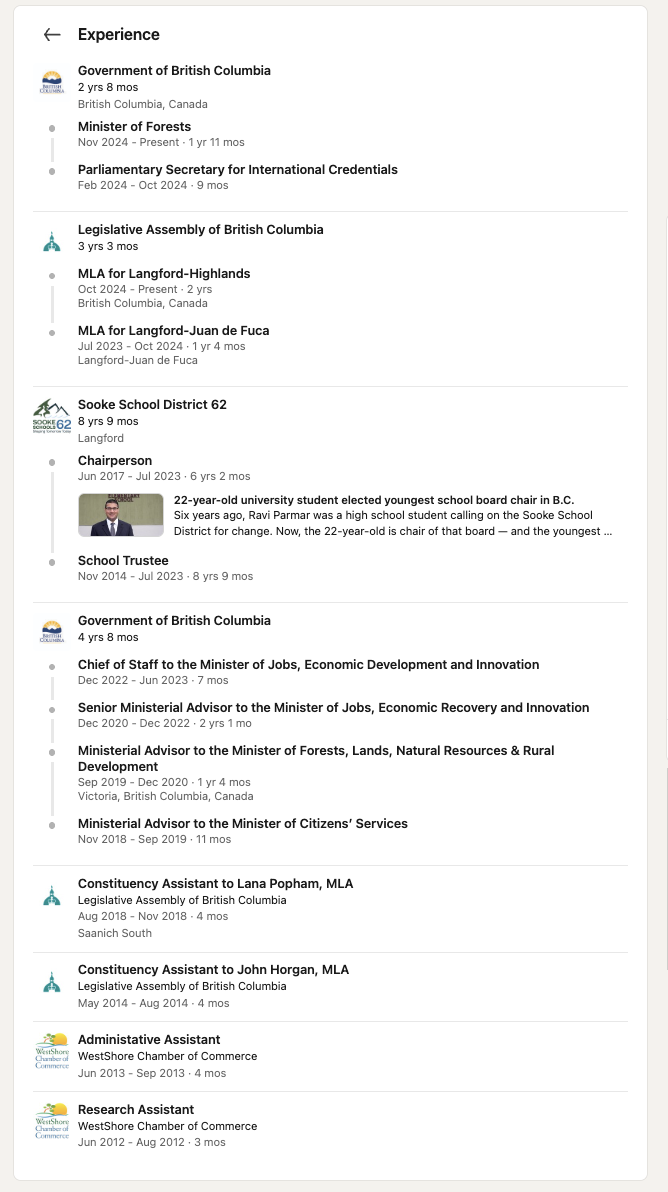
What it shows
One entry touches forestry: Ministerial Advisor to the Minister of Forests — one year and four months, a political staff job in a minister’s office, ending four years before he was handed the ministry itself. Everything above and below it is elected office or political staff work. The only two entries that are neither are student summers at a chamber of commerce: three months and four.
That is the whole curriculum vitae of the man running British Columbia’s forests. Seven months of work outside politics in a lifetime. Sixteen months within a hundred metres of the file he now owns. No forestry credential — the Forest Professionals BC register returns nothing under his name, and it keeps former registrants on the books for a decade, so the absence is real. And his statutory conflict-of-interest filings, four years running, list every source of income he has ever had: an MLA salary, a Ministry of Jobs salary, school district remuneration, and rent from two properties. No forestry company, no directorship, no forestry income, no union.3738
Every road document the Ministry of Forests issues carries the seal of a Registered Professional Forester or a professional engineer, because British Columbia requires qualified people to make those judgements. The only person in the chain who needed no qualification at all was the man placed above all of them. And his one stint inside the building ended in December 2020, the month after the Auditor General reported that the ministry was not maintaining its roads to its own policies.
He does not dispute any of this. Asked by BCBusiness in December 2024 how he answered constituents worried about electing someone with no experience outside politics: “I’ve been in politics my entire adult life… While I may not have that direct experience that others may expect for the minister of forests, I think I have the lived experiences.”36 Fifteen months later, defending his own ministry’s estimates in Committee of Supply, he put it more briefly.
“Again, I’m not a forester.”
Ravi Parmar · Hansard, 12 March 2026 · his own ministry’s estimates35
He is right. That is the problem.
02He learned the Ministry of Forests in its worst decade
Before he was elected to anything provincial, Parmar worked inside this same ministry as a senior advisor to Minister Doug Donaldson, who held the portfolio from July 2017 to November 2020.02
In Donaldson’s final month the Auditor General of British Columbia published Management of Forest Service Roads, and found the ministry was not maintaining its roads to its own policies. The numbers underneath that sentence are the ones that matter. For 2019/20 the districts asked for $40.2 million to keep the network up and were given $5.5 million. Requests had climbed forty-one per cent in three years while the allocation never moved. Nearly nine million dollars of work the districts themselves ranked high-priority simply went unfunded. Seven of the eight districts the auditor sampled could not produce an inspection record. And an internal audit had said all of this already — in 2008.03
14%
Of what its own districts asked for to maintain forest roads in 2019/20
$8.9M
High-priority maintenance left unfunded in a single year
4 of 9
Auditor General road recommendations still not complete, as at 31 March 2025
Six years later, under his own signature, the Ministry of Forests reported what it had actually done about that. In 2024/25 it reported capital improvements to 29 kilometres of forest service road, on seven roads, with 23 major structures repaired or replaced. Against a 58,000-kilometre network that is five one-hundredths of one per cent in a year — a renewal cycle of roughly two thousand years. It is the only province-wide kilometre figure the ministry has published, and it has not published one since.21
There is a reason nothing improves. Across his current three-year plan, the 2026/27–2028/29 Service Plan, the phrases forest service road, road maintenance, deactivation, bridge and culvert appear zero times. The ministry has never created a published performance measure for the 58,000-kilometre network at all.23 Nothing is measured, so nothing can be missed.
When somebody does go and look, this is what they find. In 2024 the Forest Practices Board audited BC Timber Sales — the government’s own logging agency, inside this ministry — in the Boundary and found it had inspected none of the 124 kilometres of road it had itself rated high or very high risk. The following year the Board audited BCTS on Haida Gwaii and found no road inspections since 2018, and a bridge over a fish stream that had failed.24
This is the room Ravi Parmar learned the job in. Not a ministry that builds things: a ministry that had quietly decided it could not afford what it already owned, and had been told so twice. He did not walk into that culture as a stranger in 2024. He was raised in it. Twenty-two months at the top of it have not changed the arithmetic.
He will point to one number, and he is entitled to. In the same estimates debate where he said he was not a forester, Parmar told the committee he had raised the provincial road maintenance budget from $6.1 million in 2022/23 to $16.5 million in 2025/26.35 Take it at face value. It is still less than half what the districts alone asked for in the single year the Auditor General examined, spread across a network his own ministry puts at 60,000 kilometres, and his current three-year plan sets no target for any of it. Tripling a number that was never close to adequate does not make it adequate.
03He promised to restore confidence
His official biography states that he “specifically requested the forestry portfolio from Premier David Eby, with a clear focus on restoring confidence in the sector.”02 Nobody drafted him. He wanted it.
“I think there are tough days ahead, but I have to be optimistic, because I asked for this job.”
Ravi Parmar, Minister of Forests · The Tyee, 6 March 202615
At least he still has his. Fifteen thousand forestry workers do not.
Set what he said against what arrived.
There is not one line where the promise and the outcome meet.
04The money left, and it is not coming back
Forestry used to pay for things in British Columbia. In 2020/21 it returned more than $1.3 billion to the provincial treasury. The budget now forecasts $521 million for 2026/27. By 2028/29 the Province expects to take almost three times as much from natural gas as from its forests.05
Read that last sentence again, because it is the quiet end of an era and it is happening on his watch. The resource this province was built on is being overtaken, in the government’s own accounts, by a pipeline.
Forest revenue to the Province
BC Budget forecasts as reported 17 February 202605
His mandate letter of 16 January 2025 gave him one hard, measurable number: work toward a land base able to sustain a harvest of 45 million cubic metres a year.04
His own ministry’s annual report puts the 2024 harvest at 38.9 million cubic metres across private and Crown land, unchanged from 2023.21 The Province’s own fiscal plan is blunter still: Budget 2026 assumes a Crown harvest of 29.0 million cubic metres, and holds it flat every year through 2028/29.22
Take whichever basis you like. On the ministry’s own all-lands number he is short. On the government’s own Crown number he is short by more than a third. And the fiscal plan does not contain a single year that trends toward forty-five — his own government has quietly stopped believing his mandate, while the mandate still says forty-five.
Harvest against the target in his own mandate letter
Mandate letter, 16 January 202504 · Ministry of Forests Annual Service Plan Report21 · Budget 2026, Table A522
05Twenty-one mills, fifteen thousand people
Numbers on a budget line are abstract. Mills are not. In 2025 alone the Crofton pulp mill, a West Fraser sawmill at 100 Mile House and a Drax pellet mill at Williams Lake all shut. Crofton put roughly 350 people out of work in jobs paying around $100,000 a year. In 2026 Canfor announced the closure of Northwood Pulp in Prince George, taking another 300. Quesnel River Pulp curtailed. Howe Sound Pulp and Paper curtailed indefinitely.060708
The industry’s own council counts twenty-one mills closed permanently or indefinitely since 2023, and more than fifteen thousand forestry jobs gone since 2022.07 Statistics Canada, looking only at Parmar’s first full year in office, counted at least 1,200 jobs lost in forestry and at least 800 in sawmills between December 2024 and December 2025.09
21
Mills closed permanently or indefinitely since 2023
15,000+
Forestry jobs lost since 2022
2,000
Lost in his first full year alone, Dec 2024 to Dec 2025
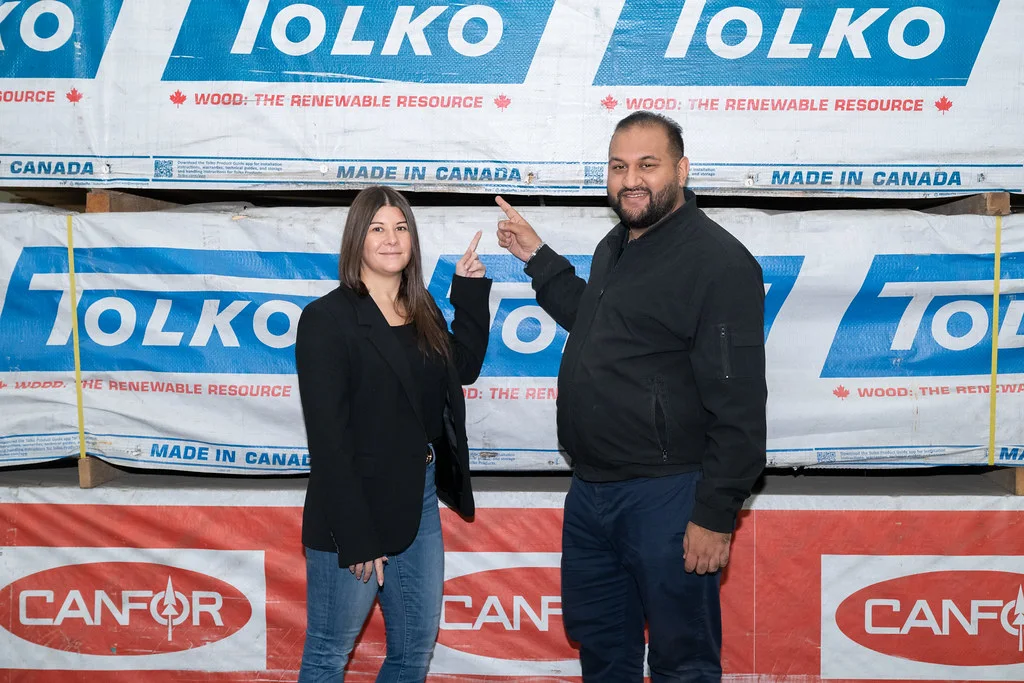
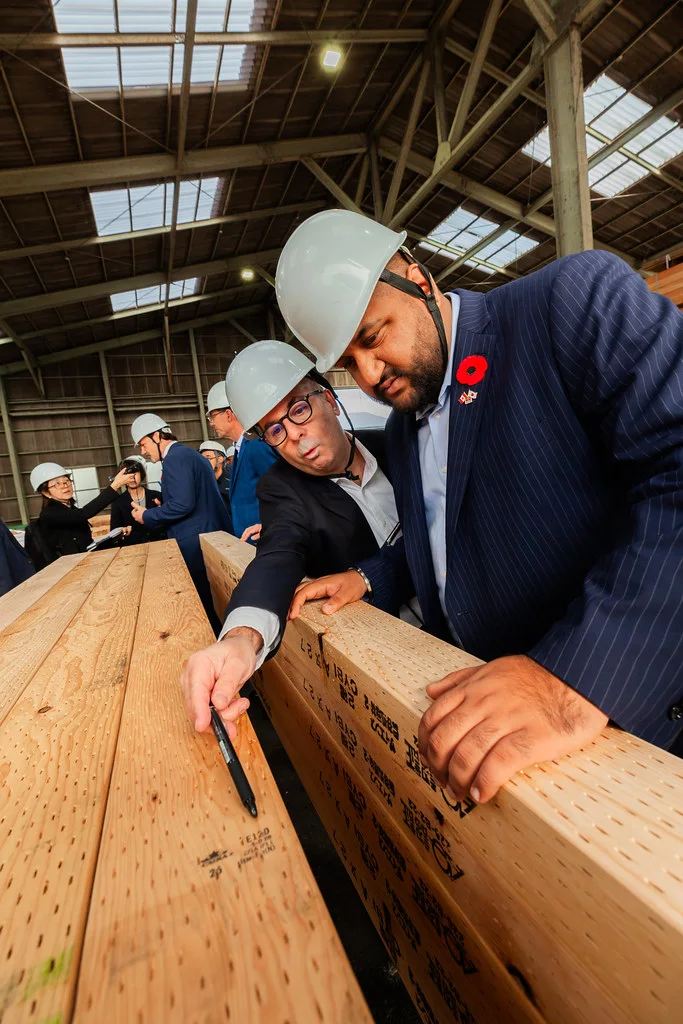
Every one of those is a household in a town that has few other employers, and most of those towns are exactly the places the rest of this government keeps telling to build a recreation economy instead.
06He is also the minister responsible for the fires
The Ministry of Forests owns the BC Wildfire Service. Wildfire is not weather that happens to this Minister — it is the largest operational responsibility he holds, and the largest cost he carries.
British Columbia has spent the past five years learning what happens when that responsibility is not met. On 30 June 2021 the village of Lytton burned almost completely to the ground, the day after it recorded the highest temperature ever measured in Canada. Two people died. Residents were still not home years later.20 In 2023 fire tore through the Shuswap and West Kelowna and the province recorded its most destructive season on record — 2.84 million hectares, on the Province’s own published summary.10
Those fires were not Ravi Parmar’s. Lytton burned three years before he took the portfolio, and the Shuswap a year before that. They are the inheritance against which his own record has to be read — because the question for a minister who arrives after a disaster is a simple one. Did anything change?
The cost says no. British Columbia spent $621 million fighting fire in 2024 and more than a billion in 2023; 2025 came in at $510 million as of 1 November. Across 2016–2025 the province averaged $525 million a year on suppression; across the preceding decade it averaged $252 million. The cost of fighting fire here has doubled in ten years. The annual figure has come down since 2023, but not because anything was fixed: 2025 burned 886,348 hectares — above the ten-year average of 791,278 — and still cost half a billion dollars.10
What it costs to fight fire in the forests he manages
Provincial wildfire suppression expenditure10
Then came his own season, and it deserves setting out properly. British Columbia recorded 1,389 fires and roughly 475,000 hectares burned in 2026 — about sixty per cent of the ten-year average. By area, it was a quiet year.32
It did not feel quiet. On 8 August 2026 the Province declared a state of emergency. More than twenty thousand people were driven from their homes. The Bald Range fire above Summerland ran to some 25,000 hectares, the community of Faulder was described by the district’s own chief administrative officer as nearly erased, and an eighty-year-old woman died in Meadow Valley trying to leave her house.33 Against a budget of $236 million, the year is forecast to cost $850 million.
Hold those two facts together, because the combination is the indictment. A below-average fire year still emptied twenty thousand homes, killed someone, and ran nearly four times over budget. That is not what a bad year looks like. That is what an average year now costs a province that has spent two decades not doing the prevention work, and whose current Minister of Forests responded by halving the treatment target.
And the emergency itself reached far beyond the fires. A state of emergency is declared province-wide, and it is declared by Emergency Management and Climate Readiness, not by the Minister of Forests. But its effect lands everywhere at once: travel advisories, cancellations and closures in valleys hundreds of kilometres from any flame, in a province where a single smoke-free week in August is the difference between a profitable season and a lost one for a backcountry lodge. Revelstoke had almost no smoke in 2026 and still wore the declaration. Nothing published sets out the threshold — how many hectares, how many crews committed, how many communities at risk — at which a fire emergency stops being regional and becomes province-wide. A blanket declaration is the cheapest instrument available and the most expensive one to the recreation economy, and nobody has to show their working before reaching for it. The recreation economy absorbs the cost of a fire season it did not cause and cannot prevent — and it is the same economy this Minister’s ministry is dismantling one forest service road at a time.14
That is the week in which the Minister of Forests was asked whether he should keep his job. It is worth being exact about how he answered.
07His own ministry’s scorecard, signed by him
Every figure so far has come from somebody else’s document. This one comes from his.
The Ministry of Forests publishes an Annual Service Plan Report grading itself against its own targets. The 2025/26 edition — Parmar’s first full fiscal year — was published in August 2026 and is signed by him personally, on 28 July 2026.21 It records that the ministry missed three of its seven published performance measures.
The worst of them is not close. Forest landscape plans are the legal regime created to deliver the Old Growth Strategic Review — the ministry’s own plan calls them integral to it. The target for the year was two. The number initiated was zero.21
3 of 7
Of his ministry’s own published performance measures missed in his first full year
0 of 2
Forest landscape plans initiated against target — zero per cent
51%
Cut to the Ministry of Forests’ own wildfire-risk treatment target — first reason given in its footnote: “available funding”
That last figure belongs with the fire numbers above. After the worst fire decade in the province’s history, the ministry cut its own target for area treated to reduce wildfire risk from 10,150 hectares to 5,000 — a 51 per cent reduction, and 58 per cent below what it had actually achieved the year before. Its own footnote names the reason: available funding.23
He halved the province’s own community fire-protection target in the decade its own record says was the worst on file.
And the agency he runs directly is shrinking. BC Timber Sales’ annual volume fell from 11.7 million cubic metres in 2020/21 to 4.5 million in 2024/25, a 62 per cent decline — a figure that appears in the task force report Parmar himself commissioned and which is addressed to him by name.26
08The fires are expensive because nobody prevented them
There is a reason British Columbia keeps paying half a billion dollars a year to put fires out, and it is not bad luck.
The Forest Practices Board reported in June 2023 that 39 million hectares — forty-five per cent of all public land in British Columbia — sits at high or extreme wildfire threat. Against that, roughly 26,000 hectares had been treated since 2018 to reduce the risk: “just over one percent of the [wildland-urban interface].” The Board’s own verdict on the pace was that such efforts “do not come close to achieving the scale required to restore landscape resilience.”25
39M ha
Of BC public land at high or extreme wildfire threat — 45% of it
~1%
Of the wildland-urban interface treated to reduce that risk since 2018
11:1
Hectares logged in the interface against hectares treated for fire risk, 2014–2023
That last figure is the one that belongs to this ministry specifically. In June 2025 the Board found that between 2014 and 2023 approximately 175,700 hectares were logged in the interface, against just 16,200 hectares treated specifically to reduce wildfire risk — eleven to one. Over a million British Columbians live in communities rated high or extreme risk.27 The same ministry authorises both. The Board is careful to say logging is not designed to reduce fire risk and that some practices can reduce it — its finding is that the two are not being coordinated. That is the charge: not that his ministry set out to make the interface more dangerous, but that it runs the biggest lever it has over that landscape without aligning it to the risk at all.
This is not a new discovery, and that is the damning part. The review the Province itself commissioned after the 2017 fires put the arithmetic in an appendix, using the BC Wildfire Service’s own data: across 2003–2017 British Columbia spent $3.099 billion suppressing fires and $73.8 million preventing them. Prevention was 2.3 per cent of what was spent.28 The Auditor General reached the same conclusion in February 2018 under a heading that needs no summary: “Wildfire prevention activities are not sufficient.”29
So what has this Minister done with that inheritance? He cut the treatment target by half and named available funding as the reason. And his ministry underspent its own fire preparedness budget in 2025/26 by $4.5 million, in a year it overspent suppression by $407 million.30
Which points at the deeper fiction. Over nine fiscal years British Columbia has voted $1.37 billion for fire management and actually spent $5.39 billion — nearly four times the vote — and the recorded variance is zero in every single year, because the money is authorised after the fact to match whatever was burned through. The budget is not a constraint. It is a placeholder.30
The current year makes the point in his own numbers. For 2026/27 the ministry budgeted $236 million for fire management. By September the forecast was $850 million. The same $236 million is budgeted again for each of the next two years.31
One last thing about the mandate letter. It runs to four pages and eight priorities for the Minister of Forests, the minister who owns the BC Wildfire Service. The words wildfire, fire, prevention, evacuation and emergency appear in it zero times. Tariff appears five times.04 That is the Premier’s document, not Parmar’s, and the failure of imagination in it belongs to David Eby. But Ravi Parmar asked for this portfolio, and a minister who wanted to prevent fires was never going to be stopped by a letter that forgot to mention them.
09Everyone is telling him. From every direction.
Criticism from the opposition can be dismissed as politics. Criticism from the opposition, the scientists the Province appointed, conservation groups, and the public, all at once, cannot.
After the Crofton pulp mill closes, taking roughly 350 jobs.
“Regulatory uncertainty, delayed permitting, and policy failures.”08
Deferrals are not achieving their original intent. Some deferral areas are now planned for harvest, or have already been logged.
“No visible plan on how to integrate them into ecologically based plans.”11
Volume increased through the government’s own logging agency while the deferrals it promised remain unresolved.12
Eight of British Columbia’s eighteen southern mountain herds are already gone.
Caribou are “not the smartest animal” because they run when they are disturbed.13
Calls for his resignation widen through the worst weeks of the fire season. He was answering criticism of his government’s wildfire management.
“I don’t have time for the BC Conservatives. If they want to play politics, they can fill their boots.”14
Note what is missing from every one of those answers: a result. Asked about his old-growth policy in March, he replied with what his government had done since 2017. Asked about caribou, he criticised the animals. Asked whether he should go, he told the people asking to fill their boots. A minister with something to show reaches for the something. This one reaches for a line.
10The industry stopped asking him, and started explaining the basics
On 4 September 2026 fifteen organisations representing essentially the whole of British Columbia’s forest sector signed a letter about the crisis in their industry.34
They did not send it to the Minister of Forests.
They sent it to Premier David Eby, and what they asked him for was a “Forestry Crisis Action Group, led by the Premier’s Office” — a phrase the letter uses twice. Ravi Parmar does not appear in the body of the document at all. He appears on page five, as the first of eight ministers copied on it. The single reference to him is oblique and is addressed to the Premier: a reminder that “your Minister of Forests” made a commitment in the Legislature on 9 April 2025 that has not been delivered.34
15
Forest-sector organisations signed the letter, including the BC First Nations Forestry Council and the United Steelworkers
0
Of them addressed it to the Minister of Forests
CC 1 of 8
Where Parmar appears — first in a list of copied ministers, on page five
Then it does something more damning than complain. It starts explaining the job to him. The letter’s own section headings are “The First Priority: Do No Further Harm”, “The Second Priority: Get the Wood Moving” and “Retain Workers—Do Not Wait to Retrain Them”. Underneath them is a six-point list any competent ministry would have written for itself: freeze new provincial fees and charges while the trade crisis lasts; stand up a cross-ministry permitting and fibre triage team; and — the line that should sting most — “within 30 days, release a public Forest Sector Crisis Action Plan identifying specific measures, responsible ministers and firm implementation timelines.”34
On wildfire the letter is blunter than the Minister has ever been: “invest in silviculture and forest management activities to prevent catastrophic fires in the first place. Prevention is much cheaper than response.”34 An industry coalition had to write that down for the minister responsible for the BC Wildfire Service.
And it hands over the harvest arithmetic too. The letter notes the Province’s fiscal plan assumes about 29 million cubic metres, says the industry believes BC can move toward 45 million, and reminds the Premier that “on April 9, 2025, your Minister of Forests confirmed in the Legislature that this objective was being advanced” — a commitment the signatories say has not been delivered.34 Fifteen organisations independently arrived at the same two numbers set out above, and had to remind the Premier that his own minister promised to close the gap between them.
Their language is not diplomatic. “BC’s forest sector is at a breaking point. Immediate action is required.” The mandate they want is “get economically viable wood moving, reduce costs, remove regulatory barriers, stabilize fibre supply, protect operating businesses, and retain—not retrain—British Columbia’s skilled forestry workforce.” And on page four, the line that should end any argument about whether this Minister still has the confidence of the sector he governs: “Long-term transformation of the forest sector remains important. But the time for relying primarily on incremental measures, studies and long-term transformation plans has passed.”34
They also remind the Premier that the federal Forest Sector Transformation Task Force “confirmed what industry has been saying for some time: many of the most serious challenges confronting Canadian forestry are ‘homegrown.’” Not tariffs. Not markets. Homegrown. And they tell him plainly: “The Province has both the authority and the responsibility to act.”34
Parmar’s public answer came five days later, at a media conference: “Clearly we are in arguably the most challenging period in forestry’s history.”34
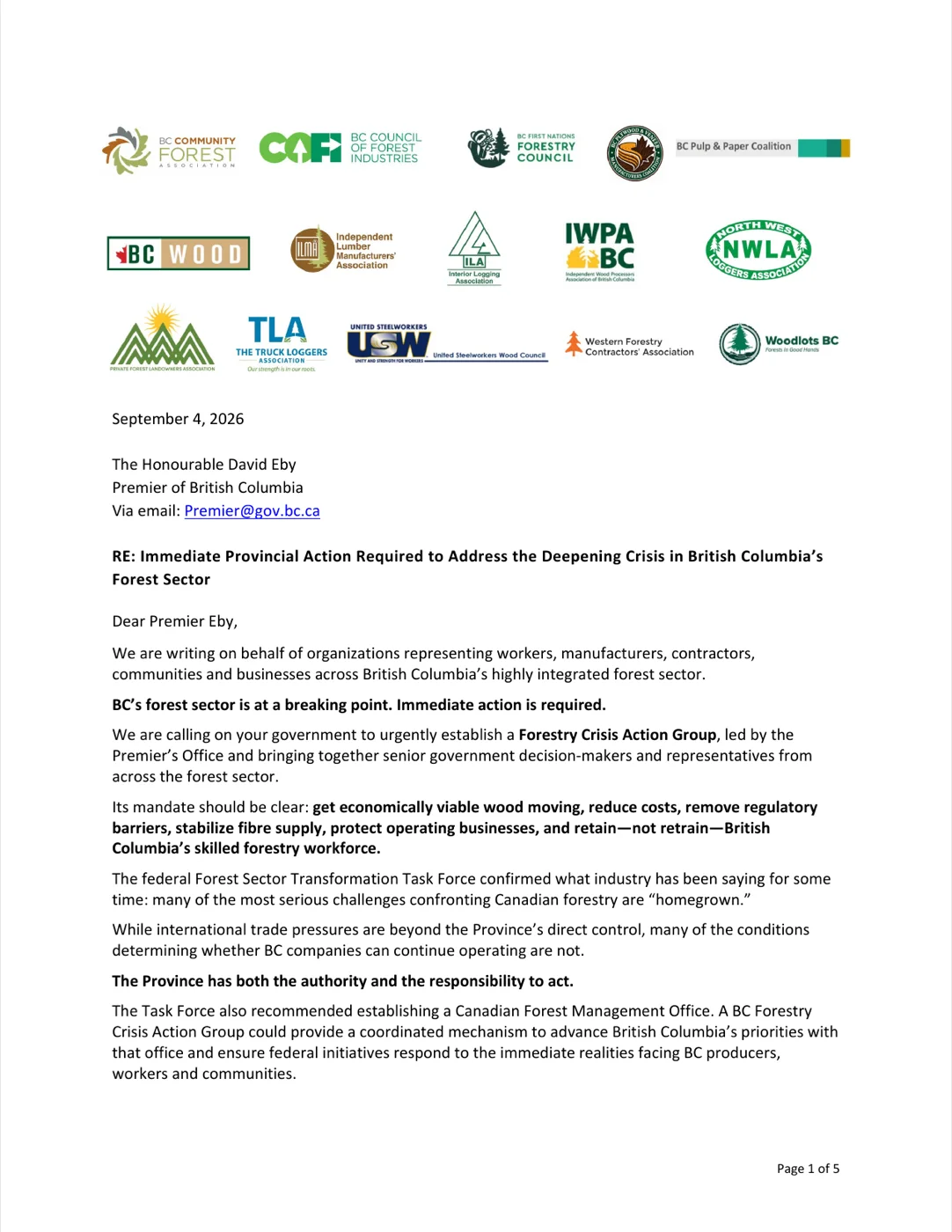
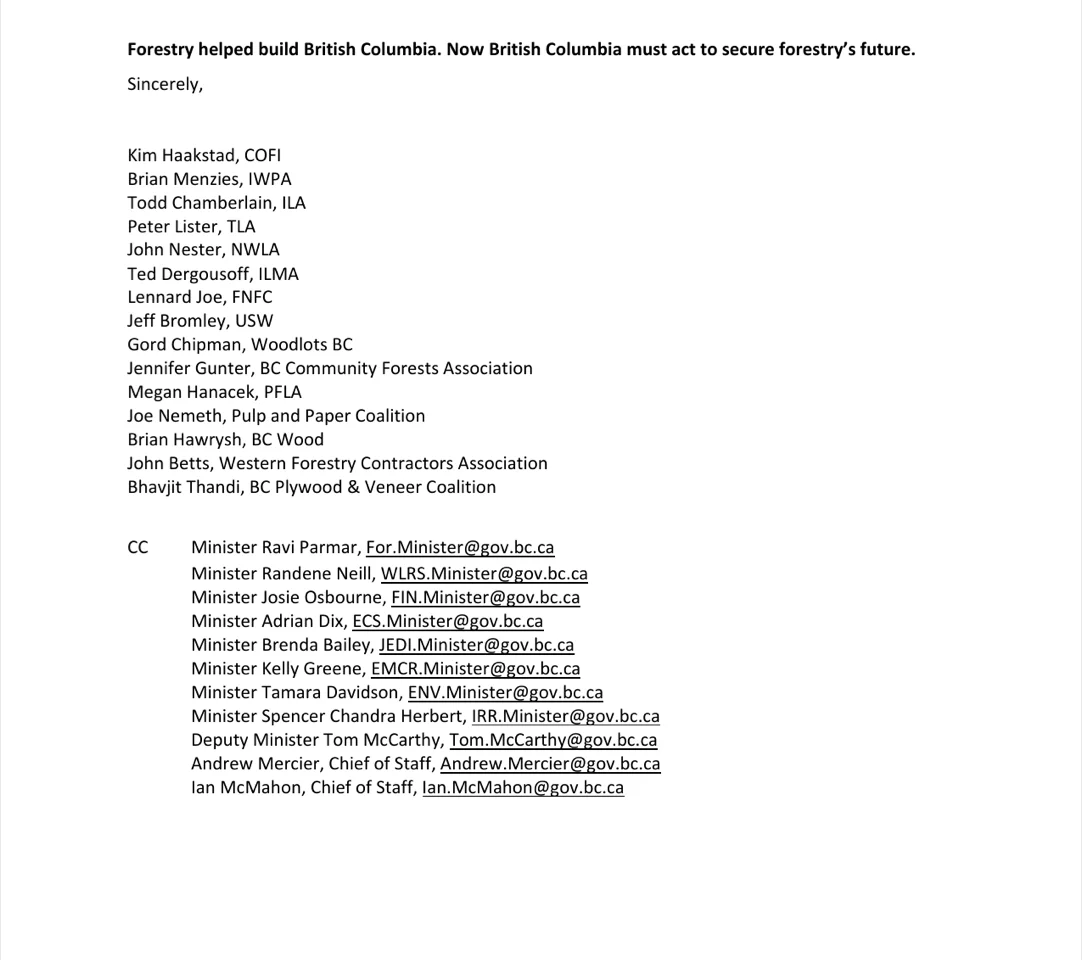
What it shows
The letter is addressed to the Premier. The ask, in its own words, is a “Forestry Crisis Action Group, led by the Premier’s Office.” Fifteen organisations sign it, from COFI and the Truck Loggers to the United Steelworkers and the First Nations Forestry Council.
The Minister of Forests appears once in five pages — first in the list of people copied. The industry did not ask him to fix it. It asked his boss, and copied him in.
When the entire industry you are responsible for writes past you to your boss and asks him to run it instead, the question of whether you still hold the job has already been answered by everyone except you.
11A board of directors, governing for shareholders, would have fired him already
Take the word minister off the file and put it in front of people whose own money is in the business.
The chief executive asked for this division. Since he took it, revenue has fallen to about forty per cent of its 2020/21 level and the finance department's four-year forecast leaves it there. Production is short of plan on every basis the company itself publishes, and the finance department’s own forecast holds it there. Twenty-one plants have closed. More than fifteen thousand people have left the workforce. The biggest operational cost line has doubled over a decade. Four of the external auditor’s nine recommendations from the last review are still outstanding, five years on, on a problem the internal audit first raised eighteen years ago. The expert panel the company itself appointed has put in writing that the flagship programme does not work. He has no qualification in the industry, has never run an operating business, and can point to no measurable improvement anywhere in the file.
He would not survive the next board meeting. And the directors would be asked, in public, why they let it run two years.
In business the executive usually goes before he is pushed, because the numbers have already made the argument and staying is the more humiliating option. In government he gives an interview about how he asked for the job — and then proceeds to fake it until he makes it, on an industry that employs tens of thousands of people and a forest estate the size of a country. That is not leadership. It is an internship with a ministry attached.
12The optics matter more to him than the outcome
Ravi Parmar’s career has been one unbroken ascent since he was sixteen. Youngest trustee in Canada. Youngest board chair in the province. Ministerial advisor, then chief of staff, then the seat a premier vacated, then cabinet at thirty. Nothing in that record has ever required him to stand in front of a room and say a thing had gone wrong on his watch. He has never had to.
Then he asked for the Ministry of Forests — and that request is the hinge of this whole story. Nobody handed him a failing portfolio. He went and got it, which means every number in it is personally his in a way it would not have been had he simply been assigned.
And every honest thing he could now do would require him to say, out loud, that the industry is smaller than it was and is not coming back. Funding a road for recreation instead of hauling means admitting the hauling is finished. Handing a road to a community rather than demolishing it means admitting his ministry will never afford it again. Building the recreation and tourism economy the rest of his government has already started building means standing in a mill town and telling people the mill is gone. Every one of those is the right call for the province. Every one of them also puts the words managed decline next to the name of a man whose entire brand is that he makes things happen.
So he does not say it. Watch what he reaches for instead, because it is the same move every time and it is always a move to protect the story rather than fix the file. Asked about his own panel’s finding that his old-growth policy is failing, he answered with what his government had done since 2017 — a record that predates him. Asked about a caribou population in collapse, he criticised the intelligence of the caribou. Asked whether he should resign with twenty thousand people out of their homes, he told his critics to fill their boots. Asked, in writing, to pause the destruction of the Rady Creek forest service road above Trout Lake, he did not reply; his ministry commissioned a fresh report written to a conclusion already fixed, re-tendered the work, and budgeted security guards to stand over it.
None of those is the behaviour of a man solving a problem. They are the behaviours of a man managing how the problem looks. A minister who cared more about the outcome than the optics would have taken the industry’s September letter as the emergency it plainly is; instead the letter went past him to the Premier and he told a media conference it was “arguably the most challenging period in forestry’s history” — a sentence that describes the weather and commits him to nothing.
So nothing is conceded, and the province gets the worst of every road. The target is missed and remains the only plan he knows. The forest service roads are neither maintained nor transferred — they are demolished, the one option that costs nothing next year and forecloses everything after it. The recreation economy grows in a room he is not in.
He is protecting a career. The people in Trout Lake, and in the other rural communities his forestry industry has abandoned, are paying for it. Fifty residents, three industries, one road, and a minister who will not risk the admission that would save it.
All he had to do was support his own government’s mandate to transition to a new recreation economy. Instead he clings to optics handed down to him by the men he understudied.
13His own government has moved on without him
On 21 May 2026 the Province launched Look West: B.C.’s Outdoor Recreation Strategy — seventeen targets, built on the finding that outdoor recreation contributes $4.8 billion a year and supports more than 1,400 businesses. It came from the Ministry of Environment and Parks under Tamara Davidson and the Ministry of Jobs and Economic Growth under Ravi Kahlon, the minister Parmar once served as a senior ministerial advisor. Kahlon’s case for it: outdoor recreation helps communities “diversify their economies and build long-term prosperity.”16
The Ministry of Forests is not on that announcement. The ministry that owns the 58,000 kilometres of road almost all of that recreation is reached by was not a partner in its own government’s recreation strategy.
$1M
To an outdoor-recreation manufacturing and training centre in the Kootenays · 21 May 2026
$400K
To restore snowmobile trail access at Renshaw near McBride, including a bridge · same announcement
4,395 m
Of Kootenay recreation road his ministry tendered for permanent destruction four months later
14What it looks like when it reaches the ground
Rady Creek forest service road 0321.02 climbs out of Trout Lake, a village of about fifty full-time residents whose remaining economy is tourism, mineral exploration and recreation. All three go up that road. His ministry has tendered 4,395 metres of it for permanent deactivation, with bids closing at 1:00 PM on 24 September 2026.17
On 6 July 2026 a provincial recreation federation put the file on the Minister’s desk and asked for an administrative pause.18 On 8 September the Selkirk Natural Resource District took delivery of a new forty-two page deactivation prescription it had commissioned. On 9 September the tender went back out. The instruction handed to the consultant before any engineering was done was that the road “is intended to be deactivated to a permanent standard, and that post-deactivation vehicular access is not required.” The tender budgets for round-the-clock on-site security, because the ministry’s own paperwork describes the job as “contentious” and “well known to the public.”17
There is one more document in this file, and it is the one that should settle the argument about consultation. In October 2021 the Ministry postponed this same deactivation and circulated its reason, in writing, to everyone who had written in to object: the delay would “allow for further consultation and discussions to be conducted if needed with interested stakeholders.” That undertaking was given by the Ministry of Forests. No consultation for Rady Creek appears anywhere on the record in the five years since — the last twenty-two months of them his.39
Fourteen cents on the dollar in 2019/20 is why the district cannot maintain this road. A mandate written to keep costs low is why the cheapest disposal wins. A recreation strategy his ministry was not invited to is why nobody ever costed the alternative. He was asked in July to stop it and did not. A minister will say, correctly, that he does not personally sign a road prescription — that these files are settled by an assistant deputy minister and a district office, well below his desk. That is true, and it is the whole point. Officials decide what the minister’s priorities allow them to decide. A ministry told to keep costs low, given no road target to hit and no recreation mandate to serve, will produce exactly this decision in exactly this district, over and over, until somebody at the top changes what it is for. That is the job he asked for. Rady Creek is Ravi Parmar’s record arriving in one valley, with security guards hired to stand over it.
And the Selkirk Natural Resource District is not an outlier in his ministry. It is his ministry working exactly as configured: an office that found the money for round-the-clock security but has not found an afternoon for a meeting in five years, that commissioned an engineering report after the conclusion was already written into the brief, and that let a written undertaking to consult sit unhonoured since 2021. No district behaves like that for five years unless the building above it is content.
15Let’s all say it out loud together: Ravi, you should just resign
Forestry was in trouble before him and will be in trouble after him. Softwood duties, a beetle-killed fibre supply and a warming climate are not his invention, and no minister should be run out of office over weather. That is not the case against Ravi Parmar.
The case against him is that he asked for a job he was not qualified to hold, promised to restore confidence in a sector, and delivered nothing measurable in two years. Every published metric is worse. His own target has been missed on every basis his government publishes, and its fiscal plan contains no year that trends toward it. His own experts say his own policy is failing. His ministry has been working through the same road-maintenance findings since 2008. And on every occasion he has been asked about it, he has answered with 2017, with the stupidity of caribou, or with an invitation to fill our boots.
Good leaders stand down when they cannot do the job. They do not wait to be voted out or shamed out. They look at a record like this one, accept that somebody else would do it better, and go — because the towns carrying the consequences are real places with real people in them, and because at some point staying is no longer service. It is just vanity.
So let us all say it out loud together, Minister. Ravi, you should just resign. Not because forestry is hard, but because you asked for this, you promised to restore confidence in it, and on every number your own government publishes you have made it worse. Go, and let whoever comes next begin with the two things you would not do: pause the Rady Creek deactivation, and publish a mechanism for transferring public roads into the recreation economy instead of demolishing them.
At this point, that kind of humility is the only thing that could save your legacy from the same destruction you are using to harm rural communities — communities that depend on transitioning away from your failed forestry business model and towards a recreation economy.
Share this story
6 images carrying this story on their own — the figure, the claim and the document each one comes from. Made to be posted.


Slide 1 of 6
Suggested caption
British Columbia’s Minister of Forests has never worked a day in the forest industry.
He said it himself, defending his own ministry’s budget: “Again, I’m not a forester.” He asked Premier David Eby for the job anyway. Twenty-two months on:
Forest revenue down to 40% of its 2020/21 level — $1.3B a year, now a forecast $521M.
21 mills closed. 15,000+ forestry jobs gone — 2,000 in his first full year.
His ministry missed 3 of its 7 own targets, in a report he signed himself. Forest landscape plans: target two, delivered zero.
29 km of forest road improved in a year, out of 58,000 — a two-thousand-year renewal cycle. His three-year plan never once says “forest service road”.
His own agency inspected none of the 124 km it rated high risk. Haida Gwaii: no inspections since 2018, and a failed bridge over a fish stream.
39M hectares at high or extreme wildfire threat. Barely 1% treated. 2014–2023 his ministry authorised 175,700 ha logged in the fire interface against 16,200 treated for risk.
Then he halved his own wildfire-protection target — 10,150 ha to 5,000 — after the worst fire decade on record.
$236M budgeted to fight fire this year. $850M forecast. Over nine years: $1.37B voted, $5.39B spent.
On 4 September fifteen forest-sector organisations wrote to the Premier. Not to him. They asked Eby for a crisis group “led by the Premier’s Office”. Parmar isn’t in the letter — he’s on page five, first of eight ministers CC’d.
When the whole industry writes past you to your boss, the question of whether you still hold the job has been answered by everyone except you.
Asked if he should resign, he said critics could “fill their boots”.
Ravi Parmar should resign as Minister of Forests.
Pause the Rady Creek deactivation. Transition public roads into the recreation economy instead of demolishing them.
backcountry.cx/editorials/ravi-parmar-failed-leadership/
#BCpoli #PublicLand #RecreationEconomy #Kootenays #Forestry
Sources
- ↩Belmont Secondary walkout, 2011. The petition of more than 1,700 signatures, the walkout over air quality, asbestos, mould and a leaking roof, its presentation in the legislature by Juan de Fuca MLA John Horgan, and the announcement of funding for two West Shore schools on 31 October 2011. Goldstream News Gazette. https://goldstreamgazette.com/news/belmont-students-rally-for-new-west-shore-high-schools
- ↩Career record. Trustee, School District 62, 2014 at age twenty; board chair 2017 at twenty-two; senior ministerial advisor in the Ministry of Forests under Minister Doug Donaldson; Senior Ministerial Advisor to Ravi Kahlon at Jobs, Economic Recovery and Innovation, and later Chief of Staff at Jobs, Economic Development and Innovation under Brenda Bailey; by-election win 24 June 2023; re-election 19 October 2024; appointed Minister of Forests 18 November 2024. The quoted sentence that he “specifically requested the forestry portfolio from Premier David Eby” is from the Minister’s own official biography. Doug Donaldson held the Forests, Lands, Natural Resource Operations and Rural Development portfolio from 18 July 2017 until 26 November 2020, the date the Province announced Katrine Conroy’s appointment to it (news release 2020PREM0102-001966). Parmar’s trustee service ran from the general local election of November 2014 to his resignation on 27 July 2023, the day before he was sworn in as an MLA. https://news.gov.bc.ca/ministries/forests/biography https://en.wikipedia.org/wiki/Ravi_Parmar https://news.gov.bc.ca/releases/2020PREM0102-001966
- ↩Office of the Auditor General of British Columbia, Management of Forest Service Roads. Report dated November 2020, transmittal letter signed January 2021, released 19 January 2021, audit period 2016 to 2019. The conclusion that the ministry did not manage safety and environmental risks on forest service roads as required by its policies, at pp. 5, 7 and 9; the 58,000 km network split 38,000 km district and 20,000 km BC Timber Sales, at Exhibit 1, p. 24; the $40.2M requested against $5.5M allocated in 2019/20 — 14 per cent, against 20 per cent in 2017/18 — at Exhibit 8, p. 39; the $8.9M of unfunded high-priority maintenance, and the $21.5M capital-road request funded at 26 per cent, at Exhibit 9, p. 40; district record-keeping, the eight-of-23 sample and the 2008 Internal Audit & Advisory Services findings at p. 38. Recommendation status is from the Office of the Auditor General’s October 2025 Annual Follow-up Report, which records five of the nine recommendations complete and four not complete as at 31 March 2025. Published in full with the Rady Creek record at saverady.com. https://www.oag.bc.ca/app/uploads/sites/963/2024/08/OAGBC-20210119-Management-Forest-Service-Roads_RPT.pdf https://www.oag.bc.ca/app/uploads/sites/963/2025/10/OAGBC-202510-AFR-final-RPT.pdf https://saverady.com/
- ↩Mandate letter to the Honourable Ravi Parmar, Minister of Forests, signed David Eby, KC, Premier, 16 January 2025. The source of the 45,000,000 cubic metre target and of the instruction to work with the Minister of Finance to “review all existing Ministry of Forests programs and initiatives… and help keep costs low for British Columbians” in the context of “current Provincial budget constraints.” Retrieved 14 September 2026, 140,449 bytes. The same target is restated in the Ministry of Forests 2025/26–2027/28 Service Plan. https://www2.gov.bc.ca/assets/gov/government/ministries-organizations/premier-cabinet-mlas/minister-letter/mandate_letter_ravi_parmar.pdf
- ↩Provincial forest revenue. $1.3 billion in 2020/21; $521 million forecast for 2026/27; $556 million forecast for 2028/29 against $1.57 billion in natural gas royalties the same year. BC Budget figures as reported by The Globe and Mail, 17 February 2026. https://www.theglobeandmail.com/business/article-bc-budget-natural-gas-forestry-revenue/
- ↩Business in Vancouver, “Mill closures pile up as BC harvest lags behind allowable cut.” The pattern of closures and curtailments across 2025 and 2026 against a harvest running well below the allowable cut. Harvest volumes themselves are taken from the Province’s own documents at sources 21 and 22 rather than from news reporting, because three different harvest figures circulate on three different bases — all-lands, Crown, and log-export reporting — and only the government’s own basis is safe to set against a government target. https://www.biv.com/news/resources-agriculture/bc-forest-sector-faces-another-tough-year-in-2026-11793817
- ↩BC Council of Forest Industries. “at least 21 BC lumber mills have closed permanently or indefinitely” since 2023, and “more than 15,000 forestry jobs have been lost since 2022.” These are the BC Council of Forest Industries’ own figures, not the Province’s. https://cofi.org/cofi-statement-on-indefinite-curtailment-of-pulp-mill/
- ↩Closures and the first resignation call. The Crofton pulp mill, roughly 350 workers at an average of about $100,000 a year, and the Conservative caucus call for the Minister’s resignation of 2 December 2025 citing “regulatory uncertainty, delayed permitting, and policy failures”; the 2025 closures of a West Fraser sawmill at 100 Mile House and a Drax pellet mill at Williams Lake; Canfor’s Northwood Pulp closure in Prince George, 300 jobs; and the curtailments at Quesnel River Pulp and Howe Sound Pulp and Paper. https://conservativebc.ca/conservatives-call-for-forest-minister-ravi-parmar-to-resign-after-crofton-pulp-mill-closes/ https://www.cbc.ca/news/canada/british-columbia/canfor-mill-closes-9.7270420
- ↩Statistics Canada’s survey of employment and payroll, as reported 19 March 2026. “at least 1,200 job losses in forestry, which include logging and supporting jobs, and at least 800 job losses in sawmills between December 2024 and December 2025.” December 2024 to December 2025 is Parmar’s first full year in the portfolio. Canadian Press wire report. https://ca.news.yahoo.com/employment-statistics-highlight-still-tough-130042801.html
- ↩Provincial wildfire suppression expenditure. $510 million in 2025 against 886,348 hectares burned; $621 million in 2024; more than $1 billion in 2023; and an annual average of $525 million across 2016–2025 against $252 million a year across 2006–2015. The Province’s own season summaries record 2.84 million hectares in 2023 and 886,300 hectares in 2025. https://www.castanet.net/news/BC/586042/B-C-spent-510-million-fighting-wildfires-this-year https://www2.gov.bc.ca/gov/content/safety/wildfire-status/about-bcws/wildfire-history/wildfire-season-summary
- ↩Old Growth Technical Advisory Panel. Letter from all five panel members, reported 20 March 2026, including that deferrals are not achieving their original intent, that some deferral areas are now planned for harvest or already harvested, and that there is “no visible plan on how to integrate them into ecologically based plans.” Black Press. https://revelstokereview.com/2026/03/20/b-c-allowing-old-growth-logging-despite-protection-promise-experts-say/
- ↩Sierra Club BC on the increase of BC Timber Sales volume by a further 800,000 cubic metres. https://sierraclub.bc.ca/stories-events/media-releases-kits/sierra-club-bc-forests-minister-ravi-parmar-pushing-unsustainable-logging-rates/
- ↩Caribou remarks. Made to Black Press Media during the Minister’s visit to Revelstoke on 9 June 2026 and reported 16 June 2026; the figure that eight of eighteen southern mountain caribou herds are extinct is given in the same reporting. Revelstoke Review. https://revelstokereview.com/2026/06/16/extremely-concerning-b-c-environmentalists-outraged-by-ministers-caribou-comments/
- ↩Resignation calls of August 2026 and the Minister’s reply. “I don’t have time for the BC Conservatives. If they want to play politics, they can fill their boots”; the provincial state of emergency declared 8 August 2026 and more than 20,000 people under evacuation. Tree Frog News · Al Jazeera. https://treefrogcreative.ca/calls-for-forests-minister-ravi-parmar-to-resign-intensify-amid-wildfire-crisis/ https://www.aljazeera.com/news/2026/8/8/british-columbia-issues-evacuation-orders-ahead-of-fast-moving-wildfires
- ↩The Tyee, “BC’s Forests Minister on ‘Tough Days,’ Wildfire, Mill Closures and More,” Tyler Olsen, 6 March 2026. The source of “I have to be optimistic, because I asked for this job” and “My government, since 2017, has done more to protect old growth and biodiversity than any government in the history of British Columbia.” https://thetyee.ca/News/2026/03/06/Ravi-Parmar-Interview/
- ↩Province of British Columbia, Look West: B.C.’s Outdoor Recreation Strategy, news release 2026ENV0024-000574, 21 May 2026. Issued by the Ministry of Environment and Parks (Minister Tamara Davidson) and the Ministry of Jobs and Economic Growth (Minister Ravi Kahlon) — seventeen targets; $4.8 billion in annual economic contribution; more than 1,400 businesses; and the Rural Economic Diversification and Infrastructure Program awards of $1 million to the ReHub Circular Technology Centre at College of the Rockies in the Kootenays and nearly $400,000 to the Renshaw snowmobile trail system revitalisation near McBride, including bridge installation. The Ministry of Forests does not appear as an issuing ministry. https://news.gov.bc.ca/releases/2026ENV0024-000574
- ↩Rady Creek FSR 0321.02. 4,395 m tendered for permanent deactivation, BC Bid opportunity 233877, re-posted 9 September 2026, closing 1:00 PM on 24 September 2026; the deactivation prescription of 8 September 2026 prepared for the Ministry of Forests, Selkirk Natural Resource District by SNT Geotechnical Ltd., including the instruction that the road “is intended to be deactivated to a permanent standard, and that post-deactivation vehicular access is not required”; and the tender’s provision for 24/7 on-site security and its description of the work as “contentious” and “well known to the public.” The full document file is published at saverady.com. https://saverady.com/
- ↩Escalation to the Minister. A provincial recreation federation published an account, on 13 July 2026, of the request it sent to Minister Parmar on 6 July 2026 asking for an immediate administrative pause on the Rady Creek deactivation. The organisation is not part of this coalition; the account is public and the citation is available on request to contact@backcountry.cx.
- ↩Photographs of the Minister. Province of British Columbia, BC Government Photos. Each image used here carries published caption text naming him: “Pictured: Ravi Parmar, Minister of Forests” and “Pictured (right): Ravi Parmar, Minister of Forests.” Reproduced for the purpose of news reporting and criticism, credited to the Province. The header photograph is a Wikimedia Commons image of Parmar released under CC BY 2.0. https://www.flickr.com/photos/bcgovphotos/
- ↩Lytton, 30 June 2021. The village was destroyed by fire the day after recording the highest temperature ever measured in Canada; two people died and rebuilding ran for years afterwards. This fire predates Minister Parmar’s appointment by more than three years. British Columbia’s wildfire season summaries, including the 2.84 million hectares burned in 2023 described by the Province as its most destructive season on record, are published at gov.bc.ca. https://www2.gov.bc.ca/gov/content/safety/wildfire-status/about-bcws/wildfire-history/wildfire-season-summary
- ↩BC Ministry of Forests, 2025/26 Annual Service Plan Report, published August 2026. The government’s own scorecard for Parmar’s first full fiscal year, signed “Honourable Ravi Parmar, Minister of Forests, July 28, 2026” at p. 5. Three of seven published performance measures missed (pp. 11–21); forest landscape plans initiated, target 2, actual 0 (PM 2.1, p. 14). And the 2024/25 Annual Service Plan Report, August 2025, signed 8 August 2025 — source of the 38.9 million cubic metre all-lands harvest for 2024 (p. 7) and of the 29 km of forest service road improved with 23 major structures repaired or replaced in 2024/25. https://bcbudget.gov.bc.ca/Annual_Reports/2025_2026/pdf/ministry/for.pdf https://bcbudget.gov.bc.ca/Annual_Reports/2024_2025/pdf/ministry/for.pdf
- ↩BC Ministry of Finance, Budget and Fiscal Plan 2026/27–2028/29, 17 February 2026. Table A5, p. 156: Crown harvest assumption of 29.0 million cubic metres, held flat across 2025/26 to 2028/29 (Interior 21.8–22.1, Coast 6.9–7.3). Forest revenue figures are from the same plan. https://www.bcbudget.gov.bc.ca/2026/pdf/2026_Budget_and_Fiscal_Plan.pdf
- ↩BC Ministry of Forests, 2026/27–2028/29 Service Plan, February 2026. The wildfire-risk treatment target reduced to 5,000 hectares from the 10,150 hectares set in the 2025/26–2027/28 Service Plan, with “available funding” named in the ministry’s own footnote; 11,894 hectares were achieved in 2025/26. Method for the road-silence claim: case-insensitive term counts across the converted text of all four plans and reports — in the 2026/27–2028/29 Service Plan, “forest service road”, “road maintenance”, “deactivation”, “bridge”, “culvert” and “resource road” each return zero. Where roads do appear in the annual reports it is in narrative text, never as a performance measure. https://www.bcbudget.gov.bc.ca/2026/sp/pdf/ministry/for.pdf
- ↩Forest Practices Board, Audit of BC Timber Sales and Timber Sale Licence Holders: Boundary TSA Portion of the Kootenay Business Area, FPB/ARC/266. BCTS had not inspected any of the 124 km of road it had itself rated high or very high risk. And Forestry Audit: BCTS & TSL Holders — Haida Gwaii Natural Resource District Portion of the Chinook Business Area, FPB/ARC/270 — no road inspections since 2018 and a failed bridge over a fish stream. BC Timber Sales is an agency of the Ministry of Forests. https://www.bcfpb.ca/wp-content/uploads/2024/08/ARC266-BCTS-Boundary-TSA.pdf https://www.bcfpb.ca/wp-content/uploads/2025/01/ARC270-Haida-Gwaii.pdf
- ↩Forest Practices Board, Forest and Fire Management in BC: Toward Landscape Resilience, SR61, June 2023. 39 million hectares, 45 per cent of BC public land, at high or extreme wildfire threat on the 2021 Provincial Strategic Threat Analysis; approximately 26,000 hectares treated since 2018, “just over one percent of the WUI,” at an estimated $72 million; and the Board’s finding that such efforts “do not come close to achieving the scale required to restore landscape resilience.” https://www.bcfpb.ca/wp-content/uploads/2023/06/SR61-Landscape-Fire-Management.pdf
- ↩Task Force on BC Timber Sales — Recommendations, prepared for the Honourable Ravi Parmar by Lennard Joe, Brian Frenkel and George Abbott, July 2025, published September 2025. BCTS annual volume falling from 11.7 million cubic metres in 2020/21 to 4.5 million in 2024/25, a 62 per cent decline. Commissioned by the Minister and addressed to him by name. https://www2.gov.bc.ca/assets/gov/farming-natural-resources-and-industry/forestry/bc-timber-sales/business-plans-performance-reports/bcts_task_force_report.pdf
- ↩Forest Practices Board, Help or Hinder? Aligning Forestry Practices with Wildfire Risk Reduction, SIR56, June 2025. Between 2014 and 2023 approximately 175,700 hectares were logged in the wildland-urban interface against 16,200 hectares treated specifically to reduce wildfire risk; 2.1 million hectares of interface classified high or extreme risk as of 2021; more than one million British Columbians live in high or extreme risk communities. https://www.bcfpb.ca/wp-content/uploads/2025/06/SIR56-Help-or-Hinder.pdf
- ↩George Abbott and Chief Maureen Chapman, Addressing the New Normal: 21st Century Disaster Management in British Columbia, submitted 30 April 2018, Appendix B, Table 2, pp. 115–116. Across 2003–2017, suppression expenditure of $3,099,000,000 against prevention expenditure of $73,761,344, and 11,678.5 hectares treated against 3,385,881 hectares burned. Prevention was 2.3 per cent of combined spending. The underlying data was provided by the BC Wildfire Service in April 2018; this is a review the Province itself commissioned. https://www2.gov.bc.ca/assets/gov/public-safety-and-emergency-services/emergency-preparedness-response-recovery/embc/bc-flood-and-wildfire-review-addressing-the-new-normal-21st-century-disaster-management-in-bc-web.pdf
- ↩Auditor General of British Columbia, Managing Climate Change Risks: An Independent Audit, February 2018, pp. 74–75. Section heading “Wildfire prevention activities are not sufficient”; 11,248 hectares treated or planned against an estimated 1,347,000 hectares of high-risk area, under 1 per cent. https://www.oag.bc.ca/app/uploads/sites/963/2024/07/OAGBC-2018-02-01-Climate_Change_FINAL.pdf
- ↩Ministry of Forests Annual Service Plan Reports, Financial Report — Financial Summary, Fire Management row, fiscal 2017/18 to 2025/26. $1,370.080M voted against $5,387.831M actually spent across nine years, with a recorded variance of zero in every year because supplementary authority is granted after the fact. Fire preparedness was underspent by $4.514M in 2025/26 ($62.405M budgeted, $57.891M actual) in the same year fire management ran $407.065M over its vote. Published at bcbudget.gov.bc.ca under each fiscal year. https://www.bcbudget.gov.bc.ca/
- ↩BC Ministry of Finance, First Quarterly Report 2026/27, released 14 September 2026. $236 million budgeted for fire management in 2026/27 against a forecast of $850 million, with $236 million budgeted again for each of 2027/28 and 2028/29. https://www2.gov.bc.ca/assets/gov/british-columbians-our-governments/government-finances/quarterly-reports/2026-27_first_quarterly_report.pdf
- ↩2026 season totals. 1,389 fires and 475,124.6 hectares in fire year 2026, computed from the BC Wildfire Service’s own published fire-locations layer as at 14 September 2026, against a ten-year average of 791,278 hectares published by the Province. The Province has not published a 2026 season summary: its summary page was last updated 2 January 2026 and stops at 2025, so this is a live figure that moves. 2026 was a below-average year for area burned. https://www2.gov.bc.ca/gov/content/safety/wildfire-status/about-bcws/wildfire-statistics/wildfire-averages
- ↩The death near Summerland. An 80-year-old woman in Meadow Valley who died while attempting to leave her home during the Bald Range fire, reported by the RCMP; the BC Coroners Service was investigating. Evacuation orders and the provincial state of emergency are issued by Emergency Management and Climate Readiness under the Emergency and Disaster Management Act, not by the Minister of Forests. https://www.castanet.net/news/Summerland/627520/RCMP-confirm-woman-80-died-when-Bald-Range-wildfire-swept-through-Meadow-Valley
- ↩Joint letter to the Honourable David Eby, Premier of British Columbia, “Immediate Provincial Action Required to Address the Deepening Crisis in British Columbia’s Forest Sector,” 4 September 2026, five pages. Signed by fifteen forest-sector organisations including the BC Council of Forest Industries, the BC First Nations Forestry Council, the United Steelworkers, the Truck Loggers Association, the Interior Logging Association, the BC Community Forest Association, Woodlots BC, the Private Forest Landowners Association and the BC Plywood & Veneer Coalition. Quoted passages are at pp. 1, 2 and 4; the request for a Forestry Crisis Action Group “led by the Premier’s Office” appears at p. 1 and again in the formal ask at p. 4; the Minister of Forests appears only in the CC block at p. 5. The letter itself (PDF, republished here) — 253,673 bytes, md5 4b36ddafe5d4ba3cc61f8b89e017e9ec, retrieved 14 September 2026. Minister Parmar’s reply of 9 September 2026 was given at a media conference. The letter itself contains no job-loss or mill-closure counts; those figures are sourced separately above. https://cofi.org/joint-letter-to-premier-eby/
- ↩Hansard, 43rd Parliament, 2nd Session, Thursday 12 March 2026, afternoon, Issue No. 141. Committee of Supply, estimates of the Ministry of Forests. The Minister: “Again, I’m not a forester, but I trust the foresters and my ministry and those out working in the land and in the bush to be able to make those decisions based on the science.” https://lims.leg.bc.ca/hdms/file/Debates/43rd2nd/20260312pm-Hansard-n141.html
- ↩BCBusiness, “5 Questions: New forests minister Ravi Parmar,” Nathan Caddell, 19 December 2024. The interviewer’s framing is that he has “spent all of your working life in government” and asks how he answers those concerned about “electing an MLA who had no experience outside of politics.” https://bcbusiness.ca/business/natural-resources/ravi-parmar-new-forests-minister-5-questions-interview-struggling-forestry-sector-tariffs-john-horgan-bc/
- ↩Public disclosure statements filed under the Members’ Conflict of Interest Act, Legislative Assembly of British Columbia, 2023 through 2026. The 2023 statement lists sources of income as MLA salary and allowances, a Ministry of Jobs, Economic Development and Innovation salary ceasing 26 June 2023, remuneration from School District No. 62 ceasing the same day, and rental income from two investment properties. The 2024, 2025 and 2026 statements show the same picture. These filings are the complete legal record of his sources of income. https://www.leg.bc.ca/about/accountability/members-disclosures/public-disclosure-statements/
- ↩Experience record. Reproduced from Ravi Parmar’s own published professional profile, which lists each employer, role, date range and duration. Dates and durations in Exhibit 01 are his, as he states them; where the public record differs slightly — the Lobbyists Registry, which carries 703 dated third-party filings between 2020 and 2026 stamping his title and ministry, places the start of the Chief of Staff post nearer February 2023 — the exhibit carries his figures, because the point of it is what he says about himself. Order in Council 595/2024 is the instrument appointing him Minister of Forests on 18 November 2024, and the Legislative Assembly’s member record carries his election dates. https://www.lobbyistsregistrar.bc.ca/ https://www.leg.bc.ca/members/43rd-Parliament/Parmar-Ravi https://www.bclaws.gov.bc.ca/civix/document/id/oic/arc_oic/0595_2024
- ↩The consultation undertaking. Letter circulated by the constituency office of the then Minister of Forests, 26 October 2021, sent to everyone who had written in about the Rady Creek deactivation and describing itself as “a bit of what has been sent to most people who have written”: the work is postponed “which will allow for further consultation and discussions to be conducted if needed with interested stakeholders.” The same letter states the decision was based not on caribou habitat but “strictly on public safety.” The undertaking was given under a previous minister; it has not been met under this one. Published in full with the rest of the file at saverady.com. https://saverady.com/