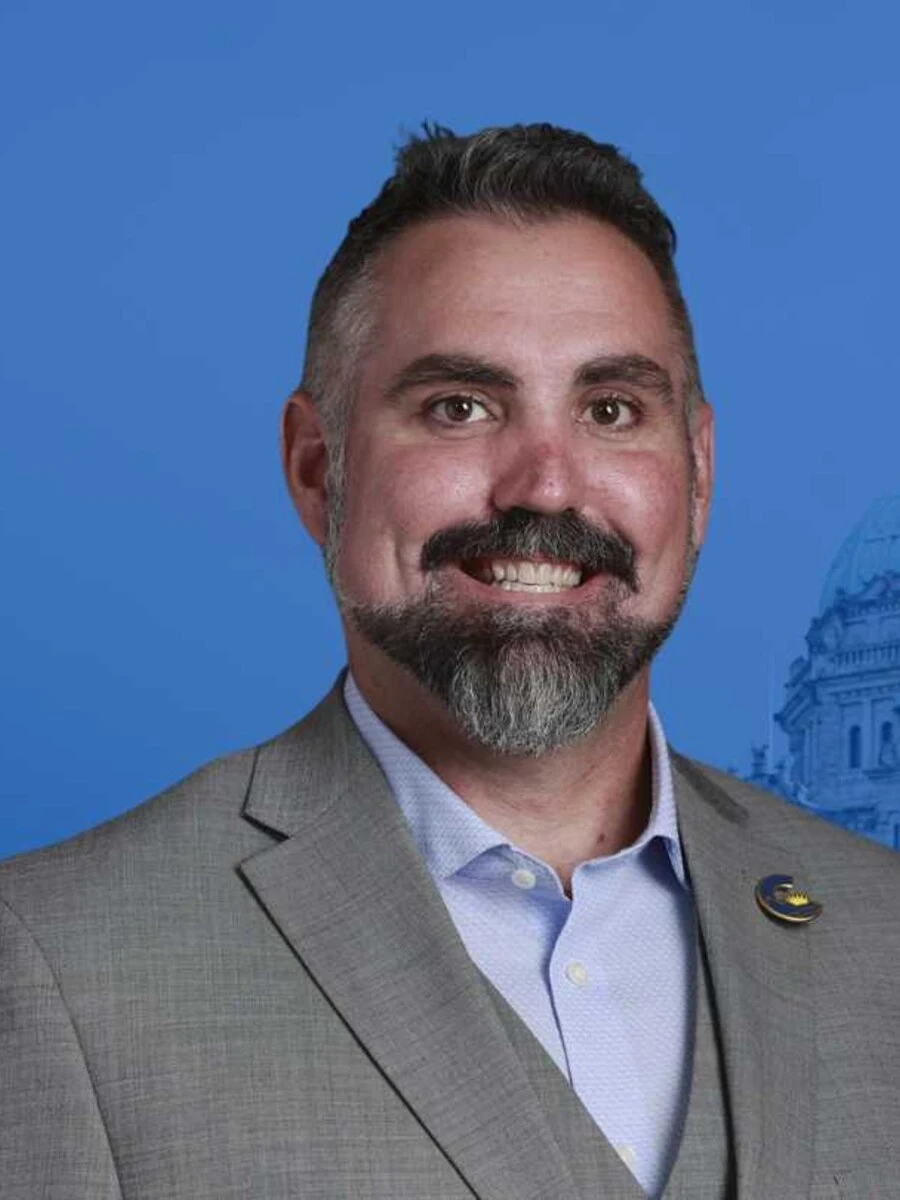
Scott McInnis, Donegal Wilson, Ward Stamer and Warren Mirko set the example
every MLA should follow.
One tabled the only petition in the whole 43rd Parliament against a road being taken out: 1,500 names against deactivating the Incomappleux Forest Service Road. One used estimates — the one proceeding that makes a minister produce a number — and got the Minister of Forests to put two numbers on recreation road access and then say out loud that neither was for recreation. One, the Conservative Forests critic, asked the Minister of Forests twice, eleven months apart, how many forest roads were being deactivated and was given no count either time. One has never held a seat in the legislature, and built a registered society instead. This is what each of them actually did, the procedure each used, and what each one has left on the public record.
Backcountry Coalition is independent. This page is not authorized by any party or candidate.
01 The job is about seven levers wide
Almost everything written about an election is about what candidates believe.
Almost nothing is about what the job physically lets them do. Those are different
questions, and only the second one has a checkable answer, because every one of these
levers leaves a dated public record behind when somebody pulls it.
So we went and read the record. All 188 official transcripts of
the 43rd Parliament, from the opening on 18 February 2025 to the last sitting on
28 May 2026, taken from the Legislative Assembly’s own document service and
searched in full.01 Committee of Supply is inside that corpus, which matters: estimates
is where a member gets hours rather than minutes with a minister.
Here is the whole toolkit: seven things, six of them used on this subject and one
not.
Table a petition
Any member, on any sitting day
A member presents signatures to the House. It compels nothing. What it does is put a number and a subject into the permanent record on a dated morning, where the government has to decide in public whether to answer.
Used 40 times in the 43rd Parliament. Once against a road being taken out.
Question a minister in estimates
Any member, during Committee of Supply
Committee of Supply gives members hours with a minister and the officials who hold the numbers. A minister has to say something, and whatever is said becomes the government's position. It is the only proceeding in the House that reliably converts a question into a figure.
Produced the only occurrence of “Rady Creek” in the parliament and two budget figures nobody had published. Asked twice for a count of roads being deactivated, it produced none.
Ask an oral question
Opposition members, 30 minutes a sitting day
Question period is short, televised, and filed by the House under its own subject heading. A minister has to say something on the spot, and what a minister says on the spot is the thing that ages.
Produced a minister’s flat denial, in May 2025, that backcountry access was being turned off — “in fact, not at all.”
Speak on the record
Any member, in debate
A budget speech or a throne-speech reply is unlimited in subject and lightly contested. What it buys is a citable sentence with a date on it, which a constituent can hold up two years later.
Two dated budget-debate passages on backcountry access, from one member, across the parliament.
Go in person
Anybody, elected or not
No procedure at all, and the one with no substitute. Standing on a road yourself means the account of it stops being a briefing note. It also creates a record of who else came.
More than 70 people on the Incomappleux and at Rady Creek, 8 July 2026. One MLA. No minister and no senior official.
Incorporate and file
Anybody, no seat required
A registered society can hold a bank account, sign a joint release, commission research and file a freedom-of-information request under its own name. None of that requires a seat, and a request filed by a society is answered the same way as one filed by anyone else.
BC society S0082239, registered 7 March 2025, active. Eleven releases, one FOI publication, one commissioned survey.
Introduce a bill
Any member, as a private member
The strongest lever on paper and the weakest in practice: a private member's bill that the government does not adopt dies at first reading. It is still the only way to put a drafted remedy, rather than a complaint, on the table.
Not used. No bill on resource roads, road deactivation or public access was introduced in the 43rd Parliament.
Counts from the corpus, not from an index. The Legislature’s
per-sitting index is editorially compiled and does not file estimates debate by subject, so
an index search misses the richest seam in the record. Every figure on this page comes from
the transcripts themselves, and the sweep reproduces: 40 petition
presentations across 26 sittings, found twice by two methods
that share no assumption.
None of these seven levers repairs a road, and that is the point. What they produce is an
answer with a date on it, from somebody who has to own it afterwards. Four people now on
the 24 October ballot produced one.
02 Scott McInnis tabled the one petition, then stood on
the Incomappleux road
Scott McInnisFORMER MEMBER FOR COLUMBIA RIVER-REVELSTOKE (HOUSE DISSOLVED) CONSERVATIVE PARTY CANDIDATE, 24 OCTOBER
Petitions presented
Five across the parliament
On a road deactivation
One — the only one in the
whole parliament
Assigned portfolios
Indigenous Relations; Tourism and Resort
Municipalities; the Columbia River Treaty; Caucus Policy
Portfolio covering roads or forests
None of them
Portfolios attributed to the party’s own announcements as reported by
e-know.ca. The petitions, the speeches and the dates are read from Hansard.
On the morning of 28 May 2026 — the last day the 43rd Parliament ever sat
— McInnis stood up during Petitions and said one sentence.02
I rise to present a petition on behalf of 1,500 individuals who are vehemently opposed to the deactivation of the Incomappleux Forest Service Road.
Scott McInnis, then the member for Columbia River-Revelstoke.
Hansard, Issue 187, the morning sitting of Thursday 28 May 2026, 187B:1120.
That is the entire entry. He said nothing else; the next member up presented an unrelated
petition about wood-pole preservative. And a single sentence is exactly the right size to
measure, because a petition is a procedure with a known cost and a known effect. The cost is
thirty seconds of a sitting day. The effect is that a subject and a number enter the
permanent record on a date, where a government has to decide in the open whether to answer
it.
Across the parliament, members presented 40 petitions. Two of
them were about roads. One was Sheldon Clare’s, in May 2025, carrying 1,256 signatures
asking the province to recommission the Quesnel-Hixon Road. The other was this one.
No other member in sixteen months asked the House to stop a road being taken out.01
It is also the largest petition McInnis presented. His other four ran to roughly 500, an
unstated number, 487 and nearly 1,000.02
Date
Sitting
Subject
Signatures
24 Feb 2025
Issue 7
Rural retention incentive for health-care professionals, for the East Kootenay branch of the B.C. Nurses Union
approximately 500
26 May 2025
Issue 69
Concerns of residents and business owners in the town of Golden
not stated
21 Oct 2025
Issue 84
A crosswalk in the school speed zone on Highway 95A at Marysville Elementary
487
4 May 2026
Issue 171
Year-round boat launch access at Martha Creek Provincial Park, Revelstoke
nearly 1,000
28 May 2026
Issue 187
Against the deactivation of the Incomappleux Forest Service Road
1,500
Scott McInnis raised backcountry closures for a year before the signatures arrived
Two of the seven levers are speech. McInnis used both. In May 2025 he used an oral
question, which the House then filed under its own subject heading — Back-Country
Land Use in Columbia Valley and Kootenays:03
Question period · 8 May 2025
Scott McInnisThen member for Columbia River-Revelstoke
“Residents are already alarmed at an increase in arbitrary back-country closures without meaningful public consultation. Can the minister give an explanation to prospectors, hunters and everyday back-country users of why their access is being cut off at an alarming rate?”
Hon. Randene NeillMinister of Water, Land and Resource Stewardship
“Back-country use is not being turned off at an alarming rate — in fact, not at all... The very last thing we’re going to do is turn the back country off from folks who love to use it.”
Hansard, Issue 59, morning sitting of 8 May 2025, oral question period, under the heading Back-Country Land Use in Columbia Valley and Kootenays.
That answer is the reason the lever is worth pulling. The minister’s denial, made in
two minutes under pressure in question period, is a fixed point. Everything government has done on Kootenay
forest service roads since May 2025 now has to be read against it.
Nine months later, in the budget debate, he put road closures in a list of reasons to vote
against the budget — between the price of a house in Revelstoke and the shortage of
doctors:04
We’ve got to stop this arbitrary closure of the back country. It’s not a luxury for the people in my riding. It’s a way of life. You see closure after closure. No explanation. Roads deactivated. Access cut off. It has got to stop.
Scott McInnis Hansard, Issue 120, afternoon sitting of 19 February 2026, budget debate.
A year earlier again, in his first budget speech, he had said that
“Unfettered free access to Crown land for recreation is essential in B.C.” and that he would be “unapologetic” about advocating
for “the free, unrestricted use of Crown land for all British Columbians.” That
passage sits inside an argument about Indigenous title, consultation and the
Declaration Act, not about forest service roads, and it reads differently with that
context than without it.05
The fifth lever is not a procedure at all
On 8 July 2026, more than seventy people — property owners, prospectors,
recreation organisations, two village councils and a chamber of commerce — spent a day
on the Incomappleux Forest Service Road and at Rady Creek. The society’s own account
of who was there, and who was not, is the single most useful paragraph in this record. The society is Warren Mirko’s, so this is one subject’s account of another; the Revelstoke Review’s reporting of the same day is cited below.0607
Public Land Use Society · release of 9 July 2026
“MLA Scott McInnis also participated, spending the day hearing directly from residents and stakeholders. Provincial ministers and senior ministry officials were invited but declined to attend.”
“Following the morning tour, participants gathered at the Trout Lake Community Hall before travelling to the Incomappleux Forest Service Road, where they were met by law enforcement. Natural Resource Officers were directed to be there by Ministry staff, who themselves had declined to attend.”
The same release records that local recreation organisations had offered to take on
maintenance of the road and were advised the proposals would not be considered.
Five weeks later a reporter found him at Trout Lake and asked him what the petition had
achieved. It had been tabled without opposition, and the province had not acted on it.07
You’ve got to yell to be heard. … At the end of the day, we’ve got people living up there.
Scott McInnis Revelstoke Review, Evert Lindquist, 15 August 2026, reporting the
8 July visit.
Two limits belong here, in his section, where a reader can weigh them. The first is that
none of this was his job. Across three assignments — Indigenous Relations and
Reconciliation from November 2024, Tourism, Resort Municipalities and the Columbia River
Treaty from October 2025, and caucus policy from August 2026 — no portfolio he has
ever held covers forests, roads or transport. The second is that his engagement
with these particular roads is recent: his own published review of 2025, which runs through
health care, housing, seniors and his critic role, mentions neither the Incomappleux nor Rady
Creek nor forest service roads at all.08
03 Donegal Wilson used the only proceeding that
turns a question into a figure
A petition can be ignored. A speech can be ignored. Estimates cannot, because it is
the one proceeding that makes a minister produce a number, with the officials who hold the
figures sitting behind. It is the slowest, least televised and most productive lever on the list. Two members
used it on this subject in the parliament. Wilson used it twice, eleven months
apart, and the Forests critic who opened both debates comes next.
Donegal WilsonFORMER MEMBER FOR BOUNDARY-SIMILKAMEEN (HOUSE DISSOLVED) CONSERVATIVE PARTY CANDIDATE, 24 OCTOBER
Times “Rady Creek” is named in the parliament
Once — by her
Uses of “high-value recreation roads”
Once — by her
Her file in opposition
Water, Land and Resource Stewardship, and
Wildlife
Bills introduced on road access
None found
Her party page describes the critic role in the past tense and the House was
dissolved for the election, so she is not described here as currently holding it.
In April 2025 she asked the Minister of Forests a question with only one possible kind of
answer — a number:09
Ministry of Forests estimates · 9 April 2025, 7:45 p.m.
Donegal WilsonThen member for Boundary-Similkameen
“Staying on the same theme around recreation and road access, while we do appreciate that Rec Sites and Trails is no longer within your ministry, just about every access to a park or recreation site in the province does involve a forestry road to get there. What specific budget has the province allocated in this fiscal year for the maintenance and repair of forestry roads to provide access to recreation sites, trails and B.C. parks?”
Hon. Ravi ParmarMinister of Forests
“In our capital budget, the integrated resource operations division has $20.3 million set aside and B.C. Timber Sales has $47.83 million set aside for roads. Again, I just want to reiterate that these are dollars not for rec sites or for recreation.”
Hansard, Issue 38, afternoon sitting of 9 April 2025, Ministry of Forests estimates, 7:45 p.m.
Read that answer again, because it is the clearest thing in this entire record. Asked what
the province spends to keep recreation roads passable, the Minister of Forests produced
$20.3 million and $47.83 million — and then volunteered that
neither figure is for recreation. Nobody had published those numbers. Nobody had put
that caveat on the record. One question in Committee of Supply did both, and it is now
permanent.
She did not let it go: “While I understand there is budget, I would love to know the actual priority list of where that money goes... At the end of the day, that road to that trail is not protected or included in these budgets, and that’s really disappointing.”
Eleven months later, the question the government still has not answered
On 12 March 2026 she came back to the same minister with the structural question —
why a road that could be closed with a sign is instead dismantled:10
Ministry of Forests estimates · 12 March 2026, 141C:1535
Donegal WilsonThen member for Boundary-Similkameen
“I want to talk a little bit about high-value recreation roads — no surprise that I want to talk recreation. But I’m wondering why in some cases when we deactivate a road, we do ditching, we take out the culverts and we do a little bit of cross-ditching... Just put up a sign: “Use at your own risk from here.” Then the next time we go in and we literally re-slope, replant, take out all the bridges. And it’s done under the guise of removing liability to the licensee. Does the “Use at your own risk” not remove the liability? Why are there those two levels of deactivation?”
Hon. Ravi ParmarMinister of Forests
“When a licensee is deactivating that road — mild deactivation to wilderness standards — it has less to do with liability and more to do with the environmental standards that they’re required to uplift. Liability continues to exist as long as that road is activated.”
Hansard, Issue 141, afternoon sitting of 12 March 2026, Ministry of Forests estimates, 141C:1535–1540. The minister then asked her for an example.
She gave him one. It is the only time in 188 transcripts that Rady Creek is
named at all:
The one that does come to mind for me is Rady Creek out of Trout Lake. I think that is one where we’re looking at a complete re-slope, replant. The hazard, I believe, is some unstable slope. It is a mining road that has been there 120 years. Recreation has been using it for all of that time, so there is some question of whether it can be just used at your own risk from that point.
Donegal Wilson, then member for Boundary-Similkameen.
“Rady Creek” occurs once in the 43rd Parliament and
“Incomappleux” three times.
There is a detail in her phrasing worth stopping on. “High-value recreation
roads” is not her coinage — it is the Province’s, from its own Outdoor
Recreation Strategy. That phrase appears once in the whole
parliament, in her question. The strategy’s own name appears
once, in lower case, on the morning of the very same day, when
Tamara Davidson, the Minister of Environment and Parks who signed it, welcomed two visitors
to the gallery:11
Hon. Tamara DavidsonMinister of Environment and Parks
“They joined me in my office this morning to talk about the B.C. outdoor recreation strategy, as well as the support and alignment that we have from them.”
Hon. Tamara Davidson, Minister of Environment and Parks · Hansard, Issue 140, morning sitting of 12 March 2026, Introductions by Members — the only occurrence of B.C.’s Outdoor Recreation Strategy in the parliament
So on 12 March 2026 B.C.’s Outdoor Recreation Strategy was mentioned once in the morning, as a
courtesy to guests, and one of its own target phrases was put to the Minister of Forests that
afternoon by an opposition member. Those are the only two appearances either makes.
“Target 8”, the numbered commitment that phrase belongs to,
never appears there at all.
What Donegal Wilson did with the rest of the toolkit
Outside the House she has published her own constituency writing on exactly this
mechanism: on Recreation Sites and Trails BC walking away from a 67-kilometre section of the
Columbia Western Rail Trail in 2020, leaving “no plan, no budget, and no responsible
stewardship”; on a point most people never learn, that motorized recreation access is
regulated through the same instrument as hunting, so “changes introduced through
hunting regulations can directly affect recreational access... even for people who are not
hunting”; and on a concrete remedy, recognising the Kettle Valley Rail Trail as
“British Columbia’s first linear provincial park.” She has also taken the
cross-ministry route, meeting a minister alongside a regional district director about a
single trail.12
The seventh lever is the one she did not use, and nor did anybody else. No private
member’s bill on resource roads, road deactivation or public access was introduced in
the 43rd Parliament. A drafted remedy is still the only thing on this list that would
survive its author losing an election.
04 Ward Stamer asked twice how many forest roads
were going, and was never given a count
Wilson’s questions in estimates did not arrive on their own. In both years of Forests estimates,
the Conservative who opened the subject of road access and then handed her the floor was the
party’s own Forests critic. Across the whole parliament, no member used the language of road
access in more speaking turns than he did, and that includes the Forests minister.13
Ward StamerFORMER MEMBER FOR KAMLOOPS-NORTH THOMPSON (HOUSE DISSOLVED) CONSERVATIVE PARTY CANDIDATE, 24 OCTOBER
Speaking turns on road access
23 of his 484, the most
of any member
His file in opposition
Forests, from November 2024 to dissolution
Count of roads deactivated
Asked for twice and never given
A closing road named in the House
None
The critic role is attributed to Radio NL and CFJC Today. The speaking turns, the
questions and the dates are read from Hansard.
The count comes from testing every speaking turn in the 188 transcripts for thirteen terms
of road access, from “forest service road” to “logging road”. Stamer
used them in 23 of his 484 turns. The minister responsible for those roads used them in 21,
Wilson in 19 and McInnis in 17. The count flatters him, and it should be read in full: nine of
his 23 turns use “Crown land” or “public land” about timber, stumpage
or wildfire funding, and eight are about whether people can keep using a road.13
Those eight are specific. On the first night of Forests estimates, 9 April 2025, he asked
the question that sits under every other one in this article:14
Ministry of Forests estimates · 9 April 2025, 7:05 p.m.
Ward StamerThen the member for Kamloops-North Thompson
“Can you tell me how many roads were permanently deactivated under the ministry’s responsibility, BCTS and MOF? Can you tell me how many bridges were permanently removed under the same criteria, BCTS and Ministry of Forests? Can you tell me how many roads are going to be permanently deactivated, planned in 2025? Bridges as well.”
Hon. Ravi ParmarMinister of Forests
“To the member’s particular question around the number of roads or bridges that will be deactivated in 2025, we don’t have a specific answer. You could have an inspection tomorrow that could lead to a conversation or a deactivation.”
Hansard, Issue 38, afternoon sitting of 9 April 2025, Ministry of Forests estimates, from 7:05 p.m. The same answer gives the size of the network and how much of it is maintained, but no count of roads deactivated or bridges removed.
He had opened by saying that if the numbers did not come back that night, “that’s
fine.” What the minister did give was the scale. Of about 60,000 kilometres of forest
service road, he said, “roughly 12,000 are roads and sections of roads that we are
actively maintaining,” and many of the rest are “just left to erode once
they’re no longer used by industry and are eventually deactivated.”14
The next morning, 10 April 2025, he asked who gets a say before a road goes:15
If there’s an expectation, say, on a particular forest service road that has been used, basically, for generations… Is there an opportunity for the public to engage before these decisions are made and before the work is completed?
Ward Stamer, then the member for Kamloops-North Thompson.
Hansard, Issue 39, morning sitting of Thursday 10 April 2025, Ministry of Forests estimates.
The minister answered that forestry roads are “predominantly user-maintained”
and that “it’s not always feasible for the province to maintain all resource roads
in perpetuity.” Eleven months later, on 12 March 2026, Stamer came back to the count:16
I do have a couple of questions, similar to what we had last year, on deactivated roads… Having said that, can the minister give me an update on where we were last year on deactivated roads?
Ward Stamer Hansard, Issue 141, the afternoon sitting of 12 March 2026, Ministry of Forests estimates, 3:20 p.m.
The answer was a budget, not a count. Road maintenance funding had grown from
$6.1 million in 2022–23 to $16½ million in 2025–26,
the minister said, and his “long-term vision” was to list every forest service
road on a website. He added that the ministry had “some work to do” on telling
communities about closures. Stamer then handed the floor to Wilson, and later in the same
sitting, when she asked what the maintenance budget would be for 2026–27, the minister
said: “It’s the same as last year.”16
In April 2026, at committee stage of Bill 14, which gave BC Timber Sales new powers to
build, buy and lease logging roads, he asked whether the forest operations maps shown to the
public would say whether roads were “permanently constructed or they’re going to
be deactivated.” The maps would show where the roads go, the minister said, “but
not to the extent that you would have in an operational plan.”17
What Ward Stamer’s questions did not do
The questions did not move the ministry. The count he asked for twice was never given in
the House, and the maintenance budget for 2026–27 is the same as the year before. Across
all 484 of his speaking turns he never named a road that was being closed: there is no Rady
Creek, no Incomappleux and no Trout Lake. The roads were named by Wilson, in time he had set
aside for her.13
He is also the only person in this article to carry the seventh lever all the way. His
private member’s bill, the Dashboard Cameras in Commercial Vehicles Act, received
Royal Assent on 28 May 2026.18 It concerns commercial trucks on the highway rather
than forest roads, so on this subject the seventh lever is still unused. On the roads
themselves, his record is questions, and every one of them is on the record with a date.
05 Warren Mirko has never been an MLA, so he registered
the Public Land Use Society instead
Most levers so far belong to somebody who already won an election. That is the obvious
objection to this piece, and the answer to it is the fourth person here, who has
never held provincial office and did not wait for one.
Warren MirkoCANDIDATE, KOOTENAY-MONASHEE CONSERVATIVE PARTY · HAS NEVER HELD PROVINCIAL OFFICE
BC society registration
S0082239, registered
7 March 2025, ACT (active)
Business number
713048825
Releases the society has issued
11, of
261 items posted
Municipal office
Acclaimed to Warfield council; takes the seat in
November
Registration read from the BC Registry through OrgBook BC on
6 October 2026.
He registered Public Land Use Society in March 2025. A society costs about a hundred
dollars and a set of bylaws, and what it buys is standing: it can sign a joint release, hold
a bank account, commission research and file a freedom-of-information request under its own
name.19 None of that requires a seat, and none of it requires permission.
Three of the society’s eleven releases are about these roads. On 4 June 2026, jointly
with the Quad Riders Association of British Columbia, it asked the Province for a stop-work
order on the Incomappleux — with the questions set out so a refusal to answer would
itself be on the record:20
The government still has not clarified whether it has the authority to proceed, whether the corridor remains a public highway, or how access, Crown grant interests, legacy mine sites, and conservation monitoring will be protected. Those answers must come before the Ministry of Forests permanently removes access.
Warren Mirko, Public Land Use Society.
Joint release with the Quad Riders Association of British Columbia, 4 June 2026.
That release also put three things into public view that would otherwise have stayed in
correspondence: that the stakeholder group had asked the Minister of Forests for a stop-work
order on 15 May 2026 and requested an answer within seven days; that the ministry had told
affected parties work might begin on 9 June; and that the Selkirk Resource District had
written to one landowner that the summer’s work “will permanently remove road
access to your private property.”
In August, speaking to a trade publication about prospectors losing access in the
Kootenays, he put it more plainly:21
Warren MirkoPublic Land Use Society; now the Conservative candidate in Kootenay-Monashee
“Government is going to strand property owners behind this (road) because they’re saying we don’t have the money to maintain the road.”
Resource Works, Nelson Bennett, 6 August 2026 — the parenthesis is the
publication’s
Filing, commissioning, publishing
Two further levers, both available to anybody, both used. In May 2026 the society
published what a freedom-of-information request returned about the Tahltan Foundation
Agreement talks — and, more usefully, what it did not return: more than 400 pages
withheld, and no copy of the agreement itself.22 Publishing the refusal is the part
that turns an FOI from a private answer into a public record.
In August it published a commissioned survey: 1,002 BC adults, fielded by
Abacus Data from 9 to 15 July 2026, online, margin of error
±3.09%, 19 times out of 20, with the full data deck posted alongside the findings.23 Stating
the method beside the number is what separates a survey from a press line.
Here is where that record has to be described accurately rather than
flattered. Public Land Use Society’s centre of gravity is not roads. Of the
261 items on its news page, 11 are its own releases and the rest are
reposted columns by other people; the survey is about governance of Crown land and
reconciliation, not about access; and the freedom-of-information request concerned title
negotiations in the northwest. The road work is a genuine but narrow part of a broader
campaign about who controls Crown land.
The society’s About page lists four petitions it supports, and one of them names
this campaign’s own road: “Deactivation of the Historical Silver Cup Ridge Trail & Rady Ck Road near Trout Lake BC.” Alongside it
sits “The Incomappleux Forest Service Road not be deactivated” — the petition McInnis would later
carry into the House. Those are change.org petitions the society endorses rather than ones it
runs, which is worth knowing before anyone counts them twice.19
What his biography says, and what we could confirm
He was acclaimed to Warfield council on 25 September 2026, to his
inaugural seat; all five seats there were filled without a vote, so Warfield holds no
municipal election on 17 October.24 Acclamation is not office. Under the
Community Charter, a councillor’s term begins at the new council’s first
regular meeting after the general local election — which, for Warfield, falls in
November. Both his party’s candidate page and the society’s own board page say,
word for word and in the present tense, “He is a Councillor in the Village of Warfield and a public affairs consultant who helps clients navigate government relations and align with regulatory and community expectations.” Until that first
meeting he is a councillor-elect, not yet a councillor.
The same shared paragraph credits him with fifteen years supporting public protection
mandates “at BC Financial Services Authority, Engineers and Geoscientists BC, Transport
Canada, and other regulatory authorities.” The first of those is confirmed by the
regulator’s own releases, which name him as media contact, in its communications
team, on five separate occasions between 2023 and 2024.25
And when he announced his candidacy on 28 September 2026, the sentence he led with was
about the thing this article is about:26
For communities, businesses and families that depend on access to land, natural resources and clear, predictable rules, there is colossal importance in knowing who governs B.C., how those decisions are made, and whether the public has a democratic voice in them.
Warren Mirko Candidacy announcement, as published by the Castlegar News,
Jim Bailey, 1 October 2026.
Two more facts belong on the record so the ballot described here is the
real one. All four people in this article stand as Conservative Party candidates on
Elections BC’s final list, under that exact name.27
Two of them, McInnis and Wilson, left that caucus on 2 September 2026 and returned later that
month. It is not what this article measures, but leaving it out would make the article
easier to attack than the record it rests on.
06 The ledger — eight entries, and what each
left behind
Here is all of it: eight entries over sixteen months, each leaving something a
constituent can now point at.
Procedure
Who used it
What it produced
Where
Petition to the Legislative Assembly
Scott McInnisColumbia River-Revelstoke
1,500 signatures against the deactivation of the Incomappleux Forest Service Road, presented on 28 May 2026. The largest of the five petitions he presented, and the only one in the parliament against a road being removed.
Issue 187 · 28 May 2026
Estimates questioning
Donegal WilsonBoundary-Similkameen
Asked what the province had budgeted to keep recreation roads passable and was given $20.3 million and $47.83 million, with the minister adding that neither was for recreation. Eleven months later, asked why a sign saying use at your own risk does not discharge the liability a full removal is said to address, and named Rady Creek.
Issues 38 and 141 · 9 Apr 2025, 12 Mar 2026
Estimates and bill committee
Ward StamerKamloops-North Thompson
Asked how many forest roads and bridges were being permanently deactivated and was told “we don’t have a specific answer.” Asked again eleven months later and was given a maintenance budget instead of a count. Also asked whether the public can be heard before a road goes, and whether public maps will show which roads are to be deactivated.
Issues 38, 39, 141 and 159 · Apr 2025 – Apr 2026
Question period and debate
Scott McInnisColumbia River-Revelstoke
An oral question in May 2025 that drew a minister’s assurance that backcountry access was not being turned off, and two budget speeches on Crown land and backcountry closures, one of which lists road deactivation beside housing and doctors as a reason to vote against the budget.
Issues 21, 59 and 120 · 2025–2026
Going to the road
Scott McInnisColumbia River-Revelstoke
Spent 8 July 2026 on the Incomappleux with more than 70 residents, property owners and recreation organisations. Provincial ministers and senior officials were invited and did not come; Natural Resource Officers attended at Ministry staff’s direction.
8 July 2026
Incorporating a society
Warren MirkoKootenay-Monashee
Registered Public Land Use Society in March 2025 and has run it since. Eleven releases, three of them on these roads, including a joint call for a stop-work order on this corridor. One freedom-of-information publication and one commissioned survey.
S0082239 · from 7 Mar 2025
Freedom of information
Warren MirkoKootenay-Monashee
Filed and published, including the count of what was refused: more than 400 pages withheld and no copy of the agreement itself. Publishing the refusal is the part that makes an FOI a public record rather than a private answer.
19 May 2026
Commissioning research
Warren MirkoKootenay-Monashee
A survey of 1,002 British Columbians by Abacus Data, with the field dates, the sample and the margin of error published alongside the findings and the full data deck posted. Its subject is governance of Crown land rather than roads.
31 August 2026
Not one of those eight rows repaired a metre of road. In August the Revelstoke Review reported that the province had
not acted on the petition and that work to close the Incomappleux road was under way this
field season, with the road to Rady Creek slated for deactivation the same summer.07 What the rows did produce is a
government position that can be quoted back — two budget figures and the admission that
neither is for recreation, a minister with no count of the roads being deactivated, a minister’s assurance that backcountry access is not being
turned off, an invitation declined, a written statement that access to a private property will be
permanently removed, and 1,500 names on a date.
That is the realistic ceiling of the job, and it is not nothing. It is the difference
between a decision that has to be defended and a decision that simply happens.
07 What to ask everybody else on the ballot
There are 355 candidates in this election and four of them appear above. The other 351
are not described here as silent, because most of them have never held office and have
never had a procedure to use. What they do all have, starting now, is the same
toolkit — and a reason to say which part of it they intend to pick up.
Which of these will you use, and by when? Not “do you support access.” A petition, an estimates question, a bill, a letter you will publish, a day on the road. Name the procedure and name the date.
Why are there two levels of deactivation? A sign saying use at your own risk is one standard; a full re-slope and replant with the bridges pulled is another. The question was put to the Minister of Forests in March 2026 and the answer was about environmental standards, not about the two levels. It is still open.
Before a road goes, will the engineering, the cost and the alternatives be published? Local organisations offered to take on maintenance of the Incomappleux and were told the proposals would not be considered. A published file is what makes that kind of refusal arguable instead of final.
The first question is the one that does the work, because it cannot be answered with
agreement. “I support backcountry access” costs nothing. “I will put a
written question to the Minister of Forests in the first estimates of the next
parliament” is a thing you can check in Hansard a year from now — which is
exactly how this article was written.
Share this story
Seven images carrying this story on their own — the toolkit, the one
petition, the numbers estimates did and did not pull out of a minister, what a
society can do without a seat, and the questions to put to everyone else. Made to be posted.
Scott McInnis, Donegal Wilson, Ward Stamer and Warren Mirko set the example every MLA should follow.
We read all 188 official transcripts of the 43rd Parliament to find out what that is worth. Members presented 40 petitions over sixteen months. One asked the House to stop a road being taken out — Scott McInnis, 1,500 signatures on the Incomappleux Forest Service Road, on the morning of the last day the House ever sat. It was the largest petition he presented.
Estimates is the lever that actually extracts something. Donegal Wilson asked the Minister of Forests what the province budgets to keep recreation roads passable and got $20.3 million and $47.83 million — plus the minister volunteering that neither figure is for recreation. Eleven months later she asked why a road that could be closed with a sign gets re-sloped and replanted instead, and named Rady Creek. That is the only time this road is named in the entire parliament.
Ward Stamer, the Conservative Forests critic, asked in the same estimates how many forest roads and bridges were being permanently deactivated. The minister said: “we don’t have a specific answer.” He asked again in March 2026 and was given a budget figure, not a count. No member used the language of road access in more speaking turns.
Warren Mirko has never been an MLA, so he registered a society — BC S0082239 — and used what a society can do: a joint call for a stop-work order, an FOI published together with the 400-plus pages withheld, a commissioned survey with its method printed beside its findings.
So the question for everyone on your ballot is not whether they support access. It is which of these procedures they will use, and by when.
↩Hansard, 43rd Parliament — the full-text sweep behind every count on this page. All 188 official House transcripts of both sessions, issues 1 to 188 with no gaps, from 18 February 2025 to 28 May 2026, taken from the Legislative Assembly’s own Hansard document service and searched in full. Petition presentations were found twice by two methods that share no assumption — once scoped to each sitting’s Petitions section and once unscoped across the whole corpus — and both return the same single road-deactivation petition. The other road petition is Sheldon Clare’s, Issue 56, 6 May 2025, 1,256 signatures to recommission the Quesnel-Hixon Road. Link
↩Hansard, 43rd Parliament, Second Session, Issue 187, morning sitting of Thursday 28 May 2026, 187B:1120, and the sitting index for that day — the Incomappleux petition, indexed under Kootenay area and under Petitions → Highways and roads. Issue 188 is the afternoon of the same day and is the last issue of the parliament. Also Issues 7, 69, 84 and 171 for the four other petitions McInnis presented.
↩Hansard, 43rd Parliament, First Session, Issue 59, morning sitting of Thursday 8 May 2025 — the oral question filed by the House under its own heading Back-Country Land Use in Columbia Valley and Kootenays, with Hon. Randene Neill’s reply.
↩Hansard, 43rd Parliament, Second Session, Issue 120, afternoon sitting of Thursday 19 February 2026, budget debate, between the printed stamps [3:05 p.m.] and [3:10 p.m.] — the passage beginning “We’ve got to stop this arbitrary closure of the back country.” It is one unbroken run of sentences, not stitched from two places.
↩Hansard, 43rd Parliament, First Session, Issue 21, afternoon sitting of Monday 10 March 2025, budget debate, between [4:55 p.m.] and [5:00 p.m.] — the Crown land passage, which sits inside an argument about Indigenous title, the Declaration Act and consultation.
↩Public Land Use Society, release of 9 July 2026, “Province Poised to Cut Off Access to Homes, Private Property, and Public Lands in the Incomappleux Valley”, and its backgrounder on the 8 July community access tour — the turnout, the visit to Rady Creek and SilverCup Ridge, the note that MLA Scott McInnis participated while provincial ministers and senior officials were invited and declined, the Natural Resource Officers sent in their place, and the maintenance offers that would not be considered. Link
↩Revelstoke Review, Evert Lindquist, 15 August 2026, “Residents, stakeholders unite to stop deactivation of valued forest road near Trout Lake” — original reporting on the 8 July visit, carrying both McInnis quotations, the note that the petition was tabled without opposition and the province had not acted on it, and the 2026 field-season schedule for the Incomappleux and nearby roads, including the one to Rady Creek. Published 15 August; the event it reports is 8 July. The article’s own figure of more than 2,000 signatures collected is not the 1,500 Hansard records as tabled, and the two are not merged here. Link
↩Revelstoke Review, Paul Rodgers, 18 December 2025, “MLA Scott McInnis reflects on Columbia River-Revelstoke’s 2025” — read in full; it covers health care, housing, seniors, constituent services and his critic role, and mentions neither the Incomappleux, Rady Creek, forest service roads nor road deactivation. Also e-know.ca of 21 November 2024, 1 October 2025 and 25 August 2026 for the three shadow portfolio assignments. Link
↩Hansard, 43rd Parliament, First Session, Issue 38, afternoon sitting of Wednesday 9 April 2025, Ministry of Forests estimates at the printed stamp [7:45 p.m.] — Donegal Wilson on the budget for recreation road access, with the Minister of Forests’ answer giving $20.3 million and $47.83 million and stating that neither is for recreation, and her follow-up on the priority list.
↩Hansard, 43rd Parliament, Second Session, Issue 141, afternoon sitting of Thursday 12 March 2026, Ministry of Forests estimates, 141C:1535–1540 — Wilson on the two levels of deactivation, the minister’s answer, and her naming of Rady Creek out of Trout Lake in reply to his request for an example. This is the only occurrence of “Rady Creek” and the only occurrence of “high-value recreation roads” in the parliament.
↩Hansard, 43rd Parliament, Second Session, Issue 140, morning sitting of Thursday 12 March 2026, Introductions by Members — the single occurrence in the whole parliament of the B.C. outdoor recreation strategy, in lower case, in a welcome to two visitors, on the morning of the same day as the estimates exchange above.
↩Donegal Wilson’s own constituency publications at donegalwilsonmla.ca, read in full — on the Columbia Western Rail Trail and Recreation Sites and Trails BC; on motorized recreation access being regulated through the hunting-regulation framework and the Motor Vehicle Prohibition Regulation; on recognising the Kettle Valley Rail Trail as a linear provincial park; and on meeting a minister with a regional district director. Her party candidate page describes the Water, Lands and Resource Stewardship critic role in the past tense, and the site carries a notice that it is paused for the election. Link
↩Hansard, 43rd Parliament — speaking turns on road access. Every speaking turn in the 188 transcripts of source 01, assigned to the member who opened it and tested, with line breaks collapsed, for thirteen terms: forest service road, resource road, Rady Creek, deactivat*, decommission*, Crown land, backcountry, Incomappleux, public land, road access, access road, motorized recreation and logging road. Ward Stamer 23 of 484 turns, the most of any member; Hon. Ravi Parmar 21 of 599; Donegal Wilson 19 of 450; Scott McInnis 17 of 556. Eight of Stamer’s 23 turns concern whether people can keep using a road, six concern road budgets or the BC Timber Sales road powers, and nine use “Crown land” or “public land” about stumpage, tenure, wildfire funding, fibre or interface harvesting. A search of all 484 of his own turns finds no Rady Creek, Incomappleux or Trout Lake. The Forests critic role is reported by Radio NL, 20 November 2024, “John Rustad reveals BC Conservative shadow cabinet”, and CFJC Today, Victor Kaisar, 31 July 2026, “Forests critic Stamer laments Interfor’s decision to relocate corporate head offices out of B.C.” The House was dissolved on 22 September 2026, when the election was called. The portrait is from his Conservative Party candidate page. Radio NL · CFJC Today · Candidate page
↩Hansard, 43rd Parliament, First Session, Issue 38, afternoon sitting of Wednesday 9 April 2025, Ministry of Forests estimates, from the printed stamp [7:05 p.m.] — Ward Stamer’s opening remark that “if we don’t get the numbers right back, that’s fine”; his questions on roads permanently deactivated, bridges removed and those planned for 2025; and Hon. Ravi Parmar’s answer between [7:10 p.m.] and [7:15 p.m.], including “we don’t have a specific answer” and the 60,000 and 12,000 kilometre figures. No count of roads deactivated or bridges removed appears in any of his answers in the parliament. Link
↩Hansard, 43rd Parliament, First Session, Issue 39, morning sitting of Thursday 10 April 2025, Ministry of Forests estimates (continued), at about [11:15 a.m.] — Ward Stamer on whether the public can engage before a forest service road is deactivated, with the minister’s answer that forestry roads are “predominantly user-maintained” and that “it’s not always feasible for the province to maintain all resource roads in perpetuity.” Link
↩Hansard, 43rd Parliament, Second Session, Issue 141, afternoon sitting of Thursday 12 March 2026, Ministry of Forests estimates, from about [3:20 p.m.] — Ward Stamer’s question on deactivated roads and his hand-over to a colleague on “access points”; the minister’s answer at [3:25 p.m.] on the maintenance budget ($6.1 million in 2022–23 to $16½ million in 2025–26), the planned website and “some work to do” on communication; and, at about [3:45 p.m.] in the same sitting, the minister’s answer to Donegal Wilson on the 2026–27 maintenance budget, “It’s the same as last year.” Link
↩Hansard, 43rd Parliament, Second Session, Issue 159, afternoon sitting of Tuesday 21 April 2026, committee stage of Bill 14, the Forests Statutes Amendment Act, 2026, at about [4:20 p.m.] — Ward Stamer on whether forest operations maps will show whether roads are “permanently constructed or they’re going to be deactivated”, with the minister’s answer, and the clauses giving BC Timber Sales power to construct, maintain, purchase, rent or lease logging roads and bridges. Link
↩Hansard, 43rd Parliament, First Session, Issue 87, morning sitting of Thursday 23 October 2025, first reading of Bill M217, the Dashboard Cameras in Commercial Vehicles Act, presented by Ward Stamer; and Issue 188, afternoon sitting of Thursday 28 May 2026, Royal Assent to Bills, at which the Administrator assents to it. Link
↩BC Registry, via OrgBook BC, read 6 October 2026 — PUBLIC LAND USE SOCIETY, registration S0082239, business number 713048825, registration date 7 March 2025, entity status ACT, entity type S (society), home jurisdiction BC, neither inactive nor revoked. Also the society’s own About page for the four petitions it supports. Link
↩Public Land Use Society and the Quad Riders Association of British Columbia, joint release of 4 June 2026, Nakusp — the call for a stop-work order, the 15 May letter to the Minister of Forests and its seven-day deadline, the 9 June start date given to affected parties, and the Selkirk Resource District’s written statement to a landowner. Link
↩Resource Works, Nelson Bennett, 6 August 2026, “Prospectors losing road access in Kootenays” — on the Incomappleux and Rady Creek forest service roads, quoting Warren Mirko as executive director of the Public Land Use Society. The parenthesis in the quoted sentence is the publication’s own. Link
↩Public Land Use Society, release of 19 May 2026 on the freedom-of-information records concerning the Tahltan Foundation Agreement negotiations — including that more than 400 pages were withheld and that no version of the agreement itself was released. Link
↩Public Land Use Society and Abacus Data, release of 31 August 2026 — an online survey of 1,002 BC adults fielded 9 to 15 July 2026, margin of error ±3.09% nineteen times out of twenty expressed as the equivalent for a comparable probability sample, with the full data deck published alongside. Its subject is governance of Crown land and reconciliation rather than road access. Link
↩Trail Times, Sheri Regnier, 25 September 2026, “Meet 2 of Warfield’s acclaimed councillors” — all five Warfield seats filled by acclamation for the 2026–2030 term so that Warfield holds no vote on 17 October, Warren Mirko acclaimed to his inaugural seat, and his own first-person description of himself as founder and executive director of the society. The term start is set by the Community Charter, s. 119(1)(a) with s. 125(1): office begins at the new council’s first regular meeting after the general local election. Link
↩BC Financial Services Authority news releases of 10 January 2023, 8 November 2023, 10 January 2024, 24 January 2024 and 13 February 2024, each naming Warren Mirko as media contact — four as Communications Manager and one as Manager, Communications. Link
↩Castlegar News, Jim Bailey, 1 October 2026, “Warfield councillor to run for B.C. Conservatives” — the 28 September announcement date, the candidacy statement quoted here in full, and the biography the paper itself prefaces with “according to his biography.” The same article’s line that the Greens had not named a Kootenay-Monashee candidate is superseded by the Elections BC final list. Link
↩Elections BC, 2026 Provincial General Election — Candidate List, the final list published after nominations closed at 1 p.m. on 3 October 2026; 355 candidates across all 93 electoral districts. The affiliation the list uses is Conservative Party. The caucus departures and returns of September 2026 are attributed to the Grand Forks Gazette of 3 October 2026 and the Columbia Valley Pioneer. Portraits are the official portraits of the three ministers and the candidates’ own published photographs; Ward Stamer’s is from his Conservative Party candidate page. Link