
EDITORIAL · THE RECORD
The NDP calls outdoor recreation rural British Columbia’s future while its own Ministry of Forests tears out the roads it runs on.
Brittny Anderson, the Minister for Rural Communities, is nowhere to be seen for even her own rural community.
In May a reporter got a quote from her about $25,000 for an access trail — money that came from riders’ own ICBC registration fees, administered by an agency that is not hers. In September her government refused to hand over the Trout Lake–Rady Creek road, six kilometres from her riding, and moved to destroy it to “relieve ourselves of liability”. She was copied on the letter. She describes her own job as working “across all of the ministries”. She has not used it once.

- Appointed
- 18 November 2024
- Her riding
- Kootenay Central
- The road is in
- Columbia River-Revelstoke
- Mandate letter
- “recreation” 0“road” 0
- Hansard
- 39 entries · 35 introductions
- On Rady Creek
- no public statement found
01 What the Province says this is worth
On 21 May 2026 the Province published Look West: B.C.’s Outdoor Recreation Strategy. The then Minister of Jobs and Economic Growth put a number on the thing it was protecting, and the number is not small: outdoor recreation contributes $4.8 billion annually to British Columbia’s economy and supports more than 1,400 businesses and communities provincewide.02 The Ministry of Tourism, Arts, Culture and Sport has a target to double tourism revenue to $48 billion by 2036. Since 2022 the Rural Economic Diversification and Infrastructure Program has put $156.5 million into 525 rural projects02.
Published, against binding
Every figure on the left is the Province’s own, from its own releases and its own strategy. The right-hand column is what the documents that oblige a minister to act contain.
Counts are over the full text of each document named in §03.
None of that is in dispute, and none of it is ours. It is the Province describing its own policy in its own releases. We went looking for the same commitment somewhere it obliges somebody — a service plan, a mandate letter, a budget line — and that is where the story is.
02 Look West diagnoses the problem correctly
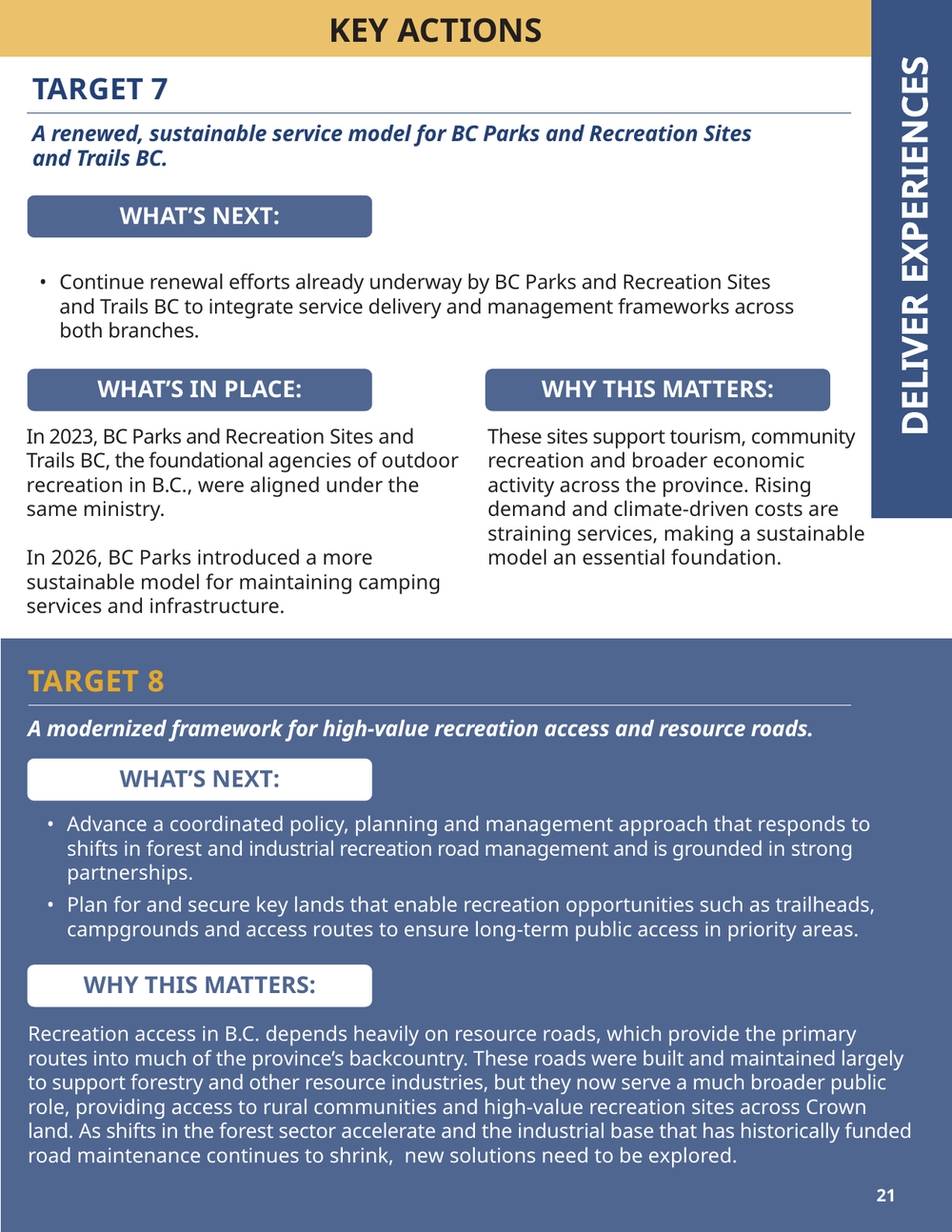
Target 8 of that strategy is “A modernized framework for high-value recreation access and resource roads.” Under the heading why this matters, the Province writes:
Recreation access in B.C. depends heavily on resource roads, which provide the primary routes into much of the province’s backcountry. As shifts in the forest sector accelerate and the industrial base that has historically funded road maintenance continues to shrink, new solutions need to be explored.
And earlier in the same document, more plainly still:
As forest companies reduce operations and road maintenance at an accelerating pace, communities risk losing valuable recreation access and the economic benefits that flow from it.
That is the government naming the exact harm, in a strategy carrying a minister’s signature. Target 8 is one of only two of the seventeen targets with no “what’s in place” section01. It names no lead ministry, carries no funding, and sets no date.

03 What the documents that bind a minister contain
A service plan is the document a ministry is held to. A mandate letter is the document a minister is given. Between them they are the government’s own account of who is responsible for what. We read each of these in full.05, 06, 07 Every figure below is a count over the whole text, not a sample.
Ministry of Forests service plan2026/27–2028/29
the ministry’s own statement of what it will deliver. Recreation access and resource roads are not in it, and neither is deactivation.
Tourism, Arts, Culture and Sport service plan2026/27
sets out the tourism economy at length and never reaches the trails or the forest service roads that get people to them. Look West is not mentioned.
Mandate letter — Minister of Jobs and Economic Growth14 August 2026
the minister who runs REDIP, the fund that pays for rural recreation projects. He is given no instruction about tourism, outdoor recreation or trails. The first priority is a cost-efficiency review citing “current Provincial budget constraints”.
Mandate letter — Minister of State for Local Governments and Rural Communities16 January 2025
two instructions: be the point of contact for local governments, and identify what small communities need to grow. Nothing about the forest service roads they reach their economy on.
Mandate letter — Parliamentary Secretary for Rural Development18 November 2024
no rural-specific priority of any kind. The parliamentary secretary for rural development is given no written rural mandate.
Mandate letter — Minister of Tourism, Arts, Culture and Sport17 July 2025
no trails, no backcountry, no roads, and no outdoor recreation as a sector. Destination BC is not mentioned.
Mandate letter — Minister of Housing and Municipal Affairs17 July 2025
entirely housing. The minister who answers for municipalities is given nothing on rural access.
Every minister who could have been given this, and what they were given instead
A mandate letter is the list a Premier hands a minister; a service plan is what a ministry commits to deliver. Below is every one of them that touches rural communities, tourism, jobs, housing or the forests themselves — each with the minister who holds it. The numbers are how many times that document uses each term. Not one of these people has been made responsible for recreation access or resource roads.
SERVICE ROADTRAILTOURISMDEACTIV-
ATIONLOOK WEST


Budget 2026 service plans and the ministerial mandate letters, read in full. The Tourism plan discusses the tourism economy at length and never reaches the trails or the forest service roads.
The control that makes those zeros mean something. The government’s own news index returns thirteen results for “deactivation” and nine for “road deactivation” — every one of them from Forests or Transportation, between 2011 and 2020. The vocabulary exists in the Province’s own writing. It has simply never met these portfolios.
Target 8 has also never been announced, funded or spoken to. Searches of the government’s own news index for its own phrases — “modernized framework”, “high-value recreation access” — return nothing on point.
04 What the Premier actually asked her to do
Brittny Anderson’s title is Minister of State for Local Governments and Rural Communities, and she was appointed to it on 18 November 202404. The post sits in the Office of the Premier rather than under a line ministry, which she has described herself, in the House:
We’re a really small team in my portfolio as the Minister of State for Local Government and Rural Communities. We primarily work with IGRS, but we also work across all of the ministries, which is a really new and unique position.
The official form is plural — “Local Governments” — in the cabinet release, the mandate letter, the ministry page and Hansard. She herself, UBCM and her own newspaper columns use the singular. Quotes below keep whatever form the speaker used.
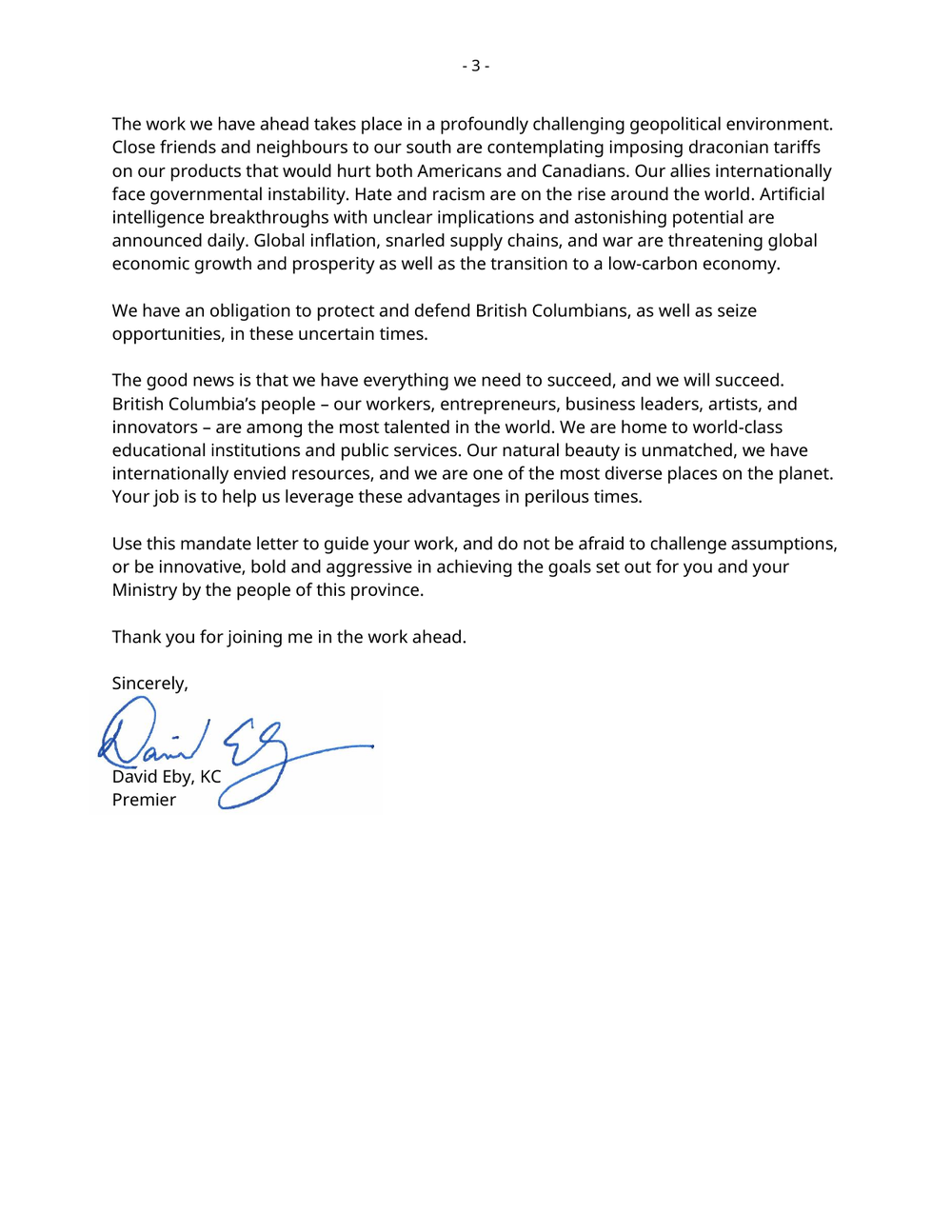
A mandate letter is not a speech. It is the list a Premier gives a minister of what that minister is to do — the whole list, in writing, signed. Hers is dated 16 January 2025 and runs to three pages03. Here is the only part of it written for her:


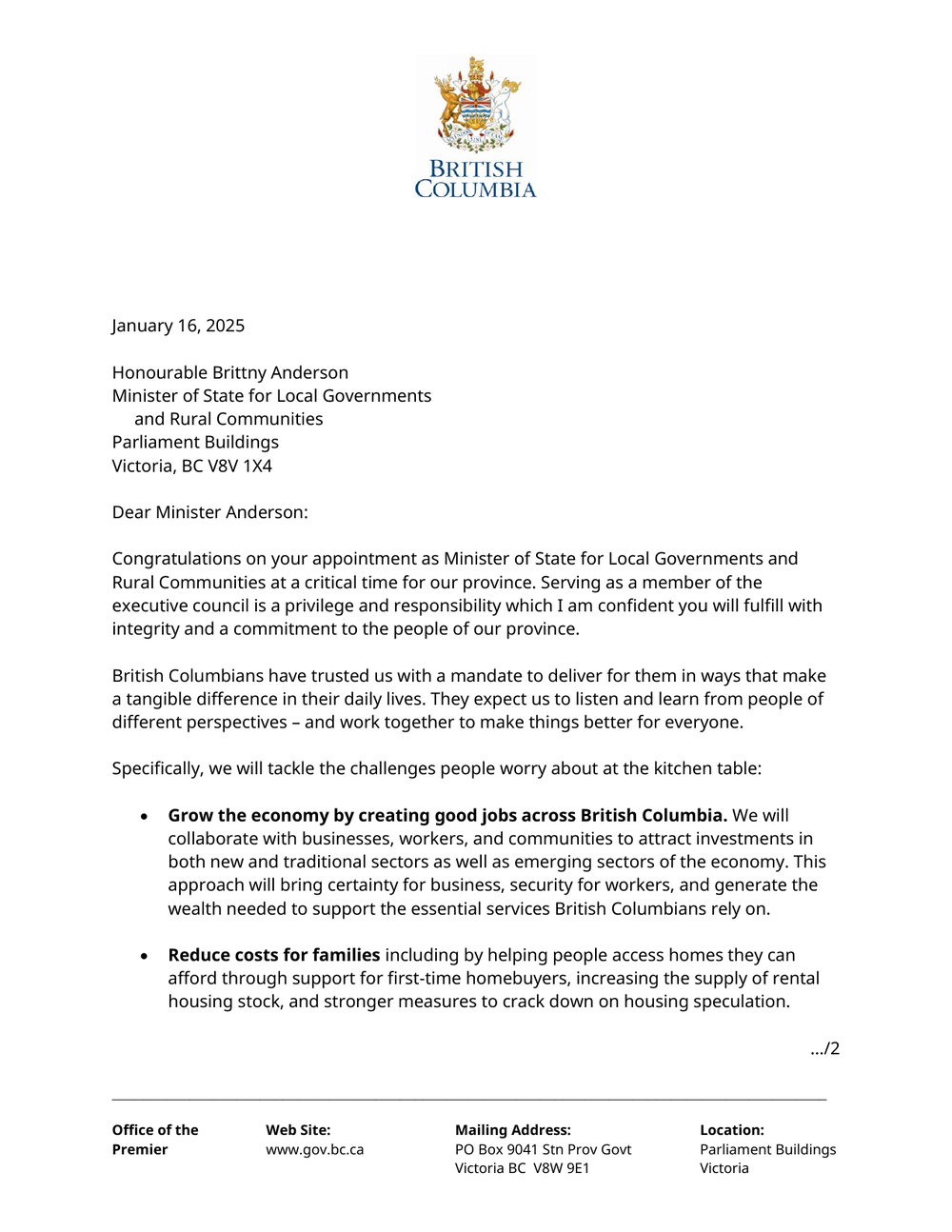
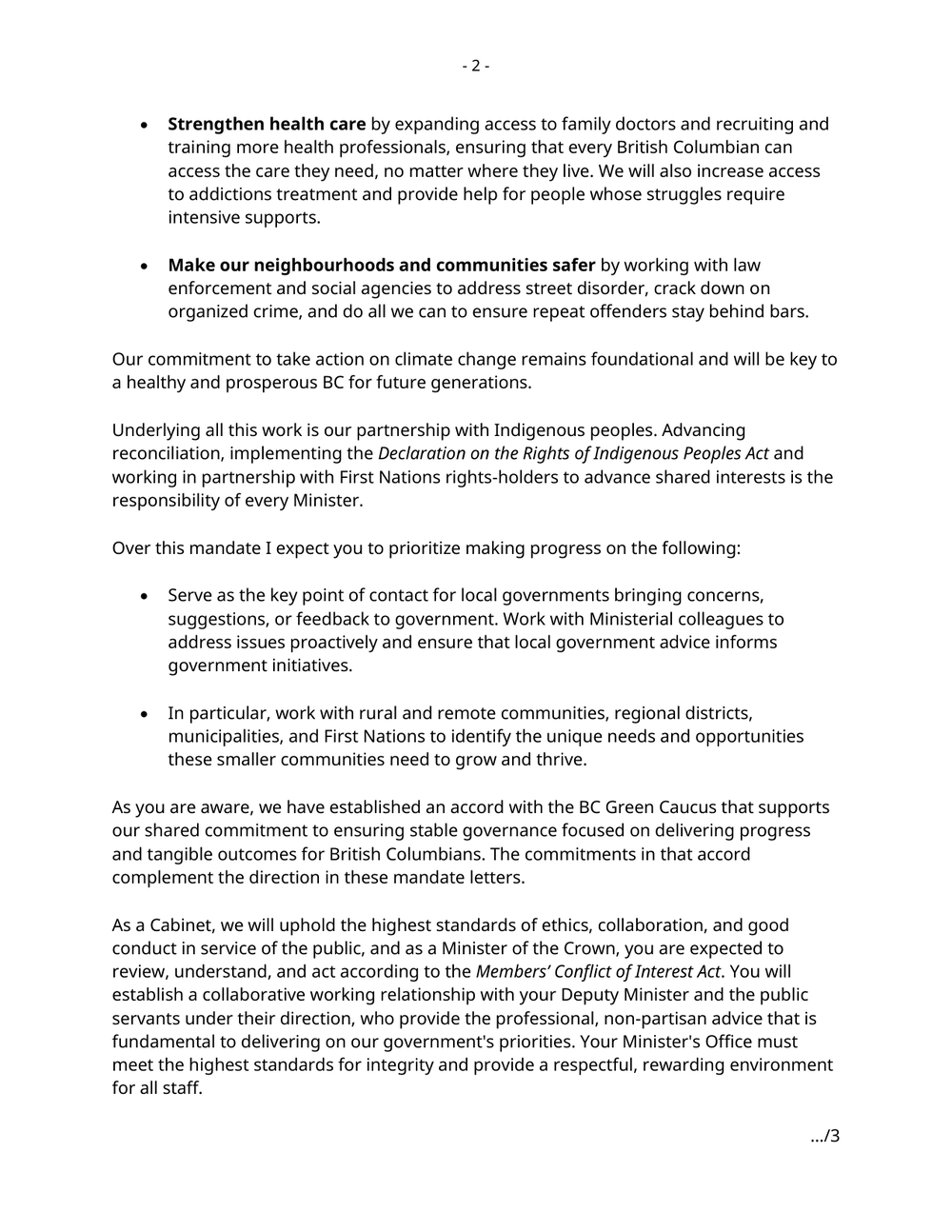
Every one of the four hits for “access” is housing or health — homes people can afford, family doctors, the care they need, addictions treatment. Two of the three for “rural” are in the address block.
Transcribed, the two bullets read:
Serve as the key point of contact for local governments bringing concerns, suggestions, or feedback to government. Work with Ministerial colleagues to address issues proactively and ensure that local government advice informs government initiatives.
In particular, work with rural and remote communities, regional districts, municipalities, and First Nations to identify the unique needs and opportunities these smaller communities need to grow and thrive.
The rest of the letter is the four-priority block that appears in every 2025 mandate letter — jobs, costs, health care, community safety — plus the Green accord, conflict-of-interest and tariff passages. There is no third bullet.
So the minister whose title contains the words “rural communities” is asked, in writing, to be a point of contact for local governments and to identify what small communities need. She is not asked to do anything about the forest service roads those communities reach their economy on. That is not a word missing from a document. It is a duty that was never assigned — and the letter is the document that assigns duties.
For completeness, across the whole three pages: “recreation”, “road”, “trail”, “tourism” and “forest” do not appear at all. “Access” appears four times, every one about housing or health care. We downloaded the letter and counted it ourselves.
05 A full parliament of Hansard
There is no working public full-text search for British Columbia’s Hansard. The Legislature publishes it as per-sitting PDFs with per-sitting indexes and no cumulative one. So we crawled them: 754 candidate URLs, 187 retrieved, issues 1 to 188 present except issue 11508.
She appears in the index 39 times. 35 of those are “Introductions by members” — the formality of welcoming visitors to the gallery. Her entire substantive indexed record for the parliament is four items:
27 Feb 202512B:1355-1405
Business Practices and Consumer Protection Amendment Act, 2025 (Bill 4) — debate
6 Mar 2025—
Members’ statement: Alice Maitland, life and service as mayor of Hazelton
19 Feb 2026120B:1510-1540
Budget debate
13 Apr 2026150B:1625-1630
Environmental Assessment Amendment Act, 2026 (Bill 15) — debate
Not one of them concerns recreation, trails, backcountry access, tourism, roads, resource roads or forest service roads. There are no “oral questions (response)” entries against her name anywhere in the parliament.
Everything she rose to speak to in a full parliament
Not how often she was in the room — what she argued when she stood up. Across both sessions of the 43rd Parliament she spoke to the business of the House four times. This is all four, and what each one was about.
Per-sitting Hansard indexes, both sessions — 187 retrieved, issues 1 to 188 present except issue 115.
A consumer bill, a tribute to a mayor in the northwest, a budget speech and an assessment bill. Her riding’s economy runs on trails, roads and backcountry access, and across every opportunity a full parliament gave her, she rose on none of them. No question answered on the subject, and no members’ statement made about it.
She did say the word once. Read in full, because the context is the point:
In one of the communities I was in, I commented on how every small community is like a snowflake because they are so unique and special. Even in two communities that might be neighbours, their industries can be different, and they can be quite culturally different. Their facilities, their recreation — it’s all unique.
That is a remark about small communities being distinctive, not a statement of policy. It is here because it is the only time the word appears in a full parliament, and a reader is entitled to see what that one time was.
For contrast, from the same index we crawled:
The only mention of the BC Snowmobile Federation in the 43rd Parliament
a members’ statement by Donegal Wilson, Boundary-Similkameen, BC Conservative, 11 March 2025
The only entries on a Kootenay forest service road deactivation
Scott McInnis’s, 28 May 2026 — the last sitting day before dissolution, filed under both “Kootenay area” and “Highways and roads”
“Rady” in any Hansard index of the 43rd Parliament
zero occurrences
06 She is quoted on money that is not hers, and silent on the thing that is
None of the money below came from her. REDIP is run by the Ministry of Jobs and Economic Growth. The ORV Trail Fund is user-funded — administered by Recreation Sites and Trails BC and paid for out of riders’ own ICBC registration fees. In every one of these releases she is quoted as the member for her riding, not by her ministerial title11, because the decision was never hers to make. A reporter wanted a local voice and she supplied one.
That is the pattern worth noticing. Where there is a ribbon, she is available. Where there is a fight with another ministry, she is not. Not one of these appearances mentions the forest service roads that every one of these projects is reached by.
11 April 2023$79,556
Kaslo Outdoor Recreation and Trails Society — Milford Ridge Trail Feasibility Assessment, one line in a $1,923,952 Kootenay round that also carried $99,986 for Lardeau Valley LINKS
What she lent her name toentrepreneurs, non-profit services and clean energy. Recreation, trails, roads and access are not mentioned.
BC NDP caucus release, 11 Apr 2023 (Internet Archive snapshot 20230923100905); amounts from the Province’s own REDIP 2022-23 funded-projects list
27 October 2023$65,000 and $359,975
Nelson Cycling Club Society, for the Smallwood recreation sites and trails network; and Nakusp & Area Bike Society, for a new beginner and adaptive mountain bike trail
What she lent her name tobear-safe garbage containers. The mountain-biking line in the same release went to Katrine Conroy, the member for Kootenay West.
BC NDP caucus release, 27 Oct 2023 (Internet Archive snapshot 20231103004656)
21 May 2025$937,153
Black Jack Cross Country Ski Club Society — expansion of trailhead facilities, part of more than $4 million in the Kootenays
What she lent her name tochildcare. The REDIP line went to Steve Morissette.
BC Gov News release 2025JEDI0018-000472, 21 May 2025; caucus release same date (Internet Archive snapshot 20250531002919)
15 July 2026nearly $86,000
Village of Nakusp — Nakusp Hot Springs growth planning
What she lent her name toa gathering place and an economic driver. Access, trails and roads are not mentioned.
BC Gov News release 2026JEG0052-000826, 15 Jul 2026
Four appearances about getting people into the backcountry, across three years, in a riding whose economy depends on it. Not one mentions a road. None of the money was hers. And on the one question that is squarely hers — whether rural communities keep the forest service roads their economy runs on — there is nothing.
The warmest she has ever been about the backcountry in public was before she had any power over it — a 2022 trail announcement and a 2023 search-and-rescue release, both as a backbench MLA. Since being given the portfolio that covers every rural community in the province, she has announced money for backcountry access and said nothing whatever about losing it.
07 Nine weeks
Then put three dates next to each other.15
15 July 20262026JEG0052-000826
The Province announces nearly $86,000 through REDIP for visitor-demand planning and water and wastewater engineering at Nakusp Hot Springs — inside her riding — with her quoted in support as “MLA for Kootenay Central”, alongside the Jobs minister and the Tourism minister.
15 September 2026file 285993, held on file
Charlene Strelaeff, District Manager for the Selkirk Natural Resource District, writes that the Ministry “will not consider transferring the road to another entity” and will “complete our deactivation work to relieve ourselves of liability”. The letter is copied to her.
22 September 2026CBC, Jacqueline Gelineau
The Ministry of Forests tells CBC: “At this time, the decision for deactivation is final.” No elected official of any kind is quoted in the story.
One arm of this government is paying to bring visitors to the backcountry economy. Another is removing the Rady Creek road they would drive in on. Both know what the other is doing. Neither has been made to answer for it, and neither has volunteered.
And the Province has already contradicted itself in writing on precisely this point. On 26 May 2026 the Ministry of Environment and Parks funded a Valemount trail association and said, in its own release, that the money “helps keep a forest service road connection open to a managed trail system.”12 Thirteen months earlier the Ministry of Forests had written that forest service roads “are designed and built for industrial use, not public access.”13 Both sentences belong to the same government. Neither is in a service plan.
There is a comparator for what this costs to undo. REDIP paid almost $400,000 to the McBride10 Big Country Snowmobile Association for a new bridge, “re-establishing access to the Renshaw snowmobile area” — in the same calendar year the Ministry of Forests refused to transfer Rady Creek. The Renshaw bridge came out after an inspection found it on the verge of structural failure, so it is not evidence of anyone intending to close anything. It is evidence of the price: the community reported a seventy per cent drop in riders, and the local Chamber projected a $3.15 million loss.20
08 The same government sells the recreation economy and destroys the forest service roads it runs on
This is one government taking credit twice. It announces the recreation economy as rural British Columbia’s future and puts money behind it, and it tears out the forest service roads that economy depends on — and it does both in the same year, about the same roads, in writing. Brittny Anderson’s side makes the promise. Ravi Parmar’s ministry breaks it.
How their party sells it
to rural communities

“Outdoor recreation contributes $4.8 billion annually to B.C.’s economy and supports more than 1,400 businesses and communities provincewide.”
21 May 2026 · 2026ENV0024-00057419
“Outdoor recreation is increasingly recognized as essential to our well-being, community connection and regional economic development.”
26 May 2026 · 2026ENV0026-000592“B.C.’s natural beauty and access to the outdoors are a major reason visitors choose our province.”
9 April 2026 · 2026WLRS0020-000388“Outdoor recreation is such a draw for people, both here in the Kootenays and in rural communities across the province.”
21 May 2026 · 2026ENV0024-000574How their party acts
in rural communities
“I’m not the decision maker that closes the road. It’s an engineer, and they’re bound by their credential.”
28 September 2026 · our fact check“FSR’s are designed and built for industrial use, not public access.”
April 2025 · file 11250-30/3397“The Ministry of Forests will not consider transferring the road to another entity … and will complete our deactivation work to relieve ourselves of liability.”
15 September 2026 · file 285993“At this time, the decision for deactivation is final.”
22 September 2026 · CBC, 22 Sep 2026On 26 May 2026 the Ministry of Environment and Parks paid a Valemount trail association $25,000 and wrote, in its own release, that the money “helps keep a forest service road connection open to a managed trail system” — thirteen months after the Ministry of Forests had written that forest service roads are not for public access. Both sentences belong to the same government.
Every name in both columns is from the same party. This is not two parties arguing. It is one government, one caucus and one cabinet holding both positions at once, and taking the credit for each.
So one of two things has to be true. Either the recreation economy is what rural British Columbia is being offered after forestry, in which case the Ministry of Forests cannot keep removing the roads it depends on. Or the roads go, in which case the $4.8 billion promise is not a plan for rural communities and should stop being sold as one. Both cannot hold.
Settling that is exactly the job of a Minister of State for Local Governments and Rural Communities — a portfolio that sits in the Premier’s office and, in her own words, works “across all of the ministries”. It is the argument she exists to have with the Minister of Forests. We can find no evidence she has had it.
And Parmar’s stated reasons do not survive checking
On 28 September 2026 he answered a delegation on camera about this exact road. We transcribed it and checked every claim. Thirteen were scored against the statutes, the Estimates and his own ministry’s files: seven were false, three misleading, one contradicted itself four minutes later. Two held up. The full check is here.
He said
“$11 million budget to maintain those roads.”
On checkingThe Estimates show $27.84 million operating and $20.30 million capital. $11.67 million is a Budget 2023 increment, not the budget.
He said
“You could take over Rady Creek Road if you wanted to.”
On checkingThe Trout Lake club had already applied, offered to carry the liability and insure the corridor, and been refused five weeks earlier.
He said
“If someone was injured or, God forbid, someone died, the province would be liable.”
On checkingSince 25 June 2012, s.3.1 of the Occupiers Liability Act18 has deemed every user of a resource road to have assumed all risks. The Province announced that change itself, under the headline “More backcountry roads to be kept open.”
These are the reasons the Rady Creek road is being destroyed, and the Province’s own records are what show they are wrong. If the minister responsible for rural communities had contested any of it, there would be a record of her doing so.
Searched: a full parliament of Hansard, every provincial release, her own signed newspaper columns, her caucus archive, and the seven news stories covering this closure. Nothing found on either side of the argument.
09 It is already happening inside her own riding
Rady Creek sits just outside Kootenay Central. The same thing is happening inside it.
Sitkum Creek Forest Service Road, file 0235, is a 14.2 kilometre road held by the
same Selkirk Natural Resource District that is removing Rady Creek. It runs into a community
watershed above the West Arm of Kootenay Lake, inside Kootenay Central, and the Province
has deactivated it before: in 2014 it pulled the bridge at about the eight-kilometre mark and,
in the words of a resident writing to the Nelson Star, destroyed
hundreds of meters of road on either side of the creek
with it. The public paid to put
that access back. It is on the list again.
And the places she has turned up for are the places those roads reach. Kaslo, Nelson, Nakusp, the Lardeau Valley, Nakusp Hot Springs — every one in Kootenay Central, every one reached by the kind of road her government is removing. She has been photographed at the destinations and has said nothing about the way in.
And the riding is not the defence
It will be said that Rady Creek is not hers. It is not — it sits in Columbia River-Revelstoke, and we checked that twice against the Province’s own gazetted boundaries so that nobody can wave this away on a technicality. But her title is Minister of State for Local Governments and Rural Communities, not member for Kootenay Central. The portfolio sits in the Premier’s office and works, in her own words, across every ministry. Whose riding a road sits in does not decide whose job it is.
This is the part we got wrong first, and nearly printed. The Trout Lake–Rady Creek Forest Service Road is in the Lardeau valley, and Brittny Anderson’s riding covers most of that valley. It is an easy inference and it is false.
We settled it against the Province’s own gazetted data, twice, by two different methods. First, the gazetteer point: BC Geographical Names holds one official feature called Rady Creek, adopted in 1956, recorded at its mouth16. Run against the gazetted electoral boundary layer, it falls in exactly one district. Second, the road itself: the forest tenure layer gives road 0321 section 02, “TROUT LAKE-RADY CR”, 4,396 metres of active road, as 724 separate points. All 724 are in the same district, and it is not hers.17
| Place | Map sheet | Electoral district |
|---|---|---|
| Rady Creek | 82K/11 | Columbia River-Revelstoke |
| Trout Lake | 82K/12 | Columbia River-Revelstoke |
| Gerrard | 82K/11 | Kootenay Central |
| Lardeau | 82K/2 | Kootenay Central |
Rady Creek and Gerrard sit on the same map sheet, nine kilometres apart, in different ridings. The boundary runs between them, across the south end of Trout Lake. Nelson and Revelstoke were run through the same test as controls and both landed where they should.
So the road belongs to Columbia River-Revelstoke, whose member is Scott McInnis of the Conservative Party of BC — and he is the MLA who went to Trout Lake, heard the users, and tabled the petition in the Legislature. The only Hansard entries on a Kootenay forest service road deactivation in the whole parliament are his, on the last sitting day before dissolution. In the BC Snowmobile Federation’s own article on Rady Creek he is named five times. Brittny Anderson is named none.
That changes the shape of this, and not in the government’s favour. Columbia River-Revelstoke is the one riding of the three touching this story that the NDP does not hold. It went Conservative in 2024 by 670 votes, and the candidate who came within those 670 votes is running again. The Province is removing the Rady Creek road in the seat it most wants to win back, while funding the recreation economy that road serves.
Her position is still worth stating, precisely. She was copied on the 15 September letter confirming the deactivation, as a minister of the Crown.14 The $86,000 for Nakusp Hot Springs is in her riding09. Rady Creek is not.
10 Her own party will not stop talking about recreation. She is the exception when it counts!
Talk is the one thing this government has never been short of on outdoor recreation, and none of it has ever been made to bind anybody — least of all her, in the one place where it would have cost her something to say it.
The province’s own Outdoor Recreation Strategy, published 21 May 2026,
states the problem in plain terms at Target 8 — Recreation access in B.C. depends
heavily on resource roads… as the industrial base that has historically funded road
maintenance continues to shrink, new solutions need to be explored.
That target names
no lead ministry, no funding and no deliverable date, and it is one of only two of the
seventeen carrying no “What’s in place” section at all. The Ministry of
Forests, which holds these roads, publishes a service plan for 2026/27–2028/29 in which
recreation access, resource roads, deactivation and Target 8 do not appear.
So the problem is written down by one arm of the government and owned by none of them. That is precisely the gap a minister of state for rural communities exists to close, and her mandate letter says so in terms: her work runs “across all of the ministries”. It is the one job in the cabinet that cannot be excused by saying the file belongs to somebody else, because her file is the space between files.
Brittny Anderson: the minister whose file is the space between files
Brittny Anderson BC NDP · Minister of State for Local Governments and Rural CommunitiesIn May a reporter got a quote from her about $25,000 for the Harlow access trail21 — money that is not hers to give, paid for out of riders’ own ICBC registration fees. She did not fund that trail. She appeared beside it.
On the forest service roads being destroyed, across seven news stories, a full parliament of Hansard, her ministry’s own feed and her signed columns: not one word.
She was copied on the 15 September letter. She represents the riding the same district is deactivating roads in. She holds the only portfolio written to reach across ministries. Every condition that would make this her business is met, and there is no record of her acting on any of them.
11 What she was actually asked to do, and what she did with it
She cannot sign a road closed. That power sits with the Minister of Forests and with the district manager who signs the prescription. That is the whole of what is not her responsibility, and it is not a defence, because nobody asked her to sign anything.
Her mandate letter of 16 January 2025 gives her two priorities. This is not a summary of them. It is both of them, in full:
“Serve as the key point of contact for local governments bringing concerns, suggestions, or feedback to government. Work with Ministerial colleagues to address issues proactively and ensure that local government advice informs government initiatives.”
“In particular, work with rural and remote communities, regional districts, municipalities, and First Nations to identify the unique needs and opportunities these smaller communities need to grow and thrive.”
That is the entire job. A regional district brought the concern and tabled the petition. The ministerial colleague who could address it proactively sits in her own cabinet. The rural community is six kilometres from her riding boundary, and the next road on the same list runs into a watershed inside it. There is no reading of those two sentences that does not put this squarely on her desk — which is why the absence of recreation, roads, trails and forests from the rest of that letter is not an excuse. Her two priorities are written broadly enough to cover exactly this, and that is the point of a minister of state.
And one of them is wrong. The Ministry of Forests has put in writing that forest
service roads are not for public access
. Her own government has put in writing, in the
Outdoor Recreation Strategy, that recreation access depends heavily on those same roads and
that the economy they carry is rural British Columbia’s future. Both documents are
current, both carry a minister’s name, and they cannot both be right. Settling
which one the government actually means is the proactive work with ministerial colleagues her
letter describes, and there is no record that she has attempted it.
She was copied on the 15 September letter in which the Selkirk district refused to transfer the Rady Creek road and committed to destroying it. She did nothing. She did not reply on the record, ask the Minister of Forests in writing to pause it, raise it in the House, or answer any of the seven news stories. What each of those costs is a letter.
And she is not alone in it. Four ministers put their names to the recreation economy
— Jobs and Economic Growth on the $4.8 billion figure, Environment and Parks on Look West, Tourism on access to the outdoors, the Parliamentary Secretary for Rural Development
on what it means to the Kootenays. Every one of them watched the Ministry of Forests write that
forest service roads are not for public access
and move to destroy one.
Not one of them said a word in public to bring that ministry into line. They are all in
the same caucus and the same cabinet, and they meet every week.
It is sometimes argued that this is a gap in the paperwork rather than a choice. The paperwork is real: no service plan and no mandate letter makes anyone answer for it. But a minister does not need a mandate letter to object to something happening to the communities she is named after, and a cabinet does not need a document to tell one of its own ministries that it is destroying the thing the rest of them are selling. They had the standing and the meeting and the whole of a parliament to use them. They chose not to.
12 Ask them to put it in writing
A news release obliges nobody. A mandate letter and a service plan do. So the ask is not for a comment — it is for two commitments short enough to answer on a doorstep and specific enough to be read back in a year: give Target 8 an owner, a budget line and a date, and stop deactivating roads for liability alone while that framework is written.
It goes to Brittny Anderson directly, and copies the four ministers in her own party who have been selling the recreation economy while the Ministry of Forests removes the roads it runs on. One person is asked the question; the people who should be asking it with her are watching.
- Copy the letter.
- Open your email, addresses and subject already filled in.
- Paste, edit, send. Better in your words than ours.
Add the people contesting these seats. Both ridings the Rady Creek road and the ones like it run through are held by the BC NDP:
- Kootenay Central — Brittny Anderson (BC NDP), Gordon Skulnec (Conservative), Nicole Charlwood (BC Green), Hunter Corrigal (OneBC).
- Kootenay-Monashee — Steve Morissette (BC NDP), Warren Mirko (Conservative), Connie Larochelle (BC Green), Stephen Hill (OneBC).
Contacts for every candidate are at elections.bc.ca.
Minister Anderson,
(copied to the Minister of Forests, the Minister of Environment and Parks, the Minister of Tourism, and the Minister of Jobs and Economic Growth)
On 21 May 2026 the Province published Look West, its Outdoor Recreation Strategy, with a Minister's Message signed by the Minister of Environment and Parks. Target 8 of that strategy is "A modernized framework for high-value recreation access and resource roads." It explains why it matters in the Province's own words:
"Recreation access in B.C. depends heavily on resource roads, which provide the primary routes into much of the province's backcountry. As shifts in the forest sector accelerate and the industrial base that has historically funded road maintenance continues to shrink, new solutions need to be explored."
And earlier in the same document:
"As forest companies reduce operations and road maintenance at an accelerating pace, communities risk losing valuable recreation access and the economic benefits that flow from it."
That is the Province diagnosing the problem correctly, in a strategy a minister signed. The Backcountry Coalition then went looking for where that commitment is written down somewhere it obliges someone, and read every service plan and every mandate letter that binds the ministers responsible. Their full working, with every source named and every document reproduced, is here:
https://backcountry.cx/editorials/brittny-anderson-rural-communities/
WHO IS ACTUALLY RESPONSIBLE FOR THIS, ACCORDING TO YOUR OWN DOCUMENTS
A service plan is a ministry's own statement of what it will do. A mandate letter is the Premier's written instruction to a minister. Between them, they decide who answers for what.
The Minister of State for Local Governments and Rural Communities is instructed to do two things: serve as the key point of contact for local governments, and work with rural and remote communities to identify what they need to grow and thrive. That is the whole of her specific mandate.
The Minister of Jobs and Economic Growth, who runs REDIP, is given no instruction about tourism, outdoor recreation or trails.
The Parliamentary Secretary for Rural Development is given no rural priority of any kind.
The Ministry of Forests service plan sets out what that ministry will deliver, and recreation access and resource roads are not in it.
So when the Ministry of Forests decides to remove a road that a rural community's economy depends on, there is no minister whose written job is to object. That is not a drafting oversight. It is a gap in who is accountable, and it is the reason this keeps happening.
AND YOUR OWN MINISTRIES ARE OPENLY CONTRADICTING EACH OTHER
The Ministry of Environment and Parks, 26 May 2026, funding a trail association: the money "helps keep a forest service road connection open to a managed trail system."
The Ministry of Forests, Selkirk district, April 2025: "FSR's are designed and built for industrial use, not public access."
Both are the Province. One is paying to keep a forest service road open for recreation; the other says that is not what those roads are for. Nobody has reconciled them, because no document requires anybody to.
WHAT HAPPENED IN THE NINE WEEKS AFTER THAT
On 15 July 2026 the Province announced nearly $86,000 through REDIP for visitor-demand planning and water and wastewater engineering at Nakusp Hot Springs, in Kootenay Central.
On 15 September 2026 the District Manager for the Selkirk Natural Resource District wrote that the Ministry "will not consider transferring the road to another entity" and would "complete our deactivation work to relieve ourselves of liability" on the Trout Lake-Rady Creek Forest Service Road.
On 22 September 2026 the Ministry of Forests told CBC: "At this time, the decision for deactivation is final."
One arm of this government is paying to bring visitors to the backcountry economy. Another is removing the Rady Creek road they would drive in on. Both know what the other is doing. Neither has been made to answer for it, and neither has volunteered - and nobody in that cabinet has told the Ministry of Forests to stop.
On 26 May 2026 the Ministry of Environment and Parks funded the Valemount and Area Recreation Development Association and said, in its own release, that the money "helps keep a forest service road connection open to a managed trail system." Thirteen months earlier the Ministry of Forests had written that forest service roads "are designed and built for industrial use, not public access." Both statements are the Province's. Only one of them is in a service plan, and it is neither.
WHAT I AM ASKING YOU TO SAY OUT LOUD
Not a comment. Two commitments, each a yes or a no, each short enough to answer on a doorstep, and each able to be read back to you in a year:
1. Will you give Target 8 a lead ministry, a budget line and a delivery date in the first mandate letters and service plans your government writes? A target with no owner is not a plan.
2. Will you commit that no forest service road is deactivated for liability reasons alone while the Target 8 framework is being written, and that where a qualified organisation offers to take a road on, the law will be changed so it can? Section 3.1 of the Occupiers Liability Act has deemed every user of a resource road to have assumed all risks since 25 June 2012. The liability that is said to force these decisions was legislated away fourteen years ago.
If you think any of this is wrong, every document named above is public and the working is published at the link. Say which part is wrong and it will be corrected in public.
AND THE REASONS GIVEN FOR DESTROYING THE RADY CREEK ROAD DO NOT SURVIVE CHECKING
On 28 September 2026 the Minister of Forests answered a delegation about the Rady Creek deactivation on camera. Thirteen of his claims were checked against the statutes, the Estimates and his own ministry's records. Seven were false, three misleading, one contradicted itself four minutes later.
He said he was no longer the Minister of Forests because of the election. He was - dissolution ends the terms of MLAs, not ministers, and the power to close a forest service road is the minister's own under s.121(9) of the Forest Act.
He said the provincial road maintenance budget is $11 million. The Estimates show $27.84 million operating and $20.30 million capital.
He said a club could take the road over if it wanted to. The Trout Lake club had applied, offered to carry the liability and insure the corridor, and had been refused five weeks earlier.
He said the Province would be liable if someone were hurt. Since 25 June 2012, s.3.1 of the Occupiers Liability Act has deemed every user of a resource road to have assumed all risks - a change the Province announced itself, under the headline "More backcountry roads to be kept open."
The full check, with every claim timestamped to the recording:
https://backcountry.cx/editorials/ravi-parmar-fact-check-rady-creek/
Those are the stated reasons. If the minister whose portfolio is rural communities disagreed with any of them, there is no record of her saying so.
Two further pieces set out what a transfer framework would have to contain, and why the body that was supposed to govern these roads does not exist:
https://backcountry.cx/editorials/resource-road-organization/
https://backcountry.cx/email/public-access-to-public-lands/
One of you will form a government and inherit the Rady Creek road, and the twenty-two like it in the Selkirk district alone. The rest of you inherit the job of holding that government to whatever it says during this campaign. I am writing while you are still asking for my vote.
I would like an answer before I vote.
If the buttons above did not work
Copy the letter and the addresses by hand and paste them into a new message. Everything you need is on this page — nothing is hidden behind a form and we do not collect your address.
Share this story
Six images carrying this story on their own — the count from her mandate letter, a full parliament of Hansard, what her quote was about each time she announced recreation money, the nine weeks, and the riding the Rady Creek road is actually in. Made to be posted.


Suggested caption
Brittny Anderson is British Columbia’s Minister of State for Local Governments and Rural Communities. Her entire portfolio is rural communities. She is the BC NDP candidate for Kootenay Central.
Her government calls outdoor recreation rural British Columbia’s future — a $4.8 billion economy — and its own strategy admits, in writing, that backcountry access is collapsing as the forest industry that paid for the forest service roads withdraws.
Her colleague Ravi Parmar’s Ministry of Forests is removing those roads. Both of them are BC NDP. Both positions are on the record in the same year, about the same roads.
A mandate letter is the list a Premier gives a minister of what to do. Hers has two items on it, and neither mentions a road. The Ministry of Forests service plan does not mention recreation access or resource roads at all. No document that binds a minister assigns this to anybody.
Across a full parliament she rose to speak four times. Not once on recreation, trails, access or roads. The word “Rady” appears in no Hansard index of the 43rd Parliament at all.
On 15 July 2026 the Province put $86,000 of rural money into tourism in her riding. On 15 September the Selkirk district refused to transfer the Rady Creek road and moved to destroy it, to “relieve ourselves of liability”. She was copied on the letter and has said nothing.
Target 8 of her government’s own Outdoor Recreation Strategy says recreation access depends on resource roads and that “new solutions need to be explored”. It names no lead ministry, no funding and no date. The Ministry of Forests service plan does not mention Target 8, recreation access, resource roads or deactivation. Her portfolio is the one written to work across all of the ministries. This is the gap it exists to close, and she has not touched it.
A news release obliges nobody. A mandate letter does. Ask them to put Target 8 in writing.
backcountry.cx/editorials/brittny-anderson-rural-communities/
#BCpoli #PublicLand #Kootenays #ResourceRoads #Outdoors
Sources
- Ministry of Environment and Parks, Look West: B.C.’s Outdoor Recreation Strategy, published 21 May 2026, with a Minister’s Message signed by the Minister of Environment and Parks — Target 8, “A modernized framework for high-value recreation access and resource roads,” and the passage on the shrinking industrial base. One of only two of the seventeen targets — with Target 3 — that carry no “what’s in place” section. Page 21. Link
- BC Gov News release 2026ENV0024-000574, 21 May 2026 — the $4.8 billion figure and “more than 1,400 businesses and communities provincewide,” quoted from the then Minister of Jobs and Economic Growth; and almost $1.5 million of REDIP money for three recreation projects, including almost $400,000 for the Renshaw Snowmobile Trail System Revitalization. Link
- Mandate letter, Minister of State for Local Governments and Rural Communities, dated 16 January 2025, signed by the Premier. Three pages. Counts over the full extracted text: “recreation” 0, “road” 0, “trail” 0, “tourism” 0, “forest” 0, “access” 4 (all housing or health), “rural” 3. Link
- BC Gov News, cabinet announcement 2024PREM0067-001590, 18 November 2024 — the portfolio name and appointment date, listed first after the Premier. “The new cabinet includes 23 ministers and four ministers of state.” Link
- Ministry of Forests 2026/27–2028/29 Service Plan, 3,728 words — zero instances of “recreation,” “forest service road,” “resource road,” “deactivation,” “tourism” or “Look West.” Link
- Ministry of Tourism, Arts, Culture and Sport 2026/27 Service Plan, 3,603 words — “tourism” forty times, “trail” zero, “Look West” zero, “recreation” twice and neither on point. Link
- Mandate letter, Parliamentary Secretary for Rural Development, 18 November 2024 — no rural-specific priority of any kind. Link
- Hansard, 43rd Parliament, both sessions — per-sitting indexes crawled, 187 retrieved, issues 1 to 188 present except issue 115. 39 index entries against her name, 35 of them “Introductions by members.” Her budget speech of 19 February 2026 (Issue 120) and her Bill 15 speech of 13 April 2026 (Issue 150) read in full. The only entries on a Kootenay forest service road deactivation are those of the member for Columbia River-Revelstoke, 28 May 2026 (Issue 187). “Rady”: zero occurrences. Link
- BC Gov News release 2026JEG0052-000826, 15 July 2026 — nearly $86,000 through REDIP for Nakusp Hot Springs growth planning, with her quoted as “MLA for Kootenay Central.” Link
- Province of British Columbia, REDIP funded-project lists, 2022-23 to 2024-25 — Kaslo Outdoor Recreation and Trails Society, Milford Ridge Trail Feasibility Assessment, $79,556; Lardeau Valley LINKS, $99,986; Black Jack Cross Country Ski Club trailhead expansion, $937,153; and “ʔaq’am Resource Road: Economic development Connector,” $80,000. Link
- BC Gov News, 27 October 2023 — Nelson Cycling Club Society, Smallwood recreation sites and trails network, $65,000; Nakusp & Area Bike Society, beginner and adaptive mountain bike trail, $359,975. Her quote in that release is about bear-safe garbage containers; the mountain-biking line is the member for Kootenay West’s.
- BC Gov News release 2026ENV0026-000592, 26 May 2026 — the ORV Trail Fund awards, and the Ministry of Environment and Parks’ own words that the funding “helps keep a forest service road connection open to a managed trail system.” The fund is user-financed from ICBC off-road vehicle registration fees, not general revenue. Link
- Ministry of Forests, Selkirk Natural Resource District, FAQ — Incomappleux Forest Service Road Deactivation, April 2025 — “FSR’s are designed and built for industrial use, not public access.”
- Selkirk Natural Resource District, District Manager to the BC Snowmobile Federation, file 285993, 15 September 2026 — “will not consider transferring the road to another entity… will complete our deactivation work to relieve ourselves of liability.” Copied to the Minister of State for Local Governments and Rural Communities. Held on file; this is our own copy of the letter rather than a published record.
- CBC News, Jacqueline Gelineau, 22 September 2026 — “At this time, the decision for deactivation is final.” No elected official is quoted in the story. Link
- BC Geographical Names — Rady Creek, officially adopted, decision date 1 March 1956, position MOUTH, NTS 82K/11, recorded at 50°33′16″N 117°22′58″W. Link
- Province of British Columbia gazetted electoral boundaries, layer EBC_PROV_ELECTORAL_DIST_SVW, boundary set 11, gazetted 7 December 2023, 93 districts — Rady Creek falls in Columbia River-Revelstoke (district 271). Confirmed a second way against the forest tenure road layer: road 0321 section 02, “TROUT LAKE-RADY CR,” 4,396 metres, all 724 of its points in the same district. Nelson and Revelstoke run as controls. Link
- Occupiers Liability Act, RSBC 1996 c.337, s.3.1 — in force 25 June 2012; every user of a resource road is deemed to have willingly assumed all risks, and the government is named a limited liability entity. Announced by the Province under the headline “More backcountry roads to be kept open.” Link
- BC Gov News release 2026PREM0057-000949, 14 August 2026 — the three cabinet changes, moving the Jobs and Economic Growth portfolio. The $4.8 billion quote therefore belongs to a former holder of that office. Link
- Castanet, “Trail users in Nakusp region to see improvements for off-road vehicles, snowmobiles,” 28 May 2026, read from the Internet Archive snapshot of 29 May 2026 — Brittny Anderson, MLA for Kootenay-Central, announcing $25,000 to the Arrow Lakes Ridge Riders Association for the Harlow access trail brushing project. The grant is listed in the Province’s own 2026 ORV Trail Fund awards. Link
- The Rocky Mountain Goat, Andrea Arnold, 12 March 2024 — the Renshaw bridge closed 22 January 2024 after an August 2023 inspection found it “on the verge of complete structural failure”; and the seventy per cent drop in riders. The Chamber’s projected $3.15 million loss to McBride was reported by the same paper on 13 December 2024.