
EDITORIAL · A PROPOSAL
The roads you hunt, sled, fish and climb from are being torn out, and no agency in British Columbia is responsible for keeping them open to the public. Here is who should be, and what it would cost.
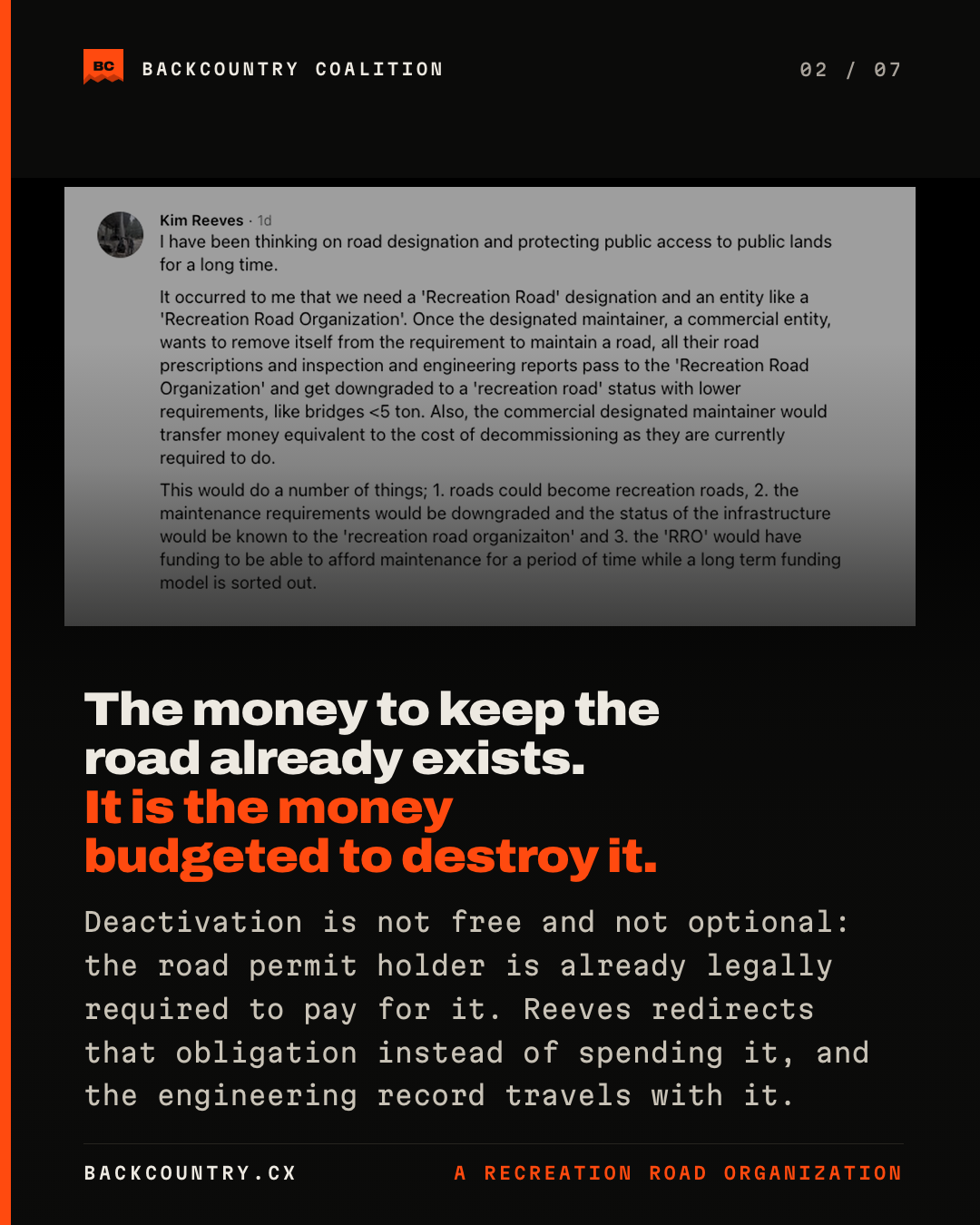
On 24 September the coalition sent an open letter to candidates and to the organisations whose members use the roads: British Columbia is demolishing the roads its future recreation economy runs on, and no agency here is responsible for keeping them open to the public. Kim Reeves, Past President of the Four Wheel Drive Association of BC, wrote back with the mechanism: when a commercial maintainer wants out of a road, it should hand over the engineering record along with the demolition money the law already requires it to spend.
Somebody is responsible for the road itself. Section 79(3) of the Forest Planning and Practices Regulation says the government must maintain a forest service road, structures included, until it is deactivated.24 Nobody is responsible for keeping it open to the public — for deciding that a road people drive to a lake on is worth keeping, and paying for that decision. That blank space is what the open letter was about. It went to candidates for the Legislative Assembly, to the BC Snowmobile Federation, to the Four Wheel Drive Association of BC and to the secretary-treasurer of the Trout Lake Recreational Club.
The replies mattered more than the letter. One of them contained a proposal, and this page exists because of it. Kim Reeves — Past President of the Four Wheel Drive Association of BC, made the association’s tenth director at its 2026 annual general meeting when the board created the advisory position of Past President, and previously also a director on the board of the Outdoor Recreation Council of BC — did not write back with an objection or an endorsement. He wrote back with a mechanism.23
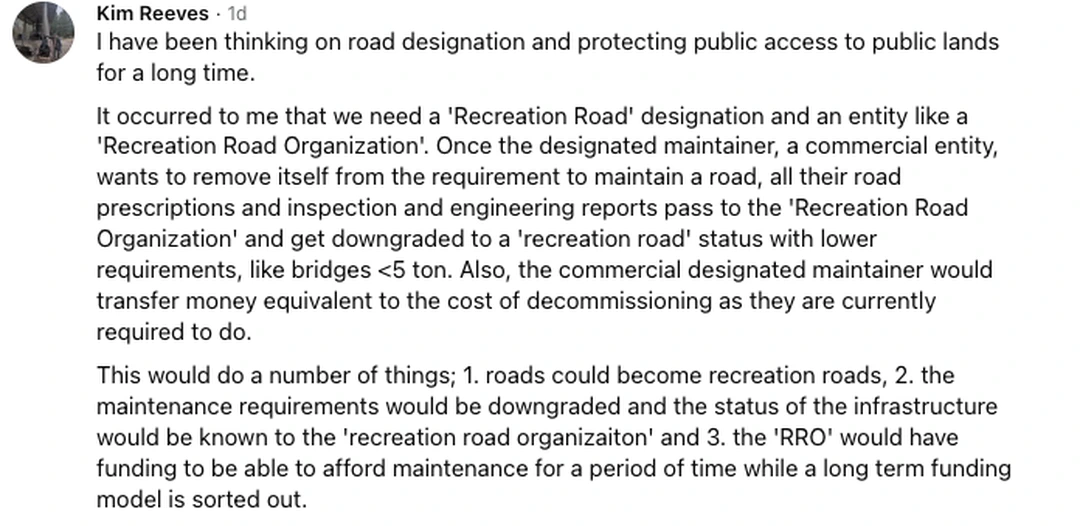
That last sentence is the one every previous version of this idea has failed on. Deactivation is not free and it is not optional: the holder of the road permit is already legally required to pay for the demolition, and that obligation is the only funded certainty anywhere in the arrangement. Reeves redirects it rather than spending it. The dollars that would trench the running surface and pull the bridges go instead to whoever keeps the road, and the engineering record travels with them, so the body that inherits the road also inherits the file that says what condition it is in.
Nothing below improves on that. What follows is what it would take to build it — what such a body would hold, what it must never touch, who has to be at the table before its first meeting, and what the whole thing costs against a province that has been paying the same bill for twenty years. The idea is his. The rest is the work of making it survive contact with the record, and the record opens with a difficulty: no organisation in British Columbia has ever adopted it as a published ask, and no proposal on the record has ever paired the body with a transfer of the deactivation money and the engineering file.
Two drawings carry the rest of this page. Read the bottom line of the first one before the rows above it, because it is the limit on the whole idea.
The second drawing is the table, and its only claim is arithmetic. Recreation is not one interest with one seat, and the seat settled before the body exists at all is the one that cannot be outvoted on its own territory.
Section 01No organisation has ever put it in writing: 590 records of what the sector demands, and not one proposes a body
Before building on a proposal it is worth establishing whether somebody had already made it. We looked where it would be if it existed: the resolutions municipalities send the Province, the recommendations independent officers make to ministers, the published positions of the outdoor organisations, and the trade press the forest industry writes for itself.
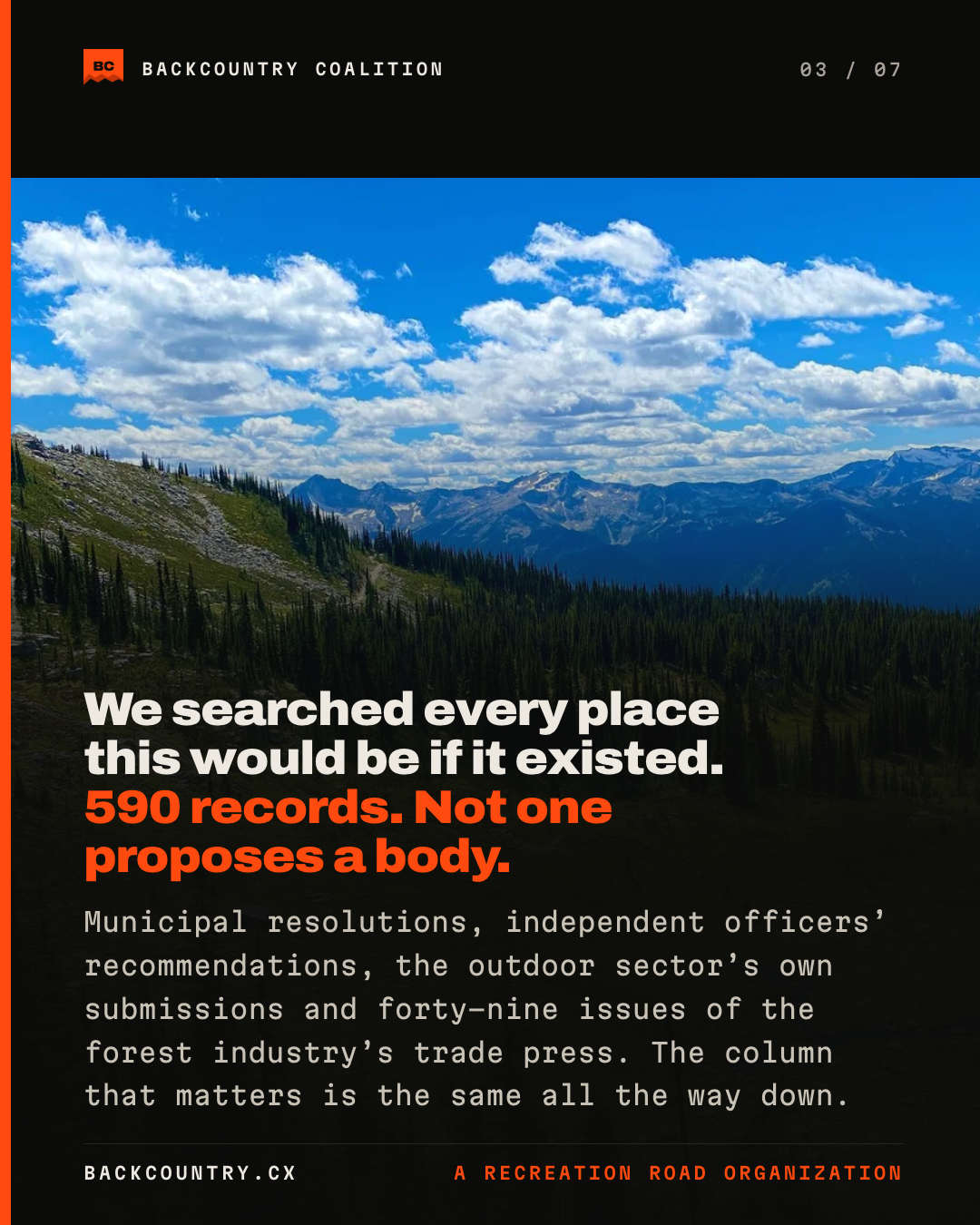
Five hundred and ninety records, and not one proposes a single organisation responsible for resource roads. What the sector asks for instead is always a process, money, clearer mandates among the ministries that already exist, or one statute in place of eleven. The Outdoor Recreation Council names the gap exactly — “There is currently no government agency specifically responsible for keeping resource roads open for recreation” — and then asks for a “more coordinated approach,” which describes better behaviour rather than a body.13
The closest anyone had come is one line in a conference proceeding. Patrick Daigle, a retired professional forester writing as science emeritus for the Ministry of Environment, told a Columbia Mountains Institute conference in Nelson in May 2014 that resource-road management needed “a single accountable coordinating organization” with “long-term political will and funding” behind it.11 One retired professional, one slide, one afternoon. Even that line stops at the organisation; it does not pair the body with a transfer of the deactivation money, and until September 2026 nothing on the record did.
A proposal that pretends to be a consensus is a weaker proposal. This one has one name attached to it and nothing else, and that belongs on the first page rather than the third.
Section 02The watchdog told government to plan access, government declined, and the file was closed ten years ago
The Forest Practices Board is an independent body created by statute to audit forest and range practices and report to the public. Section 6.2 of its April 2015 special report contains the plainest sentences any public institution in this province has written about the problem.
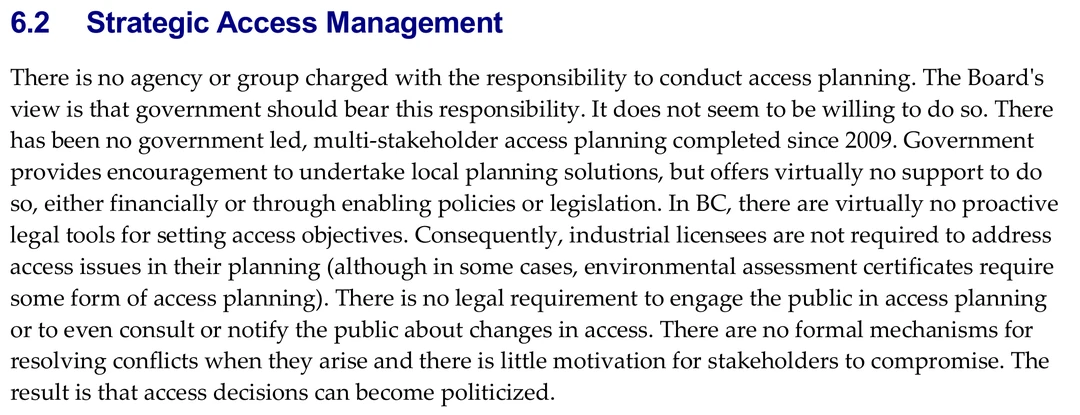
The report made six recommendations, one of them that government complete an inventory of the roads and rate the risk each one carries. Fourteen months later the Board’s chair wrote to the deputy minister of forests to record what had become of them.
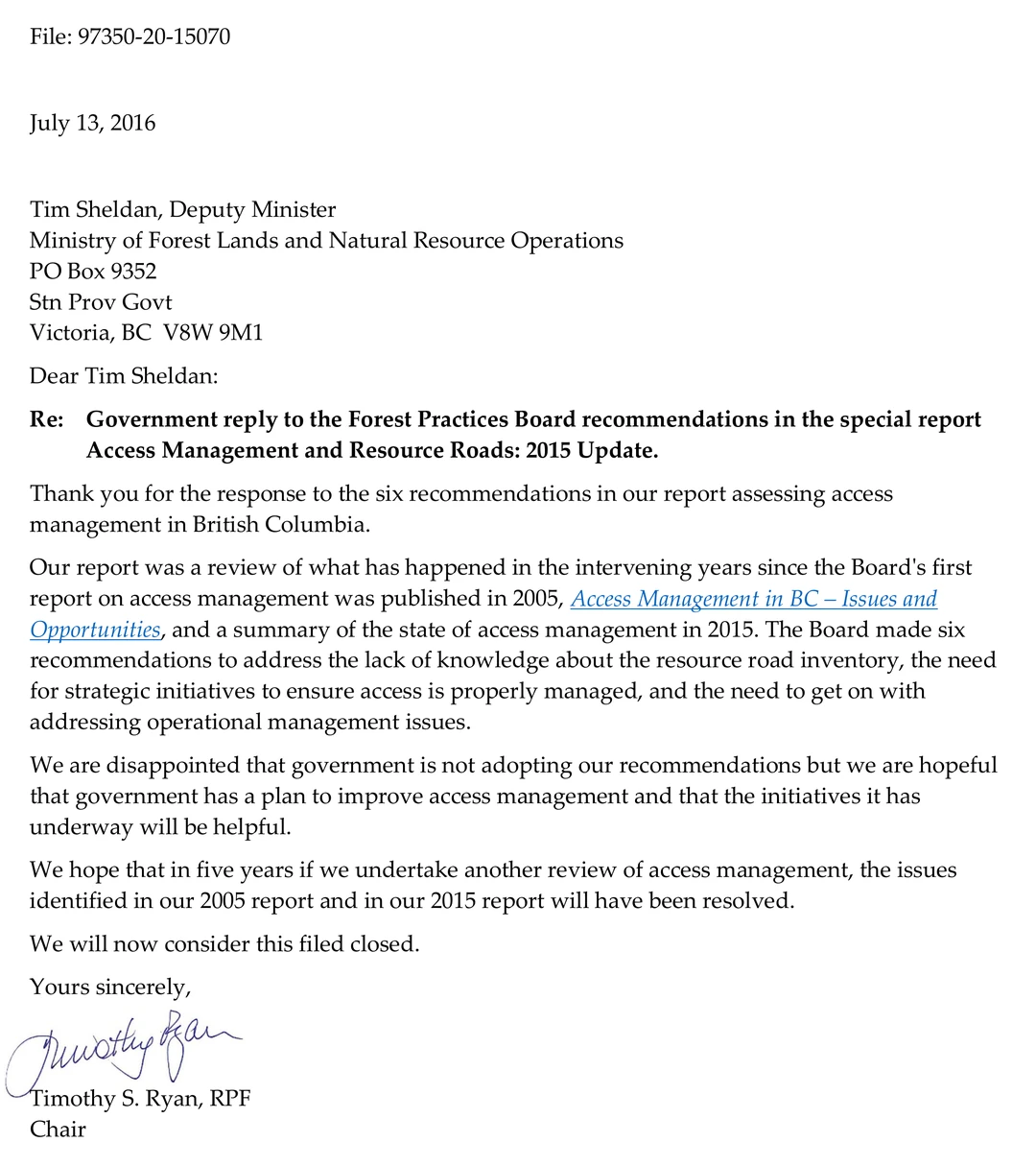
That letter is ten years old this summer. The five-year review it hoped for never happened, the inventory was never built, and in the decade since, the same absence has produced the deactivation notices this site has spent the year documenting.
The legislative route was tried twice and finished neither time. A bill reached the House in spring 2008 — Bill 30, the Resource Road Act, 262 sections establishing a Resource Road Authority with a chair, staff outside the Public Service Act and an annual reporting duty.06 No such authority has ever existed, and the Ministry’s published answer is one sentence: “Bill 30 was removed from the legislative agenda following first reading.”05 The second attempt, the Natural Resource Road Act, was a different reform — one Act consolidating several, never one agency05 — and it drew four thousand responses and fourteen working groups14 without a bill ever reaching the House.19
Part of what defeated both attempts is that nobody agrees on the size of the thing being fixed. The discussion paper says resource roads are governed by “up to 11 different laws”;15 the Province’s engagement page says “11 acts and regulations”;14 the Ministry’s safety FAQ says “more than a dozen”;05 and the Board says seven.01 Four documents, four counts, no agreement — and the Board wrote the epitaph in the same report: one comprehensive statute has been “the ‘holy grail’ of resource road management for over two decades”.01
The honest verb is not “cancelled.” Nothing was cancelled. The work was abandoned in practice without ever being formally cancelled, and the Province’s public engagement page still tells a reader that a project team is working toward a bill.14
Laid out on one axis, the four attempts stop looking like bad luck. Each ran for a while and then stopped for a recorded reason, and the reasons are not the same reason.
Section 03British Columbia has never counted its own roads, and a hundred thousand kilometres of them belong to nobody
An organisation that funds roads has to know which roads exist. British Columbia does not, and that is recorded by the people whose job it was. Carol Ogborne, of the Ministry’s own Resource Roads Integration Program, told the same 2014 Nelson conference that government databases were “missing up to 100,000 kilometres of the known 450,000 km of resource roads” and that “more than half of the road mapping in the province is more than 7 years out of date.” She gave the reason in one line: “There is currently no single agency that is collecting and consolidating spatial components of resource roads.”11
Two numbers circulate and they measure different things. About 450,000 km is what the Province’s databases held. About 620,000 km is the Forest Practices Board’s estimate of what is on the ground. Neither is the size of the network, because nobody has ever measured it: “no one, including the Board, has ever had, nor now has, a comprehensive inventory of roads in BC.”01
The Province says the same thing on its own resource roads page, updated in May 2025: there are non-status roads on Crown land that “may be found on maps but have no permit status” and “are not maintained or inspected”.16 A hundred thousand kilometres of public land is reachable along roads no institution admits to having. The Board recommended fixing that in 2015 and government declined;02 eleven years later the work is being attempted by six volunteer organisations running a web survey open until 2027.13
You cannot fund, rank or protect a network you have never counted. The register is not paperwork that comes after the decision. It is the first thing the organisation is for.
Section 04The strongest objection was written in 2007 by the industry’s own watchdog, and half of it still stands
A single road authority is not a new idea, and the place it was examined is the least convenient for anyone proposing it now. The BC Forest Safety Ombudsman — an office appointed and funded by the forest industry through the BC Forest Safety Council — reviewed resource roads in 2007 and published No longer the road less travelled. Under a heading of its own it set out having considered exactly this, and having decided against it.
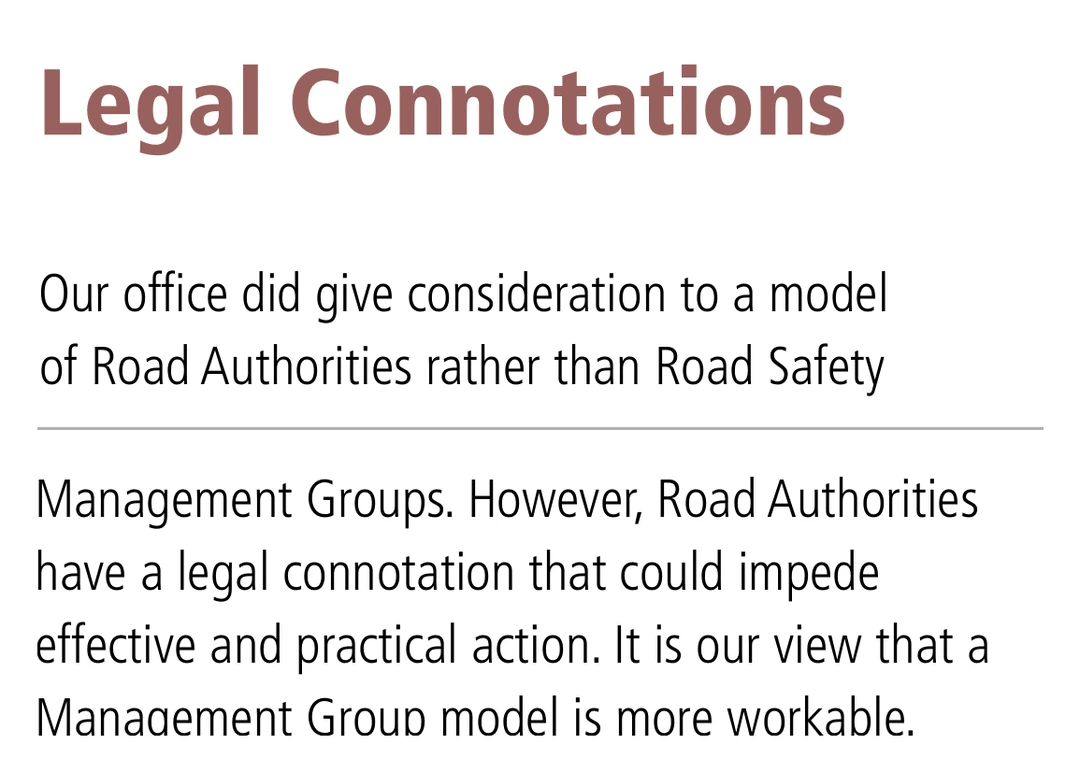
The first objection is precise, which is what makes it answerable. It is not an objection to coordination, to inventory or to money. It is an objection to one thing: an authority whose legal character — its power to authorise, order and enforce over other parties — drops it into the space that ministries, regulators and rights holders already occupy, where it would have to be litigated into position before it could do anything useful. Bill 30 proves the point: its explanatory note describes a body that would “issue, amend and transfer road authorizations”, its section 6 let it delegate quasi-judicial powers, and its section 262 left the whole Act to come into force at Cabinet’s convenience with every fee still unwritten.06 A regulator whose rules did not yet exist is a fair thing to refuse.
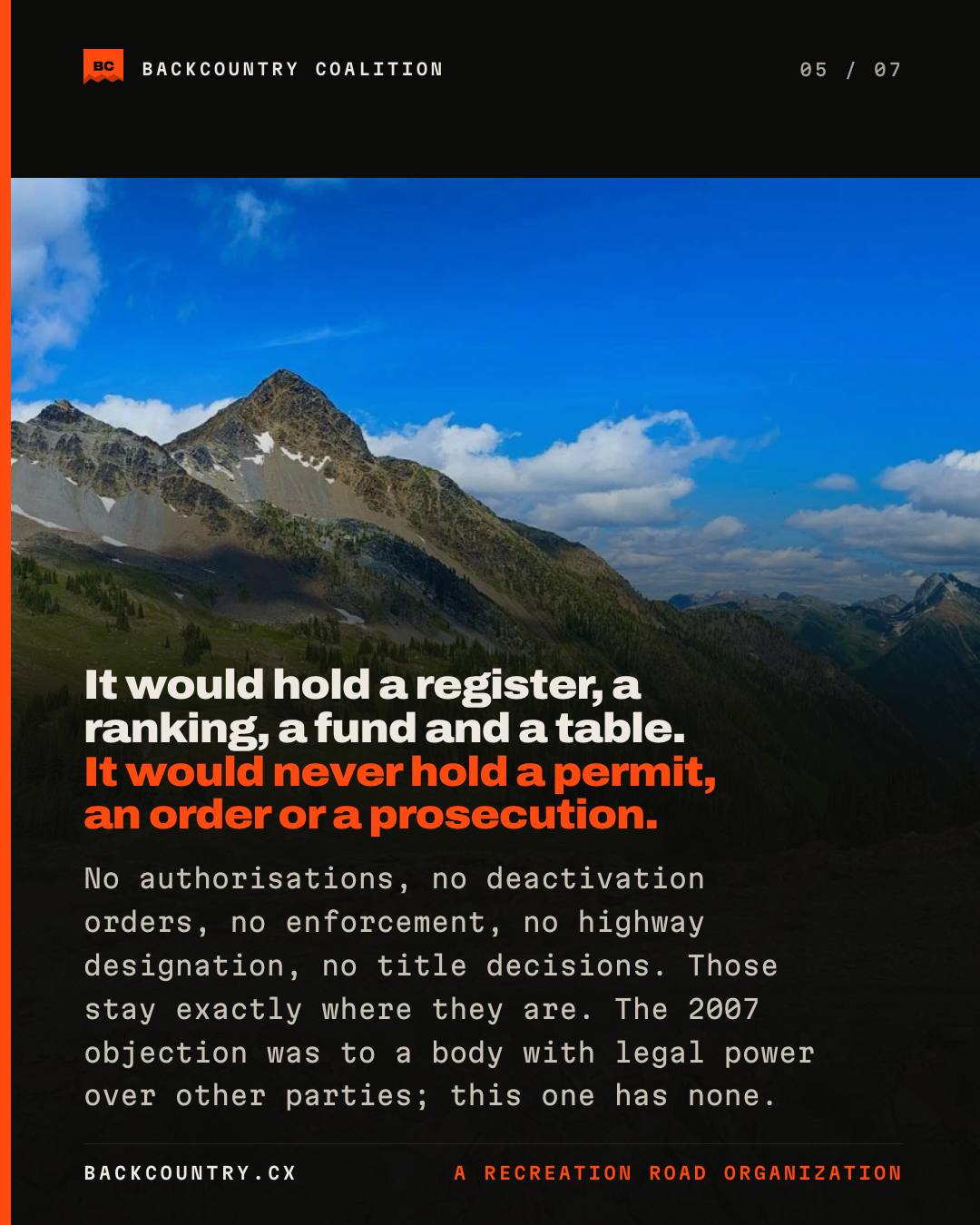
So the design is constrained by the 2007 finding rather than argued past it. The organisation proposed here holds no authorisation power, issues no order and prosecutes no one. Take the regulator out of a road authority and what is left is the part the Ombudsman never objected to.
The practical test of that design is what happens in a disagreement. If the organisation ranks a road as high value and the district intends to deactivate it, the organisation does not overrule the district. It publishes the ranking, publishes the reasons, tables the funding it holds for the alternative — and the district then has to explain its decision against a public document rather than into silence. That is a weaker instrument than a veto and a far stronger one than a letter, and it is the instrument missing from every road story on this site.
The boundary matters more than the mandate, so it is worth drawing rather than listing. Everything inside the fence is something the organisation makes — a record, a ranking, a bank balance, a meeting. Everything outside it is a power over somebody else, and every one of those stays exactly where it is today.
The 2007 review never reached the objection that has actually stopped every transfer since, because a road is an occupied premises and the first question a volunteer board asks is who gets sued. British Columbia answered part of that in 2012: section 3.1 of the Occupiers Liability Act deems a person using a resource road to have “willingly assumed all risks”, leaving the road’s “limited liability entity” owing only a duty not to create a danger with intent to do harm or act with reckless disregard. But the Act defines that entity as the maintainer or the government, and a maintainer as someone “obligated or authorized under an enactment” to maintain the road.25 A body that took a road by agreement rather than under an enactment sits outside that definition on its face. That is the blocker, and the coalition’s own letter names its consequence: the only tenure available today loads unlimited liability onto volunteer directors, no responsible board signs that, and no road has ever been transferred.27
Which makes the legal form a first decision rather than a later one. Three of the four holdings — the register, the priority list and the fund — need no statute; a society under the Societies Act can build and hold them this year. The moment the organisation holds a road, it needs one amendment rather than 262 sections: a designated road manager written into the Occupiers Liability Act definition of maintainer, with an insurance floor set in the open — Quebec’s is $5,000,000.27
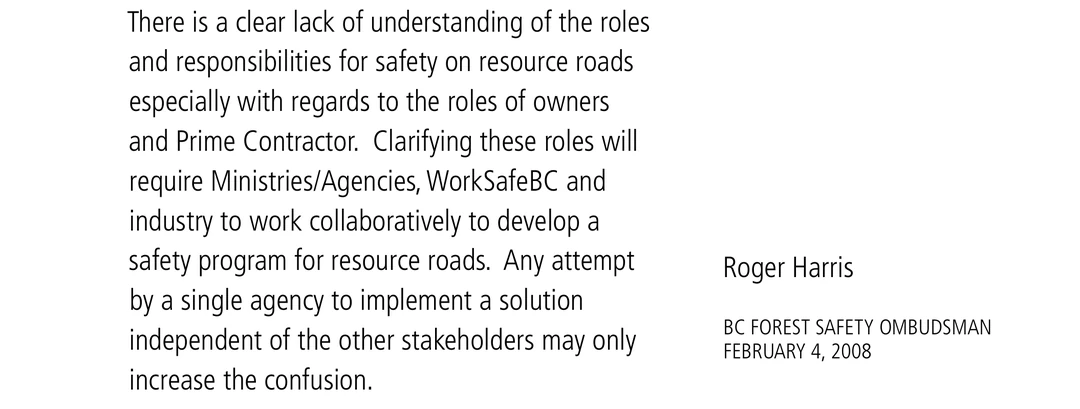
The second half of the 2007 warning is not designed around, because it cannot be. An organisation with a register, a list and a chequebook still has to be joined by the parties who hold the actual powers. If the Province declines the invitation, the result is a very well-informed body watching roads disappear.
Section 05The Union of BC Indian Chiefs opposed the last attempt, and both of its reasons are the test this proposal has to pass
The Natural Resource Road Act did not only run out of legislative time. It was opposed. On 14 September 2012 the Union of BC Indian Chiefs carried Resolution 2012-35, certified by Grand Chief Stewart Phillip. A resolution of that kind directs UBCIC’s own executive: it binds nobody else and does not speak for any individual Nation’s Title, and that it is the only resource-road resolution in the public archive across sixteen years is a fact about an archive, not about what Nations think. What it gives is two reasons, and both are still live.
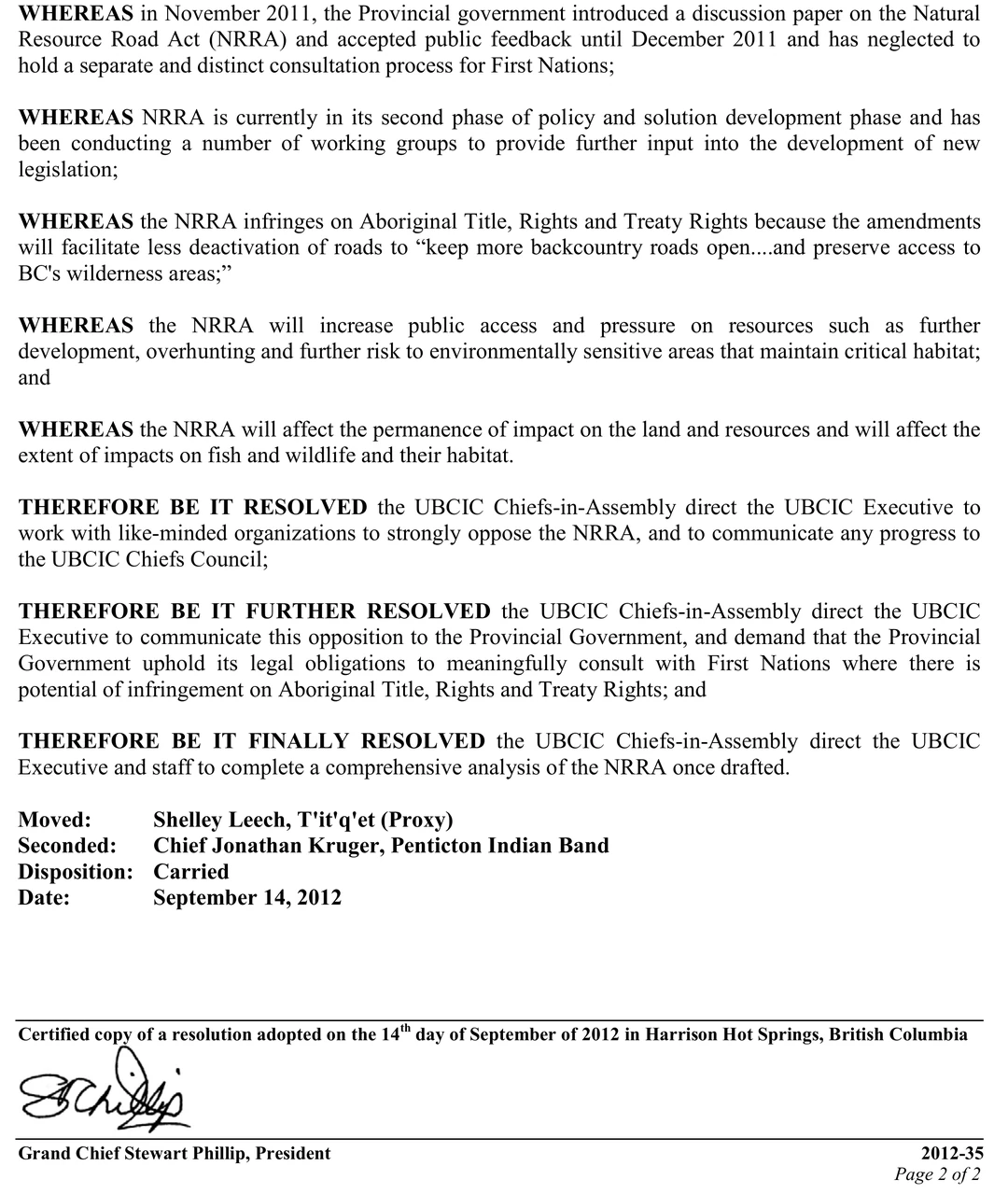
The second reason cuts against the argument this site usually makes. A reform designed to keep more backcountry roads open is a reform that increases pressure on land, water, fish and wildlife, and that decision is not the Province’s alone to take.
Both clauses are the test. The first says what a process must not be: a general public comment window with First Nations inside it. The second says what the organisation must be able to hear — that the right answer for a particular road may be to close it. Concretely that is three things. The mandate, the seats and the decision rule are drafted with First Nations rather than circulated for comment once drafted. The priority list cannot rank a road inside a territory over the objection of the Nation whose territory it is. And closing a road stays a live outcome, funded on the same terms as keeping one open, because an organisation that can only ever say “keep it” is a lobby wearing a mandate.
None of that needs inventing, and the instrument did not exist in 2011. Under section 7 of the Declaration on the Rights of Indigenous Peoples Act the Lieutenant Governor in Council may authorise a minister to enter an agreement with an Indigenous governing body for “the exercise of a statutory power of decision jointly” or for “the consent of the Indigenous governing body before the exercise of a statutory power of decision”.26 A seat held as of right is a description of a section 7 agreement.
A proposal that repeats the 2011 mistake is not worth publishing. Consent is the first design decision here, not the last consultation.
Section 06Ontario pays up to 100 per cent of its primary forest road costs. British Columbia’s districts asked for $40.2 million and were given $5.5 million
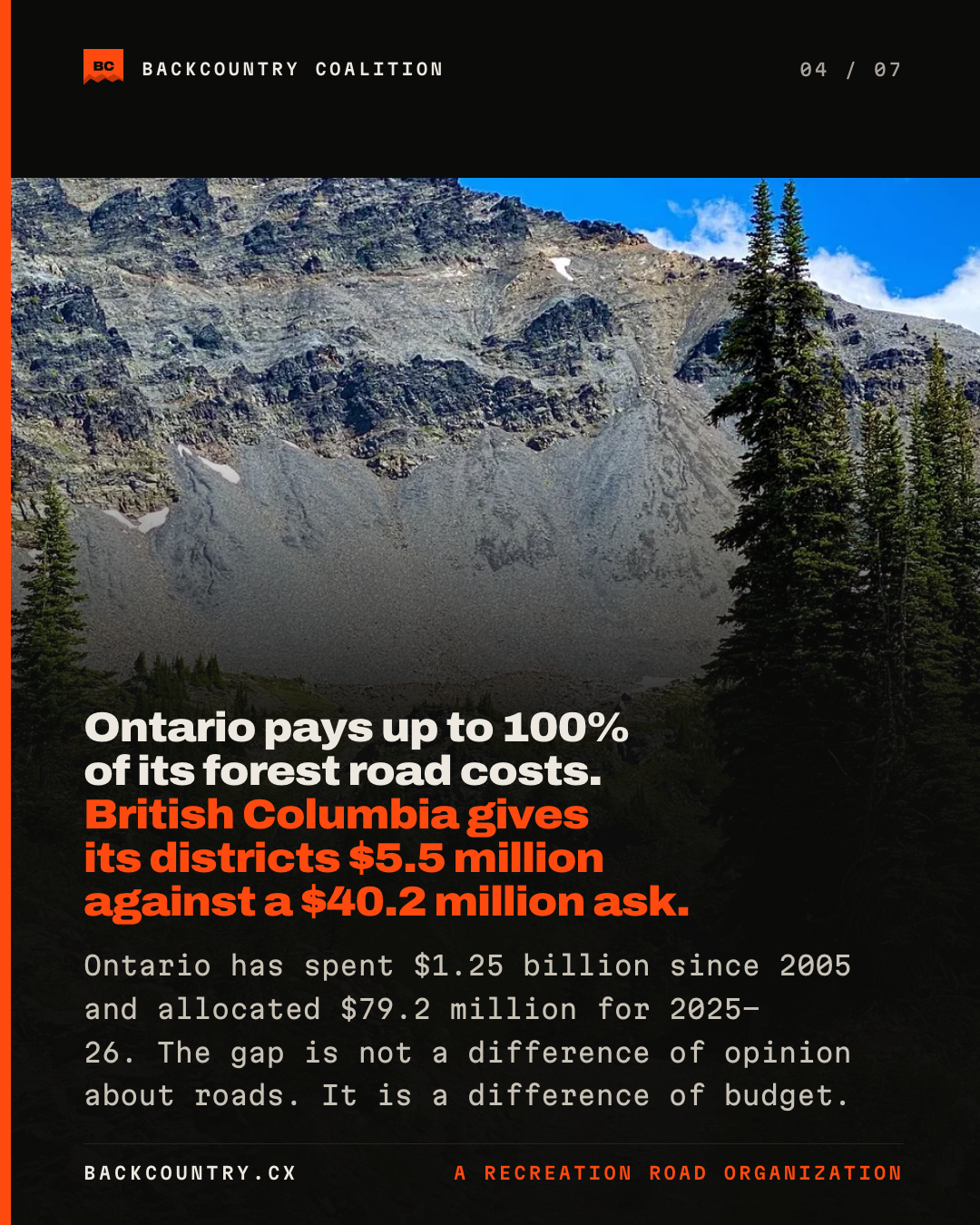
Every coordination exercise British Columbia has run since 2002 has failed at the same point, and the point is not goodwill. There has never been money attached. Ontario’s Provincial Forest Access Roads Funding Program covers “up to 100% of primary road costs” and “up to 50% of branch road costs” on Crown forest roads, and its eligibility page names the beneficiaries without embarrassment: mining companies, tourism operators, Aboriginal communities, utilities, railways, and “hunters, anglers, campers, trappers and cottagers”. Since 2005 it has paid out $1.25 billion.08
The British Columbia figures come from the Auditor General’s 2020 audit, and 2019/20 is not an outlier: districts asked $28.6M and received $5.6M in 2017/18, asked $39.0M and received $5.7M in 2018/19, and asked $40.2M and received $5.5M in 2019/20 — 20, 15 and 14 per cent.07 Newfoundland and Labrador is the smallest comparison and in some ways the sharpest: Budget 2026 carries a named line of $4.8 million for forest access roads and states the reasons, among them “hunting and fishing, and cabin access”.10
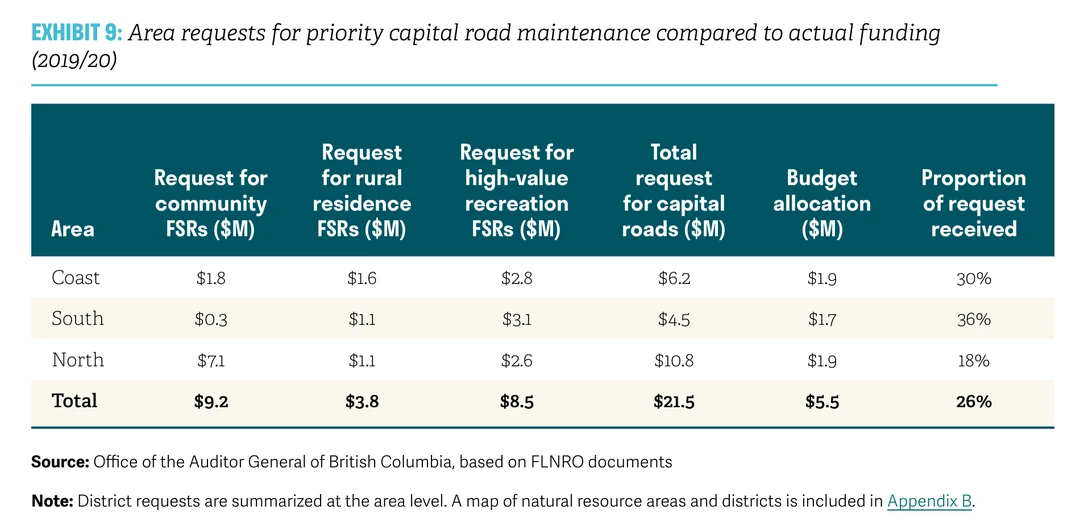
Underfunding is not a shortfall on the way to a decision. It is the decision. The Auditor General found the Engineering Program Funding Policy advises districts to deactivate the roads they cannot afford to maintain — which converts a budget the district never controlled into a removal order for a road it was told to look after.07
So a scale already exists in Canadian practice. Closing the documented British Columbia gap — the difference between what districts ask for and what they receive — is on the order of $35 million a year at 2019/20 prices. A fund at Ontario’s current scale is $79.2 million. The register and the secretariat behind it are a rounding error beside either: staff, survey and data work, not a building.
Where that money comes from has three honest answers. An appropriation is what Ontario and Newfoundland both use, and it is the only source with a published record of paying for public benefit on an industrial road. Cost recovery from authorisation holders is Bill 30’s model: its section 38 charged maintenance fees to each “non-maintaining user”, defined as a person who “holds a road authorization” and is not the designated maintainer.06 A driver at a trailhead holds no road authorisation and fell entirely outside it — the distinction most likely to be lost in a public meeting. It is fair where industrial traffic is present and useless where the industry has gone, which the Province’s own 2026 strategy names as the problem: “the industrial base that has historically funded road maintenance continues to shrink”.12 The third answer, a user contribution, cannot be the foundation, because a network this size will never be funded out of the pockets of the people at the trailhead.
Reeves’s transfer sits underneath all three. It is not new money and needs no appropriation to begin: it is money already committed, already owed by a named party, and currently spent on destroying the asset. Monika Bittel of the Federation of Mountain Clubs put the rest of it to the Squamish Chief in one line: “I said, well, we’re not asking for 600,000 kilometres of roads to be funded.”18 That is the whole use of the priority list. Nobody is asking for the network. They are asking for the roads on a list that does not yet exist.
Section 07Run it against Rady Creek and Sitkum Creek, and the missing thing is a list, a budget and a meeting
A proposal that cannot be run against a real road is a slogan. Two roads in the Selkirk Natural Resource District, both posted for destruction by the same office, are on the public record in enough detail to test it.17 One is barricaded this autumn; the other comes out next summer.
At Rady Creek, the road serving Trout Lake, the access ends on a date. The Ministry of Forests told CBC on 22 September 2026 that “the decision for deactivation is final,” and that the project entails barricading the road by 1 November 2026.21 The one route that could have kept the corridor open as a recreation trail had already closed: Recreation Sites and Trails BC declined the Trout Lake club’s application on 19 August 2026, because its authority to authorise recreation trails does not generally extend to a forest service road — leaving a Land Act licence of occupation as the route back, available only once the road has been pulled apart.22 Two ministries, two files, and no seat anywhere that owns the transition between them. Underneath the date is a 42-page geotechnical prescription dated 8 September 2026, produced mid-tender, whose quantities are in Figure 08.
Run Rady Creek through the organisation and the four things inside the fence all bite: it is in the register with its condition recorded, so the engineering question is answerable before a tender rather than during one; it carries a ranking somebody signed rather than an adjective in a letter; “maintain it instead” is a costed option rather than a request with nowhere to go; and the people who ride, sled and hunt from that road hear about it before the contract is advertised.
At Sitkum Creek the arithmetic is plainer, and the people losing the road are the ones who built it back. The district has posted the upper 3.9 kilometres of Sitkum Creek FSR 0235 01 for deactivation in approximately June 2027, with no detailed prescription available.17 The road runs through a community watershed above the intake of a licensed waterworks. The Province deactivated it once already, in 2014, and volunteers put the access back in 2016. A register would have recorded that the people who use this road had already rebuilt it once — the fact most likely to change a ranking and least likely to survive in a district file.
Both roads are measured in public, and what is measured is the demolition. Everything the organisation would have brought to either of them is the part with no number against it.
Now the harder half, which is why these two roads test the proposal rather than prove it. At neither is there a commercial maintainer to transfer anything: both are forest service roads, and section 79(3) puts the duty to maintain one on the government until it is deactivated, so the payer and the demolisher are the same party.24 The mechanism belongs to a different case, and that case is on the record at Rady Creek too: the licensee, Cooper Creek Cedar, wrote that it was “willing to transfer any road sections under our Road Permit to stakeholder groups that would like to assume liability”, and copied Recreation Sites and Trails BC. Nothing in government was built to receive that offer. Two conditions would have made it real: an independent valuation of the decommissioning estimate, so the sum transferred is not priced by the maintainer’s own engineer, and a duty to offer the transfer before deactivating.27
And across most of the network the transfer is silent. A road no longer used by industry can be held open as a wilderness road under section 81 of the Forest Planning and Practices Regulation, which turns the maintenance duties down rather than off;24 the Forest Practices Board found over three quarters of forestry road-permit roads are already held that way rather than deactivated, because deactivation costs more than wilderness-road maintenance.27 Where nobody has decided to deactivate there is no committed demolition money to redirect. The transfer works where a maintainer is leaving and is silent everywhere else — which is why the fund behind it has to be appropriated rather than assumed.
At both roads the missing thing is the same, and it is not a rule. It is a list, a budget and a meeting.
One objection survives everything above, and it comes from inside the outdoor sector. The British Columbia Wildlife Federation carries policy pushing the other way: legislated limits on the density of roads and other linear features, and funding for reclamation.20 That is not a fringe view, and it is not incompatible with everything here. It is directly incompatible with the version of this proposal that treats every road as worth keeping — which is why the priority list is the centre of the design. The Chiefs-in-Assembly said it in 2012 and the Wildlife Federation says it now, from different places and for different reasons, and both describe the same test: a body that cannot say no to a road has no business deciding about roads.
The Province, meanwhile, has committed to Target 8 of Look West, “A modernized framework for high-value recreation access and resource roads,” and to “a coordinated policy, planning and management approach”.12 It is the fourth iteration of the same promise since 2002, and it is not, on its face, a body, a budget or a date.18
So take it somewhere, and take it with the credit in the right places. Reeves proposed the designation, the entity, and the transfer of the prescriptions, the reports and the decommissioning money. The register, the scored priority list, the seats held as of right and the appropriation behind all of it are the coalition’s, and he is not answerable for them. The ask fits on one page: build the register, publish the priority list, redirect the demolition money wherever a maintainer is leaving, appropriate the rest at a scale a neighbouring province has been paying for twenty years, write a designated road manager into the Occupiers Liability Act so a board can sign, and settle the seats under a section 7 agreement before the first meeting rather than after the first objection.
The road under you belongs to somebody. Make it somebody with a name, a budget, and a table.
Share this story
Seven images carrying this story on their own — the reply that started it, the money already budgeted to destroy the road, the 590 records, the funding gap, the limits and the table. Made to be posted.


Slide 1 of 7
Suggested caption
British Columbia is tearing out the roads its recreation economy runs on, and no agency here is responsible for keeping them open to the public. On 24 September 2026 the coalition put that in an open letter. Kim Reeves, Past President of the Four Wheel Drive Association of BC, wrote back with a mechanism.
His proposal: a Recreation Road designation, and a Recreation Road Organization. When a commercial maintainer wants out of a road, the prescriptions, inspection reports and engineering record pass to that body, the road is downgraded to recreation standards, and the money already budgeted for decommissioning transfers with it. The money to keep the road is the money budgeted to destroy it.
We searched every place a proposal like this would be if anyone had made it — municipal resolutions, independent officers’ recommendations, the outdoor sector’s own submissions and forty-nine issues of the forest industry’s trade press. 590 records. Not one proposes a body.
The Forest Practices Board told government to plan access in 2015. Government declined, and the Board closed the file in 2016.
Ontario pays up to 100 per cent of its primary forest road costs, has spent $1.25 billion since 2005, and allocated $79.2 million for 2025–26. British Columbia’s districts asked for $40.2 million and were given $5.5 million.
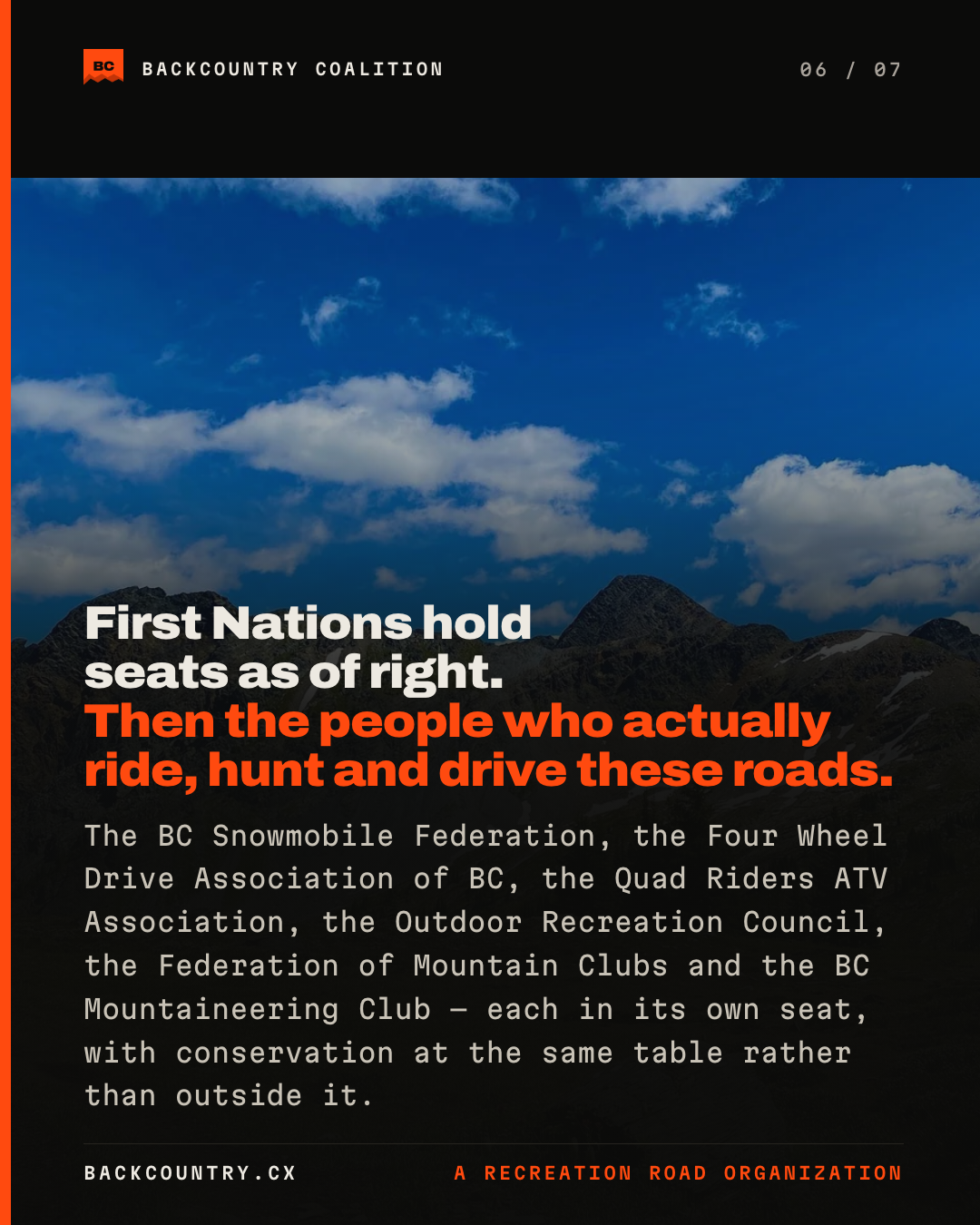
It would hold a register, a ranking, a fund and a table. It would never hold a permit, an order or a prosecution. First Nations hold seats as of right, alongside the BC Snowmobile Federation, the Four Wheel Drive Association of BC, the Quad Riders ATV Association, the Outdoor Recreation Council, the Federation of Mountain Clubs and the BC Mountaineering Club.
The road under you belongs to somebody. Make it somebody with a name, a budget, and a table.
backcountry.cx/editorials/resource-road-organization/
#BCpoli #PublicLand #Kootenays #ResourceRoads
Sources
- ↩↩↩↩↩↩↩Forest Practices Board, Special Report FPB/SR/49, Access Management and Resource Roads: 2015 Update, April 2015, 51 pp. §6.2 for “There is no agency or group charged with the responsibility to conduct access planning… It does not seem to be willing to do so”; the executive summary for “There is no legal requirement to notify the public about changes in access”; the summary for the “holy grail” passage and the seven-statute count; p.30 for government’s December 2007 assurance that it was “expecting proclamation of the Resource Roads Act… in the fall of 2008” and for the prorogation of the session in which Bill 30 was introduced; the category table for 620,000 km, 240,000 km of cutblock road, ~100,000 km of non-status road where “no one, including government, is identified as being responsible”, and ~20,000 km each of oil and gas and other-industry road; the same report for the recommendation to complete an inventory, and for the Oil and Gas Activities Act consolidation of “four separate enactments”. https://www.bcfpb.ca/wp-content/uploads/2015/04/SR49-Access-Management-2015-Update.pdf
- ↩↩↩Forest Practices Board, Chair Timothy S. Ryan, RPF, to Deputy Minister Tim Sheldan, file 97350-20-15070, 13 July 2016. Government’s response to the six FPB/SR/49 recommendations, and the Board’s reply: “We are disappointed that government is not adopting our recommendations… We will now consider this filed closed.” https://www.bcfpb.ca/wp-content/uploads/2015/04/SR49-Response-to-Recommendations.pdf
- ↩↩↩BC Forest Safety Ombudsman, No longer the road less travelled, 2007–08 Review: Resource Roads. Under the heading “Legal Connotations,” for the consideration and rejection of “a model of Road Authorities rather than Road Safety Management Groups”; the Ombudsman’s own covering message, Roger Harris, 4 February 2008, for “Any attempt by a single agency to implement a solution independent of the other stakeholders may only increase the confusion”; the recommendations, which run 1 to 17, for Recommendation 1 on a new public highway designation, Recommendation 5 on regional Road Safety Management Groups, and Recommendation 13 leaving enforcement with the Ministry of Forests and Range, the Ministry of Transportation, the RCMP and WorkSafeBC. The office is appointed and funded by the forest industry through the BC Forest Safety Council. Limit: whether government ever formally responded to the review’s 17 recommendations is not established. https://www.bcforestsafe.org/wp-content/uploads/2021/01/BCFCS_2007_Resource-Road_Report.pdf
- ↩↩Union of BC Indian Chiefs, Resolution 2012-35, “Opposition to Provincial Natural Resource Road Act,” 44th Annual General Assembly, Harrison Hot Springs, 14 September 2012; carried; certified by Grand Chief Stewart Phillip. Quoted from the assembly’s resolutions package. It is the only resource-road resolution in the UBCIC public archive across 2010–2026. The resolutions index is at ubcic.bc.ca/resolutions. https://assets.nationbuilder.com/ubcic/pages/132/attachments/original/1551207092/UBCIC_AGA_09-14_Resolutions.pdf
- ↩↩↩Ministry of Forests, Lands and Natural Resource Operations, Safety on Resource Roads & Natural Resource Road Act — frequently asked questions, 8 pp. Q21 for “Bill 30 was removed from the legislative agenda following first reading”; Q6 and Q7 for the Natural Resource Road Act as “a single management and administrative framework” that would “consolidate, harmonize and streamline” existing provisions “under a single piece of legislation”; Q12 for the list of eleven statutes; Q18 for duties assigned to “the Province”. The word “authority” does not appear in the document. https://www2.gov.bc.ca/assets/gov/farming-natural-resources-and-industry/natural-resource-use/resource-roads/nrra_frequently_asked_questions.pdf
- ↩↩↩Bill 30 — 2008, Resource Road Act, 4th Session, 38th Parliament; introduced by Hon. Rich Coleman, Minister of Forests and Range; first reading only. The explanatory note for “It establishes a Resource Road Authority and allows that authority and its delegates to issue, amend and transfer road authorizations”; s.2 for the chair, vice-chairs and appointees; s.5 for staff outside the Public Service Act; s.6 for delegation of quasi-judicial powers; s.8 for the annual report; s.11 for the bar on charging non-industrial users unless the regulations provided otherwise; s.38 for maintenance fees and s.1 for the definition of “non-maintaining user” as an authorisation holder; s.225 for the repeal of the Industrial Roads Act; s.262 for commencement by regulation. Read it as a bill that died, not as law: it never reached second reading, so it has no consolidated BC Laws page and there is no Resource Road Authority in British Columbia today. https://www.bclaws.gov.bc.ca/civix/document/id/lc/billsprevious/4th38th:gov30-1
- ↩↩↩↩↩Auditor General of British Columbia, Management of Forest Service Roads, November 2020. For the funding series — $28.6M requested and $5.6M allocated in 2017/18, $39.0M and $5.7M in 2018/19, $40.2M and $5.5M in 2019/20; for the ~58,000 km forest service road network; for high-value recreation as the South area’s largest single capital category, funded at 36% of its ask; for the Engineering Program Funding Policy advising districts to deactivate roads they are unable to maintain; and for the audit’s nine recommendations. https://www.oag.bc.ca/app/uploads/sites/963/2024/08/OAGBC-20210119-Management-Forest-Service-Roads_RPT.pdf
- ↩↩Government of Ontario, Provincial forest access roads funding program, ontario.ca; published 17 July 2014, updated 26 September 2025; read 27 September 2026. For “up to 100% of primary road costs” and “up to 50% of branch road costs”, for “Since 2005, Ontario has provided $1.25 billion to construct and maintain forest access roads”, and for the beneficiary list including “hunters, anglers, campers, trappers and cottagers”. https://www.ontario.ca/page/provincial-forest-access-roads-funding-program
- ↩Government of Ontario, Success at a glance: Ontario’s Forest Sector Strategy 2025 progress report, ontario.ca; published 26 September 2025, updated 20 July 2026; read 27 September 2026. “In fiscal year 2024-25, Ontario provided $59.2 million… For 2025-26, the annual allocation for the Provincial Forest Access Roads Program has been increased to $79.2 million.” https://www.ontario.ca/page/success-glance-ontarios-forest-sector-strategy-2025-progress-report
- ↩↩Government of Newfoundland and Labrador, Budget 2026, A Plan to Build; read 27 September 2026. “$4.8 million to maintain forest access roads, which are vital for forest management, commercial harvesting, mining exploration, agriculture, hunting and fishing, and cabin access.” https://www.gov.nl.ca/budget/2026/what-you-need-to-know/a-plan-to-build/
- ↩↩↩Columbia Mountains Institute of Applied Ecology, Resource Roads in British Columbia: Environmental challenges at a landscape level, conference proceedings, Nelson, 14–15 May 2014, 181 pp. Patrick Daigle, MSc, RPF (Retired), Science Emeritus, BC Ministry of Environment, pp.35–41, for “a single accountable coordinating organization”; Carol Ogborne, BC Resource Roads Integration Program, Ministry of Forests, Lands and Natural Resource Operations, for “missing up to 100,000 kilometres of the known 450,000 km of resource roads”, “more than half of the road mapping in the province is more than 7 years out of date”, and “There is currently no single agency that is collecting and consolidating spatial components of resource roads.” https://cmiae.org/wp-content/uploads/Resource-Roads-conference-2014-summary_FINAL_3.pdf
- ↩↩↩Look West: B.C.’s Outdoor Recreation Strategy, Province of British Columbia, launched 21 May 2026, 36 pp. Target 8, “A modernized framework for high-value recreation access and resource roads”; its stated rationale, including “As shifts in the forest sector accelerate and the industrial base that has historically funded road maintenance continues to shrink, new solutions need to be explored”; and its key action, “Advance a coordinated policy, planning and management approach…”. Launch release 2026ENV0024-000574. https://www2.gov.bc.ca/assets/gov/sports-recreation-arts-and-culture/outdoor-recreation/bc-parks/bcparks_ors_bcparks_outdoor-recreation-strategy.pdf
- ↩↩↩Outdoor Recreation Council of BC, Resource Road Access Survey; read 27 September 2026. “There is currently no government agency specifically responsible for keeping resource roads open for recreation… there is an opportunity to consider a more coordinated approach to managing priority recreation access routes.” The survey “will remain open until 2027” and is run by ORCBC’s Resource Road Working Group, whose members are listed on the page as the Outdoor Recreation Council of BC, the Federation of Mountain Clubs of British Columbia, the BC Snowmobile Federation, the Four Wheel Drive Association of BC, the Quad Riders ATV Association of BC and the British Columbia Mountaineering Club. https://www.orcbc.ca/resource-road-access-survey
- ↩↩↩Province of British Columbia, govTogetherBC, Proposed Natural Resources Road Act — engagement results; read 27 September 2026. For “currently governed by 11 acts and regulations” and the goal to “consolidate the current regulatory framework into a single act”, and for the scale of the 2011 consultation. Limit: the page still describes drafting work as under way; its wording matches the Ministry’s own Natural Resource Road Act site as it stood under an “Updated January 2014” stamp, and its 9 March 2023 modification date reflects a content-system migration rather than a status update. https://engage.gov.bc.ca/govtogetherbc/impact/proposed-natural-resources-road-act-results/
- ↩Ministry of Forests, Lands and Natural Resource Operations, Natural Resource Road Act Project discussion paper, 16 pp., feedback deadline 15 December 2011. For “up to 11 different laws” and for framework principle (f): “Any road lacking a designated maintainer may be subject to deactivation.” Set beside the Ministry FAQ’s own “more than a dozen different pieces of legislation” and the Forest Practices Board’s “seven different pieces of legislation”: four counts, four documents, no agreement. https://www2.gov.bc.ca/assets/gov/farming-natural-resources-and-industry/natural-resource-use/resource-roads/discussion-paper.pdf
- ↩Province of British Columbia, “Resource roads”, www2.gov.bc.ca; page last updated 5 May 2025. “Resource Roads may be deactivated when no longer needed or where it is cost prohibitive to continue to maintain. There are also non-status roads (NSRs) on Crown land. These roads may be found on maps but have no permit status. These roads are not maintained or inspected…” https://www2.gov.bc.ca/gov/content/industry/natural-resource-use/resource-roads
- ↩↩↩Selkirk Natural Resource District road safety information page, Ministry of Forests; page footer “Last updated on September 18, 2026”; read 27 September 2026. The district’s own deactivation entry: “Sitkum Creek FSR 0235 01 (July 6, 2026) — Sitkum Creek FSR from 2.9km to 6.8km, in the Sitkum Creek watershed, is planned for deactivation in approximately June 2027. Deactivation planning is currently underway, and a detailed prescription is not yet available.” The Rady Creek record, the 8 September 2026 geotechnical prescription and its specified works, the Sitkum community watershed designation, the 2014 deactivation and the 2016 volunteer rebuild funded with $8,000 of Columbia Basin Trust money are set out in full, with their own sources, in the Sitkum Creek and Rady Creek pieces on this site. https://www2.gov.bc.ca/gov/content/industry/natural-resource-use/resource-roads/local-road-safety-information/selkirk-natural-resource-district-road-safety-information
- ↩↩Liz McDonald, “Who decides when a B.C. resource road dies?”, Squamish Chief, 5 July 2026. For “This patchwork of responsibility means no one agency is responsible for keeping access alive” and for Monika Bittel of the Federation of Mountain Clubs: “I said, well, we’re not asking for 600,000 kilometres of roads to be funded.” https://www.squamishchief.com/local-news/who-decides-when-a-bc-resource-road-dies-12510082
- ↩↩Our own search of the record, September 2026 — the corpora behind Figure 03, and their limits. The bodies searched were: the full text of 535 Truck LoggerBC articles across 49 issues, Summer 2013 to Summer 2026, for “resource road organization”, “resource road authority”, “resource road agency” and “single road authority”, with control terms confirming the corpus was reachable; 15 UBCM resolutions touching resource roads in the convention resolutions database; the 17 recommendations of the 2007 Forest Safety Ombudsman review; the 9 recommendations of the Auditor General’s 2020 audit; the 6 recommendations of FPB/SR/49; and the published positions of ORCBC, the Federation of Mountain Clubs, the BC Snowmobile Federation, ATVBC, the Four Wheel Drive Association of BC, the BC Mountaineering Club, the BC Wildlife Federation and Backcountry Hunters & Anglers BC. Limits, stated rather than hidden: the Truck LoggerBC sweep, the UBCM database sweep and the legislature sweep that dates the Natural Resource Road Act’s last mention in the House to March 2014 are our own research work rather than third-party publications, and are recorded in full in the research file behind this page; UBCM’s database rendering strips apostrophes, slashes and parentheses, so no quotation is taken from it; Truck LoggerBC issues from 2009 to 2012 are not digitised and could not be searched; and the legacy Hansard tree returns HTTP 404, so no debate transcript is quoted anywhere on this page. https://www.ubcm.ca/convention-resolutions/resolutions/resolutions-database
- ↩British Columbia Wildlife Federation — policy on linear feature density, carried by resolution in 2026. The federation’s policy direction is the reverse of the access organisations’: legislated limits on the density of roads and other linear features, and funding for reclamation. Limit: the federation’s 2026 disposition of resolutions was not reachable at source on 27 September 2026, so the resolution is described rather than quoted and the density figure it proposes is not reproduced here. https://bcwf.bc.ca/resolutions/
- ↩Jacqueline Gelineau, “Outdoor recreation community frustrated with latest B.C. forest road closure,” CBC News, 22 September 2026. For the Ministry of Forests’ written statement, attributed to an unnamed ministry spokesperson: “At this time, the decision for deactivation is final.” The same report records that the project entails barricading the road by 1 November 2026, that the ministry acknowledged the deactivation may concern people who have used the corridor for recreation for many years, and that a Land Act licence of occupation becomes available to organisations only once decommissioning and re-sloping are complete. Read 27 September 2026; page’s own datePublished is 2026-09-22T12:00:00Z. Quoted in short form only; no photograph reproduced. https://www.cbc.ca/news/canada/british-columbia/trout-lake-rady-creek-forest-service-road-closures-9.7352990
- ↩Nicole Matei, “BC Wants to Grow Outdoor Recreation. So Why Are We Removing Access?”, BC Snowmobile Federation, 24 August 2026. For the refusal in the federation’s own words: “Recreation Sites and Trails BC stated they declined the Trout Lake Recreational Club’s application because its authority to authorize recreation trails generally does not extend to resource roads such as Forest Service Roads,” and for the Land Act Licence of Occupation named as the alternative. How the date is fixed, and its limit: the article gives a sequence rather than a date — CTV reported on 18 August 2026 that the application was still under review, “the following morning, that application was declined,” and “two days later” the Ministry of Forests confirmed it would proceed, which the same article dates to a Friday, 21 August 2026. That brackets the refusal at 19 August 2026. The decision itself is not published, no official is named, and the date is therefore the federation’s account rather than a government record. Visible byline shows only “Aug 24”; the page’s datePublished is 2026-08-24T09:08:20-0700. Read 27 September 2026. https://bcsf.org/articles/bc-wants-to-grow-outdoor-recreation-so-why-are-we-removing-access
- ↩↩↩Kim Reeves, public reply to the coalition’s open letter of 24 September 2026, shown in full at Exhibit 01; screenshot captured 27 September 2026. Quoted as posted. His positions, and how they are verified: the Four Wheel Drive Association of BC’s notice of its 2026 annual general meeting records that the board created the advisory position of Past President and appointed him the association’s tenth director; he was previously also a director on the board of the Outdoor Recreation Council of BC. Limits: the post carries a relative timestamp rather than a date, so it is dated to September 2026 and no closer; and it is a public post rather than a filing. https://4wdabc.ca/
- ↩↩↩↩Forest Planning and Practices Regulation, B.C. Reg. 14/2004, ss. 79 and 81. s.79 is headed “Road maintenance”; s.79(3) reads “Subject to subsection (4), the government must maintain a forest service road, including bridges, culverts, fords and other structures associated with the road, until the road is deactivated”, and s.79(4) lets the minister order a road use permit holder to assume all or part of that responsibility. s.81 is headed “Wilderness roads” and, where a road is not being used by industrial users, applies s.79(6)(a) and (b) “only to the extent necessary to ensure there is no material adverse effect on a forest resource”. Read against BC Laws, 29 September 2026. Limit: s.79(3) is a duty to maintain the road, not a duty to keep it open to the public, and nothing in the regulation obliges anyone to keep a road for recreation. https://www.bclaws.gov.bc.ca/civix/document/id/complete/statreg/14_2004
- ↩Occupiers Liability Act, RSBC 1996 c. 337, ss. 1, 3(3) and 3.1. s.3.1(1) deems a person who enters onto or otherwise uses a resource road to have “willingly assumed all risks”, leaving a “limited liability entity” subject only to the s.3(3) duty not to “create a danger with intent to do harm” or “act with reckless disregard”. s.1 defines “limited liability entity”, in relation to a resource road, as “(a) the maintainer, if any, of the resource road; (b) the government”, and defines “maintainer” as the person “that is obligated or authorized under an enactment to maintain the resource road”. Read against BC Laws, 29 September 2026. Limit: whether a body holding a road by agreement rather than under an enactment falls inside that definition has not been decided by a court, and is stated here as the open question it is. https://www.bclaws.gov.bc.ca/civix/document/id/complete/statreg/96337_01
- ↩Declaration on the Rights of Indigenous Peoples Act, SBC 2019 c. 44, ss. 6 and 7. s.6 “Agreements” lets a member of the Executive Council enter into an agreement with an Indigenous governing body on behalf of the government. s.7 “Decision-making agreements” lets the Lieutenant Governor in Council authorise such an agreement relating to “(a) the exercise of a statutory power of decision jointly by (i) the Indigenous governing body, and (ii) the government or another decision-maker; (b) the consent of the Indigenous governing body before the exercise of a statutory power of decision”. Read against BC Laws, 29 September 2026. Limit: no s.7 agreement about resource roads exists; it is named here as the available instrument, not as one already used. https://www.bclaws.gov.bc.ca/civix/document/id/complete/statreg/19044
- ↩↩↩↩Backcountry Coalition, open letter to candidates and to the outdoor organisations, 24 September 2026 — British Columbia is demolishing the roads its future recreation economy runs on. For the finding that “the only tenure available loads unlimited liability onto volunteer directors. No responsible board will sign that, which is why no road has ever been transferred”; for Quebec’s $5,000,000 insurance floor; for Cooper Creek Cedar’s written offer that it is “willing to transfer any road sections under our Road Permit to stakeholder groups that would like to assume liability”, copied to Ministry staff including Recreation Sites and Trails BC; and for the Forest Practices Board’s finding that “currently over three quarters” of forestry road-permit roads are held as wilderness roads rather than deactivated because “the cost of deactivation is greater than the cost of wilderness road maintenance”. Each of those carries its own source in the letter. /memos/memo-003.html