
EDITORIAL · THE RECREATION ECONOMY
The Province says recreation will save these towns. Its forests ministry is erasing the roads recreation depends on.
Trout Lake has about fifty people and three industries left. All of them go up one road, and Ravi Parmar’s ministry is paying to destroy it — twenty years after this same ministry created a category of forest road it promised to maintain for recreation access. One government, two directions. Only one of them is being funded.
One government is speaking with two voices, and only the destructive one has a budget. The Province tells resource towns that a recreation economy is how they survive the mills closing. Ravi Parmar’s ministry is removing the access that economy runs on — here, and under a policy that applies to every forest service road in British Columbia. Until that ministry is brought into line with the government it belongs to, no amount of strategy written in Victoria will reach a town like this one.
This is not an article about a road. It is an article about what a government owes a place once the industry it built the place around has gone.
Under Ravi Parmar, the Ministry of Forests is deleting the assets his own government’s strategy depends on. Recreation is not something outsiders wished onto this ministry — it is a category the ministry built itself. In 2006 it amended its own road funding policy to create Recreation Use Forest Service Roads and give them “a recreation access level of maintenance”, published in an audited annual report over a minister’s signature. It has spent the twenty years since defunding that promise. It is now tendering the removal of the access the three industries a village of fifty people has left all run on, and the recreation economy it is dismantling sits in another minister’s portfolio entirely. Rady Creek is where that shows.
Trout Lake sits at the head of a long valley in the Selkirk Mountains. It is unincorporated, so it has no census population of its own; the community’s own recreation club counts just over fifty full-time residents, and about a hundred if you take in the surrounding communities.01 Miners cut the first grade up the mountain behind it more than a century ago. A thousand people lived here in 1897. Seven lived here in 1959. The mine closed, the town emptied, the road stayed, and people kept using it.
What is left of the local economy runs on three things: tourism, mineral exploration, and recreation. All three of them go up the Rady Creek forest service road, which the Ministry of Forests has tendered for permanent removal — 4,395 metres of it, with the tender closing on 24 September 2026.02 Three industries, one road, and a government department preparing to take the road out.
British Columbia is in the middle of a long, grinding contraction in forestry. The industry’s own council counted, in a statement issued three weeks ago, at least 21 lumber mills closed permanently or indefinitely since 2023 and more than 15,000 forestry jobs gone since 2022.03 Those are the industry council’s own numbers, not the Province’s. Nobody in a mill town disputes the shape of them. Ministers say, correctly and often, that these closures are hard on the communities that carry them.
The question here is narrower and more awkward than that. When the industry finishes with a place, the Province is left holding the infrastructure the industry built. It has to decide what that infrastructure becomes. In Trout Lake it has decided, and what it decided was to pay to take it out.
Section 01The company said so itself
The clearest account of why the Rady Creek road is being removed was not written by the Ministry of Forests. It was written by the logging company, in a referral it circulated itself.
On 2 March 2020 the harvesting supervisor for Cooper Creek Cedar — a Registered Professional Forester — explained that the company “no longer has operable tenure within the areas that these roads access due to harvesting restrictions imposed to preserve Caribou Habitat,” and that its objective was “to deactivate road sections to a standard that will relieve Cooper Creek Cedar of the liability associated with the Road Permit.” In the same message he said the company “will attempt to maintain at minimum ATV access.”04
Read that again, because it is the whole story in miniature. The industry is leaving. Its own road-builder, on his way out the door, says he will try to leave something behind that ordinary people can still use, and offers to hand road sections to any group willing to carry the liability. Six years later the Ministry of Forests, which inherited the corridor, has tendered works that end that access entirely. The logging company showed more interest in public access than the ministry that holds the public’s road.
And the users were not silent. The referral drew a written response: on 27 February 2020 the General Manager of the Quad Riders ATV Association of BC wrote back, attaching the association’s letter on the deactivation. That letter is not in anything released to us. What the record does show is the reply it drew four days later — the company’s 2 March message, which opens by naming what it took to be the association’s main concern, quotes the association’s letter beneath it, and was copied to Tennessee Trent, Regional Director of Recreation Sites and Trails BC: the one agency that could have designated these routes as recreation. No reply from that agency appears in anything released to us. Organised recreation users did not fail to object. They objected, to the company, in writing, with the responsible agency on the thread — and it changed nothing.04
Section 02The Province already invented the answer
Here is the part that should be uncomfortable for anyone who has spent the last two years telling forestry communities that the Province understands their position.
The Province has already built the policy instrument for this exact situation. It built it twenty years ago, and it wrote it down in an audited annual report signed by the Minister of Forests and Range.05
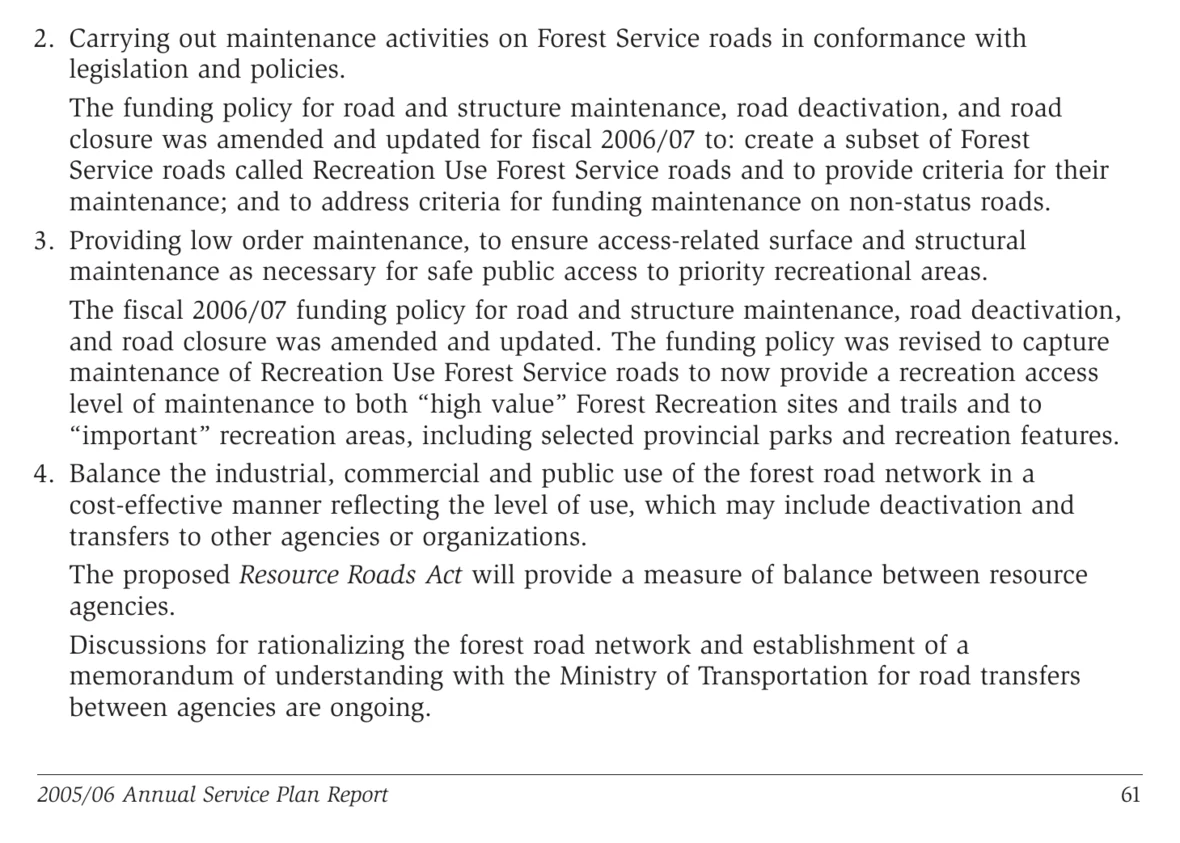
What it shows
In the year it wrote this, the Ministry amended its road funding policy to create a subset of Forest Service roads called Recreation Use Forest Service roads and to now provide a recreation access level of maintenance to high-value recreation sites, trails and important recreation areas. Not a study. Not a pilot. A funded category of road, kept open because people walk and ride on it.
Strategy 4, on the same page, talks about deactivation and transfers to other agencies or organisations — and its subject is the forest road network as a whole, not the recreation category created two strategies above it. Its own follow-on sentences are about a proposed Resource Roads Act and a memorandum of understanding with the Ministry of Transportation. The two passages are separate, and the page is reproduced whole above so you can check that for yourself.
What the page does support is this: two decades ago the Province decided that some forest roads exist for recreation and should be maintained for it, and said so in public, in its own words, with a Minister’s signature on the front. That is not a press release. It is a commitment in an audited report, and it is the standard this ministry should be measured against — by its own government, if not by us.
Section 03Then it stopped paying
In November 2020 the Auditor General of British Columbia audited how the Province manages its 58,000 kilometres of forest service road, and concluded that the Ministry was not maintaining them to its own policies. Every year the natural resource districts — the people who actually inspect these roads — submit maintenance budget requests. Every year head office funds a fraction of them. In 2019/20 that fraction was 14 per cent. Across the three years the audit covered it ran between 14 and 20 per cent, while $8.9 million of high-priority maintenance went unfunded in a single year. Of eight districts sampled, seven kept no historical inspection data at all — the same failure the Ministry’s own internal audit had identified in 2008, twelve years earlier.06
Hold those two dates together, because they are the charge. A ministry found its own defect in 2008. Its own Auditor General found the identical defect in 2020. Nothing had been fixed in between. You can call that many things; “doing its best with what it has” is not one of them. And it is not Trout Lake’s problem alone — that is a provincial network, a provincial policy and a provincial failure. Every small town in British Columbia at the end of a forest road is downstream of it.
The Ministry was invited to respond inside the report, and its response is the sentence that matters most to a place like Trout Lake: “…we have adjusted our risk-based operational maintenance funding model to focus primarily upon communities and rural residences.”06
Those are the first two tiers of the funding policy. Tier one is roads serving communities of fifty or more year-round residents. Tier two is roads serving rural residences. Tier three — the tier a recreation road would have to clear — is high-value recreation sites, as designated by a Recreation Sites and Trails BC representative. A road that clears any tier becomes what the Ministry calls a capital road, and the Auditor General describes capital roads as unlikely to be deactivated and as requiring continual maintenance.06
So read what the Ministry did when it was caught. Told by the Auditor General that it was not maintaining roads to its own policies, it did not fund the category it had created in 2006. It narrowed the model to communities and rural residences — and moved recreation further down the list. In 2006 this ministry invented the recreation road. In 2020 it deprioritised it. In 2026 it is paying to remove one. That is not a policy evolving. That is a department walking away from a commitment its own minister signed, while the government it serves tells these same towns that recreation is their way through.
50+
Full-time residents the community’s own club counts in Trout Lake — and fifty is the tier-one threshold
14%
Share of district maintenance requests the Province funded in 2019/20
2006
Year the Province created a maintained recreation category of forest service road
Fifty year-round residents is the tier-one threshold, and on the club’s own count Trout Lake sits on the line rather than under it. Nothing released records this road being assessed against tier one. Nobody lives on Rady Creek itself, so tier two never applied. What we can say is that the recreation tier — the one the Province built in 2006 — was the door this road was pointed at, and that nothing released to us records it being opened, or refused, or considered.
Section 04The cheaper option nobody priced
On 9 September 2026 the Ministry re-issued the tender with a new prescription attached: a forty-two page geotechnical report by a consultancy it commissioned, written after a site walk three weeks earlier. Two passages in it decide everything that follows.
The first is not a finding. It is an instruction the consultant was handed before any engineering was done, set in the report’s own bold type at the close of the section setting out the regulation, immediately before the deactivation plan begins: “The MOF has indicated that the road is intended to be deactivated to a permanent standard, and that post-deactivation vehicular access is not required.”07
The second is on page 10, in the paragraph prescribing the recontouring at the switchback.

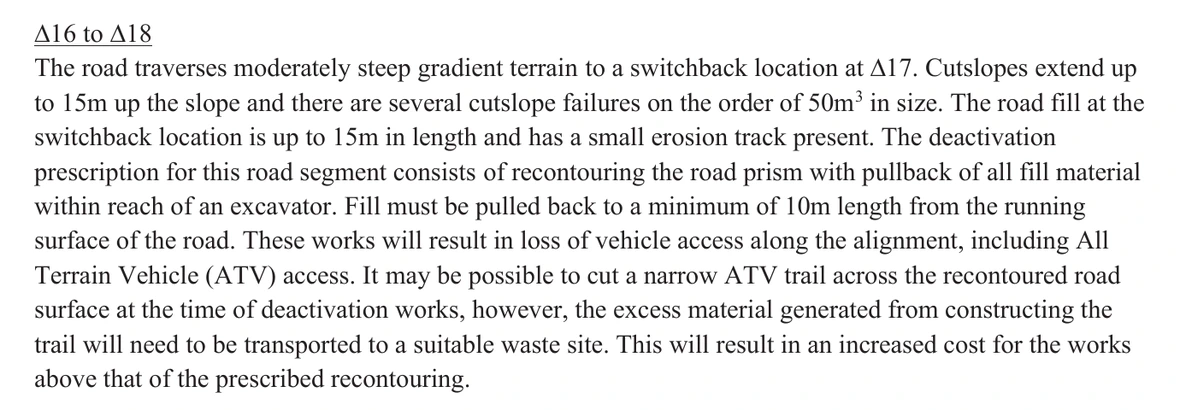
What it shows
A qualified professional retained by the Ministry records three things, and only these three. That the works end vehicle access along the alignment, including ATV access. That cutting a narrow ATV trail across the recontoured surface may be possible. And that doing so “will result in an increased cost” above the prescribed recontouring. The report does not say the trail was assessed, costed or refused, and it does not say a narrow trail would be adequate. It is mentioned in this one paragraph and nowhere else in forty-two pages.
Put the two passages in the order they were written and you get the sequence on the record. The Ministry said no vehicle access was required. The prescription was written to that instruction. And in the single place an alternative surfaces in the document, it surfaces as a line item that would cost more.
The cheaper option was to leave a trail behind. Nobody was asked what it would cost.
The alternative appears once in forty-two pages · as an added cost, not a decision
It is something duller and more corrosive than a conspiracy: a decision made so far upstream that by the time an engineer walked the ground, the only question left open was how thoroughly to erase the road. The people who would have used the trail were not in the room where the requirement was set, because there was no room. That is not a hard decision handled badly. It is a decision taken with the affected public outside the process entirely — and it is the same ministry, in the same district, that in 2021 was offered five dates to walk this road and could not find one.

Section 05A road can be destroyed. It cannot be handed over.
Ask why the Ministry did not simply give the corridor to Recreation Sites and Trails BC, the agency that manages recreation, and you arrive at the gap under all of this.
When a forest service road stops being needed for logging, the Province has one tool that clearly applies to it: deactivation. We have looked for an instrument that converts a forest service road into a managed recreation trail under Recreation Sites and Trails BC, and we have asked for one. None has been produced. Not a slow mechanism, not an underfunded one — none that anyone has been able to name to us. So when the industrial use ends, the only question a district office can actually answer is how much of the road to take out.
There is one instrument that goes part of the way, and it deserves to be said out loud because it is the Ministry’s own. The Ministry publishes the FS 1205 — Forest Service Road Maintenance Agreement, subtitled “For a Non-Industrial User To Carry out Maintenance Works.” It lets somebody who is not a logging company maintain a forest service road, puts the indemnity and a two-million-dollar liability policy on that user rather than on the Crown, and is signed by the District Manager — the same office that holds the deactivation decision for this road.08
It is not a rescue on its own. It covers routine surface work, not bridges or culverts; it does not stop a deactivation; and nothing obliges a district to offer one. But it exists, it is published, it is signed by the very office that holds this deactivation — and nothing released to us shows it was ever put on the table here. A ministry that wanted this road kept had a form for it in its own filing cabinet and did not reach for it. A ministry that wanted the road gone had a tender ready in three weeks.
Section 06This belongs to two ministers, not one
The road is the Ministry of Forests’. The economy it serves is not.
A recreation economy — the thing every forestry community in this province has been told is part of what comes next — sits in the portfolio of the Minister of Tourism, Arts, Culture and Sport, Anne Kang. A road that carries a village’s tourism, its mineral exploration and its recreation is a tourism asset that happens to be administered by a forestry ministry. It is being removed without her ministry, as far as any record we hold shows, being part of the conversation. One minister is dismantling another minister’s economy.
So the ask is addressed to both, and it is not a demand to keep every road in British Columbia open forever. It is three things:
- Price the trail before the excavators arrive. The Ministry’s own consultant says a narrow ATV trail across the recontoured surface may be possible at an increased cost. Nobody has been asked to say what that cost is. Ask. The tender closes 24 September 2026.
- Say whether the recreation tier was ever considered for the Rady Creek road. The Province created the category in 2006 and committed to funding a recreation access level of maintenance for it. Either this road was assessed against that commitment or it was not. The Ministry has never said which.
- Build the transfer. A corridor the public has used for a century should not be destroyed because the filing cabinet has no drawer for it. If no mechanism exists to move a road from the forestry system into the recreation system, that is a gap two ministers can close between them.
Both offices publish an address. The Minister of Forests is the Honourable Ravi Parmar — FOR.Minister@gov.bc.ca. The Minister of Tourism, Arts, Culture and Sport is the Honourable Anne Kang — TACS.minister@gov.bc.ca. Both addresses are taken from those ministries’ own published contact pages.09
There is a version of this story where a government that genuinely regrets what is happening to forestry towns reaches for a category it already created, spends a little more to leave a trail where a road used to be, and hands a valley of fifty people the one thing it can still use. That version costs more than recontouring, and less than most things governments announce on a Tuesday.
The version on the record is the other one. The requirement that no vehicle access remain was set before the engineering began, the alternative appears once as an added cost, and the excavators are tendered. If that is what compassion for resource communities looks like in practice, the people in Trout Lake would like somebody to say so plainly, so they can stop waiting for the other kind.
Minister Parmar: your government tells these towns that recreation is their future. Your ministry is removing it, one road at a time, under a policy your own Auditor General found you were not meeting. You do not have to defend all of that today. You have to make one call before 1:00 PM on 24 September. Pause the Rady Creek deactivation.
Share this story
Six images carrying this story on their own — the figure, the quotation and the document each one comes from. Made to be posted.


Slide 1 of 6
Suggested caption
Trout Lake has about fifty people left and three industries: tourism, mineral exploration and recreation. All three go up one road, and the Ministry of Forests is paying to destroy it.
In 2006 this ministry created a category of forest road it promised to maintain for recreation access, in an audited report signed by the Minister of Forests and Range. It has spent the twenty years since defunding that promise, while the government tells resource towns that a recreation economy is how they survive the mills closing.
Ravi Parmar’s ministry is deleting the assets his own government’s strategy depends on.
At Rady Creek the requirement came before the engineering. The consultant’s report records the ministry’s instruction: the road “is intended to be deactivated to a permanent standard, and that post-deactivation vehicular access is not required.”
An ATV trail appears once in forty-two pages. It “may be possible,” and it “will result in an increased cost.” Nobody was asked what that cost would be.
In 2020 the Quad Riders ATV Association of BC objected in writing to the logging company, with Recreation Sites and Trails BC on the thread. No reply from that agency appears in anything released.
Minister Parmar: pause the Rady Creek deactivation. Price the trail, say whether the recreation tier was ever considered for this road, and build the transfer.
backcountry.cx/editorials/after-the-industry-leaves/
#BCpoli #PublicLand #TroutLake #Kootenays #RecreationEconomy
Sources
- ↩Population — Trout Lake Recreational Club, 4 September 2026. This is the community’s own count, not a government record: Trout Lake is unincorporated and has no census population of its own. The figure is published with the rest of the record at saverady.com. https://saverady.com/
- ↩Rady FSR 0321.02 — 4,395 m tendered for permanent deactivation. BC Bid opportunity 233877, re-posted 9 September 2026, closing 24 September 2026. BC Bid releases each document only after a browser check, so the opportunity number rather than a direct file link is given. https://www.bcbid.gov.bc.ca/page.aspx/en/bpm/process_manage_extranet/233877
- ↩BC Council of Forest Industries, statement of 20 August 2026, Kim Haakstad, President & CEO: “Since 2023, at least 21 BC lumber mills have closed permanently or indefinitely”; “More than 15,000 forestry jobs have been lost since 2022.” The industry council’s own figures, not the Province’s. cofi.org https://cofi.org/cofi-statement-on-indefinite-curtailment-of-pulp-mill/
- ↩↩Cooper Creek Cedar — referral circulated by the company’s harvesting supervisor, RPF, 2 March 2020, covering planned road deactivation works in the Trout Lake Forest Development Unit; the covering e-mail of 27 February 2020 from Kim Smith, General Manager, Quad Riders ATV Association of BC, attaching the association’s letter of response, which is not in anything released to us; and the company’s reply of 2 March 2020, quoting that letter and copied to John Hawkings and to Tennessee Trent, Regional Director, Recreation Sites and Trails BC. Held in the Rady Creek document file and published at saverady.com.
- ↩Ministry of Forests and Range, 2005/06 Annual Service Plan Report, page 61, Objective 5, Strategies 1–4. Accountability statement signed by the Minister of Forests and Range, 30 June 2006. ISSN 1911-0383. bcbudget.gov.bc.ca — retrieved and the quoted passages re-read against the original on 11 September 2026 (1,322,556 bytes, md5 ba30beca668c3bc1048c957163cb2b86). The Engineering Manual sentence cited in the note is Strategy 1 on the same page. https://www.bcbudget.gov.bc.ca/Annual_Reports/2005_2006/for/for.pdf
- ↩Office of the Auditor General of British Columbia, Management of Forest Service Roads, November 2020 — the conclusion that the ministry was not maintaining roads to its own policies, and the 58,000 km network, at p. 11 and Exhibits 4–6; the $8.9M unfunded figure at Exhibits 4–6 and pp. 35, 38, 40; the 20/15/14 per cent funding shares at Exhibits 8 and 9; district record-keeping, the audited ministry’s response in Audit Response from the Auditee, the maintenance funding tiers and the treatment of capital roads as set out in the same report. Reproduced in full, with the pages named, at saverady.com. https://www.oag.bc.ca/app/uploads/sites/963/2024/08/OAGBC-20210119-Management-Forest-Service-Roads_RPT.pdf
- ↩Deactivation prescription — geotechnical report prepared for the Ministry of Forests, dated 8 September 2026, 42 pages, issued with BC Bid opportunity 233877 on 9 September 2026. Page 5, close of section 2 (the bold is the document’s own); page 10, section 6, segment Δ16 to Δ18. The Province publishes this report itself, as “Trout Lake Rady-Creek FSR Deactivation Prescription and Map”, on the Selkirk district road safety page. https://www2.gov.bc.ca/assets/gov/farming-natural-resources-and-industry/natural-resource-use/resource-roads/local-road-safety-information/selkirk/trout_lake_rady_creek_deactivation_prescription_map.pdf
- ↩Ministry of Forests, Forest Roads permits, authorizations and access agreements, under the heading “Maintenance Agreements”, and the form itself — FS 1205 — Forest Service Road Maintenance Agreement, For a Non-Industrial User To Carry out Maintenance Works, footer-stamped FS1205 2024/03/27. Insurance at clause 6.02, indemnity at 6.01, structures requiring District Manager approval in Schedule A. www2.gov.bc.ca https://www2.gov.bc.ca/gov/content/industry/natural-resource-use/resource-roads/district-road-requirements
- ↩Ministry contacts as published by the Province, retrieved 11 September 2026 — Ministry of Forests contacts (Honourable Ravi Parmar, Minister of Forests) and Ministry of Tourism, Arts, Culture and Sport contacts (Honourable Anne Kang, Minister of Tourism, Arts, Culture and Sport). Ministers’ office addresses only; no personal or staff addresses are published here. https://www2.gov.bc.ca/gov/content/governments/organizational-structure/ministries-organizations/ministries/forests/ministry-contacts https://www2.gov.bc.ca/gov/content/governments/organizational-structure/ministries-organizations/ministries/tourism-arts-culture/ministry-contacts