
EDITORIAL · SPOTLIGHT · SELKIRK DISTRICT
Russ Laroche runs the region whose Selkirk District says liability forces it to deactivate roads, has published no plan to meet the public, and now says it “will not be engaging” any critic. Isn’t it his fiduciary duty to check complaints against the law and reform policy that violates it?
Graded on the public record, Russ Laroche’s performance as Regional Executive Director is an F. Since January 2022, when the registry first lists him in the post, about 290 km of forest service road has been retired from his region’s register, 85 per cent of it in Selkirk. Separately, all or part of fourteen roads in one Selkirk riding have been closed, posted or retired since 2020, Rady Creek, Incomappleux, Sitkum, Heights and Kuskanax among them, and Selkirk has awarded $1.16 million in deactivation contracts since 2015. At Rady the road was posted on an unsealed 2020 spreadsheet, access was ruled out before the engineers reported, and the sealed report went to bidders with its seal painted over. His district cites a legal duty the statute does not impose, and the 2021 inspection reforms were never delivered. That record drew fair public scrutiny; on 8 October 2026 he called it harassment and wrote that the region “will not be engaging” with its critics.If the region will not fix Selkirk, we must demand the next premier does.
The Selkirk Natural Resource District manages the forest service roads of the West Kootenay. Since 2020 it has closed, posted for removal or retired all or part of fourteen of them in a single riding. It tells the public that the law obliges it to do this, when no law we can find says so. It removes roads that its own consultant says could keep a trail, it consults on some roads and not others, and it publishes the least about the roads it is about to take.01020304
One bad decision is a dispute about a road. Five years of the same decisions, across many roads, from one office, is a question of management. Selkirk’s road management needs new leadership from the top. This piece sets out the public record that supports that argument, and assesses the record of the official placed over the district.
The district sits inside the Ministry of Forests’ Kootenay Boundary Region. The senior official of that region, by the Province’s own staff directory, is Russ Laroche, Regional Executive Director. He is the official placed above the district, and this is an assessment of his record in that post, drawn from public documents.0506
Who answers for Selkirk
Ministry of Forests
Kootenay Boundary Region
Russ Laroche
Regional Executive Director
Selkirk District
1907 Ridgewood Rd, Nelson
Rocky Mountain District
Cranbrook
- Title Regional Executive Director, per the Province’s directory, April 20260507
- Authority on record Final decision-maker on disputed forest service roads, per the Engineering Manual08
- In post since On the lobbying registry as a Regional Executive Director from January 202209
Not on the public record: who appoints district managers, or his exact start date.06
Named for the senior public office he holds, and for nothing beyond it.
This piece holds him accountable for his region’s conduct. As Regional Executive Director he is the senior official over the Selkirk district. The ministry’s own manual makes him the final decision-maker when the officials who administer a forest service road disagree over it, and the reforms the ministry promised the Auditor General were to be delivered by districts in regions like his. So what Selkirk publishes, issues and fails to correct, it does under his leadership, and he answers for it. Where a document shows who wrote or signed something, we say so; where it does not, we say only what happened on his watch. The one document here he wrote himself is his email of 8 October 2026.05081011
Section 01The ministry promised to fix road inspections by spring 2021. By its own report, it still has not.
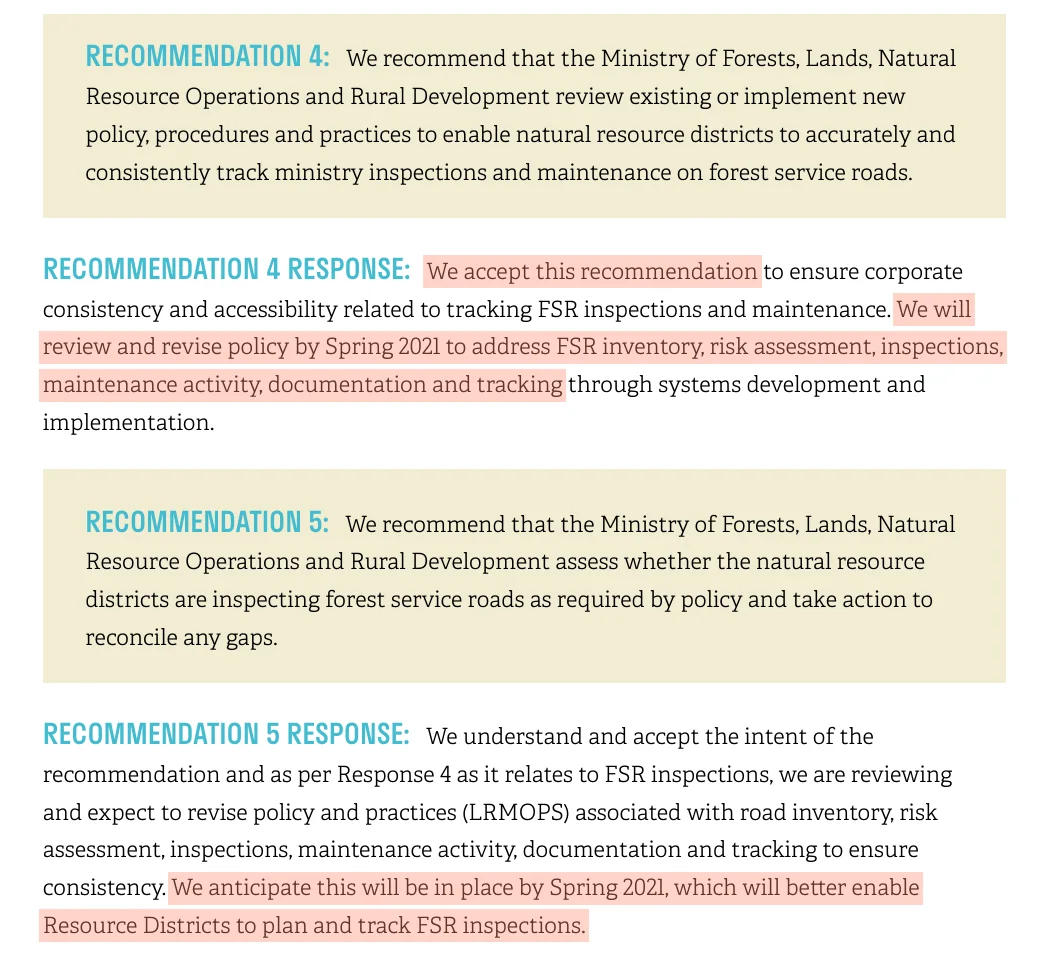
In January 2021 the Auditor General published an audit of how the Ministry of Forests manages its forest service roads. Two of its recommendations went to the heart of whether anyone knows the condition of these roads: give the districts a way to “accurately and consistently track ministry inspections and maintenance”, and “assess whether the natural resource districts are inspecting forest service roads as required by policy”. The ministry accepted both, and said in writing when it would be done.12
Four years later the ministry reported on itself. At 31 March 2025 both recommendations were “Not completed”, with completion now expected in 2026. Its own explanation says where the work has stalled: the new policies “are in various stages of being implemented by the districts across the province.”10
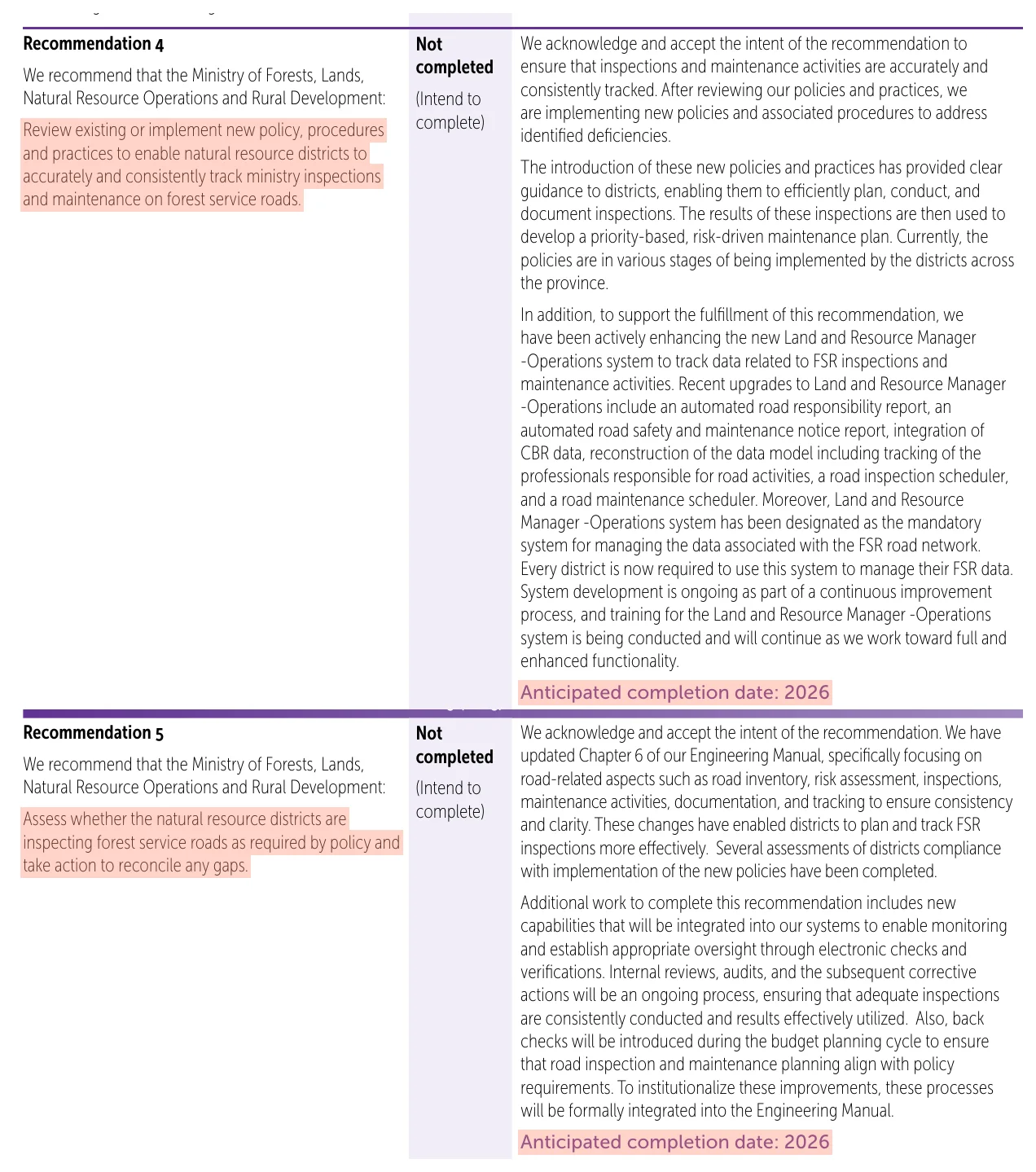
Promised
Spring 2021
Status · March 2025
Not completed
A reform his region was meant to deliver.
The reform the ministry promised in 2021 had to be delivered in districts like Selkirk, under the regional executive, and the ministry says it is being carried out district by district. On the public record it has not been delivered. The recommendations were addressed to the ministry, and the Auditor General’s report does not name him; but the districts of the Kootenay Boundary sit under the Regional Executive Director. In our view that is the plainest fact in this file: he had an obligation to deliver the reform in his region, and the record does not show that he did.100506
The rules the ministry did rewrite say what a deactivation decision must rest on. Its Engineering Manual, revised in May 2026, says forest service roads are to be deactivated “in a planned manner that considers future access needs, road user safety, cost efficiency, and values at risk”. It lists when deactivation should be considered: a road no longer needed by industry, public safety risks that warrant restricting access, or upkeep at the wilderness level costing more than keeping the road open is worth. It requires “a thorough assessment of terrain stability, hydrologic function, road condition, and future land-use needs” to support the decision. And it says “stakeholder input must be solicited and considered when determining whether an FSR should be deactivated.”08
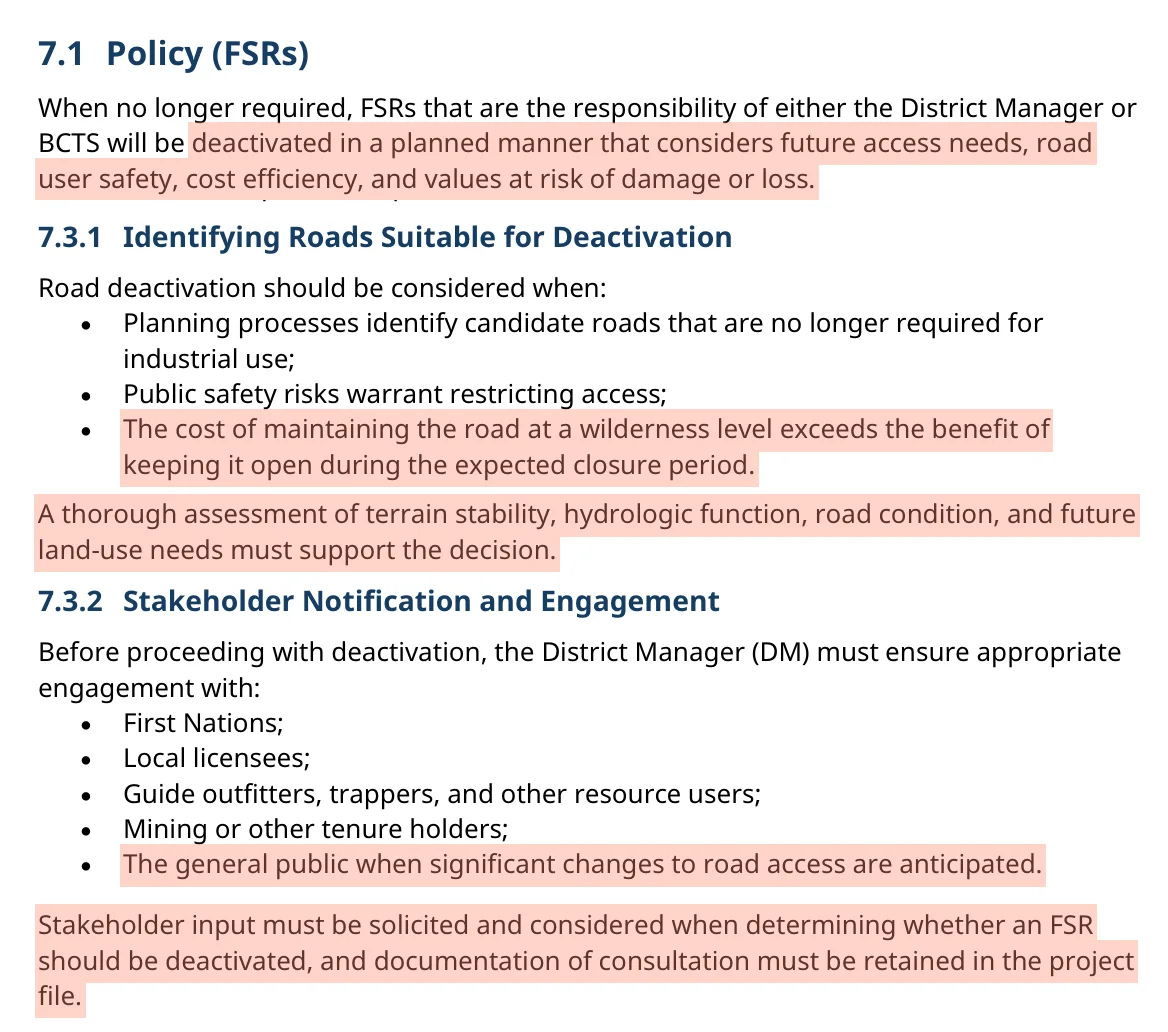
Set those rules against what Selkirk has published under his leadership since January 2022.
What the rule says
What Selkirk did under his leadership
What the rule says
Liability is not a reason.
Deactivation is considered when industry no longer needs the road, safety risks warrant it, or upkeep costs more than the road is worth. Liability is not on the list.
Engineering Manual § 7.3.1 · May 2026
What Selkirk did under his leadership
Says liability obliges it.
It will deactivate “because it is obligated to relieve itself of liability.”
✕ Incomappleux FAQ, answer 14 · April 2025, still linked 9 Oct 2026
What the rule says
Assess land-use needs first.
A thorough assessment of future land-use needs “must support the decision.”
Engineering Manual § 7.3.1 · May 2026
What Selkirk did under his leadership
Ruled out before the report.
The ministry told its engineers before they reported that vehicle access “is not required.”
✕ Rady prescription, page 4 · September 2026
What the rule says
Ask the public first.
Stakeholder input “must be solicited and considered” when deciding whether to deactivate.
Engineering Manual § 7.3.2 · May 2026
What Selkirk did under his leadership
No comment period. No prescription.
No written comment deadline at Rady Creek. Sitkum and Heights were posted with a sign and no prescription.
✕ Selkirk road page · July–October 2026
The manual is the ministry’s, not the region’s, and a district’s internal files may hold assessments it has not published. But the public record is what the public gets, and on that record Selkirk’s stated reasons and steps, under his leadership, do not match the rules its own ministry rewrote after the audit, and he has left them standing.0802030413
Read more The ministry told its auditor the deactivation rules were fixed. Then it tendered Rady Creek.
Section 02Selkirk’s record under his leadership: fourteen roads in one riding, and the same pattern on each.
This site mapped the district’s own road notices against the Province’s tenure register. Since 2020, fourteen forest service roads inside the Kootenay Central riding have been closed, posted for removal or retired, in whole or in part. Seven are closed with no date to reopen. Eight of the fourteen were closed or posted after the start of 2025. Most closures followed a failed bridge or a washout, and nobody should drive a bridge rated at zero tonnes. The problem is what follows. On all but one of those entries the district gives no planned repair date, or plans to remove the road altogether.01
- Rady Creek
Posted for deactivation in November 2025 on an unsigned, unsealed 2020 prescription, with the work “planned for 2026”. The only sealed geotechnical report is dated 8 September 2026, one day before the tender was issued. The ministry’s consultant was told before it began that “post-deactivation vehicular access is not required.” The tender, issued on 9 September 2026, called the project “contentious and well known to the public” and budgeted round-the-clock security. On 8 October the region wrote that no contractor was found before winter, and that the project is scheduled to be revisited in 2027.13031411
- Incomappleux
Gated since 2017 and slated for deactivation since 2021. The district’s FAQ gives the reason that “there are no funds available to do maintenance on it”, says there are “no plans to have a public meeting”, and says the district “is obligated to relieve itself of liability.”02
- Sitkum Creek
The ministry pulled the bridge in 2014. Volunteers rebuilt access in 2016 with money from the Columbia Basin Trust. On 6 July 2026 the district posted the upper half of the road for deactivation again, with no prescription published.0413
- Heights
Posted on 6 July 2026. The district says there will be no ATV access afterwards, and it has published no prescription to show why.13
- Kuskanax Creek
Deactivation planning is under way for the 2026 field season. The district adds that the road “may be fully rehabbed if incremental funding is available.”13
The district’s road page tells the public what is happening to each road. It does not tell the public why one road keeps an ATV trail and another does not, or why one gets a comment period and another does not. Those are management decisions, and they are made in one office.13
Read more Fourteen forest roads in Brittny Anderson’s riding have been closed, posted or retired · Another Rady? Selkirk District is tearing out Sitkum Creek FSR for the second time · Scott McInnis took the Incomappleux to the Legislature and stood on the road at Rady Creek · It will pay for guards. It will not pay for a meeting.
Section 03Rady Creek on its merits: the decision came first, and the engineering did not require it.
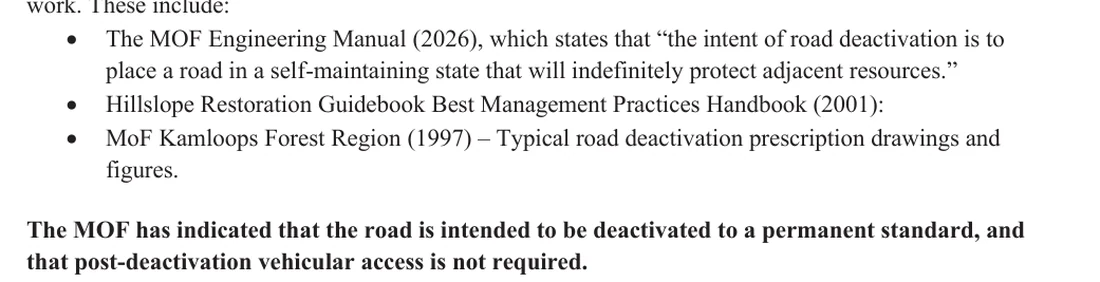
At Rady Creek the ministry paid SNT Geotechnical for a 42-page prescription, dated 8 September 2026, the day before the tender opened. The report records what it was told before it began: “The MOF has indicated that the road is intended to be deactivated to a permanent standard, and that post-deactivation vehicular access is not required.” The end of vehicle access was an instruction to the engineers, not a finding of theirs.03
Then the report says what it found. The consultant reviewed air photographs from 1968 to 2011 and 2025 satellite imagery: “No timber development or road related landslides are visible on the face unit slope where the Rady FSR is located for the duration of the air photo record”, and “the landslide incidence on the face unit slope appears to be low.” The elements at risk it lists are fish habitat in two creeks and Trout Lake, and Highway 31, 1,700 metres downslope. It does not list a person or a road user. It did not carry out a risk assessment, because it expected a low to very low residual hazard once its own works were done.03
On the upper road, waypoints 1 to 16, the road sits on gentle to moderate alpine and subalpine ground with “minimal cuts and fills”, and the prescription is cross ditches to manage water. The heavy work is at the switchback, where the report prescribes pulling back the fill and recontouring the road. That, it says, ends vehicle access, including ATVs. Then it names the alternative.03
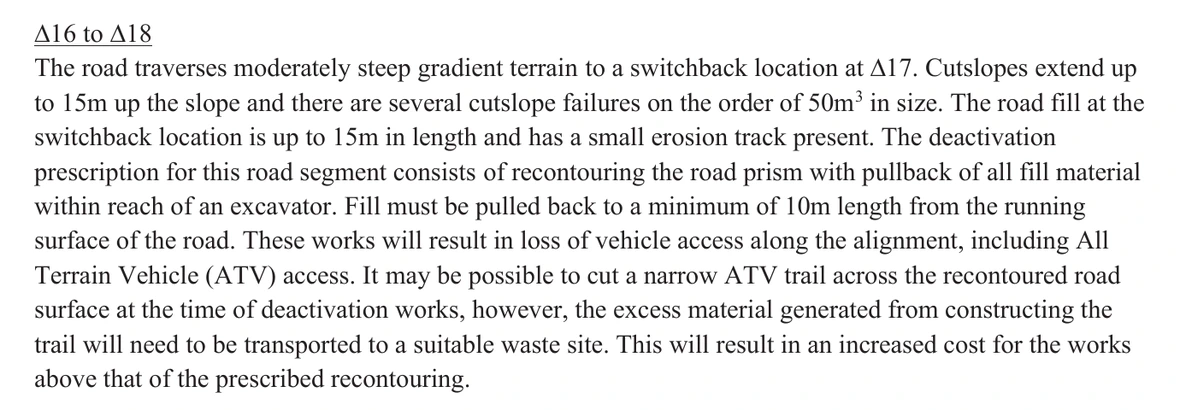
Read on its merits, the file says this. The ministry decided vehicle access would end before its engineers reported. The engineers found no road-related landslide in more than half a century of photographs, and listed no person at risk. They identified a way to keep a trail, and the only barrier they named was money. On that record, the decision to end all access at Rady Creek was a choice about cost and policy, not a finding the engineering forced.0315
The ministry’s own rules offer other courses. A road that industry no longer uses can stay open as a wilderness road under section 81 of the Forest Planning and Practices Regulation, with a much lighter maintenance duty. A deactivated road must be barricaded against motor vehicles “other than all-terrain vehicles”. A public user can ask to maintain a road under a maintenance agreement. And the ministry’s December 2025 FAQ answers “No” to the question “Do all unmaintained FSRs have to be deactivated?”161718
No published Selkirk document shows that any of these was weighed and rejected in writing for any of the roads above.13
Read more Michael Ferguson and the Rady Creek prescription · The prescription they did not want · Rady Creek isn’t in Donegal Wilson’s riding. She took it to the minister anyway.
Section 04The record the decisions rest on is wrong in places, and the scrutiny was earned.
Public criticism of Rady Creek did not come from nowhere. Set the district’s documents beside the record and they do not hold. Below, each row puts what the district or its consultant wrote beside what the record shows. Where the documents directly contradict each other, we call it an error. Where a conclusion is simply unsupported, we say that instead.0319
01
The old prescription is dated. The consultant was told it wasn’t, or was given a copy without the date.
The 2020 prescription prints its date and its access level, “Access Level Remaining after Deact: ATV”, at the top of its first page. The 2026 report says the prescription it was given “is not dated”. So either the ministry gave its consultant a copy without that header, or the report misstates the document. If the consultant was given an undated copy, the date, and the ATV access level printed beside it, were withheld from it. In our view, either way the consultant reviewed the ministry’s earlier decision without the full record, a record that showed the ministry’s own prescription kept ATV access.
The 2026 report
Said it had no date.
“The deactivation prescription is not dated.”
✕ Rady prescription, page 4 · 8 September 2026
The 2020 prescription
Dated on its face.
“Date Prescribed: October 7, 2020” and “Access Level Remaining after Deact: ATV”, revised 11 May 2021.
Rady prescription, page 1 · 7 Oct 2020


02
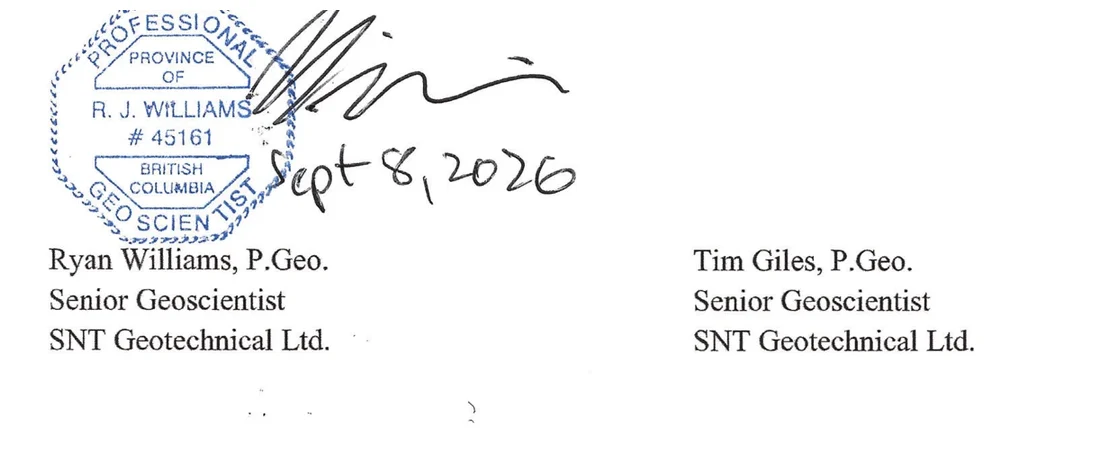
For five years the decision rested on unsealed paper. The sealed report came a day before the tender.
The road was posted for deactivation in November 2025 on the ministry’s own spreadsheet. The only sealed professional assessment was walked on 18 August 2026, sealed on 8 September and issued with the tender on 9 September. The sign-off came after the decision, not before it.
What the district relied on
Five years, no seal.
A 2020 spreadsheet prescription by a Registered Forest Technologist, with its “Prescriber” and “Date Signed” lines left blank.
✕ Posted November 2025
The sealed report
Sealed a day before the tender.
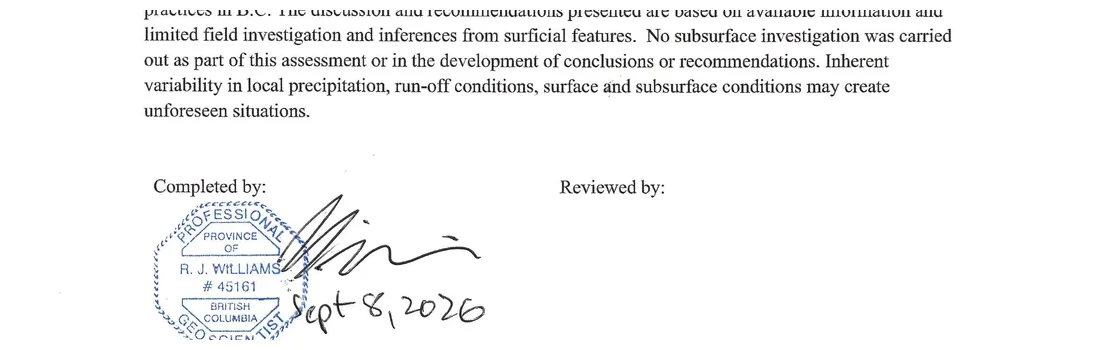
A professional geoscientist’s seal and signature, dated “Sept 8, 2026”, one day before the tender was issued.
SNT report, page 19 · 8 Sep 2026

03
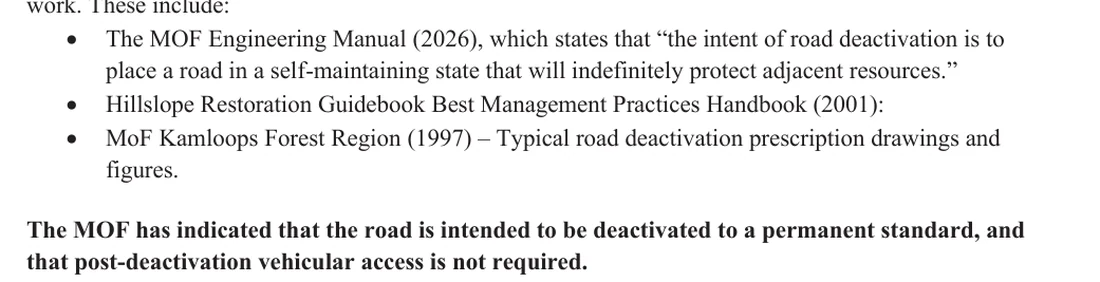
The ministry’s first prescription kept the road open to ATVs. The order to end all access came before the engineering.
The ministry’s own 2020 prescription set the access level after deactivation at “ATV”. By 2026 its consultant had been told vehicle access was “not required” before it reported. No engineering finding in the published record made that change.
The 2026 report
Access ruled out by instruction.
“The MOF has indicated … that post-deactivation vehicular access is not required.”
✕ Rady prescription, page 4 · 8 September 2026
The 2020 prescription
The ministry kept ATV access.
“Access Level Remaining after Deact: ATV”.
Rady prescription, page 1 · 7 Oct 2020

04
The district told the public deactivation must block all vehicles. The regulation exempts ATVs.
The FAQ paraphrases section 82 of the regulation and stops before its last four words. Those words are the legal basis for keeping a deactivated road open to ATVs.
The district’s FAQ
Dropped the ATV exception.
Barricading “to prevent access by motor vehicles.”
✕ Incomappleux FAQ, answer 9 · April 2025, still linked
The regulation
ATVs are exempt.
Barricade “to prevent access by motor vehicles, other than all-terrain vehicles.”
FPPR s. 82(1)(a)


05
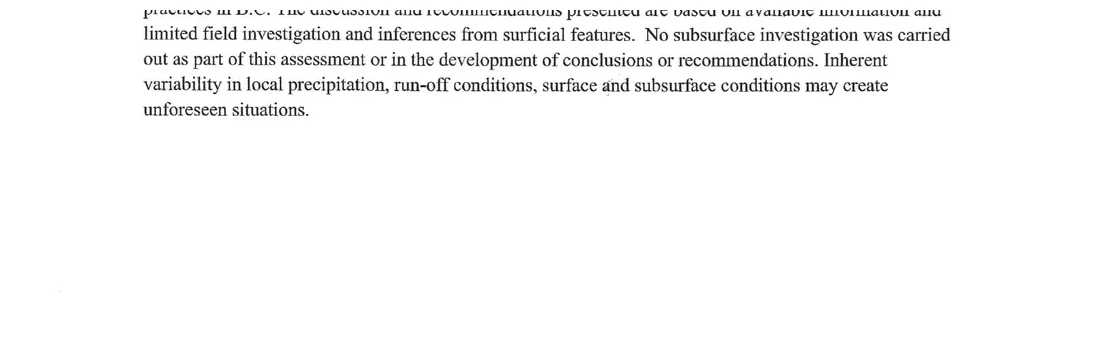
The Province issued a sealed report with the seal painted over.
The consultant sealed its report properly. The copy the Province issued to bidders and published has the seal, signature and date covered by white rectangles, which lift off. No released record says who applied them; the copy was issued from his region.
As issued to bidders
Seal painted over.
The “Completed by” and “Reviewed by” blocks are blank.
✕ Tender EN27DSE008 · 9 September 2026
The same page, underneath
Sealed and signed underneath.
The geoscientist’s seal, his signature and “Sept 8, 2026”.
Page 19, under the covering
06
The case for ending all access was never backed by a risk assessment.
The ministry’s manual requires a thorough assessment to support a deactivation decision. The report it paid for says it did not do a risk assessment, and lists no person among the elements at risk. This is not a contradiction; it is a conclusion asserted without the assessment its own manual requires.
The 2026 report
No risk assessment.
It “does not include a partial risk assessment”.
✕ Rady prescription, page 8 · 8 September 2026
The ministry’s manual
An assessment must support it.
“A thorough assessment … must support the decision.”
Engineering Manual § 7.3.1


Six things follow. For five years the district relied on unsealed paper, and the sealed engineering arrived only after the decision, one day before the tender. The consultant misdescribed the ministry’s own document. The Province issued a sealed report to bidders with the seal and signature covered. The ministry’s first prescription kept the road open to ATVs, and the change came from a decision, not a finding. The district’s public explanation drops the words in the regulation that allow ATV access after deactivation. And the safety and liability case for removing all access was never backed by the risk assessment the manual calls for. On those documents, the scrutiny the district now calls harassment was earned.03160802
Read more Michael Ferguson and the Rady Creek prescription · The prescription they did not want
Section 05The engineering title: what the public record shows, and what it does not.
The Rady file runs through an office with an engineering name. The September 2026 prescription opens: “At the request of Michael Ferguson, RFT, of the Ministry of Forests – Selkirk Natural Resource District”. RFT is a Registered Forest Technologist, a title reserved to Forest Professionals BC. The Province’s staff directory gives his post as “Engineering Officer”; its 2017 directory gave his title as “Engineering Specialist”.0305
Engineers and Geoscientists BC publishes guidance on who may use which titles. It lists “Jamie Smith, Engineering Specialist” among the titles a non-registrant may not use, and it says the duty follows the person: “If your title contravenes the misuse of title prohibitions under the Act, then you must revise that title, even if it was given to you by your employer.” The rule behind it is section 52 of the Professional Governance Act, which bars a non-registrant from using a reserved title, or any title or description that “expresses or implies” registration.2021
The ministry builds these posts that way on purpose. Its own advertisement for an Engineering Officer in another district asked for applicants registered with Forest Professionals BC as a Registered Professional Forester, “OR another applicable professional (i.e. PENG)”. The engineering title is the employer’s, attached to a forestry post.22
We could not check the Engineers and Geoscientists BC register, which refused automated access, so we cannot say from a public record whether he is registered with it. “Engineering Officer” is not one of the titles in the regulator’s published table, and no regulator has made any finding about it. The 2026 prescription itself was sealed by a professional geoscientist, and it names a Registered Forest Technologist as the ministry’s professional of record, which its own text lists as a qualifying registration. The record shows a ministry that gives engineering titles to forestry posts. Whether any title crosses the line in the Act is for the regulator to decide.0321
Read more Michael Ferguson and the Rady Creek prescription
Section 06Under his leadership, Selkirk tells the public the law requires deactivation. No law we can find does, and no other district says so.
Section 3.1 of the Occupiers Liability Act, in force since 25 June 2012, says that a person who uses a resource road “is deemed to have willingly assumed all risks”. The government and the road’s maintainer then owe only a duty not to create a danger with intent to do harm, and not to act with reckless disregard for a person’s safety. The Province passed it to “reduce the number of resource roads that are closed due to concerns regarding third party liability”, and it has argued in court that a forest service road attracts that reduced standard.23242526
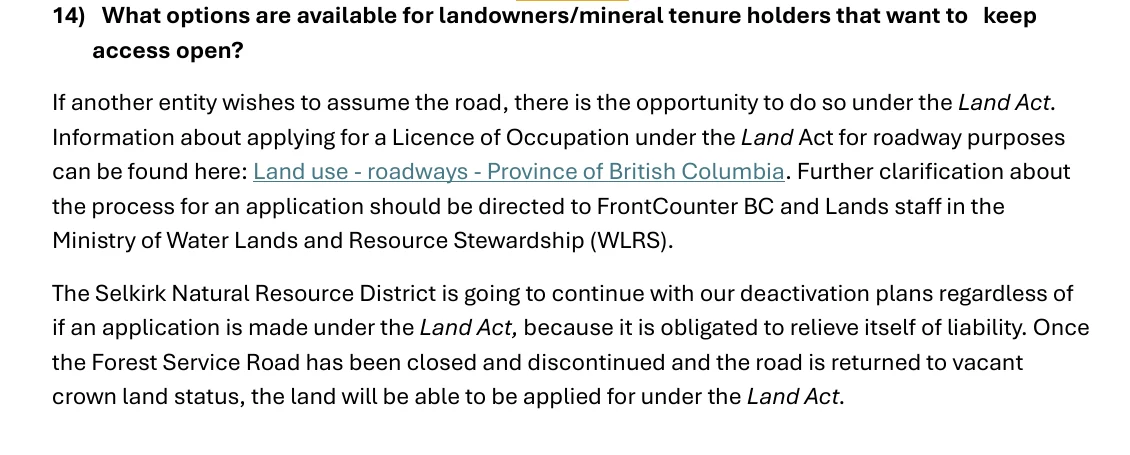
When this site read every PDF published on the road pages of all twenty-three natural resource districts, 223 documents in all, this was the only one that gave liability as a reason a road had to be deactivated. The ministry’s own Engineering Manual says roads must be maintained so that users “are reasonably safe in accordance with the Occupiers Liability Act”, and warns that deactivation can create liability rather than remove it. Section 79(3) of the regulation makes deactivation the end of the duty to maintain, not a duty in itself.180816
There is a fair reading on the district’s side. Its FAQ also says deactivation is done “to relieve the permit or tenure holder of their ongoing obligation to maintain roads”, and the Auditor General found that districts were funded at between 14 and 20 per cent of what they asked for to maintain roads. If “liability” means the cost of upkeep, the district is describing a budget choice. A budget choice is not a legal obligation, and the public is entitled to be told which one it is.0212
Section 3.1 has not yet been decided by a reported appellate court; the Court of Appeal left the question for trial in 2025. Section 8(2)(c) separately excludes the government as occupier of “a road under the Forest Act”, and no court has said how that sits with section 8(3). The duty not to act with reckless disregard still applies, including to hazards that deactivation work creates. This site has set out the statute in full in The law everyone forgot.272318
Section 07Under his leadership it consults on some roads and not others, and his region’s own procedures are not published.
Selkirk has shown it knows how to consult. For Incomappleux it posted draft prescriptions and advertised a comment period in the Valley Voice, and wrote that comments “will be reviewed and considered by the decision maker”. For the Blazed and Jersey roads in 2022 it posted a written comment deadline. At Rady Creek it set no written comment deadline. At Sitkum Creek the whole public notice is a short entry on the road page and a sign in the field.020413
The same district told the public in its Incomappleux FAQ that “the province cannot release liability through the use of a sign.” A sign is now most of what the public gets before a road is posted for removal.02
None of the roads on the district’s current deactivation list carries a published plan for a public meeting. For Incomappleux the district wrote that “there are no plans to have a public meeting in relation to the planned deactivation.”0213
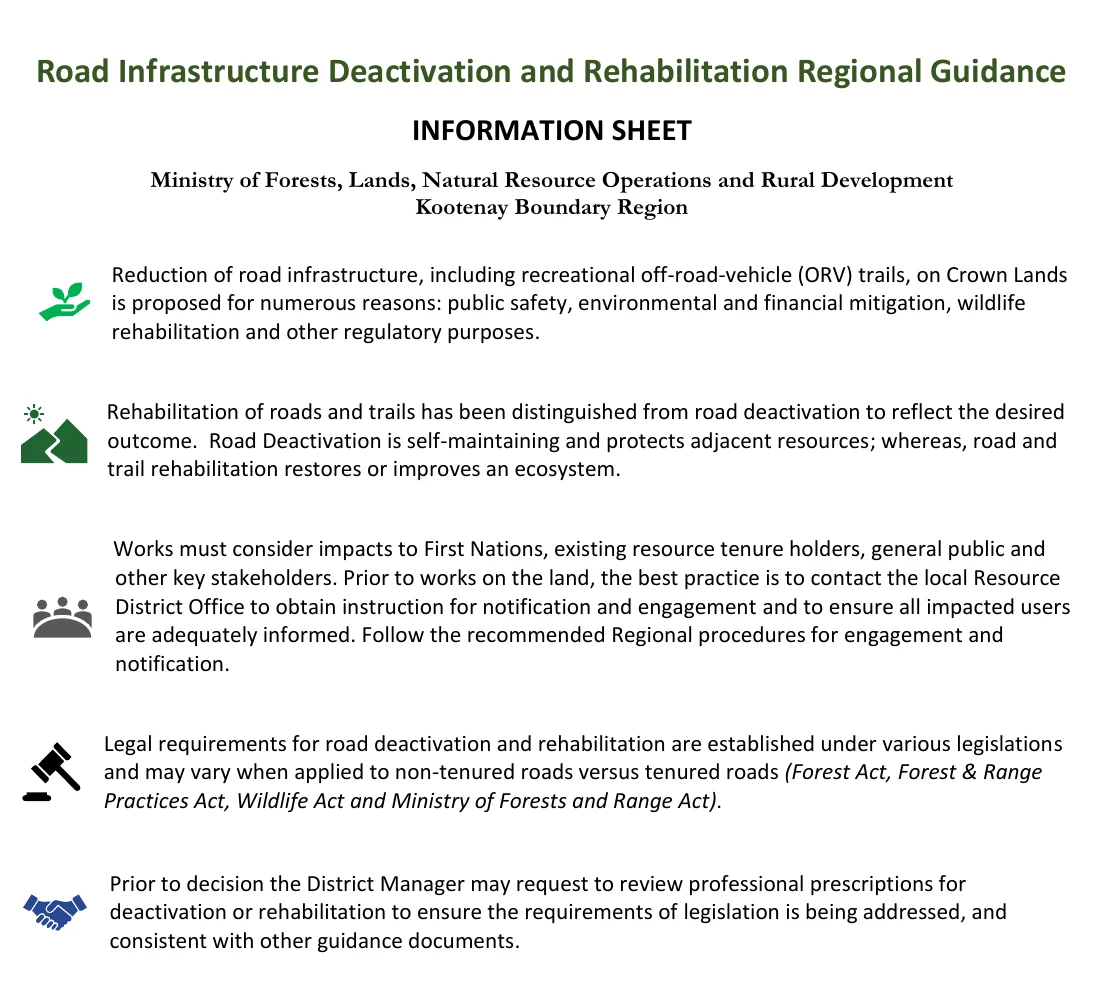
The guidance sheet carries the region’s name, not the district’s. It dates from 2021, before the registry first lists him as a Regional Executive Director, so he did not issue it. He has kept it in force: it is still linked from the Selkirk road page today.2813
Read more Another Rady? Selkirk District is tearing out Sitkum Creek FSR for the second time · It will pay for guards. It will not pay for a meeting. · The roads you hunt, sled, fish and climb from are being torn out, and no agency in British Columbia is responsible for keeping them open to the public
Section 08What the public data shows about his region’s roads.
The Province publishes its road register, its contract awards and its lobbying records as open data. We pulled all three for the whole Kootenay Boundary Region, both districts under him. Each pattern below is stated with its source and method, and none of it alleges anything about any company or group named in it.
A large public road network, and a steady removal. The Kootenay Boundary holds 11,445 kilometres of active forest service road, second only to the Thompson-Okanagan, and 20 per cent of the provincial total. Since 1 January 2022, the earliest date the Lobbyists Registry records him as a Regional Executive Director, 141 sections and 290 kilometres have been retired from the register across the region; since 2020 the figure is 472 kilometres. Selkirk accounts for 248 of the 290 kilometres since 2022, Rocky Mountain for 42. By length retired since 2022 the region ranks fifth of eight; as a share of its network it sits below the provincial rate, because the network is so large. Inside it, in the Kootenay Central riding alone, all or part of fourteen roads have been closed, posted or retired since 2020.2901
290 kmof forest service road retired from the register across his region since January 2022, when the Lobbyists Registry first lists him as a Regional Executive Director.
Forest service road retired since 1 January 2022, by Ministry of Forests region
Forest Tenure Road Section Lines, all 286,220 records, retrieved 14 October 2026; regions as the ministry lists them. Retirement is a change in the register, not proof that a road was physically closed.
Show the numbers
| Region or district | Active FSR km | Retired since 2020, km | Retired since Jan 2022, km | Sections since Jan 2022 |
|---|---|---|---|---|
| West Coast | 4,097 | 770.3 | 721.3 | 568 |
| Omineca | 8,602 | 862.3 | 545.2 | 148 |
| Thompson-Okanagan | 13,832 | 930.2 | 530.5 | 261 |
| Skeena | 5,858 | 485.0 | 473.3 | 319 |
| Kootenay Boundary | 11,445 | 471.8 | 290.0 | 141 |
| Northeast | 692 | 164.5 | 91.6 | 7 |
| Cariboo | 8,158 | 132.7 | 88.1 | 46 |
| South Coast | 3,738 | 82.9 | 81.4 | 55 |
| Selkirk district | 7,594 | 428.8 | 247.5 | 109 |
| Rocky Mountain district | 3,852 | 43.1 | 42.5 | 32 |
| Province | 56,423 | 3,899.7 | 2,821.5 | 1545 |
85%of the region’s retirements since January 2022 were in the Selkirk district: 248 of 290 km.
Kootenay Boundary: forest service road retired per year, km. Orange from 2022; Rocky Mountain is the pale top segment; the white line is the running total since 2022
Same register, by retirement date. 2026 is to 14 October.
Show the numbers
| Year | Selkirk km | Rocky Mountain km | Region km |
|---|---|---|---|
| 2012 | 19.7 | 0.0 | 19.7 |
| 2013 | 35.5 | 15.4 | 50.9 |
| 2014 | 10.4 | 5.5 | 15.9 |
| 2015 | 55.2 | 0.0 | 55.2 |
| 2016 | 84.2 | 0.0 | 84.2 |
| 2017 | 18.3 | 0.0 | 18.3 |
| 2018 | 27.0 | 47.7 | 74.7 |
| 2019 | 77.3 | 0.0 | 77.3 |
| 2020 | 77.9 | 0.0 | 77.9 |
| 2021 | 103.3 | 0.6 | 103.9 |
| 2022 | 68.0 | 0.0 | 68.0 |
| 2023 | 48.7 | 0.0 | 48.7 |
| 2024 | 36.9 | 0.0 | 36.9 |
| 2025 | 72.4 | 39.6 | 112.0 |
| 2026 | 21.7 | 2.8 | 24.5 |
A retirement in the register is an administrative change and is not proof that a road was physically closed. It also runs behind events: Rady Creek, Incomappleux (gated since 2017), Sitkum Creek, Heights and Kuskanax Creek, every road on the district’s current deactivation list, are still listed as active, so these figures leave out the roads now being removed.2913
What it costs to remove them. The ministry’s contract-awards data lists eight Selkirk road-deactivation works contracts from 2015 to 2023 and a 2022 contract for a deactivation specialist in the Columbia engineering zone. It lists no Rocky Mountain deactivation award. Two regional geotechnical services contracts went to SNT Geotechnical, the firm that wrote the Rady prescription, in 2016 and 2025; the data does not say which jobs ran under them. Across all of government, the Public Accounts list payments to SNT Geotechnical of $148,556 in 2022/23 and $741,718 in 2025/26; those listings are not broken down by ministry or job, and nothing in them ties any payment to Rady Creek. No award for the Rady tender appears, and the region has written that no contractor was found and that the project is scheduled to be revisited in 2027.303111
$1.16Min published contracts to plan and carry out Selkirk road deactivations since 2015: $914,944 in works, $247,210 in specialist services. Two regional geotechnical contracts to SNT Geotechnical add $165,000.
Contract awards by date; circle area is the award value. Orange: deactivation works. White: specialist services. Grey: regional geotechnical contracts
Ministry Contract Awards open data, all quarterly files 2012 to September 2026. No Rocky Mountain deactivation award appears. The Rady tender was not awarded; the region says no contractor was found.
Show the numbers
| Awarded | Contract | Value | Type |
|---|---|---|---|
| 2015-08-24 | Barnes Creek West | $50,650.00 | Works |
| 2016-04-15 | SNT Geotechnical, regional geotechnical services | $75,000.00 | Regional geotechnical |
| 2020-08-17 | Tangiers | $129,828.20 | Works |
| 2022-04-27 | Deactivation specialist, Columbia zone | $247,210.00 | Specialist services |
| 2022-06-20 | EN23DSE012 | $140,372.50 | Works |
| 2022-09-08 | Maryland/Boundary | $73,700.00 | Works |
| 2022-10-17 | Deactivation services | $105,000.00 | Works |
| 2023-08-09 | Akokli | $167,815.00 | Works |
| 2023-08-10 | Lower Blazed | $98,500.00 | Works |
| 2023-08-30 | Grano Creek | $149,078.06 | Works |
| 2025-04-14 | SNT Geotechnical, regional geotechnical services | $90,000.00 | Regional geotechnical |
Compared with other regions. We tried to set his region’s spending against the other seven. The contract-awards data identifies a district in the tender number for only a minority of awards: since January 2022, 23 road-related Ministry of Forests awards can be placed in a region that way, and 313 worth $68.0 million cannot. Of the 23, the Kootenay Boundary’s 15 total $981,960, and $566,282 of that, 57.7 per cent, is deactivation; Omineca’s four total $517,787 with $175,241 in deactivation; Cariboo’s four total $251,825 with none. The other regions have no awards that can be placed. That is too thin a sample to rank regions, and we do not. No public source we found breaks the ministry’s road budget down by region.30
Who tries to reach him, and what came of it. Since January 2022 eight registered lobbying reports name him as Regional Executive Director, more than name any other Regional Executive Director in the Ministry of Forests. Six came from recreation and access groups: The B.C. Wildlife Federation three times in early 2022, and the British Columbia Snowmobile Federation three times in July and August 2026 on “Public recreation access and resource roads”. One came from Canadian Forest Products Ltd. and one from the Western Canada Wilderness Committee. None of the eight records a meeting arranged with him. A registry report records a lobbyist’s attempt at contact; it is not evidence that he engaged. What the groups say came of their efforts is on a public recording. In the British Columbia Snowmobile Federation’s open forum of 21 September 2026, with its executive director Amber Lane and Colin Stuart of the Four Wheel Drive Association of BC on the panel, the moderator asked whether they had been able to get the Ministry of Forests “to the table”. The answer from the panel: “We have tried countless times. They have not spoken to us at all. The only time we have heard anything from the [Ministry] of Forests is through news clips” (22:11). Asked later about dialogue with the Selkirk office, the panel said that was “what we’ve been asking for”, and that the efforts had gone “unheard” (37:24). The recording does not name him; it describes the ministry and the Selkirk office he oversees.40 Across the seven other Regional Executive Directors named in the same period, four of thirteen reports record a meeting arranged, including two with the Guide Outfitters Association of British Columbia, one with an environmental group and one with a science centre. He is the most-lobbied of the eight and the only one with more than two reports and none arranged.09
Who his region does deal with. Road tenure tells the other side. Since 1 January 2022 the Kootenay Boundary’s districts have taken 962 industry road-permit sections, 726 kilometres, onto the register, against 290 kilometres of public forest service road retired in the same period. In the Selkirk district alone, harvesting began on 1,970 cut blocks from 2022 to the middle of 2026. We found no Gov News release in that period that names him, and no registered lobbying report that names any other Selkirk or Kootenay Boundary office holder. This is a pattern on the public record, not a claim that any permit was traded for anything.2909
6 · 0Recreation and access groups filed six registered lobbying reports to reach him. None records a meeting arranged with him, and neither do the other two reports that name him.
Registered lobbying reports naming each Ministry of Forests Regional Executive Director, January 2022 to October 2026, by filer type
Russ Laroche · Kootenay Boundary
8 reports · 0 meetings arranged
Josh Pressey
3 reports · 1 meeting arranged
Allan Johnsrude
3 reports · 1 meeting arranged
Karrilyn Vince
2 reports · 1 meeting arranged
Lori Borth
2 reports · 0 meetings arranged
Sharon Hadway
1 report · 0 meetings arranged
Jeff Sheldrake
1 report · 1 meeting arranged
Jennifer Reid
1 report · 0 meetings arranged
Recreation and accessGuide outfittersForest and resource industryEnvironmentalOther
BC Lobbyists Registry open data (files dated 20 September 2026) and report pages posted to 14 October 2026. Office holders whose registered title is Regional Executive Director with a Forests agency; superseded versions dropped. A report records a lobbyist’s attempt at contact. “Meeting arranged” is the registry’s own field. Guide outfitters are a commercial association and are shown separately from recreation and access groups.
Show the numbers
| Regional Executive Director | Reports | Meetings arranged | Filers, as registered |
|---|---|---|---|
| Russ Laroche | 8 | 0 | The B.C. Wildlife Federation (3); British Columbia Snowmobile Federation (3); Western Canada Wilderness Committee (1); Canadian Forest Products Ltd. (1) |
| Josh Pressey | 3 | 1 | Guide Outfitters Association of British Columbia (3) |
| Allan Johnsrude | 3 | 1 | Watershed Watch Salmon Society (2); West Coast Environmental Law Association (1) |
| Karrilyn Vince | 2 | 1 | The B.C. Wildlife Federation (1); Guide Outfitters Association of British Columbia (1) |
| Lori Borth | 2 | 0 | Artemis Gold Inc. (1); Canadian Forest Products Ltd. (1) |
| Sharon Hadway | 1 | 0 | Mosaic Forest Management Corporation |
| Jeff Sheldrake | 1 | 1 | A.S.T.C Science World Society |
| Jennifer Reid | 1 | 0 | Interfor Corporation |
Read more Who do B.C.’s NDP MLAs really work for? · Fourteen forest roads in Brittny Anderson’s riding have been closed, posted or retired
Section 09The government’s own auditor found the ministry was not managing these roads to its own policies. Four of its fixes are still not done.
None of what follows is this site’s finding. It is the Province auditing itself. In November 2020 the Auditor General of British Columbia reported on how the Ministry of Forests manages its forest service roads, and the conclusion is printed in one paragraph.12
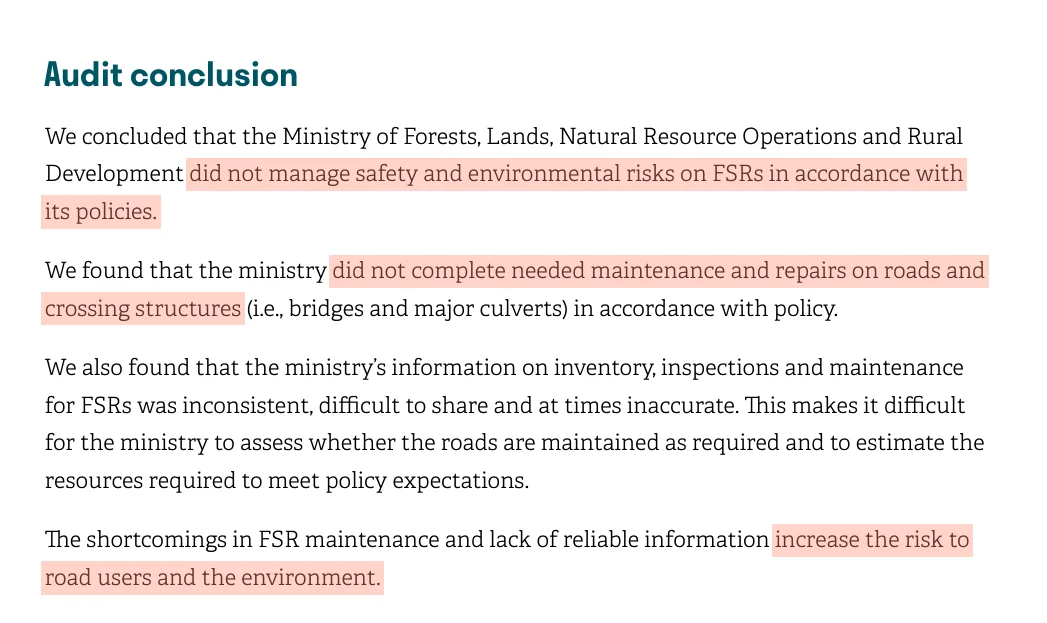
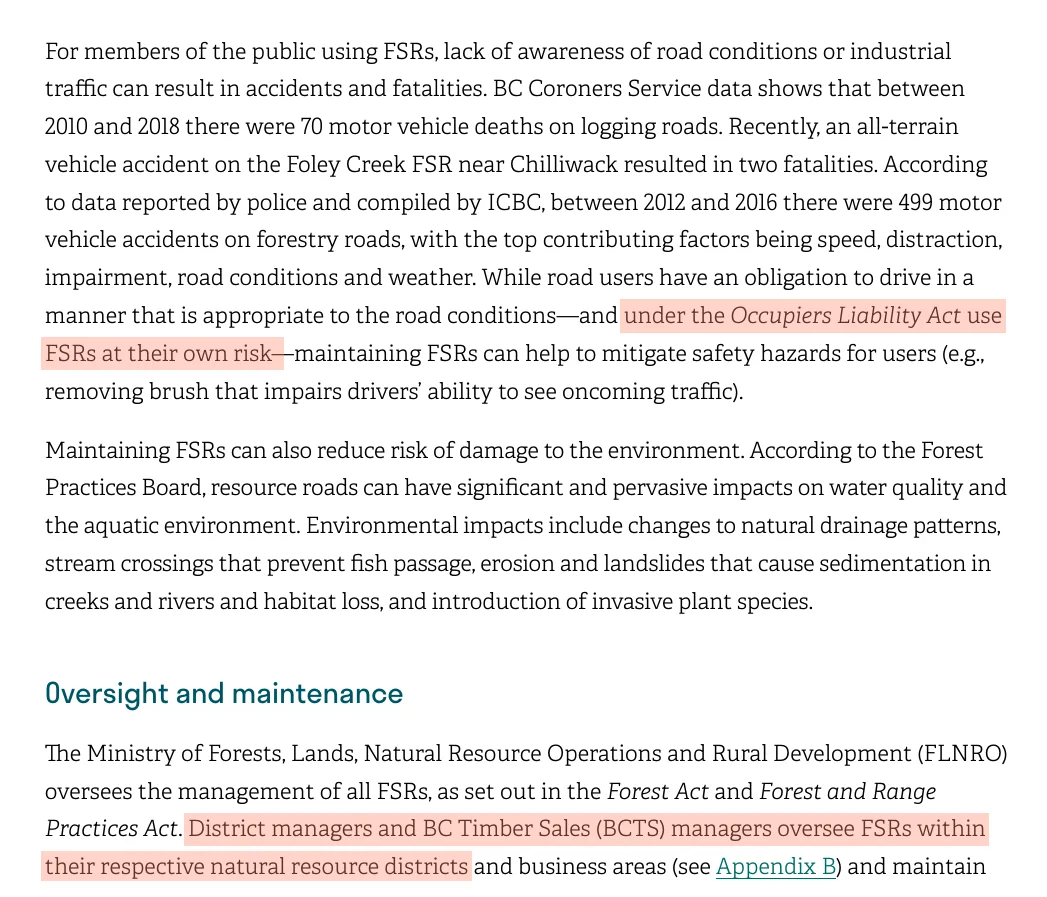
The same report says who is responsible on the ground, and it says what the law already does for road users. District managers “oversee FSRs within their respective natural resource districts”. And road users, the auditor wrote, “under the Occupiers Liability Act use FSRs at their own risk.” The Province’s own auditor stated in 2020 the reading of the Act that the Selkirk district’s FAQ leaves out.12
Then the money. The auditor found that districts “did not receive the funding from the ministry that they identified as needed to maintain and repair roads according to policy.” From 2017/18 to 2019/20 they received between 14 and 20 per cent of what they asked for. The South area, which contains the Selkirk district, did better than the rest, at 26 to 31 per cent, which still left most of its maintenance request unfunded.12
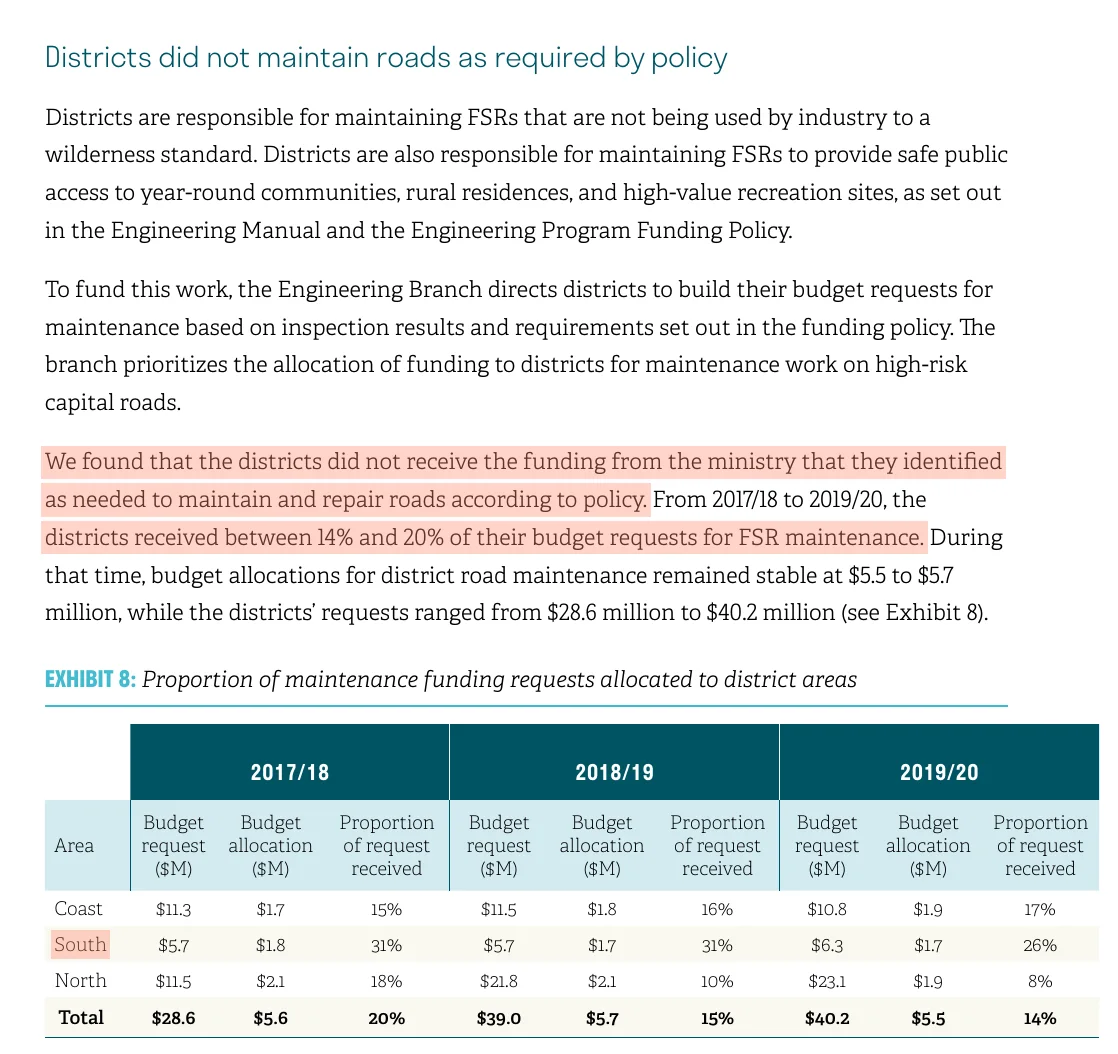
$12.5Mof South Area road-maintenance requests went unfunded in three years. The South Area is the Cariboo, Thompson-Okanagan and his Kootenay Boundary region.
Requested → funded → removed: the chain in the government’s own documents
Requested
South Area districts asked for this much road maintenance, 2017/18 to 2019/20.
Funded
They received this much: 31%, 31% and 26% of each year’s request.
Unfunded
Left undone, by the Auditor General’s own figures.
The auditor: road deactivation is used to “manage liability associated with FSRs that are not maintained because of inadequate funding.”
In his region since January 2022: 290 km of forest service road retired from the register.
Auditor General of British Columbia, Management of Forest Service Roads, November 2020, Exhibit 8 (printed page 39) and printed page 46; road register as above. The auditor reports these figures by area, not by region; no public source we found breaks the ministry’s road maintenance budget down by region or district.
Show the numbers
| Year | South Area requested ($M) | Funded ($M) | Share funded |
|---|---|---|---|
| 2017/18 | 5.7 | 1.8 | 32% |
| 2018/19 | 5.7 | 1.7 | 30% |
| 2019/20 | 6.3 | 1.7 | 27% |
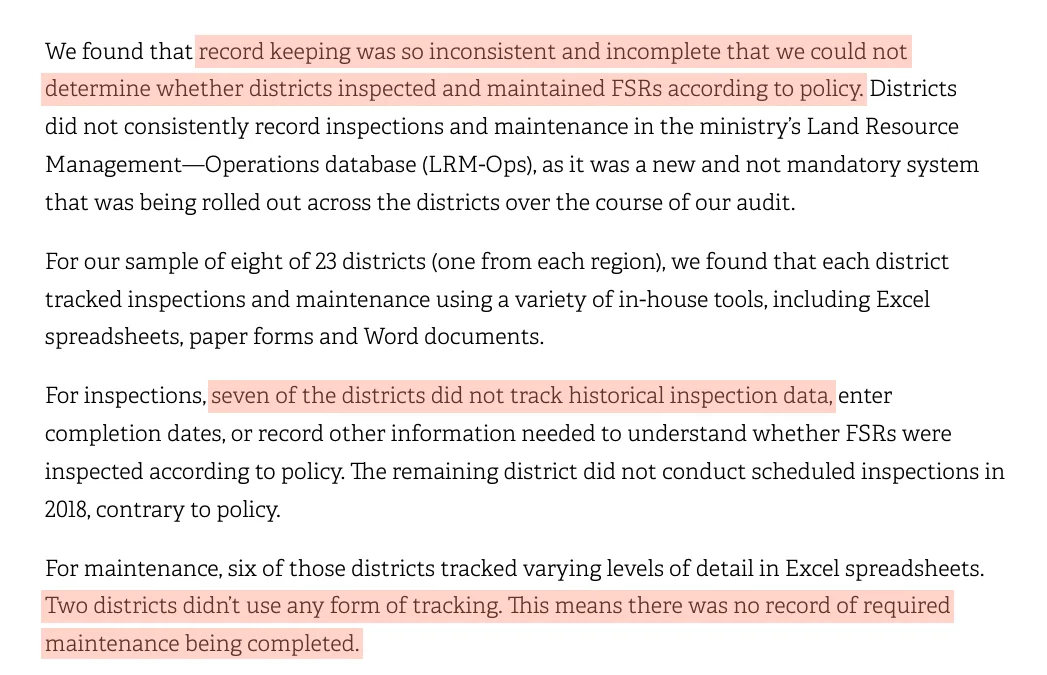
The auditor also found that the ministry could not show whether its districts were doing the work at all. It sampled eight of the twenty-three districts, one from each region, and found record-keeping “so inconsistent and incomplete that we could not determine whether districts inspected and maintained FSRs according to policy.” Seven did not track their inspection history. Two kept no maintenance tracking, which “means there was no record of required maintenance being completed.” The report does not name the sampled districts, so it cannot be said whether the Kootenay Boundary’s sample was Selkirk.12
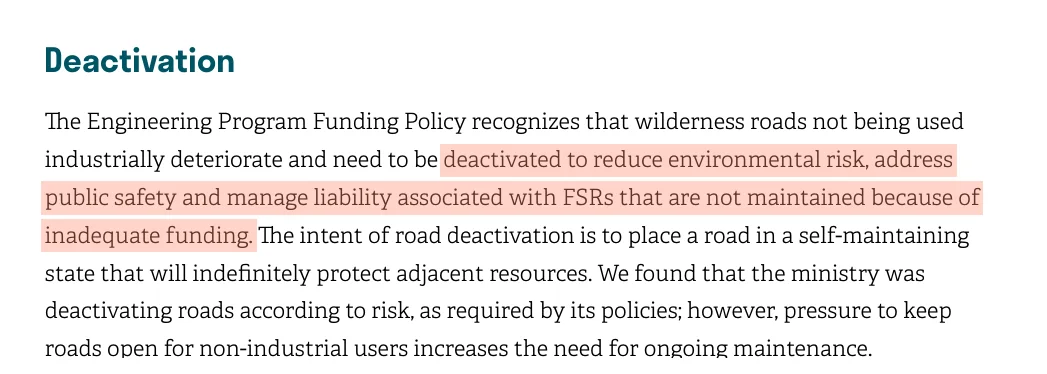
On deactivation, the auditor recorded why it happens. The ministry’s funding policy says roads that industry no longer uses deteriorate and need deactivation “to reduce environmental risk, address public safety and manage liability associated with FSRs that are not maintained because of inadequate funding.” In the government’s own documents, then, the liability is the product of the funding gap. The auditor also found, in fairness to the ministry, that it “was deactivating roads according to risk, as required by its policies.”12
The ministry accepted all nine recommendations. By its own progress report to 31 March 2025, five are complete and four are not, including the two on tracking and checking district inspections set out at the top of this piece. The other two incomplete items belong to BC Timber Sales.10
The audit is ministry-wide, and it does not single out Selkirk. What it establishes is the system Selkirk works inside: districts funded at a fraction of their maintenance needs, records too thin to show whether roads are inspected, and deactivation as the way the funding gap is closed. Those are the government’s findings about itself. In the South area the single largest category of capital-road requests was high-value recreation, $3.1 million of a $4.5 million ask, and the area received $1.7 million against it. We found no Ombudsperson report on the district’s road decisions.32
Read more The ministry told its auditor the deactivation rules were fixed. Then it tendered Rady Creek.
Section 10Why the answer is new leadership, and why it now falls to the next premier.
Each of the decisions above could be defended on its own. Together they show an office that removes roads before it asks whether they could stay, gives the public a legal reason the law does not support, and consults when it chooses to. Those are not the failings of one file or one season. They are habits of an office, and habits of an office change when the people who lead it change. Selkirk’s road management needs new leadership from the top.
This is an argument about how an office is run, not an accusation against any person in it. The record does not show who made each decision, and it does not show bad faith. It shows a pattern that the people responsible for the district have not corrected, and that someone above the district has the standing to address.
The first person with that standing is the Regional Executive Director. The ministry’s manual already makes him the final decision-maker in disputes over who is responsible for a forest service road, and the region issues its own guidance on deactivation. Whether he can replace a district manager himself, or must recommend it to the deputy minister, is not in any published document.0828
On the public record, the region has not acted. Its 2021 guidance sheet still leaves out the Occupiers Liability Act. The district’s liability claim is still published under the region’s watch. Its engagement procedures are still unpublished, and we found no regional review of any of these roads. On that record, the region will not change it. That conclusion rests on what the region has published and left standing, not on anything decided in private.280213
Then, on 8 October 2026, the region answered a recreation club that had asked where the Rady Creek file stood. The reply came from Mr Laroche himself.11
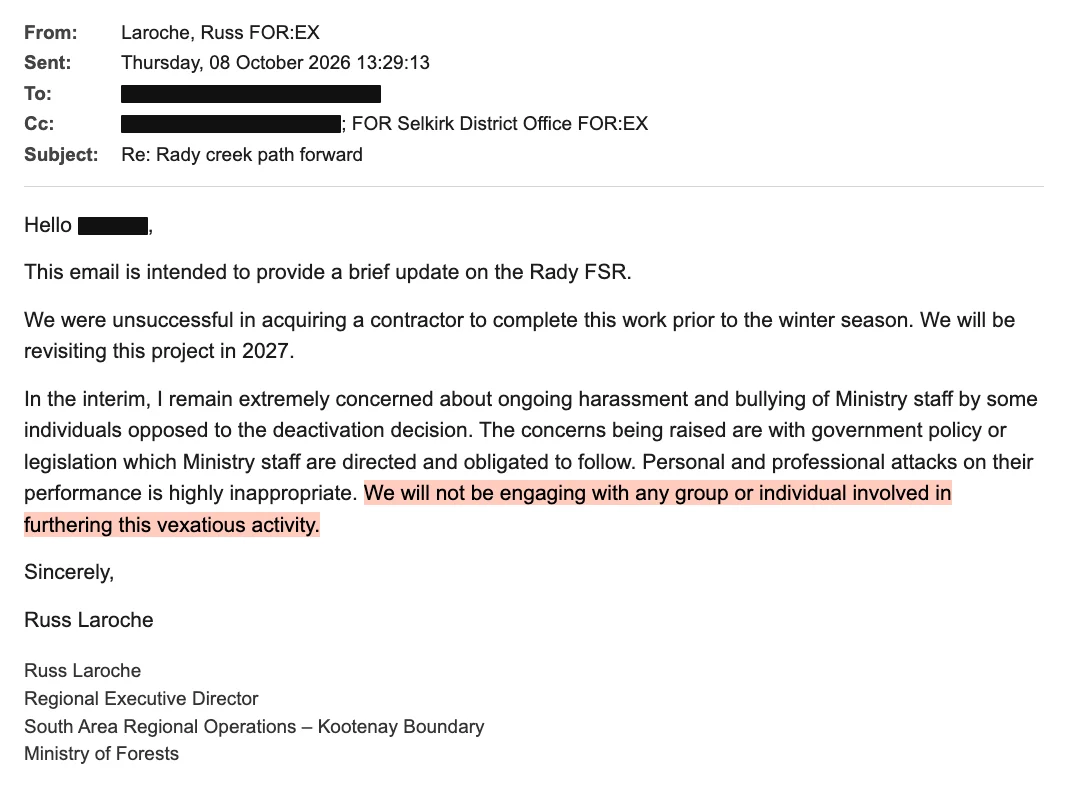
The scrutiny was earned. On his watch at Rady Creek, the road was posted for deactivation on an unsigned, unsealed 2020 spreadsheet; the only sealed geotechnical report is dated 8 September 2026, one day before the tender carrying it was issued. The ministry ruled out vehicle access before its engineers reported, and issued the sealed prescription to bidders with the geoscientist’s seal, signature and date painted over. The district told the public that the law obliged it to deactivate when the statute says road users accept the risk, and the Auditor General said the same. The inspection reforms the ministry promised for spring 2021 were still not delivered in 2025. In our view the record shows misconduct in how Rady was decided, and it drew what such a record should draw: letters, published criticism, a formal complaint to the Forest Practices Board and calls for the professional regulators to review the prescription. No regulator has made a finding. Public scrutiny of how public servants do their public jobs is not harassment, and it is not bullying; it is the lawful, ordinary way citizens hold their government to account. Calling it “vexatious” turns accountability into an offence.03021019
What his own rules require when the public complains
His employer’s standards say how a public servant answers the public, critics included. They are a condition of his employment.33
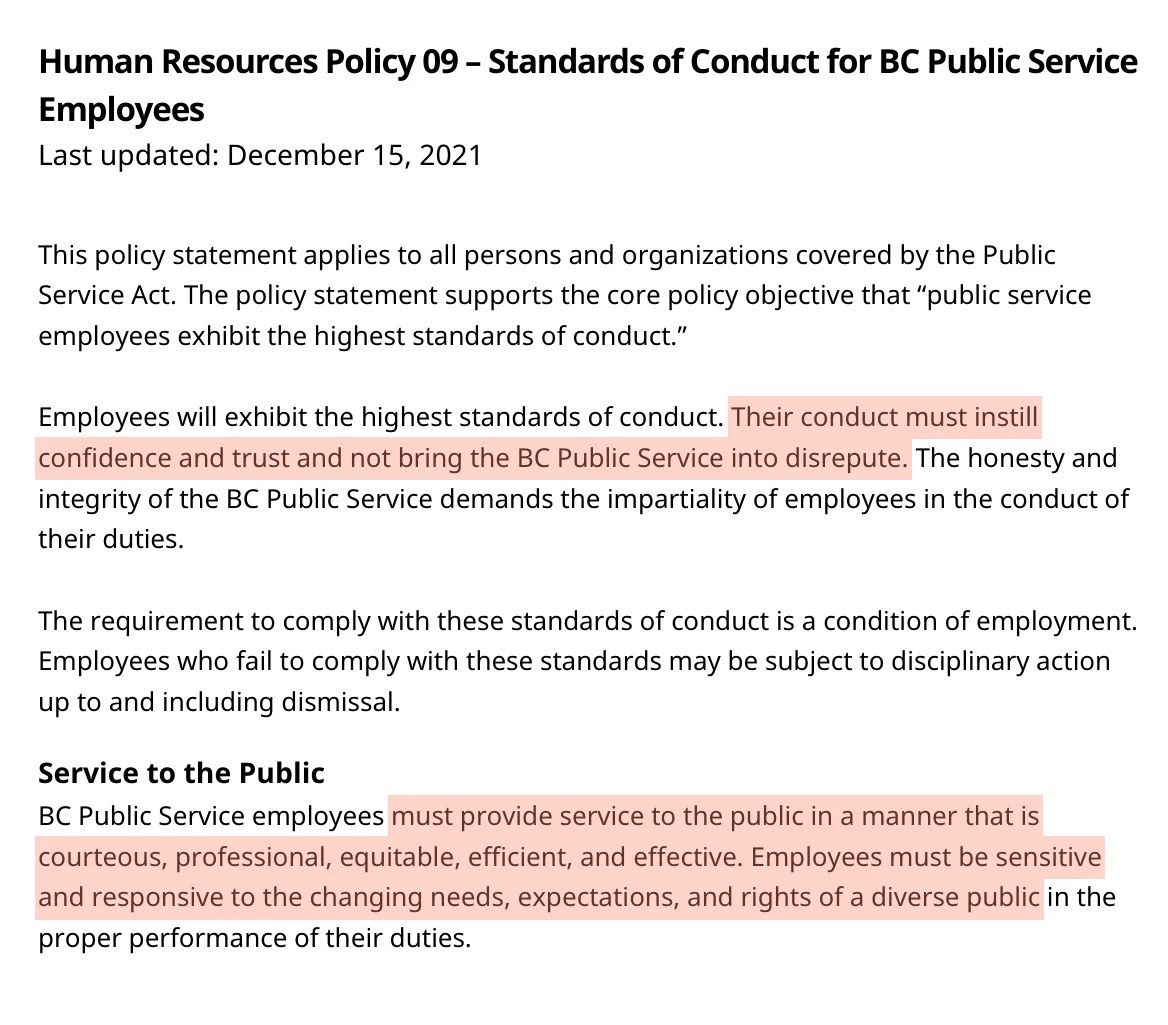
The Ombudsperson, the independent officer of the Legislature who oversees fairness in provincial administration, has published what a public body must do before it stops dealing with a member of the public. Restricting access is “a last resort”. It must be “proportionate to the behaviour being addressed” and tailored to the person. It requires notice, reasons “with as much detail as possible”, a stated review, and a written record of “the behaviour that led to the restriction”.34
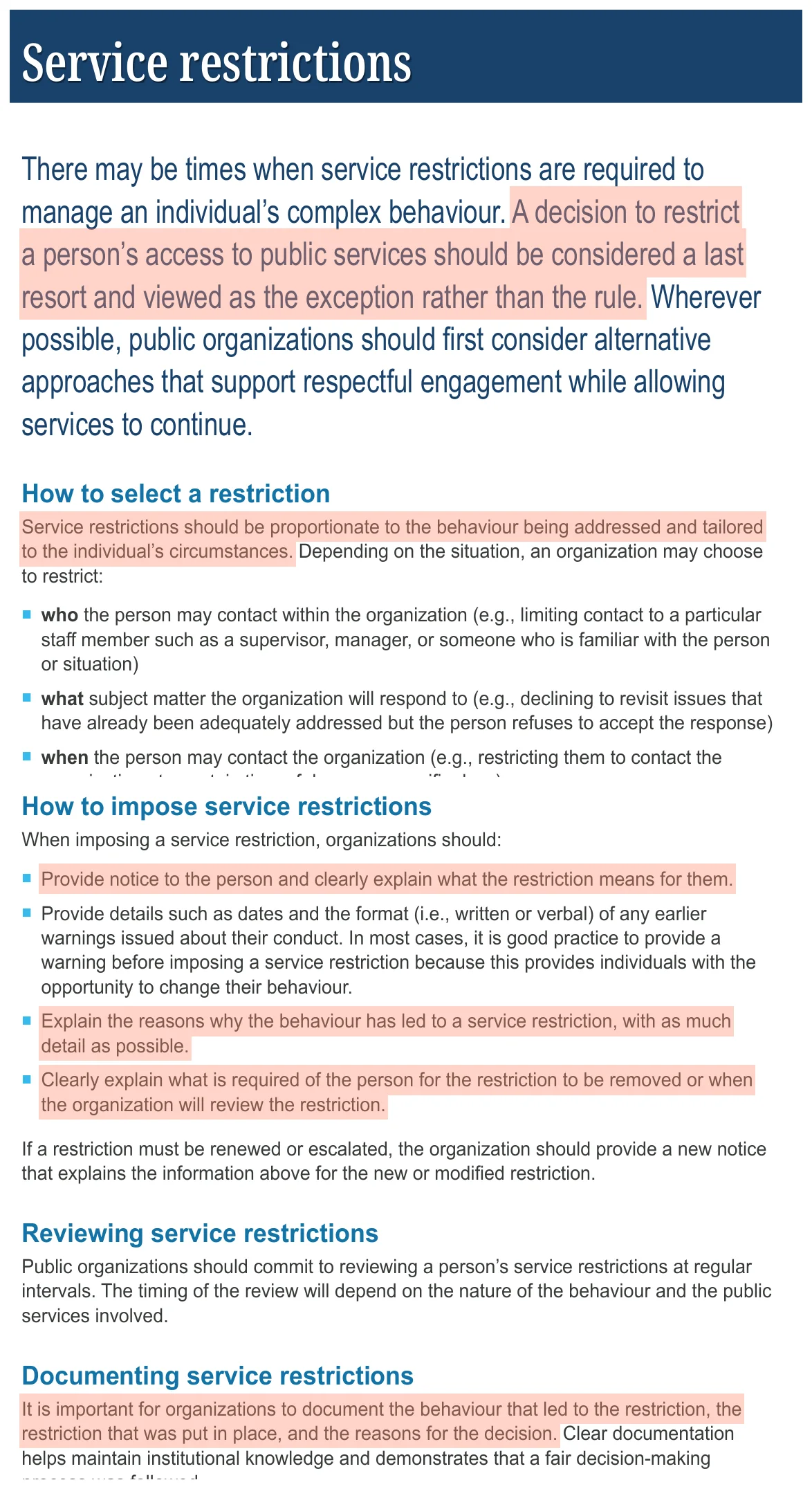
What the standards require
What his email did
What his standards require
Serve every member of the public.
Service must be “courteous, professional, equitable, efficient, and effective.”
Standards of Conduct, HR Policy 09 · 2021
What his email did
Refused a whole class of critics.
The region “will not be engaging with any group or individual” it links to criticism.
✕ His email · 8 October 2026
What fair administration requires
Restrict only as a last resort.
A restriction is “a last resort”, “proportionate” to documented behaviour, with notice and reasons.
Ombudsperson, Respectful Engagement · 2026
What his email did
Blanket, unexplained, undocumented.
No notice to any named person, no incident named, no reasons, no review date.
✕ His email · 8 October 2026
What the duty requires
Answer the substance.
Decisions must be justified by the facts and the law that bind them.
Administrative law; Standards of Conduct
What his email did
Answered none of it.
Nothing on the liability claim, the access decision or the 2021 reforms. Instead: “harassment”.
✕ His email · 8 October 2026
Measured against those documents, his email fails. It gives no process and no notice to any named person. It names no incident and documents no harassment, and nothing in the public record shows any; the record shows criticism made through letters, complaints to regulators and published pieces. It addresses none of the substance: not the liability claim, not the access decision made before the engineering, not the reforms left undone. And it imposes a blanket refusal on “any group or individual”, which is the opposite of the proportionate, individual, documented restriction the Ombudsperson describes as a last resort. His email says “the concerns being raised are with government policy or legislation which Ministry staff are directed and obligated to follow”; a senior official told that his region’s stated legal reason is wrong is the one person best placed to check it.113402
The criticism is about decisions and professional conduct. His email recasts it as a personal attack and the officials as its victims, and uses that to stop engaging. In our view, this is victim signalling, and it is unprofessional: a failure of his duty to the public, judged against his own employer’s standards and the Ombudsperson’s principles of fair administration. It disregards the first duty of an executive, which is to take criticism of his office’s decisions and fix the policy when the criticism is right. A regional executive director does not get to choose which citizens he serves. Whatever one calls the duty, fiduciary or otherwise, it is not discharged by refusing to listen.11333534
One day after the complaints were reported
The email did not arrive in a quiet week. Set the published dates side by side.
- 19 September 2026
CTV News reports recreation groups asking the Province to stop the Rady Creek deactivation.36
- 29 September 2026
A member of the public files a formal complaint about Rady Creek with the Forest Practices Board.19
- 30 September 2026
This site publishes its account of the Rady prescription with a complaint addressed to Forest Professionals BC and Engineers and Geoscientists BC. The published complaint text copies the Regional Executive Director’s office address.1937
- 7 October 2026
This site reports that the complaint has been filed with two regulators and an oversight board, and that one regulator replied that day.37
- 8 October 2026
His email: an update that no contractor was found, then “We will not be engaging with any group or individual involved in furthering this vexatious activity.”11
Within a day of a published report that complaints about the Rady prescription had gone to the regulators, the region announced it would no longer engage with anyone involved. Was that a response to the complaints? The public record cannot show his reasons, and whether his office received the copies is not on it. But the timing invites the question, and his email names no other incident. In our view, the timing has the look of retaliation against people who used the lawful route to complain, and his email names no specific incident.1137
No statute we found gives members of the public an express protection against reprisal for complaining; the protections in the Public Interest Disclosure Act cover public servants, not the public. The standards that do apply are the ones above: service that is “courteous, professional, equitable”, and, in the Ombudsperson’s guidance, restrictions that are a “last resort”, proportionate to documented behaviour, with notice and reasons. A complaint to a regulator is not behaviour that guidance treats as grounds for cutting off service.3334
When the district has not changed and the region has said it will not engage, the decision goes to the top. British Columbia votes on 24 October. Whoever forms the next government will own the Ministry of Forests and this record, and the mandate is plain: change the leadership responsible for road management in Selkirk, and reform the ministry’s road and deactivation practice directly, in every district that works this way. The site’s other pieces compare what the parties have said; this one sets out what the winner will inherit.
Does a regional executive director have a fiduciary duty to act on a record like this? In the strict legal sense, the answer is no. The Supreme Court of Canada has held that the Crown owes fiduciary duties only in limited circumstances, and a public servant’s duty of loyalty runs to his employer. The duties that do apply point the same way. The public service oath speaks of “the special trust placed in them to carry out their duties on behalf of all British Columbians”. The Standards of Conduct require service that is “courteous, professional, equitable, efficient, and effective”. And administrative law expects public decisions to be justified by the facts and the law that bind them.38353339
Read more Michael Ferguson and the Rady Creek prescription · It will pay for guards. It will not pay for a meeting.
Section 11Seven questions of his fiduciary duty, graded on the record.
Each line below is a duty a regional executive director should be responsible for, the question it raises, and what the public record shows. This is the site’s assessment of his public role from public documents. It grades the record of the office, not the man, and only what the documents on this page show.
The rubric. A: the duty is met on the public record. C: partly met. F: the public record shows it unmet. INC, incomplete: the public record is silent, so no grade is given. The overall grade averages the graded lines only (A = 4, C = 2, F = 0; 3.5 and above is A, 2.5 B, 1.5 C, 0.5 D, below 0.5 F). Incomplete lines are listed and not counted.
Duty 01
Has the region reviewed Selkirk’s road decisions, and do they rest on accurate, documented assessments?
No published regional review exists. Under his leadership, the record the Rady decision rests on is wrong in places: the consultant called the ministry’s dated prescription “not dated”; the ministry’s first prescription kept ATV access; the district’s FAQ leaves the ATV exception out of the regulation; and the risk case was made without a risk assessment.03191613
Duty 02
Has the district’s leadership been reviewed, and who would decide to change it?
No published document says whether a Regional Executive Director can replace a district manager or must recommend it to the deputy minister, or whether any review has happened. The manual gives him the final decision in one kind of dispute over these roads; the rest of his role is not on the public record.0508
Duty 03
Does the region agree that the Crown “is obligated to relieve itself of liability”?
The district’s FAQ still says so on a government page updated in October 2026. The Act says road users accept the risk, the Auditor General wrote the same in 2020, and the region’s own guidance sheet does not mention the Act. He has left the claim standing.02131228
Duty 04
Has the region answered public criticism fairly, professionally and against the law?
His employer’s standards require service that is “courteous, professional, equitable”, and the Ombudsperson describes restricting contact as “a last resort”, proportionate, with notice, reasons and a written record. On 8 October 2026 he wrote that the region “will not be engaging” with “any group or individual” it links to criticism, with no process, no incident named and no answer to the substance. Eight registered lobbying reports name him since 2022, the most of any Regional Executive Director, and none records a meeting arranged. In a public forum on 21 September 2026 the groups said the ministry “have not spoken to us at all”, and that efforts to reach the Selkirk office had gone “unheard”.40 His email came one day after this site reported that complaints about the Rady prescription had gone to the regulators.1133340937
Duty 05
Are the alternatives to deactivation weighed in writing before a road is posted?
On his watch at Rady Creek the ministry ruled out vehicle access before its engineers reported, and nothing published shows the ATV trail they identified was costed or considered. No published Selkirk document records wilderness status or a maintenance agreement being weighed for any road.0313
Duty 06
What do the region’s “recommended Regional procedures for engagement and notification” say?
His region’s own guidance sheet, which he has kept in force, tells the public to follow them. We could not find them published anywhere, and the district consults on some roads and not others.2804
Duty 07
Has the region delivered the reforms the ministry accepted in 2021?
The ministry promised the Auditor General that districts would be able to track and check road inspections “by Spring 2021”. Its own report marks both fixes “Not completed” at March 2025, and says the policies are “in various stages of being implemented by the districts”. In Selkirk, under his leadership, the published decisions give liability as a reason the rewritten manual does not list, and do not show the assessment or stakeholder input the manual requires.12100802
Report card · graded on the public record
Performance on the record: F
6 of 7 lines can be graded from public documents: 6 unmet, 1 incomplete. The incomplete lines are where the public record says nothing at all.
If you hold public records about road decisions in the Selkirk district, such as notices, published decisions or a regional procedure document, send what you have the right to share to contact@backcountry.cx. Say where each item came from. Nothing sent will be published until it has been checked against other sources.
The district has not changed it. If the region will not fix Selkirk, we must demand the next premier does.
Share this story
Six images carrying this story on their own — the grade, the roads retired across his region, the money, the Rady record, the broken promise and his own words. Made to be posted.


Slide 1 of 6
Suggested caption
Russ Laroche runs the region whose Selkirk District says liability forces it to deactivate roads, has published no plan to meet the public, and now says it “will not be engaging” any critic. Isn’t it his fiduciary duty to check complaints against the law and reform policy that violates it?
Graded on the public record, Russ Laroche’s performance as Regional Executive Director for the Kootenay Boundary is an F: six duties failed, one with no public record.
In 2021 the ministry promised the Auditor General it would fix how districts track and check road inspections “by Spring 2021”. By its own report, both fixes were still “Not completed” in March 2025.
Across his region, 290 km of forest service road has been retired from the register since January 2022. His Selkirk District still says it “is obligated to relieve itself of liability”, and he has left it standing, though the law has deemed road users to accept the risk since 2012.
On his watch at Rady Creek the ministry ruled out access before its engineers reported, and issued the sealed prescription to bidders with the seal and signature painted over. That record drew fair public scrutiny and calls for the regulators to review it. On 8 October 2026 his answer was to call it harassment and say the region “will not be engaging” with its critics. The same email says no contractor was found for Rady Creek, which is scheduled to be revisited in 2027.
The district has not changed it. If the region will not fix Selkirk, we must demand the next premier does.
backcountry.cx/editorials/russ-laroche-kootenay-boundary/
#BCpoli #PublicLand #ForestServiceRoad #Kootenays
Sources
- ↩↩↩Backcountry Coalition, “Fourteen forest roads in Brittny Anderson’s riding”, published as brittny-anderson-sitkum-creek. Maps the Selkirk district’s published road notices against the Province’s forest tenure register inside the gazetted boundary of Kootenay Central: fourteen forest service roads closed, posted for removal or retired since 2020, seven closed with no date to reopen, eight closed or posted after the start of 2025, and on all but one no planned repair date or a plan to remove the road. backcountry.cx/editorials/brittny-anderson-sitkum-creek/
- ↩↩↩↩↩↩↩↩↩↩↩↩↩Selkirk Natural Resource District, “Frequently Asked Questions – Incomappleux Forest Service Road Deactivation”, dated April 2025, file 11250-30/3397. Answer 1: “Deactivation is done to relieve the permit or tenure holder of their ongoing obligation to maintain roads and associated structures.” Answer 9: “For the Ministry of Forests to limit liability, it must deactivate the road … The province cannot release liability through the use of a sign.” Answer 14: the district will continue “because it is obligated to relieve itself of liability.” Still linked from the district’s road page on 14 October 2026. https://www2.gov.bc.ca/assets/gov/farming-natural-resources-and-industry/natural-resource-use/resource-roads/local-road-safety-information/selkirk/faq_document_for_incomappleux_deactivation.pdf
- ↩↩↩↩↩↩↩↩↩↩↩↩↩↩SNT Geotechnical Ltd., “Rady Forest Service Road (FSR) Road Deactivation Prescription”, report 26.510.01.01.16, 8 September 2026, prepared for the Ministry of Forests – Selkirk Natural Resource District. Page 4: “The MOF has indicated that the road is intended to be deactivated to a permanent standard, and that post-deactivation vehicular access is not required.” Published by the Province on the Selkirk district road page as “Trout Lake Rady-Creek FSR Deactivation Prescription and Map”. The photograph used on this page’s card and first slide is Photo 1 of its Appendix A. https://www2.gov.bc.ca/assets/gov/farming-natural-resources-and-industry/natural-resource-use/resource-roads/local-road-safety-information/selkirk/trout_lake_rady_creek_deactivation_prescription_map.pdf
- ↩↩↩↩↩Backcountry Coalition, “Another Rady? Selkirk District is tearing out Sitkum Creek FSR for the second time”, 29 September 2026. The 2014 bridge removal, the 2016 volunteer rebuild with $8,000 committed by Columbia Basin Trust, the July 2026 posting, the absence of a published prescription, and the district’s written comment deadlines for the Blazed and Jersey roads in 2022 and at Incomappleux, against none at Rady Creek. Each finding carries its own sources there. backcountry.cx/editorials/sitkum-creek-fsr/
- ↩↩↩↩↩↩BC Government Directory, official extract BCGOV_directory_people.csv, as captured by the Internet Archive on 9 April 2026. Two rows read Laroche, Russ · Regional Executive Director · Ministry of Forests, one under the unit Kootenay Boundary Region and one under Regional Operations, South Area. The same unit lists two district managers and the region’s timber sales manager. The extract records unit and title only; it has no supervisor field, so it shows who sits in the region, not who reports to whom. The earlier official extract, captured 14 February 2017 (XML), lists him as Timber Sales Manager. The live directory at dir.gov.bc.ca is now closed to the public; the extract was published under the Open Government Licence – British Columbia. SHA-256 of the 2026 file as retrieved: 99292824…6dd. Retrieved 14 October 2026. https://web.archive.org/web/20260409001353id_/https://dir.gov.bc.ca/downloads/BCGOV_directory_people.csv
- ↩↩↩Ministry of Forests, “Region and district contacts”. Lists two natural resource districts under the heading Kootenay / Boundary Region: the Selkirk Natural Resource District (1907 Ridgewood Road, Nelson; FOR.SelkirkDistrictOffice@gov.bc.ca) and the Rocky Mountain Natural Resource District (1902 Theatre Road, Cranbrook; FCBC.CBK@gov.bc.ca). The page gives no general address for the regional office. Read 14 October 2026. https://www2.gov.bc.ca/gov/content/industry/forestry/managing-our-forest-resources/ministry-of-forests-lands-and-natural-resource-operations-region-district-contacts
- ↩Rachael Lesosky, “New documentary showcases solutions to prevent BC from burning”, Valley Voice, published by pentictonherald.ca, 10 September 2025. Describes the 26 August 2025 screening in Nakusp, followed by a question-and-answer session with “Russ Laroche, Kootenay Boundary Regional Executive Director with the Ministry of Forests.” This is the earliest dated public record of him in the post that we were able to read. https://www.pentictonherald.ca/spare_news/article_b236b7cf-a038-5e05-8d15-07060683f682.html
- ↩↩↩↩↩↩↩↩↩Ministry of Forests, Engineering Manual, edition dated 25 May 2026. § 1.2.4.1, “Dispute Resolution”: “If the DM and TSM cannot reach agreement, the matter must be referred to the Regional Executive Director (RED). The RED will make the final decision to ensure timely resolution and continuity of FSR maintenance.” § 6.4.3: FSRs “must be maintained in accordance with forest legislation to protect forest resources and other values, while also ensuring that road users are reasonably safe in accordance with the Occupiers Liability Act.” § 7.3.3 warns of “creating unintended access and liability issues” when deactivating a road that serves other tenures; § 7.3.5 records that a deactivated road “Transfers responsibility for terrain stability to the Crown rather than the Ministry.” The glossary defines a wilderness road as one that “may continue to provide limited access for recreation or management purposes”. https://www2.gov.bc.ca/assets/gov/farming-natural-resources-and-industry/natural-resource-use/resource-roads/engineering-manual/engineering_manual.pdf
- ↩↩↩↩Office of the Registrar of Lobbyists for B.C., Lobbyists Registry open data (files dated 20 September 2026) and published report pages to 14 October 2026. Reports naming Russ Laroche as “Regional Executive Director”: 4448-15800 and 4448-16378 (13 January 2022) and 4448-16963 (4 February 2022), The B.C. Wildlife Federation; 3397-32890 (11 October 2022), Western Canada Wilderness Committee; 3616-52898 (4 June 2026), Canadian Forest Products Ltd.; 572-54390 (21 July 2026), 572-54394 (17 August 2026) and 572-54391 (22 August 2026), British Columbia Snowmobile Federation. All in-house; none records an arranged meeting. Earlier reports (2020–21) name him as Executive Director, Species at Risk Recovery. The registry does not record his region. No report names a Selkirk district office holder. https://www.lobbyistsregistrar.bc.ca/the-registry/open-data/
- ↩↩↩↩↩↩Office of the Auditor General of British Columbia, Annual Follow-up Report: Status of Performance Audit Recommendations (2019–2023), October 2025, pages 46–50. Includes the Ministry of Forests’ progress report on Management of Forest Service Roads (2020), status at 31 March 2025, with the Auditor General’s review report dated 14 July 2025. Recommendations 1, 2, 3, 6 and 9 are marked completed; 4 and 5 (ministry) and 7 and 8 (BC Timber Sales) are marked “Not completed (Intend to complete)”, with anticipated completion in 2026. https://www.oag.bc.ca/app/uploads/sites/963/2025/10/OAGBC-202510-AFR-final-RPT.pdf
- ↩↩↩↩↩↩↩↩↩Email from Russ Laroche, Regional Executive Director, South Area Regional Operations – Kootenay Boundary, Ministry of Forests, Thursday 8 October 2026, 13:29, subject “Re: Rady creek path forward”. A reply to a recreation club’s request of 7 October 2026 for an update on the Rady Creek FSR file, copied to the Selkirk District Office. Correspondence on file; reproduced in full with the names and addresses of recipients redacted. Exhibit on this page
- ↩↩↩↩↩↩↩↩↩Office of the Auditor General of British Columbia, Management of Forest Service Roads, November 2020 (56 pp.). Printed page 21: road users “under the Occupiers Liability Act use FSRs at their own risk”; district managers “oversee FSRs within their respective natural resource districts”. Page 25: audit conclusion. Page 38: sample of eight of 23 districts, one from each region; record-keeping findings. Page 39 and Exhibit 8: districts received 14% to 20% of maintenance requests, 2017/18 to 2019/20; South area 31%, 31% and 26%. Page 46: deactivation and liability “associated with FSRs that are not maintained because of inadequate funding”; the ministry “was deactivating roads according to risk, as required by its policies”. The PDF page number is one higher than the printed page. https://www.oag.bc.ca/app/uploads/sites/963/2024/08/OAGBC-20210119-Management-Forest-Service-Roads_RPT.pdf
- ↩↩↩↩↩↩↩↩↩↩↩↩↩↩↩Ministry of Forests, “Selkirk Natural Resource District road safety information”, last updated 9 October 2026. Lists Trout Lake Rady-Creek FSR 0321.02 (13 November 2025): “Deactivation planned for 2026”; Heights FSR and Sitkum Creek FSR (6 July 2026) as planned for deactivation; Incomappleux FSR (3 November 2025) with the April 2025 FAQ; and, under Important resources, the regional guidance information sheet. Read 14 October 2026. https://www2.gov.bc.ca/gov/content/industry/natural-resource-use/resource-roads/local-road-safety-information/selkirk-natural-resource-district-road-safety-information
- ↩Backcountry Coalition, “The Selkirk district office”, 11 September 2026, and “The prescription they did not want”, 22 September 2026. Set out Invitation to Tender EN27DSE008 (BC Bid opportunity 233877), issued 9 September 2026 with tenders closing 24 September 2026, and the September 2026 prescription. BC Bid now sends automated requests to a browser check, so we could not read whether a contract has been awarded. backcountry.cx/editorials/selkirk-district-office/
- ↩Backcountry Coalition, “The prescription they did not want”, 22 September 2026. Reads the September 2026 Rady prescription section by section, including its instruction to leave the road prism intact on most sections and the ATV-trail passage. backcountry.cx/editorials/the-prescription-they-did-not-want/
- ↩↩↩↩Forest Planning and Practices Regulation, B.C. Reg. 14/2004, consolidation current to 6 October 2026. Section 79(3): “the government must maintain a forest service road … until the road is deactivated.” Section 81 (wilderness roads) limits the duty on a road not used by industrial users to what is needed to avoid a material adverse effect on a forest resource, and removes the duty that it be safe for industrial users. Section 82(1)(a): a person who deactivates a road must “barricade the road surface width in a clearly visible manner to prevent access by motor vehicles, other than all-terrain vehicles”. https://www.bclaws.gov.bc.ca/civix/document/id/complete/statreg/14_2004
- ↩Ministry of Forests, “FAQ – Engineering Roads Funding Policy”, December 2025. “Do all unmaintained FSRs have to be deactivated? No. Some resource roads provide important tourism or recreational opportunities and are inspected on a risk basis. These roads are left open unless closure is necessary to protect the environment and/or mitigate other risks.” https://www2.gov.bc.ca/assets/gov/farming-natural-resources-and-industry/natural-resource-use/resource-roads/faq__engineering_roads_funding_policy.pdf
- ↩↩↩Backcountry Coalition, “The law everyone forgot”, 25 September 2026. Sets out s. 3.1, its 2012 history, the absence of any regulation under the Act, the Province’s position in Oviatt v. Masi, the untested state of the section, and the count of 223 published district documents, of which one, the Selkirk FAQ, gives liability as a reason to deactivate a road. Each of those findings carries its own sources there. backcountry.cx/editorials/the-law-everyone-forgot/
- ↩↩↩↩↩Backcountry Coalition, “Michael Ferguson and Jordan Pyette: the Rady Creek prescription”, 30 September 2026. Records the formal complaint about the Rady Creek FSR filed with the Forest Practices Board on 29 September 2026, and sets out the route for complaints to Forest Professionals BC and Engineers and Geoscientists BC about the prescription. No regulator has made any finding. backcountry.cx/editorials/michael-ferguson-jordan-pyette-rady-creek/
- ↩Engineers and Geoscientists BC, “Unauthorized Practice or Title FAQs”, as captured by the Internet Archive on 21 March 2026. Question 10: “No. The obligation to comply with the Act’s misuse of title prohibitions follows the individual who is using the title. If your title contravenes the misuse of title prohibitions under the Act, then you must revise that title, even if it was given to you by your employer.” The table of example titles marks “Jamie Smith, Structural Engineering / Jamie Smith, Engineering Specialist” as Registrant: Yes, Non-Registrant: No. The EGBC registrant directory returned HTTP 403 to an automated request on 14 October 2026 and was not bypassed. https://web.archive.org/web/20260321104117/https://www.egbc.ca/complaints-discipline/unauthorized-practice-or-title/unauthorized-practice-misuse-of-title/unauthorized-practice-or-title-faqs
- ↩↩Professional Governance Act, SBC 2018, c. 47, s. 52. Section 52(3): a person other than a registrant “must not use a reserved title or other name, title, description or abbreviation … in any manner that expresses or implies that the person is a registrant … or is authorized to practise in a profession that is subject to a reserved title.” Reserved titles are set by regulation, including B.C. Reg. 14/2021 (engineering and geoscience) and B.C. Reg. 15/2021 (forestry, including “registered forest technologist”). https://www.bclaws.gov.bc.ca/civix/document/id/complete/statreg/18047
- ↩Forest Professionals BC career centre, “Engineering Officer”, Ministry of Forests, Chilliwack Natural Resource District, as captured by the Internet Archive on 23 January 2025. Qualifications: “Applicants must be registered or eligible for registration with the Forest Professionals BC (FPBC) as Registered Professional Forester, OR another applicable professional (i.e. PENG) eligible to hold a special practice permit with the FPBC.” Cited for how the ministry staffs the post; it is not a Selkirk posting. https://web.archive.org/web/20250123104343/https://www.fpbc.ca/career-centre-details/engineering-officer/
- ↩↩Occupiers Liability Act, RSBC 1996, c. 337, BC Laws consolidation current to 6 October 2026. Section 1 (definitions of “resource road”, “limited liability entity” and “maintainer”); s. 3(3) (the surviving duty); s. 3(3.2)–(3.3) (the 1998 categories, including “recreational trails reasonably marked as recreational trails”); s. 3.1 (resource roads); s. 8(2)(c) and 8(3) (the government as occupier of a road under the Forest Act and of a resource road). Section 3.1 was enacted by S.B.C. 2012, c. 14, s. 15, in force 25 June 2012, and the Point in Time record lists no amendment since. https://www.bclaws.gov.bc.ca/civix/document/id/complete/statreg/96337_01
- ↩Ministry of Forests, Lands and Natural Resource Operations, Information Bulletin 2012FOR0025-000249, “Legislation to limit liability on resource roads”, 7 March 2012. One of the two stated purposes: “Reduce the number of resource roads that are closed due to concerns regarding third party liability.” https://archive.news.gov.bc.ca/releases/news_releases_2009-2013/2012FOR0025-000249.htm
- ↩Hansard, 39th Parliament, 4th Session, Thursday 26 April 2012, afternoon sitting, committee of the whole on Bill 26. Hon. S. Thomson: the change would “create a disincentive to close a road strictly because of the liability issues”, and was meant as “an incentive to keep the roads open and to have less closures”. Read from the Legislature’s PDF on 14 October 2026. https://lims.leg.bc.ca/hdms/Debates/39th4th/H0426pm-07.pdf
- ↩Oviatt v. Masi, 2018 BCSC 930, para. 68. The Province “agrees with Interfor that Adams West is a ‘resource road’ within the meaning of the Occupiers Liability Act and, therefore, attracts a reduced standard of care.” The applications were dismissed and no ruling on s. 3.1 was made. https://www.bccourts.ca/jdb-txt/sc/18/09/2018BCSC0930.htm
- ↩Chisholm v. Valemount Forest Products Ltd., 2025 BCCA 48, para. 38. Whether the road was a “resource road” attracting the s. 3.1 duty: “That is a matter for trial.” No reported decision of the Supreme Court or Court of Appeal of British Columbia has yet decided that question. Settled claims and Provincial Court matters are not in that record. https://www.bccourts.ca/jdb-txt/ca/25/00/2025BCCA0048.htm
- ↩↩↩↩↩Ministry of Forests, Lands, Natural Resource Operations and Rural Development, Kootenay Boundary Region, “Road Infrastructure Deactivation and Rehabilitation Regional Guidance – Information Sheet”, one page, file created 23 March 2021. Lists the reasons for reducing road infrastructure, tells users to “Follow the recommended Regional procedures for engagement and notification”, and names the Forest Act, the Forest & Range Practices Act, the Wildlife Act and the Ministry of Forests and Range Act as the sources of legal requirements. It does not mention the Occupiers Liability Act. Linked from the Selkirk district road page on 14 October 2026. We could not find the regional procedures it refers to published anywhere. https://www2.gov.bc.ca/assets/gov/farming-natural-resources-and-industry/natural-resource-use/resource-roads/local-road-safety-information/deactivation_rehabilitation_information_sheet_kb_region.pdf
- ↩↩↩Province of British Columbia, Forest Tenure Road Section Lines (WHSE_FOREST_TENURE.FTEN_ROAD_SECTION_LINES_SVW), Open Government Licence – British Columbia. All 286,220 records retrieved through the Province’s WFS service on 14 October 2026. Forest service roads are file type B40 and road permits B01; district by geographic district code (Selkirk is DSE); length is mapped length. Selkirk: 1,578 active FSR sections, 7,594 km, of 56,423 km province-wide; 196 sections and 428.8 km retired since 1 January 2020 (5.0% of active plus retired length, against 5.8% province-wide); 12,560 active road-permit sections, 17,340 km. Trout Lake-Rady Cr FSR 0321 section 02 is listed ACTIVE. Retirement in the register is an administrative change, not proof of physical deactivation. https://catalogue.data.gov.bc.ca/dataset/forest-tenure-road-section-lines
- ↩↩Province of British Columbia, Ministry Contract Awards open data, all quarterly files 2012 to July–September 2026. Selkirk deactivation works awards: EN16DSE012 Barnes Creek West $50,650.00; EN21DSE006 Tangiers $129,828.20; EN23DSE012 $140,372.50; EN23DSE007 Maryland/Boundary $73,700.00; EN23DSE009 deactivation services $105,000.00; EN24DSE005 Akokli $167,815.00; EN24DSE006 Lower Blazed $98,500.00; EN24DSE001 Grano Creek $149,078.06. EN26474007, “Geotechnical Engineering Services – Kootenay/Boundary Region”, SNT Geotechnical Ltd., $90,000, awarded 14 April 2025. The latest published quarter runs to award dates of 11 August 2026, so no award for EN27DSE008 (Rady) appears. BC Bid redirected automated requests to a reCAPTCHA browser check on 14 October 2026 and was not bypassed. https://catalogue.data.gov.bc.ca/dataset/ministry-contract-awards-province-of-british-columbia
- ↩Province of British Columbia, Public Accounts, Consolidated Revenue Fund Detailed Schedules of Payments, “Other Suppliers”, 2022/23 to 2025/26. SNT Geotechnical Ltd.: $148,556 (2022/23, p. 595), $361,876 (2023/24, p. 726), $406,638 (2024/25, p. 731), $741,718 (2025/26, p. 690). Government-wide, cash basis, payees of $25,000 or more; not broken down by ministry or contract. https://www2.gov.bc.ca/assets/gov/british-columbians-our-governments/government-finances/public-accounts/2025-26/pa-2025-26-crf-detailed-schedules-of-payments.pdf
- ↩Backcountry Coalition, “The ministry told its auditor the deactivation rules were fixed”, on the Auditor General’s 2020 audit. Exhibit 9 of the audit for the South area’s capital requests; the sampled districts’ record-keeping; and the ministry’s progress report to 31 March 2025, which shows five of nine recommendations complete and four, including those on tracking and assessing district inspections, not complete. backcountry.cx/editorials/auditor-general-road-audit/
- ↩↩↩↩↩BC Public Service, Human Resources Policy 09, “Standards of Conduct for BC Public Service Employees”, last updated 15 December 2021, pages 1–2. “Their conduct must instill confidence and trust and not bring the BC Public Service into disrepute.” Employees “must provide service to the public in a manner that is courteous, professional, equitable, efficient, and effective”; “The honesty and integrity of the BC Public Service demands the impartiality of employees in the conduct of their duties”; and, under loyalty, employees “must act honestly and in good faith and place the interests of the employer ahead of their own private interests.” https://www2.gov.bc.ca/assets/gov/careers/managers-supervisors/managing-employee-labour-relations/hr-policy-pdf-documents/09_standards_conduct_policy.pdf
- ↩↩↩↩↩Office of the Ombudsperson of British Columbia, Respectful Engagement: Practical guidance for delivering public services, 2026, printed pages 16 and 18 (PDF pages 18 and 20), “Service restrictions”. “A decision to restrict a person’s access to public services should be considered a last resort and viewed as the exception rather than the rule.” “Service restrictions should be proportionate to the behaviour being addressed and tailored to the individual’s circumstances.” When imposing one, organizations should “Provide notice to the person and clearly explain what the restriction means for them”, “Explain the reasons why the behaviour has led to a service restriction, with as much detail as possible”, and say when it will be reviewed; and “document the behaviour that led to the restriction, the restriction that was put in place, and the reasons for the decision.” https://bcombudsperson.ca/wp-content/uploads/2026/10/OMB_Guide_2026_RespEngGuide_WEB_PDF.pdf
- ↩↩BC Public Service, “Oath of Employment”. Employees covered by the Public Service Act take the oath, which the page says “reminds BC Public Service employees of the special trust placed in them to carry out their duties on behalf of all British Columbians”. Taking it, employees promise to be loyal to the government as employer, to serve the government of the day, to perform their duties in a way that will not bring the public service into disrepute, and to abide by the Standards of Conduct. https://www2.gov.bc.ca/gov/content/careers-myhr/all-employees/new-employees/when-you-start/first-three-months/oath
- ↩CTV News Vancouver, “Recreational users call for province to stop deactivation of Rady Creek forest service road”, 19 September 2026. “The provincial Ministry of Forests says the closure is necessary because of slope stability and environmental concerns.” The same report dates the first plans to restrict access to 2021. https://www.ctvnews.ca/vancouver/article/recreational-users-call-for-province-to-stop-deactivation-of-rady-creek-forest-service-road/
- ↩↩↩↩Backcountry Coalition, “The Province calls Michael Ferguson an Engineering Officer…”, 7 October 2026. Reports that a group of people filed the same complaint about the Rady Creek deactivation prescription with two regulators and one oversight board, and that one regulator replied on 7 October 2026. The complaint text the site published from 30 September 2026, at /email/file-a-complaint/, is addressed to Forest Professionals BC and Engineers and Geoscientists BC and copies the Regional Executive Director’s office address. Whether his office received the copies is not on the public record. backcountry.cx/editorials/the-title-the-province-wrote/
- ↩Alberta v. Elder Advocates of Alberta Society, 2011 SCC 24. The Supreme Court of Canada held that the Crown owes fiduciary duties only in limited circumstances, generally where it has undertaken to act in the best interests of particular beneficiaries, and that its ordinary duties to the public at large are not fiduciary. The Court’s own site refused automated access on 14 October 2026, so this is stated from the decision’s well-known holding rather than re-read for this page. https://decisions.scc-csc.ca/scc-csc/scc-csc/en/item/7934/index.do
- ↩Canada (Minister of Citizenship and Immigration) v. Vavilov, 2019 SCC 65. On review, a reasonable administrative decision is one that is justified in relation to the facts and the law that constrain the decision-maker, including the governing statutory scheme. As with source 38, the Court’s site refused automated access, so the holding is stated rather than quoted. https://decisions.scc-csc.ca/scc-csc/scc-csc/en/item/18078/index.do
- ↩↩BC Snowmobile Federation, “Rady Creek & the Future of Backcountry Access in BC | BCSF Open Forum”, YouTube, recorded 21 September 2026, uploaded 23 September 2026. Panel: Amber Lane, BCSF executive director, and Colin Stuart, Four Wheel Drive Association of BC; moderated by Nicole Maddie, BCSF. At 22:11 the moderator asks whether they have been able to get the Minister of Forests to the table; the answer: “We have tried countless times. They have not spoken to us at all. The only time we have heard anything from the [Ministry] of Forests is through news clips when they’ve been asked about Rady Creek.” At 37:24, on opening a dialogue with the Selkirk engineering office: “I think that’s what we’ve been asking for … unheard.” Quoted from YouTube’s automatic captions, which do not identify speakers; obvious caption errors corrected in brackets. Full timestamped transcript held on file. https://www.youtube.com/watch?v=385dZG5IV8I