

Walking path, Bowron Lake Provincial Park · Photo: Trougnouf (Benoit Brummer), CC BY 4.0
EDITORIAL · CROWN LAND AND PUBLIC ACCESS · BILL M 247, THE CROWN LAND AND FINANCIAL TRANSPARENCY ACT
Conservative MLA Lorne Doerkson tabled a bill he said would show the public every Crown land transfer and who receives it. It died after first reading.
On 26 May, Lorne Doerkson, the MLA for Cariboo-Chilcotin and now the Conservatives’ interim leader, introduced Bill M 247, the Crown Land and Financial Transparency Act. It would have made the minister publish, every year, each piece of Crown land the Province gave up and the public money paid for it. It went no further than first reading, and it died when the Legislature was dissolved on 22 September. It says nothing about the public’s access to that land. Here is what it would have shown, what it leaves out, and where the parties stand.
At about half past ten on the morning of 26 May, Lorne Doerkson, the MLA for Cariboo-Chilcotin, rose in the Legislature to introduce a bill of his own. He called it the Crown Land and Financial Transparency Act, “legislation designed to bring much-needed clarity, accountability and public confidence to the disposition of Crown land in British Columbia.”1
He named the people he had in mind. “Residents in our province have spent the last decade watching rights regarding Crown property placed at risk, whether it be docks in Pender Harbour, guide-outfitting rights in the Tatlayoko Valley or ranchers losing tenure on Crown grazing lands.” Then he made the promise at the heart of the bill.1

Lorne DoerksonMLA for Cariboo-Chilcotin; interim leader of the Conservative Party of BC
“For the first time, British Columbians will be able to see not only the financial transactions involved but also clearly understand who is transferring land interests and who is receiving them.”
Two days later he pinned a short post to the top of his Facebook page. “Introduced the ‘Crown Land and Financial Transparency Act’ This bill will encourage more transparency around the transfer of crown land, tenures and interests in crown property.” it read. “It was passed at first reading!”2
Five months on, Doerkson leads the Conservatives into Saturday’s election as the party’s interim leader. His bill is gone: it never got past first reading, and it died when the Legislature was dissolved for the election on 22 September.3,4 Here is what it would have made public, what it would not have touched, and what has happened to it since.
For anyone who hunts, fishes, rides or camps in B.C., this is a public-access question before it is a money question. “Ninety-four per cent of British Columbia is provincial Crown land.” Much of the backcountry people use is on it, and a transfer or a tenure on that land can change who gets in. So we asked one question of the bill: would it have told the people who use the backcountry before the land they use changed hands, and given them a chance to object?5
01 Lorne Doerkson’s bill would make the minister publish, every year, a list of the Crown land the Province gave up. It would also list the public money that moved with it.
Bill M 247 is short: seven sections on four pages. Its reach comes from one definition. A “disposition” is “every act of the government of British Columbia where Crown land or any right, title, interest or estate in Crown land is granted, disposed of or affected,” along with any act that creates an interest in Crown land or permits its use. That covers an outright sale or transfer, and it covers the leases, licences and tenures Doerkson listed in the House.6
The bill then does three things. Before any disposition, the minister must give notice to each “affected person,” meaning “a person that would reasonably be expected to be affected, monetarily or otherwise, by the disposition of Crown land,” and let them make their case. By 30 April every year, the minister must report every disposition and all the public money paid out or taken in for them, table the report and post it online. And a special committee of MLAs must examine the whole system and report back within a year.6
Bill M 247, Crown Land and Financial Transparency ActFirst reading, 26 May 2026 · page 1, sections 2 and 3 (1) (a)
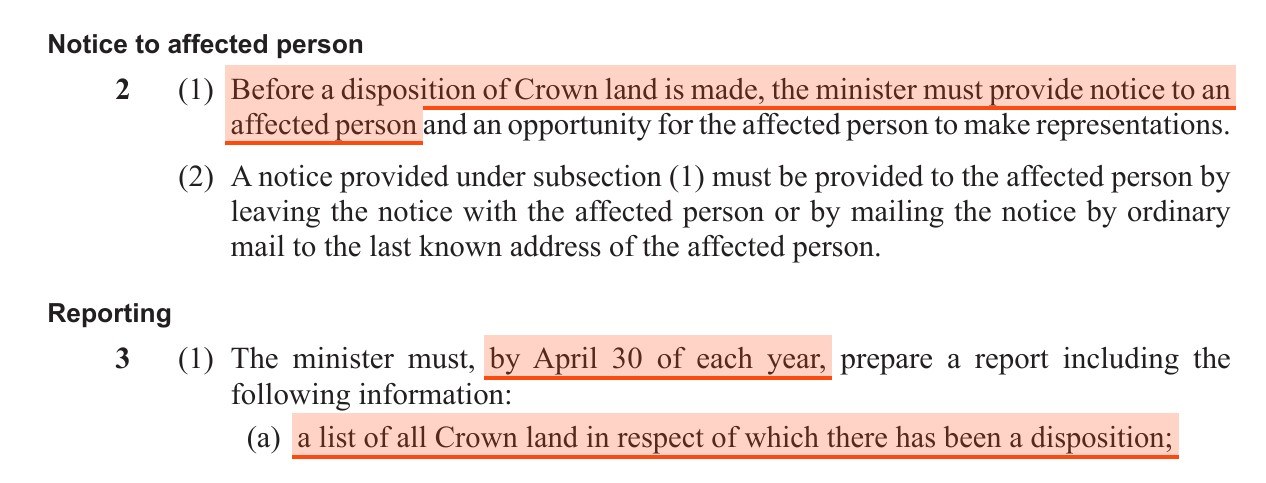
Notice before the land changes hands, and a yearly list after. The highlights are ours. Tap to enlarge.6
Bill M 247, continuedPage 2, section 3 (1) (b) and (c), and section 3 (2)
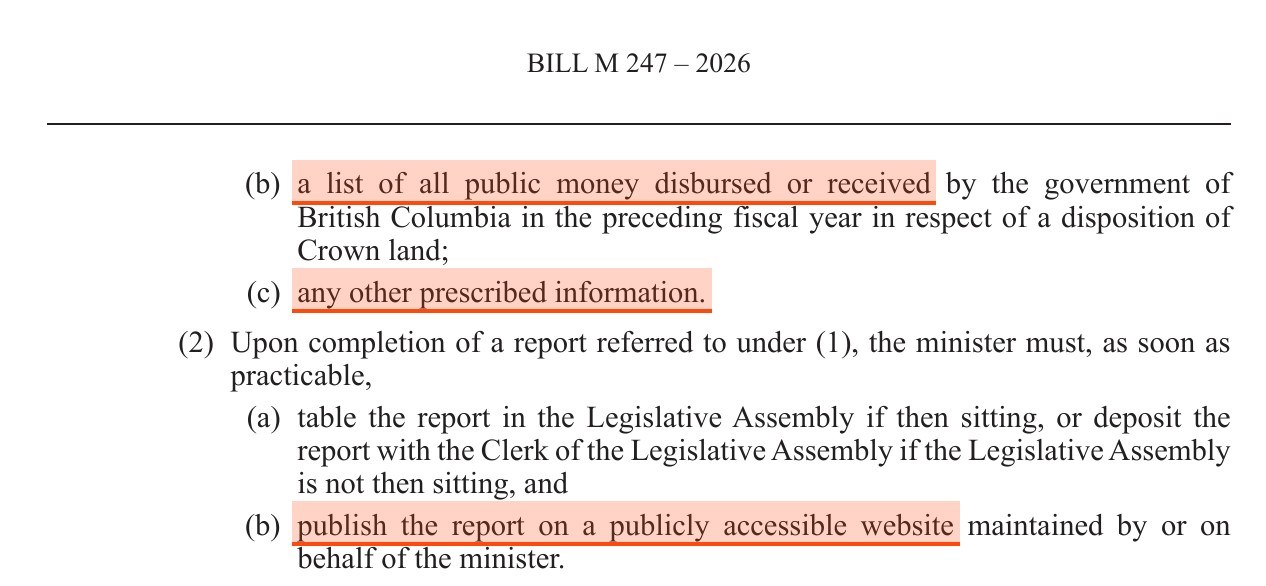
The money, the open-ended item (c), and publication online. The highlights are ours. Tap to enlarge.6
Read together, the two pages describe a public ledger of Crown land: what left the Province’s hands each year, and what was paid or received for it.
02 Doerkson told the Legislature the yearly list would show sale prices and name the new owners. The bill’s text leaves the names to a cabinet regulation.
In the House, Doerkson described the report this way: “The act will require the minister to publicly release each year a full list of Crown land and tenure dispositions from the previous year, including sale prices and the identities of new owners and tenure holders.” “This is a new level of transparency that will apply to all parties, including major corporations and foreign interests.” he added.1
The bill’s text is narrower than the speech. Section 3 requires a list of the land and a list of the money, and the money list would carry the sale prices. It does not say the report must name who received the land or the tenure. The only door to that is item (c), “any other prescribed information,” which means whatever the cabinet later adds by regulation.6
That is a drafting gap, not a hidden one, and a government that wanted the names published could close it with one regulation. But as introduced, the bill would have let a future cabinet publish the ledger without the names Doerkson promised.
03 Under the NDP government, the public sees much less than Doerkson’s bill would have shown. Here are the two, side by side.
Measured against what British Columbians can see today, the bill would have been a real change. The Province does publish a map of current Crown tenures, and Christine Boyle, the Minister of Indigenous Relations and Reconciliation in 2025, told the Legislature that “The agreements are public.” But no public record we could find adds up, in one place, what land left the Crown in a year and what was paid for it.7,8
 | What the public gets today | |
|---|---|---|
| A public list of Crown land given up | Every disposition, each year, by 30 April, tabled in the Legislature and posted online (s.3). | The Province’s public tenure dataset shows current leases, licences and applications. It leaves out Crown grants, the outright transfers of ownership, and anything expired or completed.7 |
| The money | All public money paid out or received for each disposition in the year (s.3 (1) (b)). | The 2024 shíshálh agreement was announced 166 days after it was signed, in a release with no dollar figure. Christine Boyle, then the minister, said “These land transfer agreements don’t typically include the assessed value of the land.”8,9 |
| Warning before the land changes hands | Notice to each affected person, and a chance to make representations, before any disposition (s.2). | The Ministry of Forests plan for “approximately 400 parcels” was shown to forest companies only under non-disclosure agreements, Northern Beat reported.10 |
| Who reviews the system | A special committee of MLAs, reporting within a year, and asked to consider an oversight authority and a compensation fund (s.4). | Asked whether the public can see the criteria behind land deals, Boyle answered: “The simple answer is that no.” Negotiation mandates are confidential.8 |
| Public access after a transfer | Not addressed. | The Province’s June 2026 land-transfer Q&A: “After transfer, the land is no longer public.”10 |
The bill’s column is from its text; the other column is from the Province’s own records, Hansard and our earlier reporting.6
The last row matters most to the people who use the backcountry, and it is the one row the bill leaves blank.
04 Doerkson’s bill would have told hunters, anglers and riders about the 400 parcels only after each was transferred. By then, the Province says, “the land is no longer public.”
The leaked Ministry of Forests documents count “approximately 400 parcels” of Crown land committed for transfer under treaties and reconciliation agreements. Across 40 pages they never mention public access.10
Bill M 247 reports dispositions, and a parcel is disposed of when it is transferred, not when it is promised. So the 400 parcels would have reached the public list one by one, in the April after each transfer, with the money that went with it. The people who hold tenures or licences on each parcel would have had notice and a chance to object first. A hunter or a snowmobile club might count as affected too, since the definition reaches people affected “monetarily or otherwise,” but the bill leaves the details of notice to regulation.6
What the bill would not have done is put the plan itself, or the list of parcels, in front of the public before the deals were signed. A list that arrives a year after the land has changed hands tells you what happened. It does not give you a say in it.
For the backcountry, that timing is everything. The Province’s own June 2026 Q&A on land transfers in the northeast asks, “Can the public still access the lands after transfer?” Its answer begins: “After transfer, the land is no longer public.” Public roads and recreation trails are kept open, it says, “by excluding the roads or trails, or by providing road permits, statutory right of ways, or easements,” and “Some roads built for resource activities, such as logging, may be closed once their purpose is complete.”5,10 Under Bill M 247, a hunter would learn from the April report that the valley he hunts was transferred the year before. Whether the road in was excluded, permitted or closed would not be on the list.
05 Doerkson’s bill does not guarantee public access, and it does not ask the public. Its notice goes only to people directly affected, by hand or by mail.
The same applies to tenures that close roads or put up gates. A lease or licence is a disposition under the bill, so it would appear on the yearly list, and the definition of an affected person is wide enough to reach a rider who loses the road in. But the bill does not say so, and it leaves the content of notices to cabinet.6
The bill’s seven sections do not mention public access, roads, trails or recreation. Its notice is personal: the minister leaves it with each affected person or sends it “by mailing the notice by ordinary mail to the last known address of the affected person.” Nothing in it requires a public posting or a public comment period before a disposition.6
Its committee would study and recommend; it would not create the oversight authority or the compensation fund itself. Its section 5 switches off the general penalty in B.C.’s Offence Act, so a report filed late, or never, would carry no penalty. That makes it a reporting law, not a protection for the land or the people who use it.6
Doerkson’s party makes the access promise separately. The Conservative platform pledges to “guarantee public access to Crown land, beaches and backcountry for all British Columbians in law, subject only to legitimate conservation and safety requirements.”11 That would be a different law, and we looked at what the platform budgets for it in our reading of the Conservative costing.12
06 Doerkson posted that his bill “was passed at first reading.” It went no further, and it died when the Legislature was dissolved on 22 September.
Lorne Doerkson, Cariboo ChilcotinFacebook · pinned · 28 May 2026
Introduced the ‘Crown Land and Financial Transparency Act’ This bill will encourage more transparency around the transfer of crown land, tenures and interests in crown property. It was passed at first reading!
First reading is the step at which a bill is introduced and printed. Hansard records the House approving it without debate, and Doerkson then moved that it be set down for second reading at the next sitting.1
It never got there. The Legislature’s progress record for M 247 shows first reading on 26 May 2026 and nothing after it: no second reading, no committee stage, no third reading.4 On 22 September, Premier David Eby asked the Lieutenant Governor to dissolve the Legislature, and the writs for Saturday’s election were issued the same day.3,13 Dissolution ends every bill still on the order paper. To become law, Bill M 247 would have to be introduced again, from the start, in the new Legislature.
The post was accurate: the bill did pass first reading. But read without that context, “passed” suggests more progress than a first reading gives.
07 The Conservative platform promises more transparency on land but does not name Doerkson’s bill. The NDP offers nothing like it.
Lorne Doerkson’s 71-page platform says, on page 14: “We will bring more transparency to decisions affecting land and investment.” On page 46 it accuses the NDP of conducting “dealings in secret” and promises an Aboriginal Title Transparency Act: “We will publish maps and information about active claims, negotiations, legal actions and agreements affecting public or private land before they become binding.”11
That second promise would publish some land agreements before they bind, which is the stage Bill M 247 does not reach. But the platform does not name the Crown Land and Financial Transparency Act or commit to bringing it back. Whether a Conservative government would reintroduce it, and in what form, is not on the record.11
The BC NDP’s plan makes no commitment to publish Crown land transfers or the money paid in them.14 Its record in government is the right-hand column of the table above, and its minister’s answer to whether the public can see the criteria was “The simple answer is that no.”8
08 In our view, Doerkson’s bill is the right idea, and it should come back stronger. A Conservative government would not need a private member’s bill to pass it.
We think a public ledger of Crown land is overdue. Every year the Province gives up land and tenures that British Columbians use, and the public cannot see in one place what went, to whom, or for how much. Doerkson’s bill would have fixed most of that, and it would have applied to every deal, whoever was on the other side of it.
It should come back with three changes: the names of the new owners and tenure holders written into section 3, as Doerkson promised in the House; publication of each disposition before it is final, the standard his own platform sets for title agreements; and the access terms of every transfer published with it. If Doerkson forms government, he would not need a private member’s bill and a lucky place on the order paper. He could bring it in as a government bill.
Doerkson’s bill would have shown what land the Crown gave up. It should also show who got it, before the deal is signed, and whether you can still get in.
09 Doerkson’s post was still pinned to the top of his Facebook page this week. On Saturday, voters choose the government that could bring his bill back.
The people who use the backcountry have been told about Crown land deals late, under NDAs, or not at all; in our earlier reporting we put it this way: “the people who hunt, fish, ride and camp there are never asked.”5
In May, Doerkson told the House: “This bill ensures that decisions about our shared Crown land are open, accountable and considerate of the people and communities who depend upon it.” It is a good sentence, and on Saturday British Columbians choose the government that would have to make it true.1
Before you vote, ask the candidates in your riding one question: will you commit to publishing every Crown land transfer, with who received it, what was paid and whether the public keeps access, before it is signed? Final Voting Day is scheduled for Saturday, 24 October.13
Share this story
Six images to share, one point on each.


Suggested caption
Conservative MLA Lorne Doerkson tabled a bill he said would show the public every Crown land transfer and who receives it. It died after first reading.
On 26 May, Doerkson, the MLA for Cariboo-Chilcotin and now the Conservatives’ interim leader, introduced Bill M 247, the Crown Land and Financial Transparency Act.
It would have made the minister publish every Crown land disposition each year, with the public money paid or received for it, and given affected people notice first.
It does not guarantee public access, it reports transfers only after they happen, and it leaves the new owners’ names to a cabinet regulation.
It died when the Legislature was dissolved on 22 September. The Conservative platform does not name it, and the NDP offers nothing like it.
In our view it is the right idea, and it should come back stronger. Final Voting Day is scheduled for Saturday, 24 October.
🔗 backcountry.cx/editorials/crown-land-financial-transparency-act/
#BCpoli #BCElection #CrownLand #PublicLand
Sources
- ↩ Hansard, Legislative Assembly of British Columbia, Tuesday, 26 May 2026, morning sitting, Issue No. 184, “Introduction and First Reading of Bills: Bill M247 — Crown Land and Financial Transparency Act,” about 10:30 a.m.: Lorne Doerkson’s remarks, the first-reading motion and his motion to place the bill on the orders of the day for second reading. leg.bc.ca
- ↩ Lorne Doerkson, Facebook page “Lorne Doerkson, Cariboo Chilcotin,” pinned post dated 28 May, with video of his remarks in the Legislature, as shown in a screenshot on file from 23 October 2026 (324 reactions, 62 comments, 51 shares). Facebook shows no year on posts from the current year, and the bill was introduced on 26 May 2026.
- ↩ The Canadian Press, “B.C. opposition forces unite as Eby calls Oct. 24 snap election, citing Trump threat,” 22 September 2026, via CFJC Today: Premier David Eby went to Government House to ask the Lieutenant Governor to dissolve the legislature; “interim Conservative leader Lorne Doerkson.” cfjctoday.com
- ↩ BC Laws, “Progress of Bills with Hansard Debates, 2nd Session, 43rd Parliament (2026): Members’ Bills,” read 23 October 2026: M 247 shows first reading on 26 May 2026 and no later stage. bclaws.gov.bc.ca
- ↩ Backcountry Coalition, “Are Carney and Eby washing B.C.’s Crown land of a 155-year-old legal debt?” 20 October 2026: provincial Crown land as 94 per cent of B.C., and the Province’s June 2026 land-transfer Q&A on what happens to public access after a transfer, each with its own sources. backcountry.cx
- ↩ Legislative Assembly of British Columbia, Bill M 247, Crown Land and Financial Transparency Act, member’s bill, Second Session, Forty-third Parliament, 2026, first reading, Lorne Doerkson. Explanatory note and sections 1 to 7; the excerpts shown are from section 2, section 3 (1) (a) on the first page of the bill, and section 3 (1) (b) and (c) and (2) on the second. bclaws.gov.bc.ca (PDF)
- ↩ Province of British Columbia, BC Data Catalogue, “TANTALIS – Crown Tenures,” dataset description, read 23 October 2026: current Land Act tenures and applications; “Conveyances of ownership are not included,” Crown grants are not included, and expired or completed records are not included. catalogue.data.gov.bc.ca
- ↩ Hansard, Legislative Assembly of British Columbia, Wednesday, 30 April 2025, afternoon sitting, Issue No. 51, estimates of the Ministry of Indigenous Relations and Reconciliation: Minister Christine Boyle and Scott McInnis. lims.leg.bc.ca We set out the exchange in full in our piece on Christine Boyle.
- ↩ Backcountry Coalition, “In 2024 NDP ministers Murray Rankin and Nathan Cullen also signed Eby’s $104-million land deal with the shíshálh Nation,” 16 October 2026: the agreement dated 16 August 2024, its redacted land maps, and its announcement on 29 January 2025. backcountry.cx
- ↩ Backcountry Coalition, “Leaked: Eby’s government plans to transfer about 400 parcels of Crown land to First Nations,” 16 October 2026: the Ministry of Forests documents published by Northern Beat on 15 October, Rob Shaw’s report that forest companies saw them only under non-disclosure agreements, the Province’s June 2026 land-transfer Q&A, and the 2024 shíshálh timeline, each with its own sources. backcountry.cx
- ↩ Conservative Party of BC, “Lorne Doerkson’s Plan for a Stronger BC | 2026,” 71 pages, posted 18 October 2026: p.14 (“more transparency to decisions affecting land and investment”) and p.46 (the Aboriginal Title Transparency Act and public access to Crown land in law). The plan does not name Bill M 247. conservativebc.ca (PDF)
- ↩ Backcountry Coalition, “Doerkson’s plan would write backcountry access into law. But it has no budget line for the roads and trails that get you there,” 19 October 2026. backcountry.cx
- ↩ Province of British Columbia, Order in Council 410/2026, approved 22 September 2026: writs issued 22 September 2026 and Final Voting Day on Saturday, 24 October 2026; Elections BC’s Where to Vote application. bclaws.gov.bc.ca (PDF) · wheretovote.elections.bc.ca
- ↩ BC NDP, “Build BC Strong” plan page, read 18 October 2026: it makes no commitment to publish Crown land transfers or the money paid in them. bcndp.ca/plan
Sources were read on 23 October 2026. Words are quoted exactly as published; the highlights are ours. The bill excerpts are cropped from the first-reading PDF on BC Laws. Photo of Lorne Doerkson in the chamber: a still from the Legislative Assembly of B.C.’s Hansard video of the 26 May 2026 sitting, cropped. Small head-shot icons: Lorne Doerkson by RoyalObserver via Wikimedia Commons, CC BY-SA 4.0, cropped.