

Valhalla Range, West Kootenay · Photo: Murray Foubister, CC BY-SA 2.0
EDITORIAL · CROWN LAND · TITLE, TREATIES AND THE PUBLIC
Are Carney and Eby washing B.C.’s Crown land of a 155‑year‑old legal debt? The public that uses it gets no seat at the table.
Since 1871, B.C. and Ottawa have held land that the courts now say was never theirs alone. Prime Minister Mark Carney’s and Premier David Eby’s governments are settling that debt with the land itself: through treaties, transfers to Nation-owned companies, and public money for a charity’s land deals. Is that washing the land? The record shows the Crown shedding liability with land it books at a dollar, and the people who hunt, fish, ride and camp there are never asked.
Ninety-four per cent of British Columbia is provincial Crown land.1 A leaked Ministry of Forests backgrounder counts “approximately 400 parcels committed for transfer”.2 Public money helps a charity buy land and set its own entry rules.34 In Cowichan, a judge found Aboriginal title under land the Crown had already granted to others.5
Premier David Eby says paying forest companies less for transferred land “does help reduce pressure on the provincial budget”.6 Prime Minister Mark Carney’s government is appealing Cowichan while it funds B.C.’s push to protect 30% of its land by 2030.789
So are they washing the land? For 155 years, both governments have held land the courts now say was never theirs alone. The record below shows them settling that debt with the land itself and shedding liability as they go. The people who use the land have no seat at the table.
The question · five steps · evidence: the record
Is the land being washed? Follow the liability out, the hectares counted, and the public losing the gate.
- 01
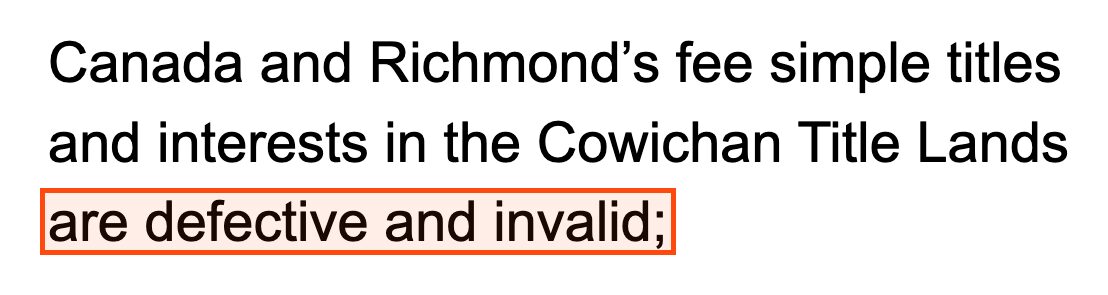
The courts keep finding title under land the Crown thought it owned.5
Cowichan Tribes v. Canada · 2025 BCSC 1490
- 02
The land is worth a dollar. The liability has no number.10
B.C. Public Accounts 2025/26 · p. 51
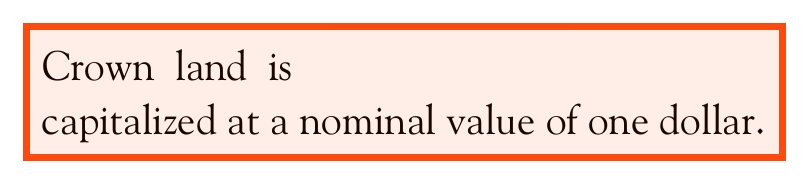
B.C. Public Accounts 2025/26 · p. 83

- 03
Crown land buys the Province a release from liability.11
Cheslatta land transfer · 2023 · Schedule 3

- 04
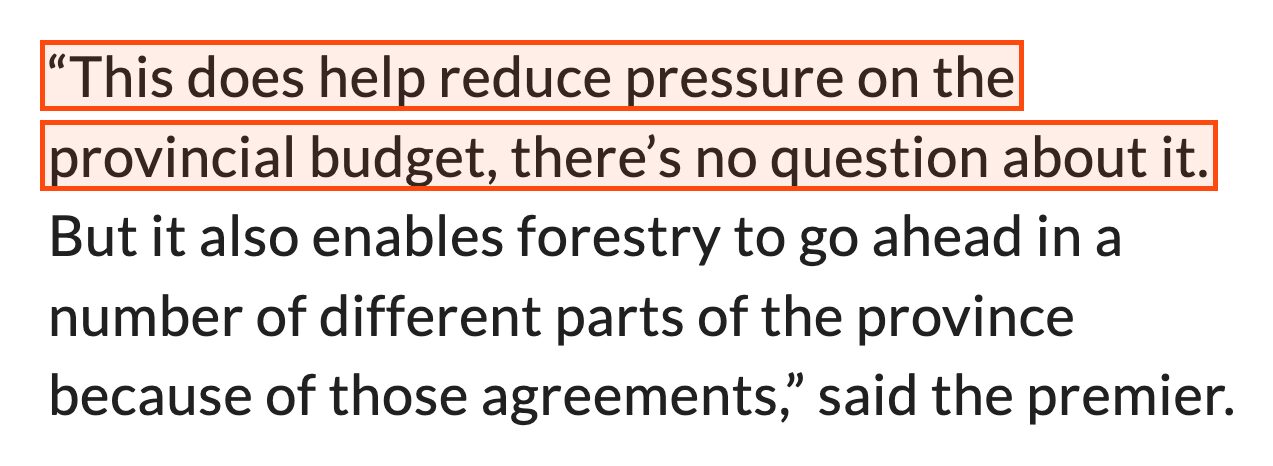
Premier David Eby says the plan eases the provincial budget.6
Daily Hive · 15 Oct 2026
- 05
After a transfer, the public needs permission to get in.12
B.C. land transfer Q&A · June 2026 · p. 12

No seat at the table.


01 The Crown promised in 1763 to buy Indigenous land before settling it, and in B.C. it almost never did
The record
- The Royal Proclamation of 7 October 1763 lets only the Crown buy Indigenous land, and only at a public meeting.13
- Governor James Douglas signed 14 treaties between 1850 and 1854, covering about 927 square kilometres of Vancouver Island.14
- The payments recorded run from £27 10s to £86 per conveyance.14
- Apart from Treaty 8, signed in 1899, B.C. has no other historic treaties.1415


In 1867, Joseph Trutch, the colony’s Chief Commissioner of Lands and Works, explained why the treaty-making stopped.16
“The Indians have really no right to the lands they claim.”
Joseph Trutch, Chief Commissioner of Lands and Works · 28 August 1867
02 When B.C. joined Canada in 1871, the Province kept the land and Ottawa took charge of the people, and that split still decides who pays
The record
- Article 13 of the Terms of Union, in force from 20 July 1871, gave Ottawa “the charge of the Indians” and their reserves.17
- Section 109 of the Constitution Act, 1867 left public land with the Province, subject to “any Interest other than that of the Province”.18
- The McKenna-McBride Commission reported on 30 June 1916. Its reserve cut-offs were confirmed in 1923 and 1924, and settled by an Act only in 1984.19
- From 1927 to 1951, the Indian Act barred raising money for a land claim without Ottawa’s permission, according to historians.20

The split still decides who pays. B.C. owns the land and carries the title risk, while Canada writes most of the cheques when claims are settled.1810
03 Since 1973 the courts have told both governments the debt is real, and in 2014 they told them how to avoid paying for it in court
The record
- In Calder, on 31 January 1973, six of seven Supreme Court judges recognized Indigenous title, though the appeal failed 4 to 3.21
- In Delgamuukw, on 11 December 1997, the Court held that title is “a right to the land itself”, transferable only to the Crown.22
- In Haida, on 18 November 2004, it held that the Crown must consult before title is proven.23
- In Tsilhqot’in, on 26 June 2014, it declared Aboriginal title for the first time, 41 years after Calder.2421
Paragraph 92 of Tsilhqot’in set out the risk to the Crown, and paragraph 97 set out the way around it.24


Exhibit · the timeline
Two hundred and sixty years, in four stages: a promise, a split, a reckoning and a settlement.
- 7 Oct 1763The Royal Proclamation said Indigenous land can be acquired only by the Crown, by purchase, at a public meeting.13
- 1850–1854James Douglas signed 14 treaties on Vancouver Island, paid in sums stated in pounds sterling. With Treaty 8, they are the only historic treaties in B.C.14
- 28 Aug 1867Joseph Trutch, the colony’s land commissioner, wrote that “The Indians have really no right to the lands they claim”.16
- 20 Jul 1871B.C. joined Canada. The Province kept its public land, and Ottawa took “charge of the Indians” and their reserves.1718
- 12 Apr 1876The Indian Act put legal title to every reserve in the Crown.25
- 21 Jun 1899Treaty 8 was signed. It reached B.C.’s northeast through the 1900 adhesion at Fort St. John.15
- 1912–1924The McKenna-McBride Commission adjusted reserves, and orders in council confirmed the “cut-offs” of reserve land.19
- 1927–1951The Indian Act barred raising money to pursue a land claim without Ottawa’s permission, according to historians.20
- 31 Jan 1973In Calder, six Supreme Court judges recognized Indigenous title as a legal right.21
- 17 Apr 1982Section 35 of the Constitution recognized and affirmed existing Aboriginal and treaty rights.18
- 1992Canada, B.C. and the First Nations Summit set up the BC Treaty Commission.26
- 11 Dec 1997Delgamuukw ruled that title is “a right to the land itself”.22
- 11 May 2000The Nisg̱a’a Final Agreement took effect as a “full and final settlement”.27
- 18 Nov 2004In Haida, the Crown must consult before title is proven.23
- 26 Jun 2014In Tsilhqot’in, the Supreme Court declared title for the first time and told governments that consent avoids the charge of infringement.24
- 28 Nov 2019DRIPA became law. Section 7 lets cabinet share decisions with Indigenous governing bodies.28
- 2024The Haida title agreement and Act recognized title across Haida Gwaii, with fee simple land continuing.29
- 7 Aug 2025In Cowichan, a judge found title under land the Crown had already granted in fee simple. Canada, B.C. and others appealed.57
- Apr 2026Eby dropped his plan to amend, then suspend, DRIPA.30
- Sep 2026A confidential Forests backgrounder counts about 400 parcels committed for transfer.2
- 24 Oct 2026The B.C. general election is scheduled for this date.31
04 Treaties were meant to settle the debt, but 34 years after B.C.’s treaty process began, only eight Nations have a modern treaty in force
The record
- Canada, B.C. and the First Nations Summit set up the BC Treaty Commission in 1992.26
- Eight Nations have a modern treaty in force: Nisg̱a’a (2000), Tsawwassen (2009), the five Maa-nulth Nations (2011) and Tla’amin (2016).2627
- The Nisg̱a’a treaty transfers about 1,992 square kilometres in fee simple, minerals included.27
- In 2019, Ottawa committed $1.4 billion to forgive or repay the loans Nations took out to negotiate.32

05 DRIPA moved the hard decisions into cabinet agreements, and Eby’s own attempt to rewrite the law collapsed in April
The record
- DRIPA, the Declaration on the Rights of Indigenous Peoples Act, became law on 28 November 2019.28
- Four section 7 agreements are listed, signed between June 2022 and July 2026. None of them transfers land.33
- Nathan Cullen, then Minister of Water, Land and Resource Stewardship, withdrew the proposed Land Act amendments on 21 February 2024.34
- In Gitxaala, the B.C. Court of Appeal ruled on 5 December 2025, and the Supreme Court of Canada granted leave on 21 May 2026. No hearing date is set.35

After Gitxaala, Eby said “clearly amendments are needed”. By April 2026 he had dropped plans to amend the Act and then to suspend it.3630 The 2024 Haida agreement recognized title across Haida Gwaii and never mentions public access.29 Ottawa called it proof of “the effectiveness of negotiation rather than litigation”.37
06 In Cowichan, a judge found title under land the Crown had already granted away, and Carney and Eby are both appealing
The record
- The Cowichan claim covered about 1,846 acres at Tl’uqtinus in Richmond. Madam Justice Young of the B.C. Supreme Court found title over part of it on 7 August 2025.5
- She suspended her declaration of invalidity for 18 months.5
- Canada appealed four of the six findings on 8 September 2025.7
- As of 15 October 2026, no Court of Appeal hearing date had been found.38

Attorney General Niki Sharma said B.C. would appeal and seek a stay, citing “significant unintended consequences for fee simple private property rights”.39 In March 2026, Spencer Chandra Herbert, Minister of Indigenous Relations and Reconciliation, and the Cowichan chiefs said neither side seeks to invalidate private title.40 Both governments backed a landowner, Montrose Properties, in a failed bid to reopen the trial.4138

07 On the Province’s books the land is worth one dollar and the title liability has no number, which makes land the cheapest way to pay
The record
- B.C.’s statements carry Crown land “at a nominal value of one dollar”.10
- Its Public Accounts list 20 treaty-table land commitments, which add up to about 135,425 hectares by our count.10
- Canada carries $27,781 million for 828 specific claims and $10,348 million for 103 comprehensive land claims, $38.1 billion in all.43
- Canada’s Parliamentary Budget Officer says the growth comes mainly from “revaluations of existing claims”.44


Canada pays the cash in most treaties, and B.C. supplies land it values at a dollar.1012 In our view, that is the engine behind the transfers.
08 Eby says a leaked plan to pay forest companies less for transferred land “does help reduce pressure on the provincial budget”
The record
- The backgrounder counts about 400 parcels committed for transfer. No list has been published.2
- Today the Forest Act pays licence holders in full for land transferred to a First Nation, but nothing on the first 5% of cut lost to roads or parks.45
- In 2003, the Province took back 20% of major licensees’ cutting rights, 8.3 million cubic metres, with a fund of up to $200 million.46
- Weyerhaeuser received C$32.1 million for 1.2 million cubic metres of cut and 8,000 hectares of licences.47

“This does help reduce pressure on the provincial budget, there’s no question about it.”
Premier David Eby, on the leaked Forests plan · 15 October 2026, as reported by Daily Hive
A bill is scheduled for the spring 2027 session, if the next government proceeds.2 We found no public consultation on what the transfers mean for the roads and trails across the parcels.48
09 In the Cheslatta transfer, Crown land bought the Province and Rio Tinto a release from liability
The record
- The Cheslatta Group 1 transfer took effect on 28 August 2023 and covers seven areas of about 1,345 hectares.11
- The shíshálh transfer of 4 October 2018 conveyed three parcels of about 686 hectares.49
- B.C.’s June 2026 Q&A on its northeast transfers says: “After transfer, the land is no longer public.”12

In the shíshálh deal, the Nation’s company took on environmental liabilities and released the Province, and the agreement expects the land may later be sold.49 The agreements show liability leaving the Crown with the land.

10 Federal 30 by 30 money helps a charity buy land where the charity, not the public, decides who gets in
The record
- Under the 2023 nature agreement, Canada committed up to $500 million and B.C. committed $563 million.89
- Federal funding counted toward it reached $279,322,555 by March 2025, including $126,488,668 for environmental groups and non-profits.9
- The Ministry of Water, Land and Resource Stewardship paid the Nature Conservancy of Canada $15,000,000 in 2023/24 and $8,500,000 in 2025/26.3
- Ottawa added $27 million for the charity’s 45,000-hectare Kootenay Forest Lands.50

Here, public money changes hands rather than Crown land. On land a charity owns, the charity decides who gets in. Darkwoods, about 63,000 hectares, is permit-only, and snowmobiles are banned.4 A gifted property carries a 50% tax if sold without Ottawa’s consent, but land a charity buys outright carries no such bar.51 NCC sold $519,000 of conservation property in 2024.52 Carney’s $3.8-billion nature strategy does not use the words “hunting” or “recreation”.53
11 Here are the five places the land and the money go, and at none of them does the public hold the gate
The record
Where it starts
Public land and public money
Provincial Crown land is 94% of B.C. It is open to the public by default and managed under public law by ministers who answer to the Legislature.1
Modern treaty land
Fee simple, owned by the Nation, constitutionally protected
- Who sets access
- The Nation. Land it designates Public Lands must stay reasonably open, including for hunting and fishing.
- Can it be sold later?
- Yes, by the Nation, to anyone. The land stays treaty land.
- The public’s say
- The Legislature ratifies the treaty. After that, the public has no role.
Land transfer or incremental agreement
Fee simple, often held by a Nation-owned company
- Who sets access
- The owner. The Province’s own Q&A says that after transfer “the land is no longer public”.
- Can it be sold later?
- Yes, by the owner. No government buy-back was found. The Crown keeps the minerals.
- The public’s say
- Public engagement at most, and no vote.
Aboriginal title land
Collective title, for example Haida Gwaii
- Who sets access
- Unsettled. The Haida agreement never mentions public access.
- Can it be sold later?
- Only to the Crown.
- The public’s say
- The courts, and the Legislature where an Act is passed.
Charity land
Mostly private land, bought by a registered charity such as the Nature Conservancy of Canada with public and donor money
- Who sets access
- The charity, property by property. Darkwoods needs a permit, and sleds are banned.
- Can it be sold later?
- Yes, by the charity, with limits on gifted and federally funded land.
- The public’s say
- None.
Park or conservancy
Stays Crown land, managed by BC Parks
- Who sets access
- BC Parks, by regulation and permit. Hunting in a conservancy is banned unless it is listed.
- Can it be sold later?
- Not sold. Cabinet can shrink or cancel one created by order alone.
- The public’s say
- Cabinet or the Legislature, with comment only on management plans.
At every destination, the people who hunt, fish, ride and camp on the land have no seat at the table where these decisions are made.
12 Are they washing the liability off the land so they can sell the rights later? The record shows the washing, but not the resale
The record
The question we tested
Are the governments washing their liabilities off the land, and moving it to private hands so they can sell off the rights later?
The Crown is settling its debt with land. The Nisg̱a’a treaty calls itself the “full and final settlement” of title. Canada pays the cash in treaties, the Province says, and B.C. supplies the land.271012
The land costs the Province a dollar on its books, while the claims have no number.10
Specific liabilities leave with the land. In the Cheslatta transfer, the Nation released B.C. and Rio Tinto from liability, and in the shíshálh transfer, the Nation and its company took on environmental liabilities.1149
Money is part of the reason. Eby says paying forest companies less for transferred land “does help reduce pressure on the provincial budget”.6
DRIPA moves no land. Its section 7 agreements share decisions and transfer nothing.33
No agreement we read lets B.C. or Canada sell the rights later. None gives either government a buy-back, a reversion or a share of a later sale. The Crown keeps minerals and water on transferred land rather than selling them.491155
Most destinations are harder to sell than Crown land was. Title land can go only to the Crown, reserves only by surrender, and gifted conservation land carries a 50% tax on sale.225451

In our view, the governments are washing the land: they shed a debt and its risk by handing over land that costs them nothing on their books. We found no evidence of a plan to sell the rights back later. Once land leaves the Crown, access and any future sale belong to the new owner, with no public process.12274
13 Mark Carney’s government is spending on major projects and nature while it fights Cowichan, and we found no promise on public access
The record
- Carney was sworn in as Prime Minister on 14 March 2025.58
- The Building Canada Act received Royal Assent on 26 June 2025. No project had been designated under it by 21 September 2026.59
- Budget 2025 confirmed the Indigenous Loan Guarantee Program at $10 billion.60
- The nature strategy of 31 March 2026 promises $3.8 billion of new money.53

The Nature Accountability Act, the previous government’s bill on Canada’s 2030 nature targets, died in January 2025 and has not been reintroduced.61 We found nothing from Ottawa on the public’s right to use the Crown land in between.4253
14 Carney, Eby and six of their ministers own these decisions, and here is what each has said on the record
The record

Mark Carney
Prime Minister of Canada
On the record
“This government fundamentally disagrees” with Cowichan.
Canada appealed four of the six findings.7
Neither his nature strategy page nor his launch speech mentions hunting.53
Photo: The White House, public domain


David Eby
Premier of B.C. · BC NDP leader
On the record
The leaked plan “does help reduce pressure on the provincial budget”.
He dropped his plans to amend, then suspend, DRIPA in April.30
He faces voters in the election scheduled for 24 October.31
Photo: Province of British Columbia

Rebecca Alty
Minister of Crown-Indigenous Relations
On the record
Her department’s note: Canada appealed because “further legal clarity is needed”.
Photo: Office of the Prime Minister

Julie Dabrusin
Minister of Environment, Climate Change and Nature
On the record
Her department runs the nature funds behind Ottawa’s B.C. pledge.
Photo: Lukasz Kobus / European Commission, CC BY 4.0

Niki Sharma
Attorney General of B.C.
On the record
“We disagree strongly with the decision.”
She is appealing Cowichan and seeking a stay.39
Photo: Province of British Columbia

Spencer Chandra Herbert
Minister of Indigenous Relations and Reconciliation
On the record
Neither side seeks to invalidate private title, he and the Cowichan chiefs said.
Photo: Province of British Columbia

Ravi Parmar
Minister of Forests
On the record
His ministry wrote the leaked compensation plan.
Photo: Province of British Columbia


15 Both governments should answer these questions before more Crown land changes hands
The record

For Premier David Eby and the B.C. government
- Which of the roughly 400 parcels are being transferred, under which agreements, and what public access will each keep?
- How much does the Province expect to save by paying forest companies less, and who bears the cost instead?
- Will every land transfer carry the public-access designation that modern treaties already use?
- What did the $15 million paid to the Nature Conservancy of Canada in 2023/24 buy, and who sets access on it?
For Prime Minister Mark Carney and the federal government
- You have promised to protect private property in Cowichan. Will you promise the same for public access to Crown land?
- How much 30 by 30 money has gone to land held by charities, and does any of it require public access?
- Will Ottawa attach a public-access condition to the federal money behind B.C.’s nature agreement?
16 Before 24 October, ask your candidates to give the public a seat at the table
The record

What can change is how governments make these decisions. Today a minister, a cabinet order or a charity’s board decides what happens to land the public has used for generations. In the case of the 400 parcels, the public heard about it from a leak.2
Three commitments to ask for
- Publish the list. Before any transfer, publish each parcel, its agreement and the public access it will keep.
- Write access in. Carry the modern treaties’ public-access designation, and Crown corridors for roads and trails, into every transfer and every publicly funded land purchase.
- Give the public a seat. Open the Forest Act change and every large transfer to public comment before it is decided, alongside consultation with First Nations.
Governments are settling a 155-year-old debt with the backcountry. The people who use it deserve a seat at the table.
Share this story
Six images to share, each built on one document.


Suggested caption
Prime Minister Mark Carney’s and Premier David Eby’s governments are settling a 155-year-old legal debt with B.C.’s Crown land, and the people who use that land have no seat at the table.
A leaked Ministry of Forests backgrounder counts about 400 parcels of Crown land committed for transfer. No list of them has been published.
On the Province’s books, Crown land is worth one dollar. Eby says a leaked plan to pay forest companies less for transferred land “does help reduce pressure on the provincial budget.”
In the Cheslatta transfer, Crown land bought the Province and Rio Tinto a release from liability. Canada pays the cash in most treaties, and B.C. supplies land it values at a dollar. In our view, that is the engine behind the transfers.
If you hunt, fish, ride or camp on Crown land, ask your candidates before 24 October to publish every parcel, write public access in, and give the public a seat at the table.
🔗 backcountry.cx/editorials/carney-eby-washing-the-land/
#BCpoli #BCElection #CrownLand #PublicAccess
Sources
- ↩ Province of British Columbia, Natural Resource Use: “B.C. is comprised of 94% provincial Crown land, 1% federal Crown land and 5% private land.” gov.bc.ca
- ↩ Ministry of Forests, “Backgrounder and Informational Materials: Forest Compensation Framework”, watermarked confidential, page 1: “approximately 400 parcels committed for transfer through Treaty and reconciliation agreements”, and “Given ongoing fiscal constraints, these provisions create substantial barriers to completing land returns.” Published by Northern Beat (Rob Shaw, 15 October 2026) on Google Drive. drive.google.com (PDF) · northernbeat.ca
- ↩ Province of British Columbia, Public Accounts, CRF Detailed Schedules of Payments, Government Transfers, The Nature Conservancy of Canada: $15,000,000 from Water, Land and Resource Stewardship in 2023/24, and $7,000,000 and $1,500,000 in 2025/26; the schedules do not say what the payments were for. 2023/24 (PDF) · 2025/26 (PDF)
- ↩ Nature Conservancy of Canada, Darkwoods Conservation Area, read 15 October 2026: day use from July through September; “Permits are required for entry”; off-road vehicles and snowmobiles prohibited. And NCC’s land-use page: “Our lands are privately-owned and managed for conservation.” natureconservancy.ca
- ↩ Cowichan Tribes v. Canada (Attorney General), 2025 BCSC 1490, Madam Justice Young, 7 August 2025, corrected judgment of 19 March 2026: a claim area of “approximately 1,846 acres”; a declaration of Aboriginal title over the Cowichan Title Lands in Richmond; “Canada and Richmond’s fee simple titles and interests in the Cowichan Title Lands are defective and invalid”, with an exception for airport fuel-delivery lands; and a duty on British Columbia to negotiate in good faith over privately held fee simple; “I suspend this declaration for 18 months” (para. 3638). bccourts.ca
- ↩ Kenneth Chan, Daily Hive, on the leaked Forests documents and Premier David Eby’s response, 15 October 2026: “This does help reduce pressure on the provincial budget, there’s no question about it. But it also enables forestry to go ahead in a number of different parts of the province because of those agreements.” dailyhive.com
- ↩ Crown-Indigenous Relations and Northern Affairs Canada, Question Period note CIR-2025-QP-2902 (Canada appealed four of the six findings on 8 September 2025) and CIR-2025-QP-2908, received 21 November 2025 (Canada appealed because “further legal clarity is needed”, and a proposed class action on behalf of title owners). QP-2902 · QP-2908
- ↩ Canada, British Columbia and the First Nations Leadership Council, Tripartite Framework Agreement on Nature Conservation, signed 3 November 2023: s. 6.4.1 (“at least 30% of B.C.’s land base by 2030”), s. 8.3 (to “help mitigate the need for regulatory orders under federal legislation”) and s. 11.1 (“Canada will contribute up to $500 million”, to be matched). A text search finds no mention of public access, recreation or hunting. gov.bc.ca
- ↩ Province of British Columbia, Tripartite Framework Agreement on Nature Conservation, Annual Report 2024/25: federal funding counted toward the agreement from April 2021 to March 2025 of $279,322,555, of which $126,488,668 went to environmental groups and non-profits; and the First Annual Report, page 18: B.C.’s commitment of $563,000,000, with $371,000,000 spent in 2023/24, including $150 million to the BC Parks Foundation’s Conservation Financing Mechanism. 2024/25 report (PDF) · gov.bc.ca
- ↩ Province of British Columbia, Public Accounts 2025/26: Note 1, page 51 (“Crown land is capitalized at a nominal value of one dollar”); and Note 28, pages 82 and 83: 20 Crown land commitments at treaty tables, listed by First Nation and hectares; claims for “declarations with respect to Aboriginal rights and title” and “damages for unjustified infringements” (“The amount of any provincial liability is not determinable at this time”), the Crown land committed at treaty tables, and “It is expected the capital transfer components for all treaty agreements will be, in most cases, entirely provided by Canada”. gov.bc.ca (PDF)
- ↩ Cheslatta Carrier Nation, “Footprints Back on Our Land” Group 1 Land Transfer Agreement, effective 28 August 2023: seven areas totalling about 1,345 hectares in fee simple; Schedule 3, Release and Indemnity, page 73, recital E: Cheslatta and its designated company “have agreed to indemnify British Columbia and RTA and to release British Columbia and RTA from liability”; the definitions cover the Nechako Reservoir, including “any actual or potential adverse impacts on Cheslatta’s asserted or determined aboriginal rights, including aboriginal title”. RTA is Rio Tinto Alcan. gov.bc.ca (PDF)
- ↩ Ministry of Indigenous Relations and Reconciliation, Treaty Land Entitlement and Site C Agreement Land Transfers in Northeast B.C., Part 2: Questions & Answers, updated June 2026: the agreements “correct longstanding injustices and support reconciliation” (page 4); “the federal government is providing funding to First Nations … while the Province transfers the land” (page 8); and “After transfer, the land is no longer public” (page 12). engage.gov.bc.ca (PDF)
- ↩ Royal Proclamation, 7 October 1763: unceded lands are “reserved to them”, and if the Indigenous owners wish to sell, the land “shall be Purchased only for Us, in our Name, at some public Meeting or Assembly”. Text as transcribed by solon.org; no official government copy was used. solon.org
- ↩ Crown-Indigenous Relations and Northern Affairs Canada, Treaty Texts: Douglas Treaties, reproducing the 1850–1854 conveyances from Papers Connected with the Indian Land Question (1875): fourteen conveyances, with payments stated in pounds sterling, and the common clause that “our village sites and enclosed fields are to be kept for our own use”, that the land “becomes the entire property of the white people for ever”, and that the signatories may hunt and “carry on our fisheries as formerly”. Payments run from £27 10s to £86 per conveyance. And the Legislative Assembly of B.C., “1850 – Douglas Treaties”: 14 treaties that “cover approximately 927 square kilometers”; the Douglas Treaties and Treaty 8 “are the only historic treaties in British Columbia”. rcaanc-cirnac.gc.ca · leg.bc.ca
- ↩ Crown-Indigenous Relations and Northern Affairs Canada, Treaty No. 8 (21 June 1899) and its adhesions, including the Beaver at Fort St. John on 30 May 1900. rcaanc-cirnac.gc.ca
- ↩ Papers Connected with the Indian Land Question, 1850–1875 (Victoria, 1875), letter of Joseph Trutch, Chief Commissioner of Lands and Works, 28 August 1867: “The Indians have really no right to the lands they claim”. Read in the Internet Archive’s text of the printed volume. archive.org
- ↩ British Columbia Terms of Union, Order in Council of 16 May 1871, in force 20 July 1871, Article 13: “The charge of the Indians, and the trusteeship and management of the lands reserved for their use and benefit, shall be assumed by the Dominion Government”. justice.gc.ca
- ↩ Constitution Act, 1867, s. 91(24) (federal authority over “Indians, and Lands reserved for the Indians”) and s. 109 (lands belong to the provinces, “subject to any Trusts existing in respect thereof, and to any Interest other than that of the Province”); and Constitution Act, 1982, s. 35(1): “The existing aboriginal and treaty rights of the aboriginal peoples of Canada are hereby recognized and affirmed.” laws-lois.justice.gc.ca
- ↩ British Columbia Indian Cut-off Lands Settlement Act, S.C. 1984, c. 2: the McKenna-McBride Agreement of 24 September 1912, the Royal Commission report of 30 June 1916, and their confirmation by B.C. Order in Council 911 (26 July 1923) and federal Order in Council 1265 (19 July 1924); “cut-off lands” are reserve lands that ceased to be set aside under those instruments. laws-lois.justice.gc.ca
- ↩ The Conversation, “How the Indian Act’s blackout period denied Indigenous peoples their legal rights”, October 2022: section 141, added in 1927 and repealed in 1951, barred raising money to pursue a claim without the department’s permission. Secondary source; the 1927 statute text was not found on an official site. theconversation.com
- ↩ Calder et al. v. Attorney-General of British Columbia, [1973] SCR 313, 31 January 1973: appeal dismissed 4 to 3; six judges recognized Indian title as a legal right and split three to three on whether it had been extinguished; Pigeon J. decided on a procedural point. decisions.scc-csc.ca
- ↩ Delgamuukw v. British Columbia, [1997] 3 SCR 1010, 11 December 1997: Aboriginal title “is a right to the land itself” (para. 138), and it cannot be transferred, sold or surrendered “to anyone other than the Crown” (para. 113). decisions.scc-csc.ca
- ↩ Haida Nation v. British Columbia (Minister of Forests), 2004 SCC 73, 18 November 2004: the duty to consult arises when the Crown has “knowledge, real or constructive” of a potential right (para. 35); it gives no veto (para. 48); and “The honour of the Crown cannot be delegated” to third parties (para. 53). decisions.scc-csc.ca
- ↩ Tsilhqot’in Nation v. British Columbia, 2014 SCC 44, 26 June 2014: title confers “the right to decide how the land will be used” (para. 73); without consent, government must justify an incursion under s. 35 (para. 76); a project begun without consent “may be required to cancel” once title is established “if continuation of the project would be unjustifiably infringing” (para. 92); and governments “can avoid a charge of infringement or failure to adequately consult by obtaining the consent of the interested Aboriginal group” (para. 97). decisions.scc-csc.ca
- ↩ Indian Act, 1876, S.C. 1876, c. 18, s. 3(6): a reserve is land set apart for a band “of which the legal title is in the Crown”. Indigenous Services Canada transcription. sac-isc.gc.ca
- ↩ BC Treaty Commission, About us (the Commission and the six-stage process were established in 1992) and “B.C. K’ómoks Treaty Act Ratified”, 29 May 2026, which lists eight self-governing modern treaty Nations in B.C.; and the Commission’s pages for the Tsawwassen (effective 3 April 2009), Maa-nulth (1 April 2011) and Tla’amin (5 April 2016) treaties. bctreaty.ca · release (PDF)
- ↩ Nisg̱a’a Final Agreement, Chapter 2, para. 22: “This Agreement constitutes the full and final settlement in respect of the aboriginal rights, including aboriginal title”; and Chapter 3, paras. 2 to 5 and 19: about 1,992 km² held in fee simple, which the Nation may sell “to any person” without the consent of Canada or B.C., and which does not cease to be Nisg̱a’a Lands on a change of ownership, with all mineral resources owned by the Nation. In effect 11 May 2000. Chapter 2 · Chapter 3
- ↩ Declaration on the Rights of Indigenous Peoples Act, S.B.C. 2019, c. 44, ss. 1(3), 3 and 7, unamended as of 6 October 2026: a minister may negotiate an agreement for joint decision-making or for the consent of an Indigenous governing body before a statutory decision, effective only once published in the Gazette. bclaws.gov.bc.ca
- ↩ Gaayhllxid • Gíihlagalgang “Rising Tide” Haida Title Lands Agreement, 2024, ss. 4.4 to 4.10 (fee simple continues under provincial jurisdiction), and the Haida Nation Recognition Act, S.B.C. 2023, c. 24, as amended in 2024. The agreement does not use the words “access” or “recreation”. agreement (PDF) · Act
- ↩ The Canadian Press, “Eby called changes to Indigenous law ‘non-negotiable,’ but series of backdowns ensued”, 20 April 2026, via CityNews: the January plan to amend DRIPA, the 2 April switch to a three-year suspension, and its withdrawal on 19 and 20 April. citynews.ca
- ↩ Elections BC, 2026 Provincial Election: writ day 22 September 2026, advance voting 16 to 21 October 2026, and Final Voting Day scheduled for 24 October 2026. elections.bc.ca
- ↩ Government of Canada, Budget 2019, gender-based analysis, chapter 3: “$1.4 billion over seven years … to forgive all outstanding comprehensive claim negotiation loans and to reimburse Indigenous governments that have already repaid these loans”. budget.canada.ca
- ↩ Province of British Columbia, “Making Decisions Together” (updated 17 July 2026): the section 7 agreements with the Tahltan Central Government (Eskay Creek, 2022; Red Chris, 2023), the ’Namgis First Nation (forestry, December 2025) and the Simpcw First Nation (Yellowhead, July 2026); and “no section 6 agreements have been signed to date”. gov.bc.ca
- ↩ Province of British Columbia, statement by Nathan Cullen, Minister of Water, Land and Resource Stewardship, on the Land Act, 21 February 2024: “our government has decided not to proceed with proposed amendments to the Land Act.” news.gov.bc.ca
- ↩ Gitxaala v. British Columbia (Chief Gold Commissioner), 2025 BCCA 430, 5 December 2025; and Supreme Court of Canada docket 42200: leave granted 21 May 2026, interveners admitted 14 October 2026, interveners’ factums due by 20 November 2026, and “The hearing date will be confirmed following a determination by the Court of its hearing schedule.” bccourts.ca · scc-csc.ca
- ↩ The Canadian Press via CFJC Today, 8 December 2025: after Gitxaala, Premier David Eby said “clearly amendments are needed” and that British Columbians, through their elected representatives, “remain in control of this process, not the courts”. Saved copy at research/crown-land-history/sources/f-wire-cp-cfjc-eby-amend-not-repeal-dripa-2025-12-08. cfjctoday.com
- ↩ Crown-Indigenous Relations and Northern Affairs Canada, Question Period note CIR-2025-QP-2901, received 10 September 2025: the B.C. Supreme Court’s consent declaration of Haida title of 5 September 2025, and the agreement as “an example of the effectiveness of negotiation rather than litigation as a means to resolve Aboriginal title claims”. open.canada.ca
- ↩ Status of the Cowichan appeals: The Globe and Mail, Justine Hunter, 19 March 2026 (appeals and the Province’s stay application waiting on a final order); Vancouver Sun via Yahoo, 13 August 2026 (no hearing dates; stay process expected to run “through the fall and into the new year”); Blakes via Mondaq, 7 July 2026 (the Montrose Properties application to reopen the trial dismissed on 29 June 2026); and Vancouver Sun via Yahoo, 21 July 2026 (Montrose appeals). No Court of Appeal hearing date or decision was found by 15 October 2026. theglobeandmail.com · Aug 2026 · mondaq.com · Jul 2026
- ↩ Province of British Columbia, statement by Attorney General Niki Sharma on the Cowichan decision, 11 August 2025: “We disagree strongly with the decision. British Columbia will be filing an appeal and seeking a stay”, and the ruling “could have significant unintended consequences for fee simple private property rights in B.C.” news.gov.bc.ca
- ↩ Province of British Columbia, joint statement by Minister Spencer Chandra Herbert and the Cowichan Nation chiefs, 2 March 2026: the parties “are in negotiations”, and “neither the Cowichan Nation nor British Columbia are seeking to invalidate any privately held fee simple titles”. news.gov.bc.ca
- ↩ Black Press, “Landowner seeks to reopen Cowichan case with backing of B.C., federal gov’t”, 26 May 2026: both governments supported the Montrose application. thenorthernview.com
- ↩ House of Commons, Question Period, 29 April 2026, Prime Minister Mark Carney: “Private property rights are fundamental”, and “This government fundamentally disagrees with the B.C. Supreme Court’s decision in Cowichan.” Transcript as published by openparliament.ca. openparliament.ca
- ↩ Government of Canada, Public Accounts of Canada 2025, Volume I, Section 2, Note 9, Table 17 (at 31 March 2025, in millions): specific claims 27,781 (828 claims) and comprehensive land claims 10,348 (103 claims). tpsgc-pwgsc.gc.ca
- ↩ Office of the Parliamentary Budget Officer, Overview of Contingent Liabilities, 25 July 2024: “the main factor behind the increase in Indigenous claims results from revaluations of existing claims”. pbo-dpb.ca
- ↩ Forest Act, R.S.B.C. 1996, c. 157, Part 15, s. 182(2)(a) (a “first nation purpose” includes disposing of fee simple Crown land to a First Nation under a treaty-related, interim or economic measures agreement), and Part 16 (compensation for those deletions with no 5% threshold, while access and non-timber deletions are paid only beyond 5% of the original allowable annual cut). Part 15 · Part 16
- ↩ Forestry Revitalization Act, S.B.C. 2003, c. 17, s. 2(2) (“Each area of Crown land described in a timber licence is reduced by 20%”) and s. 9 (compensation of “not more than $200 million”); and the Ministry of Forests 2002/03 Annual Service Plan Report, page 9: “20 per cent, or 8.3 million m3” of harvesting rights taken back. bclaws.gov.bc.ca · annual report (PDF)
- ↩ Weyerhaeuser, “B.C. Government and Weyerhaeuser Agree on Tenure Reallocation”, 14 September 2004: under the Forestry Revitalization Act the Province reduces Weyerhaeuser’s cutting rights by 1.2 million cubic metres of allowable annual cut and 8,000 hectares of timber licences, and Weyerhaeuser “will receive C$32.1 million in compensation”. weyerhaeuser.com
- ↩ Province of British Columbia, govTogetherBC, read 15 October 2026: no public engagement on the Forest Act compensation change, and the notice that the site is not being updated during the election period. engage.gov.bc.ca
- ↩ shíshálh Nation Land Transfer Agreement, 4 October 2018: three parcels of about 686 hectares; title partly to a Nation-owned limited partnership; lands taken “as is”; the Nation and its company assume environmental liabilities and release the Province (ss. 6.1 and 6.6 to 6.7); s. 7.15 contemplates a later sale. gov.bc.ca (PDF)
- ↩ Environment and Climate Change Canada, Kootenay Forest Lands announcement, 16 December 2025 ($20 million from the Nature Smart Climate Solutions Fund and $7 million from the Old Growth Nature Fund, for about 45,000 hectares held by the Nature Conservancy of Canada); and Black Press, 17 December 2025 (the Province’s $7 million). theprogress.com
- ↩ Income Tax Act, s. 207.31: a recipient that disposes of, or changes the use of, an ecological gift without the Environment Minister’s authorization pays a tax of 50% of its fair market value; and ss. 118.1 and 38(a.2) on donors’ tax treatment. laws-lois.justice.gc.ca
- ↩ Nature Conservancy of Canada, audited financial statements, year ended 31 May 2025, notes 2 and 5: donated “non-conservation lands” held to be disposed of, and “In 2024, the Conservancy sold conservation properties for proceeds equal to the carrying value of $519,000 … In 2025, there was no land sold”. natureconservancy.ca (PDF)
- ↩ Office of the Prime Minister, remarks launching “A Force of Nature: Canada’s Strategy to Protect Nature”, Gatineau Park, 31 March 2026 (“invests $3.8 billion of new funds across three pillars”); and the strategy page on canada.ca. Neither uses the words “hunting” or “recreation”, and neither mentions the B.C. Tripartite agreement. pm.gc.ca · canada.ca
- ↩ Indian Act, R.S.C. 1985, c. I-5, ss. 37 and 38: reserve lands “shall not be sold nor title to them conveyed until they have been absolutely surrendered to Her Majesty”, and may be leased only after designation. laws-lois.justice.gc.ca
- ↩ Land Act, R.S.B.C. 1996, c. 245, s. 50(1): a Crown grant conveys no right to minerals, coal, petroleum or gas, and reserves land for roads and existing highways; it contains no reservation of public recreational access. bclaws.gov.bc.ca
- ↩ Wildlife Habitat Canada, Natural Heritage Conservation Program, Land Trusts Conservation Fund, Year 7 Large Grants Funding Agreement (2025), s. 6.04: the land trust “shall not transfer, sell, dispose of or encumber” the property without approval, and any approved sale must be at or above fair market value. NCC’s own federal agreement was not found. whc.org (PDF)
- ↩ Park Act, R.S.B.C. 1996, c. 344, s. 7(1) (cabinet may by order “cancel, reestablish or revise the boundaries” of a park or conservancy established under the Act) and s. 8 (no interest in park or conservancy land may be granted or sold except by park use permit); parks and conservancies in the schedules of the Protected Areas of British Columbia Act can be changed only by an Act; and the Park, Conservancy and Recreation Area Regulation, B.C. Reg. 180/90, ss. 28 and 29 (hunting only where listed in Schedule B). Park Act · B.C. Reg. 180/90
- ↩ Office of the Prime Minister, Cabinet, read 15 October 2026 (Julie Dabrusin, Environment, Climate Change and Nature; Rebecca Alty, Crown-Indigenous Relations; Mandy Gull-Masty, Indigenous Services; Sean Fraser, Justice; François-Philippe Champagne, Finance; Tim Hodgson, Energy and Natural Resources; Dominic LeBlanc, One Canadian Economy); and the swearing-in of the 30th Ministry, 14 March 2025. pm.gc.ca · swearing-in
- ↩ Building Canada Act, S.C. 2025, c. 2, s. 5 (enacted by Bill C-5, Royal Assent 26 June 2025): consultation with Indigenous peoples whose s. 35 rights may be affected before a project is listed; Schedule 1, the list of national-interest projects, is empty in the consolidation current to 21 September 2026. And the Prime Minister’s release of 11 September 2025 on the first projects referred to the Major Projects Office. laws-lois.justice.gc.ca · pm.gc.ca
- ↩ Government of Canada, Budget 2025, 4 November 2025: the Indigenous Loan Guarantee Program, “which we doubled from $5 billion to $10 billion”; and savings targets of “up to 15 per cent” over three years for Parks Canada and Environment and Climate Change Canada. budget.canada.ca (PDF)
- ↩ Parliament of Canada, LEGISinfo: Bill C-73, the Nature Accountability Act, died when the session ended on 6 January 2025; none of the 191 bills of the 45th Parliament, 1st session, is a nature accountability bill. parl.ca
- ↩ Province of British Columbia, Cabinet ministers, updated 8 September 2026: David Eby, Premier; Niki Sharma, Attorney General; Spencer Chandra Herbert, Indigenous Relations and Reconciliation; Ravi Parmar, Forests; Randene Neill, Water, Land and Resource Stewardship. gov.bc.ca
- ↩ Province of British Columbia, news release 2025FOR0056, 15 December 2025: the ’Namgis section 7 forestry agreement; Forests Minister Ravi Parmar, “This agreement is a first of its kind, and it brings stability, certainty and jobs to the north Island.” news.gov.bc.ca
- ↩ Province of British Columbia, “How British Columbians can shape the future of our public lands”, by Randene Neill, Minister of Water, Land and Resource Stewardship, 28 January 2026: “Public land belongs to all of us, and that is why it must be protected.” news.gov.bc.ca
- ↩ BC NDP, “Build B.C. Strong” platform commitments, read 15 October 2026: “protect 30% of B.C.’s land by 2030, conserve the environment, protect wildlife habitat, and preserve public access.” bcndp.ca
Every source was read on 15 October 2026, and copies are kept on file. Portraits: Mark Carney, The White House (public domain); Julie Dabrusin, Lukasz Kobus / European Commission (CC BY 4.0); Rebecca Alty, Office of the Prime Minister; David Eby, Niki Sharma, Spencer Chandra Herbert, Ravi Parmar and Randene Neill, Province of British Columbia.