
EDITORIAL · THE SOUTH PEACE CLOSURES
South Peace riders waited 16 months for renewed permits. Within four months, NDP minister Randene Neill scrapped the permit system and closed their riding areas indefinitely for caribou.
The club permits that let snowmobiles into the South Peace caribou closures expired in October 2024. The ministry said nothing for 16 months. Then Minister Randene Neill signed M236, which replaced the permits with closures that have no expiry date. Her stated reason: caribou and snowmobile tracks seen “simultaneously in an area.” Snowmobile traffic at Bullmoose fell 31%. The herds grew from about 165 to about 530. This is the first link in a chain: the caribou program behind the closures, whose 2021 plan went out under Russ Laroche’s signature, is now in Neill’s ministry, and the same ministry has paid the Nature Conservancy of Canada about $24 million. These are the documents.
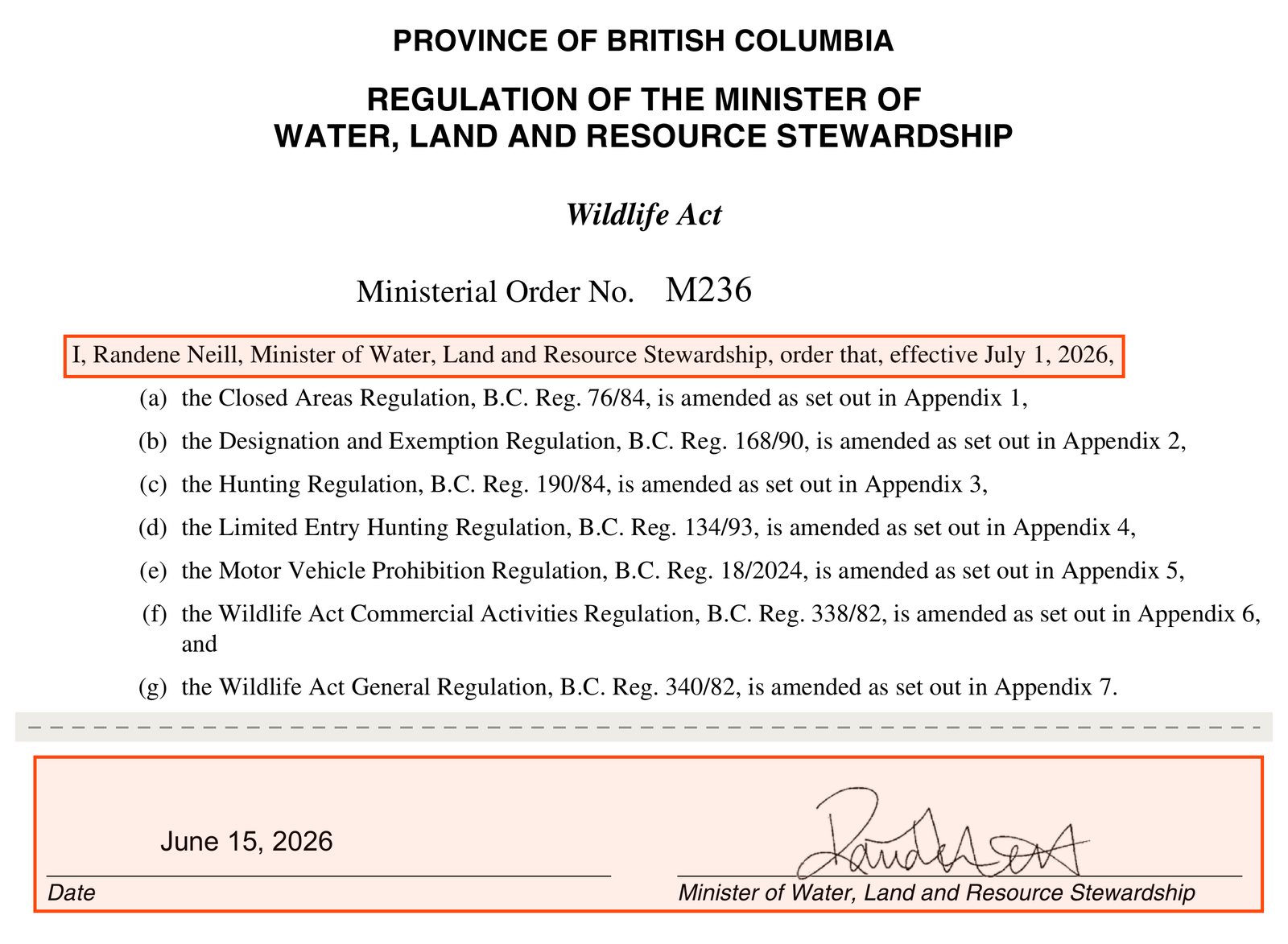
On 15 June 2026 Randene Neill, the NDP Minister of Water, Land and Resource Stewardship, signed Ministerial Order M236.1 It ended the permits that let three clubs ride the caribou closures around Tumbler Ridge, Chetwynd and Mackenzie, and put fixed closures in their place. It kept the heart of Bullmoose closed all year.32 The permits had to be renewed. The closures never come up for renewal. They stay until a minister repeals them, and there is no review date.14191 Before she signed, the riders waited 16 months for permits. Her ministry has never said why.

Randene Neill
Minister of Water, Land and Resource Stewardship since November 2024
She signed M236 on 15 June 2026. She defended the change in budget estimates on 5 May 2026. She met the BC Snowmobile Federation about caribou recovery and recreation on 2 and 9 July 2026.546 The legislature was dissolved on 22 September 2026, and the general election is scheduled for 24 October 2026. She remains minister until a new cabinet is sworn in.43
01 On 15 June 2026, Neill signed an order that replaced the riders’ permits with closures that never expire.
M236 opens: “I, Randene Neill, Minister of Water, Land and Resource Stewardship, order that, effective July 1, 2026”. Its fifth appendix rewrites the closure the regulation calls “Northern Rockies”. That closure covers the South Peace riding areas. It was deposited as B.C. Reg. 97/2026 on 16 June.12
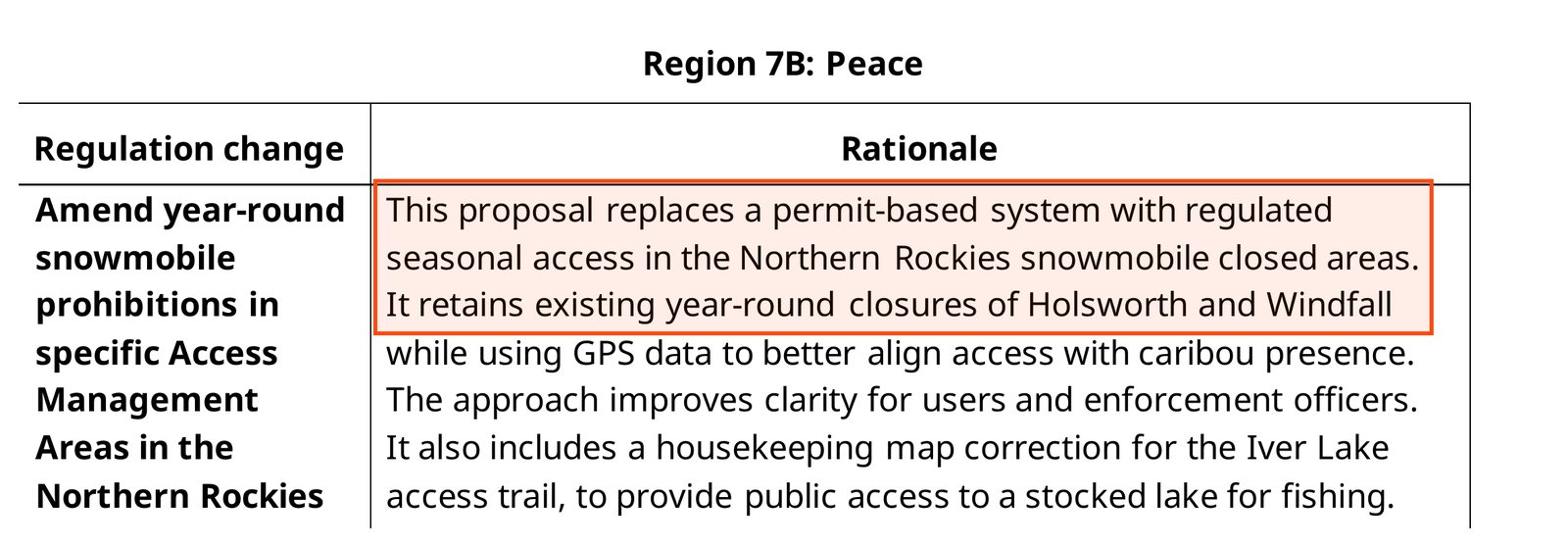
The government’s own summary says what it does. It “replaces a permit-based system with regulated seasonal access”. It “retains existing year-round closures of Holsworth and Windfall”, the two areas at the heart of Bullmoose.3 The minister sold it as access for everyone: it “provides predictability and accessibility for any rider, whether or not they have a permit.”4 What it ends is the local deal. Club members could ride the active management areas when the caribou were not there.
M236’s closures have no expiry date, no sunset and no review date.
The permits ran for fixed terms. They expired in October 2024. The reissued Chetwynd and Mackenzie permits ran only to 30 April 2026.1419 M236’s closures do not run out. Its new section 6 reads: “The closure is effective year-round in any portions of M.U.s 7-19, 7-21 to 7-23, 7-30 and 7-31 shown shaded in red on Map No. 5-6/26”. Only a 20-metre snowmobile corridor is excepted. The orange, teal and purple areas close on the same dates every year. The order sets no expiry date, no sunset and no review date.1
The order does not close the land for all time. A minister can amend or repeal a regulation. The Permit Regulation still lets a regional manager exempt a person from “a provision of the Motor Vehicle Prohibition Regulation”.13 But M236 creates no permit route of its own, and the government’s summary says it replaces the permit system.3 Riders used to hold permits that had to be renewed. They now face closures that stay until a minister signs another order.
02 The permits lapsed in October 2024, and for 16 months Neill’s ministry gave no reason.
The permits were a legal instrument, not a favour. The Wildlife Act lets a regional manager issue permits. The Permit Regulation lets those permits exempt a person from the Motor Vehicle Prohibition Regulation.1213 The exemption let members of three clubs ride the active management areas: the Tumbler Ridge Riders, the Pine Valley Trail Blazers in Chetwynd and the Rocky Mountain Riders in Mackenzie. They had to carry proof of membership.16
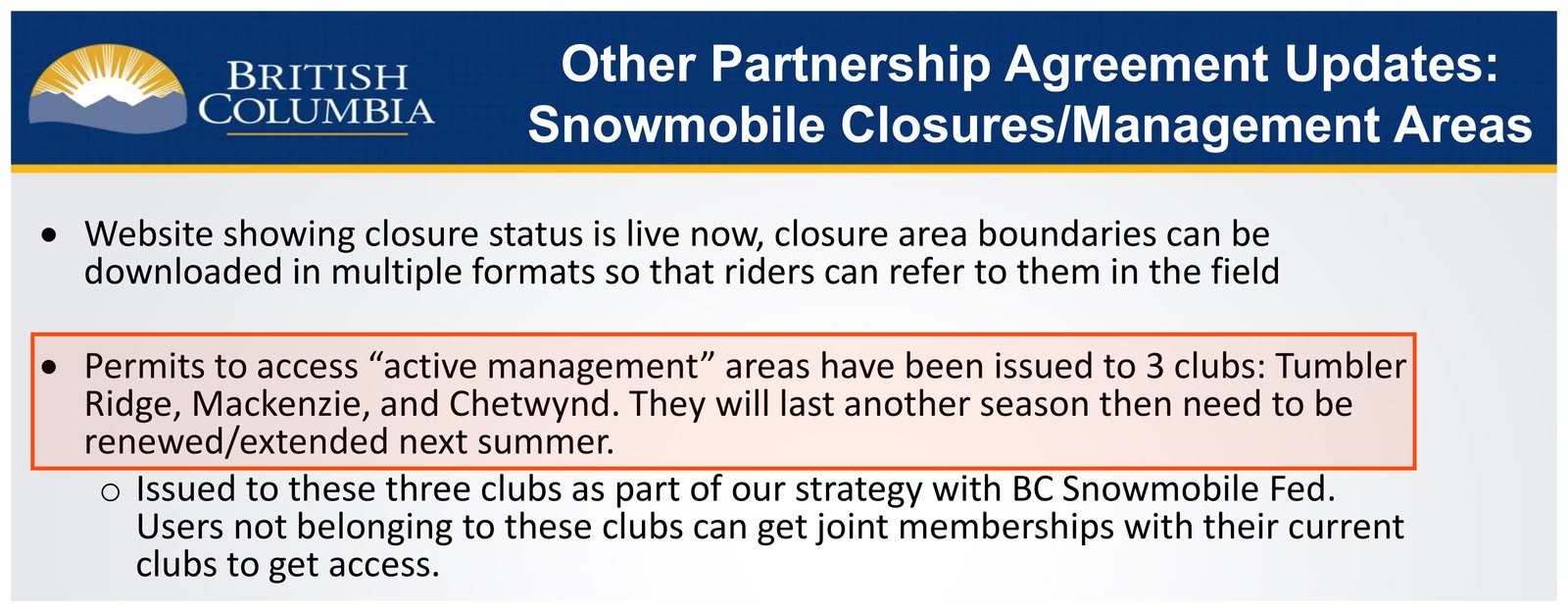
The Province knew the renewal date a year ahead. Its own slide said the permits would “last another season then need to be renewed/extended next summer.”15 They expired in October 2024. The clubs filed for renewal in December.14 Steve Larrivee of the Tumbler Ridge Riders said the permits were meant to run two years, and the Province “shut the active management areas down after 18 months”.16
The ministry told CJDC-TV that no decision had been made and that the Province was “highly supportive” of backcountry recreation. No official put a name to that statement.14 Permits came back about 23 February 2026, and only to 30 April for the Chetwynd and Mackenzie clubs.19
“It was the administrative fault on the part of the government.”
Larry Neufeld, MLA for Peace River South · CJDC-TV, 28 January 2025
Every explanation on record comes from outside the ministry. Neufeld blamed the government’s administration.17 The BC Snowmobile Federation told members the lapse was “an administrative process gap” and “not due to non-compliance or changes in herd behavior.”18 The ministry has given no reason in any public record.
03 The closures hit three towns and their clubs: Tumbler Ridge, Chetwynd and Mackenzie.
It hits three towns and three clubs: Tumbler Ridge, Chetwynd and Mackenzie.16 The Province’s 2021 closures shut about 454,000 hectares of Crown land to snowmobiles in 13 of 21 riding areas.30 The riders’ own committee had proposed closing about 69,000.24
When the permits lapsed, nine riding areas closed from 23 January 2025: Silver Sands, Powder King, Murray, Hasler, Upper Burnt East, Watson, Tunnel Mountain, Windfall Lake and Holzworth Meadows.16 Neither M236 nor the government’s summary gives the area its new map closes.13
The District of Tumbler Ridge asked for a voice. On 8 September 2025 its Policies and Priorities Committee told staff to ask the Caribou Recovery team “how they are deciding on which trails to close or keep open and if there is a seat available for Tumbler Ridge”. Both motions carried.21 No reply appears in the District’s public records. At the September 2026 convention of the Union of BC Municipalities (UBCM), the recorded outcome was that the ministry “agreed to seek update regarding Tunnel Mountain”.22 The District’s draft strategy warns the new regulation “may reduce local involvement in future closure decisions”.20
What the riders got in return was small. The Caribou Recovery Program paid the BC Snowmobile Federation $330,000 for riding in the areas left open.34 The federation’s master plan put the region’s need at $15 million.35
The Province paid the BC Snowmobile Federation $330,000. The federation’s master plan said the region needed $15 million.The caribou program’s money for riding in the areas left open came to about 2.2% of that need.
04 The record shows riding at Bullmoose fell 31% while the South Peace caribou herds more than tripled.
Snowmobile traffic fell. The District’s Bullmoose trail counter recorded 3,035 passes in 2023–24 and 2,085 in 2024–25, the season the permits lapsed. That is 31% fewer.20
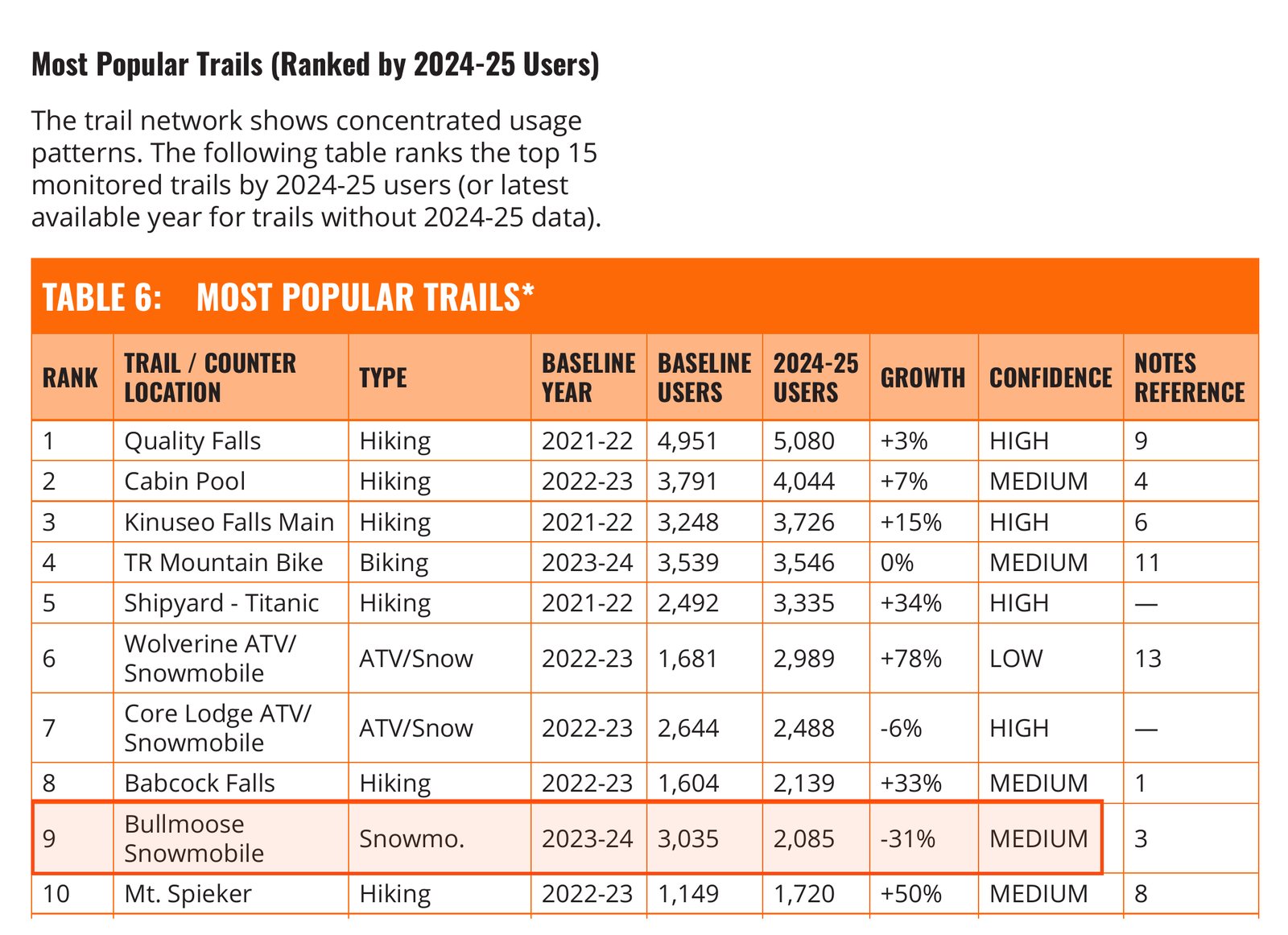
The District says why: “The 2024-25 reduction reflects a lapsed annual permit renewal for caribou closure access, not declining demand.”20
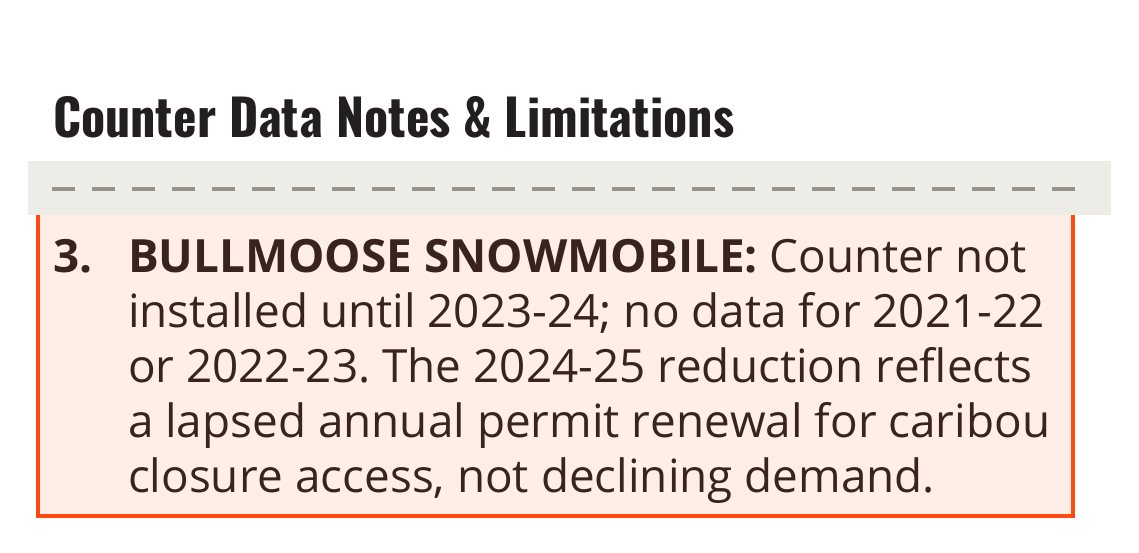
Snowmobile passes at Bullmoose fell 31% in the first season without permits.The Bullmoose trail counter recorded 3,035 passes in 2023–24 and 2,085 in 2024–25, after the permits expired. The District’s draft strategy puts the drop down to the lapse, “not declining demand.”
The caribou grew. The ministry’s November 2025 summary says the South Peace herds “increased from approximately 165 to 530 caribou” since wolf reduction began in 2015. It credits wolf reduction, maternal penning and supplemental feeding. The Quintette herd “appears to have tripled in size to approximately 174 caribou through wolf reduction alone.”36 No provincial report credits the snowmobile closures with any of it.
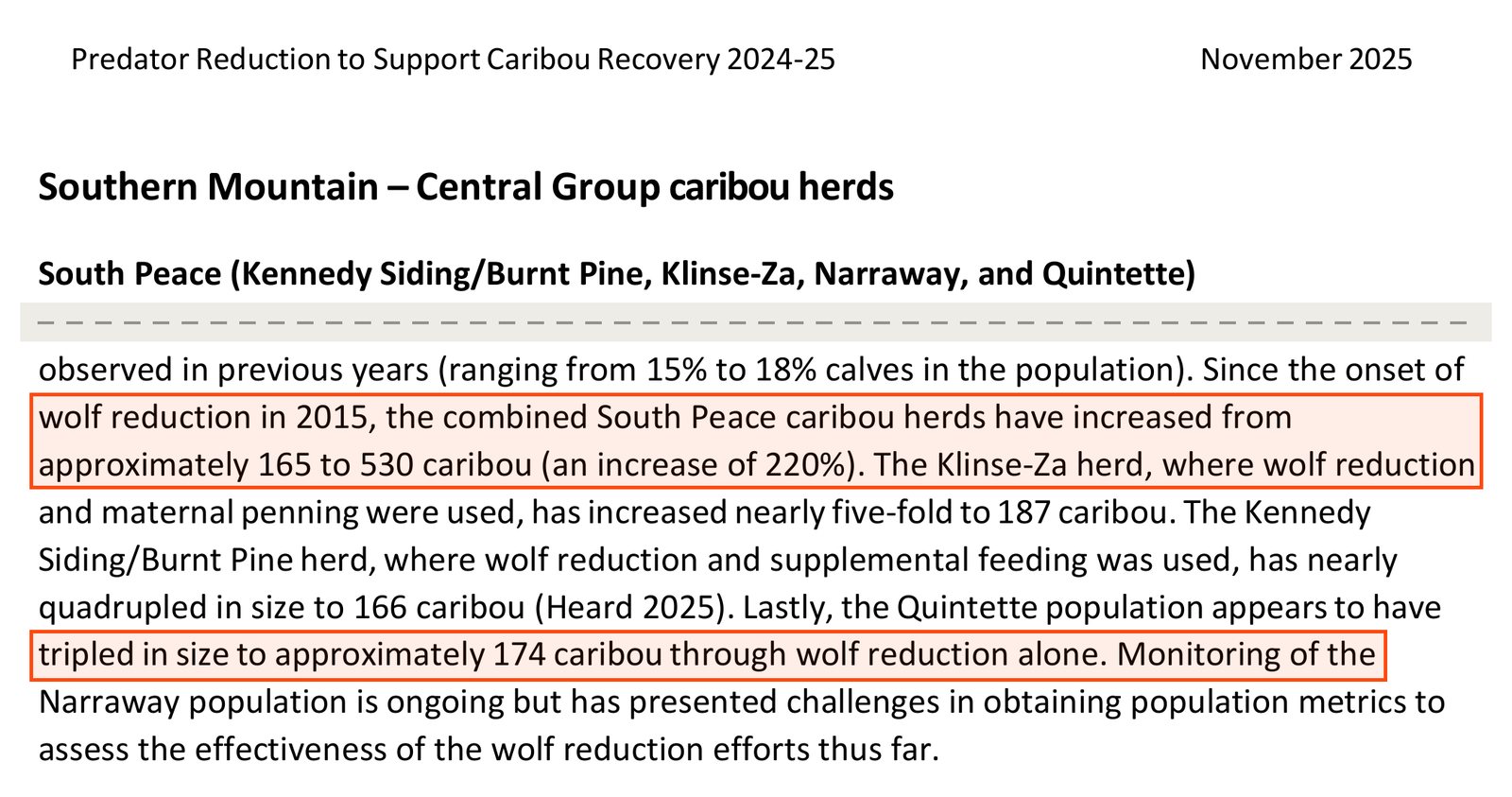
The South Peace caribou herds grew from about 165 animals to about 530.The four herds more than tripled while the closures were tightened. The ministry credits wolf reduction, maternal penning and supplemental feeding.
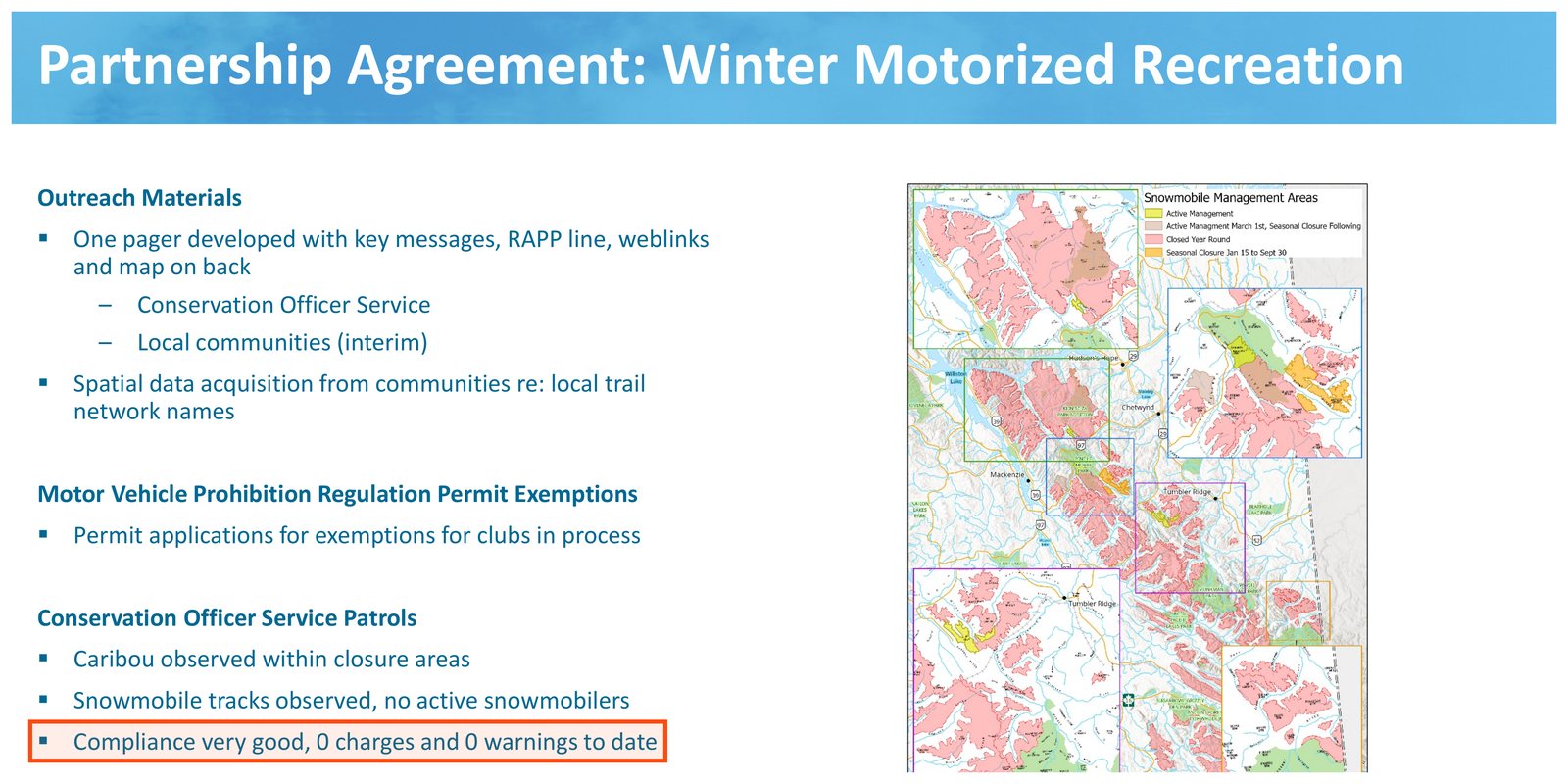
Neill cited snowmobile tracks seen on patrols. The Province’s reports from the permit years record no notable infractions.
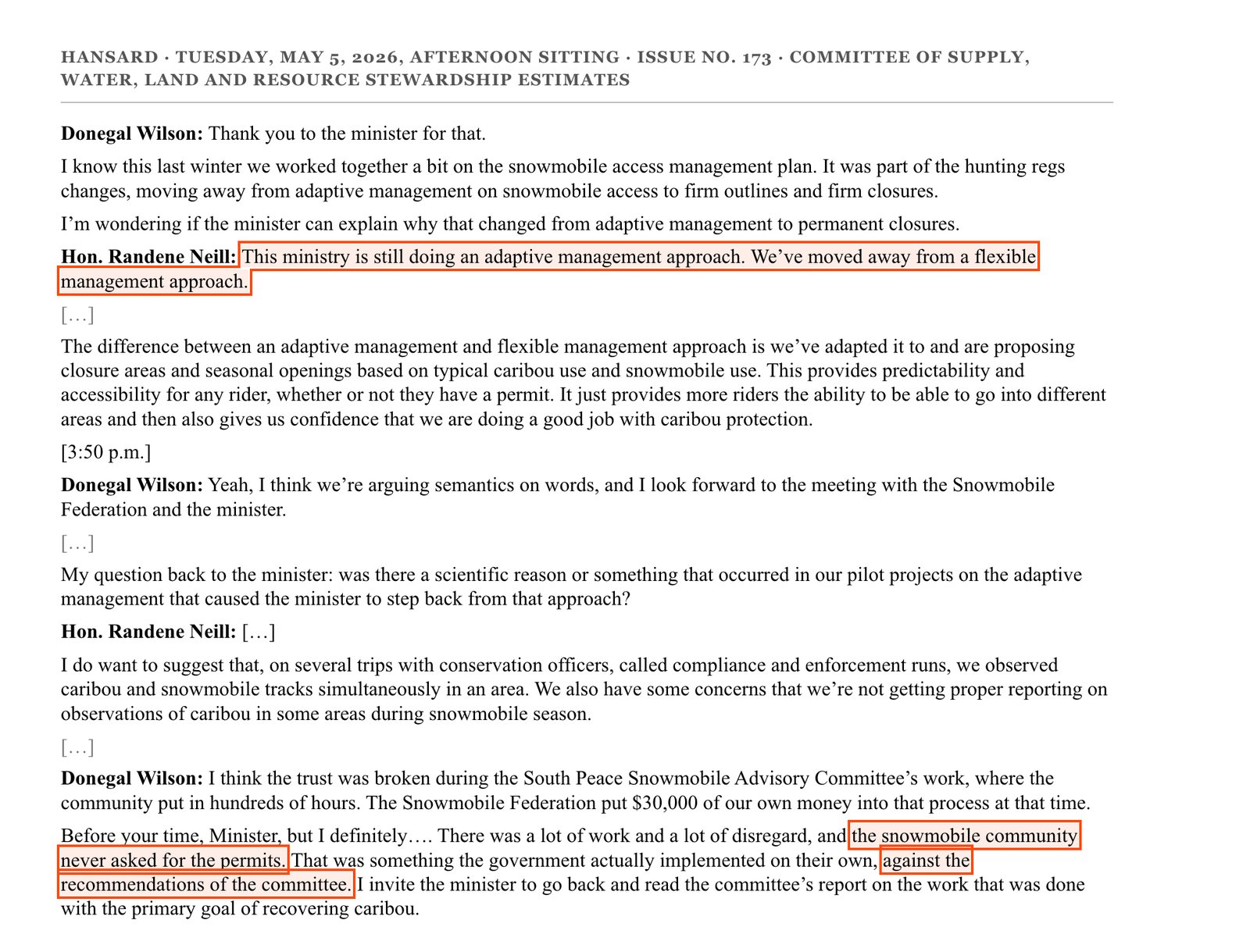
Six weeks before she signed, Donegal Wilson, then the Conservative critic for the ministry, asked Neill in budget estimates why the plan had moved “from adaptive management to permanent closures.” Wilson is a former executive director of the BC Snowmobile Federation and sat on the riders’ committee.424
“This ministry is still doing an adaptive management approach. We’ve moved away from a flexible management approach.”
Minister Randene Neill · Hansard, Issue 173, 5 May 2026
Her evidence: “on several trips with conservation officers, called compliance and enforcement runs, we observed caribou and snowmobile tracks simultaneously in an area.” She gave no dates or places. The patrol records are not published.4 Wilson answered that the snowmobile community “never asked for the permits”, which government brought in “against the recommendations of the committee”.4
The Province’s own reports on the permit years point the other way. In February 2022 compliance was “very good, 0 charges and 0 warnings to date.”8 For 2023–24: “No notable infractions.”9 The tracks and charges in the news came after the permits lapsed. February 2026 patrols found tracks in closed areas, but “no snowmobiles were actively seen in a closed area.”10 Three people were charged over the Holtzworth Meadow closure in March 2026.11 Nothing published shows the permit system failing while it ran.
In May 2025, with the nine areas closed, Neill told the House: “Back-country use is not being turned off at an alarming rate — in fact, not at all.”4216
05 The Province never published a final plan, the promised two-year review, or what it heard in 2026.
It began with a 2020 partnership agreement between Canada, B.C., West Moberly First Nations and Saulteau First Nations. Clause 37 says “BC will develop and implement a management plan for motorized recreation”, “in consultation with technical experts, First Nations, local governments, and snowmobile clubs.” It sets no size for any closure.23 Every South Peace closure since was drafted and signed by the Province.
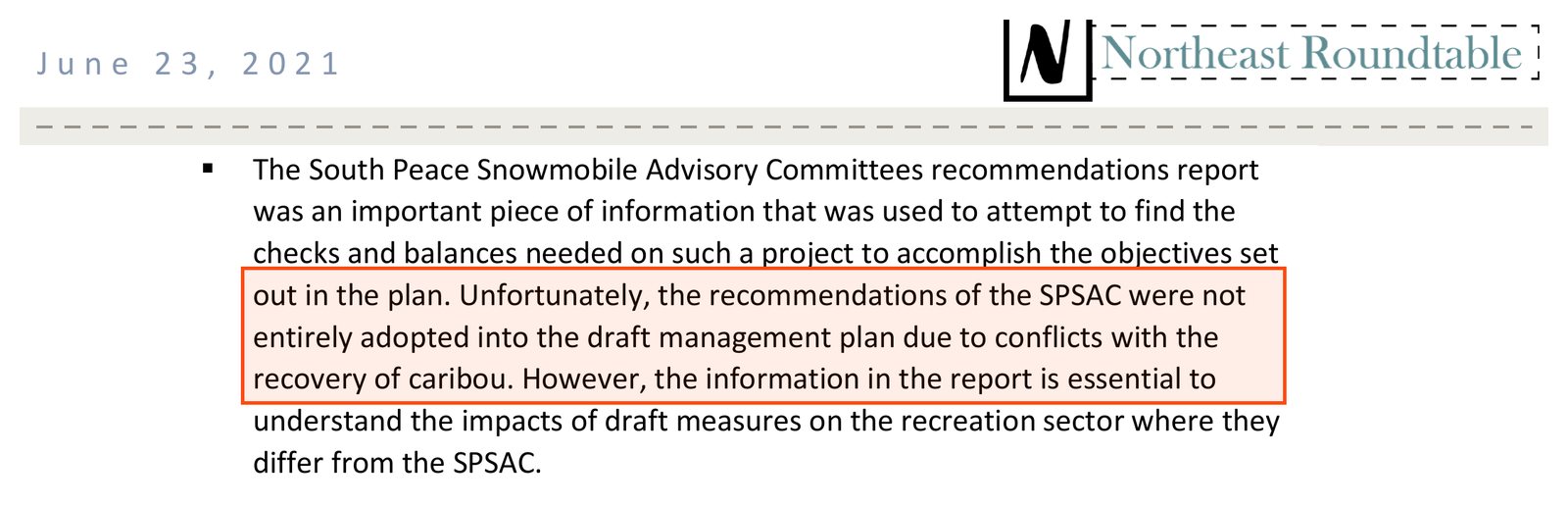
The riders did their part. Their advisory committee met 13 times, gave about 450 volunteer hours and reached consensus. Its members included three mayors, five clubs and the BC Snowmobile Federation.24 The Province released its own draft in May 2021.25 A month later it told the Northeast roundtable the committee’s recommendations were “not entirely adopted”.27
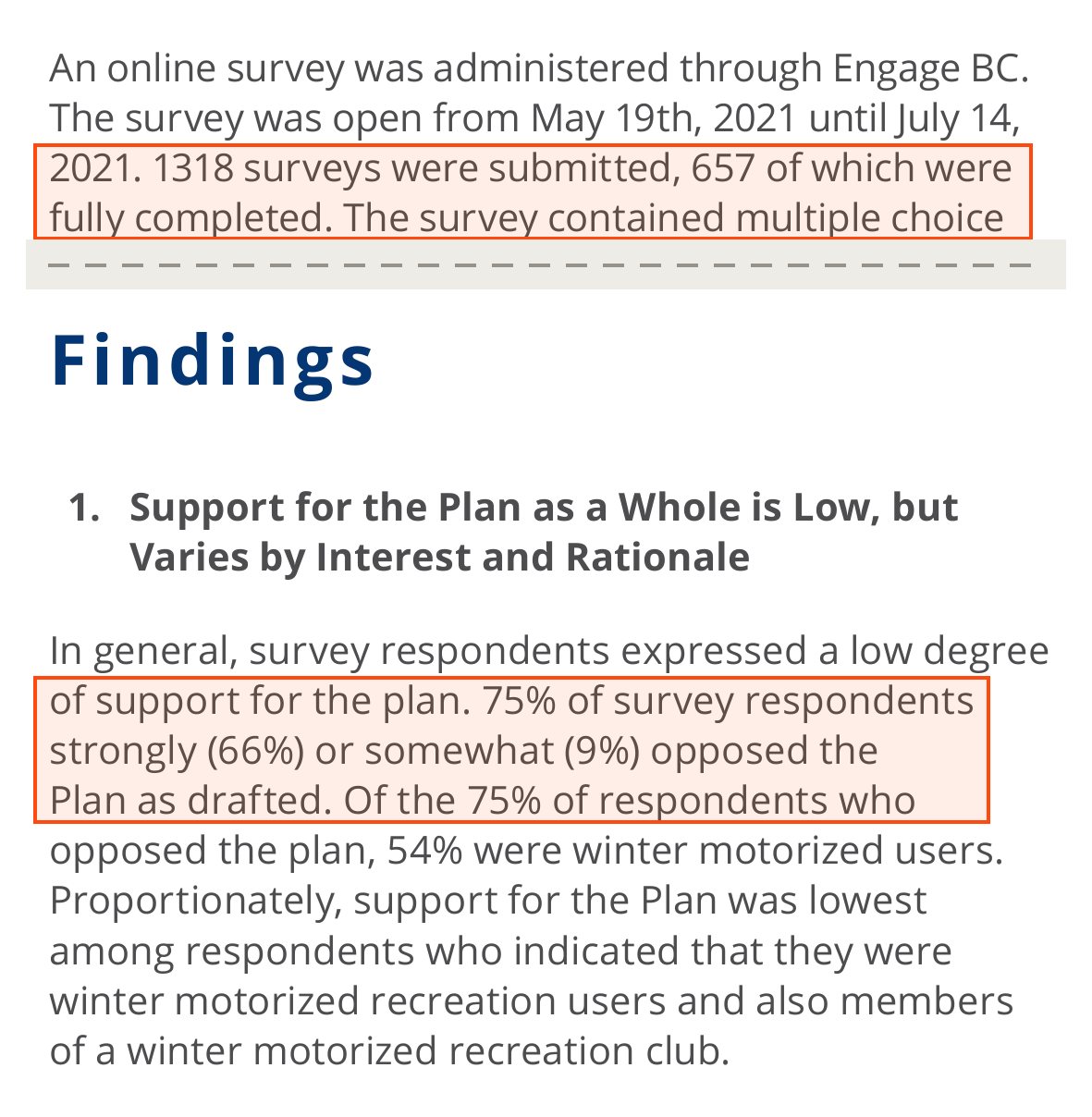
The public opposed it. The Province counted 1,318 surveys, and 75% of respondents opposed the plan as drafted.28
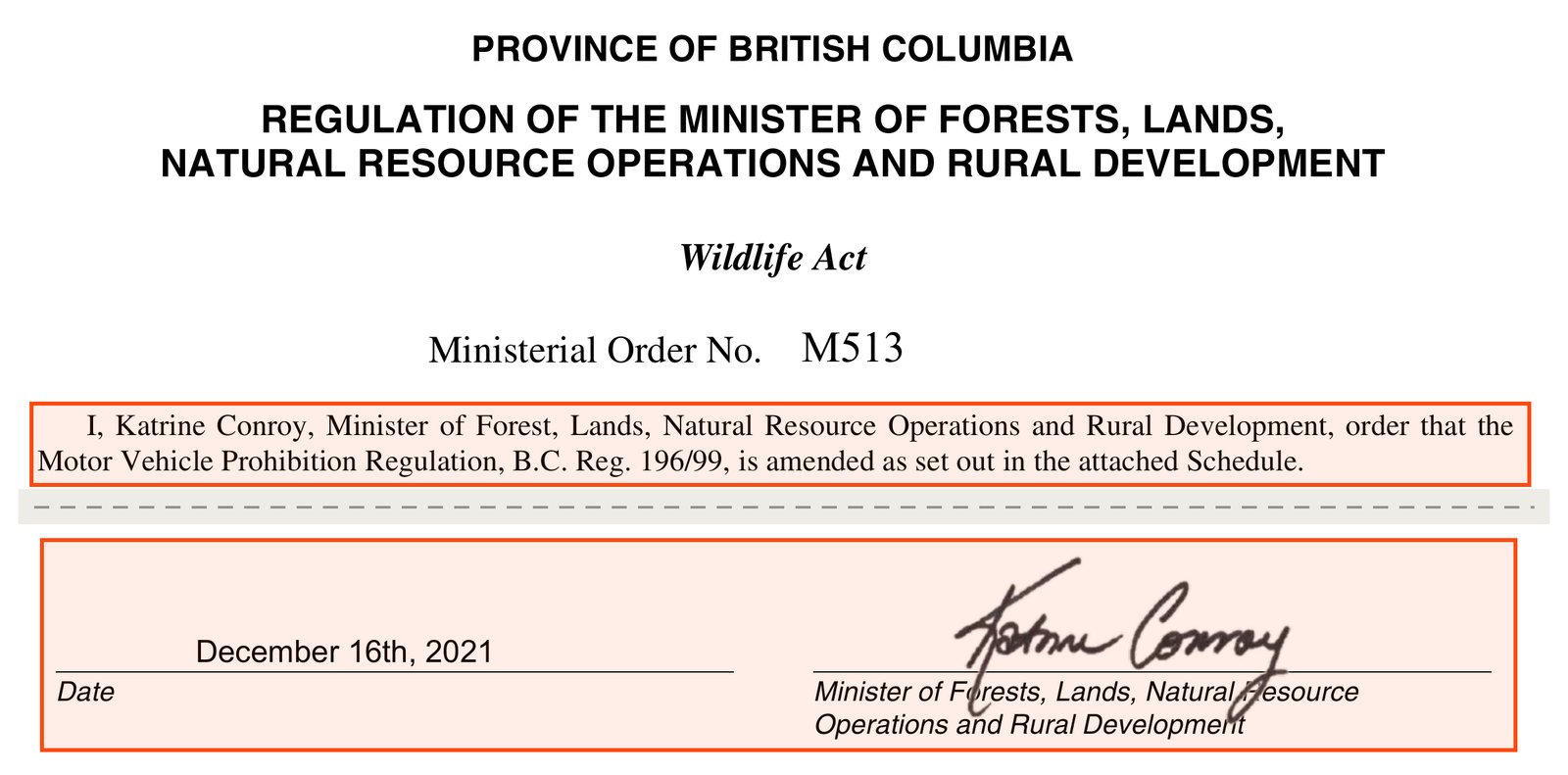
The closures went ahead. Katrine Conroy, then forests minister, signed M513 on 16 December 2021.29 Nathan Cullen, then Minister of Water, Land and Resource Stewardship, carried the closure into the rewritten regulation in 2024.33
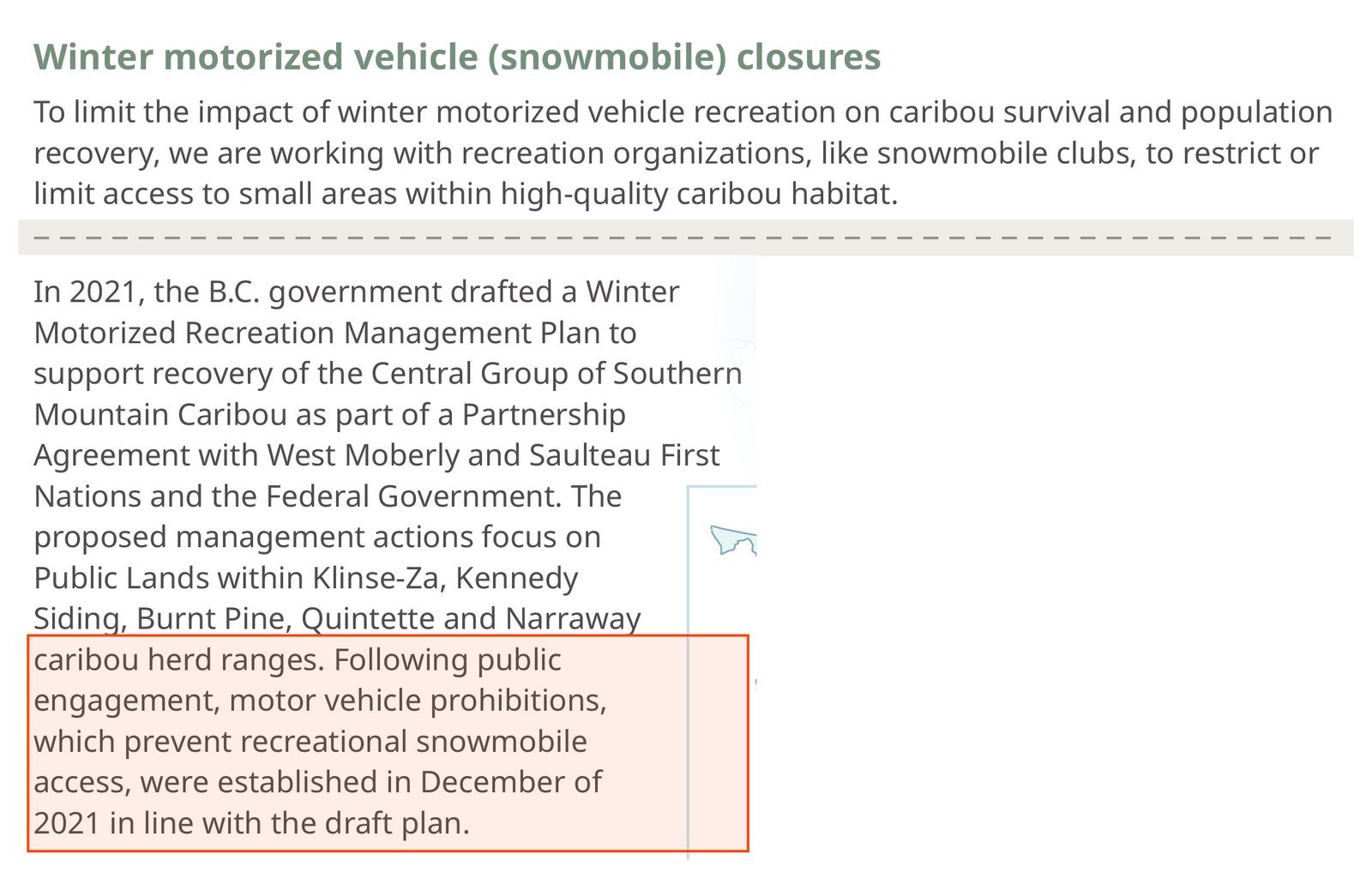
No final plan was ever published. The ministry’s own report says the prohibitions were set “in line with the draft plan.”32
The draft promised a review. Six areas, Bullmoose among them, were to be reviewed after two years. Any regulatory change was to follow “public and stakeholder engagement”.25
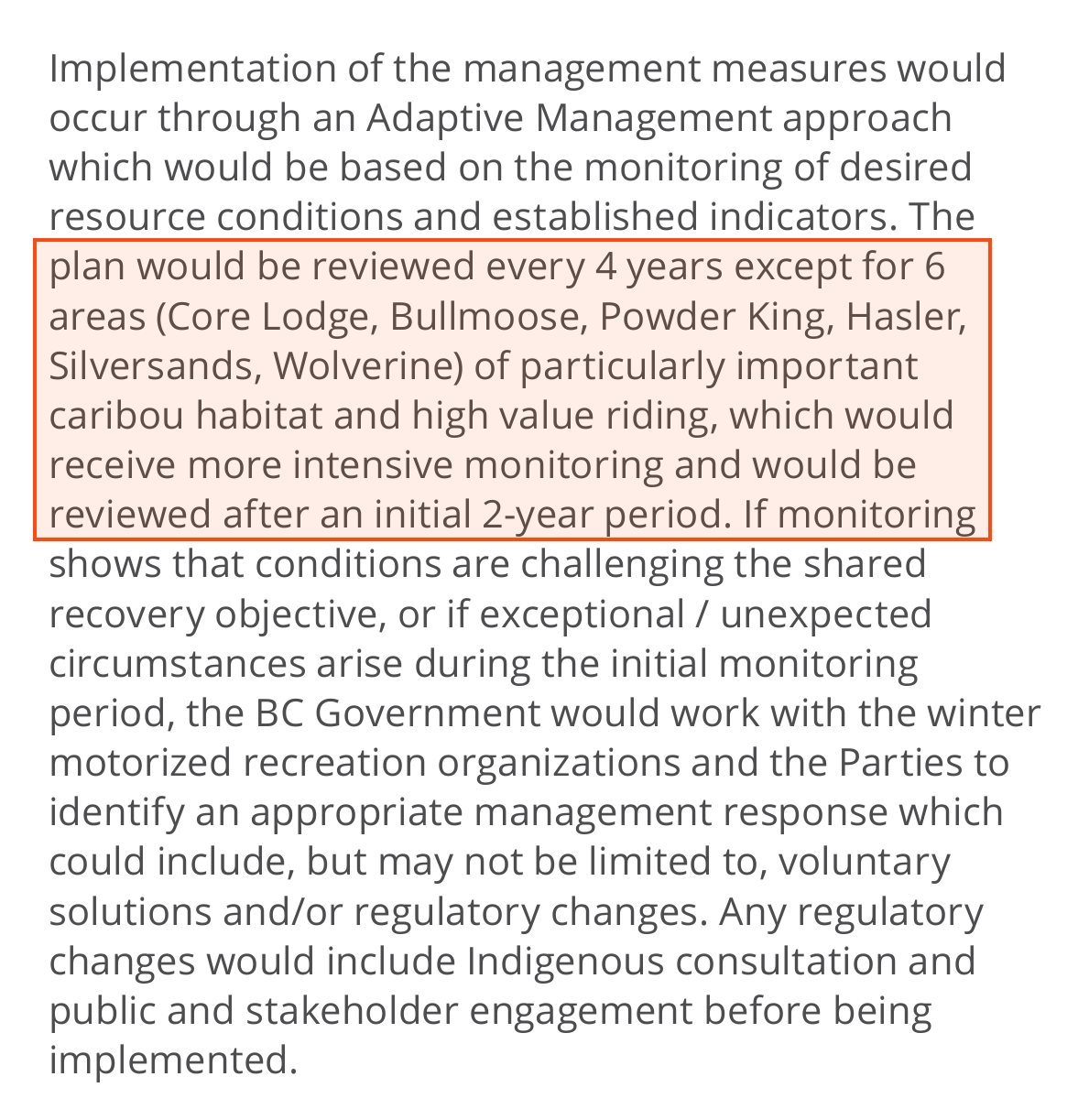
That review was never published. The 2026 proposal rested on an “analysis of caribou location and habitat data” that was never published either.7 Comments on it were “visible only to designated government staff and to the user who posted the comment”. The engagement page gives no count and no summary.37 In 2021 the Province published what it heard. In 2026 it did not.
06 This is the first link in a chain: the same ministry, the same caribou program and the same money.
Each step below is on the public record. The links are the same ministry, the same caribou program, the same rationale and the same money. Where the record stops, we ask questions.
The caribou program behind it is in her ministryCaribou Recovery Program · WLRS
The new ministry was given the caribou mandate in its first service plan in 2022: “plan and deliver key actions to stabilize, recover and/or maintain identified woodland caribou herds in B.C.”49 On 1 November 2023 the Caribou Recovery Program “fully moved under the Terrestrial Species Recovery Branch of the Resource Stewardship Division of WLRS”.9
Russ Laroche signed out its South Peace planThen Executive Director, Species at Risk Recovery
The Public Accounts list him as “Dir. Caribou Recovery Project” in 2019/20 and “ED – Species at Risk Recovery” in 2020/21. He signed the cover letter of the May 2021 South Peace draft plan. From 2021/22 he is “Regional Executive Director”, now for Kootenay Boundary at the Ministry of Forests.452526
The same rationale, in his regionRady Creek · Selkirk district
A 6 July 2021 briefing note on the Rady Creek road says: “The Caribou Program and Region 4 strongly support not providing snowmobile or ATV access as part of the deactivation of Rady Creek”.46
The same ministry funds the Nature Conservancy of CanadaWLRS · government transfers
The Public Accounts record five WLRS transfers to the Nature Conservancy of Canada (NCC), a private land-conservation charity, about $24.3 million in all. The charity declares about $24.1 million from WLRS on the lobbyist registry.4748
Russ Laroche signed out the caribou program’s South Peace plan, and now runs the Ministry of Forests’ Kootenay Boundary region.
Russ Laroche, now the Ministry of Forests’ Regional Executive Director for Kootenay Boundary, helped run the caribou program that is now part of Neill’s ministry. In 2020/21 he was Executive Director of the Species at Risk Recovery branch, which housed the Caribou Recovery Program; the year before, his payroll title was “Dir. Caribou Recovery Project”.45 In that role he signed the letter that took the South Peace closure plan to the public.25 The program moved fully into WLRS in November 2023.9
Laroche moved the other way, to the Ministry of Forests. His Kootenay Boundary region holds Rady Creek.26 The 2021 note recording the caribou program’s support for no snowmobile or ATV access there was written to the region’s Regional Executive Director at the time, Garth Wiggill.46
The limits of the record matter, so here they are. His name does not appear in any of the Rady Creek records we hold from that release. The note was written before he moved to the region. Road deactivation is a Forests decision: the same note says the recommendation to deactivate “is based on the environmental and public safety risks of this road.”46 We found no rule that gives WLRS or its caribou program a formal role in Forests’ road decisions. No public record shows Laroche taking any part in M236.
Questions for WLRS and Forests
- Is the caribou rationale WLRS’s program applied in the South Peace now reaching Forests’ road decisions in Kootenay Boundary through the official who signed out that plan?
- What advice on motorized access has the Kootenay Boundary region received from the Caribou Recovery Program since 2021, and what did it do with that advice?
- Who in WLRS recommended that M236 replace the South Peace permits with closures that have no expiry date?
The ministry that closed the South Peace has paid the Nature Conservancy of Canada about $24.3 million.
WLRS also pays the Nature Conservancy of Canada. In December 2025 Neill joined NCC’s president at the announcement of the 45,000-hectare Kootenay Forest Lands purchase, to which the provincial government committed $7 million.53 The Public Accounts list these government transfers from Water, Land and Resource Stewardship. Payments made in April appear in two years’ schedules; we count each once.47
| Paid | Amount | What for |
|---|---|---|
| 2022/23 | $200,000 | Not stated |
| April 2023 | $15,000,000 | Not stated. The lobbyist registry dates it 6 April 2023.48 |
| 2023/24 | $573,461 | Old Growth Nature Fund, Kwiakah52 |
| 2024/25 | $7,000,000 | Kootenay Forest Lands, the provincial share, as reported53 |
| 2025/26 | $1,500,000 | Not stated |
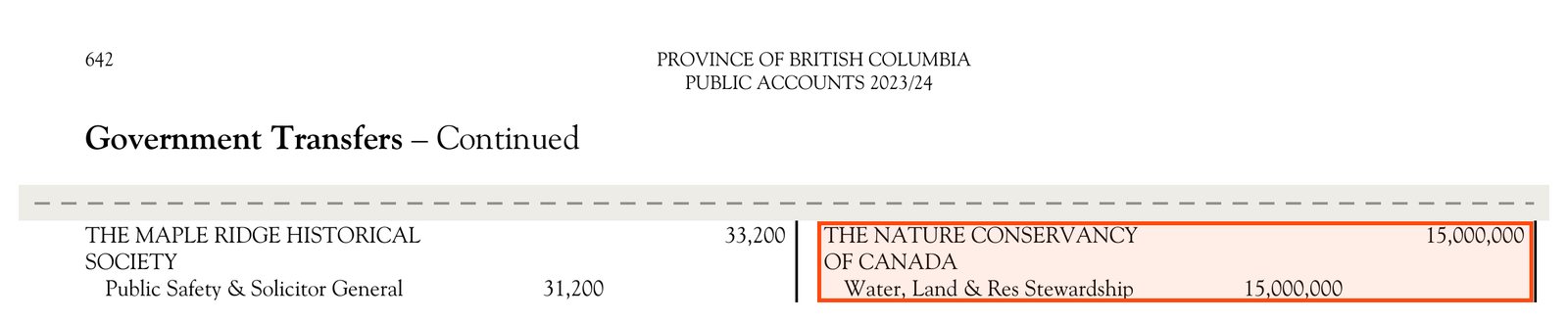
None of this money is tied to the South Peace closures, and none of it is tied to Laroche. We found no NCC property, payment or role in the South Peace. The link is the ministry: the one that wrote closures with no expiry date in the South Peace is the one paying a private charity to buy land elsewhere.147 Do not confuse the Nature Conservancy of Canada with Nature United, a separate organization.
The Province counts the caribou partnership’s park expansion toward 30 per cent. The snowmobile closures are not counted.
The caribou work counts in the Province’s nature accounting too. The first report under the Tripartite Framework Agreement on Nature Conservation lists the Caribou Recovery Program among B.C.’s programs under the agreement: $30 million communicated, $7.1 million spent in 2023/24. It says the Klinse-za/Twin Sisters Park expansion “contributes to the goal of protecting 30% of lands in B.C. by 2030”, and that it is “the result of a historic 2020 partnership agreement”.44 That is the agreement whose clause 37 started the South Peace snowmobile plan.23 The federal database lists the park at 199,780 hectares as a protected area. It does not list the snowmobile closures.50
The pattern is plain. One ministry decides closures and conservation money. Land under its programs is counted toward 30 per cent. And whether the public can still get in is settled out of public view or by the landowner’s own rules. In the South Peace, the comments were seen only by staff. At Darkwoods, the Nature Conservancy of Canada sets the permits.3751
07 Neill, Deputy Minister Lori Halls and three officials under them answer for the closures. No record shows who let the permits lapse.
Each person is named only for what the record shows they did or the office they hold.
Lori HallsDeputy Minister
Neill thanked “my team — Deputy Minister Lori Halls” at estimates, and Halls was lobbied with the minister on 2 July 2026.386 In 2022 she wrote that “The closures in the South Peace are part of B.C.’s overall commitment to reducing risks to caribou and their habitat from winter motorized recreation.”39
The regional managerThe office that issues the permits
The Northeast’s Director of Resource Management holds that power. The ministry’s roundtable records show Heather Onsorge in the post by February 2025, with Section Head James Morgan as deputy. No public record shows who let the permits expire, or why.12134041
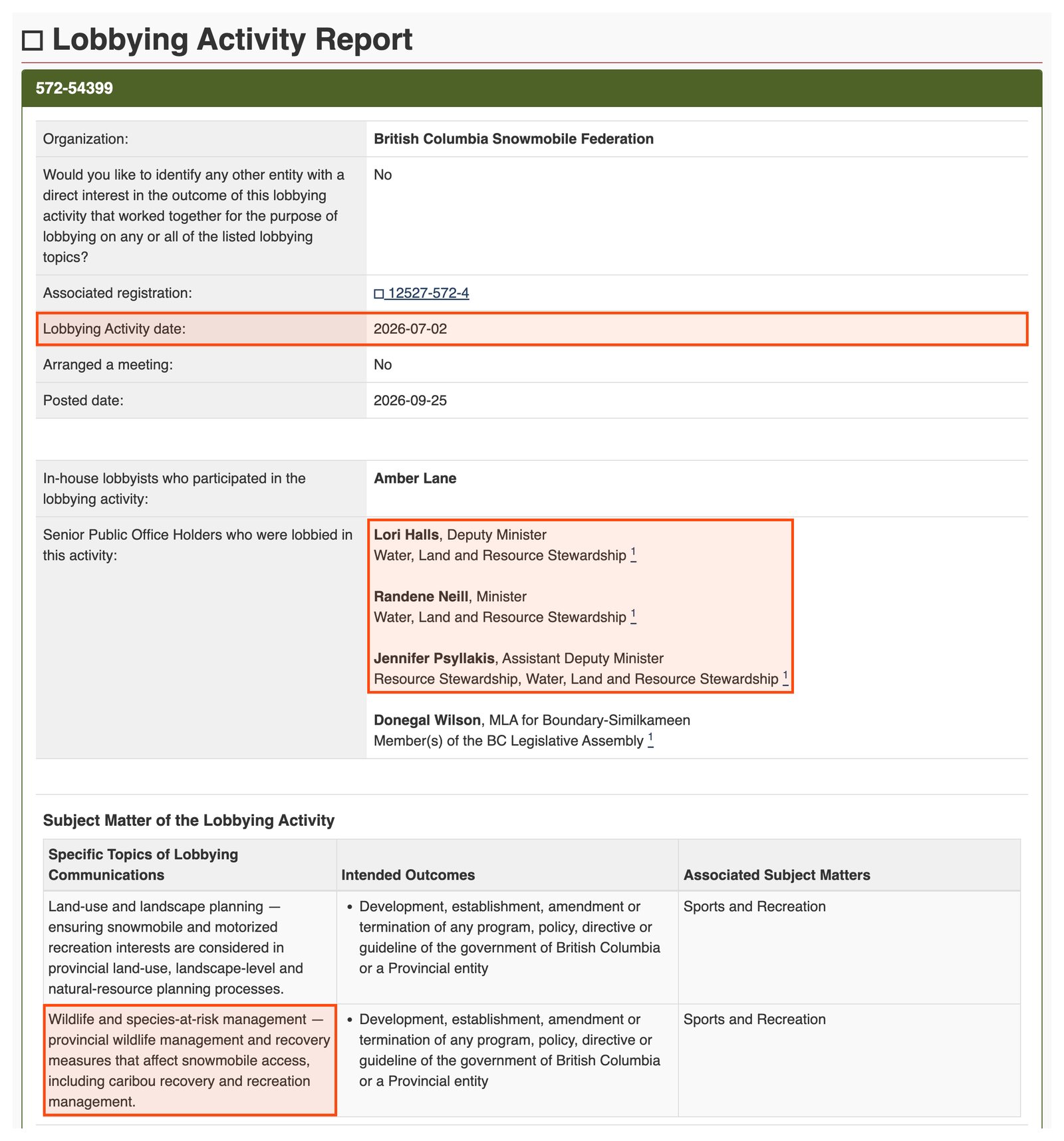
The closures are older than Neill’s time. Conroy signed the 2021 order and Cullen carried it over.2933 The step that ended the permits is hers.
| Step | Date | Instrument | Who signed or was responsible |
|---|---|---|---|
| Draft closure plan released for comment | 18 May 2021 | South Peace Winter Motorized Recreation Management Plan, draft | Russ Laroche, then Executive Director, Species at Risk Recovery, signed the cover letter.25 |
| Committee’s recommendations set aside | June 2021 | Northeast Stakeholder Roundtable minutes, 23 June 2021 | The Province. The minutes name no official.27 |
| Closures enacted | 16 Dec 2021 | Ministerial Order M513 | Katrine Conroy, then Minister of Forests, Lands, Natural Resource Operations and Rural Development, signed it.29 |
| Closures carried into the rewritten regulation | Feb and Jun 2024 | Ministerial Orders M35/2024 and M197/2024 | Nathan Cullen, then Minister of Water, Land and Resource Stewardship, signed both.33 |
| Club permits expire | Oct 2024 | Wildlife Act s.19 (1); Permit Regulation s.3 (2) (a) | The office of the regional manager, which the Act gives the power to issue the permits. No public record shows who let them expire, or why.121314 |
| Sixteen months without permits | Jan 2025 to Feb 2026 | None published | The ministry under Minister Randene Neill and Deputy Minister Lori Halls. Its only public comment came from an unnamed spokesperson.1419 |
| Permits replaced by closures with no expiry date | 15 Jun 2026 | Ministerial Order M236; B.C. Reg. 97/2026, in force 1 July 2026 | Randene Neill, Minister of Water, Land and Resource Stewardship, signed it.12 |
08 The South Peace closures, date by date, from the 2020 partnership agreement to M236.
- 21 Feb 2020
Canada, B.C., West Moberly and Saulteau sign the Partnership Agreement. Clause 37 commits B.C. to a motorized recreation plan made in consultation with snowmobile clubs.23
- Feb 2021
The South Peace Snowmobile Advisory Committee delivers its consensus recommendations after 13 meetings.24
- 18 May 2021
The draft plan is released for comment, with Russ Laroche’s cover letter.25
- 23 Jun 2021
The Province tells the Northeast roundtable that the committee’s recommendations were “not entirely adopted”.27
- Aug 2021
The What We Heard Report counts 1,318 survey responses, 75% of them opposed.28
- 16 Dec 2021
Minister Katrine Conroy signs M513, closing about 454,000 hectares in 13 of 21 riding areas.29
- Apr 2022
The Caribou Recovery Program pays $330,000 to the BC Snowmobile Federation for riding in the open areas.34
- Apr 2023
The federation’s master plan puts the region’s need at $15 million.35
- 1 Nov 2023
The Caribou Recovery Program moves into the Resource Stewardship Division of WLRS.9
- Feb 2024
Minister Nathan Cullen’s rewritten regulation carries the closures over.33
- Oct 2024
The club permits expire, and the clubs apply to renew them in December.14
- Nov 2024
Randene Neill becomes Minister of Water, Land and Resource Stewardship.5
- 23 Jan 2025
Nine riding areas close while the clubs wait for renewal.16
- Feb 2025
The first report under the Tripartite nature agreement lists the Caribou Recovery Program among B.C.’s programs and counts the Klinse-za park expansion toward the 30 per cent goal.44
- 8 Sep 2025
Tumbler Ridge’s committee directs staff to ask the Caribou Recovery team how it decides which trails close, and for a seat.21
- 12 Jan 2026
The Province proposes to replace the permits with regulated seasonal access. Comments close on 13 February.37
- 23 Feb 2026
Permits are reissued, about 16 months after they expired.19
- 4 May 2026
The District’s draft strategy records the 31% fall at Bullmoose and puts it down to the lapse.20
- 5 May 2026
Neill defends the change in estimates.4
- 15 Jun 2026
Neill signs M236. The closures it writes carry no expiry date.1
- 1 Jul 2026
B.C. Reg. 97/2026 takes effect. Holsworth and Windfall stay closed all year.2
- 2 and 9 Jul 2026
The BC Snowmobile Federation lobbies Neill, Halls and Psyllakis on caribou recovery and recreation.6
- Sep 2026
At UBCM, the District raises caribou closures and local participation with WLRS. The ministry “agreed to seek update regarding Tunnel Mountain”.22
09 Neill’s ministry can publish what it heard, explain the lapse and restore local permits.
The riders did what the Province asked. They sat on its committee, answered its survey, carried its permits and applied to renew them. The Province closed more than they recommended. It left them 16 months without permits and gave no reason. Then it replaced the permits with closures that have no expiry date. Minister Neill signed that last step. Three things are hers to put right.
Three things WLRS can do now
- Publish what it heard in 2026. Release the number of comments on the Region 7B proposal, a summary of them, and the caribou location analysis the proposal relied on.
- Explain the 2024 lapse. Say why the permits were allowed to expire, why renewal took until February 2026, and who decided.
- Restore a local, permit-based model. Give the clubs and the District of Tumbler Ridge a seat, publish the triggers that open and close each area, and complete the two-year review the 2021 draft promised.
About the exhibits: each one is cropped from the document named under it, with nothing retyped. The orange boxes mark the key lines, and a dashed band marks where part of a page was cut.
Share this story
These six images are made to be posted, and each carries one piece of the record: the order the minister signed, the sixteen months without permits, the fall in riding at Bullmoose, the growing herds, the committee the Province overruled, and who at the ministry answers for it.


Suggested caption
South Peace riders waited 16 months for renewed permits. Within four months, NDP minister Randene Neill scrapped the permit system and closed their riding areas indefinitely for caribou.
On 15 June 2026 the Minister of Water, Land and Resource Stewardship signed Ministerial Order M236. From 1 July it replaced the club permits around Tumbler Ridge, Chetwynd and Mackenzie with fixed closures that carry no expiry date, and it kept Holsworth and Windfall at Bullmoose closed all year.
Those permits expired in October 2024. Nine riding areas closed in January 2025, and permits did not come back until February 2026. The ministry has never given a reason.
The District of Tumbler Ridge counted 31 per cent fewer snowmobile passes at Bullmoose that season and says the cause was the lapsed permit, “not declining demand.” The ministry’s own figures show the South Peace herds growing from about 165 to 530 caribou. The two-year review promised in 2021 was never published, and the riders’ advisory committee was overruled.
The first link in the chain. The caribou program behind the closures is now in Neill’s ministry. Its 2021 plan went out under the signature of Russ Laroche, now the Ministry of Forests’ Regional Executive Director for Kootenay Boundary. The same ministry has paid the Nature Conservancy of Canada about $24 million.
Ask the ministry to publish what it heard in 2026, explain the 2024 lapse and restore a local, permit-based model. Ask your candidates where they stand.
backcountry.cx/editorials/randene-neill-south-peace-closures/
#BCpoli #BCElection #PublicLand #Snowmobiling #TumblerRidge
Sources
- ↩ Province of British Columbia, Ministerial Order M236, Wildlife Act, signed by Randene Neill, Minister of Water, Land and Resource Stewardship, and dated 15 June 2026, effective 1 July 2026. Appendix 5, section 3, replaces section 6 of Schedule 5 of the Motor Vehicle Prohibition Regulation, under the heading “Northern Rockies”. bclaws.gov.bc.ca (PDF)
- ↩ Province of British Columbia, Motor Vehicle Prohibition Regulation, B.C. Reg. 18/2024, point-in-time record, which lists the amendments “by BC Reg 97/2026, effective July 1, 2026”; and the Cumulative B.C. Regulations Bulletin, which lists M236/2026 as B.C. Reg. 97/2026, deposited 16 June 2026. bclaws.gov.bc.ca
- ↩ Province of British Columbia, 2026 Hunting and Trapping Regulation Changes Summary, Region 7B: Peace, “Amend year-round snowmobile prohibitions in specific Access Management Areas in the Northern Rockies”. gov.bc.ca (PDF)
- ↩ Hansard, B.C. Legislative Assembly, Issue 173, 5 May 2026 (afternoon), Committee of Supply, estimates of the Ministry of Water, Land and Resource Stewardship, about 3:45 to 3:55 p.m.: Donegal Wilson and Randene Neill. leg.bc.ca
- ↩ Province of British Columbia, Minister biography: Randene Neill, BC Gov News: first elected as MLA for Powell River–Sunshine Coast in 2024 and appointed Minister of Water, Land and Resource Stewardship in November 2024. news.gov.bc.ca
- ↩ Office of the Registrar of Lobbyists for B.C., Lobbying Activity Reports 572-54399 and 572-54397, British Columbia Snowmobile Federation, lobbying on 2 July 2026 (Lori Halls, Randene Neill, Jennifer Psyllakis and others) and 9 July 2026 (Randene Neill, Jennifer Psyllakis, Heather Wiebe and others), on “Wildlife and species-at-risk management” including “caribou recovery and recreation management”. Both posted 25 September 2026. 572-54399 · 572-54397
- ↩ Province of British Columbia, Snowmobile Active Management Areas proposal page, as captured by the Internet Archive on 13 February 2026: the Region 7B rationale, including “Analysis of caribou location and habitat data has improved understanding of when and how caribou use these areas”. The live page no longer exists. web.archive.org
- ↩ Northeast Stakeholder Roundtable, Caribou Recovery Program presentation, 16 February 2022: Conservation Officer Service patrols, “Compliance very good, 0 charges and 0 warnings to date”. nestakeholderroundtable.ca (PDF)
- ↩ Ministry of Water, Land and Resource Stewardship, “Caribou Recovery Program Updates,” 28 February 2024, presented to the Northeast Stakeholder Roundtable by Joelle Ward, Director, Caribou Recovery Program: the program “fully moved under the Terrestrial Species Recovery Branch of the Resource Stewardship Division of WLRS” on 1 November 2023; “Director Ward takes over for Director Peel, who retired Jan 31”; and, for winter motorized recreation compliance, “No notable infractions.” nestakeholderroundtable.ca (PDF)
- ↩ The Weather Network, “Illegal snowmobile tracks found in protected B.C. caribou habitat,” 11 February 2026, quoting the Conservation Officer Service on aerial patrols in the Peace and Okanagan regions. theweathernetwork.com
- ↩ Energeticcity, “Three charged after conservation officers spot snowmobile tracks in caribou closures,” 19 March 2026: a Peace-Liard helicopter patrol on 14 March 2026 and three people charged over the Holtzworth Meadow closure near Tumbler Ridge. energeticcity.ca
- ↩ Wildlife Act, R.S.B.C. 1996, c. 488, section 19 (1): “A regional manager or a person authorized by a regional manager may … by the issue of a permit, authorize a person …”. bclaws.gov.bc.ca
- ↩ Permit Regulation, B.C. Reg. 253/2000, section 3 (2) (a): a regional manager may issue a permit exempting a person from “a provision of the Motor Vehicle Prohibition Regulation”. bclaws.gov.bc.ca
- ↩ CJDC-TV, “B.C. Snowmobile Federation awaiting permit renewals amid South Peace closures,” 31 January 2025: permits “expired in October 2024”, renewal “filed in December”, and the ministry’s statement that a decision had not been made. cjdctv.com
- ↩ Northeast Stakeholder Roundtable, Caribou presentation, 27 September 2023: the club permits “will last another season then need to be renewed/extended next summer.” nestakeholderroundtable.ca (PDF)
- ↩ Tumbler RidgeLines, “Locals riders concerned as caribou closures continues,” 21 February 2025: the nine closed areas, closed since 23 January, and Steve Larrivee of the Tumbler Ridge Riders. tumblerridgelines.com
- ↩ CJDC-TV, “South Peace snowmobilers could lose season if province doesn’t restore access to Crown land,” 28 January 2025, quoting Larry Neufeld, MLA for Peace River South. cjdctv.com
- ↩ BC Snowmobile Federation member statement of January 2026, as reposted on the Snow and Mud forum, 15 January 2026: the permits expired because of “an administrative process gap” and “not due to non-compliance or changes in herd behavior”. The original email is not published by the federation. snowandmud.com
- ↩ BC Snowmobile Federation, “Stewardship agreements extended for Chetwynd and Mackenzie clubs,” 23 February 2026: exemption permits reissued to 30 April 2026, and the Tumbler Ridge Riders’ permits closer to “the proposed seasonal closure model”. bcsf.org
- ↩ District of Tumbler Ridge, Regular Meeting of Council, 4 May 2026, agenda, including the draft Tumbler Ridge Destination Management Strategy prepared by Selkirk Planning & Design: trail-counter table (Bullmoose Snowmobile, 3,035 and 2,085, −31%), note 3 (“The 2024-25 reduction reflects a lapsed annual permit renewal for caribou closure access, not declining demand”) and the legal and regulatory barriers section. tumblerridge.civicweb.net (PDF)
- ↩ District of Tumbler Ridge, Policies and Priorities Committee, minutes of 8 September 2025, motions 2025-40-18 and 2025-40-19, both carried. tumblerridge.civicweb.net (PDF)
- ↩ District of Tumbler Ridge, “2026 UBCM Minister Meetings Overview,” staff report to the Policies and Priorities Committee, 13 October 2026: the Ministry of Water, Land and Resource Stewardship meeting and its recorded outcome, and the effect of the election call. report (PDF) · agenda (PDF)
- ↩ Intergovernmental Partnership Agreement for the Conservation of the Central Group of the Southern Mountain Caribou, signed 21 February 2020 by Canada, British Columbia, West Moberly First Nations and Saulteau First Nations: clause 37. canada.ca (PDF)
- ↩ South Peace Snowmobile Advisory Committee, recommendations report, February 2021, facilitated by RC Strategies: Table 1 (members), the consensus process, “13 meetings” and “approximately 450 hours of volunteer time”, and the impact of its proposed actions (“approximately 93,374 ha or 20% of all riding area”, of which “over 68,975 ha” closed); and the BC Snowmobile Federation’s note on submitting it. report (PDF) · bcsf.org
- ↩ Ministry of Forests, Lands, Natural Resource Operations and Rural Development, Winter Motorized Recreation Management Plan in the South Peace, draft, 14 May 2021, released 18 May 2021: cover letter signed by Russ Laroche, Executive Director, Species at Risk Recovery; section 6.1.4 (active management areas and their triggers); and the initial 2-year review for six areas. engage.gov.bc.ca (PDF)
- ↩ Valley Voice via the Penticton Herald, “New documentary showcases solutions to prevent BC from burning,” 10 September 2025, naming “Russ Laroche, Kootenay Boundary Regional Executive Director with the Ministry of Forests.” pentictonherald.ca
- ↩ Northeast Stakeholder Roundtable, minutes of 23 June 2021: the government’s update on the South Peace winter motorized recreation plan. nestakeholderroundtable.ca (PDF)
- ↩ Province of British Columbia, Winter Motorized Recreation Management Plan in the South Peace: What We Heard Report, August 2021: “1318 surveys were submitted, 657 of which were fully completed”; “75% of survey respondents strongly (66%) or somewhat (9%) opposed the Plan as drafted”; and “14,661 engagement notice postcards were sent”. As captured by the Internet Archive on 24 June 2024; the original address now returns an error. web.archive.org (PDF)
- ↩ Province of British Columbia, Ministerial Order M513, signed by Katrine Conroy, Minister of Forests, Lands, Natural Resource Operations and Rural Development, 16 December 2021, adding the “Northern Rockies” snowmobile closure to the Motor Vehicle Prohibition Regulation. bclaws.gov.bc.ca (PDF)
- ↩ Province of British Columbia, “Snowmobile closures in the South Peace support caribou recovery,” information bulletin 2021FLNRO0097-002430, 21 December 2021: “About 454,000 hectares of Crown land are closed to snowmobiles in 13 of 21 identified riding areas.” news.gov.bc.ca
- ↩ Tumbler RidgeLines, “And the closures come down,” 6 January 2022, quoting Mayor Keith Bertrand. tumblerridgelines.com
- ↩ Ministry of Water, Land and Resource Stewardship, 2023 Caribou Recovery Program State of the Program Report, December 2025, page 75, which says the South Peace prohibitions “were established in December of 2021 in line with the draft plan.” gov.bc.ca
- ↩ Province of British Columbia, Ministerial Orders M35/2024 (signed by Nathan Cullen, Minister of Water, Land and Resource Stewardship, 8 February 2024, repealing and remaking the Motor Vehicle Prohibition Regulation effective 1 March 2024, including Schedule 5, section 6, “Northern Rockies”) and M197/2024 (signed by Cullen, 19 June 2024, replacing that section’s map). M35 (PDF) · M197 (PDF)
- ↩ BC Snowmobile Federation, “The BC Snowmobile Federation establishes new Snowmobile Infrastructure Fund,” 8 April 2022: “our first investment of $330,000 from the Province of BC - Caribou Recovery Program”. bcsf.org
- ↩ BC Snowmobile Federation, “South Peace Snowmobile Development Master Plan Identifies a Needed Investment of 15 Million Dollars,” 25 April 2023. bcsf.org
- ↩ Ministry of Water, Land and Resource Stewardship, Caribou Recovery Program, Predator Reduction to Support Caribou Recovery: 2024-25 Summary, November 2025: the South Peace herds “increased from approximately 165 to 530 caribou” since 2015; Klinse-Za, Kennedy Siding/Burnt Pine and Quintette. gov.bc.ca (PDF)
- ↩ Province of British Columbia, Angling, hunting and trapping engagement page (“User comments are visible only to designated government staff and to the user who posted the comment”); the GovTogetherBC page for the engagement of 12 January to 13 February 2026, whose “Results” section gives no count or summary; and information bulletin 2026WLRS0002-000023, 12 January 2026. gov.bc.ca · engage.gov.bc.ca · news.gov.bc.ca
- ↩ Hansard, B.C. Legislative Assembly, Issue 172, 5 May 2026 (morning): the opening of the ministry’s estimates, in which Neill thanks “my team — Deputy Minister Lori Halls”. leg.bc.ca
- ↩ Energeticcity, “Response from province on snowmobile closures in South Peace received,” 23 June 2022, on a letter from Deputy Minister Lori Halls to the Peace region MLAs and MP. energeticcity.ca
- ↩ Ministry of Water, Land and Resource Stewardship, Office of the Deputy Minister, “Designation of Regional Managers and Deputy Regional Managers under the Wildlife Act,” 30 October 2025: “Each person who holds from time to time the position of Director, Resource Management” is a Regional Manager, and the “Section Head, Fish & Wildlife” a Deputy Regional Manager. It replaces a designation of 25 October 2023. gov.bc.ca (PDF)
- ↩ Northeast Stakeholder Roundtable, minutes of 26 February 2025 and 3 June 2025 (“Heather Onsorge – WLRS Director of Resource Management”), minutes of 28 February 2024 (“WLRS is going to decide how they’re going to build both the Director of Resource Management and the section head for Fish and Wildlife”), and the Fish and Wildlife presentation of 6 May 2026 (James Morgan, “Fish and Wildlife Section Head”). 26 Feb 2025 (PDF) · 3 Jun 2025 (PDF) · 28 Feb 2024 (PDF) · 6 May 2026 (PDF)
- ↩ Hansard, B.C. Legislative Assembly, Issue 59, 8 May 2025 (morning), Question Period: Scott McInnis on back-country closures in the Columbia Valley and the Kootenays, and Neill’s reply. leg.bc.ca
- ↩ Elections BC, 2026 Provincial Election: writ day 22 September 2026 and Final Voting Day scheduled for 24 October 2026. Ministers stay in office during the campaign. elections.bc.ca
- ↩ Tripartite Framework Agreement on Nature Conservation (Canada, British Columbia and the First Nations Leadership Council), First annual report, February 2025: “Provincial Spending by Program Areas” (Caribou Recovery Program, $30,000,000 communicated for 2023/24 to 2025/26 and $7,100,000 expended in 2023/24) and the project profile “Klinse-za/Twin Sisters Park expansion”, which “contributes to the goal of protecting 30% of lands in B.C. by 2030”, will “protect nearly 200,000 hectares” and is “the result of a historic 2020 partnership agreement”; and the Annual Report 2026, which carries the Caribou Recovery Program line forward. first report (PDF) · 2026 report (PDF)
- ↩ Province of British Columbia, Public Accounts, Consolidated Revenue Fund Detailed Schedules of Payments, employee remuneration over $75,000, entries for “LAROCHE,RUSSELL”: “Dir. Caribou Recovery Project” (2019/20), “ED – Species at Risk Recovery” (2020/21) and “Regional Executive Director” (each year from 2021/22 to 2025/26). 2019/20 (PDF) · 2020/21 (PDF) · 2025/26 (PDF)
- ↩ Ministry of Forests, Lands, Natural Resource Operations and Rural Development, Selkirk Forest District, briefing note for information, 6 July 2021, “Public concern over deactivation of Rady Forest Service Road”, prepared for Garth Wiggill, Regional Executive Director. Released under freedom of information at page 402 of a 1,410-page package. Quoted from the page image.
- ↩ Province of British Columbia, Public Accounts, Consolidated Revenue Fund Detailed Schedules of Payments, 2022/23 to 2025/26, Government Transfers, “THE NATURE CONSERVANCY OF CANADA”, each line from “Water, Land & Res Stewardship”: $200,000 and $15,000,000 (2022/23); $15,000,000 and $573,461 (2023/24); $573,461 and $7,000,000 (2024/25); $7,000,000 and $1,500,000 (2025/26). Payments made in April appear in two years’ schedules, so the distinct payments are $200,000, $15,000,000, $573,461, $7,000,000 and $1,500,000, about $24.3 million. The schedules do not say what any payment was for. 2022/23 (PDF) · 2023/24 (PDF) · 2024/25 (PDF) · 2025/26 (PDF)
- ↩ Office of the Registrar of Lobbyists for B.C., registrations of the Nature Conservancy of Canada (client 3258), government funding received, open data export dated 20 September 2026: entries from “Govt. of BC - Ministry of Water, Land & Resource Stewardship” totalling about $24.1 million, including $15,000,000 dated 6 April 2023. lobbyistsregistrar.bc.ca
- ↩ Ministry of Land, Water and Resource Stewardship, 2022/23 – 2024/25 Service Plan, February 2022: “plan and deliver key actions to stabilize, recover and/or maintain identified woodland caribou herds in B.C.”; and the ministry’s 2023/24 Annual Service Plan Report on the transfer of statutory authorities and over 900 positions from the Ministry of Forests on 19 October 2023. service plan (PDF) · annual report (PDF)
- ↩ Environment and Climate Change Canada, Canadian Protected and Conserved Areas Database (CPCAD), 2025 release, B.C. terrestrial records: 365 “Privately Protected Area” records with the Nature Conservancy of Canada as owner, about 125,446 hectares, all counted as protected areas; “KLINSE-ZA/TWIN SISTERS PARK”, 199,780 hectares. No record type for Motor Vehicle Prohibition Regulation closures appears among the B.C. records. data-donnees.az.ec.gc.ca
- ↩ Nature Conservancy of Canada, Darkwoods project page, public access: “accessible for low impact recreational day use from July through September. Permits are required for entry. Camping, off-road vehicles, snowmobiles, fires, trapping and cutting firewood on the property are prohibited.” natureconservancy.ca
- ↩ Province of British Columbia, information bulletin 2024WLRS0033-001029, on Old Growth Nature Fund land purchases: “Kwiakah, Phillips Arm (Central Coast); 75 hectares; Nature Conservancy of Canada; $573,461”. news.gov.bc.ca
- ↩ Chilliwack Progress (Black Press), “Historic 45,000-hectare land conservation buy confirmed for southeastern B.C.,” 17 December 2025: the provincial government committed “$7 million”, and the announcement included Minister Randene Neill and NCC president Catherine Grenier. theprogress.com
- ↩ Northeast Stakeholder Roundtable, minutes of 3 June 2025: the “Caribou Program” item presented by Joelle Ward, Ministry of Water, Land and Resource Stewardship. nestakeholderroundtable.ca (PDF)
Every source was read on 15 October 2026.